Search

band annie's Weblog

I have a parallel blog in French at http://anniebannie.net

Shimon Peres from the perspective of his victims

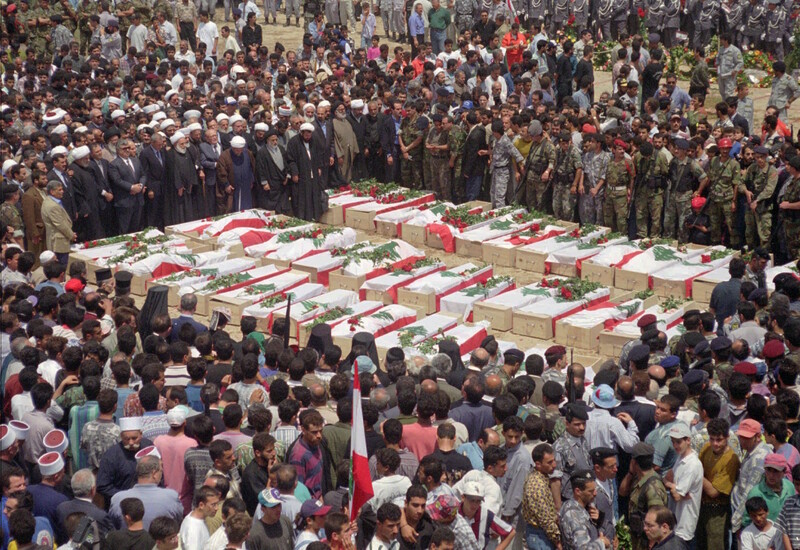
Officials and mourners surround coffins covered with Lebanese flags during a mass funeral in the southern Lebanese town of Tyre, 30 April 1996. The victims were killed in an Israeli artillery attack on a UN base in Qana, in southern Lebanon, on 18 April as part of an operation ordered by then Israeli Prime Minister Shimon Peres. Ahmed Azakir AP Photo

The obituaries for Shimon Peres have already appeared, no doubt prepared in advance as the news of his hospitalization reached the media.

The verdict on his life is very clear and was already pronounced by US President Barack Obama: Peres was a man who changed the course of human history in his relentless search for peace in the Middle East.

My guess is that very few of the obituaries will examine Peres’ life and activities from the perspective of the victims of Zionism and Israel.

He occupied many positions in politics that had immense impact on the Palestinians wherever they are. He was director general of the Israeli defense ministry, minister of defense, minister for development of the Galilee and the Negev (Naqab), prime minister and president.

In all these roles, the decisions he took and the policies he pursued contributed to the destruction of the Palestinian people and did nothing to advance the cause of peace and reconciliation between Palestinians and Israelis.

Born Szymon Perski in 1923, in a town that was then part of Poland, Peres immigrated to Palestine in 1934. As a teenager in an agricultural school, he became active in politics within the Labor Zionist movement that led Zionism and later the young State of Israel.

As a leading figure in the movement’s youth cadres, Peres attracted the attention of the high command of the Jewish paramilitary force in British-ruled Palestine, the Haganah.

Nuclear bomb

In 1947, Peres was fully recruited to the organization and sent abroad by its leader David Ben-Gurion to purchase arms which were later used in the 1948 Nakba, the ethnic cleansing of Palestinians, and against the Arab contingents that entered Palestine that year.

After a few years abroad, mainly in the United States, where he was busy purchasing arms and building the infrastructure for the Israeli military industry, he returned to become director general of the defense ministry.

Peres was active in forging Israel’s collusion with the UK and France to invade Egypt in 1956, for which Israel was rewarded by France with the needed capacity to build nuclear weapons.

Indeed it was Peres himself who largely oversaw Israel’s clandestine nuclear weapons program.

No less important was the zeal Peres showed under Ben-Gurion’s guidance and inspiration to Judaize the Galilee. Despite the 1948 ethnic cleansing, that part of Israel was still very much Palestinian countryside and landscape.

Peres was behind the idea of confiscating Palestinian land for the purpose of building exclusive Jewish towns such as Karmiel and Upper Nazareth and basing the military in the region so as to disrupt territorial contiguity between Palestinian villages and towns.

This ruination of the Palestinian countryside led to the disappearance of the traditional Palestinian villages and the transformation of the farmers into an underemployed and deprived urban working class. This dismal reality is still with us today.

Settlers’ champion

Peres disappeared for a while from the political scene when his master Ben-Gurion, Israel’s founding prime minister, was pushed aside in 1963 by a new generation of leaders.

He came back after the 1967 War and the first portfolio he held was as minister responsible for the occupied territories. In this role, he legitimized, quite often retroactively, the settlement drive in the West Bank and Gaza Strip.

As so many of us realize today, by the time the pro-settlement Likud party came to power in 1977, the Jewish settlement infrastructure, in particular in the West Bank, had already rendered a two-state solution an impossible vision.

In 1974, Peres’ political career became intimately connected to that of his nemesis, Yitzhak Rabin. The two politicians who could not stand each other, had to work in tandem for the sake of political survival.

However, on Israel’s strategy toward the Palestinians, they shared the Zionist settler-colonial perspective, coveting as much of Palestine’s land as possible with as few Palestinians on it as possible.

They worked well together in quelling brutally the Palestinian uprising that began in 1987.

Peres’ first role in this difficult partnership was as defense minister in the 1974 Rabin government. The first real crisis Peres faced was a major expansion of the messianic settler movement Gush Emunim’s colonization effort in and around the West Bank city of Nablus.

Rabin opposed the new settlements, but Peres stood with the settlers and those colonies that now strangulate Nablus are there thanks to his efforts.

In 1976, Peres led government policy on the occupied territories, convinced that a deal could be struck with Jordan, by which the West Bank would be within Jordanian jurisdiction but under effective Israeli rule.

He initiated municipal elections in the West Bank but to his great surprise and disappointment, the candidates identified with the Palestine Liberation Organization were elected and not the ones loyal to Jordan’s Hashemite monarchy.

But Peres remained faithful to what he named the “Jordanian option” as an opposition leader after 1977 and when he returned to power in coalition with the Likud in 1984-1988. He pushed forward the negotiations on the basis of this concept until King Hussein’s decision to cede any political connection between Jordan and the West Bank in 1988.

Israel’s international face

The 1990s exposed to the world to a more mature and coherent Peres. He was Israel’s international face, whether in government or outside it. He played this role even after the Likud ascended as the main political force in the land.

In power, in Rabin’s government in the early 1990s, as prime minister after Rabin’s 1995 assassination, and then as a minister in the cabinet of Ehud Barak from 1999 to 2001, Peres pushed a new concept for what he called “peace.”

Instead of sharing rule in the West Bank and Gaza Strip with Jordan or Egypt, he now wished to do it with the Palestine Liberation Organization. The idea was accepted by PLO leader Yasser Arafat, who may have hoped to build on this a new project for the liberation of Palestine.

As enshrined in the 1993 Oslo accords, this concept was enthusiastically endorsed by Israel’s international allies.

Peres was the leading ambassador of this peace process charade that provided an international umbrella for Israel to establish facts on the ground that would create a greater apartheid Israel with small Palestinian bantustans scattered within it.

The fact that he won a Nobel Peace Prize for a process that advanced the ruination of Palestine and its people is yet another testimony to world governments’ misunderstanding, cynicism and apathy toward their suffering.

We are fortunate to live in an era in which international civil society has exposed this charade and offers, through the boycott, divestment and sanctions movement and the growing support for the one-state solution, a more hopeful and genuine path forward.

Qana

As prime minister, Peres had one additional “contribution” to make to the history of Palestinian and Lebanese suffering.

In response to the endless skirmishes between Hizballah and the Israeli army in southern Lebanon, where Hizballah and other groups resisted the Israeli occupation that began in 1982 until they drove it out in 2000, Peres ordered the bombing of the whole area in April 1996.

During what Israel dubbed Operation Grapes of Wrath, Israeli shelling killed more than 100 people – civilians fleeing bombardment and UN peacekeepers from Fiji – near the village of Qana.

Despite a United Nations investigation that found Israel’s explanation that the shelling had been an accident to be “unlikely,” the massacre did nothing to dent Peres’ international reputation as a “peacemaker.”

In this century, Peres was more a symbolic figurehead than an active politician. He founded the Peres Center for Peace, built on confiscated Palestinian refugee property in Jaffa, which continues to sell the idea of a Palestinian “state” with little land, real independence or sovereignty as the best possible solution.

That will never work, but if the world continues to be committed to this Peres legacy, there will be no end to the suffering of the Palestinians.

Shimon Peres symbolized the beautification of Zionism, but the facts on the ground lay bare his role in perpetrating so much suffering and conflict. Knowing the truth, at least, helps us understand how to move forward and undo so much of the injustice Peres helped create.

The author of numerous books, Ilan Pappe is professor of history and director of the European Centre for Palestine Studies at the University of Exeter.


Was Shimon Peres a Man of Peace?

If Israel is on the verge of a moral abyss, then Peres had a part in that. If it’s a country en route to apartheid, he was a founding partner. The truth must be told: Shimon Peres wanted peace, but never saw Palestinians as equal to Jews.

He was my private political instructor for four years, day and night. He didn’t act like a teacher, but I learned a lot from him, about what to do, but also what not to do. I was very young, and he was already Shimon Peres. We parted with mixed feelings.

He was the last of the old-time Israelis. What’s “Israeli” to you? Once it was Shimon Peres. Now Miri Regev represents Israeliness much more than he does. But when Israel still wanted to be portrayed as a peace-seeking nation, it had Peres.
read more: http://www.haaretz.com/opinion/1.744906

Gideon Levy    Sep 28, 2016 9:01 PM

Jewish Exodus from Iraq Revisited

A number of recent novels have addressed the relationship between Muslim, Christian, and Jewish populations of Baghdad. Iraqi writer Ali Shakir tells his story:

By Ali Shakir

Who would have thought?

At the age of ten, I took to the stage in my primary school in Baghdad to recite verses that called for an immediate liberation of Palestine’s land from the vicious Jewish occupation. My short poem was met with a roar of applause, I felt ecstatic. … Thirty-six years after what I’ve considered a glorious moment in my life; my comprehension of the notion of animosity has noticeably changed, and here I am, writing about Jewish writers and the injustice done to their people. But wait! Passports aside; the Jews I’m talking about are no less Iraqi than I am. They were born, grew up and studied in Baghdad just as I did, and we both migrated from Iraq—albeit in different times—when life there became unbearable for us and our families.

My first encounter with the plight of the Iraqi Jews was in 2007 when Saudi-owned, London-based news website Elaph ran a series of essays by Shmuel Moreh—professor emeritus in the Department for Arabic Language and Literature at the Hebrew University in Jerusalem. Reading the intimate recollection of stories on my laptop screen triggered memories of the beautiful villas I’d driven by on my way to the university. The British-colonial-style buildings, I was told, belonged to wealthy Jewish families, but were confiscated by the government after their owners had fled the country to Israel in the early 1950s.

Tormented by the past, struggling to adjust to an ever-changing, ever-challenging present; the fresh immigrant that I was at the time could relate to the nostalgia in professor Moreh’s pieces, but found them unrealistically sterile for a man who’d been wronged and forced off the land of his ancestors. How could there not be even a hint of anger or blame? I couldn’t understand. The stories, nonetheless, managed to pique my interest. I started looking for more information about what might have caused the mass migration of Jews from Mesopotamia; the land where they’d established their first diaspora community, following the Babylonian captivity.

A guiding thread came unexpectedly from my mother, who turned out to have had a Jewish childhood friend named Evelyn. The two little girls bid tearful farewell at my grandmother’s while an angry mob screamed obscenities against “the filthy Jews” aloud in the street, my mother told me. I decided to include Evelyn’s story in my then unfinished book A Muslim on the Bridge and went on searching for other firsthand testimonials.

I was visiting the Middle East in 2011, when—unexpectedly, again—Ghada, my Jordanian friend of Palestinian descent recommended Memories of Eden: A Journey Through Jewish Baghdad (Northwestern University Press, 2010) a collection of letters, sent by Violette Shamash to her daughter, Mira, and journalist son-in-law Tony Rocca, who together edited the stories into an impressive memoir. I remember going through the pages and photographs as if I were watching a fascinating documentary. Shamash’s letters gave me an insight into what happened during the infamous Farhud—an unprecedented series of attacks against Baghdad’s Jewry, following a failed pro-Nazi coup in 1941.

The indiscriminate rape, killing and pillage that went on for two consecutive days not only marked the end of a centuries-long honeymoon between the Muslims and Jews in Iraq, they are also thought to have resulted in the spread of Zionism amongst the young members of the community, the majority of which had so far opposed Jewish immigration to Palestine and refused to consider any country other than Iraq to be their eternal homeland. … I needed to learn more about the sudden shift in loyalties, how it started and evolved.

Upon browsing the library shelves in Auckland a few years ago; I found Last Days in Babylon: The History of a Family, the Story of a Nation (Free Press, 2006) by journalist Marina Benjamin who admits that she only became interested in the legacy of her forebears after giving birth to her first child. The riveting moment made her aware of the widening gap between her past and present, and set out on an ambitious mission to bridge it. With a British passport in hand, Marina arrived in Baghdad decades after the bitter departure of her mother and grandmother to trace whatever might have remained there of their history. Sadly, there wasn’t much, not even a marker to identify her grandfather’s grave.

Benjamin didn’t return empty-handed from Baghdad, though. She visited the last standing synagogue, and—with understandable difficulty—managed to convince the few remaining Jews in the city to speak to her. Their accounts of the hardships that had befallen them and their families over the past decades and the miserable lives they were leading shed light on several corners of their people’s history and haunted me long after finishing the book.

Up until that point, I’d deliberately steered clear of novels. Facts were my main focus, and I was keen not to allow the allure of fictitious affairs to distract me from them. My inquisitive approach to the truth provided me with a considerable amount of information, but it also left me confused, feeling like a child surrounded by scattered jigsaw puzzle’s pieces, clueless as to how to assemble them into a complete picture. I thought it was probably time to turn to fiction for help. … Having familiarized myself with events, places and key political players and atmosphere; I glided to a smooth landing on the epoch of The Dove Flyer by Eli Amir, translated from Hebrew by Hillel Halkin (Halban Publishers, 2010).

The novel is set in 1950 Baghdad. Two years have passed since the declaration of the establishment of Israel in Palestine. An anti-Jewish sentiment is sweeping the city streets, and the consequences of the Farhud continue to snowball, causing a serious rift in the community. To his credit, Eli Amir casts no halo about any faction. Rather, he gives us a stark portrayal of the blustery political and social scene in an eloquent, epic-like monologue which extends across several pages: After surviving an attack by a furious crowd of fellow-Jews, Rabbi Bashi vents frustration over his ungrateful and impossible to please community, the Zionists, the Communists, the Muslims, Iraqi royals and politicians, even The Master of the Universe.

The Dove Flyer not only stands out as a decent work of literature, but also and most importantly as a vivid historical document. It made me relive the intensity of the pressures and threats imposed on its characters, and realize that their exodus from Iraq was a desperate act of survival rather than a lack of patriotism, even treason—as described in our school history books. … “We’ve lived with the Jews longer than anyone can remember. Let no one touch them!” I quote Khayriiya from the novel—a simple Muslim woman, who comes to her longstanding neighbors’ rescue, positioning herself at their gate and yelling at the rioters—and wonder.

Iraqi-born, New Zealander architect and author of A Muslim on the Bridge (Signal 8 Press, 2013) and Café Fayrouz (ASP Inc. 2015).

source

DEMOCRACY NOW – SEPTEMBER 14, 2016 EDWARD SNOWDEN THE FILM

CLICK ON IMAGE
edward-snowden-people-self-police-their-own-views

History of the World Part 1 1981 Movie – Mel Brooks & Gregory Hines

The Prison


blinding-absence-of-lightThis article about Arab prison writing was published at the National.

From ‘Prisoner Cell Block H’ to ‘Orange is the New Black’, prison dramas fill the Anglo-Saxon screen. In the Arab world, you’re more likely to see them on the news. In recent months, for example, detainees of the Syrian regime have staged an uprising in Hama prison and been assaulted in Suwayda prison.

No surprise then that contemporary Arab writing features prisons so prominently, sometimes as setting, more often as powerful metaphor.

“About My Mother”, the latest novel by esteemed Moroccan writer Taher Ben Jelloun (who writes in French), is an affectionate but unromantic portrait of his parent trapped by incoherence. The old lady suffers dementia, mistaking times, places and people, but there is a freedom in her long monologues, the flow of memory and shifting scenes, torrents of speech which eventually infect the narration.

The novel is family memoir and social history as well as an experiment with form. Jelloun’s mother was married thrice, and widowed first at sixteen. At the first wedding, the attendants presenting the bride chorus: “See the hostage. See the hostage.”

Fettered by tradition and domestic labour, now by illness and age, she responds with superstition, fatalism and resignation. Her own confinement is echoed by memories of national oppression, first by the French, then by homegrown authorities. She learns to mistrust the police even before her son Taher’s student years are interrupted by eighteen months in army disciplinary camp, punishment for his low-level political activism. “That’s what a police state is,” the adult writes, “arbitrary punishment, cruelty and barbarity.”

Yet the ultimate prison here is death, frailly resisted by language and dreams.

Jelloun has also written about prison as a lived experience. His 2001 ‘non-fiction novel’ “This Blinding Absence of Light” is loosely based on the actual testimony of Aziz Binebine, refigured here as ‘Salim’. Salim “became ageless on the night of July 10th 1971”. In this historical respect his story is somewhat representative of the many who disappeared from sight as the Arab security states consolidated themselves in the early 70s.

Salim was a junior officer, a dazed participant (following orders) in the first attempted coup against King Hassan II. Formally sentenced to ten years, he spent almost eighteen in Tazmamart, a secret, underground prison. The law itself may be lenient or harsh, it makes no difference; once imprisoned you move beyond all notion of law or justice. This arbitrariness is itself the key point of the system.

Salim is entirely cut off from his past life. “I could only communicate in thought with the world above.” In the presence of scorpions and cockroaches, and the ravening absence not only of light but also hygiene, medical care, motion, time, sex and hope, men murder themselves, or die of diarrhoea, hunger or hatred. In Cell Block B, the darkened scene of all the action, 19 of 23 men die.

As a means of survival, the survivors speak to each other. One, working by intuition, serves as the timekeeper; another as the Quran reciter. Salim is the storyteller, remembering aloud Balzac and Camus, even the plot of ‘A Streetcar Named Desire’. His tales sustain the prisoners to such an extent that one dies when Salim is too ill to talk.

A Westerner might read these books for the same reason they read thrillers, or accounts of mountaineering – because they depict the protagonist in extremity (and this is a fine reason to read). But in contemporary Arab literatures prison is an enormous theme, an entire category in its own right. These stories from the buried frontline of dictatorship bear significance for the whole of society.

In “Dancing in Damascus”, her soon-to-be published analysis of Syrian revolutionary art, cultural critic and Arabist miriam cooke (so she writes her name) argues for the proto-revolutionary nature of prison writing, its role as prefigurer if not catalyst of revolt. Certainly these texts formed a whispered counter-current when Syria was known as a ‘kingdom of silence’. Cooke suggests their authors were truth tellers who re-established value after its defeat by the vast propaganda system. The possibility of honest speech ultimately made resistance possible.

Such a writer is the polar opposite to the tamed state intellectual, imaged in Jelloun’s novel by Salim’s father, a courtier, actually the king’s court jester, who tells jokes and reads poems in return for favours. Who publically disowns his prisoner son.

In Iraq, prison writing straddles the regime change, from “Saddam City”, Mahmoud Saeed’s fierce portrayal of Baathist prisons, to Hassan Blasim’s character (in the occupation-era story “The Reality and the Record”) who pleads so effectively on ransom videos he ends up being sold, perpetually, from one militia to another. A thousand tyrants have replaced one, Iraqis often say. The prisons are endlessly replicated.

Prisons inevitably mean torture, perpetrated not to glean information but to display unadulterated power. Its enactment follows the same logic behind an ISIS atrocity video, or an Elizabethan hanging, drawing and quartering. Intelligent regimes don’t advertise it abroad, though the domestic audience should know and be suitably frightened. But inside the interrogation chamber the immediate audience is the torturers themselves. For them it becomes a matter of habit. Bara Sarraj, author of “From Tadmor to Harvard”, an account of incarceration in Syria’s notorious Tadmor prison, describes a newly-arrived guard at first trembling in the torture room, but dealing blows with visible pleasure after a couple of weeks.

In “The Treachery of Language and Silence”, poet Faraj Bairaqdar calls Tadmor “the kingdom of death and madness”. Leftist intellectual Yassin al-Haj Saleh was another long-term inmate. Rejecting easy categorisation, he calls his memoir, “With Salvation, O Youth: Sixteen Years in Syrian Prisons”, “a matter of concern” rather than ‘prison literature’.

The most celebrated account of the Tadmor experience is Moustafa Khalifa’s “The Shell”. Khalifa is a Christian accused of Muslim Brotherhood membership, but in actual fact he’s an atheist, which means he’s doubly cast out, shunned by the Islamist prisoners too. The prison is an absurd realm where logic is as alien as justice. Freed detainees talk of meeting children inside, hostages held to pressure an activist relative to surrender, or simply by mistake.

A realm of unreason. Activist AbdulRahman Jalloud (interviewed for our book “Burning Country”) told us he would deliberately break prison rules (staying longer than a minute in the toilet, for instance) in order to increase his torture, because he preferred physical pain to the mental torments of solitary confinement. AbdulRahman gave us another paradox: “Prison was the only place in the country where you didn’t see Assad’s picture.”

And for Jelloun’s Salim, “death turned into a superb ray of sunshine” because funerals in the yard were the only opportunity to breathe the open air.

Salim endures by mental gymnastics, keeping to “the immutable instant” and shutting out the past. His meditations tend towards the spiritual: “Since being condemned to the slow death of bodily decay, I had called unceasingly upon God. The nearness of death, the destruction of all dignity, the perverse oppression lurking around me had pushed me onto the path of this transparent solitude.”

To resign himself to his lot, he must raise a mental barrier to accompany the physical, a screen that cannot be penetrated, not by “dreams, or plans, or the perfume of a rose.” The necessary austerity of this attitude recalls the enthusiasm which too easily turns into violent, traumatised religiosity. After all, Sayyid Qutb’s seminal jihadist texts – so influential today in our prison-bred region – were the offspring of an Egyptian cell.

In 2011 prisons helped spark the Arab Spring and served the gathering counter-revolutions too. The first protests in Libya commemorated Qaddafi’s 1996 slaughter of inmates at Abu Slim prison. Challenged in Egypt, the Mubarak regime’s first response was to release criminals into the streets.

In Syria, once the revolution erupted, the prisons burst their walls and took over everything outside. Mass incarceration overcrowded the dungeons, so hospitals, schools and sports stadiums were converted for use. At least 200,000 currently languish in the Assadist gulag. But even this repression didn’t staunch the rebellion. When stubborn whispers of resistance give way to the language of bullets, entire cities were made to resemble torture chambers, sealed shut and filled with screams, human entrails, flying fragments of bone. At least 900,000 are currently trapped in such besieged communities.

How much longer? This is the age of prison breakouts. The people will no longer be buried quietly.

source


This is the best news ever!!


Dear Avaaz movement,

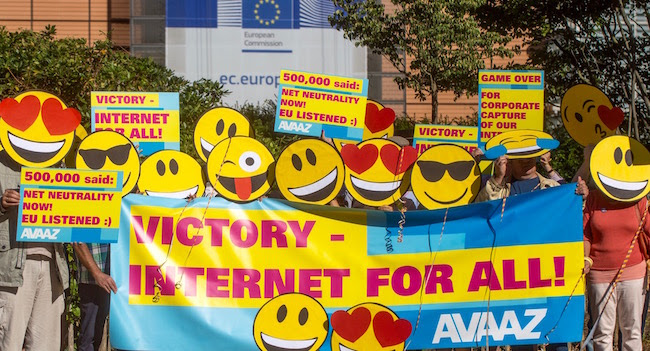
For 7 years we’ve fought corporate giants to save the internet, and it’s looking like WE’VE WON!!!!!

First in the US, then Brazil, India and now here’s what the top French official (and key swing vote) told us last week before he announced the EU law safeguarding the internet for half a billion people:

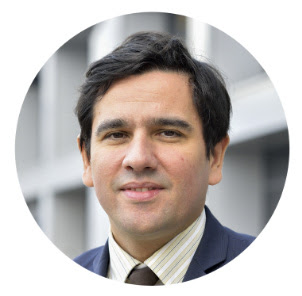
Sebastien Soriano

“I must confess that some of these tweets and messages that I received made me emotional… people asking me to “Save the Internet” and “Stop corporate capture…” I really wanted to respond to them.”
— Sebastien Soriano, Head of French Internet Regulator ARCEP

Officials announcing the law showed charts of unprecedented numbers of public comments – up to 640 per minute, the overwhelming majority from Avaaz!

Corporations wanted a fast internet for the mega-rich, and a slow one for the rest of us. We fought for the principle of “net neutrality” – equal internet for all!

It was a global fight that ranged across 7 years and 4 continents:

Net Neutrality US

United States – 2.5 million of us join a US Senator who threatened to block discussion by reading our signatures out from the Senate floor! The legislation dies. WIN!

Net Neutrality India

India – Avaaz partners with national campaign groups, with tens of thousands of our Indian members joining a call to the Telecoms minister. WIN!

Net Neutrality Brazil

Brazil – Large numbers of parliamentarians actually join our campaign, helping to pass “the Marco Civil – the most advanced law to protect the internet in the world.” WIN!

Net Neutrality EU

Europe – Telecoms giants launch a massive push to get loopholes in our hard won net neutrality law. We stop them. The press doesn’t normally tell happy stories, but this is one they’re raving about. Read about the latest victory for people power in Reuters, Tagesspiegel, Politico, EFE, Euractiv and the Wall Street Journal. WIN!

Net Neutrality Media

The internet is more than just another issue. It’s a profound empowerment of human beings to connect us to each other. Net inequality would have channeled that power to the rich few – their websites would have loaded much faster and worked better than small businesses, bloggers, or nonprofits like Avaaz.

But we used the power of our connection to defend connection itself, and net neutrality is now the standard for the internet everywhere.

And that’s a sign of hope for every challenge the world faces. Because as long as we stick together, and stay connected, we CAN build the world we all dream of.

With joy and gratitude,

Ricken, Alice, Ben, Luca, Pascal, Emma, Fatima, Wissam and the whole Avaaz team

P.S. Avaaz can only do all this because we are 100% funded by small individual donations — no corporate, government, foundation, or large donor money. To keep our work for Internet Freedom going, chip in here: https://secure.avaaz.org/en/save_the_internet_donate/

* And a big THANK YOU and CONGRATS to all our amazing allies involved in winning these historic victories in each country, especially: Access Now, Digitale Gesellschaft, DemandProgress, EFF, EDRi, Fight for the Future, FreePress, Gilberto Gil, La Quadrature du Net, MoveOn, Save the Internet, World Wide Web Foundation, The Right to Know campaign and so many more!


Avaaz is a 44-million-person global campaign network
that works to ensure that the views and values of the world’s people shape global decision-making. (“Avaaz” means “voice” or “song” in many languages.) Avaaz members live in every nation of the world; our team is spread across 18 countries on 6 continents and operates in 17 languages. Learn about some of Avaaz’s biggest campaigns here, or follow us on Facebook or Twitter.

You became a member of the Avaaz movement and started receiving these emails when you signed “” on 2010-04-22 using the email address annie.damas@gmail.com.
To ensure that Avaaz messages reach your inbox, please add avaaz@avaaz.org to your address book. To change your email address, language settings, or other personal information, contact us, or simply go here to unsubscribe.

To contact Avaaz, please do not reply to this email. Instead, write to us at www.avaaz.org/en/contact or call us at +1-888-922-8229 (US).

Join Us In Urging President Obama To Pardon Chelsea Manning

Because the public deserves the truth and whistle-blowers deserve protection.

We are military veterans, journalists, educators, homemakers, lawyers, students, and citizens.

We ask you to consider the facts and free US Army Pvt. Chelsea (formerly Bradley) Manning.

As an Intelligence Analyst stationed in Iraq, Chelsea Manning had access to some of America’s dirtiest secrets–crimes such as torture, illegal surveillance, and corruption—often committed in our name. Manning acted on conscience alone, with selfless courage and conviction, and gave these secrets to us, the public.

“I believed that if the general public had access to the information contained within the [Iraq and Afghan War Logs] this could spark a domestic debate on the role of the military and our foreign policy,” Manning explained to the military court. “I wanted the American public to know that not everyone in Iraq and Afghanistan were targets that needed to be neutralized, but rather people who were struggling to live in the pressure cooker environment of what we call asymmetric warfare.”

Journalists used these documents to uncover many startling truths. We learned:

  • Donald Rumsfeld and General Petraeus helped support torture in Iraq.
  • Deliberate civilian killings by U.S. forces in Iraq and Afghanistan went unpunished.
  • Thousands of civilian casualties were never acknowledged publicly.
  • Most Guantanamo detainees were innocent.

For service on behalf of an informed democracy, Manning was sentenced by military judge Colonel Denise Lind to a devastating 35 years in prison. Government secrecy has grown exponentially during the past decade, but more secrecy does not make us safer when it fosters unaccountability.

Chelsea Manning was convicted of Espionage Act charges for providing WikiLeaks with this information, but the prosecutors noted that they would have done the same had the information been given to The New York Times. Prosecutors did not show that enemies used this information against the U.S., or that the releases resulted in any casualties.

Chelsea Manning has already been punished, even in violation of military law. She has been:

  • Held in confinement since May 29, 2010.
  • Subjected to illegal punishment amounting to torture for nearly nine months at Quantico Marine Base, Virginia, in violation of the Uniform Code of Military Justice (UCMJ), Article 13—facts confirmed by both the United Nation’s lead investigator on torture and military judge Col. Lind.
  • Denied a speedy trial in violation of UCMJ, Article 10, having been imprisoned for over three years before trial.
  • Denied anything resembling a fair trial when prosecutors were allowed to change the charge sheet to match evidence presented, and enter new evidence, after closing arguments.

Chelsea Manning believed you, Mr. President, when you came into office promising the most transparent administration in history, and that you would protect whistle-blowers. We urge you to start upholding those promises, beginning with this American prisoner of conscience.

We urge you to grant Chelsea Manning’s petition for a Presidential Pardon.

petition here

Exclusive: Freed CIA Whistleblower John Kiriakou Says “I Would Do It All Again” to Expose Torture

Click on image

John Kirakou
John Kirakou

Blog at WordPress.com.

Up ↑