Search

band annie's Weblog

I have a parallel blog in French at http://anniebannie.net

Flip Wilson

Clerow “Flip” Wilson Jr. (December 8, 1933 – November 25, 1998) was an African American comedian and actor, best known for his television appearances during the late 1960s and 1970s. In the early 1970s, Wilson hosted his own weekly variety series, The Flip Wilson Show. The series earned Wilson a Golden Globe and two Emmy Awards, and at one point was the second highest rated show on network television.
Wilson also won a Grammy Award in 1970 for his comedy album The Devil Made Me Buy This Dress.
In January 1972, Time magazine featured Wilson’s image on its cover and named him “TV’s first black superstar”.
According to The New York Times, Wilson was “the first black entertainer to be the host of a successful weekly variety show on network television.”

Christopher Columbus

Geraldine

Flip Wilson Show The Church Of What’s Happening Now

Michael Jackson – Maths skit with Flip Wilson

The war for ‘The New York Times’


18 Comments

A war has begun for the soul of The New York Times.

People in the Palestinian solidarity movement criticize the Times all the time — we do; the glass is always half empty — but then so do supporters of Israel. The glass is also half-empty for them. And something you may not have noticed lately is that we are beginning to have victories. There are people at The New York Times who fully comprehend Israel’s crisis and want the newspaper to reflect that reality. They are digging in, and they are under attack. But they are having little victories.

Consider:

— Jodi Rudoren is gone. She was the last New York Times bureau chief in Jerusalem and came out of a firmly Zionist background and could be counted on to offer a warm, fuzzy, pro-Israel slant to any story that was often embarrassing. Even the human rights atrocities of Gaza could be spun by Rudoren (“sliver of opportunity“). She has been replaced by Ian Fisher, who seems like a fair, open-minded reporter who is probably right now in shock at what he is seeing. His hunger strikers piece yesterday was very good. His piece on Banksy’s new hotel — Fisher’s emphasis was the “ugly” wall. Anyone who tells it like he sees it is going to help Palestinians.

— Yesterday the Times International edition ran Marwan Barghouti’s piece saying that Israel is a “moral and political failure.” We know we slammed the Times for burying this piece in the international edition in our dudgeon yesterday. But the amazement is that it ran at all — Barghouti’s explanation that 40 percent of the male Palestinian population has been in Israeli prisons, that his son jailed in the years that Americans go to college, and these prisons are the cradle of a global anti-colonial movement . . . Yes, the piece has come under enormous attack. Israelis including the prime minister are expressing outrage that it ran at all. To the point that the backsliders of the New York Times have appended a clarification filling in what Barghouti was convicted of. “The article . . . neglected to provide sufficient context by stating the offenses of which he was convicted. They were five counts of murder and membership in a terrorist organization . . .” Etc.

Actually, the many Nelson Mandela references were sufficient context; Mandela was also charged with terrorism, the ANC did use violence. But it is a measure of the war that the Times is in that Michael Oren became unhinged over the newspaper’s role:

Shame on NYT for printing libelous op-ed by convicted killer Barghouti, the Palestinian Dylann Roof. Americans would be horrified. So are we

Crazy, yes. But Oren’s right about one thing: the Times is now in play. And where it goes, everyone else will follow.

— Yes, you say: the New York Times hired neoconservative crank Bret Stephens as an op-ed columnist the other day, a great setback to the discourse; Stephens has a long track record of racist statements. But while editorial page editor James Bennet’s announcement was fulsome (“beautiful,” “profound,” “bravery,” “generous,” “thoughtful”), it contained this important signal:

We read this as a sign that a pro-Palestinian columnist is coming, maybe even an anti-Zionist. Bennet knows exactly what Zaid Jilani is saying at the Intercept and what we have been saying here about the Times‘s conservative pro-Israel range. David Brooks’s son served in the Israeli military, for god’s sakes. The Times is getting battered by young people on the left for the fact that Roger Cohen and Tom Friedman’s weary Zionism is the best it has to offer to critics.

And bear in mind, if you’re pro-Israel, you have seen a deficit. Where is the firebreather to replace AM Rosenthal, William Safire and Bill Kristol? Well, you just got Stephens. The Times is in play.

— There is further evidence of the Times-at-war in the pushback to Stephens from within the Times ranks. (Michael Calderone reported on this at Huffpo.) Declan Walsh, the paper’s Cairo bureau chief, tweeted the following over the weekend:

Max Fisher, the Times “interpreter,” promptly expanded the thought:

Bret Stephens became defensive about the criticism and slung some more anti-Arab horseshit.

There was a time when journalists at a major newspaper were careful not to criticize that paper publicly. Those days are over, thanks to the internet. Two Times reporters are peeved at the racism of a colleague. They surely speak for many more. (Some of whom read Yakov Hirsch pointing out this racism first, last year: “The Politics of Jewish Ethnocentrism.”)

There was a time when the New York Times was a reliable supporter of Israel. A.M. Rosenthal and Max Frankel begat Ethan Bronner and Jodi Rudoren. We say those days are coming to an end. The shift in American discourse on the Palestinian issue that Bernie Sanders reflected a year ago is happening deep inside the Times too. Younger writers are woke on this question. They’re not going to just shut up about it. The neocons are also digging in. But the coverage is getting better . . . the coverage is getting better. Glass half full.

– See more at: http://mondoweiss.net/2017/04/the-york-times/?utm_source=Mondoweiss+List&utm_campaign=04957f876b-RSS_EMAIL_CAMPAIGN&utm_medium=email&utm_term=0_b86bace129-04957f876b-309259350&mc_cid=04957f876b&mc_eid=39adaa9ab6#sthash.pSLErpIS.dpuf

Birds-of-Paradise Project Cornell University

Miko Peled : It’s Personal.

Miko Peled

As thousands of Palestinian political prisoners jailed by Israel are going through a hunger strike, we would do well to delve into the deeper, more personal and historical aspects of Palestine.  Though the politics and violence of settler colonialism have determined its fate for almost one hundred years, Palestine is not just a “case” or an “issue,” it’s personal. My dear, dear friend Nader Elbanna said to me a long time ago, “The Palestinian tragedy is more than just losing the house and the land.”  None of us will ever fully understand Palestine, none of us who are not Palestinian, that is, because it is personal. But there are ways to learn. Visiting Palestine is a good start. Living in Palestine is good too and learning Arabic affords a glimpse. Reading Ghassan Kanafani’s stories is moving and enlightening.


Ghassan Kanafani, in his short stories presents an intensely personal narrative and paints a picture that is painfully detailed. In one of his short stories, a young man asks, “would you like to hear about my life?” and he proceeds to describe a mother who died under the ruins of a house in Safed, the house that was built for her by her husband. He describes the father, now working in another part of the Arab World and unable to see his children, and a brother “learning humiliation” in an UNRWA school. In another short story Kanafani describes a father who is standing in the rain leaning on a broken shovel, taking a break from the back- breaking work of digging a ditch in the rain. He is digging in an effort to stop the rain water from flooding a tent where his family, now refugees, must live. He is cold, tired and hungry but avoids going inside the tent, not wanting to see his wife’s glare, knowing she blames him for the inevitable state of being unemployed and unable to provide for his family. Seeing his child wear a torn, old shirt he contemplates taking part in a scam operation, stealing bags of rice from the UNRWA storage facility and selling them on the black market. “The guard is in on it and for a small fee he will look the other way,” he is told by a man of whose morals he does not approve, and whose very presence makes him uneasy.

The occupation of Palestine is not only about the brutality that is inherent in settler colonialism but the daily, painful existence of a nation that is denied the right to live in the land to which it belongs. A nation forced to live in abject poverty in camps that are unfit for humans and which exist just hours away from the land and the homes from which they were kicked out. A land for which they have the deeds, and homes for which they still hold the keys now inhabited by Jewish settlers. “For us, to liberate our country is as essential as life itself” Kanafani says to an Australian reporter in a rare interview in English. He is fierce and forthright, sitting in his office, with photos of Che Guevara and Ho Chi Minh behind him.

But Palestinians are permitted only to be victims or terrorists, never freedom fighters or heroes. If Palestinians wrote “Live Free or Die” on a license plate they will be accused of terrorism and locked up, deported or simply killed, though in New Hampshire it is the official motto. Ironically, Israeli children learn about a legendary Jewish hero who, having been killed in battle in Palestine said, “it is good to die for one’s country” though clearly, he was fighting to take the country of others. Kanafani was brutally murdered, along with his young niece Lamees who was only seventeen, for saying and doing just that – fighting to liberate his country. Since his assassination by Israel almost half a century ago, countless Palestinians were killed by Israel, some fighting, most while sleeping in their beds or trying to flee.

Kanafani talks about “them,” the “Yahud” the Zionists who colonized Palestine and exiled his people, turning them into “people with no rights, with no voice.” “They have put enormous efforts into trying to melt me,” he writes, “Like a sugar cube in cup of tea.” And he talks about “You” the Arab authorities under whom Palestinians are now forced to live. “You had managed to melt millions of people and lump them into one lump, into a single thing you can now call ‘a case.’” And, he continues, “now that we are all ‘a case’” there is no personal attachment to any single person or story. How convenient. That is what allows for the ease with which the world treats the Palestinian tragedy. That is how the West can sell Israel the weapons and technology with which it slaughters Palestinians by the thousands and maintains the oppression.

One wonders what Kanafani would say about the horrific, large scale massacres endured by the people in Gaza since 2008. What would he say if he knew that since his death things have become worse now that Israel’s army of terror has access to more “modern” weapons that allow it to murder and maim thousands in a single “operation.” How would Kanafani react if he heard about entire families that were wiped out by mortars and missiles fired at them and others, incinerated by millions of tons of bombs dropped from war planes? One wonders what stories he might write about children burned and mutilated with such ease in the twenty first century? “We are a small, brave nation” Kanafani said in 1970, “who will fight to last drop of blood.”

Israel – the name that was given to the Zionist state which occupies Palestine – is indignant at the very mention of Palestine and at the idea that as a state it should respect the rights of Palestinians. People who support Israel are offended when they hear accusations of racism, indiscriminate violence and genocide. But these same people have no problem with the actual ongoing campaigns of genocide, ethnic cleansing and the reality of racist apartheid perpetuated by Israel. Because for them Palestine is not personal, it is just a “case,” just a “problem.” But Palestine is not a problem, it is personal, it has a beating heat, and that is why the fight for justice in Palestine is gaining momentum all over the world. As the Palestinian leader and political prisoner Marwan Barghouthi wrote recently from a cell in an Israeli jail, “The chains that bind us will break before our captors can break our resilience.”


Democracy Now on Trump bombing Assad

click on image

It took Trump two days to do what Obama never would

Rime Allaf

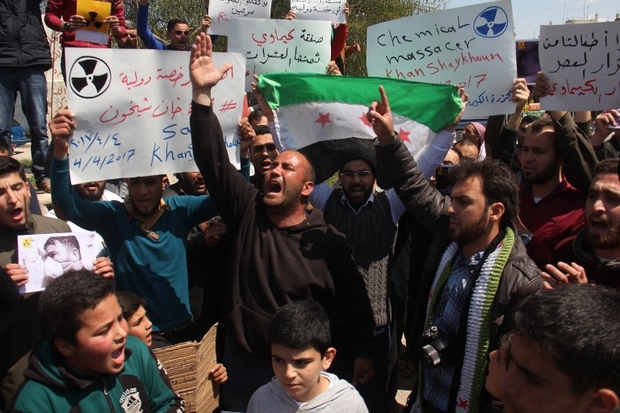
Syrian residents of Khan Sheikhun hold placards and pictures on April 7, 2017 during a protest condemning a suspected chemical weapons attack on their town earlier this week that killed at least 86 people, among them 30 children, and left hundreds suffering symptoms including convulsions, vomiting or foaming at the mouth.
In the Syrian town of Khan Sheikhun, site of an alleged chemical weapons attack on April 4, residents still mourning their dead welcomed US strikes earlier today as a way to pressure Damascus. The strikes targeting a Syrian forces airfield, ordered by President Donald Trump, were the first direct US military action against Syria’s government since the conflict began six years ago. / AFP PHOTO / Omar haj kadour

Many Syrians would still be alive, safe and home today had there been a response to the Assad regime’s first massive chemical massacre in 2013
Everyone seems to have misread President Trump, or at least underestimated his capacity for decisive action, considering older statements to be proof of his positions.

Indeed, his tweets to Obama appealing that he abstain from striking Assad after the massive chemical massacre of 2013 were understood by most of us as a staunch position on the matter. But Trump was neither in power, nor even a politician then; inside the Oval Office, perspectives vary, information is precise, and the quality of advisors matters.

Whereas Obama was too arrogant to admit he was ever wrong, Trump’s own legendary ego nevertheless left room for what he described as flexibility, admitting that something changed his mind
For Syrians waiting for an end to the hell raining down on them, two elements positively distanced Trump from his predecessor. Whereas President Obama intended from day one for his legacy to be a nuclear deal with Iran, and intended to do – and more importantly not to do – everything it took to achieve it, President Trump doesn’t pretend to know yet what his own specific legacy will be, beyond generally making America great again. Apart from a solid opposition to the Iran deal, he has no claim to eventual fame in the tumultuous Middle East.

And whereas President Obama was too arrogant to admit he was ever wrong, even after his infamous red line inaction resulted in doubling the number of Syrian victims, unleashing a flood of refugees from Syria, and allowing the Islamic State (IS) to strengthen, Trump’s own legendary ego nevertheless left room for what he described as flexibility, admitting that something changed his mind. Whether it was really upon seeing new images of Syrian children choking to death, or whether purely upon consultation with his senior advisors, Trump did not hesitate to change course on Syria – even if it meant going back on his word.

Russia misread

President Trump did in two days what his predecessor failed to do in six years: he showed clarity of purpose when the occasion called for direct action, an action whose consequences have yet to be determined.

When push came to shove, Russia was impotent and immobile
An abundance of commentators had warned repeatedly that eventual US attacks against the Assad regime would bring great catastrophe, including direct conflict with Russia, a complication of the war, and more Syrian civilian deaths, a matter supposedly of great concern to the suddenly vocal “Hands Off Syria” crowd which remained silent when Russian bombs tore Syrians to shreds.

But if this doomsday scenario has not materialised, it is possibly because it is Russia which misread Trump and his advisors the most.

For all the experts waxing poetic about President Putin’s chess master qualities and his alleged cunning, Russia was left with no option but to stand aside while the US carried out its punitive strike on Assad’s assets. Usually well-spoken and calm Lavrov, Russia’s foreign minister, could only give a disjointed, moot statement suspending cooperation with the US in Syrian airspace.

And Russia’s strange, rather lame sudden recognition of West Jerusalem as Israel’s capital on Thursday took even Netanyahu by surprise. When push came to shove, Russia was impotent and immobile; the presence of a smiling Chinese President Xi at Trump’s dinner table when the strike was announced merely added to the humiliation.

Five factors to consider

None of this means that Russia remains without options next time, nor indeed that there may be a next time. But this week’s developments have exposed a number of factors which can’t be brushed aside again. They are on the table.

First, Assad’s blatant renewed use of chemical weapons demonstrates that Russia is either unable or unwilling – or both – to rein him in. As Secretary of State Rex Tillerson bluntly stated: “Clearly Russia has failed in its responsibility. Either Russia has been complicit or either Russia has been simply incompetent in its ability to deliver on its end of that agreement.”

It is the presence of General McMaster, and that of General Mattis at the head of the Pentagon, which is likely to have shaped President Trump’s swift action
Second, the fact that the Assad regime did not hand over all of its chemical arsenal means that someone still has to rid him of it. According to National Security Advisor General HR McMaster, the US strike was targeted to avoid a storage unit that was stockpiling the nerve agent in order to protect civilians.

Third, in contrast to the Obama administration’s attempts to minimise the strike that never was, the Trump administration is neither shy nor apologetic about its actions: “This was not a small strike,” McMaster said.

Fourth, while the strike was a response to the specific use of chemicals, it is hard to envisage that the Trump administration will retreat from condemning, and possibly acting on mass killings by other means in Syria. Statements from various cabinet members have indicated a much stronger involvement that initially planned.

Finally, the surprise reshuffle in the National Security Council and the removal of Steve Bannon from it, days before the US took action against Assad, seems to have finally placed the right advisors at their rightful places, giving studied and measured assessments.

It is the presence of McMaster, and that of General James Mattis at the head of the Pentagon, which is likely to have shaped President Trump’s swift action. Both these senior military advisors happen to have remarkable acumen and experience in Middle East matters in particular; while their personal positions on Syria are not yet public, their history in the region implies an understanding that fighting IS while ignoring the Assad regime would be counterproductive, especially when Islamist extremists use Western inaction as rallying cries.

The right signals

In one fell swoop, President Trump’s strike on Assad has exposed the limits of Russian bravado and revived the notion of a coalition to change the status quo.

While he did not repeat the empty “Assad has to go” mantra, Trump’s address to the nation, calling “on all civilised nations to join us in seeking to end the slaughter and bloodshed in Syria” seems to be a sign that the US is, finally, reclaiming a leadership position under the careful guidance of able and experienced military advisors.

Many Syrians would still be alive, safe and home today had there been a response to the Assad regime’s first massive chemical massacre in 2013. While Trump cannot undo the damage, his administration has now signalled it is both able and ready to solve the conflict.

– Rime Allaf is a Syrian-born writer and political analyst. She was an Associate Fellow at Chatham House from 2004 to 2012, in the Middle East and North Africa Programme. She has published numerous analyses and articles on the region, with Syria being the focus of her area of expertise, and continues to write, speak and advise on Syrian affairs. She is on the Board of Directors of The Day After, a renowned Syrian-led civil society organisation working to support a democratic transition in Syria, with grants from several Western institutes and governments. She is also on the Board of Directors of the Syrian Economic Forum, a think tank working on building a strong economy to support a free, pluralistic and independent state.

The views expressed in this article belong to the author and do not necessarily reflect the editorial policy of Middle East Eye.


http://www.middleeasteye.net/columns/it-took-trump-two-days-do-what-obama-never-would-1009440608


Assad’s Militias Turn to Schoolchildren to Fill Manpower Void


Mar 29th, 2017 by Alsouria Net (opposition website)

Opposition outlet claims loyalist paramilitary groups are routinely exploiting Syrians’ needs for a stable income by recruiting children into their ranks for up to $200 a month, with many of them being sent to battlefronts without proper training

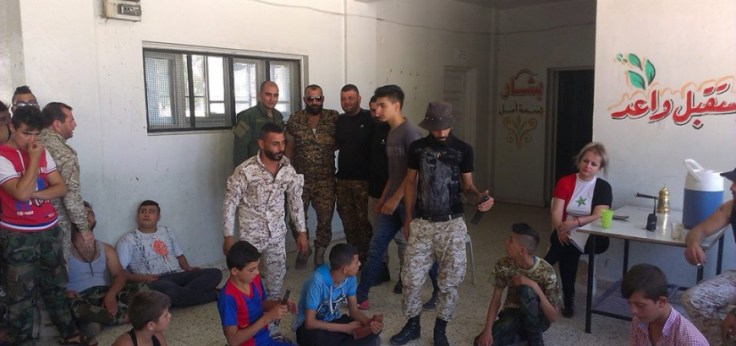
Conscripted from schools or places of work to fight in the ranks of Syrian President Bashar al-Assad’s regime, children walk through areas of Damascus and its countryside in full military gear, only to end up dead or stationed on battlefronts to await their fate.

Amid a dire economic climate and widespread financial stress for many families, celebrations for the conscription of schoolchildren under 18 years old have become a normal affair, as the regime exploits people’s need for an income against a backdrop of skyrocketing prices.

Damascus and its countryside have seen the conscription of children from the ages of 13 to 17 in various areas. One such area is Adra al-Amaliyeh, close to the city of Douma in the Damascus countryside, where a number of secondary and preparatory schools have witnessed the presence of recruiters from the Baath Brigades militia, while a party was held for about 40 children signing up to fight with the loyalist Fifth Corps, according to what sources told Alsouria Net, requesting anonymity out of fear for their safety.

The sources said there were no regulations for recruiting children, whereby the Baath Brigades accepted any child to fight in its ranks in exchange for $200 a month. Other incentives include the recording of their attendance in school and securing opportunities to succeed in academic courses.

In the Rukneddine area in the capital Damascus, children appear in their military gear alongside the National Defense Forces group and a number of other Shiite militias. Many of the children enter into fighting without having taken training courses to prepare them for the battle, increasing the likelihood of them being fatally wounded during clashes.

Among the children who told their stories to Alsouria Net was the child Shihab, 16, who lives in the Kashkool area near Jaramana and fights alongside the NDF militia for 35,000 Syrian pounds ($160) a month. He told his relatives that he had left school because his family was unable to secure a living and that he benefits from the salary he receives and from looting, which regime forces carry out in the areas they enter.
Although the most recent constitution, authored by the Assad regime in 2012, includes compulsory schooling for all children, it seems ensuring the education of those who drop out of school is not considered a priority in the areas under regime control.

The NDF militia, the popular committees and the Baath Brigades are the most prominent parties into which children are conscripted for the benefit of the Assad regime — something the regime has repeatedly denied. From time to time loyalist pages on social media will publish images of bases for conscripting children, while the NDF militia in the Hama countryside has previously published images of children who were receiving training, some of them wearing military uniform, overseen by fighters from the regime forces.

This article was translated and edited by The Syrian Observer. Responsibility for the information and views set out in this article lies entirely with the author.

http://syrianobserver.com/EN/Features/32538/Assad_Militias_Turn_Schoolchildren_Fill_Manpower_Void

AIPAC speakers say the enemy is BDS, while ‘biggest Jewish-led protest’ surges outside

Young Jewish demonstrators from IfNotNow outside AIPAC conference yesterday

Young Jewish demonstrators from IfNotNow outside AIPAC conference yesterday

This morning, Israeli Prime Minister Benjamin Netanyahu spoke by video to the Israel lobby group AIPAC (the American Israel Public Affairs Committee) in Washington. He bragged about his warm relationship with President Trump to great applause, and said that many states in his region were turning to Israel in the fight of modernism against medievalism. He said it was time for Palestinian Authority to “above all, once and for all, recognize the Jewish state.”

Netanyahu also addressed the Boycott, Divestment and Sanctions, or BDS, movement aimed at Israel, saying Israel will defend itself on the “moral battlefield… We’ll defend ourselves against slander and boycotts.”

Last night Vice President Mike Pence was introduced as an enemy of BDS. He told the AIPAC conference, “The president of the United States is giving serious consideration to moving the United States Embassy from Tel Aviv,” to huge applause. He then called on the next ambassador to Israel, David Friedman, a supporter of settlements, to stand. He also got a warm reception.

Martin Indyk took a jaundiced view of Pence’s promise, saying that George W. Bush had seriously considered the move for eight years, and Trump will still be seriously considering in another four years. “We’re freiers [suckers] to think otherwise.”

Israeli opposition leader Isaac Herzog called on AIPAC’s followers to opposed the BDS movement. While former Prime Minister of Canada Stephen Harper said that BDS was the most serious threat to Israel and merely the latest form of classical anti-Semitism.

“The third threat to Israel is the one we actually need to take the most seriously as Canadians and Americans, and that is the BDS movement… One can disagree with the Israeli government’s policies in this aspect or that, but the BDS is not about that. The BDS movement is about translating the old ideology of anti-Semitism into something acceptable to a new generation.”

The theme was echoed by AIPAC officials.

Democratic political consultant Paul Begala said this morning on the AIPAC stage that he was thinking of making “aliyah” to Israel because of political developments in Washington but affirmed: “I have never worked for someone who is anti-Israel and I never will… How could I and be true to my progressive values?”

As for progressive values: there was a large demonstration yesterday outside the Washington convention center by the “Jewish resistance,” led by IfNotNow. A few demonstrators from IfNotNow managed to get inside the hall and drop a banner protesting the occupation. While hundreds of others in the resistance group led a march to the convention center in an effort to stop the conference. Ben Norton said it’s the “biggest-ever Jewish-led protest” of AIPAC. Bigger than Neturei Karta.

Here’s Ahmed Shihab-Eldin’s thorough video coverage of the demonstration for AJ+.

One organizer says what makes this anti-AIPAC demonstration different is that it’s the 50th year of occupation, and these young people are not going to let AIPAC speak for the Jewish community anymore. Others emphasized the crisis inside the Jewish community. Among the soundbites:

Fifty years is too long. It’s a moral crisis for the Palestinians, it’s eroding our community. AIPAC does not speak for American Jews.

The Trump administration is forcing the American Jewish community to pick.

AIPAC stands for endless occupation. We are the Jewish Resistance.

I’m here fighting for freedom and dignity for all Israelis and Palestinians, and a Jewish community that stands up for those things.

Jews can’t have liberation if Palestinians don’t.

We refuse as Jews and humans to be part of the American Jewish establishment…. I feel heartbroken that it’s taken our community so much to move…. We have a long way to go.

At Minute 20 you can see a dozen demonstrators forming a human chain outside the convention doors.

Shortly after, a group said to be part of the Jewish Defense League attacked the demonstration.

Some shouted at IfNotNow, “sharmouta,” Arabic for prostitute.

Shihab-Eldin asked why no one from JDL was arrested.

Thanks to Annie Robbins. 


The Inside Story on Our UN Report Calling Israel an Apartheid State

A Palestinian woman argues with Israeli soldiers at a West Bank checkpoint south of Hebron on August 16, 2016. (Reuters / Mussa Qawasma)

A Palestinian woman argues with Israeli soldiers at a West Bank checkpoint south of Hebron on August 16, 2016. (Reuters / Mussa Qawasma)

A people cannot be permanently repressed in all these ways without viewing the structure that has emerged as an apartheid regime.

Six months ago, the UN’s Economic and Social Commission for West Asia (ESCWA) asked Virginia Tilley and me to write a study examining the applicability of the international criminal law concept of apartheid to Israel’s policies and practices toward the Palestinian people. We were glad to accept the assignment, and conceived of our role as engaging in an academic undertaking. ESCWA, one of several UN regional commissions, requested the study as a result of an uncontested motion adopted by its 18 Arab member governments.

Almost within hours of its release on March 15, our report was greeted by what can only be described as hysteria. The US ambassador to the UN, Nikki Haley, denounced it and demanded that the UN repudiate it. The newly elected secretary general, António Guterres, quickly and publicly called for ESCWA to withdraw the report from its website, and when Rima Khalaf, the head of the commission, resisted, Guterres insisted. Rather than comply, Khalaf resigned. Soon thereafter, the report was withdrawn from the commission’s website, despite its having been published with a disclaimer noting that it represents the views of its authors and not necessarily that of ESCWA or the UN.

What is striking about this response, which resembles in many respects the US government response to the Goldstone Report (the UN Fact-Finding Mission on the Gaza Conflict of 2008-9), is the degree to which Israel’s supporters, in response to criticism, have sought to discredit the messenger rather than address the message.

We had hoped that our analysis would prompt debate, dialogue, and consideration of our recommendations.

Tilley, a professor of political science at Southern Illinois University Carbondale, and I, as well as ESCWA, would welcome substantive discussion of and critical feedback on our report, and we had hoped that our analysis and conclusions would provide the basis for dialogue and further consideration of the recommendations appended at the end. ESCWA, for its part, took steps to ensure that the report lived up to scholarly standards, submitting the draft text to three prominent international jurists, who anonymously submitted strong positive appraisals along with some suggestions for revision, which we gratefully incorporated before the final text was released. For government officials and others to dismiss our report as a biased polemic is irresponsible, with respect both to the authority of the UN and to international law.

During my tenure as the UN’s Special Rapporteur on human rights in the occupied Palestinian territories (2008-14), I saw how defenders of Israel attempt to discredit critics. My reports in that post often contained sharp criticisms of Israel and other actors, ranging from defiance of international law, unlawful expansion of settlements, excessive use of force, and complicity of international corporations and banks that do business for profit with the settlements. To my surprise, I never received substantive pushback regarding my allegations, but I did have the unpleasant experience of having my words on unrelated issues torn out of context. Among my harshest critics were not only the usual ultra-Zionist NGOs, but also Barack Obama’s diplomats at the UN, including Susan Rice and Samantha Power, as well as then-Secretary General Ban Ki-moon. I mention this personal experience only to note that it falls into a longstanding pattern of rebuttal that prefers to smear rather than engage in reasoned debate about important issues of law and justice.

The international crime of apartheid was set forth in the 1973 Convention on the Suppression and Punishment of the Crime of Apartheid. The main elements of the crime consist in deliberate and systematic acts of racial discrimination with the purpose of maintaining unlawful structures of domination by one race over another. Our report also considered whether, in the context of inquiring into the presence of apartheid, it was appropriate to consider Jews and Palestinians as distinct races; we found that there was abundant grounding to do so. As our report shows, “race” in this context is treated as a socially and politically constructed category defining a distinct people. It has no necessary correlation with biogenetic realities, which in this case show an overlap between Jews and Palestinians.

Even Palestinian citizens of Israel, who can vote and form political parties, are subject to many discriminatory laws.

The report also proceeds from the proposition that whether apartheid exists or not depends on the overall treatment of the Palestinian people as a whole. Adopting what we believed to be innovative methodology, we approached this challenge by dividing the Palestinians into four domains that correspond to the manner in which Israel has exercised its authority over the course of many decades, although specific tactics of control have varied through time. In the past, a thorough study by international law scholars found that Israel’s practices in the occupied Palestinian territories are consistent with apartheid. It called attention to the discriminatory treatment of Palestinians, who are subject to military administration as compared to the Jewish settler population, which enjoys the full benefit of the rule of law as it is observed in Israel in relation to Jewish nationals. That study found that such features as “settler-only roads,” dual legal systems, and the draconian separation of the two populations into regions on the basis of race are the hallmark of apartheid. Repressive practices that have made the lives of ordinary Palestinians a daily ordeal are part of this system, as international law establishes that penalizing resistance to apartheid is itself a crime of apartheid.

A second domain investigated in the report involves Palestinians who are residents of Jerusalem. Here the apartheid character of Israeli rule is exhibited in the way the government undermines the security of those Palestinians, manipulating their rights of residence as well as imposing a variety of discriminatory practices, ranging from fiscal measures to the issuance of building permits. The third domain concerns the Palestinian minority living in Israel, perhaps the most problematic component in terms of establishing a definition of apartheid that encompasses the entire Palestinian population. In this category are some 1.7 million citizens of Israel, who are allowed to form political parties and vote in elections. But this minority, which makes up about 20 percent of the overall Israeli population, is prohibited by law from challenging the proclaimed Jewish character of the state and is subject to a wide range of discriminatory nationality laws as well as administrative practices that severely restrict their rights, with effects on land acquisition, property, immigration, family reunification, and marital freedom.

International law has detached apartheid from its South African origins; it’s now a stand-alone crime against humanity.

A fourth domain, and the one affecting the largest demographic segment, is made up of Palestinians registered as refugees by UN procedures or living under conditions of involuntary exile. In the background is the non-implementation of UN General Assembly Resolution 194 (1948), which confirms the right of return enjoyed by Palestinians dispossessed or displaced by Israel in 1948. This right of return is declared in General Assembly Resolution 3236 to be an “inalienable right,” which thus presumably incorporates those additional several hundred thousand Palestinians displaced by the 1967 war. As far as is known, no Palestinian displaced since the establishment of Israel in 1948 has been granted the right of return to resume residence.

From the perspective of international law, the crime of apartheid has been detached from its historical origins in South Africa. Neither the 1973 Convention nor the 1998 Rome Statute underlying the International Criminal Court ties apartheid to South Africa, but rather treats its practice as a stand-alone crime against humanity. Thus, there are important differences between the way apartheid operated in South Africa and the way it is currently being imposed on the Palestinians, but these differences are not relevant to the question of whether it fairly and accurately applies to Israel. One notable difference is that in South Africa the Afrikaner leadership forthrightly proclaimed apartheid as a reflection of its ideological belief in the separation of races, whereas for Israel such a structure of separation on the basis of race is denied and repudiated. There are other differences as well, relating to degrees of labor dependence and the demographic ratio.

This quasi-permanent structure of domination cannot be justified convincingly by reference to Israeli security needs.

Our report concludes that Israel has deliberately fragmented the Palestinian people in relation to these four demographic domains, relying on systematic discrimination, including “inhuman acts,” to maintain its control, while continuing to expand territorially at the expense of the Palestinian people. On the basis of these findings—backed up by detailed presentations of empirical data, including reliance on Israeli official sources—we conclude that the allegation of apartheid as applied to the Palestinian people is well founded.

We realize that our report is the work of academic investigators and is not an authoritative finding by a formal judicial or governmental institution. At this point it has not—contrary to media reports and diplomatic denunciations—even been endorsed or accepted by the UN, or even ESCWA. We do recommend such an endorsement, and we urge the UN, national governments, and civil society to take measures designed to encourage Israel to dismantle its apartheid regime and treat the Palestinian people in accord with the dictates of international law and human rights, as well as elementary morality.

The broader setting associated with our contention that Israel has become an apartheid state draws on the reality that there is no peaceful resolution to the conflict on the diplomatic horizon, and thus no foreseeable prospect for ending the discriminatory regime. This quasi-permanent structure of domination cannot be justified convincingly by reference to Israeli security needs. A people cannot be permanently repressed in these various ways without viewing the structure that has emerged as an apartheid regime. Indeed, part of the reason for not awaiting a more formal assessment of these charges is our sense of urgency in ending a set of arrangements that have for so long been responsible for so much suffering and denial of basic rights, above all the right of self-determination.

It remains our central hope, one shared by ESCWA, that the widespread availability of the report will lead to a clearer understanding of the Palestinian plight and encourage more effective responses by the UN, by governments, and by civil society. Beyond this, it is our continuing wish that people of good will throughout the world, especially within Israel, will work toward a political solution that will finally allow Jews and Palestinians to live together in peace, with justice.


Blog at WordPress.com.

Up ↑