Search

band annie's Weblog

I have a parallel blog in French at http://anniebannie.net

Category

zionism

 Zionism’s Transference of Trauma

33 770 vues 27 oct. 2024 #colonialism#catastrophe#hateIs it ok to use the Holocaust and its perpetrators as analogy for recent potential threats? Is it ok for Israel to label whoever is her enemy as Nazis or identify them as monsters about to commit another genocide of the Jews?

This is the approach by the leadership of Israel over the last 50 years. To inject fear into its own people. To remind those international nations who looked away when the events of the Holocaust took place. To remind them of their guilt so that they may accept all the hostility and inhumanity that Israel will reign down on its enemies. µ

It’s a touchy subject, but analogies can be misguiding and misrepresent both the reality of any threat as well as diminish the real significance and uniqueness of the Holocaust tragedy. This video addresses the methodology of how the Holocaust was transitioned from an event Jews wanted to forget to a weapon used on a daily basis.

Subscribe: https://bit.ly/3jCXuCw: Instagram: http://www.instagram.com/tareqkandari Twitter: http://www.twitter.com/tareqkandari Patreon.com/TheKandariChronicles

Holocaust Trauma or Holocaust PSYCHOSIS? Daniel Maté

The Zionist project is coming to an end, with Ilan Pappé (The Electronic Intifada)

The Unspoken Rule About Zionism Was Broken

Do Zionism quietly, discreetly, under the cover of darkness.

Author

Zachary Foster
February 09, 2024

The Unspoken Rule About Zionism Was Broken

For more than a century, Zionists have understood that the Zionist project involved doing some unpleasant things, and it was best to keep quiet about those things.

Theodor Herzl realized this as early as 1891. He confided in his diary that “we must expropriate gently the private property on the estates assigned to us” and “we shall try to spirit the penniless population across the border,” adding that “the process of expropriation and the removal of the poor must be carried out discreetly.” [Emphasis added].

The State of Israel has broken the unspoken rule. Israeli soldiers have been publishing videos of themselves blowing up dozens of residential neighborhoods in Gaza. Jewish Israeli leaders have been publicly declaring their intention to ethnically cleanse Gaza while Jewish Israeli journalists have been calling on the military to flatten the entire Strip. Prime Minister of Israel Benjamin Netanyahu himself likened Israel’s enemy to Amalek twice, Amalek being the people the Biblical Israelites were instructed to commit a genocide against.

Of course, not all pro-war Israelis have forgotten the rule. The Israeli judge appointed to the ICJ by Israel, Aharon Barak, voted in support of South Africa’s claim about incitement to genocide. For Barak, the problem was not what Israel was doing, the problem was what Israeli leaders were saying. They were violating the unspoken rule about Zionism. When removing Palestinians from their homes, and making it impossible for them to return, best to do it discreetly.

The Zionist leader Jacob Thon (1880-1950), who worked at the Palestine Land Development Co. buying up land from Arabs in the 1910s, believed that “of course” transferring the Arabs to Transjordan was desirable. But, Thon warned, if the Zionists talked about transfer openly their chances of accomplishing it would diminish. Any steps to “transfer” Arabs would have to be taken “privately.”

During the 1920s, Israel Zangwill (1864-1926) frequently wrote and spoke openly of the removal of the Palestinian Arab population of Palestine. In his view, that was necessary to establish a Jewish democratic state, and so Palestinian Arabs often cited Zangwill’s writings as evidence of Zionism’s nefarious aims. Zionist leaders learned an important lesson from Zangwill’s frankness: “under no circumstances should they talk as though the Zionist program required the expulsion of the Arabs, because this would cause the Jews to lose the world’s sympathy,” in Tom Segev’s words.

Golda Meir also understood the importance of doing things quietly. By 1971, Israeli ministers were going on media roadshows in their newly established settlements in the Israeli-occupied West Bank. The Geneva Conventions of 1948 prohibit states from transferring their civilian population onto land occupied in war, something obvious to Meir but apparently not her ministers. “Before we move forward with our discussion,” Meir said at the outset of a 1971 cabinet meeting, “there’s something I’d like to ask. It was our habit that for anything that has to do with settlements, outposts, land expropriations and so on, we simply do and do not talk [about it].”

Until recently, the Israeli government appreciated the importance of doing the expulsions and the expropriations quietly. For more than a decade, Israeli archivists have been scouring the Israeli archives on a hunt for documents related to the expulsion of Palestinians from their homes. Hundreds of documents have been concealed in “a systematic effort to hide evidence of the Nakba,” or Israel’s ethnic cleansing of the Palestinians in 1948.​

Israelis have generally understood that, whenever the matter pertains to removing Palestinians from their homes, or settling Jews in those homes, the actions must be done quietly to avoid attention. That’s why, in November 2020, Israel chose US Presidential election day to carry out its largest forced displacement in over four years, making 73 Palestinians in Khirbet Humsa homeless. That’s also why Israeli Jewish settlers usually take over Palestinian homes in the middle of the night (123456). Incidentally, that’s also why Israel bombs Gaza at night. That’s also why Israel does not allow foreign journalists to enter Gaza and why journalists native to Gaza are so often targeted. They are giving a voice to what Israel doesn’t want you to hear, and they are shining a light on what Israel doesn’t want you to see.

Perhaps Zionism should embrace a new slogan. Do Zionism quietly, discreetly, under the cover of darkness.

Keep reading

"There is no moral equivalency between Israel & Hamas."

“There is no moral equivalency between Israel & Hamas.”

source

Israel Defence Minister calls for mass expulsion all Palestinian citizens of Israel

 pig

The final and only solution is a pure Jewish state empty from all the Palestinians

In an exclusive interview with Ben Caspit from Al-Monitor February 22, 2017, Israel Defense Minister Avigdor Liberman confirmed that he still “supports a two-state solution”, but one involving population as well as land “swaps” and as one part of a regional. In another word, Liberman is clearly advocating for all Palestinian citizens of Israel (currently 20% of the population) to be stripped of their citizenship and forcibly expelled into the tiny Palestinian territories. This would include all the current Knesset members who are Palestinians. The second part of his plan is the total annexation of all areas that contain Jewish settlements that are currently built on private Palestinian lands in the West Bank. Practically a solution worse than the bantustan solution with an aryan twist. A Jewish state empty of Palestinians, and a tiny Palestinian “state” empty of Jews.

Below is except from the interview which interesting headed as “Israel defense minister: we must coordinate moves with Trump

“I don’t know what anyone else’s position is. All I know is my position. I haven’t budged from it in close to 15 years. On this particular issue, over time I have only become more convinced of my position. As part of a two-state solution, we must establish a Jewish state, not a binational state. The model that is now on the table is based on the creation of a homogeneous Palestinian state, in which there are no Jews, alongside a binational Jewish state with [an Arab] minority making up 20% of the population. I oppose that. I support a two-state solution that includes an exchange of territories and populations rather than ceding territories for peace. The concept of territories for peace has failed.”

“I spoke about this plan at the Munich Conference [Feb. 19]. The auditorium was packed, but no one fell out of their seats [when I presented my plan]. I didn’t hear a single protest. In private talks I had later with numerous senior officials, everyone told me how much sense the plan makes. I spoke loudly and clearly, and I didn’t see anyone shocked by it.”

Full Interview Here:

97 Years Ago: Balfour and British Imperialism in Palestine

p.200 #244_1


“The four Great Powers are committed to Zionism. And Zionism, be it right or wrong, good or bad, is rooted in age-long traditions, in present needs, in future hopes, of far greater import than the desires and prejudices of the 700,000 Arabs who now inhabit that ancient land.” – Arthur James Balfour


November 2nd marked the 97th anniversary of the 1917 Balfour Declaration declaring “His Majesty’s Government view with favour the establishment in Palestine of a national home for the Jewish people” in a letter from U.K. Foreign Secretary Arthur James Balfour to British Zionist partisan Lionel Walter Rothschild. Although the Zionist movement had an active leadership, which had inaugurated a series of congresses and established modest settlements in Palestine, it is the endorsement of Zionism by the leading imperial power of the day that would elevate the nationalist crusade into a genuine European colonial project à la the Afrikaners’ South Africa.
p.102 #96

For Lord Balfour, Zionism stirred Protestant aspirations for a Jewish “return” to the Holy Land and appeared to settle the so-called “Jewish Question” by guiding the waves of eastern European and Russians Jews fleeing anti-Semitic pogroms to Palestine rather than Western Europe and North America.


At the 1919 Paris Peace Conference, the victorious leaders of the United States, France, Italy, and Great Britain awarded the latter dominion over Palestine in the framework of a League of Nations mandate that entrusted London with carrying out the task of establishing representative institutions and recognition of the Jewish people’s “right to reconstitute their National Home [in Palestine].”


The unavoidable contradiction between supporting a Jewish homeland and self-determination in an overwhelmingly Arab country was not missed by Balfour, who attended the conference and wrote in a memo, “the contradiction between the letter of the Covenant [of the League of Nations] and the policy of the Allies is even more flagrant in the case of the ‘independent nation’ of Palestine… For in Palestine,” we do not propose even to go through the form of consulting the wishes of the present inhabitants of the country.” That contradiction was easily settled by Balfour as the epigraph above concludes the memo.
p.246 #294

British sovereignty over Palestine and sponsorship of a now confident colonial venture furthered Zionist settlement growth and, more crucially, suppressed inevitable Palestinian resistance to Zionism, particularly the 1936-1939 revolt. The success of the Zionist project in the birth of the State of Israel, and its corollary of Palestinian expulsion, dispossession and military occupation, would have been inconceivable without British imperial aid and support.


“Everything that has followed in that conflict-riven land has flowed inevitably from this decision” to endorse a Jewish state in an Arab country by “the greatest power of the age,” Journal for Palestine Studieseditor Rashid I. Khalidi wrote in Resurrecting Empire. Whatever one may think of Israel and the Palestinians, it would be hard to argue against the judgment that Palestinians and Israelis continue to residue in the shadow of the Balfour Declaration and all its attendant consequences.


Portrait of Lord Balfour and the original declaration:
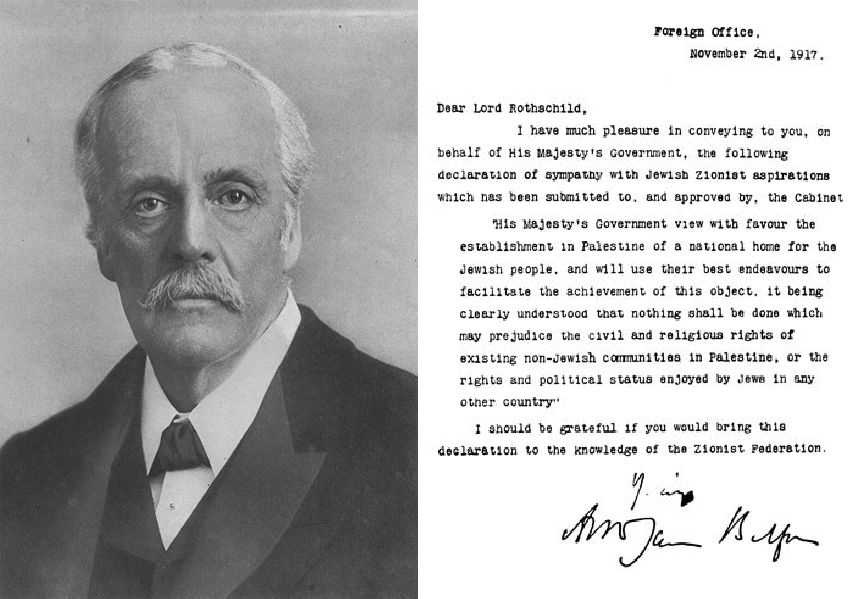
Balfour_portrait_and_declaration


Featured Articles from the Journal of Palestine Studies:


Colonialism, Nationalism, and the Politics of Teaching History in Mandate Palestine

Author: Elizabeth Brownson

Source: Journal of Palestine Studies, Vol. 43, No. 3 (Spring 2014), pp. 9-25


Dividing Jerusalem: British Urban Planning in the Holy City

Author: Nicholas E. Roberts

Source: Journal of Palestine Studies, Vol. 42, No. 4 (Summer 2013), pp. 7-26


War-Time Contingency and the Balfour Declaration of 1917: An Improbable Regression

Author: William M. Mathew

Source: Journal of Palestine Studies, Vol. 40, No. 2 (Winter 2011), pp. 26-42


From Law and Order to Pacification: Britain’s Suppression of the Arab Revolt in Palestine, 1936–39

Author: Matthew Hughes

Source: Journal of Palestine Studies, Vol. 39, No. 2 (Winter 2010), pp. 6-22


The Hebrew Reconquista of Palestine: From the 1947 United Nations Partition Resolution to the First Zionist Congress of 1897

Author: Walid Khalidi

Source: Journal of Palestine Studies, Vol. 39, No. 1 (Autumn 2009), pp. 24-42


Was Balfour Policy Reversible? The Colonial Office and Palestine, 1921-23

Author: Sahar Huneidi

Source: Journal of Palestine Studies, Vol. 27, No. 2 (Winter, 1998), pp. 23-41


 The Unregarded Prophet: Lord Curzon and the Palestine Question

Author: David Gilmour

Source: Journal of Palestine Studies, Vol. 25, No. 3 (Spring, 1996), pp. 60-68
source

Geoffrey Wawro- Key findings from the book “Quicksand” and Philip Weiss

and

‘It is Zionist to think that American Jews have any connection to Israel’

Sep 19, 2013 06:13 pm | M.J. Rosenberg MJ Rosenberg posted the following story on his site, under the headline, “Jewish college kid beats the crap out of me on Israel.”

I was on the bus, returning to Washington from New York where I spent Yom Kippur. I wouldn’t have talked to the kid next to me him except I could not find the outlet near my seat to charge my phone. He saw me struggling and helped me find it. (It was camouflaged under the seat in front of mine). We started to talk and, after I told him I had been in Manhattan for the Jewish holiday, he said that he had been there for the same reason.

We talked about Georgetown and why he chose to go there and then he asked me what I did. I told him “my story” which led him to say that he had no interest in the Middle East at all. His issue was income inequality in the United States. Nonetheless, he was fairly knowledgeable about the Middle East.

As the conversation went on, I discovered he was fairly knowledgeable about everything. Judging from his looks I’d have taken him for a jock or a preppy but he seemed more intellectual than either of those categories would suggest. After telling him about my odyssey from AIPAC to critic of both AIPAC and Israel, he said this (paraphrase, obviously): “I don’t get it.

I’m Jewish but Israel is not important to me. I live here and I’d like to help out people who live here. 46 million Americans live in poverty and the situation keeps getting worse and worse. In fact, this country keeps getting worse. Why should I worry about Israel?” I explained why and he said: “You may not realize it, but your premise is Zionist. You think Jews are, by definition, connected to Israel and have to care about it.

But that isn’t who I am. I’m an American kid whose religion is Jewish. Period. I have no obligation to Israel or to Palestinians because I feel no connection to either. I feel that as a privileged American I do have an obligation to Americans who aren’t privileged. I’m not saying I don’t care about people in other countries. I do.

Maybe some day I will think about Israel more than I do. But, just as likely, I’ll care about poverty in Latin America. As for your point that America is responsible for Palestinian suffering by sending aid to Israel, I agree. But how does that make the situation unique? As a taxpayer, actually a future US taxpayer, I will be contributing to all kinds of terrible things everywhere. But my being Jewish has nothing to do with it. It’s not like I would ever take a Birthright trip! I don’t consider Israel to be my birthright.”

I asked him if he was typical of his friends. He said that he was. “The Jewish kids who are deeply involved with Israel or Palestinians are sort of the same kids. They accept your premise that they are connected to that place. I don’t and most of my friends don’t either. I’d say we are post-national. America is our country because we live here. Period. It’s home. But then we travel, see the world, and want to help other people, at least some of us do. But Israel is not special to us and neither are Palestinians.

“You, MJ, are a Zionist. You think I have an obligation to try to stop the occupation because of my religion. To me, that is no different than telling me I have to support Netanyahu because of my religion. I see no difference. It is outmoded thinking. Tell me why Israel and Palestine is any more my problem than that of any other American my age, or why I should think about it anymore than I think about the treatment of women in India. I have the right to choose the issues I care about and work to solve, don’t I? Or does my being Jewish mean I have my choice made for me? Show me where I’m wrong? I’m sure that if you were 20, you would feel the exact same way. Am I right?” I had no response.

source

Yo Mama So Zionist

[youtube http://youtu.be/dAeOkdB2cl8?]

Blog at WordPress.com.

Up ↑