Search

band annie's Weblog

I have a parallel blog in French at http://anniebannie.net

Category

Bradley Manning

Chelsea writes on 5 years in confinement in new Guardian op-ed

May 27, 2015 by Chelsea E. Manning

“The years since I was jailed for releasing the ‘war diaries’ have been a rollercoaster.”

It can be difficult, sometimes, to make sense of all the things that have happened to me in the last five years.

“In the years before these documents were collected, the public likely never had such a complete record of the chaotic nature of modern warfare”, writes Chelsea E Manning.

Today marks five years since I was ordered into military confinement while deployed to Iraq in 2010. I find it difficult to believe, at times, just how long I have been in prison. Throughout this time, there have been so many ups and downs – it often feels like a physical and emotional roller coaster.

It all began in the first few weeks of 2010, when I made the life-changing decision to release to the public a repository of classified (and unclassified but “sensitive” ) documents that provided a simultaneously horrific and beautiful outlook on the war in Iraq and Afghanistan. After spending months preparing to deploy to Afghanistan in 2008, switching to Iraq in 2009 and actually staying in Iraq from 2009-10, I quickly and fully recognized the importance of these documents to the world at large.

I felt that the Iraq and Afghanistan “war diaries” (as they have been dubbed) were vital to the public’s understanding of the two interconnected counter-insurgency conflicts from a real-time and on-the-ground perspective. In the years before these documents were collected, the public likely never had such a complete record of the chaotic nature of modern warfare. Once you come to realize that the co-ordinates in these records represent real places, that the dates are our recent history and that the numbers represent actual human lives – with all of the love, hope, dreams, hate, fear and nightmares with which we all live – then you cannot help but be reminded just how important it is for us to understand and, hopefully, prevent such tragedies in the future.

A few months later, after spending months poring over at least a few thousand classified US diplomatic cables, I moved to also have these documents released to the public in the “cablegate” archive. After reading so many of these documents – detailing an exhaustive list of public interest issues, from the conduct of the “global war on terrorism” to the deliberate diplomatic and economic exploitation of developing countries – I felt that they, too, belonged in the public domain.

In 2010, I was considerably less mature than I am now, and the potential consequences and outcomes of my actions seemed vague and very surreal to me. I certainly expected the worst possible outcome, but I lacked a strong sense of what “the worst” would entail. I did expect to be demonized and targeted, to have every moment of my life re-examined and analyzed for every possible personal flaw and blemish, and to have them used against me in the court of public opinion or against transgender people as a whole.

When the military ordered me into confinement, I was escorted (by two of the friendliest guys in my unit) to Kuwait, first by helicopter to Baghdad and finally by cargo plane. It was not until I arrived at the prison camp in Kuwait that I actually felt like I was a prisoner. Over the succeeding days, it only got worse as the public and the media began to seek and learn more about what happened to me. After living in a communal setting for about a week, I was transferred to what amounted to a “cage” in a large tent.

After a few weeks of living in the cage and tent – not knowing what my charges were, having very limited access to my attorney and having absolutely no idea of the media firestorm that was beginning to swirl in the world outside – I became extremely depressed. I was terrified that I was not going to be treated in the dignified way that I had expected. I also began to fear that I was forever going to be living in a hot, desert cage, living as and being treated as a male, disappearing from the world into a secret prison and never facing a public trial.

It didn’t help that a few of the Navy guards delivering meals would tell me that I was was waiting for interrogation on a brig on a US cruiser off the coast of the horn of Africa, or being sent to the prison camps of Guantánamo Bay, Cuba. At the very lowest point, I contemplated castrating myself, and even – in what seemed a pointless and tragicomic exercise, given the physical impossibility of having nothing stable to hang from – contemplated suicide with a tattered blanket, which I tried to choke myself with. After getting caught, I was placed on suicide watch in Kuwait.

After being transferred back to the US, I was confined at the now-closed military brig at the Marine Corps base in Quantico, Virginia. This time was the most difficult for me overall, and felt like the longest. I was not allowed to have any items in my cell – no toothbrushes, soap, toilet paper, books, paper and on a few occasions even my glasses – unless I was given permission to use them under close supervision. When I was finished, I had to return these items. At night, I had to surrender my clothing and, despite recommendations by several psychiatrists that I was not deemed suicidal), wear a “suicide prevention” smock – a single-piece, padded, tear-proof garment.

Eventually, after public outcry regarding the conditions of my confinement at Quantico and the resignation of PJ Crowley, the former press secretary of the Department of State, I was transferred to medium custody and the general population at an Army prison. It was a high point in my incarcerated life: after nearly a year of constantly being watched by guards with clipboards and having my movements controlled by groups of three-to-six guards while in hand irons and chains and limited contact with other humans, I was finally able to walk around and have normal conversations with human beings again.

The government pressed forward with charges of “aiding the enemy” – a treasonable offense under the US constitution – and various charges under the Espionage Act of 1917 and the Computer Fraud and Abuse Act. Over nearly two years of hearings, I witnessed firsthand just how much the the government was willing to invest in my prosecution: the stacks of money spent; the gallons of fuel burned; the reams of paper printed; and the lengthy rolls of personnel, lawyers and experts.

For over 100 days, I watched the lawyers who prosecuted my case present me as a “traitor” and “enemy of state” in court and then become friendly people giving greetings and making chit-chat out of court. It became clear to me that they were basically just decent people doing their jobs. I am convinced that they did not believe the treason arguments they made against me – and was, even as they spoke them.

The verdict and sentencing at the end of my court-martial was difficult to predict. The defense team seriously worried about the aiding the enemy charge and the very wide range for a sentence, which was anything between “time served” and life without parole. After the judge announced my 35-year sentence, I had to console my attorneys who, after years of hard work and effort, looked worn out and dejected. It was a low-point for all of us.

After years of hiding and holding off because of the trial, I finally announced my intent to change my name and transition to living as woman on 22 August 2013 – the day following my sentencing – a personal high point for me, despite my other circumstances. However, the military initially declined my request to receive the medically-mandated treatment for my diagnosed gender dysphoria, which is to live as a woman and receiving a regular regiment of estrogen and androgen blockers. Just like during my time at Quantico and during my court-martial, I was subjected to a laborious and time consuming legal process. Finally, just under four months ago – but nearly a year and a half after my initial request – I began my hormone treatment. I am still fighting for the right to grow out my hair to the military’s standard for women, but being able to transition remains one of the highest points for me in my entire life.

It can be hard, sometimes, to make sense of all the things that have happened to me in the last five years (let alone my entire life). The things that seem consistent and clear to me are the support that I receive from my friends, my family and the millions of people all over the world. Through every struggle that I have been confronted with, and have been subjected to – solitary confinement, long legal battles and physically transitioning to the woman I have always been – I manage not only to survive, but to grow, learn, mature and thrive as a better, more confident person.
Help us provide support to Chelsea in prison, maximize her voice in the media, continue public education and build a powerful movement for presidential pardon.

Please Donate Today!

source

Evolving Anti – Surveillance Awareness

Recently, Americans have witnessed a barrage of scandals regarding the federal government’s extension of their surveillance powers. Following whistleblower Edward Snowden’s revelations—which of course point to the National Security Agency’s spy programs and the FISA Court’s endorsement of broad domestic-surveillance policies—the American citizenry’s Fourth Amendment right to privacy has taken center stage. The truth of these invasive and unconstitutional policies is giving rise to further argument, and laying ground for a practical forum to engage elected officials to more clearly define citizens’ rights in the digital era.

Yet, while Americans are engrossed in the debate over whether or not their government should be allowed to collect and examine the online data of citizens en masse, particularly without suspicion of criminal activity, the vehicle by which these revelations came to light—journalism—is now also under attack.

Journalists are realizing that they are also on the front line in the ‘ war on privacy ‘ with whistleblowers, activists and hacktivist groups like Anonymous. Recently, the FBI declared victory over Anonymous in a series of statements claiming the hacker collective is no longer able to carry out large, successful operations because most of its “largest players” have been arrested or detained by US law enforcement authorities.

The FBI’s claims about dismantling Anonymous may be only instigating the collective further. OpLastResort, an Anonymous-affiliated Twitter account, released on Friday what’s alleged to be the personal information pertaining to roughly 23,000 employees of the US Federal Reserve.

Full details of every single employee at Federal Reserve Bank of America http://www.elbigbad.com/swag.csv  How’s that, FBI? Game. Set. Match. and LULZ.

* * * * * * * * * * * * *

An eloquent and enlightened speech by Stanley Cohen, who defended Anonymous in the PayPal 14 case, at benefit for Jeremy Hammond and Barrett Brown.

In the last few years, the online collective Anonymous has become the ubiquitous face of cyber-activism. With their well-known V for Vendetta Guy Fawkes masks, this loosely tied and decentralized network acts whenever and wherever its radar catches a classic abuse of power. Beneath the mask there is an idea. Anonymous hacktivists are united by their shared sense of justice and their conviction that ideas are bulletproof. Repeatedly, the collective has shown to be a champion of the downtrodden and those who challenge the powerful — whether they be arrogant government contractors like Aaron Barr, religious organizations like Scientology, immoral governments like those of Syria or the US, or corporations like PayPal and Mastercard.

Digital Dissenters: Speaking Truth to Power

Computer scientist Nadia Heninger has argued that leaking information is now becoming the “civil disobedience of our age”. The late historian and activist Howard Zinn described the act of civil disobedience as “the deliberate, discriminate, violation of law for a vital social purpose”. He advocated it saying that such an act “becomes not only justifiable but necessary when a fundamental human right is at stake and when legal channels are inadequate for securing that right”. Snowden’s act was clearly one of civil disobedience. John Lewis, US Representative and veteran civil rights leader recently noted that Snowden was “continuing the tradition of civil disobedience by revealing details of classified US surveillance programs”.

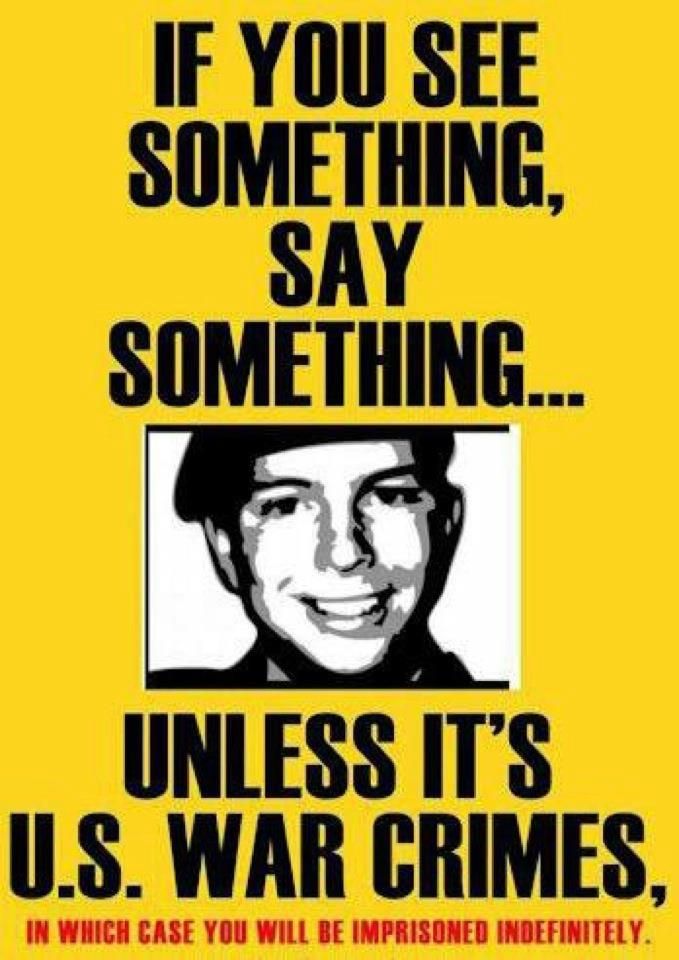
Snowden is not alone. In recent years, there have been waves of dissent that revealed the depth of corruption and abuse of power endemic in this global corporate system. Before Snowden, there were Bradley Manning and Jeremy Hammond who shook up the trend of criminal overreach within the US government and its transnational corporate and government allies. Private Bradley Manning blew the whistle on US war crimes and activist Jeremy Hammond exposed the inner workings of the pervasive surveillance state. They took risks to alert the world about the systemic failure of representative government and the trend toward a dangerous corporate authoritarianism.

Snowden, Manning and Assange are all part of an Internet generation that holds that transparency of governments and corporations is a critical check on power. They believe in the power of information and in the public’s right to know. In an interview with Glenn Greenwald of The Guardian, Snowden described how his motive was “to inform the public as to that which is done in their name and that which is done against them.” He has advocated for the participation of ordinary people in decision-making processes, which he considers to be a a vital part of democratic society, indicating that the policies of national security agencies that he exposed should be up to the public to decide.

Declaring ‘War’ on the Surveillance State: Taking Back our Privacy

Law enforcement used to be harder. If a law enforcement agency wanted to track someone, it required physically assigning a law enforcement agent to follow that person around. Tracking everybody would be inconceivable, because it would require having as many law enforcement agents as people.

Today things are very different. Almost everyone carries a tracking device (their mobile phone) at all times, which reports their location to a handful of telecoms, which are required by law to provide that information to the government. Tracking everyone is no longer inconceivable, and is in fact happening all the time. We know that Sprint alone responded to eight million pings for real time customer location just in 2008. They got so many requests that they built an automated system to handle them.

Combined with ballooning law enforcement budgets, this trend towards automation, which includes things like license plate scanners and domestically deployed drones, represents a significant shift in the way that law enforcement operates.

Police already abuse the immense power they have, but if everyone’s every action were being monitored, and everyone technically violates some obscure law at some time, then punishment becomes purely selective. Those in power will essentially have what they need to punish anyone they’d like, whenever they choose, as if there were no rules at all.

Knowledge is power and society evolving toward an ‘ anti-surveillance awareness ‘ is crucial to overcoming the abuse of civil liberties and violation of our basic right to privacy by the encroaching ‘ Surveillance State ‘.

Related Links:

Encryption Works: How to Protect Your Privacy in the Age of NSA Surveillance

How Laura Poitras Helped Snowden Spill His Secrets

Cyberpunk: Encryption

David Miranda and the Preclusion of Privacy

kstangelo | août 24, 2013 à 12:07   | Catégories: News | URL: http://wp.me/p1jpRz-4fZ

source                        

The Horrible Injustice of the Bradley Manning Verdict


“Transparency campaigners condemned the harsh sentence in prospect for
Bradley Manning, but journalists and lawyers closely associated with the
trial were relieved with the acquittal for the most serious charge —
that he “aided the enemy” by transmitting state secrets to WikiLeaks.”*

Bradley
Manning faces the prospect of spending the rest of his life in prison
for charges including espionage for whistle blowing on the U.S. military
to Wikileaks. Does he deserve the steep sentence, and will be become an
example of what happens when someone steps out of line? Why was his
case ignored by the mainstream press? Cenk Uygur breaks it down.

*Read more from the Guardian:
http://www.theguardian.com/world/2013…

Support The Young Turks by Subscribing http://www.youtube.com/user/theyoungt…


Bradley Manning Judgment – The Colbert Report 2013 31 07

WikiLeaker Bradley Manning evades the most serious charge leveled
against him, but could still receive a 154-year slap on the wrist.  (04:10)

Feel the news along with Stephen Colbert, American’s ballsiest pundit, with highlights and full episodes of The Colbert Report.

Stephen
Colbert is best known as the host, writer and executive producer of the
long-running Emmy and Peabody Award-winning series “The Colbert Report”
on Comedy Central. Colbert is also a best-selling author and
accomplished actor.

Follow Us on Twitter : https://twitter.com/ColbertReportUS

bradley_manning_war_crimes

In Bradley Manning case, Judge Lind prefers to keep low profile but ruling may have big impact

But some of the Manning case has been heard behind closed doors, and Lind rejected requests for official transcripts to be provided, forcing supporters to crowd-source funding for their own stenographers.“If you read her article, she gives the appearance of someone who would be eager to see greater transparency in military courts,” said Shane Kadidal, a lawyer with the Center for Constitutional Rights. However, when the center made an application seeking the release of transcripts, filings and court orders, Lind rejected the requests, which Kadidal described as “a slap-dash treatment of what we thought was a pretty serious issue.”

Latest from National Security

Bradley Manning found not guilty of aiding the enemy

Bradley Manning found not guilty of aiding the enemy

Julie Tate and Ernesto Londoño 12:46 AM ET

Manning was found guilty of other charges, but the verdict was a striking rebuke to military prosecutors.

Manning’s conviction said to raise odds of Assange prosecution

Manning’s conviction said to raise odds of Assange prosecution

Billy Kenber 1:50 AM ET

Prosecutors portrayed WikiLeaks founder as co-conspirator; civil liberties groups fear chilling effect.

Lind, a registered Democrat, according to voting records, has been a military judge since 2004. Her only previous brush with public attention came in 2010, when she presided over the case of Col. Terrence Lakin.Lakin, an Army flight surgeon who refused to deploy to Afghanistan because he believed “birther” conspiracy theories that President Obama was not born in the United States, was sentenced to six months in military prison.

According to friends, Lind prefers to keep a low profile and doesn’t read newspaper or online reports about herself.

Schenck, who met Lind in 1999 when they shared an office in the criminal law division at JAG’s Rosslyn headquarters, described her as someone who “reads criminal law for fun.” Lind has continued to teach a summer course at George Washington University during the Manning trial.

“There’s no down time with Denise Lind. She’s intense; she’s really intense,” said Schenck, describing her friend as a keen skier and someone who runs five miles every day.

“If she doesn’t run, she’s, like, totally wired,” she added.

Under the military justice system, Manning could have elected to be tried by a panel of officers and enlisted personnel. Instead, he decided to be tried by a single judge.

Lind cannot have failed to notice some of the intense scrutiny she is under and the political attention the case has attracted. She reacted angrily when a covert recording of Manning’s testimony was posted on the Internet, and activists wearing black T-shirts with the slogan “Truth” have been in a Fort Meade, Md., courtroom every day.

Trevor Timm, executive director of the Freedom of the Press Foundation, said it has been “disappointing to see that almost every ruling, whether they’re major or minor, seems to go against the defense.” Other activists highlighted Lind’s rulings on Manning’s right to a speedy trial — the defendant spent three years in pretrial confinement, but the judge found the delays had been “reasonable.”

Schenck said Lind has already been informed that she will take up a new position, as a judge on the U.S. Army Court of Criminal Appeals, when the Manning trial ends. And she said Lind will not be swayed by the politics of the case.

“She’s oblivious to the media,” Schenck said. “She’s not afraid to do the right thing. If the guy was not guilty, she would acquit him.”

source

Bradley Manning case shows that US government’s priorities are ‘upside down’

Posted: 30 July 2013

‘It’s hard not to draw the conclusion that Manning’s trial was about sending a message: the US government will come after you’ – Widney Brown

Despite an acquittal on the most serious “aiding the enemy” charge against him, today’s verdict against the US Private Bradley Manning reveals the US government’s misplaced priorities on national security, said Amnesty International this evening.

Amnesty International’s Senior Director of International Law and Policy Widney Brown said:

“The government’s priorities are upside down. The US government has refused to investigate credible allegations of torture and other crimes under international law despite overwhelming evidence.

“Yet they decided to prosecute Manning who it seems was trying to do the right thing – reveal credible evidence of unlawful behaviour by the government. You investigate and prosecute those who destroy the credibility of the government by engaging in acts such as torture which are prohibited under the US Constitution and in international law.

“The government’s pursuit of the ‘aiding the enemy’ charge was a serious overreach of the law, not least because there was no credible evidence of Manning’s intent to harm the USA by releasing classified information to WikiLeaks.

“Since the attacks of September 11, we have seen the US government use the issue of national security to defend a whole range of actions that are unlawful under international and domestic law.

“It’s hard not to draw the conclusion that Manning’s trial was about sending a message: the US government will come after you, no holds barred, if you’re thinking of revealing evidence of its unlawful behaviour.”

The court martial today found Manning guilty of a range of additional charges, including ten lesser charges relating to misuse of classified information to which he had already pleaded guilty. Amnesty insisted that any sentence imposed for the other charges must take into account information relating to Manning’s reasonable belief that he was exposing serious violations of human rights and international humanitarian law.

Amnesty believes it undermines accountability when the US government is so selective about who it chooses to investigate and prosecute. This is particularly true when they seem intent on punishing those who reveal unlawful government behaviour and protecting those who actually engaged in or ordered such behaviour.

The hundreds of thousands of documents Manning released to WikiLeaks included videos and dossiers that pointed to potential human rights violations – including breaches of international humanitarian law – by US troops abroad and the CIA closer to home.

Earlier this month Amnesty described the judge’s decision not to drop the charge accusing Manning of “aiding the enemy” as ludicrous and as a decision which “makes a mockery of the US military court system”.

I am Bradley Manning

see also Democracy Now on Bradley Manning : http://www.democracynow.org/live/bradley_manning_verdict

Obama Promise To ‘Protect Whistleblowers’ Just Disappeared From Change.gov

July 30, 2013

(On the day Bradley Manning’s verdict is announced, Orwell’s Memory Hole is indeed alive in the United States. This excellent article was not written by me, and originally appeared on TechDirt)

The folks from the Sunlight Foundation have noticed that the Change.gov website, which was set up by the Obama transition team after the election in 2008 has suddenly been scrubbed of all of its original content. They noted that the front page had pointed to the White House website for a while, but you could still access a variety of old material and agendas. They were wondering why the administration would suddenly pull all that interesting archival information… and hit upon a clue.

A little bit from the “ethics agenda”:

Protect Whistleblowers: Often the best source of information about waste, fraud, and abuse in government is an existing government employee committed to public integrity and willing to speak out. Such acts of courage and patriotism, which can sometimes save lives and often save taxpayer dollars, should be encouraged rather than stifled. We need to empower federal employees as watchdogs of wrongdoing and partners in performance. Barack Obama will strengthen whistleblower laws to protect federal workers who expose waste, fraud, and abuse of authority in government. Obama will ensure that federal agencies expedite the process for reviewing whistleblower claims and whistleblowers have full access to courts and due process.

Yeah. That statement seems a bit embarrassing at the very same time Obama’s administration is threatening trade sanctions against anyone who grants asylum to Ed Snowden. Also… at the same time that we get to see how whistleblower Bradley Manning’s “full access to courts and due process” will turn out. So far, it’s been anything but reasonable, considering that the UN has already condemned Manning’s treatment as “cruel and inhuman.” And people wonder why Snowden left the country…

MY COMMENT: Yeah, Hope and Change my ass.

Bonus: Make you own Hope and Change poster here.

Related Articles:

– See more at here

Blog at WordPress.com.

Up ↑