CLICK ON IMAGE
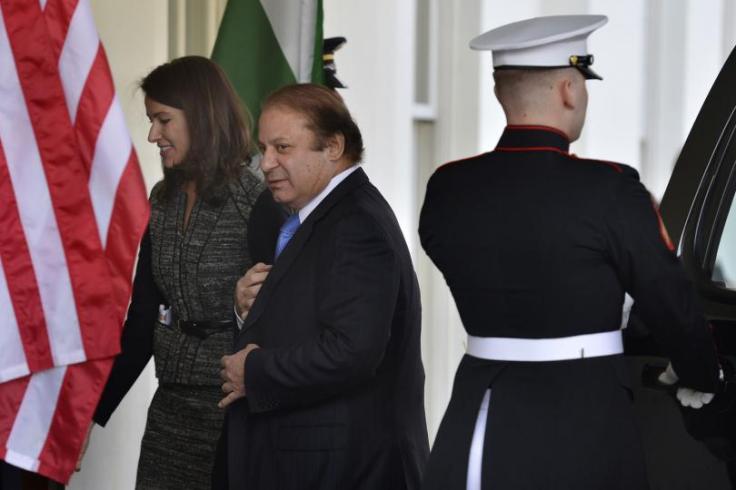
Pakistani Prime Minister Nawaz Sharif arrives at the West Wing of the White House for bilateral meetings with President Barack Obama, October 23, 2013, in Washington, DC.Read more
CLICK ON IMAGE
Pakistani Prime Minister Nawaz Sharif arrives at the West Wing of the White House for bilateral meetings with President Barack Obama, October 23, 2013, in Washington, DC.Read more
and Watch what gets closed and what remains open !!
click on image

TRANSCRIPT
This is a rush transcript. Copy may not be in its final form.
AMY GOODMAN: The partial shutdown of the federal government has entered its 16th day, and the nation is now on the brink of a default as the government’s borrowing authority ends tomorrow.
On Tuesday, Fitch Ratings warned it could cut the U.S. government’s AAA debt rating if a deal to raise the debt limit isn’t reached. In a statement, Fitch said, quote, “The prolonged negotiations over raising the debt ceiling … risks undermining confidence in the role of the U.S. dollar as the preeminent global reserve currency, by casting doubt over the full faith and credit of the U.S.”
The Senate appears to move closer to a deal to reopen the government and raise the debt limit, but the Republican-controlled House of Representatives failed twice Tuesday to produce its own plan. This is House Speaker John Boehner.
HOUSE SPEAKER JOHN BOEHNER: Listen, we’re working with our members on a way forward and to make sure that we provide fairness to the American people.
REPORTER 1: Mr. Speaker, can you guarantee to the American people Congress will not go past the deadline and push us into default?
HOUSE SPEAKER JOHN BOEHNER: Listen, I have made clear for months and months that the idea of default is wrong, and we shouldn’t get anywhere close to it.
UNIDENTIFIED: Last question?
REPORTER 2: Mr. Speaker, will there be a vote today on the plan?
UNIDENTIFIED: Right here.
REPORTER 3: Are you going to vote today on this plan that would make some changes to the Senate bill, reopen the government [inaudible]—
HOUSE SPEAKER JOHN BOEHNER: We’re—we’re talking with our members on both sides of the aisle to try to find a way to move forward today.
AMY GOODMAN: House Speaker John Boehner has refused to allow the House to vote on the Senate plan. Meanwhile, the Senate appears to be close to reaching a deal to keep the government funded through January 15th and the debt limit extended until February 7th. Senate Majority Leader Harry Reid criticized House Republicans for failing to reach its own agreement.
SEN. HARRY REID: I know I speak for many of us, who have been working in good faith, when I say that we felt blindsided by the news from the House. But this isn’t the first time. Extremist Republicans in the House of Representatives are attempting to torpedo the Senate’s bipartisan progress with a bill that can’t pass the Senate—can’t pass the Senate and won’t pass the Senate.
AMY GOODMAN: As lawmakers continue to debate a possible deal to reopen the government, the impact of the shutdown is being felt across the country. North Carolina has become the first state to halt its welfare program due to the shutdown. Meanwhile, nearly a hundred veterans converged at the National World War II Memorial in Washington Tuesday to protest the shutdown, saying it could put more than 5.5 million servicemembers at risk of not receiving their monthly benefits by November 1st.
To talk more about the government shutdown and the possible default, we’re joined by two guests. Robert Borosage is the founder and president of the Institute for America’s Future and co-director of its sister organization, the Campaign for America’s Future. He recently wrote a piece for Reuters called “Tea Party Zealots Hold the Public Debate Hostage.” We’re also joined by Amanda Terkel, senior political reporter and politics managing editor at The Huffington Post.
We welcome you both to Democracy Now! Bob Borosage, let’s begin with you. What has this shutdown meant?
ROBERT BOROSAGE: Well, it’s meant a lot of pain for a lot of Americans—infants that have lost support for nutrition, children that have been thrown out of Head Start, safety measures that are not taken because the weather buoys are no longer manned. The list can go on. And the effects accumulate each day. It’s hurt the economy dramatically, and that—those effects accumulate each day. It’s undermined our credibility globally. You know, it’s been a totally contrived and unnecessary crisis which has had real-world and horrible effects that are growing every day.
AMY GOODMAN: Amanda Terkel, you wrote a really interesting piece for The Huffington Post about what gets shut down and what remains open. Can you give us some of the examples?
AMANDA TERKEL: Sure. Well, I think it’s been very frustrating to a lot of people that many Americans are feeling the effects of the shutdown while many members of Congress who caused the shutdown aren’t feeling those same effects. So, Congress, like federal agencies, is supposed to furlough its staff and keep only essential personnel, but there are at least 10 senators and dozens of House members who haven’t furloughed a single member of their staff. And some of these people are like Senator Tom Coburn, who’s always railing about how there’s all this waste in government and all this wasted taxpayer money, yet every single one of his staff is essential.
Congress has kept its gym open, the gym for members. The gym for staff has been closed, but the gym for members is open. And then even there’s a little subway in the bottom of the Capitol so that members don’t have to walk a few hundred feet to get from the Capitol to the House and Senate office buildings, and that little train takes someone to run it. That train is still running.
AMY GOODMAN: So you have people like Steve King of Iowa, one of the die-hards against any kind of—any kind of agreement, kept his entire staff. But you talk about Nobel Prize-winning scientists furloughed.
AMANDA TERKEL: Right, exactly. I think—I believe there are five Nobel Prize-winning scientists who work for the government and who have been furloughed. There’s one man who’s a physicist who said, “You know, I guess that even if you win a Nobel Prize, you’re not considered essential.” There’s the man who kind of—who developed the Mars Curiosity rover; he’s been furloughed. And 96 percent of the Environmental Protection Agency staff has been furloughed. And cleanup at—I think it’s something like over 500 toxic Superfund sites, that has stopped, yet every single member of Steve King’s staff, they’re essential.
AMY GOODMAN: So the gym remains open. Head Start was not funded, except for a private foundation gave $10 million. What about day care for congressmembers—meaning their children, of course.
AMANDA TERKEL: That’s a good question. I’m actually not sure about that, although I know for federal agencies a lot of these day cares were being shut down, which had many people worried. They—if they, for example, weren’t furloughed, they’re still having to go to work, but now they can’t get day care, because that’s not considered an essential service. And many private day cares, too, are suffering, as well, because they are used to having all of these students coming in, and now the parents are home, they’re furloughed, they don’t need the use of this day care.
And so, I think, you know, it’s important that this isn’t just affecting people who work for government or who rely on government services, which is pretty much every American, but it’s also affecting many private businesses. Businesses who rely on tourism and who are around national parks are seeing a drop—restaurants, shops, you know, if you run a canoeing service in a national park. So this is really rippling all across all sectors of society.
ROBERT BOROSAGE: You know, Amy, it’s putting a little focus—
AMY GOODMAN: Bob Borosage.
ROBERT BOROSAGE: —a little focus on the people who work for us—federal employees—because they’ve taken the biggest hit. Eight hundred thousand employees have been furloughed. That means they are sent home without pay. If you’re an essential worker, you are required to work without pay. So you pay the costs of getting to work. You pay the costs of buying your lunch or whatever you do to eat during the day, and you’re not getting pay. We’re headed into our third week of these workers forced to work in, in essence, indentured servitude, without pay. And, you know, people tend to be cynical about bureaucrats in Washington, etc., but these employees are people who work for us, they provide services that go to us, and we are abusing them. And there’s no question that the best of them are going to start looking for different jobs.
AMY GOODMAN: Bloomberg has a piece, “Troops Forage for Food While Golfers Play On in Shutdown.” “Grocery stores on Army bases in the U.S. are closed. The golf course at Andrews Air Force base is open.” Yes, so who is essential, and who isn’t? Now, the way the tea party congressmembers are talking about it is each thing that’s essential, they can vote on, if you want that particular thing to be open. This is certainly a way of, you know, shrinking the government to the size of a bathtub. Your thoughts on that, Bob Borosage, and then what it means moving from the partial shutdown to the deadline tomorrow, October 17th?
ROBERT BOROSAGE: Well, this is—this is an example of why you shouldn’t let children play with bombs. The tea party congresspeople set out to shut down the government and threaten default on America’s debts, in order to get “Obamacare” either defunded or delayed. And when the president sensibly called their bluff and said, “Look, we’re not going to negotiate with a pistol to our head,” they have gone—proceeded to go into the shutdown and celebrate it, despite the damage it’s doing to people and to the economy. And now we’re headed into what is unimaginable, which has not been done before: a potential default on America’s debts.
It’s important for people to understand, these are debts that every Republican member in the House, including the tea party members, voted for as part of their budget resolution. So we’re talking about lifting the debt ceiling to cover debts that they supported, to pay the debts that they ran up, and they’re refusing to do that. And we really don’t know what happens if America defaults on its debt. The entire global financial system depends on the security of American bonds. And if they become less secure, if interest rates spike, as they are likely to do, if investors can’t count on them as the equivalent of cash, then you’re talking not about a small slowdown, you’re talking about a multitrillion-dollar house of financial cards that is going to be shaken at its root.
http://www.theguardian.com
Testimony from five detainees, this animated film reveals the daily
brutality of life inside Guantánamo prison, where prisoners are kept
indefinitely without charge or trial by the country that claims to be
the beacon of civilization for the rest of the world.
(SAUL LOEB/AFP/Getty Images)

Despite Secretary of State John Kerry’s frenetic efforts, preparations for the “Geneva II” peace conference on Syria’s civil war are already foundering. The rebel movement has become increasingly radicalized against Syrian dictator Bashar al-Assad and more fractured. A newly confident Assad, meanwhile, has somewhat relegitimized himself as a signatory to a new chemical-weapons ban negotiated by the United States and Russia under U.N. auspices, which his government is tasked with implementing over the next year. Defying global opprobrium over his use of sarin gas, Assad has also positioned himself in a series of high-profile TV interviews as a preferable alternative to Islamist rebels who want to create a fundamentalist state.
All of which should prompt a reexamination of the first Geneva conference in the summer of 2012, on which Kerry’s new push for peace is based. According to some officials involved, perhaps the greatest tragedy of Syria is that, some 80,000 lives ago, President Obama might have had within his grasp a workable plan to end the violence, one that is far less possible now. But amid the politics of the 2012 presidential election—when GOP nominee Mitt Romney regularly accused Obama of being “soft”—the administration did little to make it work and simply took a hard line against Assad, angering the special U.N. Syria envoy, Kofi Annan, and prompting the former U.N. secretary-general to quit, according to several officials involved.
Former members of Annan’s negotiating team say that after then-Secretary of State Hillary Rodham Clinton and Russian Foreign Minister Sergei Lavrov on June 30, 2012, jointly signed a communique drafted by Annan, which called for a political “transition” in Syria, there was as much momentum for a deal then as Kerry achieved a year later on chemical weapons. Afterward, Annan flew from Geneva to Moscow and gained what he believed to be Russian President Vladimir Putin’s consent to begin to quietly push Assad out. But suddenly both the U.S. and Britain issued public calls for Assad’s ouster, and Annan felt blindsided. Immediately afterward, against his advice, then-U.N. Ambassador Susan Rice offered up a “Chapter 7” resolution opening the door to force against Assad, which Annan felt was premature.
Annan resigned a month later. At the time, the soft-spoken Ghanaian diplomat was cagey about his reasons, appearing to blame all sides. “I did not receive all the support that the cause deserved,” Annan told reporters in Geneva. He also criticized what he called “finger-pointing and name-calling in the Security Council.” But former senior aides and U.N. officials say in private that Annan blamed the Obama administration in large part. “The U.S. couldn’t even stand by an agreement that the secretary of State had signed in Geneva,” said one former close Annan aide who would discuss the talks only on condition of anonymity. “He quit in frustration. I think it was clear that the White House was very worried about seeming to do a deal with the Russians and being soft on Putin during the campaign.” One of the biggest Republican criticisms of Obama at the time was that he had, in an embarrassing “open mike” moment, promised Moscow more “flexibility” on missile defense after the election.

Administration officials deny this account, as do some who were involved at the State Department. Nonetheless, Frederic Hof, a U.S. ambassador who was Clinton’s special adviser for transition in Syria at the time, agrees that the negotiations could have been better handled. The harsh demand that “Assad must go” voiced by Clinton and British Foreign Secretary William Hague was “gratuitous,” says Hof, a senior fellow at the Atlantic Council. “Perhaps a greater effort should have been made to give Annan the time to do his due diligence.” Still, Hof says he saw no evidence that the administration was posturing for political reasons.
A current senior State Department official concedes that one of the problems with making the Annan communique work may have been Clinton’s distaste for getting involved in extended direct mediation, in dramatic contrast to her successor, who has opened up negotiations on several fronts at once—with Syria and the Russians, with Iran, and between the Palestinians and Israelis. “We’ve made more trips to the Mideast in the last nine months than she made in four years,” says this official.
While Clinton excelled at “soft” power—selling America’s message abroad—one emerging criticism of her four-year tenure at State was that she consistently avoided getting her hands dirty with direct mediation. Clinton agreed to leave key negotiations in crisis spots—in particular the Mideast and south-central Asia—to special envoys such as George Mitchell and Richard Holbrooke, and she rarely stepped in as each of them failed. Veteran reporter David Rohde, in an assessment as Clinton was leaving office in January, suggested that Clinton wanted to avoid embarrassment or failure ahead of a 2016 presidential run; he quoted one State Department official as saying that he was “really happy to have someone in the job who does not retain political ambitions.”
Still, Hof and critics of the administration say a 2012 peace deal would have been a steep, uphill climb at best. “I think there were a couple of problems that raised their ugly head in the immediate wake of this thing being signed on June 30,” Hof says. “Number one, it became clear to both Annan and the Russians that Assad had no interest whatever in being ‘transitioned.’ He was able to read the text of the Geneva agreement quite accurately…. By the same token, the opposition was unhappy with Kofi’s handwork because there was no explicit language to the effect that Assad will step down.”
But what happened next was that the Geneva communique disappeared onto a dusty shelf; even Kerry when he took office chided the Obama administration for being “late” in pushing peace. And what Kerry faces now is a newly assertive Assad and a vastly more fractured opposition riddled with extreme elements that want no part of a U.S.- or Western-brokered peace. All of which makes that missed opportunity even more painful.
This article appears in the October 5, 2013, edition of National Journal Magazine as A Lost Chance for Peace.
The agency was authorized to conduct “large-scale graph analysis on very large sets of communications metadata without having to check foreignness” of every e-mail address, phone number or other identifier, the document said. Because of concerns about infringing on the privacy of American citizens, the computer analysis of such data had previously been permitted only for foreigners.
The agency can augment the communications data with material from public, commercial and other sources, including bank codes, insurance information, Facebook profiles, passenger manifests, voter registration rolls and GPS location information, as well as property records and unspecified tax data, according to the documents. They do not indicate any restrictions on the use of such “enrichment” data, and several former senior Obama administration officials said the agency drew on it for both Americans and foreigners.
There were apparently two policy changes that allowed this to happen, and both occurred in the past three years. First, in November of 2010, the NSA was allowed to start looking at phone call and email logs of Americans to try to help figure out associations for “foreign intelligence purposes.” Note that phrase. We’ll come back to it. For years, the NSA had been barred from viewing any content on US persons, and the NSA, President Obama and others have continued to insist to this day that there are minimization procedures that prevent spying on Americans. Except, this latest revelation shows that, yet again, this isn’t actually true.
The second policy change came in January of 2011, when the NSA was told it could start creating this massive “social graph” on Americans without having to make sure they weren’t Americans any more, as indicated above.
Somewhat amazingly, the new report notes that in 2006, the NSA asked the Justice Department for permission to do exactly this sort of thing, and was rejected, saying that a “misuse” of that kind of data “could raise serious concerns.” Indeed, it could, and does raise serious concerns, but apparently the current administration just doesn’t give a crap. If all of this sounds familiar, it’s almost exactly what the feds tried to setup in 2002 with the Orwellian name Total Information Awareness. Except that time (right after 9/11, when you’d think the public would be at its most receptive to such programs), as word got out about the program, the public rightly flipped out, and we were told the program was shuttered. Except, as some have been arguing for years, it was never shuttered, it was just rebuilt in secret.
And, of course, the NSA is still willing to defend this massive breach on Americans’ privacy:
An agency spokeswoman, asked about the analyses of Americans’ data, said, “All data queries must include a foreign intelligence justification, period.”
“All of N.S.A.’s work has a foreign intelligence purpose,” the spokeswoman added. “Our activities are centered on counterterrorism, counterproliferation and cybersecurity.”
Note the continued shift in language. For a while, they kept saying that the NSA does no surveillance on Americans at all. At all! They insisted that would be illegal. Then, later, people started to note that they would use the phrase “targeting foreign intelligence” which had just enough (barely) wiggle room to get people to think that they were only looking at non-US person data and content, but really meant as long as the overall investigation “targeted” foreign intelligence, it was fine. Now they’re even walking back from that, and saying that apparently it’s fine to spy on Americans without a warrant so long as there’s “a foreign intelligence justification.” In short: if you can come up with some excuse for how it might impact something foreign, the NSA can spy on Americans without a warrant.
That’s no limitation at all. In fact, such a rule is meaningless. We already know that the NSA gets every telephone record handed over because they claim it’s “necessary” to “connect the dots” on foreign terror plots. And, similarly, now they’re arguing that they can look at anything else so long as they claim that there’s a “foreign intelligence justification.” That means they have no limits. They just have to come up with some wacky reason to claim that so-and-so might have foreign connections that are important to know about, and voila, their life is open for the NSA to dig in, all without any oversight or a warrant.
Somewhat surprisingly, the already disclosed phone metadata dragnet is actually not used for this social network effort, but that doesn’t mean the NSA is lacking in data with which to create this shadow spying social network. It uses the NSA’s taps on fiber optic networks, the ones that collect a ton of internet data, as Dianne Feinstein confirmed last week.
The N.S.A. documents show that one of the main tools used for chaining phone numbers and e-mail addresses has the code name Mainway. It is a repository into which vast amounts of data flow daily from the agency’s fiber-optic cables, corporate partners and foreign computer networks that have been hacked.
The documents show that significant amounts of information from the United States go into Mainway. An internal N.S.A. bulletin, for example, noted that in 2011 Mainway was taking in 700 million phone records per day. In August 2011, it began receiving an additional 1.1 billion cellphone records daily from an unnamed American service provider under Section 702 of the 2008 FISA Amendments Act, which allows for the collection of the data of Americans if at least one end of the communication is believed to be foreign.
Um. That’s an awful lot of records on Americans. And yet, we’re still being told that the NSA doesn’t spy on Americans? Yeah, right.
Anyway, it appears that the GETPRSM social network has been in existence for quite some time now, and don’t worry if you haven’t received your invite. You’ve already joined.
Renditions, an underground prison and a new CIA base are elements of an intensifying US war, according to a Nation investigation in Mogadishu.
Nestled in a back corner of Mogadishu’s Aden Adde International Airport is a sprawling walled compound run by the Central Intelligence Agency. Set on the coast of the Indian Ocean, the facility looks like a small gated community, with more than a dozen buildings behind large protective walls and secured by guard towers at each of its four corners. Adjacent to the compound are eight large metal hangars, and the CIA has its own aircraft at the airport. The site, which airport officials and Somali intelligence sources say was completed four months ago, is guarded by Somali soldiers, but the Americans control access. At the facility, the CIA runs a counterterrorism training program for Somali intelligence agents and operatives aimed at building an indigenous strike force capable of snatch operations and targeted “combat” operations against members of Al Shabab, an Islamic militant group with close ties to Al Qaeda.

As part of its expanding counterterrorism program in Somalia, the CIA also uses a secret prison buried in the basement of Somalia’s National Security Agency (NSA) headquarters, where prisoners suspected of being Shabab members or of having links to the group are held. Some of the prisoners have been snatched off the streets of Kenya and rendered by plane to Mogadishu. While the underground prison is officially run by the Somali NSA, US intelligence personnel pay the salaries of intelligence agents and also directly interrogate prisoners. The existence of both facilities and the CIA role was uncovered by The Nation during an extensive on-the-ground investigation in Mogadishu. Among the sources who provided information for this story are senior Somali intelligence officials; senior members of Somalia’s Transitional Federal Government (TFG); former prisoners held at the underground prison; and several well-connected Somali analysts and militia leaders, some of whom have worked with US agents, including those from the CIA. A US official, who confirmed the existence of both sites, told The Nation, “It makes complete sense to have a strong counterterrorism partnership” with the Somali government.
The CIA presence in Mogadishu is part of Washington’s intensifying counterterrorism focus on Somalia, which includes targeted strikes by US Special Operations forces, drone attacks and expanded surveillance operations. The US agents “are here full time,” a senior Somali intelligence official told me. At times, he said, there are as many as thirty of them in Mogadishu, but he stressed that those working with the Somali NSA do not conduct operations; rather, they advise and train Somali agents. “In this environment, it’s very tricky. They want to help us, but the situation is not allowing them to do [it] however they want. They are not in control of the politics, they are not in control of the security,” he adds. “They are not controlling the environment like Afghanistan and Iraq. In Somalia, the situation is fluid, the situation is changing, personalities changing.”
According to well-connected Somali sources, the CIA is reluctant to deal directly with Somali political leaders, who are regarded by US officials as corrupt and untrustworthy. Instead, the United States has Somali intelligence agents on its payroll. Somali sources with knowledge of the program described the agents as lining up to receive $200 monthly cash payments from Americans. “They support us in a big way financially,” says the senior Somali intelligence official. “They are the largest [funder] by far.”
According to former detainees, the underground prison, which is staffed by Somali guards, consists of a long corridor lined with filthy small cells infested with bedbugs and mosquitoes. One said that when he arrived in February, he saw two white men wearing military boots, combat trousers, gray tucked-in shirts and black sunglasses. The former prisoners described the cells as windowless and the air thick, moist and disgusting. Prisoners, they said, are not allowed outside. Many have developed rashes and scratch themselves incessantly. Some have been detained for a year or more. According to one former prisoner, inmates who had been there for long periods would pace around constantly, while others leaned against walls rocking.
A Somali who was arrested in Mogadishu and taken to the prison told The Nation that he was held in a windowless underground cell. Among the prisoners he met during his time there was a man who held a Western passport (he declined to identify the man’s nationality). Some of the prisoners told him they were picked up in Nairobi and rendered on small aircraft to Mogadishu, where they were handed over to Somali intelligence agents. Once in custody, according to the senior Somali intelligence official and former prisoners, some detainees are freely interrogated by US and French agents. “Our goal is to please our partners, so we get more [out] of them, like any relationship,” said the Somali intelligence official in describing the policy of allowing foreign agents, including from the CIA, to interrogate prisoners. The Americans, according to the Somali official, operate unilaterally in the country, while the French agents are embedded within the African Union force known as AMISOM.
Among the men believed to be held in the secret underground prison is Ahmed Abdullahi Hassan, a 25- or 26-year-old Kenyan citizen who disappeared from the congested Somali slum of Eastleigh in Nairobi around July 2009. After he went missing, Hassan’s family retained Mbugua Mureithi, a well-known Kenyan human rights lawyer, who filed a habeas petition on his behalf. The Kenyan government responded that Hassan was not being held in Kenya and said it had no knowledge of his whereabouts. His fate remained a mystery until this spring, when another man who had been held in the Mogadishu prison contacted Clara Gutteridge, a veteran human rights investigator with the British legal organization Reprieve, and told her he had met Hassan in the prison. Hassan, he said, had told him how Kenyan police had knocked down his door, snatched him and taken him to a secret location in Nairobi. The next night, Hassan had said, he was rendered to Mogadishu.
According to the former fellow prisoner, Hassan told him that his captors took him to Wilson Airport: “‘They put a bag on my head, Guantánamo style. They tied my hands behind my back and put me on a plane. In the early hours we landed in Mogadishu. The way I realized I was in Mogadishu was because of the smell of the sea—the runway is just next to the seashore. The plane lands and touches the sea. They took me to this prison, where I have been up to now. I have been here for one year, seven months. I have been interrogated so many times. Interrogated by Somali men and white men. Every day. New faces show up. They have nothing on me. I have never seen a lawyer, never seen an outsider. Only other prisoners, interrogators, guards. Here there is no court or tribunal.’”
After meeting the man who had spoken with Hassan in the underground prison, Gutteridge began working with Hassan’s Kenyan lawyers to determine his whereabouts. She says he has never been charged or brought before a court. “Hassan’s abduction from Nairobi and rendition to a secret prison in Somalia bears all the hallmarks of a classic US rendition operation,” she says. The US official interviewed for this article denied the CIA had rendered Hassan but said, “The United States provided information which helped get Hassan—a dangerous terrorist—off the street.” Human Rights Watch and Reprieve have documented that Kenyan security and intelligence forces have facilitated scores of renditions for the US and other governments, including eighty-five people rendered to Somalia in 2007 alone. Gutteridge says the director of the Mogadishu prison told one of her sources that Hassan had been targeted in Nairobi because of intelligence suggesting he was the “right-hand man” of Saleh Ali Saleh Nabhan, at the time a leader of Al Qaeda in East Africa. Nabhan, a Kenyan citizen of Yemeni descent, was among the top suspects sought for questioning by US authorities over his alleged role in the coordinated 2002 attacks on a tourist hotel and an Israeli aircraft in Mombasa, Kenya, and possible links to the 1998 US Embassy bombings in Kenya and Tanzania.
An intelligence report leaked by the Kenyan Anti-Terrorist Police Unit in October 2010 alleged that Hassan, a “former personal assistant to Nabhan…was injured while fighting near the presidential palace in Mogadishu in 2009.” The authenticity of the report cannot be independently confirmed, though Hassan did have a leg amputated below the knee, according to his former fellow prisoner in Mogadishu.
Two months after Hassan was allegedly rendered to the secret Mogadishu prison, Nabhan, the man believed to be his Al Qaeda boss, was killed in the first known targeted killing operation in Somalia authorized by President Obama. On September 14, 2009, a team from the elite US counterterrorism force, the Joint Special Operations Command (JSOC), took off by helicopters from a US Navy ship off Somalia’s coast and penetrated Somali airspace. In broad daylight, in an operation code-named Celestial Balance, they gunned down Nabhan’s convoy from the air. JSOC troops then landed and collected at least two of the bodies, including Nabhan’s.
Hassan’s lawyers are preparing to file a habeas petition on his behalf in US courts. “Hassan’s case suggests that the US may be involved in a decentralized, out-sourced Guantánamo Bay in central Mogadishu,” his legal team asserted in a statement to The Nation. “Mr. Hassan must be given the opportunity to challenge both his rendition and continued detention as a matter of urgency. The US must urgently confirm exactly what has been done to Mr. Hassan, why he is being held, and when he will be given a fair hearing.”
Gutteridge, who has worked extensively tracking the disappearances of terror suspects in Kenya, was deported from Kenya on May 11.
The underground prison where Hassan is allegedly being held is housed in the same building once occupied by Somalia’s infamous National Security Service (NSS) during the military regime of Siad Barre, who ruled from 1969 to 1991. The former prisoner who met Hassan there said he saw an old NSS sign outside. During Barre’s regime, the notorious basement prison and interrogation center, which sits behind the presidential palace in Mogadishu, was a staple of the state’s apparatus of repression. It was referred to as Godka, “The Hole.”
“The bunker is there, and that’s where the intelligence agency does interrogate people,” says Abdirahman “Aynte” Ali, a Somali analyst who has researched the Shabab and Somali security forces. “When CIA and other intelligence agencies—who actually are in Mogadishu—want to interrogate those people, they usually just do that.” Somali officials “start the interrogation, but then foreign intelligence agencies eventually do their own interrogation as well, the Americans and the French.” The US official said that US agents’ “debriefing” prisoners in the facility has “been done on only rare occasions” and always jointly with Somali agents.
Some prisoners, like Hassan, were allegedly rendered from Nairobi, while in other cases, according to Aynte, “the US and other intelligence agencies have notified the Somali intelligence agency that some people, some suspects, people who have been in contact with the leadership of Al Shabab, are on their way to Mogadishu on a [commercial] plane, and to essentially be at the airport for those people. Catch them, interrogate them.”
* * *
In the eighteen years since the infamous “Black Hawk Down” incident in Mogadishu, US policy on Somalia has been marked by neglect, miscalculation and failed attempts to use warlords to build indigenous counterterrorism capacity, many of which have backfired dramatically. At times, largely because of abuses committed by Somali militias the CIA has supported, US policy has strengthened the hand of the very groups it purports to oppose and inadvertently aided the rise of militant groups, including the Shabab. Many Somalis viewed the Islamic movement known as the Islamic Courts Union, which defeated the CIA’s warlords in Mogadishu in 2006, as a stabilizing, albeit ruthless, force. The ICU was dismantled in a US-backed Ethiopian invasion in 2007. Over the years, a series of weak Somali administrations have been recognized by the United States and other powers as Somalia’s legitimate government. Ironically, its current president is a former leader of the ICU.
Today, Somali government forces control roughly thirty square miles of territory in Mogadishu thanks in large part to the US-funded and -armed 9,000-member AMISOM force. Much of the rest of the city is under the control of the Shabab or warlords. Outgunned, the Shabab has increasingly relied on the linchpins of asymmetric warfare—suicide bombings, roadside bombs and targeted assassinations. The militant group has repeatedly shown that it can strike deep in the heart of its enemies’ territory. On June 9, in one of its most spectacular suicide attacks to date, the Shabab assassinated the Somali government’s minister of interior affairs and national security, Abdishakur Sheikh Hassan Farah, who was attacked in his residence by his niece. The girl, whom the minister was putting through university, blew herself up and fatally wounded her uncle. He died hours later in the hospital. Farah was the fifth Somali minister killed by the Shabab in the past two years and the seventeenth official assassinated since 2006. Among the suicide bombers the Shabab has deployed were at least three US citizens of Somali descent; at least seven other Americans have died fighting alongside the Shabab, a fact that has not gone unnoticed in Washington or Mogadishu.
During his confirmation hearings in June to become the head of the US Special Operations Command, Vice Admiral William McRaven said, “From my standpoint as a former JSOC commander, I can tell you we were looking very hard” at Somalia. McRaven said that in order to expand successful “kinetic strikes” there, the United States will have to increase its use of drones as well as on-the-ground intelligence, surveillance and reconnaissance operations. “Any expansion of manpower is going to have to come with a commensurate expansion of the enablers,” McRaven declared. The expanding US counterterrorism program in Mogadishu appears to be part of that effort.
In an interview with The Nation in Mogadishu, Abdulkadir Moallin Noor, the minister of state for the presidency, confirmed that US agents “are working with our intelligence” and “giving them training.” Regarding the US counterterrorism effort, Noor said bluntly, “We need more; otherwise, the terrorists will take over the country.”
It is unclear how much control, if any, Somalia’s internationally recognized president, Sheikh Sharif Sheikh Ahmed, has over this counterterrorism force or if he is even fully briefed on its operations. The CIA personnel and other US intelligence agents “do not bother to be in touch with the political leadership of the country. And that says a lot about the intentions,” says Aynte. “Essentially, the CIA seems to be operating, doing the foreign policy of the United States. You should have had State Department people doing foreign policy, but the CIA seems to be doing it across the country.”
While the Somali officials interviewed for this story said the CIA is the lead US agency on the Mogadishu counterterrorism program, they also indicated that US military intelligence agents are at times involved. When asked if they are from JSOC or the Defense Intelligence Agency, the senior Somali intelligence official responded, “We don’t know. They don’t tell us.”
In April Ahmed Abdulkadir Warsame, a Somali man the United States alleged had links to the Shabab, was captured by JSOC forces in the Gulf of Aden. He was held incommunicado on a US Navy vessel for more than two months; in July he was transferred to New York and indicted on terrorism charges. Warsame’s case ignited a legal debate over the Obama administration’s policies on capturing and detaining terror suspects, particularly in light of the widening counterterrorism campaigns in Somalia and Yemen.
On June 23 the United States reportedly carried out a drone strike against alleged Shabab members near Kismayo, 300 miles from the Somali capital. As with the Nabhan operation, a JSOC team swooped in on helicopters and reportedly snatched the bodies of those killed and wounded. The men were taken to an undisclosed location. On July 6 three more US strikes reportedly targeted Shabab training camps in the same area. Somali analysts warned that if the US bombings cause civilian deaths, as they have in the past, they could increase support for the Shabab. Asked in an interview with The Nation in Mogadishu if US drone strikes strengthen or weaken his government, President Sharif replied, “Both at the same time. For our sovereignty, it’s not good to attack a sovereign country. That’s the negative part. The positive part is you’re targeting individuals who are criminals.”
A week after the June 23 strike, President Obama’s chief counterterrorism adviser, John Brennan, described an emerging US strategy that would focus not on “deploying large armies abroad but delivering targeted, surgical pressure to the groups that threaten us.” Brennan singled out the Shabab, saying, “From the territory it controls in Somalia, Al Shabab continues to call for strikes against the United States,” adding, “We cannot and we will not let down our guard. We will continue to pummel Al Qaeda and its ilk.”
While the United States appears to be ratcheting up both its rhetoric and its drone strikes against the Shabab, it has thus far been able to strike only in rural areas outside Mogadishu. These operations have been isolated and infrequent, and Somali analysts say they have failed to disrupt the Shabab’s core leadership, particularly in Mogadishu.
In a series of interviews in Mogadishu, several of the country’s recognized leaders, including President Sharif, called on the US government to quickly and dramatically increase its assistance to the Somali military in the form of training, equipment and weapons. Moreover, they argue that without viable civilian institutions, Somalia will remain ripe for terrorist groups that can further destabilize not only Somalia but the region. “I believe that the US should help the Somalis to establish a government that protects civilians and its people,” Sharif said.
In the battle against the Shabab, the United States does not, in fact, appear to have cast its lot with the Somali government. The emerging US strategy on Somalia—borne out in stated policy, expanded covert presence and funding plans—is two-pronged: On the one hand, the CIA is training, paying and at times directing Somali intelligence agents who are not firmly under the control of the Somali government, while JSOC conducts unilateral strikes without the prior knowledge of the government; on the other, the Pentagon is increasing its support for and arming of the counterterrorism operations of non-Somali African military forces.
A draft of a defense spending bill approved in late June by the Senate Armed Services Committee would authorize more than $75 million in US counterterrorism assistance aimed at fighting the Shabab and Al Qaeda in Somalia. The bill, however, did not authorize additional funding for Somalia’s military, as the country’s leaders have repeatedly asked. Instead, the aid package would dramatically increase US arming and financing of AMISOM’s forces, particularly from Uganda and Burundi, as well as the militaries of Djibouti, Kenya and Ethiopia. The Somali military, the committee asserted, is unable to “exercise control of its territory.”
That makes it all the more ironic that perhaps the greatest tactical victory won in recent years in Somalia was delivered not by AMISOM, the CIA or JSOC but by members of a Somali militia fighting as part of the government’s chaotic local military. And it was a pure accident.
Late in the evening on June 7, a man whose South African passport identified him as Daniel Robinson was in the passenger seat of a Toyota SUV driving on the outskirts of Mogadishu when his driver, a Kenyan national, missed a turn and headed straight toward a checkpoint manned by Somali forces. A firefight broke out, and the two men inside the car were killed. The Somali forces promptly looted the laptops, cellphones, documents, weapons and $40,000 in cash they found in the car, according to the senior Somali intelligence official.
Upon discovering that the men were foreigners, the Somali NSA launched an investigation and recovered the items that had been looted. “There was a lot of English and Arabic stuff, papers,” recalls the Somali intelligence official, containing “very tactical stuff” that appeared to be linked to Al Qaeda, including “two senior people communicating.” The Somali agents “realized it was an important man” and informed the CIA in Mogadishu. The men’s bodies were taken to the NSA. The Americans took DNA samples and fingerprints and flew them to Nairobi for processing.
Within hours, the United States confirmed that Robinson was in fact Fazul Abdullah Mohammed, a top leader of Al Qaeda in East Africa and its chief liaison with the Shabab. Fazul, a twenty-year veteran of Al Qaeda, had been indicted by the United States for his alleged role in the 1998 US Embassy bombings and was on the FBI’s “Most Wanted Terrorists” list. A JSOC attempt to kill him in a January 2007 airstrike resulted in the deaths of at least seventy nomads in rural Somalia, and he had been underground ever since. Secretary of State Hillary Clinton called Fazul’s death “a significant blow to Al Qaeda, its extremist allies and its operations in East Africa. It is a just end for a terrorist who brought so much death and pain to so many innocents.”
At its facilities in Mogadishu, the CIA and its Somali NSA agents continue to pore over the materials recovered from Fazul’s car, which served as a mobile headquarters. Some deleted and encrypted files were recovered and decoded by US agents. The senior Somali intelligence official said that the intelligence may prove more valuable on a tactical level than the cache found in Osama bin Laden’s house in Pakistan, especially in light of the increasing US focus on East Africa. The Americans, he said, were “unbelievably grateful”; he hopes it means they will take Somalia’s forces more seriously and provide more support.
But the United States continues to wage its campaign against the Shabab primarily by funding the AMISOM forces, which are not conducting their mission with anything resembling surgical precision. Instead, over the past several months the AMISOM forces in Mogadishu have waged a merciless campaign of indiscriminate shelling of Shabab areas, some of which are heavily populated by civilians. While AMISOM regularly puts out press releases boasting of gains against the Shabab and the retaking of territory, the reality paints a far more complicated picture.
Throughout the areas AMISOM has retaken is a honeycomb of underground tunnels once used by Shabab fighters to move from building to building. By some accounts, the tunnels stretch continuously for miles. Leftover food, blankets and ammo cartridges lay scattered near “pop-up” positions once used by Shabab snipers and guarded by sandbags—all that remain of guerrilla warfare positions. Not only have the Shabab fighters been cleared from the aboveground areas; the civilians that once resided there have been cleared too. On several occasions in late June, AMISOM forces fired artillery from their airport base at the Bakaara market, where whole neighborhoods are totally abandoned. Houses lie in ruins and animals wander aimlessly, chewing trash. In some areas, bodies have been hastily buried in trenches with dirt barely masking the remains. On the side of the road in one former Shabab neighborhood, a decapitated corpse lay just meters from a new government checkpoint.
In late June the Pentagon approved plans to send $45 million worth of military equipment to Uganda and Burundi, the two major forces in the AMISOM operation. Among the new items are four small Raven surveillance drones, night-vision and communications equipment and other surveillance gear, all of which augur a more targeted campaign. Combined with the attempt to build an indigenous counterterrorism force at the Somali NSA, a new US counterterrorism strategy is emerging.
But according to the senior Somali intelligence official, who works directly with the US agents, the CIA-led program in Mogadishu has brought few tangible gains. “So far what we have not seen is the results in terms of the capacity of the [Somali] agency,” says the official. He conceded that neither US nor Somali forces have been able to conduct a single successful targeted mission in the Shabab’s areas in the capital. In late 2010, according to the official, US-trained Somali agents conducted an operation in a Shabab area that failed terribly and resulted in several of them being killed. “There was an attempt, but it was a haphazard one,” he recalls. They have not tried another targeted operation in Shabab-controlled territory since.
Obama discussed the targeted killing operation today, but will anything really change?
How three US citizens were killed by their own government in the space of one month in 2011.
Watch the full speech: http://thefilmarchived.blogspot.com/2…
The
United States and the Soviet Union both used propaganda extensively
during the Cold War. Both sides used film, television, and radio
programming to influence their own citizens, each other, and Third World
nations. The United States Information Agency operated the Voice of
America as an official government station. Radio Free Europe and Radio
Liberty, which were, in part, supported by the Central Intelligence
Agency, provided grey propaganda in news and entertainment programs to
Eastern Europe and the Soviet Union respectively. The Soviet Union’s
official government station, Radio Moscow, broadcast white propaganda,
while Radio Peace and Freedom broadcast grey propaganda. Both sides also
broadcast black propaganda programs in periods of special crises.
In
1948, the United Kingdom’s Foreign Office created the IRD (Information
Research Department), which took over from wartime and slightly post-war
departments such as the Ministry of Information and dispensed
propaganda via various media such as the BBC and publishing.
The
ideological and border dispute between the Soviet Union and People’s
Republic of China resulted in a number of cross-border operations. One
technique developed during this period was the “backwards transmission,”
in which the radio program was recorded and played backwards over the
air. (This was done so that messages meant to be received by the other
government could be heard, while the average listener could not
understand the content of the program.)
When describing life in
capitalist countries, in the US in particular, propaganda focused on
social issues such as poverty and anti-union action by the government.
Workers in capitalist countries were portrayed as “ideologically close”.
Propaganda claimed rich people from the US derived their income from
weapons manufacturing, and claimed that there was substantial racism or
neo-fascism in the US.
When describing life in Communist
countries, western propaganda sought to depict an image of a citizenry
held captive by governments that brainwash them. The West also created a
fear of the East, by depicting an aggressive Soviet Union. In the
Americas, Cuba served as a major source and a target of propaganda from
both black and white stations operated by the CIA and Cuban exile
groups. Radio Habana Cuba, in turn, broadcast original programming,
relayed Radio Moscow, and broadcast The Voice of Vietnam as well as
alleged confessions from the crew of the USS Pueblo.
George
Orwell’s novels Animal Farm and Nineteen Eighty-Four are virtual
textbooks on the use of propaganda. Though not set in the Soviet Union,
these books are about totalitarian regimes that constantly corrupt
language for political purposes. These novels were, ironically, used for
explicit propaganda. The CIA, for example, secretly commissioned an
animated film adaptation of Animal Farm in the 1950s with small changes
to the original story to suit its own needs.
The United States
and Iraq both employed propaganda during the Iraq War. The United States
established campaigns towards the American people on the justifications
of the war while using similar tactics to bring down Saddam Hussein’s
government in Iraq.
The extent to which the US government was
guilty of propaganda aimed at its own people is a matter of discussion.
The book Selling Intervention & War by Jon Western argued that
president Bush was “selling the war” to the public.
President
George W. Bush gave a talk at the Athena Performing Arts Center at
Greece Athena Middle and High School Tuesday, May 24, 2005 in Rochester,
NY. About half way through the event Bush said, “See in my line of work
you got to keep repeating things over and over and over again for the
truth to sink in, to kind of catapult the propaganda.”
People had
their initial reactions to the War on Terror, but with more biased and
persuading information, Iraq as a whole has been negatively targeted.
America’s goal was to remove Saddam Hussein’s power in Iraq with
allegations of possible weapons of mass destruction related to Osama Bin
Laden. Video and picture coverage in the news has shown shocking and
disturbing images of torture and other evils being done under the Iraqi
Government.
By mlynxqualey on September 25, 2013 • ( 0 )
 This is important not just for the ostensible battle (over the book’s cuss words and “sexual content” vs. its “literary value”), but because Ralph Ellison’s voice, and his beautiful writing about visibility, is important for US teens to hear and read. And because of what this book’s exclusion means. And because of Jonathan Ferrell. And a hundred other becauses.
But the focus of the US’s BBW is — broadly — not about what Ellison’s exclusion from a school curriculum means. Generally, the battlegrounds exposed by BBW are whether teen readers should be exposed to sex, drugs, and suicide (in literature) or whether they should be “protected” from knowing about these scourges. When challenges to the curricular inclusion of Sherman Alexie’s The Absolutely True Diary of a Part-Time Indian are discussed, commenters generally focus on Alexie’s one-off mention of masturbation.
This past summer, I gave Alexie’s book to my then-nine-year-old to read. He didn’t notice the “sexual” content, which sailed right over his head, but he did understand the discussion of racism and bullying. I didn’t give him the book because I want my now-10-year-old to know about sex (uh, yikes!) but because I want him to read fun, beautifully crafted literature that takes him into many places beyond White America. (Meanwhile, I see that this “underpants” book has been removed from some school curricula. Yawn.)
Completely “banning” a book (once it exists) is fairly difficult in contemporary times, at least in places where access to the internet is widespread and where communities are relatively affluent. A book might be officially banned in Saudi, or kept out of the Kuwait book fair, but that doesn’t mean a clever reader can’t find a way to get a copy. Magdy al-Shafee’s Metro has been illegally reprinted in Egypt, and is sold in at least one bookstore. Egyptian authors can be bullied or even arrested, but they also have many venues for their work. While Ralph Ellison’s Invisible Man might be kept out of Randolph County public schools — or maybe the board will reverse their decision today — a teenager with a library card can still pick up a copy at the local public library.
Of course, all these restrictions still matter. In some cases, where restrictions and red lines are suffocating to creators, they matter a great deal.
But access to art is always restricted in some way or another: A limited number of texts can be in a school curriculum; a limited number of reviews can appear in mainstream publications; a limited number of books are translated each year from other languages. (In the Anglophone case, an excessively limited number of books.)
How many translations are there in school curricula? How many US students have read Zeina Abirached’s beautiful graphic novel A Game for Swallows, trans. Edward Gauvin? (Abolutely clean! No sex or cussing! Oh, but there’s a good bit of smoking….) Or how many Canadian curricula include Fatima Sharafeddine’s self-translated YA novel Faten / The Servant? What about Ghada Abdel Aal’s I Want to Get Married, trans. Nora Eltahawy, as a jumping-off point to discuss the maqama tradition, the translatability of humor, and notions of gender?
Of course these books haven’t been “banned” from anyone’s curriculum — or, at least, not to my knowledge — and the fights over what’s “appropriate” is an important topic. But so are the quieter battles over what is included, and isn’t.
Congressman Alan Grayson (FL-09) has requested that the State Department give Shahzad Akbar a visa to bring his clients to testify. He explained: “Congress would like to conduct an ad hoc hearing on drones, and it is very important for us to hear from victims of drone strikes. Rafiq ur Rehman, a school teacher in Pakistan, lost his 67-year old mother in a drone strike, and two of his children also suffered drone-strike-related injuries. The State Department has granted the visas of Rafiq and his children to travel to the U.S. and share their stories with Congress. However, it has not yet issued a visa for the family’s lawyer and translator, Shahzad Akbar. Without Mr. Akbar, Rafiq and his children will not be able to travel to the U.S.. I encourage the State Department to approve Mr. Akbar’s visa immediately.”
Robert Greenwald, who is the director of the forthcoming documentary Unmanned met and interviewed Mr. Akbar and Mr. Rehman in Pakistan and shared their stories with Congressman Grayson.
“I also met and interviewed Rafiq and his family and know that if Mr. Akbar were allowed into America by the State Department, Congress and the American people would be as moved as I was about the plight of these survivors in a covert war.”
For the film, Greenwald traveled to Pakistan in the fall of 2012 and interviewed more than 35 victims, witnesses, psychiatrists, and Pakistani leaders. The film will include exclusive footage from the Federally Administered Tribal Areas (FATA) of Pakistan, Jirgas, and interviews with many drone policy experts.
“Before I began representing civilian victims in 2010, I used to travel regularly to the U.S. My visa would be processed in 3 working days. Then, in 2011, I applied for a visa to talk at a conference about my work with drone strike victims. Suddenly, I was told my visa required additional processing which took 14 months. This time, the denial is to stop me from talking to American lawmakers who have invited me to speak about what I have witnessed. I hope to tell them about the impact of drone strikes and also to shed light on the fact that policies like drone strikes are actually a challenge to America’s national security.


 band annie's Weblog