The mysterious visitor called himself Gary Host at first, then Grace Host, which he shortened for his made-up e-mail address to “ghost,” a joke apparently, perhaps signaling mischievousness — or menace. The intruder was lurking somewhere on the MIT campus, downloading academic journal articles by the hundreds of thousands.
The interloper was eventually traced to a laptop under a box in a basement wiring closet. He wasAaron Swartz, a brilliant young programmer and political activist. The cascade of events that followed would culminate in tragedy: aSecret Service investigation, afederal prosecution, and ultimatelySwartz’s suicide.
Academy Award-winning documentary filmmaker Errol Morris joins us to talk about his new film, “The Unknown Known,” based on 33 hours of interviews with former Defense Secretary Donald Rumsfeld. The title refers to an infamous press briefing in 2002 when Rumsfeld faced questions from reporters about the lack of evidence of Iraqi weapons of mass destruction. “The Unknown Known” is Morris’ 10th documentary feature. He won a Best Documentary Oscar for his film “The Fog of War: Eleven Lessons from the Life of Robert S. McNamara.” His other films include “Standard Operating Procedure,” about alleged U.S. torture of terror suspects in Abu Ghraib prison, and “The Thin Blue Line,” about the wrongful conviction of Randall Adams for the murder of a Dallas policeman. The release of “The Unknown Known” comes in a month marking 11 years since the U.S. invaded Iraq, leaving an estimated half a million Iraqis dead, along with at least 4,400 American troops.
Top-secret documents reveal that the National Security Agency is dramatically expanding its ability to covertly hack into computers on a mass scale by using automated systems that reduce the level of human oversight in the process.
The classified files – provided previously by NSA whistleblower Edward Snowden – contain new details about groundbreaking surveillance technology the agency has developed to infect potentially millions of computers worldwide with malware “implants.” The clandestine initiative enables the NSA to break into targeted computers and to siphon out data from foreign Internet and phone networks.
Classification markings on the Snowden documents indicate that NSA has shared many of its files on the use of implants with its counterparts in the so-called Five Eyes surveillance alliance – the United Kingdom, Canada, New Zealand, and Australia.
The covert infrastructure that supports the hacking efforts operates from the agency’s headquarters in Fort Meade, Maryland, and from eavesdropping bases in the United Kingdom and Japan. GCHQ, the British intelligence agency, appears to have played an integral role in helping to develop the implants tactic.
The NSA has a diverse arsenal of malware tools, each highly sophisticated and customizable for different purposes.
One implant, codenamed UNITEDRAKE, can be used with a variety of “plug-ins” that enable the agency to gain total control of an infected computer.
An implant plug-in named CAPTIVATEDAUDIENCE, for example, is used to take over a targeted computer’s microphone and record conversations taking place near the device. Another, GUMFISH, can covertly take over a computer’s webcam and snap photographs. FOGGYBOTTOM records logs of Internet browsing histories and collects login details and passwords used to access websites and email accounts. GROK is used to log keystrokes. And SALVAGERABBIT exfiltrates data from removable flash drives that connect to an infected computer.
When Israeli Prime Minister Benjamin Netanyahu visits the White House tomorrow, President Barack Obama will tell him that his country could face a bleak future — one of international isolation and demographic disaster — if he refuses to endorse a U.S.-drafted framework agreement for peace with the Palestinians. Obama will warn Netanyahu that time is running out for Israel as a Jewish-majority democracy. And the president will make the case that Netanyahu, alone among Israelis, has the strength and political credibility to lead his people away from the precipice.
In an hourlong interview Thursday in the Oval Office, Obama, borrowing from the Jewish sage Rabbi Hillel, told me that his message to Netanyahu will be this: “If not now, when? And if not you, Mr. Prime Minister, then who?” He then took a sharper tone, saying that if Netanyahu “does not believe that a peace deal with the Palestinians is the right thing to do for Israel, then he needs to articulate an alternative approach.” He added, “It’s hard to come up with one that’s plausible.”
Unlike Netanyahu, Obama will not address the annual convention of the American Israel Public Affairs Committee, a pro-Israel lobbying group, this week — the administration is upset with Aipac for, in its view, trying to subvert American-led nuclear negotiations with Iran. In our interview, the president, while broadly supportive of Israel and a close U.S.-Israel relationship, made statements that would be met at an Aipac convention with cold silence.
Obama was blunter about Israel’s future than I’ve ever heard him. His language was striking, but of a piece with observations made in recent months by his secretary of state, John Kerry, who until this interview, had taken the lead in pressuring both Netanyahu and the Palestinian leader, Mahmoud Abbas, to agree to a framework deal. Obama made it clear that he views Abbas as the most politically moderate leader the Palestinians may ever have. It seemed obvious to me that the president believes that the next move is Netanyahu’s.
“There comes a point where you can’t manage this anymore, and then you start having to make very difficult choices,” Obama said. “Do you resign yourself to what amounts to a permanent occupation of the West Bank? Is that the character of Israel as a state for a long period of time? Do you perpetuate, over the course of a decade or two decades, more and more restrictive policies in terms of Palestinian movement? Do you place restrictions on Arab-Israelis in ways that run counter to Israel’s traditions?”
During the interview, which took place a day before the Russian military incursion into Ukraine, Obama argued that American adversaries, such as Iran, Syria and Russia itself, still believe that he is capable of using force to advance American interests, despite his reluctance to strike Syria last year after President Bashar al-Assad crossed Obama’s chemical-weapons red line.
“We’ve now seen 15 to 20 percent of those chemical weapons on their way out of Syria with a very concrete schedule to get rid of the rest,” Obama told me. “That would not have happened had the Iranians said, ‘Obama’s bluffing, he’s not actually really willing to take a strike.’ If the Russians had said, ‘Ehh, don’t worry about it, all those submarines that are floating around your coastline, that’s all just for show.’ Of course they took it seriously! That’s why they engaged in the policy they did.”
I returned to this particularly sensitive subject. “Just to be clear,” I asked, “You don’t believe the Iranian leadership now thinks that your ‘all options are on the table’ threat as it relates to their nuclear program — you don’t think that they have stopped taking that seriously?”
Obama answered: “I know they take it seriously.”
How do you know? I asked. “We have a high degree of confidence that when they look at 35,000 U.S. military personnel in the region that are engaged in constant training exercises under the direction of a president who already has shown himself willing to take military action in the past, that they should take my statements seriously,” he replied. “And the American people should as well, and the Israelis should as well, and the Saudis should as well.”
I asked the president if, in retrospect, he should have provided more help to Syria’s rebels earlier in their struggle. “I think those who believe that two years ago, or three years ago, there was some swift resolution to this thing had we acted more forcefully, fundamentally misunderstand the nature of the conflict in Syria and the conditions on the ground there,” Obama said. “When you have a professional army that is well-armed and sponsored by two large states who have huge stakes in this, and they are fighting against a farmer, a carpenter, an engineer who started out as protesters and suddenly now see themselves in the midst of a civil conflict — the notion that we could have, in a clean way that didn’t commit U.S. military forces, changed the equation on the ground there was never true.”
He portrayed his reluctance to involve the U.S. in the Syrian civil war as a direct consequence of what he sees as America’s overly militarized engagement in the Muslim world: “There was the possibility that we would have made the situation worse rather than better on the ground, precisely because of U.S. involvement, which would have meant that we would have had the third, or, if you count Libya, the fourth war in a Muslim country in the span of a decade.”
Obama was adamant that he was correct to fight a congressional effort to impose more time-delayed sanctions on Iran just as nuclear negotiations were commencing: “There’s never been a negotiation in which at some point there isn’t some pause, some mechanism to indicate possible good faith,” he said. “Even in the old Westerns or gangster movies, right, everyone puts their gun down just for a second. You sit down, you have a conversation; if the conversation doesn’t go well, you leave the room and everybody knows what’s going to happen and everybody gets ready. But you don’t start shooting in the middle of the room during the course of negotiations.” He said he remains committed to keeping Iran from obtaining nuclear weapons and seemed unworried by reports that Iran’s economy is improving.
On the subject of Middle East peace, Obama told me that the U.S.’s friendship with Israel is undying, but he also issued what I took to be a veiled threat: The U.S., though willing to defend an isolated Israel at the United Nations and in other international bodies, might soon be unable to do so effectively.
“If you see no peace deal and continued aggressive settlement construction — and we have seen more aggressive settlement construction over the last couple years than we’ve seen in a very long time,” Obama said. “If Palestinians come to believe that the possibility of a contiguous sovereign Palestinian state is no longer within reach, then our ability to manage the international fallout is going to be limited.”
We also spent a good deal of time talking about the unease the U.S.’s Sunni Arab allies feel about his approach to Iran, their traditional adversary. I asked the president, “What is more dangerous: Sunni extremism or Shia extremism?”
I found his answer revelatory. He did not address the issue of Sunni extremism. Instead he argued in essence that the Shiite Iranian regime is susceptible to logic, appeals to self-interest and incentives.
“I’m not big on extremism generally,” Obama said. “I don’t think you’ll get me to choose on those two issues. What I’ll say is that if you look at Iranian behavior, they are strategic, and they’re not impulsive. They have a worldview, and they see their interests, and they respond to costs and benefits. And that isn’t to say that they aren’t a theocracy that embraces all kinds of ideas that I find abhorrent, but they’re not North Korea. They are a large, powerful country that sees itself as an important player on the world stage, and I do not think has a suicide wish, and can respond to incentives.”
This view puts him at odds with Netanyahu’s understanding of Iran. In an interview after he won the premiership, the Israeli leader described the Iranian leadership to me as “a messianic apocalyptic cult.”
I asked Obama if he understood why his policies make the leaders of Saudi Arabia and other Arab countries nervous: “I think that there are shifts that are taking place in the region that have caught a lot of them off guard,” he said. “I think change is always scary.”
New legislation dropping on Monday will free the Obama administration to send money to Cairo after last year’s military coup put a freeze on the cash.
Congress is preparing to allow the Obama administration to give more than $1 billion dollars to the Egyptian government and military, despite the fact the generals perpetrated a coup last summer and are suppressing opposition ahead of a nation-wide constitutional referendum.The House and Senate are set to unveil a year-long spending bill that will loosen restrictions on U.S. aid to Egypt and negate the law that prevents the U.S. from funding a foreign military that has conducted a coup against a democratically elected government. The Obama administration has been lobbying Congress for permission to give the aid to the Egyptian government. Several senior senators had been working to make sure that aid was conditioned on the Egyptian government pursing a path toward democracy and respect for the rule of law.
But now, with the Egyptians speeding toward a Constitutional referendum that will cement the rule of the military-led regime and with the Egyptian government’s crackdown on the opposition ongoing, most of those conditions could be lifted by Congress or waived by the Obama administration.
For experts and congressional officials who have followed the Obama administration’s clumsy and often incoherent policy on Egypt, the potential easing of restrictions on aid represents only the latest unfortunate twist in a failed effort to preserve U.S. influence in the Arab world’s most populous country.
“When the omnibus bill is passed, there’s going to be legislation in it that in effect is going to give the administration a waiver from the coup provisions and allow them to restore aid to Egypt,” said Michele Dunne, senior associate at the Carnegie Endowment for International Peace.
Ever since the Egyptian military ousted and jailed ex-president Mohamed Morsi last July and began its campaign of arresting opposition leaders and protesters, the Obama administration and Congress have been withholding most of the $1.5 billion in annual aid the U.S. gives Egypt, most of which goes directly to the country’s army.
“I think there’s a sense of giving up on Egypt [inside of the Obama administration], on the Hill as well,” said Dunne. “There’s a sense that ‘Oh well they tried a democratic transition, it didn’t work, but we don’t want to cut ourselves off from Egypt as a security ally, so let’s just forget about the whole democracy and human rights thing except for giving it some lip service from time to time.’”
Congress is set to unveil the omnibus spending bill for the remainder of fiscal year 2014 Monday afternoon. The Daily Beast obtained the text of the section that deals with U.S. aid to Egypt. It states that the president must certify that Egypt is “sustaining the strategic relationship with the United States,” and “meeting its obligations under the 1979 Egypt-Israel Peace Treaty.”
Following that certification, Congress would allow Obama to give the Egyptian government $250 million in economic support. Also, Obama could give the Egyptian military $1.3 billion in two installments: $975 million after Egypt holds its constitutional referendum and $576.8 million after presidential and parliamentary elections.
Secretary of State John Kerry would have to certify “that a newly elected Government of Egypt is taking steps to govern democratically and implement economic reforms,” according to the text of the legislation. Kerry would also have to submit a comprehensive, multi-year strategic review of military assistance to Egypt and report back to Congress on the trials of former Egyptian leaders such as Morsi.
Egypt’s constitution referendum will be held January 14-15 amid charges of widespread voter suppression and intimidation by the Egyptian government security forces. Human Rights Watch detailed those abuses Monday, which included arrested the leaders of the political organizations who are campaigning against the ratification of the constitution.
“There’s no doubt that the referendum will pass because the people who are opposed to it won’t vote. For the first time since 2011 there is really questions about whether this is a free and fair vote,” said Nathan Brown, senior fellow at the Carnegie Endowment for International Peace. “It already seems criminal to challenge a constitution that hasn’t passed yet. This is a degree of shamelessness and a degree of accountability that really is a return to the pre-2011 era.”
Experts also point out that the new legislative language would override the existing law that prevents the U.S. from funding any military that has perpetrated a coup. Although the Obama administration decided not to say whether it believed Morsi’s overthrow was a coup, they have quietly followed the law and lobbied key congressional offices for legislative relief that would allow them to resume to flow of aid to Egypt.
Key lawmakers, including Patrick Leahy and Lindsey Graham, heads of the Senate Appropriations State and Foreign Ops Subcommittee, had been the loudest critics of the administration’s effort to ignore the anti-coup law and continue giving billions to the Egyptian government and military. Last August, Graham and John McCain traveled to Cairo and publicly declared the takeover was a coup.
But both senators appear to have backed off their position that the aid to Egypt should be halted or at least heavily conditioned. Leahy’s office declined to comment and Graham’s office did not respond to several requests for comment.
“In six months, the appropriators went from railing about human rights and democracy to giving the military a blank check to continue its return to Mubarak-era policies. They are essentially endorsing a failed administration policy that many of them initially agitated against, with little to no public discussion,” said one senior GOP senate aide.
The language was negotiated behind closed doors between appropriators and leadership, without the consultation of key senators on the Senate Foreign Relations Committee, which had just approved an Egypt aid bill with extensive restrictions in December by a vote of 16-1.
Several congressional aides said the administration had been quietly working with key House and Senate offices on the new language. Elements of the pro-Israel lobby have also been on Capitol Hill lobbying for a resumption of U.S. aid to Egypt.
There has been long-standing tension over Egypt aid between the White House and the State Department, with the State Department leaning more towards support of the military-led Egyptian government. On a November trip to Egypt, Kerry defied National Security Advisor Susan Rice’s orders to publicly raise U.S. objections to the trial of Morsi, who stands accused of murder and other serious charges.
In October, the administration announced a partial suspension of Egypt aid and said it would not deliver planes, tanks, and missiles to the Egyptian military pending actual progress in the areas of democracy, human rights, and respect for the rule of law.
“They are in many ways saying the right things,” one senior administration official said in October. “It’s important to us to see those things actually happen.”
But now the administration seems to be backing off their insistence that the aid flow be linked to positive progress in Egypt, rather than just any kind of progress to a new government system. Experts see that as a return to the failed U.S. policies that guided U.S. interactions with Egyptian dictators for several decades.
“Frankly I don’t think there’s been that progress and it wouldn’t be realistic to claim so. On the aid front, the administration is adhering to the old status quo and wants to make sure the funds can go through uninterrupted while the situation in Egypt is deteriorating,” said Stephen McInerney, executive director of the Project on Middle East Democracy. “The administration seems to be turning a blind eye towards a lot of things that are going on in Egypt and that is part of how we got to where we are now.”
There are already enough Black Friday horror stories out to have some people reconsider going out next year.
Stores like Walmart are starting to implement different tactics, such as wristbands, to make sure that building limits are kept, a tactic Walmart Vice President of Communications David Tovar compared to the rope line policy at a trendy nightclub.
“We can make all the plans and run all the numbers, but you don’t actually know how customers are going to react until you see what they’re putting in their baskets,” Tovar wrote in an email.
However, for every calm store there are plenty of businesses that weren’t immune to the violence and chaos that has become synonymous with Black Friday. Police shot a shoplifting suspect in Chicago Thursday night, for example, after he tried driving away with a police officer’s arm caught in his car in one of the more serious reports to come out so far.
With many stores opting to open on Thanksgiving night, consumers are not only trying to get the biggest deals businesses have to offer with more time, they’re grabbing plenty of footage to upload on YouTube.
1) “Walmart Kicked Me Out For THIS video”
Brian Spain was visiting his parents in North Carolina when he drove past the local Walmart on Thanksgiving night. Planning to interview a few people about the experience, he instead caught one man pushing people on the ground for a new TV while the police watched and did nothing. Instead, Spain got kicked out of the store.
2) “Wal-Mart Black Friday fight for TV 2013” read on here
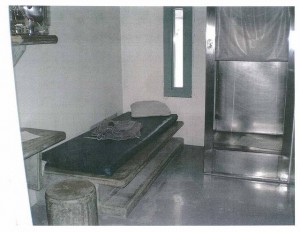
A cell at ADX Florence federal supermax, where individuals may spend years or decades in extreme solitary confinement.
Last week, representatives of six nonprofit organizations critical of solitary confinement met in a closed-door meeting in Washington, D.C., with the team hired to conduct an internal audit of the federal Bureau of Prisons’ controversial “segregation” policies.
The idea for an audit came out of Senator Dick Durbin’s June 2012 Senate hearing on solitary confinement, where BOP director Charles Samuels was grilled on the federal prison system’s use of solitary, especially on prisoners with mental illness. Further criticism emerged from media coverage, lawsuits, and a scathing report from the Government Accountability Office, which found that the BOP did not know whether its use of “segregated housing” had any impact on prison safety, how it affected the individuals who endure it, or how much it all cost American taxpayers.
The audit team is led by Ken McGinnis, the former warden who directs correctional programs at CNA, a Virginia think tank known primarily for military contracting. CNA is beginning a one year, $498,211 contract to provide a “Special Housing Unit Review and Assessment” for the National Institute of Corrections, which is itself an arm of the Bureau of Prisons.
On November 11, McGinnis and several colleagues met with representatives from the American Civil Liberties Union National Prison Project, National Religious Campaign Against Torture, CURE, Vera Institute for Justice, National Association for Mental Illness, and Prison Fellowship–a group that, according to participants, hopes to function as a sort of advisory committee to the auditors. Among other things this group has asked to receive briefings as the study progresses and to provide feedback to the final report. The group does not include any formerly incarcerated people or family members of those currently held in solitary.
According to individuals who attended the meeting, McGinnis described his plans to tour several different prisons, including the government’s notorious supermax, ADX Florence in Colorado, as well as Special Housing Units (SHUs) and Special Management Units (SMUs). An overview of the audit provided by CNA states that the project will make “an operational assessment of 8 BOP special housing units that will include at a minimum 1) Florence ADX, Florence SHU and Florence SMU; 2) Either Allenwood SHU and SMU or Lewisburg SHU; 3) Three additional SMU’s are yet to be to be determined.” (For descriptions of SHUs and SMUs, see our earlier post on the subject.)
In the end run, according to McGinnis, as many as 13 units may be inspected. Teams of experts will be dispatched to these facilities over the next few months to tour the facilities, and talk with the people who run them and the prisoners held there. McGinnis did not say whether prisoners would be interviewed without corrections staff present, or given the opportunity to fill out anonymous surveys–methods that are widely considered to be the only way to get candid information from people who are currently incarcerated.
Among CNA’s tasks will be “a comprehensive review of the Bureau’s mental health assessment process.” This controversial subject has been addressed in recent lawsuits and media reports, which show that numerous individuals with serious mental illness are being held at ADX, in violation of the BOPs own clear policy directives.
The audit will also review “the application of inmate due process rights…during duration of placement within SHU at ADX and or SMUS.” These due process rights, for the most part, consist of pro forma hearings and reviews, presided over solely by prison officials. Some critics argue that these processes lack even a semblance of fairness or independence.
The audit will pointedly not include “any inmates with Special Administrative Measures (SAMs),” which ban virtually all communications between those in prison and the outside world, and even permit monitoring of attorney-client communications. The auditors will not enter the section of ADX called H-Unit, which holds a group of the most restricted, high-security prisoners, including Ramzi Yousef (1993 World Trade Center bombings), Zacarias Moussaoui (9/11), and Ahmed Ghailani (US embassy bombings in Kenya and Tanzania).
According to one court document, individuals in H-Unit have had their mail suspended and their phone privileges and contact with immediate family members denied. Every phone call, every piece of mail is closely monitored by the FBI–and some, according to the prisoners, is discarded, including pleas for help to attorneys. H-Unit banned prisoners from receiving books by President Obama, along with such innocuous publications as a book on world history, sports magazines, and even a magazine on crocheting. Individuals held at in the unit have been subjected to force feeding when they go on hunger strikes. (See “Voices from Solitary: Life in H-Unit, ADX Federal Supermax.”)
What is particularly unusual about H-Unit is the extent to which the FBI appears to be involved in it operation. (The FBI has no statutory authority to operate inside of federal prisons.) According to court documents, FBI agents listen in on phone conversations, read mail, and dictate punishments–even when BOP personnel object.
Solitary Watch asked Shaina Vanek, the contracting officer in charge of the study and a National Institute of Corrections spokesperson who attended the meeting, confirmed in an email: “the review of the Bureau of Prisons use of Restricted Housing excludes a review of inmates with Special Administrative Measures (SAMs) and also the H unit at the ADX. The BOP has a population of approximately 219,000, and 54 inmates have SAMs.”
While the numbers are indeed small, these individuals are subject to the most extreme, and potentially torturous, form of solitary confinement; their exclusion means that such practices will receive no review whatsoever.
According to one attendee at the November 11 meeting, McGinnis and his team seemed eager to secure “buy in” from the advocates present and to produce a report that will be accepted by them. One of the advocates was asked to represent the group in future communications, and another meeting may take place in the new year.
Last month I received an encrypted email from someone calling himself by the pseudonym Kuwabatake Sanjuro, who pointed me towards his recent creation: The website Assassination Market, a crowdfunding service that lets anyone anonymously contribute bitcoins towards a bounty on the head of any government official–a kind of Kickstarter for political assassinations. According to Assassination Market’s rules, if someone on its hit list is killed–and yes, Sanjuro hopes that many targets will be–any hitman who can prove he or she was responsible receives the collected funds.
For now, the site’s rewards are small but not insignificant. In the four months that Assassination Market has been online, six targets have been submitted by users, and bounties have been collected ranging from ten bitcoins for the murder of NSA director Keith Alexander and 40 bitcoins for the assassination of President Barack Obama to 124.14 bitcoins–the largest current bounty on the site–targeting Ben Bernanke, chairman of the Federal Reserve and public enemy number one for many of Bitcoin’s anti-banking-system users. At Bitcoin’s current rapidly rising exchanges rate, that’s nearly $75,000 for Bernanke’s would-be killer.
Sanjuro’s grisly ambitions go beyond raising the funds to bankroll a few political killings. He believes that if Assassination Market can persist and gain enough users, it will eventually enable the assassinations of enough politicians that no one would dare to hold office. He says he intends Assassination Market to destroy “all governments, everywhere.”
“I believe it will change the world for the better,” writes Sanjuro, who shares his handle with the nameless samurai protagonist in the Akira Kurosawa film “Yojimbo.” (He tells me he chose it in homage to creator of the online black market Silk Road, who called himself the Dread Pirate Roberts, as well Bitcoin inventor Satoshi Nakamoto.) ”Thanks to this system, a world without wars, dragnet panopticon-style surveillance, nuclear weapons, armies, repression, money manipulation, and limits to trade is firmly within our grasp for but a few bitcoins per person. I also believe that as soon as a few politicians gets offed and they realize they’ve lost the war on privacy, the killings can stop and we can transition to a phase of peace, privacy and laissez-faire.”
I contacted the Secret Service and the FBI to ask if they’re investigating Assassination Market, and both declined to comment.
…
Sanjuro didn’t actually invent the concept of an anonymous crowdfunded assassination market. The idea dates back to the cypherpunk movement of the mid-1990s, whose adherents dreamt of using encryption tools to weaken the government and empower individuals. Former Intel engineer and Cypherpunk Mailing List founder Tim May argued that uncrackable secret messages and untraceable digital currency would lead to assassination markets in his “Cryptoanarchist’s Manifesto” written in 1992.
A few years later, another former Intel engineer named Jim Bell proposed a system of funding assassinations through encrypted, anonymous donations in an essay he called “ Assassination Politics.” The system he described closely matches Sanjuro’s scheme, though anonymity tools like Tor and Bitcoin were mostly theoretical at the time.
…
Sanjuro tells me he’s long been aware of Bell’s idea. But he only decided to enact it after the past summer’s revelations of mass surveillance by the NSA exposed in a series of leaks by agency contractor Edward Snowden. “Being forced to alter my every happy memory during internet activity, every intimate moment over the phone with my loved ones, to also include some of the people I hate the most listening in, analysing the conversation, was the inspiration I needed to embark on this task,” he writes. “After about a week of muttering ‘they must all die’ under my breath every time I opened a newspaper or turned on the television, I decided something had to be done. This is my contribution to the cause.”
…
“I am a crypto-anarchist,” Sanjuro concludes. “We have a bright future ahead of us.”




 band annie's Weblog