Hillary’s buck-passing. Petraeus’ disobedience. Obama’s fury. Bryan Curtis on the best moments of Woodward’s Obama’s Wars. Plus, the most likely sources—and what’s conspicuously left out.
Obama’s Wars, ace reporter Bob Woodward’s first book about the administration, comes out September 27. We got it early. The biggest revelations below:
What is Obama’s Wars about?
It’s about policy making. Or, rather, a political argument. The argument is: What is America going to do in Afghanistan, and how can it do it?
Barack Obama and David Petraeus walk down a runway at Baghdad International Airport on July 21, 2008. (Photo: Ssg. Lorie Jewell / AP Photo)
That sounds awfully…bureaucratic.
It is. You might expect Woodward’s narrative to zip from the White House to the Tora Bora, but just about the entire book takes place in D.C. meeting rooms. As chroniclers of the Afghanistan War go, Woodward is the anti-Sebastian Junger.
We know Obama committed 30,000 new troops to Afghanistan last December, and promised to start the withdrawal in 18 months. What mystery is Woodward trying to solve?
He’s trying to figure out whether Obama got rolled by the military.
Did he?
Woodward does not exactly say. But he demonstrates convincingly that the men in uniform—that would be David Petraeus, Stanley McChrystal, and Mike Mullen, along with Bob Gates—dangled very few battle plans in front of Obama, and used bureaucratic jujitsu to make sure he didn’t see others. For example, Obama never had a fully fleshed-out proposal for sending fewer than 30,000 new troops to Afghanistan. And even the final proposal he crafted himself, lowering the military’s demands a tad. As Petraeus says, after being informed of a slight from Pennsylvania Avenue, “They’re fucking with the wrong guy.”
How’d they get away with it?
In addition to being master bureaucratic infighters, the generals are genius P.R. men. Woodward recounts scene after scene of Petraeus talking to the press when he’s specifically been ordered to stand down. Once, just before a Situation Room meeting with Obama, he made a surprise CNN appearance from the White House briefing room.
What’s my news headline when it comes out September 27?
“AIDES DON’T BUY AFGHAN PLAN.”
Holbrooke says the war plan “won’t work.” Petraeus, who’s now running the Afghan effort, says, “You have to recognize that I don’t think you can win this war. I think you keep fighting.” (See The Times for more.)
Did Woodward snag an Obama interview?
He got an hour and fifteen minutes in July.
And how does Obama come off?
In the book’s opening pages, which take place around the 2008 election, he seems beleaguered. “You know, I’ve been worried about losing this election,” Obama tells an intelligence chief. “After talking to you guys, I’m worried about winning this election.”
“We were dealt a very bad hand,” he says later. Obama seems finally to be seeing the dog’s breakfast he inherited.
Critics who accuse Obama of being Spock-like with his emotions will find plenty of fodder here. “[John] Podesta was not sure that Obama felt anything, especially in his gut,” Woodward writes. Obama is portrayed as a deliberate consensus-seeker, insistent on hearing months of proposals. In that sense, he probably has more patience than the reader.
Obama’s Wars. By Bob Woodward. 464 Pages. Simon & Schuster. $30. We know the Woodward method. Those who tattle get better treatment. Who wins Obama’s Wars?
James Jones, the national security advisor, is treated with kid gloves. You might remember Jones as the guy one of Stanley McChrystal’s aides called a “clown” in that infamous Rolling Stone article. But here Jones is smart, determined, and sensitive to bureaucratic reverberations. He’s allowed to blast his enemies more than he is blasted—the sign you’ve made it in Woodward book.
Joe Biden also makes out like a bandit. In one of the book’s very best scenes, he’s shown confronting Hamid Karzai, the Afghan president, at a state dinner. Biden smothers Karzai with contempt disguised as diplomatic grace, right in front of the guy’s entire cabinet. That account—presumably supplied by Biden—gives the veep weight that his media portrait has thus far lacked.
Other likely babblers: Lindsey Graham, Bob Gates, and Leon Panetta.
How long can we allow the maniacs who are driving us to the brink of World War Three to stay in power? We’d better do something soon, or we will all be done for.
My special thanks to Gilad Atzmon, whose reading of the “Israeli Peace Manifesto” helps to point up the gulf between what they say and what they do. The original text can be found at: http://www.pro-israel.org/ Gilad’s rather more honest writing can be found at: http://www.gilad.co.uk/ He’s a pretty cool saxophone player, too.
Any copyrighted material in this video has been used in the interests of the survival of humanity, and anyone who objects to its use is one sick individual. We have allowed the sociopaths with their wealth, greed and selfishness to rule us for too long, only by making an effort, ourselves, will anything ever change.
My thanks to those whose videos and still pictures have made my job just a little bit easier in trying to persuade people that all is not as it seems to be: To wwwcelticvideocom for the clips from the video ” IDF Israeli soldiers beat local and international protesters” at http://www.youtube.com/watch?v=Al-Itd… where you will find information about purchasing the full video.
President Obama said Monday in a speech before the Disabled American Veterans national convention in Atlanta that the US military is on target to withdraw all its combat troops from Iraq by the end of August. We speak with independent journalist Jeremy Scahill, who says this instead marks the beginning of a downsized and rebranded occupation that will rely heavily on private military forces.
Judge Napolitano in C-SPAN with Ralph Nader – Part 1/6
Judge Napolitano in C-SPAN with Ralph Nader – Part 2/6
Judge Napolitano in C-SPAN with Ralph Nader – Part 3/6
Judge Napolitano in C-SPAN with Ralph Nader – Part 4/6
Judge Napolitano in C-SPAN with Ralph Nader – Part 5/6
Judge Napolitano in C-SPAN with Ralph Nader – Part 6/6
Bush Should Have Been Indicted
By David Edwards
Fox News’ senior judicial analyst made some surprising remarks Saturday that may go against the grain at his conservative network.
July 15, 2010 “Rawstory” — In a interview with Ralph Nader on C-SPAN’s Book TV to promote his book Lies the Government Told You, Judge Andrew Napolitano said that President George W. Bush and Vice President Dick Cheney should have been indicted for “torturing, for spying, for arresting without warrant.”
The judge believes that it is a fallacy to say that the US treats suspects as innocent until proven guilty. “The government acts as if a defendant is guilty merely on the basis of an accusation,” said Napolitano.
Nader was curious about how this applied to the Bush administration. “What about the more serious violations of habeas corpus,” wondered Nader. “You know after 9/11 Bush rounded up thousands of them, Americans, many of them Muslim Americans or Arabic Americans and they were thrown in jail without charges. They didn’t have lawyers. Some of them were pretty mistreated in New York City. You know they were all released eventually.”
“Well that is so obviously a violation of the natural law, the natural right to be brought before a neutral arbiter within moments of the government taking your freedom away from you,” answered Napolitano.
“So what President Bush did with the suspension of habeas corpus, with the whole concept of Guantanamo Bay, with the whole idea that he could avoid and evade federal laws, treaties, federal judges and the Constitution was blatantly unconstitutional and is some cases criminal,” he continued.
“What should be the sanctions [for Bush and Cheney]?” asked Nader.
“They should have been indicted. They absolutely should have been indicted for torturing, for spying, for arresting without warrant,” said Napolitano.
“I’d like to say they should be indicted for lying but believe it or not, unless you’re under oath, lying is not a crime. At least not an indictable crime. It’s a moral crime,” he said.
This isn’t the first time that Napolitano’s comments have veered away from the standard talking points at Fox News. He has predicted that Arizona’s controversial immigration law will be blocked by the court. Napolitano also said Arizona’s governor would “bankrupt the Republican Party” fighting for the law.
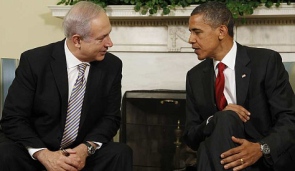
Prime Minister Benjamin Netanyahu meeting with U.S. President Barack Obama at the White House on July 6, 2010Two statesmen met in Washington on Tuesday who are looking smaller and smaller, who are taking smaller and smaller steps. They have decided not to decide, which in itself is a decision. When the chance of a two-state solution has long since entered injury time, they have decided on more extra time. Get ready for the binational state, or the next round of bloodletting.
My question is, which nations are they referring to? Israel and Palestine or Israel and the USA??
An excellent meeting
Two statesmen met in Washington on Tuesday who are looking smaller and smaller, who are taking smaller and smaller steps.
By Gideon Levy
It really was an excellent meeting: The chance that a binational state will be established has improved as a result; relations between Israel and the United States are indeed “marvelous.” Israel can continue with the whims of its occupation. The president of the United States proved Tuesday that perhaps there has been change, but not as far as we are concerned.
If there remained any vestiges of hope in the Middle East from Barack Obama, they have dissipated; if some people still expected Prime Minister Benjamin Netanyahu to lead a courageous move, they now know they made a mistake (and misled others ).
The masked ball is at its peak: Preening each other, Obama and Netanyahu have proved that even their heavy layer of makeup can no longer hide the wrinkles. The worn-out, wizened old face of the longest “peace process” in history has been awarded another surprising and incomprehensible extention. It’s on its way nowhere.
The “warm” and “sympathetic” reception, albeit a little forced, including the presidential dog, Bo, the meeting of the wives, with the U.S. president accompanying the Israeli prime minister to the car in an “unprecedented” way, as the press enthused, cannot obscure reality. The reality is that Israel has again managed to fool not only America, but even its most promising president in years.
It was enough to listen to the joint press conference to understand, or better yet, not understand, where we are headed. Will the freeze continue? Obama and Netanyahu squirmed, formulated and obfuscated, and no clear answer was forthcoming. If there was a time when people marveled at Henry Kissinger’s “constructive ambiguity,” now we have destructive ambiguity. Even when it came to the minimum move of a construction freeze, without which there is no proof of serious intent on Israel’s part, the two leaders threw up a smoke screen. A cowardly yes-and-no by both.
More than anything, the meeting proved that the criminal waste of time will go on. A year and a half has passed since the two took office, and almost nothing has changed except lip service to the freeze. A few lifted roadblocks here, a little less blockade of Gaza there – all relatively marginal matters, a bogus substitute for a bold jump over the abyss, without which nothing will move.
When direct talks become a goal, without anyone having a clue what Israel’s position is – a strange negotiation in which everyone knows what the Palestinians want and no one knows for sure what Israel wants – the wheel not only does not go forward, it goes backward. There are plenty of excuses and explanations: Obama has the congressional elections ahead of him, so he mustn’t make Netanyahu angry.
After that, the footfalls of the presidential elections can be heard, and then he certainly must not anger the Jews. Foreign Minister Avigdor Lieberman is pressuring Netanyahu now; tomorrow it might be Likud MK Danny Danon, and after all, you can’t expect Netanyahu to commit political suicide. And there you have it, his term in office is over, with no achievements. Good for you, Obama; bravo Netanyahu. You managed to make a mockery of each other, and together, of us all.
Netanyahu will be coming back to Israel over the weekend, adorned with false accomplishments. The settlers will mark a major achievement. Even if they don’t not admit it – they are never satisfied, after all – they can rejoice secretly. Their project will continue to prosper. If they have doubled their numbers since the Oslo Accords, now they can triple them.
And then what? Here then is a question for Obama and Netanyahu: Where to? No playing for time can blur the question. Where are they headed? What will improve in another year? What will be more promising in another two years? The Syrian president is knocking at the door begging for peace with Israel, and the two leaders are ignoring him. Will he still be knocking in two years? The Arab League’s initiative is still valid; terror has almost ceased. What will the situation be after they have finished compromising over the freeze in construction of balconies and ritual baths?
Two statesmen met in Washington on Tuesday who are looking smaller and smaller, who are taking smaller and smaller steps. They have decided not to decide, which in itself is a decision. When the chance of a two-state solution has long since entered injury time, they have decided on more extra time. Get ready for the binational state, or the next round of bloodletting.
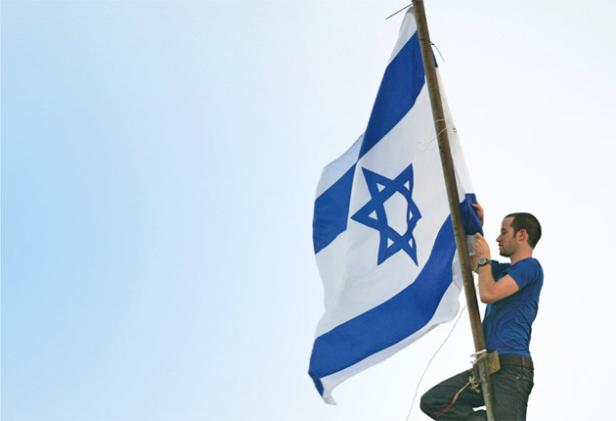
A Jewish settler hangs the Israeli flag over a vacated building in the West Bank town of Beit Sahur AFP/GETTY IMAGES
As President Barack Obama and Israeli Prime Minister Benjamin Netanyahu meet, a report reveals 42 per cent of territory is controlled by settlers
By Catrina Stewart in Jerusalem and David Usborne
Wednesday, 7 July 2010
Jewish settlers, who claim a divine right to the whole of Israel, now control more than 42 per cent of the occupied West Bank, representing a powerful obstacle to the creation of a Palestinian state, a new report has revealed.
The jurisdiction of some 200 settlements, illegal under international law, cover much more of the occupied Palestinian territory than previously thought. And a large section of the land has been seized from private Palestinian landowners in defiance even of an Israeli supreme court ruling, the report said, a finding which sits uncomfortably with Israeli claims that it builds only on state land.
Drawing on official Israeli military maps and population statistics, the leading Israeli human rights group, B’Tselem, compiled the new findings, which were released just as the Israeli prime minister, Benjamin Netanyahu, arrived in Washington to try to heal a gaping rift with US President Barack Obama over the issue of settlements.
Related articles
“The settlement enterprise has been characterised, since its inception, by an instrumental, cynical, and even criminal approach to international law, local legislation, Israeli military orders, and Israeli law, which has enabled the continuous pilfering of land from Palestinians in the West Bank,” the report concluded.
Mr Obama’s demand for a freeze on illegal building has caused months of friction between his administration and the Israeli government. But the US president, facing mid-term elections in November, appeared eager to end the dispute with Israel yesterday.
He said the country was making “real progress” on improving conditions in the Gaza Strip and was serious about achieving peace.
The two men made a joint public appearance, carefully choreographed to convey mutual ease and friendship.
When Mr Netanyahu last visited the White House, in March, US anger at his refusal to end construction meant the Israeli premier was denied a joint appearance with Mr Obama before the cameras. This time the photo-op was granted and the two men afterwards shared a meal – although not a state dinner but a working lunch.
“Reports about the demise of the special US-Israel relationship aren’t premature, there are just flat wrong,” Mr Netanyahu said, in response to a reporter’s question about the perceived tensions. Playing to the same script, Mr Obama said that the “bond between the United States and Israel is unbreakable”.
But the revelations in the B’Tselem report suggest that despite Mr Netanyahu’s stated desire for peace, his policy on settlements remains a dangerous obstacle to the establishment of an independent Palestinian state and therefore to a durable peace.
They cast an uncompromising spotlight on Israeli practices in the Palestinian territories that have long drawn international criticism for establishing “facts on the ground” hampering the creation of a viable Palestinian state.
While most of the Jewish settlement activity is concentrated in 1 per cent of the West Bank, settler councils have in fact fenced off or earmarked massive tracts of land, comprising some 42 per cent of the West Bank, B’Tselem said.
And despite the outlawing by Israel of settlement expansion on private Palestinian land, settlers have seized 21 per cent of land that Israel recognises is privately-owned.
B’Tselem alleged that Israel had devised an extensive system of loopholes to requisition Palestinian land.
At the same time, Israel has built bypass roads, erected new checkpoints, and taken control of scarce water resources to the benefit of the settlers. The measures have effectively created Palestinian enclaves within the West Bank, the report said.
Under international law, any Jewish settlements built on occupied territory are illegal. These include all the settlements in the West Bank, and thousands of Jewish homes in East Jerusalem, the Arab-dominated sector of the city annexed by Israel after the 1967 Six Day War. The international community still regards East Jerusalem as occupied territory. Despite firm commitments from successive Israeli governments to dismantle illegal outposts built after 2001 and to cease expansion of the settlements, Israel has provided millions of dollars worth of incentives to encourage poorer families to move into the West Bank. Some 300,000 settlers live in the West Bank.
Settlers immediately attacked the report, claiming it was timed as a spoiler to the Washington meeting.
In Washington, no concrete breakthroughs were announced but Mr Obama said that he believed the Israeli leader was ready to move towards direct talks with the Palestinians. Indirect talks began earlier this year, mediated by special US envoy George Mitchell.
Mr Netanyahu showed signs of responding to the pressure. “Peace is the best option for all of us and I think we have a unique opportunity to do it,” he said. “If we work together with [Palestinian] President [Mahmoud] Abbas then we can bring a great message of hope to our peoples, to the region and to the world.”
The Palestinians continue to refuse direct talks with Israel while new settlement construction is allowed. Settlement activity continues in East Jerusalem, which Palestinians aim to include in a new state.
With US-Israel ties already frayed, Mr Netanyahu postponed a visit to the White House last month in the aftermath of Israel’s deadly raid on a Turkish-led flotilla trying to deliver humanitarian goods to Gaza.
For Mr Obama, the danger is clear that any long-lasting record of animosity towards Israel could translate into lost votes at the mid-term elections.
JUAN GONZALEZ: We go now to Afghanistan, where the Ministry of Mines has announced Thursday it is taking the first steps toward opening the country’s vast mineral resources to international investors. News of Afghans’ mineral reserves made headlines earlier this week when the New York Times detailed findings of the Pentagon and US Geological Survey that Afghanistan has at least $1 trillion in untapped mineral wealth. Afghan officials suggested the reserves could be worth as much as $3 trillion.
Meanwhile, back on Capitol Hill, debate over the US war effort continues. Senior Pentagon and military officials spoke to lawmakers Wednesday to urge patience and support for their operations. The head of US Central Command, General Petraeus, told the Senate Armed Services Committee that the war was moving in the right direction, and they were on track to begin withdrawing forces from Afghanistan by next summer.
GEN. DAVID PETRAEUS: The conduct of a counterinsurgency operation is a roller coaster experience. There are setbacks, as well as areas of progress or successes. It is truly an up and down, when you’re living it, when you’re doing it, even from from afar, frankly. But the trajectory, in my view, has generally been upward, despite the tough losses, despite the setbacks.
AMY GOODMAN: For more on the ongoing US war in Afghanistan, the longest-running war in American history, we’re joined now here in New York by author Tom Engelhardt. He is the creator and editor of the website TomDispatch.com. His latest book is called The American Way of War: How Bush’s Wars Became Obama’s. His latest post on TomDispatch “Call the Politburo, We’re in Trouble: Entering the Soviet Era in America.”
What do you mean? Welcome to Democracy Now!, Tom.
TOM ENGELHARDT: What I mean is that in the Cold War, which we’ve largely forgotten at this point, the Soviet leaders made a kind of a basic miscalculation. They mistook military power for global power. They poured all their money functionally into their military. They got stuck in Afghanistan, very much like us, for ten years. In the meantime, their budget deficits were going up. They were growing—their indebtedness to other countries was growing. Their infrastructure was beginning to crumble. The very society they had built was beginning to crumble. And when the Red Army came out of Afghanistan—it limped out in 1989, after a decade—it basically returned to a country that didn’t exist, because within two years the Soviet Union collapsed.
In Washington, this caught everybody by surprise. Everybody expected the Cold War to go on and on. When American leaders saw this happen, they declared victory. The world was without an enemy at this point. And they—in one of the more striking decisions, I think, that’s been made in many, many years, they decided then to follow the Soviet path. And they began—and they put the so-called peace dividend in a ditch, and they began to pour money, successive administrations, as we know, up through the Bush administration into today, into the American military, while budget deficits rose, indebtedness rose, infrastructure crumbled, and the society began to—you know, began to weaken. Now, the United States is not the Soviet Union. It was always by far the more powerful country. And it isn’t today the Soviet Union in 1989 or 1991. But it is striking that our leaders, in declaring victory, decided to go down, in essence, the Soviet path, which was the path to implosion.
JUAN GONZALEZ: You spend quite a bit of time on the book in one chapter talking about the language of war and how the American media portrayed Muslim resistance fighters in other wars, initially in the first war in Afghanistan against the Soviets—
TOM ENGELHARDT: Yes, yes, yes.
JUAN GONZALEZ: —and in Chechnya, as well. Could you talk about the language of war?
TOM ENGELHARDT: Well, you know, if you go back, in the 1980s, of course, we were supporting many of the very people we’re now fighting. And at that point, they were not Muslim extremist whatevers. They weren’t Islamic totalitarians. They were—well, the President said it at the time. That was President Reagan. He called them “freedom fighters.” And when you look at the language in the press for these very same people doing many of the very same things, they were—it just happened to be against the Soviets—car bombs, camel bombs, bike bombs, suicide attacks, so on and so forth. I mean, and this included Osama bin Laden and so on and so forth. They were portrayed as resistance fighters. You no longer—you would never say the word “resistance” fighter with—put with the Taliban, nor, to give you an example in the Iraq war—it was very interesting. The phrase that the military often used for those they were fighting in Iraq and Afghanistan is they referred to them as “anti-Iraqi forces” or “anti-Afghan forces,” as if they were foreigners. And, of course, nobody would refer to us as anti-Iraqi forces or foreign forces or anything of the sort.
I mean, there’s a whole language that goes with American-style war. To give you just a simple example, and you hear it relatively often, when things start to go badly, American officials—Robert Gate said it relatively recently—say, let’s put an Afghan mask—an Afghan face on the war. And that’s just a commonplace thing. And it means, let’s get an Afghan out front. But if you think about that phrase for a minute, an Afghan face is, of course, a mask over really an American war. And often the words that they use, the images that they use, are very telling, if you just look barely under them, about what they think about who’s actually running what war. I mean, you can really see in our language that we feel this is ours, it should be ours, you know, it’s our war. I mean, this has—the Afghans are ancillary to the war we’re fighting.
AMY GOODMAN: How do you propose pulling out? How do you propose Obama get out?
TOM ENGELHARDT: Well, let me say, as a start, that one of the problems with answering a question like this is, you know, basically, we’ve never tried it. I mean, in other words, it’s like talking about peace. All the money goes into war. So, you know, and in addition, as you try to get out, as was true in Vietnam for years, future fantasies are put forward: you know, there’s going to be a bloodbath, terrible things will happen. We don’t know what actually will happen in Afghanistan, if we were to pull out. We know what’s happening now, and it’s quite terrible, and it’s actually devolving. I mean, I think it’s perfectly reasonable, whether you—I mean, you could simply announce a withdrawal, a reasonable withdrawal schedule, and pull out American troops. You could offer—you could offer money. We really don’t know. I think it’s very unlikely, for instance, that the Taliban would simply take over the country. They didn’t the last time. They might get part of the country, but not all of it. We really don’t know what would happen. We just know that this will otherwise be a trillion-dollar war, which, like the Soviet war, will go on forever and ever. I mean, the Soviets, from about 1986 on, for about the last three or four years, they wanted to get out. The Soviet leadership, you look at their documents, they want to get out, but they can’t muster the will. They keep worrying, will Afghanistan be stable?, etc., etc. It goes on for years. And the problem isn’t how will we get out of Afghanistan, but when Obama decides he wants to, it’s going to be difficult.
JUAN GONZALEZ: And this most recent announcement about the vast mineral wealth—
TOM ENGELHARDT: Yes.
JUAN GONZALEZ: —in Afghanistan, especially coming, the timing of it, as the war is actually not progressing as well as the Obama administration had hoped, is it your sense that this was more sort of rallying the corporate and financial elites of the world to take more renewed interest in supporting the US effort?
TOM ENGELHARDT: I’m want convinced it’s going to have that effect, actually. First of all, as you can see from the Times today—the Times had a piece on it today—and as was true with Iraq, it’s very hard to get Western, these big Western mining companies, to come into a situation where, you know, the lithium that they’re talking about is basically under lands that basically are Taliban-controlled right now. They don’t want to send their people in there. The people who might come in are the Chinese, maybe, who would be willing to take more risks, or various state mining interests that we wouldn’t be interested in. So I’m not sure this is a great benefit in that sense.
Secondly, you know, to get—in a country with almost no infrastructure and no mining infrastructure to get anything out of the ground there, I mean, I’m sure you’re talking a—you’re not talking about now, you’re not talking about something striking that’s going to happen now. I think—yeah, I mean, it was a kind of a good news story at a bad news time, and it is significant that there’s all this stuff under Afghanistan, which was known—
AMY GOODMAN: It’s not as if it wasn’t known.
TOM ENGELHARDT: No.
AMY GOODMAN: And the question is why it’s being raised as a story now, if not to justify the US’s continued presence, that maybe the US can get these natural resources.
TOM ENGELHARDT: Let’s point out that it was known by the Russians. You know, in the Russian war, the Russians knew this. I mean, I’m struck by one small thing. Mikhail Gorbachev, the Russian leader who did finally get them out, his term for Afghanistan was “the bleeding wound.” Our Afghan war commander recently referred to his kind of pet offensive in the small southern area of Marjah, where they threw in 15,000 troops in the spring, declared it a victory, and now find out that things are not going well, he’s called it a “bleeding ulcer.” There is kind of an eerie parallel there, and it reminds us that both countries will now have been in a war in Afghanistan, a place known as the graveyard of empires, for a decade.
AMY GOODMAN: You talk about, finally, garrisoning of the planet.
TOM ENGELHARDT: Yes. Well, the American way of war, which is the title of my book, is based on something that, in the United States, we have basically no interest in. Unless a base closes in the United States, and then there’s an enormous uproar, a military base, we really don’t think about much our basing policy around the world. And yet—
AMY GOODMAN: Ten seconds, then we go to a web special after.
TOM ENGELHARDT: And yet, we have maybe up to 1,200 bases, depending on what you’re counting, maybe even more, around the world. We basically garrison the planet. Washington is a war capital. We are in a state of war. We don’t know it.
AMY GOODMAN: Tom Engelhardt, congratulations on your new book, The American Way of War: How Bush’s Wars Became Obama’s. We’re going to continue this after the show and put it up at democracynow.org.

 Barack Obama and David Petraeus walk down a runway at Baghdad International Airport on July 21, 2008. (Photo: Ssg. Lorie Jewell / AP Photo)
 Obama’s Wars. By Bob Woodward. 464 Pages. Simon & Schuster. $30.
 band annie's Weblog