CLICK ON IMAGE
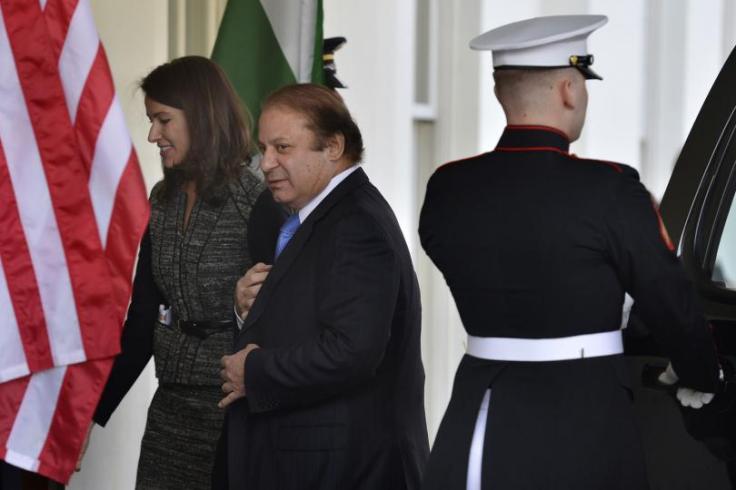
Pakistani Prime Minister Nawaz Sharif arrives at the West Wing of the White House for bilateral meetings with President Barack Obama, October 23, 2013, in Washington, DC.Read more
CLICK ON IMAGE
Pakistani Prime Minister Nawaz Sharif arrives at the West Wing of the White House for bilateral meetings with President Barack Obama, October 23, 2013, in Washington, DC.Read more
and Watch what gets closed and what remains open !!
click on image

TRANSCRIPT
This is a rush transcript. Copy may not be in its final form.
AMY GOODMAN: The partial shutdown of the federal government has entered its 16th day, and the nation is now on the brink of a default as the government’s borrowing authority ends tomorrow.
On Tuesday, Fitch Ratings warned it could cut the U.S. government’s AAA debt rating if a deal to raise the debt limit isn’t reached. In a statement, Fitch said, quote, “The prolonged negotiations over raising the debt ceiling … risks undermining confidence in the role of the U.S. dollar as the preeminent global reserve currency, by casting doubt over the full faith and credit of the U.S.”
The Senate appears to move closer to a deal to reopen the government and raise the debt limit, but the Republican-controlled House of Representatives failed twice Tuesday to produce its own plan. This is House Speaker John Boehner.
HOUSE SPEAKER JOHN BOEHNER: Listen, we’re working with our members on a way forward and to make sure that we provide fairness to the American people.
REPORTER 1: Mr. Speaker, can you guarantee to the American people Congress will not go past the deadline and push us into default?
HOUSE SPEAKER JOHN BOEHNER: Listen, I have made clear for months and months that the idea of default is wrong, and we shouldn’t get anywhere close to it.
UNIDENTIFIED: Last question?
REPORTER 2: Mr. Speaker, will there be a vote today on the plan?
UNIDENTIFIED: Right here.
REPORTER 3: Are you going to vote today on this plan that would make some changes to the Senate bill, reopen the government [inaudible]—
HOUSE SPEAKER JOHN BOEHNER: We’re—we’re talking with our members on both sides of the aisle to try to find a way to move forward today.
AMY GOODMAN: House Speaker John Boehner has refused to allow the House to vote on the Senate plan. Meanwhile, the Senate appears to be close to reaching a deal to keep the government funded through January 15th and the debt limit extended until February 7th. Senate Majority Leader Harry Reid criticized House Republicans for failing to reach its own agreement.
SEN. HARRY REID: I know I speak for many of us, who have been working in good faith, when I say that we felt blindsided by the news from the House. But this isn’t the first time. Extremist Republicans in the House of Representatives are attempting to torpedo the Senate’s bipartisan progress with a bill that can’t pass the Senate—can’t pass the Senate and won’t pass the Senate.
AMY GOODMAN: As lawmakers continue to debate a possible deal to reopen the government, the impact of the shutdown is being felt across the country. North Carolina has become the first state to halt its welfare program due to the shutdown. Meanwhile, nearly a hundred veterans converged at the National World War II Memorial in Washington Tuesday to protest the shutdown, saying it could put more than 5.5 million servicemembers at risk of not receiving their monthly benefits by November 1st.
To talk more about the government shutdown and the possible default, we’re joined by two guests. Robert Borosage is the founder and president of the Institute for America’s Future and co-director of its sister organization, the Campaign for America’s Future. He recently wrote a piece for Reuters called “Tea Party Zealots Hold the Public Debate Hostage.” We’re also joined by Amanda Terkel, senior political reporter and politics managing editor at The Huffington Post.
We welcome you both to Democracy Now! Bob Borosage, let’s begin with you. What has this shutdown meant?
ROBERT BOROSAGE: Well, it’s meant a lot of pain for a lot of Americans—infants that have lost support for nutrition, children that have been thrown out of Head Start, safety measures that are not taken because the weather buoys are no longer manned. The list can go on. And the effects accumulate each day. It’s hurt the economy dramatically, and that—those effects accumulate each day. It’s undermined our credibility globally. You know, it’s been a totally contrived and unnecessary crisis which has had real-world and horrible effects that are growing every day.
AMY GOODMAN: Amanda Terkel, you wrote a really interesting piece for The Huffington Post about what gets shut down and what remains open. Can you give us some of the examples?
AMANDA TERKEL: Sure. Well, I think it’s been very frustrating to a lot of people that many Americans are feeling the effects of the shutdown while many members of Congress who caused the shutdown aren’t feeling those same effects. So, Congress, like federal agencies, is supposed to furlough its staff and keep only essential personnel, but there are at least 10 senators and dozens of House members who haven’t furloughed a single member of their staff. And some of these people are like Senator Tom Coburn, who’s always railing about how there’s all this waste in government and all this wasted taxpayer money, yet every single one of his staff is essential.
Congress has kept its gym open, the gym for members. The gym for staff has been closed, but the gym for members is open. And then even there’s a little subway in the bottom of the Capitol so that members don’t have to walk a few hundred feet to get from the Capitol to the House and Senate office buildings, and that little train takes someone to run it. That train is still running.
AMY GOODMAN: So you have people like Steve King of Iowa, one of the die-hards against any kind of—any kind of agreement, kept his entire staff. But you talk about Nobel Prize-winning scientists furloughed.
AMANDA TERKEL: Right, exactly. I think—I believe there are five Nobel Prize-winning scientists who work for the government and who have been furloughed. There’s one man who’s a physicist who said, “You know, I guess that even if you win a Nobel Prize, you’re not considered essential.” There’s the man who kind of—who developed the Mars Curiosity rover; he’s been furloughed. And 96 percent of the Environmental Protection Agency staff has been furloughed. And cleanup at—I think it’s something like over 500 toxic Superfund sites, that has stopped, yet every single member of Steve King’s staff, they’re essential.
AMY GOODMAN: So the gym remains open. Head Start was not funded, except for a private foundation gave $10 million. What about day care for congressmembers—meaning their children, of course.
AMANDA TERKEL: That’s a good question. I’m actually not sure about that, although I know for federal agencies a lot of these day cares were being shut down, which had many people worried. They—if they, for example, weren’t furloughed, they’re still having to go to work, but now they can’t get day care, because that’s not considered an essential service. And many private day cares, too, are suffering, as well, because they are used to having all of these students coming in, and now the parents are home, they’re furloughed, they don’t need the use of this day care.
And so, I think, you know, it’s important that this isn’t just affecting people who work for government or who rely on government services, which is pretty much every American, but it’s also affecting many private businesses. Businesses who rely on tourism and who are around national parks are seeing a drop—restaurants, shops, you know, if you run a canoeing service in a national park. So this is really rippling all across all sectors of society.
ROBERT BOROSAGE: You know, Amy, it’s putting a little focus—
AMY GOODMAN: Bob Borosage.
ROBERT BOROSAGE: —a little focus on the people who work for us—federal employees—because they’ve taken the biggest hit. Eight hundred thousand employees have been furloughed. That means they are sent home without pay. If you’re an essential worker, you are required to work without pay. So you pay the costs of getting to work. You pay the costs of buying your lunch or whatever you do to eat during the day, and you’re not getting pay. We’re headed into our third week of these workers forced to work in, in essence, indentured servitude, without pay. And, you know, people tend to be cynical about bureaucrats in Washington, etc., but these employees are people who work for us, they provide services that go to us, and we are abusing them. And there’s no question that the best of them are going to start looking for different jobs.
AMY GOODMAN: Bloomberg has a piece, “Troops Forage for Food While Golfers Play On in Shutdown.” “Grocery stores on Army bases in the U.S. are closed. The golf course at Andrews Air Force base is open.” Yes, so who is essential, and who isn’t? Now, the way the tea party congressmembers are talking about it is each thing that’s essential, they can vote on, if you want that particular thing to be open. This is certainly a way of, you know, shrinking the government to the size of a bathtub. Your thoughts on that, Bob Borosage, and then what it means moving from the partial shutdown to the deadline tomorrow, October 17th?
ROBERT BOROSAGE: Well, this is—this is an example of why you shouldn’t let children play with bombs. The tea party congresspeople set out to shut down the government and threaten default on America’s debts, in order to get “Obamacare” either defunded or delayed. And when the president sensibly called their bluff and said, “Look, we’re not going to negotiate with a pistol to our head,” they have gone—proceeded to go into the shutdown and celebrate it, despite the damage it’s doing to people and to the economy. And now we’re headed into what is unimaginable, which has not been done before: a potential default on America’s debts.
It’s important for people to understand, these are debts that every Republican member in the House, including the tea party members, voted for as part of their budget resolution. So we’re talking about lifting the debt ceiling to cover debts that they supported, to pay the debts that they ran up, and they’re refusing to do that. And we really don’t know what happens if America defaults on its debt. The entire global financial system depends on the security of American bonds. And if they become less secure, if interest rates spike, as they are likely to do, if investors can’t count on them as the equivalent of cash, then you’re talking not about a small slowdown, you’re talking about a multitrillion-dollar house of financial cards that is going to be shaken at its root.
(SAUL LOEB/AFP/Getty Images)

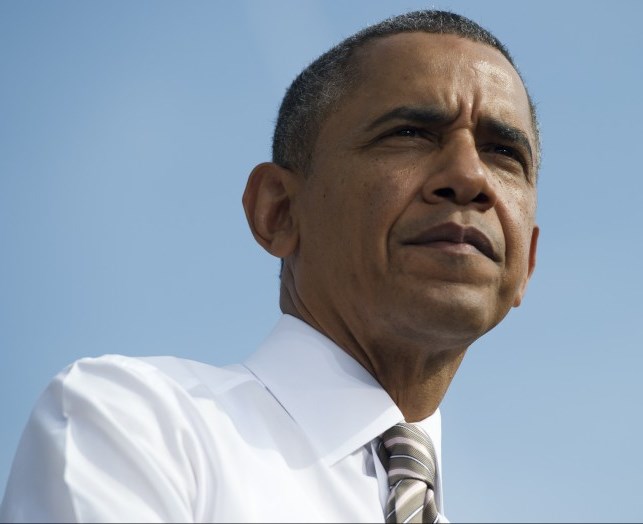
Despite Secretary of State John Kerry’s frenetic efforts, preparations for the “Geneva II” peace conference on Syria’s civil war are already foundering. The rebel movement has become increasingly radicalized against Syrian dictator Bashar al-Assad and more fractured. A newly confident Assad, meanwhile, has somewhat relegitimized himself as a signatory to a new chemical-weapons ban negotiated by the United States and Russia under U.N. auspices, which his government is tasked with implementing over the next year. Defying global opprobrium over his use of sarin gas, Assad has also positioned himself in a series of high-profile TV interviews as a preferable alternative to Islamist rebels who want to create a fundamentalist state.
All of which should prompt a reexamination of the first Geneva conference in the summer of 2012, on which Kerry’s new push for peace is based. According to some officials involved, perhaps the greatest tragedy of Syria is that, some 80,000 lives ago, President Obama might have had within his grasp a workable plan to end the violence, one that is far less possible now. But amid the politics of the 2012 presidential election—when GOP nominee Mitt Romney regularly accused Obama of being “soft”—the administration did little to make it work and simply took a hard line against Assad, angering the special U.N. Syria envoy, Kofi Annan, and prompting the former U.N. secretary-general to quit, according to several officials involved.
Former members of Annan’s negotiating team say that after then-Secretary of State Hillary Rodham Clinton and Russian Foreign Minister Sergei Lavrov on June 30, 2012, jointly signed a communique drafted by Annan, which called for a political “transition” in Syria, there was as much momentum for a deal then as Kerry achieved a year later on chemical weapons. Afterward, Annan flew from Geneva to Moscow and gained what he believed to be Russian President Vladimir Putin’s consent to begin to quietly push Assad out. But suddenly both the U.S. and Britain issued public calls for Assad’s ouster, and Annan felt blindsided. Immediately afterward, against his advice, then-U.N. Ambassador Susan Rice offered up a “Chapter 7” resolution opening the door to force against Assad, which Annan felt was premature.
Annan resigned a month later. At the time, the soft-spoken Ghanaian diplomat was cagey about his reasons, appearing to blame all sides. “I did not receive all the support that the cause deserved,” Annan told reporters in Geneva. He also criticized what he called “finger-pointing and name-calling in the Security Council.” But former senior aides and U.N. officials say in private that Annan blamed the Obama administration in large part. “The U.S. couldn’t even stand by an agreement that the secretary of State had signed in Geneva,” said one former close Annan aide who would discuss the talks only on condition of anonymity. “He quit in frustration. I think it was clear that the White House was very worried about seeming to do a deal with the Russians and being soft on Putin during the campaign.” One of the biggest Republican criticisms of Obama at the time was that he had, in an embarrassing “open mike” moment, promised Moscow more “flexibility” on missile defense after the election.

Administration officials deny this account, as do some who were involved at the State Department. Nonetheless, Frederic Hof, a U.S. ambassador who was Clinton’s special adviser for transition in Syria at the time, agrees that the negotiations could have been better handled. The harsh demand that “Assad must go” voiced by Clinton and British Foreign Secretary William Hague was “gratuitous,” says Hof, a senior fellow at the Atlantic Council. “Perhaps a greater effort should have been made to give Annan the time to do his due diligence.” Still, Hof says he saw no evidence that the administration was posturing for political reasons.
A current senior State Department official concedes that one of the problems with making the Annan communique work may have been Clinton’s distaste for getting involved in extended direct mediation, in dramatic contrast to her successor, who has opened up negotiations on several fronts at once—with Syria and the Russians, with Iran, and between the Palestinians and Israelis. “We’ve made more trips to the Mideast in the last nine months than she made in four years,” says this official.
While Clinton excelled at “soft” power—selling America’s message abroad—one emerging criticism of her four-year tenure at State was that she consistently avoided getting her hands dirty with direct mediation. Clinton agreed to leave key negotiations in crisis spots—in particular the Mideast and south-central Asia—to special envoys such as George Mitchell and Richard Holbrooke, and she rarely stepped in as each of them failed. Veteran reporter David Rohde, in an assessment as Clinton was leaving office in January, suggested that Clinton wanted to avoid embarrassment or failure ahead of a 2016 presidential run; he quoted one State Department official as saying that he was “really happy to have someone in the job who does not retain political ambitions.”
Still, Hof and critics of the administration say a 2012 peace deal would have been a steep, uphill climb at best. “I think there were a couple of problems that raised their ugly head in the immediate wake of this thing being signed on June 30,” Hof says. “Number one, it became clear to both Annan and the Russians that Assad had no interest whatever in being ‘transitioned.’ He was able to read the text of the Geneva agreement quite accurately…. By the same token, the opposition was unhappy with Kofi’s handwork because there was no explicit language to the effect that Assad will step down.”
But what happened next was that the Geneva communique disappeared onto a dusty shelf; even Kerry when he took office chided the Obama administration for being “late” in pushing peace. And what Kerry faces now is a newly assertive Assad and a vastly more fractured opposition riddled with extreme elements that want no part of a U.S.- or Western-brokered peace. All of which makes that missed opportunity even more painful.
This article appears in the October 5, 2013, edition of National Journal Magazine as A Lost Chance for Peace.
 President Obama speaks on the situation in Syria from the White House Rose Garden. (Photo: White House)
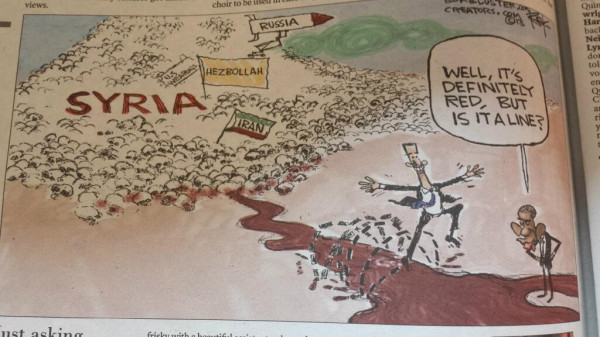
The decision of President Barack Obama to seek congressional approval for US military strikes in Syria is constitutionally sound, but strategically appalling. By not making it clear from the outset of the crisis that he would seek the approval of the Senate and House for a military response to the Assad regime’s chemical atrocity, the president’s jarring change of direction now runs the risk of thoroughly undermining whatever remains of allied confidence in his leadership. By not calling on Congress to return to Washington immediately the president conveys a sense of nonchalance that his newly discovered soaring rhetoric cannot disguise. Having taken a risk that is as profound as it is gratuitous, the administration would do well now to focus on that which it has avoided totally to date: creating and implementing an objectives-based strategy that would, among other things, employ sustained military strikes to destroy or significantly degrade the ability of Bashar al-Assad’s regime to commit mass murder in Syria.
The events of the past ten days suggest that there was no administration forethought to the possibility of a major chemical incident in Syria; there was no plan in place to respond to a major chemical attack by a regime that had already demonstrated its deep and abiding contempt for the president and his red lines. The results of this mystifying lack of preparedness have been abysmal. Secretary of State John Kerry responded quickly with a very convincing replica of presidential leadership, making a strong case for the inadmissibility of the regime’s action and the crying need for a strong American and Western response.
Over the next few days Kerry’s clarity was blurred repeatedly by statements emanating from the White House and Pentagon. What effect this uncertain trumpet may have had on the shocking, disgraceful, yet understandable vote in Britain’s parliament is not known, but the spectacle of the secretary of state making the case while other senior officials temporized and agonized is not one to which historians will assign high grades in the annals of presidential leadership.
Indeed, presidential uncertainty and talk of a loud but meaningless “shot across the bow” of the Assad regime no doubt leads some to believe that his call for a vote in Congress is less a bow to American constitutionality than a further attempt to kick the can down the road. This is why the president should have been prepared from the outset to make clear his desire to seek congressional approval. There is not a thing wrong with his official desire to act constitutionally, or his political desire to have a broad array of domestic accomplices. Yet the conclusion that he is motivated by skepticism and even disbelief in the endeavor itself, even if it is a patently unfair finding, is impossible to dismiss out of hand given his behavior over the past ten days and his approach to Syria over the past two years. It is a conclusion that, if permitted to grow roots, can have a corrosive effect on American credibility around the world. It is a conclusion whose dismissal is not facilitated by the president’s decision not to call the Congress into special session immediately.
What then is to be done? Before he heads off to the G20 summit in Russia next week, President Obama needs to be armed with a Syria strategy based on clear objectives. The mantra-like repetition of the phrase “there is no military solution to the war in Syria” is neither an objective nor a strategy. Indeed, according to the Assad regime, Russia, and Iran, it is not even a fact. President Obama may well wish to give his Russian counterpart one final opportunity to bring decency and statesmanship to bear in the Syrian context: “Vladimir, either you persuade your client to declare and enforce a unilateral ceasefire, call for and cooperate with UN observers, implement Kofi Annan’s six point plan, and send a team to Geneva next month prepared to facilitate real political transition, or I—with the approval of Congress—will ruin his whole day.” Even if Russia were willing to work to such an end, the chances of regime compliance would not be great. Yet an administration still dedicated to the one-sided, wishful proposition that this war cannot end with a military result would do well to run to ground, once and for all, the diplomatic possibilities.
The objective of sustained military strikes should be to destroy or seriously degrade the ability of the regime to bring to bear massed fires, chemical or conventional, on Syrian population centers. This would mean concentrating—for several days, if necessary—on artillery, aircraft (along with airfields), and missiles. Ideally the administration would have had a plan to execute within seventy-two hours of the August 21 outrage, one that would have put the regime out of the business of mass murder. Yet, everything that has happened since August 21 suggests that Assad’s action was a big surprise; that there was no executable plan in place. This is a failure that can be sorted out over time by congressional inquiries. Now, the challenge for the Pentagon is constantly to update targeting while the regime tries to move and hide assets.
Putting the regime out of the long-distance, mass murder business is important, not only for the Syrian victims of the Assad regime, but for Syria’s neighbors—among them American allies and friends. The fears of some in the administration that hitting too hard could cause the regime to fall, causing instability from which jihadists might benefit, are simply beyond belief. Leave aside the self-fulfilling consequences of having failed to support mainstream, Syrian nationalist armed opposition elements. Leave aside the failure to follow-up in operationally relevant ways after having recognized the Syrian National Coalition as the legitimate representatives of the Syrian people in December 2012.
When has the Assad regime been a force for stability in Syria since March 2011? When it mowed down peaceful protesters? When it authorized door-to-door massacres? When it stampeded two-million refugees across international boundaries? When it employed sarin gas against women and children? When it denied humanitarian access to parts of Syria beyond its control? When it placed itself in the hands of Iran and Iran’s Lebanese militia? This is a regime worth preserving because there is something worse? Has support for the mainstream Supreme Military Council massively increased in the past week? Is this administration, at long last, prepared to substitute action for analysis?
President Obama’s reluctance to engage in Syria has been understandable. Perhaps he now understands that disengagement also has consequences, many of them unintended. The worst of these unintended consequences has been the toll exacted of his credibility and that of the United States. From here on out, he has an opportunity to get things right: cripple the murder machine, support the mainstream opposition effectively, and facilitate the departure from Syria of a merciless, morality-free crime family. There will be no “do-overs.” Yet there is an opportunity to secure the support of Congress, persuade friends and allies that we mean business, and help Syrians save a country whose suffering is an affront to civilization.
Frederic C. Hof is a senior fellow with the Atlantic Council’s Rafik Hariri Center for the Middle East.

July 30, 2013
 (On the day Bradley Manning’s verdict is announced, Orwell’s Memory Hole is indeed alive in the United States. This excellent article was not written by me, and originally appeared on TechDirt)
The folks from the Sunlight Foundation have noticed that the Change.gov website, which was set up by the Obama transition team after the election in 2008 has suddenly been scrubbed of all of its original content. They noted that the front page had pointed to the White House website for a while, but you could still access a variety of old material and agendas. They were wondering why the administration would suddenly pull all that interesting archival information… and hit upon a clue.
A little bit from the “ethics agenda”:
Protect Whistleblowers: Often the best source of information about waste, fraud, and abuse in government is an existing government employee committed to public integrity and willing to speak out. Such acts of courage and patriotism, which can sometimes save lives and often save taxpayer dollars, should be encouraged rather than stifled. We need to empower federal employees as watchdogs of wrongdoing and partners in performance. Barack Obama will strengthen whistleblower laws to protect federal workers who expose waste, fraud, and abuse of authority in government. Obama will ensure that federal agencies expedite the process for reviewing whistleblower claims and whistleblowers have full access to courts and due process.
Yeah. That statement seems a bit embarrassing at the very same time Obama’s administration is threatening trade sanctions against anyone who grants asylum to Ed Snowden. Also… at the same time that we get to see how whistleblower Bradley Manning’s “full access to courts and due process” will turn out. So far, it’s been anything but reasonable, considering that the UN has already condemned Manning’s treatment as “cruel and inhuman.” And people wonder why Snowden left the country…
MY COMMENT: Yeah, Hope and Change my ass.
Bonus: Make you own Hope and Change poster here.

There is a world of intelligence gathering that staggers in terms of size and depth.Here’s James Bamford in Wired on a future over which citizens have no say:
Physically, the NSA has always been well protected by miles of high fences and electrified wire, thousands of cameras, and gun-toting guards. But that was to protect the agency from those on the outside trying to get in to steal secrets. Now it is confronting a new challenge: those on the inside going out and giving the secrets away.
While the agency has had its share of spies, employees who have sold top-secret documents to foreign governments for cash, until the last few years it has never had to deal with whistleblowers passing top-secret information and documents to the press because their conscience demanded it. This in a place where no employee has ever written a book about the agency (unlike the prolific CIA, where it seems that a book contract is included in every exit package).
As someone who has written many books and articles about the agency, I have seldom seen the NSA in such a state. Like a night prowler with a bag of stolen goods suddenly caught in a powerful Klieg light, it now finds itself under the glare of nonstop press coverage, accused of robbing the public of its right to privacy. Despite the standard denials from the agency’s public relations office, the documents outline a massive operation to secretly keep track of everyone’s phone calls on a daily basis – billions upon billions of private records; and another to reroute the pipes going in and out of Google, Apple, Yahoo, and the other Internet giants through Fort Meade – figuratively if not literally.
But long before Edward Snowden walked out of the NSA with his trove of documents, whistleblowers there had been trying for years to bring attention to the massive turn toward domestic spying that the agency was making. Last year in my Wired cover story on the enormous new NSA data center in Utah, Bill Binney, the man who largely designed the agency’s worldwide eavesdropping system, warned of the secret, nationwide surveillance. He told how the NSA had gained access to billions of billing records not only from AT&T but also from Verizon. “That multiplies the call rate by at least a factor of five,” he said. “So you’re over a billion and a half calls a day.” Among the top-secret documents Snowden released was a Foreign Intelligence Surveillance Court order proving the truth to Binney’s claim and indicating that the operation was still going on.
I also wrote about Adrienne J. Kinne, an NSA intercept operator who attempted to blow the whistle on the NSA’s illegal eavesdropping on Americans following the 9/11 attacks. “Basically all rules were thrown out the window,” she said, “and they would use any excuse to justify a waiver to spy on Americans.” Even journalists calling home from overseas were included. “A lot of time you could tell they were calling their families,” she says, “incredibly intimate, personal conversations.” She only told her story to me after attempting, and failing, to end the illegal activity with appeals all the way up the chain of command to Major General Keith Alexander, head of the Army’s Intelligence and Security Command at the time.
Without documents to prove their claims, the agency simply dismissed them as falsehoods and much of the mainstream press simply accepted that. “We don’t hold data on U.S. citizens,” Alexander said in a talk at the American Enterprise Institute last summer, by which time he had been serving as the head of the NSA for six years. Director of National Intelligence James Clapper made similar claims. At a hearing of the Senate Intelligence Committee last March, he was asked, “Does the NSA collect any type of data at all on millions or hundreds of millions of Americans?” To which Clapper responded, “No, sir.” The documents released by Snowden, pointing to the nationwide collection of telephone data records and not denied by government officials, prove the responses untrue.
The deception by General Alexander is especially troubling. In my new cover story for Wired’s July issue, which will be published online Thursday, I show how he has become the most powerful intelligence chief in the nation’s history. Never before has anyone in America’s intelligence sphere come close to his degree of power, the number of people under his command, the expanse of his rule, the length of his reign, or the depth of his secrecy. A four-star Army general, his authority extends across three domains: He is director of the world’s largest intelligence service, the National Security Agency; chief of the Central Security Service; and commander of the U.S. Cyber Command. As such, he has his own secret military, presiding over the Navy’s 10th Fleet, the 24th Air Force, and the Second Army.
The article also sheds light on the enormous privatization not only of the intelligence agencies but now also of Cyber Command, with thousands of people working for little-known companies hired to develop the weapons of cyber war, cyber targeting, and cyber exploitation. The Snowden case demonstrates the potential risks involved when the nation turns its spying and eavesdropping over to companies with lax security and inadequate personnel policies. The risks increase exponentially when those same people must make critical decisions involving choices that may lead to war, cyber or otherwise.
At a time when the NSA has lost its way and is increasingly infringing on the privacy of ordinary Americans, it shouldn’t come as much of a surprise that NSA employees — whether working for the agency or for one of its contractors — would feel the obligation to alert the public to the secret acts being carried out in its name. The only surprise is that we haven’t seen more such disclosures. General Alexander will surely use all his considerable power to prevent them. Don’t be surprised if he fails.
 band annie's Weblog