Thru Revlon :
A great Rap song from defiant Aleppines dedicated to the Syrian revolution:
THE SYRIAN PEOPLE
Thru Revlon :
A great Rap song from defiant Aleppines dedicated to the Syrian revolution:
THE SYRIAN PEOPLE
Saturday, November 26, 2011
It pains me to see people that I thought were principled in their commitment for justice and outspoken in their support for the Palestinians, ignore the plight of the Syrian people and dismiss what is happening there as some Western conspiracy. Those same people will accept “insights” from “sources” in Bahrain, publish Youtube videos of demonstrations in Saudi Arabia’s Qatif, and yet criticise al Jazeera for relying on anonymous sources, or Youtube videos in Syria, knowing well that all foreign media have been banned from operating there. They afford full respect to the Bahraini protesters, and relish the opportunity to use their plight as a way to highlight Western and Arab hypocrisy, and yet they waste no opportunity to ridicule coverage of Syria, and to argue about semantics or demonstrate their critical thinking and scepticism about any story that comes out of Syria. Yet at the same time they would never dream of applying such high standards of scrutiny for the same standard of stories, allegations or speculation if it came from Bahrain or, for that matter, Gaza. The opposite is true for those who conveniently ignore what is happening in Bahrain and cry crocodile tears for the Syrian people.
Shame on them all, completely and utterly. I support the people of Bahrain and all the Arab revolutions. I find no contradiction in this support, and I’m not waiting for somebody from the corrupt oppositions, the Muslim Brotherhood, or the stupid “resistance” demagogues and populists to remind me of my human duty.
The endgame has started for the Syrian regime, writes Dina Ezzat
The regime of Syria’s President Bashar Al-Assad may be in denial but the writing is on the wall. The end is coming, later rather than sooner, but inevitable nonetheless. Such is the assessment of Arab, Western and other diplomats that spoke to Al-Ahram Weekly.
In the words of one: “There is no uncertainty left. Bashar has to go. What concerns us most at the moment is who will replace him, and how to ensure that regime change in Syria does not open the doors to chaos in Iraq, Lebanon and elsewhere in the region.”
“Everybody is aware that it has become impossible for the Syrian president to stay in office. The Egyptian authorities, like many others, are asking questions about post-Bashar Syria.”
Both Washington and Paris, say diplomats, have given the nod to diplomatic and political processes that will conclude with the removal from power of Bashar and the Al-Assad clan. They may step down and seek asylum in some other country, or stay put and face the wrath of their people.
It is hoped that accelerated communications with Syrian opposition factions, and between the factions themselves, will lead to a formula for transition that can accommodate the concerns of all parties. Egypt and Israel will want an alternative that does not shake the current strategic set-up, which precludes military action to liberate the Israeli occupied Golan Heights; Lebanon and Iraq are seeking guarantees there will be no intervention in their internal affairs. Western capitals and Israel will want a replacement that ends Syrian support of Iran, of Hamas in the occupied Palestinian territories and Hizbullah in Lebanon.
A leading opposition figure, speaking on condition of anonymity, says several factions within the still fragmented opposition are willing to offer the guarantees required by Syria’s neighbours and other concerned states.
“We are examining our options. I think we are almost ready to form a coalition of most opposition groups, in Syria and in exile,” he said.
Representatives of key in-exile opposition groups are due to meet at the Cairo headquarters of the Arab League next week to discuss post-Bashar Syria scenarios.
“He might not have to come to terms with it yet but his days are numbered. We are already working with the secretariat of the Arab League, and with concerned capitals, on the nature of transition in Syria,” said another opposition figure.
Saturday’s Arab League foreign ministers meeting not only adopted a resolution suspending the participation of Syrian delegations in meetings of the foreign ministers council but also signalled its intention to host a meeting with the Syrian opposition.
The agenda was being contemplated on Wednesday by Arab foreign ministers, Turkey’s foreign minister and the Arab League secretary-general on the fringe of an Arab Turkish cooperation meeting in Rabat. According to diplomats close to the discussion the key item on the agenda will be to determine ways to ensure Syria is never again controlled by a single faction as it has been by the Alawites, under Hafez Al-Assad from 1970 to 2000, and his son Bashar from 2000 till now.
Fearing ties with Iran Sunni ruled Gulf states, led by Saudi Arabia, are also demanding guarantees that Syria’s Shia are held in check. Turkey, faced with Kurdish separatist demands, will want to prevent the consolidation of Kurdish influence in any future set-up.
Diplomats following the Syrian file say it is going to take months before an alternative to the Al-Assad regime is ready but a balanced combination is already emerging. Increasing defections from the Syrian army, they argue, auger well for the political set-up that is being assembled.
“We have no illusions. We know that the transition in Syria will not be easy and that even as we formulate the alternative we are going to face serious challenges with getting this alternative formula to work on the ground. Whatever the case, Bashar’s end is round the corner,” said a Western diplomat.
It is this Western certainty that helped prompt the change in the language and positions of the Arab countries that met on Friday evening and Saturday afternoon in Cairo and adopted a resolution that effectively issued the Syrian president with an ultimatum.
Syrian diplomats who took part in the meeting at the Arab League blamed Qatar for their growing isolation. They accused the Gulf state of “acting as a facilitator for the US in the region”.
Only Yemen, whose regime is also faced with upheaval, and Lebanon, whose government is closely associated with Syrian regime, rejected the Arab League resolution demanding protection for Syrian civilians and the recall of Arab ambassadors to Damascus. Iraq expressed reservations on the resolution, abstaining for what one Iraqi diplomat said were obvious reasons, “fear of antagonising the Syrian regime that could start unrest in Iraq”.
The six Arab Gulf states declined a call made Sunday by Syrian Foreign Minister Walid Al-Muallim for an Arab summit to discuss developments in Syria. No other Arab country has expressed interest in a summit being convened.
Jordan’s King Abdullah, a close US ally, said on Monday that were he in the shoes of the Syrian president he would have already stepped down.
Turkey is openly threatening more sanctions against Syria following the suspension of cooperation in petroleum projects and a partial halt in electricity exports. Ankara has said on more than one occasion that the Syrian regime will pay a heavy price for its continued violent repression of demonstrators.
What that price is, says one Turkish diplomat, is obvious: an end to the regime of Bashar Al-Assad and the rule of the Alawites. (see pp.8-9)
James Harkin in Homs · 19/11/2011 · guardian.co.uk
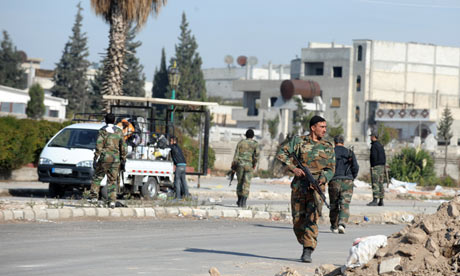 Syrian soldiers guarding the streets of Homs earlier this month. Photograph: Yin Bogu/Xinhua Press/Corbis
On Thursday morning, I woke up in Homs, the city labelled by the international media as the “capital of the Syrian revolution”.
Homs has been in more or less open revolt since at least April, but in recent weeks what is going on here has acquired ominous new significance. Facing the full force of a crackdown on their demonstrations by the Syrian army and police, at least some of the city’s residents have taken up arms, either to defend themselves and their communities or to go on the attack.
Outside Syria and in the international media, the siege has become a cause célèbre. But events here show not only the courage and the forbearance of its citizens, but also the traps that lie in wait for an unhappy people suppressed by a brutal military crackdown.
I was lucky to get here. It’s not quite true that all foreign journalists are banned from Syria, but it was extremely difficult to get in, even before the uprising, and those who succeed are carefully shepherded around. It took me two journeys back and forth from Beirut even to get across the border into Damascus.
After a few days there, I went to the bus station and bought a ticket to Homs. A policeman was on hand to check foreign passports, but fortunately he didn’t bother to check mine carefully – it clearly indicates, by means of a Syrian government stamp, that I am a journalist.
My second stroke of luck was to have been befriended by an 18-year-old boy as we boarded the bus. An engineering student on his way back home to Homs, he was concerned that here was an idiotic tourist about to get himself into trouble. “There are no tourists in Homs,” he told me, looking serious. “My mother and father are afraid to go out. Yesterday my sister saw a body in the street, and she’s been crying ever since.”
On arrival, he ushered me past any prying eyes and directly into a taxi, going out of his way to take me straight to a hotel in the city centre. The city centre is the only safe place, he said.
Homs is a city of more than half a million people in the heart of the country. It’s where Syrians go to escape the hustle of Damascus, to let their hair down in its cafes and restaurants, or watch football: Homs boasts two football teams, as well as a museum where tourists can read about the famous battles that were fought here.
Nowadays it’s fighting another battle: the city is under total military lockdown. The hotel I’ve been taken to overlooks the main square and its now infamous clock tower, where the Syrian army apparently ran amok and gunned down peaceful demonstrators in April.
Since then, the violence has moved into the residential areas, and into the shadows. In the weeks before my arrival the death rate rose, making it the most violent place in the country.
On the road into the city, we passed at least 50 military vehicles that were going in the same general direction: a convoy of long green buses, lorries carrying munitions, and trucks with weary-looking soldiers sitting in the back, smoking and sleeping.
There were no tanks, but on one lorry was mounted what looked like a huge gun. Near Homs I saw one tank sitting by the side of the road, guarding a broad, freshly dug ditch about 100 yards long by the side of the highway. It might have been a trench.
Here in the city centre, however, all is quiet. Funereal. The battles between the Syrian army, the demonstrators and unknown armed groups take place just a mile or two away from here in densely packed residential areas like Baba Amr; another flashpoint, the hotel manager tells me, is Bab al-Sebaa, just a few hundred yards up the road.
He looks at me quizzically, but doesn’t ask questions – he’s happy to have a customer, whoever I am. The hotel covers four spacious floors, but tonight I’ll be the only guest. Before the disturbances there were 75 staff here, but now there are only three during the day and one in the evening.
In my luxury business suite a huge cockroach is circling through the air in the bathroom; when I turn on the TV, it sizzles at the socket and then goes quiet. I was promised a room without a street window, just in case. But there’s no hot water, so I ask to be moved to another suite. This, too, has no hot water; it will be working very soon, he assures me.
I say I’m going to get some food, but the manager is gently solicitous. I shouldn’t really go out, he says – I can eat at the hotel. When I tell him I need to stretch my legs, he points out the window at a single shopping street. Walk down there, he says, but don’t go too far and don’t be too long. Trouble is only a few hundred yards away: a short walk in the other direction, and you enter Bab al-Sebaa.
As I walk through the retail district, people are emerging from government offices and there are signs of normality returning to the city; at a functioning street market, some business is being done. Across the road from the main square, a skinny man in a long leather jacket is staring around and barks instructions to another man.
People hurry along the street and don’t idle, going about their business under the gaze of authority. And even here, everyone shuts up shop in the afternoon and scurries home.
In an electronics showroom, beneath a huge poster of President Bashar al-Assad and his father, I get chatting to a young man of about 20; he seems prosperous, starting off the conversation by talking about his expensive car. He’s also a little guarded, suspicious of my interest. “Why did you come here? By accident? How did you get in? There are checkpoints. Didn’t you know that the army are here, that there’s fighting?”
Who are they fighting, I ask him – terrorists? “No. The people.” Whose side you are you on, I ask. Can you say? There are two other people in the shop; he grins and looks at the floor. “No,” he says, making a show of not answering. “I don’t want to say.”
There have been rumours of kidnaps, he says – paramilitaries from the president’s own Shia Alawite sect who tell drivers to go down a certain road and then kidnap or kill you. You can avoid getting hurt if you stay at home all evening, but it’s no life. “If this keeps up I’m going to emigrate,” he says. “Maybe to Australia, until things get better.”
A friend of his was arrested yesterday after a demonstration at nearby Kalamoon University, between here and Damascus – one of the jewels of Assad’s fitful programme of economic modernisation. “The police were using electrical prods,” he says.
Maybe I could take a taxi to look around the city, I ask. Don’t do that, he says – if the driver is a friend of the government he will take you to their offices, and you’ll be arrested for being a journalist. I hadn’t told him that I was a journalist. I don’t want to be arrested, I say: I have a plane to catch. He turns a little testy. “It’s OK for you,” he says. “All that will happen to you is that you’ll be deported.”
Have you seen the tanks, he asks. Not in the town centre, I say. There are some parked just a few streets away, he says; I’d take you, but the soldiers might see you if you get too close. After the Arab League decision to suspend Syria three days ago, they painted them blue. “It was their way of saying the tanks aren’t really tanks any more.” He laughs at the innocence of it.
Amazingly there are still sporadic demonstrations throughout the city during the day. In one cafe I walk into, two workers are leaning out the window as though listening for something – for a moment they thought they could hear slogans and chanting, one of them says, but it might have been something else.
On the same street I find a fancy patisserie where a well-dressed manager in his 30s is doing very little. When the other customer in the shop shuffles off, he becomes much more talkative, smiling at me, but also deadly serious.
“There are 5,000 killed here in the last six months,” he says, a figure much higher than official estimates. “There is no water, gas or electricity for most people here.” Now I know why my hotel has no hot water.
“Unesco send things here, but this is no good. We can’t go on like this.” He pats an imaginary child. “They are killing little children.”
Why did I come here, he wants to know. Aleppo is safe, he says: there are lots of safe places. Should the president go? “How can he stay,” he says, rolling his eyes, “after all this killing?” He knows this much: “I want my freedom.”
Does he support the Arab League’s suspension of Syria? He nods. Does he say these things to people?” “No,” he says, as if the answer should be obvious, and runs his index finger across his throat.
His boss, a small businessman who lives outside Homs, arrives and pulls down the shop’s shutters. Nobody is buying anything, and it’s getting dark. For the next few hours, over leaf tea and cake, we talk.
The businessman’s mobile phone keeps interrupting us, with friends chiding him for even going to Homs. When he’s here he doesn’t leave the shop, he says – just comes and goes.
On the television we switch between Syrian state TV and al-Jazeera. The former is showing a demonstration of 300,000 people in Damascus in support of the president. The shop manager is quieter now, but both my companions agree that the president can still muster a measure of support for his ability to hold the country together, even if not in Homs.
Al-Jazeera is showing grainy images on mobile phones of detainees being brutalised by soldiers, while Syrian state television is showing the bound, bloodied bodies of men it says were assassinated by terrorists in Homs. All of this must be happening just a mile or two away, but no one really knows who is doing what to whom.
“Eleven killed today in Homs,” chuckles the businessman blackly, reading the statistic from a TV channel. “Homs is now the big problem.”
It doesn’t help that Syria is a police state. In the vacuum, rumours multiply. As we eat our cake, the businessman treats us to some of them. There is a story, he says, that al-Jazeera is paying people $20,000 for photos taken on their mobile phone. The self-styled Free Syrian Army, an outfit that seems to be on the rise, and which is posting a lot of video on the internet, might be out there fighting, and if so the best of luck to them – on balance, however, he thinks that they’re an illusion puffed up by Turkey. It’s said that both the government and the opposition are paying people to attend their demonstrations in Damascus. And he’s heard it on good authority that the police are pretending that drug dealers and criminals are demonstrators; after all, he says, that way they’re “outside the law” and can simply be killed.
“All the conspiracies are true,” says the businessman. “Turkey and Qatar and the Saudis have their own axes to grind, and reasons to weaken Syria; they’re playing with us.
“Arabs,” he continues, “what have they done for us? They’re oh so concerned about us, but less keen when it comes to giving us visas to their countries.”
The shop manager agrees, but maintains he’s still proud to be Arab. Both can agree that they’re Syrian above all else. Nato gets no more than a snort; no Syrian, says the businessman, wants another Iraq. He doesn’t even want another Libya.
Syria is very far from being another Iraq – at least for the moment. From what little I saw, travelling back and forth between Damascus and Homs, the talk of “civil war” is premature and a little overheated. Most of Damascus is carrying on very much as normal, even if its residents are a little more hushed and fearful than usual. It’s in the capital’s suburbs – places such as Douma and Harasta, where huge swaths of the country’s neglected, humiliated poor live – that the demonstrations after Friday prayers occur.
But what’s embarrassing for the authorities about Homs, says the businessman, is that here the violence is taking place within the confines of the city itself; that’s why they’re cracking down so hard.
Taking pictures on your mobile phone can be enough to invite trouble. After people were gunned down in the huge demonstration at the clock tower in April, he says, Sana, the Syrian news agency, brought crowds and people armed with cameraphones to the main square to show that life was getting back to normal. But, according to the businessman, a police sniper saw the cameraphone snappers and opened fire. A few people were hurt. “Mistakes have been made,” he says, with another gallows chuckle.
He thinks that the president is a smart and decent man, undermined by shadowy forces within his own security establishment. “He didn’t sleep for three days after some of the killings, a friend of mine who knows told me.” But should the president stay in power and try to reform the system? “Too little, too late,” he says, with a flick of the wrist. “Go.”
The businessman is sleeping above the shop tonight, and the shop manager will walk the short distance home as usual. But he’s not happy about it: he’s had friends who have been hit by stray bullets.
Why not get a taxi, I ask. It’s becoming difficult, he says. Both my companions are Sunni, and both speak of discrimination against Sunnis in the country at large, but the shop manager says that taxi drivers are beginning only to pick up passengers from their own religious affiliation; the city itself, he says, is beginning to fragment along doctrinal lines. The businessman is not sure he agrees.
I walk back the 100 yards to the hotel with the shop manager and bid him goodnight. The hotel rooms are all unlocked and empty, so I walk around the place and spy on the streets down below. In the middle of a city of hundreds of thousands of people, there’s not a sound. Occasionally a few white army pickup trucks zoom up, and the soldiers jump out and investigate a building.
I sit a while with the hotel manager in the bar area. We look out, and see what at first looks like a man carrying a gun ambling down the street. Then we realise it’s an old woman carrying a bag. “She must be mad,” he says.
We retire to bed. During the night there’s the odd crackle of gunfire, and a small explosion, but nothing else.
In the morning I go out walking again and pay another visit to the electronics showroom. I hand over some money for internet access, but it doesn’t work. “Oh, that happens a lot,” the man says. “They shut it down, usually for only a couple of hours at a stretch. And especially on Thursday – the day before prayers.”
I walk a bit further, and meet the shop manager again; we’re walking in the same direction, towards the clock tower, where all that remains of the April demonstration is a single graffito in Arabic.
“There were 70,000 people here,” he says, “and the police were doing this”: he mimics the act of shooting from a machine gun. I bid him goodbye, afraid that he might draw attention; a few hundred yards away, two soldiers with Kalashnikovs are guarding a government building.
After another cursory attempt to walk up and down the few roads open to me, pretending to be a shopper, I give up. As a foreigner, I stick out like a sore thumb; not wanting to be arrested and have my notes taken, I return to my hotel room and pace up and down until it’s time to leave. In a way, it’s what the residents of Homs have been doing for the last seven months, only in much more gruelling conditions.
I want to get out of this hothouse, as quickly and as efficiently as possible. The businessman is going to Damascus, and offers to take me with him. As we go, we pass through the central square, the scene of many attacks. Hardly anyone is around, not even many soldiers; both sides are preparing for what might happen tomorrow, after prayers.
Turrets made out of sandbags are built up on one side of the road, where soldiers have dug themselves in. As we drive, the businessman confides that he, too, plans to emigrate – only for a few years, until things have got better.
Most people here, however, can’t afford to leave, even if they wanted to. Before we got into the car I went back into the pâtisserie shop one last time to buy some cake. The manager had a glint in his eye, and he said goodbye with a welcome. “Welcome to Syria,” he said, smiling his enigmatic smile. “Welcome to Homs.”
Hundreds of poor migrants are dying in Russia. Is that nation’s neo-Nazi movement to blame?
The Stream speaks with Erica Marat, a Central Asia researcher with the Jamestown Foundation, and Madeleine Reeves, a social anthropologist at the University of Manchester.
“Freedom of the press is guaranteed only to those who own one.”
The following is a the second half of an interview conducted by the new NYTimes eXaminer with PULSE co-editor Belén Fernández about her book The Imperial Messenger: Thomas Friedman at Work. Read the first half here.
Q: Did you come away with a lower opinion of Friedman or of the people and institutions that continually give him platforms to spew his idiotic, loathsome views? I find it so telling that, when Friedman did his “suck on this” performance on Charlie Rose, Rose just nods and leans in for the next question instead of calling Friedman out for saying one of the most offensive things ever said on television. Or to put it another way: Do you think the New York Times would allow one of their columnists to consistently dehumanize entire groups of people – to the point of openly calling for civilian deaths in Gaza, Afghanistan and Iraq – if those people weren’t Arab/Muslim?
Unfortunately, Orientalist dehumanization is institutionalized in US media discourse, the result being that there is no overwhelming public concern when over a million Iraq lives are lost thanks to America’s bellicose projects or when 1400 Palestinians perish in a matter of 22 days at the hands of the Israel Defense Forces.
It is utterly appalling that neither Charlie Rose nor anyone else in the US establishment media took issue with Friedman’s obscene proclamation, and that he was never required by his employer to apologize for it in the interest of maintaining a pretense of objectivity. One can imagine the uproar that would have ensued—and over which Friedman himself would have presided—had, for example, Yasser Arafat instructed Israelis to suck on things, or had Osama bin Laden justified 9/11 with similar terminology. Friedman, on the other hand, is permitted to continue blissfully peddling his contemptuous analyses of the Arab/Muslim world, such as his 2007 assessment—with regard to the US military—that Iraqis “don’t deserve such good people… if they continue to hate each other more than they love their own kids.”
Of course, it is safe to assume that most Iraqis exhibit normal human affection for their offspring, including for those millions of offspring that have been killed, maimed, displaced or otherwise made to suffer as a result of a US military-inflicted sucking, and that the half a million Iraqi children previously killed by US-championed sanctions were probably also loved by their parents.
Even if Charlie Rose et al. fail to comprehend that sucking orders do not qualify as proper journalistic etiquette, they should at least be able to comprehend that Friedman’s argument for why the sucking should occur is in complete defiance of logic. According to Friedman, Iraqis must be made to suck so that the US can effectively combat the “terrorism bubble” that has developed in “that part of the world” and that poses a “fundamental threat to our open society,” something Americans discovered on 9/11. However, this very same Friedman also explains that the real threat to “open, Western, liberal societies today” consists not of “the deterrables, like Saddam, but the undeterrables – the boys who did 9/11.” The resulting argument—made by someone who himself criticizes the Bush administration for implying a link between bin Laden and Saddam Hussein—is that war against deterrables whose weapons are not the problem will solve the problem of undeterrables who are the weapons and who by definition cannot be deterred anyway.
Regarding your question of whether I have a lower opinion of Friedman or of those who encourage and promote him, they are all part of the same system that rewards the willful subversion of human empathy on behalf of empire and capital. The system would naturally exist without Friedman; he just does his part to sustain it.
As for whether Friedman will ever be made to atone for his crimes, I’ve personally found that one effective means of stress relief is to ponder reincarnation options for him, an activity that he himself actually used to engage in on occasion in order to highlight what he deemed to be unethical behavior by certain sectors of the US citizenry. In a 2004 column entitled “In My Next Life,” for example, Friedman sarcastically described his desire for reincarnation as a college or professional athlete:
For a mere dunk of the basketball or first-down run, I want to be able to dance a jig, as if I’d just broken every record by Michael Jordan or Johnny Unitas. For the smallest, most routine bit of success in my sport, I want to be able to get in your face – I want to know who’s your daddy, I want to be able to high-five, low-five, thump my chest and dance on your grave. You talkin’ to me?
Why athletic grave-dancing is more offensive than telling entire populations to “suck. On. This” is unclear.
I would meanwhile suggest Friedman contemplate reincarnation as an Afghan civilian, an aspiration that might merit the following description (as well as sudden re-reincarnation):
“Yes, in my next life I want to be an Afghan civilian. I want to meet my demise by American B-52, and, when I do, I want the foreign affairs columnist of the US newspaper of record to place the ‘civilian’ portion of my identity inside quotation marks. I want him to take time out of his busy schedule of complaining about his own horrific experiences and the tendency of other diners to interrupt his restaurant meals with their cell phone conversations, and I want him to debunk the blasphemous idea espoused by the European and Arab media, according to which I had not actually been ‘praying for another dose of B-52’s to liberate [me] from the Taliban.
Did you find that Friedman tries to rewrite his own role in history, even though it’s quite easy to fact-check these days? For instance, I’ve noticed he often claims that he called for a $1/gallon “Patriot Tax” on gas on 9/12/01 when, in fact, he didn’t call for one until more than two years later – after both wars he had cheerled for were well under way.
Yeah, it’s not clear whether Friedman intentionally rewrites his own history or whether the rewriting is just a byproduct of the fact that he is employed in a position that does not require him to understand or keep track of what he himself thinks about things.
To give a very simple example of self-contradiction, Friedman announces 200 pages into his book The World Is Flat that Globalization 1.0 was the era in which he was required to physically visit an airline ticket office in order to make his travel arrangements. According to the definition provided at the start of the book, however, Globalization 1.0 ended around the year 1800.
On the subject of India, Friedman goes from arguing that “Indian democracy” and “economic liberalization” have enabled the high-tech industry in Bangalore to flourish, to arguing two years later that Bangalore high-tech firms “thrive by defying their political-economic environment, not by emerging from it.” Indian “democracy” is meanwhile additionally credited with the fact that “rioting didn’t spread anywhere” after the 2002 pogrom incited by the Hindu nationalist government of the state of Gujarat, in which several thousand Muslims were massacred. The article is perplexingly titled “Where Freedom Reigns,” in spite of the massacre of Muslims.
A month after declaring the war-based democracy experiment in Iraq “the most important task worth doing,” Friedman announces that he doesn’t “want to hear another word about Iraq” given that there is a sniper on the loose in Montgomery County, Maryland, who is forcing him to become well-acquainted with the delivery man from California Pizza Kitchen and to “duck… behind a pillar” while filling up his car with gas. He fails to add this to the list of reasons America must cease its dependence on oil, though he does subsequently go from insisting that George W. Bush renounce his limousine and set a “geo-green” example to exulting the following year over the fact that he himself is being chauffeured around Budapest in one. (Friedman goes as far as to provide his driver’s website—www.fclimo.hu—so that everyone can witness the capitalist evolution and integration into the global economy of a “Communist-era-engineer-turned-limo-proprietor,” but refrains from mentioning that none other than Bush is listed as a reference on the company’s website.)
A few more quick examples of Friedman’s historical revisions:
In 2005 Friedman declares the need for “a proper civil war” in Iraq. In 2011 he miraculously displaces the blame for civil war-mongering: “For all of the murderous efforts by Al Qaeda to trigger a full-scale civil war in Iraq, it never happened.”
In 2002 Friedman informs Saudi crown prince Abdullah that “the Jews of the Clinton administration are gone” and that their replacement “WASPs” of the Bush administration “couldn’t care less about the Israeli–Palestinian conflict. It is not an issue that resonates with them at all.” In 2003 Friedman announces that the Bush team “has fallen so deep into the pocket of Ariel Sharon you can’t even find it any more” and that Bush may “be remembered as the president who got so wrapped around the finger of Ariel Sharon that he indulged Israel into thinking it really could have it all—settlements, prosperity, peace and democracy.”
And so on.
One of the more intriguing things about Friedman’s rewriting of history is that he relentlessly plugs his friend Dov Seidman’s book How: Why How We Do Anything Means Everything … in Business (and in Life), according to which the centrality of blogs, Facebook, and YouTube to modern life ensures that “more and more of what you say or do or write will end up as a digital fingerprint that never gets erased.” Friedman provides the following illustrative anecdote in 2007:
Three years ago, I was catching a plane at Boston’s Logan airport and went to buy some magazines for the flight. As I approached the cash register, a woman coming from another direction got there just behind me — I thought. But when I put my money down to pay, the woman said in a very loud voice: ‘Excuse me! I was here first!’ And then she fixed me with a piercing stare that said: ‘I know who you are.’ I said I was very sorry, but I was clearly there first.
If that happened today, I would have had a very different reaction. I would have said: ‘Miss, I’m so sorry. I am entirely in the wrong. Please, go ahead. And can I buy your magazines for you? May I buy your lunch? Can I shine your shoes?’
Why? Because I’d be thinking there is some chance this woman has a blog or a camera in her cellphone and could, if she so chose, tell the whole world about our encounter — entirely from her perspective — and my utterly rude, boorish, arrogant, thinks-he-can-butt-in-line behavior. Yikes!”
It goes without saying that defending Israel’s strategy of inflicting mass civilian casualties in Lebanon in 2006, for example, does not in Friedman’s world qualify as rude, boorish, or arrogant behavior. This item from 2010 meanwhile suggests that Friedman is not overly preoccupied with the prospect of domestic cell phone cameras and blogs.
Punditry, like banking, seems to be a profession free of accountability. The more Friedman is wrong, the more Sunday morning shows he gets invited on. Is it time to Occupy Tom Friedman’s house? (He certainly has the room.)
It is definitely time to occupy Friedman’s house. I would advise incorporating an Arab and/or Muslim military into the endeavor and referring to the “occupation” only in quotation marks, as Friedman does following the US invasion of Iraq.
Incidentally, given the schizophrenic nature of his discourse, Friedman could conceivably be persuaded to advocate for the occupation of his own house if he were assured that in doing so he would somehow remain relevant to the effort to recuperate US glory.
Despite marrying into one of the one hundred richest families in the US, Friedman recently attempted to co-opt Occupy Wall Street by classifying it as an “effective” movement (in an interview with MTV, no less). Perhaps as a next step he should consider channeling his affection for Google Earth and the role it allegedly played in sparking the Arab uprisings—by alerting Bahrainis to the dimensions of the ruling family’s palaces—into an investigation of what his own 11,400-square-foot house looks like from the air.


