iranian short movie/ english and arabic subtitles
how similar dictatoships are
iranian short movie/ english and arabic subtitles
how similar dictatoships are
Balada para un loco Tango 1969 Música: Astor Piazzolla Letra: Horacio Ferrer Las tardecitas de Buenos Aires tienen ese qué sé yo, ¿viste? Salís de tu casa, por Arenales. Lo de siempre: en la calle y en vos. . . Cuando, de repente, de atrás de un árbol, me aparezco yo. Mezcla rara de penúltimo linyera y de primer polizón en el viaje a Venus: medio melón en la cabeza, las rayas de la camisa pintadas en la piel, dos medias suelas clavadas en los pies, y una banderita de taxi libre levantada en cada mano. ¡Te reís!… Pero sólo vos me ves: porque los maniquíes me guiñan; los semáforos me dan tres luces celestes, y las naranjas del frutero de la esquina me tiran azahares. ¡Vení!, que así, medio bailando y medio volando, me saco el melón para saludarte, te regalo una banderita, y te digo…
(Cantado)
Ya sé que estoy piantao, piantao, piantao…
No ves que va la luna rodando por Callao;
que un corso de astronautas y niños, con un vals,
me baila alrededor… ¡Bailá! ¡Vení! ¡Volá!
Ya sé que estoy piantao, piantao, piantao…
Yo miro a Buenos Aires del nido de un gorrión;
y a vos te vi tan triste… ¡Vení! ¡Volá! ¡Sentí!…
el loco berretín que tengo para vos:
¡Loco! ¡Loco! ¡Loco!
Cuando anochezca en tu porteña soledad,
por la ribera de tu sábana vendré
con un poema y un trombón
a desvelarte el corazón.
¡Loco! ¡Loco! ¡Loco!
Como un acróbata demente saltaré,
sobre el abismo de tu escote hasta sentir
que enloquecí tu corazón de libertad…
¡Ya vas a ver!
(Recitado)
Salgamos a volar, querida mía;
subite a mi ilusión super-sport,
y vamos a correr por las cornisas
¡con una golondrina en el motor!
De Vieytes nos aplauden: “¡Viva! ¡Viva!”,
los locos que inventaron el Amor;
y un ángel y un soldado y una niña
nos dan un valsecito bailador.
Nos sale a saludar la gente linda…
Y loco, pero tuyo, ¡qué sé yo!:
provoco campanarios con la risa,
y al fin, te miro, y canto a media voz:
(Cantado)
Quereme así, piantao, piantao, piantao…
Trepate a esta ternura de locos que hay en mí,
ponete esta peluca de alondras, ¡y volá!
¡Volá conmigo ya! ¡Vení, volá, vení!
Quereme así, piantao, piantao, piantao…
Abrite los amores que vamos a intentar
la mágica locura total de revivir…
¡Vení, volá, vení! ¡Trai-lai-la-larará!
(Gritado)
¡Viva! ¡Viva! ¡Viva!
Loca ella y loco yo…
¡Locos! ¡Locos! ¡Locos!
¡Loca ella y loco yo!
Full transcript of interview with Paolo Dall’Oglio, italian jesuit in Syria. News item can be read here.
Transcrição completa da entrevista com Paolo Dall’Oglio, jesuita italiano na Síria. Leia a notícia aqui.
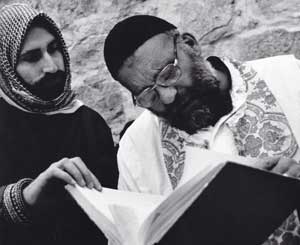
| Padre Paolo no mosteiro de Deir Mar Musa |
Ahmed AlomariI am the child listed as “number 50” in the lists you have been sharing since last night. I don’t have much to say to you… I have only one thing I’d like to say, but I forget what it is… Everything happened really fast. After the shelling that had started in the morning began to die down, they broke down the door. They came inside and took us with them, they separated us from my mother. They took me and my three siblings. My baby sister was in my mother’s lap, she was sick two days ago. They grabbed her. My mother screamed. Later I heard one of the thugs curse at my mother and then hit her. The last thing I heard from her was her screaming: “My babies!” My father was not with her…we did not know where he was. They took him a week ago from the checkpoint. We haven’t seen him since, and we haven’t heard any news about him. I don’t have much to say to you about what happened that night…only one thing. They threw us into a large car filled with children around my age. They were crying. Some of them were infants. Their screaming was really loud. The driver was cursing at them. The car stopped near a house at the edge of the village, near the field that I used to play in with my friends. The thug opened the door and ordered us to get out as he was cursing us and beating us. Every time someone stepped out he beat them. He was saying many curse words. I knew some of them. My mother used to warn me not to say them. Others I never heard before. But I understood they were bad words. I don’t have much to say to you… The thug beat me on my back as I stepped out of the car. I was carrying my baby sister. I fell on the ground and my sister fell from my hands. The thug laughed and called me a stupid Sunni. When we entered the house I saw that there were many children. Most of them had their hands tied. Some of them were crying, but not many. Only the infants were crying. There were other thugs there. One of them said that they didn’t have any more ropes. Another one replied: “We’ll just kill a few of them, we can use their intestines as ropes.” They all laughed. My sister began to cry. They left us for a while. My sister asked me what they would do with us. I knew what they would do, but I told her that I didn’t. I think she also knew. She cried and said she wanted our mother. My brother also cried and said he wanted our father. I knew we would meet him soon. I don’t have much to say to you. Everything happened really fast. The room was crowded and many of the children were crying and asking for their mothers. The new thug walked into the room. He smelled even worse than the others. He cursed a lot. He cursed us, and cursed God and Islam. I knew him. His son went to school with me. We used to play together in that field next door. The thug carried a knife in his belt. He took it out of its sheath. The sounds of crying became louder. And the sound of thugs laughing also became louder. He said he hadn’t smelled blood in 3 days and that he missed it. Another thug replied to him while laughing: “We killed the three guys that we grabbed from the checkpoint yesterday…did you forget?” He said: “yes…it feels like it was forever ago.” He cursed again. He took a step forward with the knife in his hand. Everyone moved back and the screams got louder. “Who should we start with my pretties?” he said as he laughed. “Who will be the first dead corpse?” I expected everyone to scream…I expected the crying to increase. However the exact opposite happened. Everything was silent. It was as if everyone wanted it all to just be over. The thug with the horrible smell walked up to a little girl with blonde hair. She was shaking. He grabbed her from her hair. He said to her: “I wanted to **** but slaughtering you is also fun.” She was shaking. She was begging him saying “Please sir”..”Please don’t…” He placed the knife at her throat and quickly cut it. Before she could even finish her sentence he was holding her head in his hands. He started pointing it at us all. He was holding it from her hair as the blood dripped from it. Her body was on the ground and blood was spraying at us all. The sounds of crying became louder. There was a young girl crying and saying the Shahada (Declaration of Faith, La Ilaha Illa Allah, There is no God but Allah) in a loud voice. He grabbed her and said: “This is for the Shahada,” and he stabbed her in the throat and cut out her larynx and threw it at us. But the girl reminded us of the Shahadah, so we all started saying it. We remembered what we used to hear, that whoever says the Shahadah before dying will be in heaven. So we started saying it. He got irritated and began slaughtering faster. The sound of crying began to mix with the sound of what I realized was their bodies shaking as they were being slaughtered. Those sounds also mixed with the sounds of Shahada and the sounds of laughter and cursing coming from the thugs as they watched. I saw my cousin Samer as the thug took a hold of him. I hadn’t noticed him before. Samer was quiet, unlike his usual self. But as he was being slaughtered, she shook violently and ran. His head was slightly hanging to the side of his neck, but he ran towards me. As if he wanted me to save him. The blood sprayed from him like a fountain. I found the blood covering my face. I moved back until the wall was directly behind me. I think I was in the corner. I couldn’t see because the blood was covering my eyes. But I didn’t wipe it off. I preferred not to see. I don’t have much to say to you, but I remembered you all at that moment. I remembered what my cousin Abdulrahman said to me, my cousin that joined the Free Syrian Army a month ago. Abdulrahman was a student in the University, he has a computer in his room and he used to let me play games on it. One day he showed me a page that he said you all visited. He told me that when one of us is martyred that you write about them on that page. I forgot what it was called. I asked him if you all were sick or handicapped or something…he laughed and said: “something like that.” I remembered you… I don’t have much to say to you…maybe only one word. It was on the tip of my tongue, but I forgot it. Later I couldn’t see anything. I was in the corner and I could only hear. I was sure that my sister had been slaughtered…I heard her calling for my mother. I remembered my mother. I heard a thug say he needed a new knife because the one he had turned dull. The other thug said: “Even better! They’ll feel more pain that way.” I don’t remember much after that…The same sounds began to repeat themselves. I started to differentiate the sound of blood as it flowed. Whenever the sounds of crying decreased I realized that my turn was coming. Suddenly I realized that he came closer to me, his wretched smell was easily distinguishable even with the smell of blood. He grabbed my neck… I remember now what I wanted to say to you at that moment. I spit on you all and I don’t apologize from anyone… The disgusting thug placed his knife on my neck… Original Arabic article written by Ahmed Alomarihttps://www.facebook.com/Ahmedkalomari |
:: Article nr. 88394 sent on 28-may-2012 18:01 ECT
 |
|
May 27, 2012 |
I was told a story once. It was about what happens to disgraced generals when they are arrested by the secret police. First they are dragged to the interrogation centre. There, they stand them up in a room, and the lowliest conscript walks up to him and tears off his lapels and insignia. They are thrown at his feet. Then the conscript raises his hand and with one fell swoop he slaps the officer on the face. I don’t know how to express the slap in English with the same weight it is given in Arabic. To give somebody a kaff is, I think, a grave insult. It cuts to the core of you in a way that the lowly punch never could. Whether it hurts more or less is up for debate, but the kaff is the final crossing of the line. There is no going back from it. In Syrian drama, the climax of an altercation between a man and his wife is when he gives her the kaff. The music stops, the face is frozen in shock, and the man immediately regrets what he has done, because he knows his wife will never forgive him, and will never forget. There is never anything to say after the kaff.

Photo: Department of Defense
America’s top military officer condemned in the strongest possible terms a Defense Department course that taught troops to prep for a “total war” on Islam using “Hiroshima”-style tactics.
“It was totally objectionable, against our values and it wasn’t academically sound,” Army Gen. Martin Dempsey, the chairman of the Joint Chiefs of Staff, told reporters at a Pentagon press conference on Thursday. The instructor responsible for the course, Army Lt. Col. Matthew A. Dooley, is “no longer in a teaching status,” Dempsey added — but he is still employed at the Joint Forces Staff College in Norfolk, Va.
Dempsey’s comments were prompted by a Danger Room report on Thursday that described Dooley’s course in detail. For at least a year, Dooley taught an optional course at the college for lieutenant colonels, colonels, commanders and Navy captains that proposed taking a war on Islam “to the civilian population wherever necessary,” which he likened to the bombardment of Dresden and nuclear destruction of Hiroshima and Nagasaki. Guest lecturers in the course encouraged those senior officers to think of themselves as a “resistance movement” to Islam.
Dempsey and his deputy for military education, Marine Lt. Gen. George Flynn, pulled the plug on the course last month. The general said he was “quite thankful” for an unnamed military officer who brought word of the anti-Islam material to his attention. Dempsey and his staff launched an investigation into “what motivated that elective to being part of the curriculum,” as he put it on Thursday, and the general also sent a letter to the heads of every military service and regional command instructing them to jettison any similar material, as per a White House directive issued last fall.
The inquiry, conducted by Army Maj. Gen. Frederick Rudesheim, is scheduled to conclude on May 24. Any disciplinary action against Dooley; the college’s commandant, Maj. Gen. Joseph Ward; or any other officer is contingent on its findings.
“Final judgment should await General Rudesheim’s findings, but it’s not too early to say that these excerpts are offensive (though that word may be a bit mild here),” e-mails Douglas Ollivant, a retired Army lieutenant colonel and Iraq veteran who has taught at the U.S. Military Academy at West Point. “Further, presentations like this do real harm to those trying to carefully distinguish extremism and support for it from otherwise admirable religious devotion.”
The harm perpetuated on student officers “who accepted the implied authority of the instructor,” Ollivant added, “is obvious.”
The military is hardly alone in dealing with anti-Islam instructional material passing itself off as responsible counterterrorism. Over the years, hundreds of documents claiming “mainstream” Muslims are “violent” have made their way into FBI curricula, alongside internal claims that agents working on counterterrorism cases could “bend or suspend the law.”
“Plenty of U.S. military officers and troops were inspired by their service in either Iraq or Afghanistan to learn Arabic or Dari and study the peoples of the region. I left the Army in 2004, as a matter of fact, to pursue a master’s degree in Middle Eastern Studies at the American University of Beirut,” says Andrew Exum, a retired Army captain who now serves as a senior fellow at the Center for a New American Security. “But plenty of other officers and troops began their own amateurish studies of Islam and now, like Lt. Col. Dooley, peddle claims to know the truth about the violence and hatred at the heart of Islam. Pope’s warning that a little learning can be a dangerous thing is certainly relevant here. These hucksters, like the Robert Spencers of the world, know just enough to make themselves sound credible to an uninformed audience and hide their prejudices under a thin layer of amateurish, ideologically motivated scholarship.”
bandannie agrees with this article up to a point; one cannot deny the influence of some muslim extremists who exploit the wrath and the exasperation of young people like Merah
By Abubakr ⋅ March 28, 2012 ⋅ Post a comment
Mohamed Merah was born in Toulouse.
He died in Toulouse.
In 2008, he attempted to join the French army, but was rejected. The motivations for his murders: the French military presence in Afghanistan Afghanistan, and French society’s attacks on Islamic forms of dress.
These are all French issues. Mohamed Merah is a product of modern French society, a symptom of the many terrible problems that that society faces. A society that propels far-right fascist politicians to seriously compete for the presidency, only 67 years after the end of a war where the French themselves fought fascism.
And yet in no way has he been described as a Frenchman gone bad; a product of the French environment. No, he is a Muslim, an Islamist, an Algerian, an Arab.
See, the word ‘terrorist’ cannot be associated with the word ‘French’. Put it next to the others and we’re good.
But isn’t France’s failed attempt at creating a one-size-fits-all homogenous society also partly to blame? Aren’t these attacks also a result of a society that places its poor, deprived ethnic minorities in squalid banlieues, out of sight on the outskirts of the main cities? A society where an unpopular president plays on racist and Islamophobic themes to garner more votes, rather than confront them.
That is the reality of today’s France.
You put people in a corner, and eventually, horribly, they’ll lash out in a terrible manner.
And how exactly are French Muslims being put into a corner? Well, let’s look at some recent examples.
We have Sarkozy’s recent statements on immigration, where he declared that there were ‘too many foreigners in our territory.’ The irony, of course, being that Sarkozy’s father was a Hungarian immigrant, and his own wife, the glamorous Carla Bruni, is Italian. Those who the speech was directed to understood who Sarkozy was attacking. The French far-right don’t care so much about European immigration – it’s the Muslims that are their main concern.
In fact, Sarkozy is trying so hard to win the anti-Islam vote that he is stealing extreme right policies, even when he has previously criticised them. When Marine Le Pen, the leader of the Front National announced that halal meat was invading French society, Sarkozy said that she was whipping up controversy. However, he then went on to announce that halal meat was the “issue that most preoccupies the French.” Well, the ones he’s seeking to get the votes of, anyway.
And of course, there is the ban on Muslims praying in the street. Whilst it is definitely preferable that Muslims not pray on the streets, in many instances they are forced into it, because of a lack of mosques. There are only 4 in France’s second city, Marseille, a city that’s population is 10% Muslim. If the issue of praying on the streets were about public safety and congestion then Sarkozy would seek to rectify this issue of a lack of mosques. Instead, the ban can only be seen as yet another attack on Muslims as elections near.
But isn’t France’s failed attempt at creating a one-size-fits-all homogenous society also partly to blame?
These issues aren’t new. Muslims have lived in France for over 100 years, and the problems remain the same. Muslim resentment of the situation is also longstanding. Whether it’s the riots that rip through France’s cities every so often, or the government’s continued refusal to apologize for the atrocities committed in Algeria during the colonial period; French Muslims are made to feel like the enemy within.
What Mohamed Merah did was a vicious crime, and one that shouldn’t be swept away by simply describing the man as crazy – unlike certain soldiers in Afghanistan. This piece should not be read as a justification for his crimes. However, let’s remember that, even if it has been barely mentioned, Merah killed Muslims too, Muslims who put their lives on the line for liberté, égalité, fraternité. Yet many in modern French society do not see them as equal. They are still the guestworkers, the foreigners, only in France temporarily.
But that does not take away from the reality – the Merah killings are a product of France, and not of Islam.

