Search

band annie's Weblog

I have a parallel blog in French at http://anniebannie.net

Category

Uncategorized

Shock and Awe versus Dentists, Farmers and Students

Robin Yassin-Kassab's avatarQunfuz

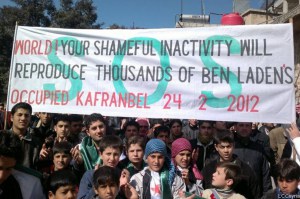
binladensWhatever the hearts-and-minds rhetoric at the United Nations, in Syria the Obama administration is feeding the flames of Sunni extremism, and proving once again the truism that the American state is an enemy of the Syrian people (as it’s an enemy, like all states, of all peoples, including the American).

We expected strikes on ISIS. Some of the strongest strikes (and the strikes are far stronger than in Iraq), however, have been aimed at Jabhat al-Nusra (the Victory Front), the organisation from which ISIS split. Nusra is certainly an extremist Salafist group, and is openly linked to al-Qa’ida. Because its ideology terrifies not only minorities but also huge swathes of the Sunni population, it’s also a strategic obstruction in the way of the Syrian revolution. In August 2013 it participated (with ISIS) in the only documented large-scale massacre of Alawi civilians in the conflict. On the other hand, Nusra (unlike…

View original post 1,315 more words

في دمشق

Inside ‘Ayn al-Islam: Islamic State Hostage John Cantlie Reports from the Ground in Kobane

SHORT FILM “JAFAR” (by Nancy Spetsioti)

CAST

NATALIA DRAGOUMI – VLADIMIROS KIRIAKIDIS – NIKOS PSARRAS 
CHARA TSIONGA – WASEEM AKTAR – GEORGIA KATSIKONOURI

PRODUCER: DIMITRIS GALANOPOULOS 

DIRECTOR: NANCY SPETSIOTI – SCRIPT: KATERINA KOUTSOMITI

CINEMATOGRAPHY: MICHALIS GERANIOS – EDITING: YIANNIS PARASKEVOPOULOS – MUSIC: CONSTANTINOS ZACHAROPOULOS – SOUND: DIMITRIS IOSIFELIS – COSTUMES: TASOS DIMAS, SOFIA KOTSIKOU, CATERINA CHALIOTI – MAKE-UP: SOFIA MICHA – PRODUCTION MANAGER: IOANNA PAKA 

PRODUCTION: http://www.iconastudioathens.gr

Isil’s reign of terror rooted in the political culture of Iraq and Syria

Isil’s extreme cruelty and filmic savagery has shocked the world, but it is not very different from what leaders of Iraq and Syria – and to some extent their colonial predecessors – have been doing to local people for decades


Isil’s ‘Caliph’ Abu Bakr al-Baghdadi

By Richard Spencer, Dohuk, northern Iraq

7:00PM BST 04 Oct 2014

The beheading of Alan Henning was not Isil’s first, as we all know full well, nor will it be the last. But by ignoring pleas for mercy from across the Muslim world, the group set any doubt to rest as to the nature of its need for video horror violence.

That violence is in part religious – a public insistence that its own ultra-aggressive interpretation of Islam is more “authentic” than the wishy-washy versions of Muslim politicians, scholars and ordinary people who want to live peacefully and get on with the modern world.

It demands recognition that Islam can be spread by the sword in the 21st century, just as much as it was in the 7th.

The violence is also rooted in the political culture of Iraq and Syria, the countries from which Islamic State of Iraq and the Levant has sprung.

The extreme cruelty with which Isil’s “Caliph” Abu Bakr al-Baghdadi and his predecessors have avenged themselves on Westerners has revealed a culture of violence to an international public. But it is not very different from what these countries’ leaders – and to some extent their colonial predecessors – have been doing to local people for décades.

Most importantly and specifically, the violence reflects a need to show a continuous momentum. Success, however horrific, breeds success; if you depend on apparently psychopathic behaviour to press your advance, you need to recruit more psychopaths, and to show it works.

A United Nations report last week showed the importance of this sense of momentum. The headlines were full of the admirable words of Human Rights reportage: it talked of “gross abuses of human rights that have been perpetrated by Isil and associated armed groups, with an apparent systematic and widespread character”.

What that doesn’t capture is the constant movement and repetition of Isil’s actions, the reiteration of its overwhelming purpose. The greater the violence, the more the idea that this is a zero-sum game, a question put to Sunni Muslims of whether they want to be winners or losers, is rubbed home.

In June, The Sunday Telegraph reported how an Isil pickup truck killing party swept through Turkmen Shia villages in northern Iraq, killing scores of people at random – old men gunned down outside their homes, women shot dead as they fled. Any sign of trying to hide was doubly punished.

That is, by now, the well-recognised modus operandi of the group, showing their followers that they have the strength and ruthlessness to lead.

But as with everything Isil does, there was a twist.

Six weeks after the Telegraph interviewed survivors in a half-built mosque where they had taken refuge in a town nearby, Isil came back.

The jihadists set off a car bomb near the building site, killing 12 of those inside, including Abdulwahid Reza Kahir, the patriarch of one of the families.

An old man in a turban and farmer’s robe, already mourning the random killings of his son, cousins, nephews, including a 15-year-old: there was no precisely definable military or political purpose to his death, other than to show that, for jihadists, anything is possible.

There will be no end to the harrying of the enemy, an idea that is writ through the history of conquest.

It is easy to say that the national psychosis which gave rise to Isil was triggered by the American and British invasion of 2003. There is of course some truth in that: al-Baghdadi’s inspiration is Isil’s founder, Abu Musab al-Zarqawi, who also ordered the filming of decapitations of western hostages, sawing off the head of the American Nicholas Berg himself.

Abu Musab al-Zarqawi (Reuters)

Zarqawi was already a local al-Qaeda leader, but his particular brand of filmic savagery, mostly inflicted on Iraqi Shia, flourished in the lawlessness and increasing sectarianism of the country in the wake of the invasion. It is a platitude that the absence of order allows deranged men to prosper.

The defeat of Saddam Hussein also fed into the widespread Middle Eastern perception that Sunni Islam is under particular threat in the Arab world, is suffering an Arab equivalent of what the Chinese call “a century of humiliation”: colonial rule, the existence of the state of Israel and its repeated defeat of its (Sunni) Palestinian enemies, the economic catastrophes represented by Egypt and Yemen.

For those with ethnic or sectarian inferiority complexes – in this case both – there is a primal appeal in seeing your foe kneel before you and die.

However, the idea that politics is not just occasionally violent, but requires of its essence demonstrative violence, long predates 2003.

The modern Iraqi state is founded upon it. When the royal family, imposed by the British Empire in its dying days, was overthrown by a coup in 1958, the prime minister was not only shot dead with the king.

His corpse was dragged through the streets of Baghdad, publicly hanged and then burned.

The fate of the coup leader, Abdul Karim Qasem, when he was in turn overthrown five years later, is even more reminiscent of Isil’s approach to the media. He was shot on live television, and the state network’s camera rested on his bloodied corpse for the rest of the day, army officers occasionally intruding to insert a knife to prove his death for the viewer.

The lawlessness, in other words, is not just a product of the absence of a state, but written into the state. In Syria next door, ordinary people routinely tell stories of similarly pointless horrors, that served some political purpose while having little apparent rationality, from long before the civil war.

One Christian friend describes watching, as a child, her nine-year-old playmate next door being lined up against a wall and executed, after the Muslim Brotherhood uprising in 1982.

Another describes how a secret school truant smoking session in a Damascus cemetery was broken up by police who wrongly thought the teenagers were drug dealers. One boy disappeared, arriving home without his finger nails a few days later.

These are just stories plucked at random.

In war, everything escalates. The same regime that did these “small”, local crimes then began mutilating corpses of teenagers who opposed it. In 2011 one 13-year-old boy was sent home without his penis. From then on, anything was possible, impunity was written into the code of conduct. Impunity’s apotheosis was the attack by a regime militia on the town of Baniyas, where among the 400 victims, many of them children with their throats cut, was a pregnant woman whose body had been cut out so her foetus could be killed too.

Like Isil, the militia’s leader boasted publicly for the camera of what he was about to do.

These victims were, in the nature of the war, Sunni. The need to see your enemy kneel and die in a pool of blood is common to both extremes.

Can the West do anything to stop this? It should only try with humility. It is all too easy to find pictures on the Internet of Western soldiers – French, Italian, even British – posing for pictures with the heads of their colonial victims in the all-too-recent past.

There is no start point to the cycle of violence.

We do, however, have the experience of putting back together what is psychologically broken, as Syria and Iraq undoubtedly are. Whether that can be done from the air, or even in the halls of the United Nations, is another matter.

source


Muhammad Ali -Then And Now (Documentary with David Frost)

How Netanyahu provoked this war with Gaza

His antagonism to all Palestinians – to Mahmoud Abbas’ Palestinian Authority no less than to Hamas – started and steadily fueled the chain reaction that led to the current misery.

On Monday of last week, June 30, Reuters ran a story that began:


Prime Minister Benjamin Netanyahu accused Hamas on Monday of involvement, for the first time since a Gaza war in [November] 2012, in rocket attacks on Israel and threatened to step up military action to stop the strikes.

So even by Israel’s own reckoning, Hamas had not fired any rockets in the year-and-a-half since “Operation Pillar of Defense” ended in a ceasefire. (Hamas denied firing even those mentioned by Netanyahu last week; it wasn’t until Monday of this week that it acknowledged launching any rockets at Israel since the 2012 ceasefire.)

So how did we get from there to here, here being Operation Protective Edge, which officially began Tuesday with 20 Gazans dead, both militants and civilians, scores of others badly  wounded and much destruction, alongside about 150 rockets flying all over Israel (but no serious injuries or property damage by Wednesday afternoon)?

We got here because Benjamin Netanyahu brought us here. He’s being credited in Israel for showing great restraint in the days leading up to the big op, answering Gaza’s rockets with nothing more than warning shots and offering “quiet for quiet.” But in fact it was his antagonism toward all Palestinians – toward Mahmoud Abbas’ Palestinian Authority no less than toward Hamas – that started and steadily provoked the chain reaction that led to the current misery.

Israeli tanks on the border with Gaza. (photo: Activestills)

And nobody knows this, or should know it, better than the Obama administration, which is now standing up for Israel’s “right to defend itself.”

It was Netanyahu and his government that killed the peace talks with Abbas that were shepherded by U.S. Secretary of State John Kerry; the Americans won’t exactly spell this out on-the-record, but they will off-the record. So a week before those negotiations’ April 29 deadline, Abbas, seeing he wasn’t getting anywhere playing ball with Israel and the United States, decided to shore things up at home, to end the split between the West Bank and Gaza, and he signed the Fatah-Hamas unity deal – with himself as president and Fatah clearly the senior partner. The world – even Washington – welcomed the deal, if warily so, saying unity between the West Bank and Gaza was a good thing for the peace process, and holding out the hope that the deal would compel Hamas to moderate its political stance.

Netanyahu, however, saw red. Warning that the unity government would “strengthen terror,” he broke off talks with Abbas and tried to convince the West to refuse to recognize the emerging new Palestinian government – but he failed. He didn’t stop trying, though. At a time when Hamas was seen to be weak, broke, throttled by the new-old Egyptian regime, unpopular with Gazans, and acting as Israel’s cop in the Strip by not only holding its own fire but curbing that of Islamic Jihad and others, Netanyahu became obsessed with Hamas – and obsessed with tying it around Abbas’ neck. Netanyahu’s purpose, clearly enough, was to shift the blame for the failure of the U.S.-sponsored peace talks from himself and his government to Abbas and the Palestinians.

But it wasn’t working. Then on June 12 something fell into Netanyahu’s lap which he certainly would have prevented if he’d been able to, but which he also did not hesitate exploiting to the hilt politically: the kidnapping in the West Bank of Gilad Sha’ar and Naftali Fraenkel, both 16, and Eyal Yifrah, 19.

Netanyahu blamed Hamas for the kidnapping. He said he had proof. To this day, neither he nor any other Israeli official has come forward with a shred of proof. Meanwhile, it is now widely assumed that the Hamas leadership did not give the order for the kidnapping, that it was instead carried out at the behest of a renegade, Hamas-linked, Hebron clan with a long history of blowing up Hamas’ ceasefires with Israel by killing Israelis. Besides, it made no sense for Hamas leaders to order up such a spectacular crime – not after signing an agreement with Abbas, and not when they were so badly on the ropes. Khaled Meshal, while refusing to confirm or deny giving the order, and saying he had no idea of the three boys’ whereabouts, lauded the kidnapping as a means of freeing Palestinian prisoners. This showed a certain moral idiocy on Meshal’s part, and on the part of his audience – the many, many Palestinians who likewise cheered the kidnapping – but it did not show that the Hamas leadership had ordered the deed. And we are still waiting to see that proof.

Israeli soldiers in the West Bank city of Hebron take part in the search operation for three kidnapped Israeli teenagers, June 18, 2014. (Photo by Oren Ziv/Activestills.org)

 Netanyahu used the kidnappings to go after Hamas in the West Bank. The target, as one Israeli security official said, was “anything green.” The army raided, destroyed, confiscated and arrested anybody and anything having to do with Hamas, killed some Palestinian protesters and rearrested some 60 Hamasniks who had been freed in the Gilad Shalit deal, throwing them back in prison.

Meanwhile, in Gaza, Israel had already escalated matters on June 11, the day before the kidnappings, by killing not only a wanted man riding on a bicycle, but a10-year-old child riding with him. Between that, the kidnappings a day later and the crackdown on Hamas in the West Bank that immediately followed, Gaza and Israel started going at it pretty fierce – with all the casualties and destruction, once again, on Gaza’s side only.

Read: ‘They left us no choice’ – On military escalation and its Israeli rationale

And that was basically it. Netanyahu had given orders to smash up the West Bank and Gaza over the kidnapping of three Israeli boys that, as monstrous as it was, apparently had nothing to do with the Hamas leadership. Thus, he opened an account with Israel’s enemies, who would wish for an opportunity to close it.

On June 30, the bodies of the three kidnapped Israeli boys were found in the West Bank. “Hamas is responsible, Hamas will pay,” Netanayhu intoned. That payment was delayed by the burning alive of Mohammed Abu Khdeir, 15, which set off riots in East Jerusalem and Israel’s “Arab Triangle,” and which put Israel on the defensive. It probably encouraged the armed groups in Gaza to step up their rocketing of Israel, while Netanyahu kept Israel’s in check. Then on Sunday, as many as nine Hamas men were killed in a Gazan tunnel that Israel bombed, saying it was going to be used for a terror attack. The next day nearly 100 rockets were fired at Israel. This time Hamas took responsibility for launching some of the rockets – a week after Netanyahu, for the first time since November 2012, accused it of breaking the ceasefire.

And the day after that, “Operation Protective Edge” officially began. By Wednesday afternoon, there were 35 dead and many maimed in Gaza, Israelis were ducking rockets, and no one can say when or how it will end, or what further horrors lie in store.

Netanyahu could have avoided the whole thing. He could have chosen not to shoot up the West Bank and Gaza and arrest dozens of previously freed Hamasniks (along with hundreds of other Palestinians) over what was very likely a rogue kidnapping. Before that, he could have chosen not to stonewall Abbas for nine months of peace negotiations, and then there wouldn’t have even been a unity government with Hamas that freaked him out so badly – a reaction that was, of course, Netanyahu’s choice as well.

But Israel’s prime minister is and always has been at war with the Palestinians – diplomatically, militarily and every other way; against Abbas, Hamas and all the rest – and this is what has guided his actions, and this is what provoked Hamas into going to war against Israel.

Related:
Live blog: Escalation in Gaza – July 2014
Dispatch from Gaza: You can never be emotionally ready
Why Netanyahu will lose this Gaza war, too

Newsletter banner 6 -540

source

Depleted Uranium And The Iraq War’s Legacy Of Cancer

In Archive, Iraq, News, USA on July 3, 2014 at 2:10 AM

Depleted uranium was used in Iraq warzone weaponry, and now kids are playing in contaminated fields and the spent weapons are being sold as scrap metal.

IRaq uranium

As instability in Iraq is forcing the United States to consider a third invasion of the Middle Eastern nation, the consequences of the first two invasions are coming into focus. For large sectors of the Iraqi population, American intervention has led to sharp spikes in the rates of congenital birth defects, premature births, miscarriages and leukemia cases.

According to Iraqi government statistics, the rate of cancer in the country has skyrocketed from 40 per 100,000 people prior to the First Gulf War in 1991, to 800 per 100,000 in 1995, to at least 1,600 per 100,000 in 2005.

The culprit behind all of these health issues is depleted uranium, a byproduct of uranium enrichment. With a mass fraction a third of what fissile uranium would have, depleted uranium emits less alpha radiation — up to 60 percent less than natural uranium, according to the U.S. Department of Defense. This “relative” safety offered a rationale for many nations — particularly, the U.S. — to put the waste material to use.

As depleted uranium is 1.67 times denser than lead, a depleted uranium projectile can be smaller than an equivalent lead projectile but produce similar results. This smaller size means a smaller diameter, less aerodynamic drag and a smaller area of impact, meaning that depleted uranium bullets can travel faster and inflict more pressure on impact, causing deeper penetration. Additionally, depleted uranium is incendiary and self-sharpening, making depleted uranium ideal for anti-tank ammunition. It is also used as armor plating for much of America’s tank fleet.

The problem with using depleted uranium, however, lies in the fact that depleted uranium is mostly de-energized. In practical terms, depleted uranium can have — at a minimum — 40 percent the radioactivity of natural uranium with a half-life that can be measured in millennia (between 703 million to 4.468 billion years). While the depleted uranium presents little to no risk to health via radiation due to its relatively weak radioactivity, direct internal contact with the heavy metal can have chemical toxicity effects on the nervous system, liver, heart and kidneys, with DNA mutations and RNA transcription errors being reported in the case of depleted uranium dust being absorbed in vitro.

While depleted uranium is not as toxic as other heavy metals, such as mercury or lead, pronounced toxicity is still possible through repeated or chronic exposure.

The politics of depleted uranium

With the Iraqi government currently crippled by the insurgency efforts of the Islamic State of Iraq and Syria — a group requesting that it be known simply as “the Caliphate” or “the Islamic State,” reflecting its perceived lack of challenge to its claims — and with the U.S. and the United Kingdom holding to the stance that depleted uranium presents no direct threat to Iraqi civilians, there is no active effort to properly dispose of the material.

As little information on the dangers of the material has been shared with the Iraqi people, depleted uranium and depleted uranium-tainted metals are regularly sold for scrap metal and re-used for any numbers of purposes — including machinery parts, cookery implements and home furnishings. Children play in depleted uranium-contaminated fields, which presents a heightened risk of unintentional ingestion due to hand-to-mouth activity. Abandoned vehicles salvaged for metal present a particularly high risk, as depleted uranium dust could accumulate from depleted uranium munitions, without access to an active airflow to dissipate it.

This lack of shared information may be intentional, though. The U.S. and the U.K. are actively blocking or opposing a binding international response to or study of the use of depleted uranium in warzones. Citing previous studies from the World Health Organization, NATO and the International Atomic Energy Agency, France, the U.S. and the U.K. — the world’s primary users of military-grade depleted uranium — argue that future studies are unnecessary and are being requested in a bid to ultimately hold the U.S. and its primary allies responsible for a health situation in Iraq that may have nothing to do with those countries. This, despite the fact that the studies cited by the U.S., the U.K. and France in their rebuttal did not look into the health implications of depleted uranium exposure, but simply depleted uranium radiation.

Depleted uranium is commonly used in the civilian market — from the triggering sensor in smoke detectors to a colorant used in dental porcelain. As it is weakly-radioactive, the radiation exposure danger of the metal does not typically exceed the ambient radiation normally present at sea level. It is believed that it would take more than 200 years for the radioactivity from a piece of depleted uranium to penetrate a person’s skin if that person was grasping the metal in his bare hand. This, however, does not mitigate or dismiss risk the metal poses to internal organs.

A known problem

However, according to Wim Zwijnenburg, policy advisor for security and disarmament for PAX, a Dutch pro-peace organization, and author of the paper “Laid to Waste: Depleted uranium contaminated military scrap in Iraq,” the U.S. is aware of the dangers of depleted uranium because the country has spent millions safeguarding its bases and military personnel from it.

As of 1999, military regulations on how to deal with vehicles contaminated with depleted uranium have been implemented, and in 2005, the General Accounting Office alleged that the Department of Defense was not monitoring the soil in Iraq to ascertain exposure to hazardous materials by American service members. At the time, however, a number of states, Congress members and military service organizations were actively challenging the Defense Department’s assertions that depleted uranium had minimal effect on the lives of the Iraq War veterans claiming depleted uranium poisoning.

“In regards to the U.S. responsibility for the depleted uranium, the Iraqi government has been put under pressure by the U.S. government not to publish too much information about it or to speculate on what it thinks has happened and to limit government resources to this issue,” Zwijnenburg told MintPress News, “as the Iraqi government still receives a lot of support from the U.S. government. Additionally, the Iraqi government does not want to scare off investment, particularly in the south, such as oil investors who may be scared off with talk of depleted uranium contamination.

“Also, the Saddam Hussein regime used depleted uranium use as a propaganda tool against the U.S. So, there is a generation of Iraqis that — in large portions — believe that the Americans gave them these diseases, including cancer. While there is an increase in the rise of cancer in Iraq, it cannot be easily attributed to [depleted uranium] use. However, the difficulty in studying the effects leave the issue in contention.”

Heavy metal America

The U.S. has suffered from its own heavy metal contamination crisis. Steve Fetter, professor at the University of Maryland’s School of Public Policy and co-author of the paper “The Hazard Posed by Depleted Uranium Munitions,” suggested to MintPress an analogous comparison to the use of depleted uranium in Iraq in order to highlight the danger of the depleted uranium.

From the 1920s to the mid-1970s, tetraethyl lead was added to gasoline to boost octane and increase fuel economy. The problem is that tetraethyl lead is toxic. The patent holders knew it was toxic, but used it anyway, despite the fact that ethanol was widely available at the time and was also known to be an octane booster.

The choice between tetraethyl lead and ethanol was a question of profit. At the time, ethanol was commonly distilled in backyard stills and mixed with gasoline to prevent “knocking,” or the misfiring of an engine’s cylinder before the air-gas mixture is properly compressed. As the use of ethanol in gasoline was a known procedure, it was not patentable, and therefore, not controllable.

As tetraethyl lead had the added benefit of sealing the microwelds used for the cylinder heads of early cars — extending the life of the car — the additive was pushed through. Although, this was done despite the fact that a collaborator on the development of the chemical wrote that “it’s a creeping and malicious poison.” During its first three years of production, eight workers died from lead poisoning at DuPont’s manufacturing plant in Deepwater, New Jersey, and another five died and 45 were hospitalized from the Baywater, New Jersey, Standard Oil plant.

Despite the known dangers, the Public Health Service ruled that the need for fuel outweighed the danger to people or the environment, and it allowed leaded gasoline to be sold until the Environmental Protection Agency ordered a scheduled phase-out of tetraethyl lead in 1974. Auto manufacturers ultimately backed this move when it was discovered that leaded gasoline clogged catalytic converters.

During the 50 years of leaded gasoline use, lead concentration in the blood rose 400 percent. As car use is heaviest in urban centers, the inner city and the populations that live there — the poor, blacks, Latinos and migrant populations — experienced the effects of lead toxicity the most. These effects include mental retardation; high blood pressure; neurological issues, including spasms, mood swings, memory loss, tingling and/or numbness in the extremities, muscle weakness and headaches/migraines; miscarriages or premature births; reduced or mutated sperm; and severe bodily pain.

As lead is naturally-occurring and a stable, non-decomposing element, lead concentration inside the body will not diminish under normal processes. If someone was exposed to lead, then, the effects of the metal could continue to cause harm even after the source had been cut, and for women of child-bearing age, the contamination could be transferred in vitro.

While comparing the United States’ use of leaded gasoline to Iraq’s depleted uranium is not a perfect analogy — lead is more toxic than uranium, for example, and there is an estimated 440,000 kilograms of depleted uranium in Iraq, compared to over a million tons of lead per year by the time the rollback began — the moral parallels are striking.

In the aftermath of leaded gasoline — which is still sold in the U.S. for non-consumer automotive uses — the U.S. is still dealing with entire socioeconomic groups affected by lead poisoning. The negative effects have manifested in a host of illnesses and disabilities in the black community and have been pointed to as a likely cause for the spike in criminalityin the inner city.

When looking at the potential of inflicting the same level of hardship on the Iraqis, caution indeed becomes the better part of virtue. While it can be argued that depleted uranium is likely not a threat to the Iraqis, the danger of the chemical should not be dismissed. (It should be noted, too, that early testimony for leaded gasoline similarly suggested that there was no risk to the public.)

“Contaminated vehicles and fragments of depleted uranium penetrators abandoned on the battlefield represent an ‘attractive nuisance.’ Curious passers-by, both adults and children, will enter the vehicles and thereby be subject to potentially significant levels of uranium exposure from resuspended and ingested aerosols. Fragments of penetrators may be picked up and taken home as souvenirs,” read the conclusion to “The Hazard Posed by Depleted Uranium Munitions.”

“In the absence of more costly decontamination efforts, we would propose that all [depleted uranium]-contaminated vehicles be filled with concrete and buried and that [depleted uranium] penetrator fragments be picked up and buried as low-level radioactive waste.”

source

Rodney Dangerfield

…………….

He gave many young comedians a decisive start

—————

…………..

Blog at WordPress.com.

Up ↑