Qunfuz
Robin Yassin-Kassab
 An edited version of this piece was published at Newsweek Middle East edition.
In 2011, according to the ASDA’A Burson-Marsteller Arab Youth Survey, “living in a democracy” was the most important desire for 92% of respondents. A mere four years later, however, 39% of Arab youths believed democracy would never work in the Arab world, and perceived ISIS, not dictatorship, as their most pressing problem.
Powerful states seem to share the perception, bombing ISIS as a short-term gestural response to terrorism, re-embracing ‘security states’ in the name of realism – concentrating on symptoms rather than causes.
How did the bright revolutionary discourse of 2011 turn so fast to a fearful whisper? Jean-Pierre Filiu’s “From Deep State to Islamic State” – a passionate, sometimes polemical, and very timely book – examines “the repressive dynamics designed to crush any hope of democratic change, through the association of any revolutionary experience with the worst collective nightmare.”
For historical analogy, Filiu evokes the Mamluks, Egypt’s pre-Ottoman ruling caste. Descended from slaves, these warriors lived in their own fortified enclaves, and considered the lands and people under their control as personal property. Filiu sees a modern parallel in the neo-colonial elites – militarised elements of the lower and rural classes – who hijacked independence in Algeria, Egypt, and Syria (and, in different ways, in Libya, Iraq, Tunisia and Yemen).
The medieval Mamluks claimed spiritual authority by protecting (actually holding hostage) the heir to the defunct Abbasid Caliphate. Their modern proteges claim the authority of the popular will, also held hostage, as periodically demonstrated by staged plebiscites.
At first the neo-Mamluks redistributed wealth from the old oligarchy, but then closely guarded the spoils. Both their privatisations and nationalisations are more correctly described as expropriations.
Perhaps more useful than the Mamluk parallel is an image Filiu borrows from 1990s Turkey: the ‘deep state’ of the title – a power nexus of organised crime, business, and the military-intelligence security sector, which solidifies most obviously in response to revolutionary challenges.
Opaque military budgets facilitate profiteering, as do military adventures – Egypt in 1960s Yemen, for instance, or the Syrian ‘locusts’ during the occupation of Lebanon. The PKK’s heroin labs in the Bekaa valley provided a particularly lucrative perk for Syria’s ‘shabeeha’ – regime-approved smugglers then, counter-revolutionary paramilitaries now. Closed borders (as between Morocco and Algeria) may be bad for development, but they boost smuggling revenues and so benefit the ruling clique.
As protection-racketeers, the “security mafias” profit from peace as much as war. The Egyptian army receives American billions in return for its truce with Israel. Syria, meanwhile, milked both the USSR and the Gulf for being a ‘frontline state’ respecting the rules of the regional game.
They offer both their own subjects and the West a security deal against demons of their own invention, and the West has long been consistent in its support for the false stability they market.
After driving Saddam Hussain’s army from Kuwait in 1991, the US nevertheless permitted Saddam’s use of helicopter gunships to repress a popular uprising.
Later that year the Algerian regime cancelled elections which the Islamic Salvation Front (FIS) was poised to win. The state armed pro-regime militias, banned the FIS, arrested its leaders, killed hundreds of protestors, and rounded up opponents, secularists included, accusing them of ‘terrorism’. In this climate the jihadist Armed Islamic Group (GIA) emerged; it slaughtered thousands of innocents. The army was accused of “military complicity or waging a ‘dirty war’ against the population”. At least 100,000 died. The experience “transformed profoundly an Algerian public who had learned in the hardest manner possible how to stay docile”.
It is an oft-repeated pattern. The Mamluks will provoke chaos, even civil war, to guard their thrones.
Filiu describes the rebound of Egypt’s deep state in 2011/12 – a “tripartite alliance between militarised intelligence, politicised judiciary and criminal gangs” which manoeuvred to defend its priviliges while neutralising the revolution’s democratic urges.
Mubarak-era grandees funded the liberal-led Tamarod movement, whose protests against the (Muslim Brotherhood’s) incompetent and authoritarian President Morsi culminated in General Sisi’s July 2013 coup. This counter-revolution was achieved with millions on the streets, Air Force planes painting smoke hearts in the skies above them. Cairo’s chronic power cuts and gasoline shortages, Filiu writes, “disappeared with a speed that gave credit to the thesis of an organised destabilisation.”
August 2013 was a pivotal moment: before it, revolutionary hopes for dignity and freedom; after it, despair, terror, and rising jihadism. In Egypt the Rabia massacre marked the start of the liquidation of the Muslim Brotherhood, then repression of leftists, liberals and workers. Sisi’s rhetoric associated all opposition with jihadism in the Sinai – a threat greatly exacerbated by the army’s iron fist tactics against the marginalised Beduin there. And on August 21st, Sisi’s ruthlessness was exceeded by the Syrian regime’s, when it murdered 1400 Damascenes with sarin gas.
No action was taken against Assad, who continues to enjoy his sponsors’ largesse. Sisi likewise, though Filiu warns, “the tragic spiral into which he is dragging Egypt, and possibly Libya, could prove more devastating than all the previous Mamluk adventures.”
In Libya, using the same war-on-jihadism rhetoric, the Sisi-backed Tobruk government has until recently attacked distant Tripoli but ignored nearby Derna, held by ISIS. And in Syria, Assad and Russia, mouthing the same words, focus their fire on democratic-nationalist rebels but generally leave ISIS alone.
The Assad regime has long played this game. In the early months of the revolution, while it was assassinating peaceful, non-sectarian activists, it released hundreds of jihadists from prison – including Abu Muhammad al-Jolani, leader of Jabhat al-Nusra. Now Assad – an arsonist dressed as a fireman – offers his tyranny’s collaboration against terrorism. Far too many are taking the offer seriously.
It should be clear by now. In Algeria, Egypt, Syria and elsewhere, the alternative to popular participation is not ‘stability’ but terror. The alternative to democratic Islamism is not secularism, but jihadism.
We need an approach like Filiu’s – less naive, more attuned to context, less willing to fall for the tyrants’ tricks. An approach which recognises that sovereignty belongs to people, not to states or the gangsters who seize them.

6 november, 2015
Suddenly he opens the door. DN’s Lena Sundström and Lotta Härdelin had a unique meeting with the whistleblower who has fans all over the world but risks lifetime imprisonment in the home country he once tried to save.
Read full text here
“I had to pick and choose whom I would save, that mother who is drowning, or the children who cannot swim, or the father who is drowning because the whole family is grabbing him. Yesterday we managed to save 242 people in total, but more than 50 had died. I saw them die. It was terrible. We are shattered physically and psychologically. And I am ashamed of Europe,” says Oscar Camps.
Oscar Camps is a volunteer lifeguard from Proactiva Open Arms, a Spanish NGO formed by professional lifeguards who moved to Lesbos Island, Greece to rescue and help the refugees who make a dangerous voyage through the Aegean Sea from the Turkish Coast to Greece.
On Wednesday (October 28, 2015), 242 refugees have been rescued from a capsizing of a boat carrying nearly 300 people through the stormy Aegean Sea, which sparked a huge search involving patrol vessels, fishing boats and a helicopter. At least 11 refugees died in the eastern Aegean Sea among them 7 children. More than 30 people are still listed as missing from this accident.
“The Turkish and Greece Fishermen rushed to the boat and started rescuing people. It was shocking. We climbed into the boat to take the children because they [the refugees] said they had no strength to lift them. The Frontex boat did nothing, All they did is to throw ropes to the drowning, like in the movies, and they stayed there their ship deck watching people die. I wonder if they would do if their relatives were drowning in the sea. It was gruesome. Those who witnessed this tragedy must bear responsibility,” say Oscar referencing to the Frontex ship, an EU coastguard vessel with a Norwegian flag.
Proactiva Open Arms announced via twitter that they will stay in Greece till mid-January 2016 since the surge – and the death toll – at the Aegean Sea are set to rise as Russian airstrikes push more refugees to flee to Europe before borders shut and the sea gets rougher.
Proactiva Open Arms was formed after their members saw the images of drowned refugees washing up on the Greek beaches, including that of three-year-old Syrian boy Aylan Kurdi.
“Those images made us think, ‘we are professionals in lifesaving and we could do something to help the refugees in Lesbos’. We have the skills and we have the equipment to do it so we took a decision and just went,” says Oriol Canals another volunteer from Proactiva Open Arms.
The group of lifeguards raised €15,000 ($17,000) between them, enough to stay for their first month, and since then they relied on raising money to remain longer in Lesbos.
Photos: Santi Palacios/AP, Jeanne Carstensen and Proactiva Open Arms.
Source: El Mundo (in Spanish): http://bit.ly/1PUmZHs
Background information: The Local (ES): http://bit.ly/1jsxNjS
Proactiva Open Arms facebook page: Proactiva Open Arms


Sacla’ the Pesto Pioneers and Italian foodies favourite, served up a great surprise at a Buckinghamshire primary school and staged an impromptu Opera in the canteen one lunch time.
Four secret opera singers, disguised as canteen staff, broke into song bringing the room to a standstill with a rousing medley of the Italian classics by Verdi, Puccini and Rossini.
From soaring soprano to booming baritone, the singers’ stunning performance thrilled the unsuspecting school children whose shocked and surprised reactions were captured on camera by a six strong film crew behind the scenes.
Join the conversation #SchoolOpera
Twitter:
https://twitter.com/SaclaUK |
Facebook:
https://www.facebook.com/SaclaItalian…
By Steven Levitsky and Glen Weyl October 23
Steven Levitsky is a professor of government at Harvard University. Glen Weyl is an assistant professor of economics and law at the University of Chicago.
We are lifelong Zionists. Like other progressive Jews, our support for Israel has been founded on two convictions: first, that a state was necessary to protect our people from future disaster; and second, that any Jewish state would be democratic, embracing the values of universal human rights that many took as a lesson of the Holocaust. Undemocratic measures undertaken in pursuit of Israel’s survival, such as the occupation of the West Bank and Gaza and the denial of basic rights to Palestinians living there, were understood to be temporary.
But we must face reality: The occupation has become permanent. Nearly half a century after the Six-Day War, Israel is settling into the apartheid-like regime against which many of its former leaders warned. The settler population in the West Bank has grown 30-fold, from about 12,000 in 1980 to389,000 today. The West Bank is increasingly treated as part of Israel, with the green line demarcating the occupied territories erased from many maps. Israeli President Reuven Rivlin declared recently that control over the West Bank is “not a matter of political debate. It is a basic fact of modern Zionism.”
This “basic fact” poses an ethical dilemma for American Jews: Can we continue to embrace a state that permanently denies basic rights to another people? Yet it also poses a problem from a Zionist perspective: Israel has embarked on a path that threatens its very existence.
As happened in the cases of Rhodesia and South Africa, Israel’s permanent subjugation of Palestinians will inevitably isolate it from Western democracies. Not only is European support for Israel waning, but also U.S. public opinion — once seemingly rock solid — has begun to shift as well, especially among millennials. International pariah status is hardly a recipe for Israel’s survival.
At home, the occupation is exacerbating demographic pressures that threaten to tear Israeli society apart. The growth of the settler and ultra-orthodox populations has stoked Jewish chauvinism and further alienated the growing Arab population. Divided into increasingly irreconcilable communities, Israel risks losing the minimum of mutual tolerance that is necessary for any democratic society. In such a context, violence like the recent wave of attacksin Jerusalem and the West Bank is virtually bound to become normal.
Finally, occupation threatens the security it was meant to ensure. Israel’s security situation has changed dramatically since the 1967 and 1973 wars. Peace with Egypt and Jordan, the weakening of Iraq and Syria, and Israel’s now-overwhelming military superiority — including its (undeclared) nuclear deterrent — have ended any existential threat posed by its Arab neighbors. Even a Hamas-led Palestinian state could not destroy Israel. As six former directors of Israel’s internal security service, Shin Bet, argued in the 2012 documentary “The Gatekeepers,” it is the occupation itself that truly threatens Israel’s long-term security: Occupation forces Israel into asymmetric warfare that erodes its international standing, limits its ability to forge regional alliances against sectarian extremists and, crucially, remains the principal motive behind Palestinian violence.
In making the occupation permanent, Israel’s leaders are undermining their state’s viability. Unfortunately, domestic movements to avert that fate have withered. Thanks to an economic boom and the temporary security provided by the West Bank barrier and the Iron Dome missile defense system, much of Israel’s secular Zionist majority feels no need to take the difficult steps required for a durable peace, such as evicting their countrymen from West Bank settlements and acknowledging the moral stain of the suffering Israel has caused to so many Palestinians.
We are at a critical juncture. Settlement growth and demographic trends will soon overwhelm Israel’s ability to change course. For years, we have supported Israeli governments — even those we strongly disagreed with — in the belief that a secure Israel would act to defend its own long-term interests. That strategy has failed. Israel’s supporters have, tragically, become its enablers. Today, there is no realistic prospect of Israel making the hard choices necessary to ensure its survival as a democratic state in the absence of outside pressure.
For supporters of Israel like us, all viable forms of pressure are painful. The only tools that could plausibly shape Israeli strategic calculations are a withdrawal of U.S. aid and diplomatic support, and boycotts of and divestitures from the Israeli economy. Boycotting only goods produced in settlements would not have sufficient impact to induce Israelis to rethink the status quo.
It is thus, reluctantly but resolutely, that we are refusing to travel to Israel, boycotting products produced there and calling on our universities to divest and our elected representatives to withdraw aid to Israel. Until Israel seriously engages with a peace process that either establishes a sovereign Palestinian state or grants full democratic citizenship to Palestinians living in a single state, we cannot continue to subsidize governments whose actions threaten Israel’s long-term survival.
Israel, of course, is hardly the world’s worst human rights violator. Doesn’t boycotting Israel but not other rights-violating states constitute a double standard? It does. We love Israel, and we are deeply concerned for its survival. We do not feel equally invested in the fate of other states.
Unlike internationally isolated states such as North Korea and Syria, Israel could be significantly affected by a boycott. The Israeli government could not sustain its foolish course without massive U.S. aid, investment, commerce, and moral and diplomatic support.
We recognize that some boycott advocates are driven by opposition to (and even hatred of) Israel. Our motivation is precisely the opposite: love for Israel and a desire to save it.
Repulsed by the Afrikaners’ ethno-religious fanaticism in South Africa, Zionism founder Theodore Herzl wrote, “We don’t want a Boer state, but a Venice.” American Zionists must act to pressure Israel to preserve Herzl’s vision — and to save itself.
Read more on this issue:
Elliott Abrams: If you love Israel, don’t boycott it
Eugene Robinson: Israel is acting as if it is free of moral responsibilities.
Nureddin Amro: Israel wrecked my home. Now it wants my land.
Israel gets no credit from Obama for a year of moderate settlement construction
I Left Israel for Two Weeks. I Came Home to a Different Country
No chief, no plan, no security, no hope. There are times I think about resigning from the tribe.

An Isaeli soldier looks on at the scene of a West Bank stabbing attack near the settlement of Adam, north of Jerusalem. October 21, 2015Reuters
There was a time when I used to forget things, to lose things, with damnable frequency.
At some point, it occurred to me that I always lost things exactly when I was leaving one place for another. I forced myself to imagine, just before leaving anywhere, that I would never be able to return to that place, so I’d sure as anything better take with me everything I’d need for this trip.
It worked. In fact, this month, leaving Israel to visit my family in California, it worked so well that the lie-to-myself, the conscious fiction, the part about never returning, may have come true without me even knowing it.
Two weeks ago, in the middle of the night, I again told myself that lie, in order to make sure that I wouldn’t forget anything before leaving for the airport in Lod. Now I’m on a plane headed back to Israel. Six miles above a Utah escarpment, I am handed yesterday’s Yedioth Ahronot newspaper and begin to sense, headline by headline, that a million nonstop hours from now, this airplane will land in the same Ben Gurion Airport I’d taken off from – but not in the same country.
The day I left Israel, that mountaintop we’d uneasily lived with so long, the smoking summit which, we knew, capped a mountain of hatred, shuddered and blew entirely off. The ensuing eruption has claimed new victims daily, in every direction. And, with the speed and unstoppability of a volcano, its flow of fire is changing the landscape into something no one can quite recognize.
Just in the short time I’ve been gone, Israel’s eternal, indivisible capital has been physically divided. Palestinians have slashed, hacked, shot or run over dozens of Israelis, killing many of them. Israelis have shot hundreds of Palestinians, scores of them fatally, some for having attacked Israelis, some not.
Within Israel, street mobs have severely assaulted Arabs for being Arabs, and have mistaken Mizrachi Jews and an Eritrean man for terrorists, with tragic and even fatal results.
“You’re right,” social activist Ronny Douek wrote in an open letter to the prime minister in thatMonday edition of Yedioth, “that in the past we’ve seen terrorist attacks more severe, and that we’ve known more dangerous periods of time.
“But do you not see that this time, in fact, something has opened a crack inside us? That, in contrast to other periods of crisis, in which we knew how to come together and look forward, this time the horizon looks dark.”
I have lived in Israel for many years, decades in fact. But I know enough about this place – and the fear and the despair in which my loved ones there are now living – to know that I am coming back to a place about which I know nothing.
I have been a member of this tribe we call the Jews for my whole life. I have been schooled in the mechanics and the horrific if periodic works of pogrom and bloodthirst and genocidal persecution from the time I heard my first fairy tales.
But this, I fear, is something different. Something somehow more permanent.
In the past, when confronted with people who wanted Israel to cease to exist, people who believed Israel was doomed, fragile, unsustainable, and/or indefensibly, immorally evil, deserving of a death sentence, I would react with a faith-based defiance grounded in optimism for a better, more just, more humane future.
I won’t lie about this: For the present, my focus is elsewhere. I want my loved ones to live.
For the future though, I am left to wonder: How is my tribe to live like this? Lost. No chief. No security. No plan. No hope.
There have been times when I thought, Why not just resign from the tribe?
Truth be told, I get letters all the time from people – fellow members of the tribe – who recommend that I do just that, in one form or another. They inform me that my name’s not Jewish enough, my politics not Zionist enough, my complaints about Israel such that I should leave the country, my complaints about Israel such that I should die.
Maybe it’s time I listened to them. Maybe it’s time to resign from the tribe that these people belong to, and to realize, at long last, that all this time I’ve been a member of a different tribe. Not a rival, exactly. Just different.
Maybe it’s time I realized that the tribes of the Holy Land are not simply the mortal enemies we call Jews and Arabs. Maybe all the deafening, implacable, violence-espousing extremists, both disgusting sides of them, are actually in one tribe, together.
And, yes, that first tribe is winning. At this point, any kid with a cleaver, any meathead yelling for death, is a chief on his own.
But maybe there’s another tribe which loves this land so deeply, that it’s still willing to seek a way to share it among the people who live here. This is a tribe which wants to see human rights defeat hatred, democracy vanquish deity-based dictatorship. The tribe of humans.
If that second tribe is paralyzed, demoralized, delegitimized by the current reality, small wonder. But sometimes, under great pressures, things which you’re sure are lost forever, can reappear. Like love itself. So here’s my letter of resignation from that first tribe, a letter which I’m submitting here, because my tribe lacks a chief I could hand it to:
I hereby resign from the tribe that says killing unarmed people is a form of self defense, whose practitioners are heroes.
I hereby resign from the tribe that says: We deserve everything, all the land, and we’ve got the Book that says so.
I resign from the tribe which says the other guys are monsters, animals, out only for our blood and our land, undeserving and disqualified from having a country of their own.
I resign from the tribe that says settlers are not civilians and are fair game for murder. I resign from the tribe that says any Jew, because they’re Jewish, deserves to be stabbed.
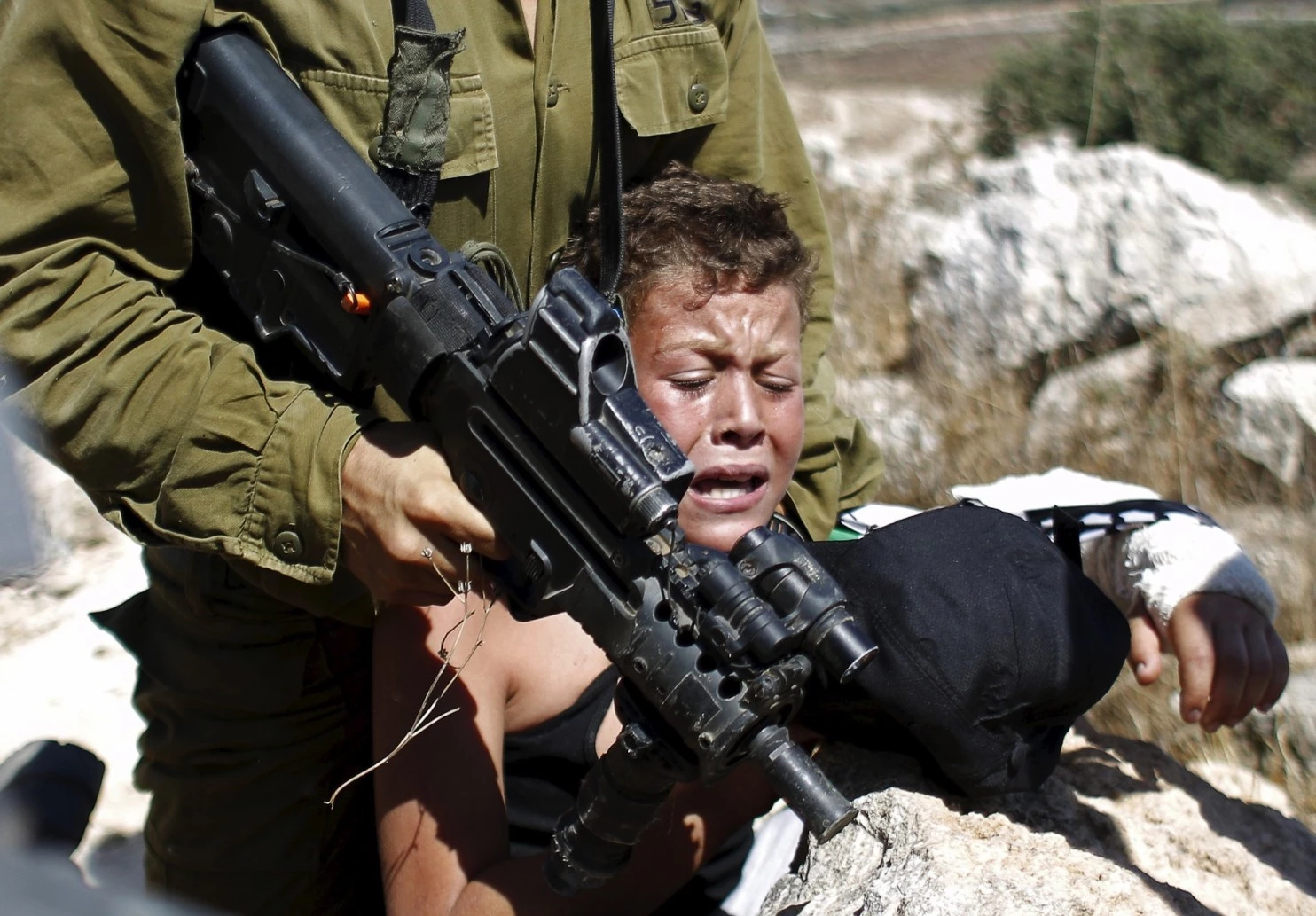
I resign from the tribe that says Palestinian kids suspected of throwing rocks should be put to death on the spot.
I resign from the tribe that says “We’ll knock flat the homes of the relatives of suspected terrorists – but only the Palestinian ones, never the Jews.” I resign from this tribe not only because this ritual is wrong and immoral and collective punishment. I resign also because it doesn’t work, only making a vicious circle that much broader and that much deeper and that much more vicious.
Maybe you have to leave a place in order to know what’s been lost there. But sometimes, as well, you have to come back, to appreciate what’s still there, what can improbably reappear.
Yes, I’m resigning. But I still I haven’t given up on all this.
Haaretz Correspondent
read more: http://www.haaretz.com/opinion/.premium-1.681689?utm_campaign=Echobox&utm_medium=Social&utm_source=Facebook

