Search

band annie's Weblog

I have a parallel blog in French at http://anniebannie.net

Category

REFUGEES

24 hours in a fuel tank


Three refugees from the war in Syria met in Turkey and crossed into Greece – but they wanted to go further. With money running out and their families in Turkey relying on them to find a new home, they made a last-ditch attempt to get into Italy. Said tells their story.

We knew the fuel tank was a bad way to go. There were Syrian guys who had tried it before and they all said, “Don’t do it!”

But we were desperate to get out of Greece. I’d been stuck there for two months, living in a flat in Athens with Anas and Badi. There was no work, no help, no way to survive. The police were hassling us every day, aggressive as hell. “Where are your papers? Where are your papers?”

The traffickers sat around in the cafes, Kurdish and Arab guys mainly, talking quite openly about the ways they could get people into other Western European countries. By plane. By boat. In the fuel tank of a lorry.

The fuel tank was the worst, but it was a surefire way to get in. “You might be a corpse by the time you arrive,” they said, “but you’ll get there.”

Fuel tank of a lorry
Many lorries have two fuel tanks, but may only need one

The guy who told us about the lorry was an Egyptian who ran an internet cafe near Omonia Square. The cafe was just a front for the smuggling operation, really. A lot of Arab kids would be in there talking to their parents on Skype, and he would listen in to find out who was trying to get into France or Italy. He told us he knew a Greek driver going to Milan. For 5,000 euros (£3,630, $5,386) each, he could take four of us in the second fuel tank.

We left Athens in a taxi, me and Badi and Anas and an Iraqi guy who we didn’t really know. The driver took us to a warehouse in an industrial zone outside Thessaloniki, not far from the sea. The lorry was hidden inside and the driver shut the warehouse doors so no-one could see what was going on.

He told us all to go to the toilet before we got in. The other guys all took a leak, but I just couldn’t go. I was too tense.

We had to get into the tank by crawling under the axle of the lorry and squeezing through this tiny door. As soon as I saw it I thought, “We’re going to die in there.”

Crawling under the lorry

When we’d taken a look we scrambled back out from under the lorry and prayed, there on the floor of the warehouse. We prayed for our children, all four of us together. Then we crammed ourselves into the tank and the driver started the engines.

As soon as the lorry started to move we knew we wouldn’t last an hour. It was burning hot and filled with diesel fumes. Anas was frantic, banging on the tank and screaming this weird scream. The driver heard him and the lorry stopped before it had left the warehouse. We scrambled out. Anas said, “I have kids, I don’t want to die.”

There was no way all four of us could go in that tank, so we agreed that the Iraqi guy would go back to Athens. The rest of us had been together for months. We were like brothers. We trusted each other.

The driver was going to lose 5,000 euros, but he didn’t want to arrive with a bunch of dead bodies in the tank. So he squeezed an extra 500 euros out of the three of us and we got back in.

Within an hour, I needed to pee so badly it hurt. We were squished together like dough. There was a rubber sheet on the floor of the tank and it just melted in the heat. I mean it turned to liquid. We were covered in this black stuff. It was like an oven, pitch black. It stank of melting plastic and diesel fumes. I was 100% certain that we were going to die.

We had a small plastic Pepsi bottle with us, and Badi and Anas managed to pee in it. Well, half of it went in the bottle and half of it went everywhere, all over their clothes and on to the floor of the tank with the melted rubber. Badi emptied the bottle outside the tank, but the lorry was going fast and the wind blew the spray back inside.

line

Where are Syrian migrants trying to go?

Said
Said en route

Syrian refugees often enter the EU in Italy or Greece, but most would prefer to get to a country with more jobs and better social welfare. Police harassment can also be a problem.

The most popular countries are in northern Europe. The UK, the Netherlands, Germany, and the Scandinavian states are all seen as places that offer a degree of support to asylum seekers and provide migrants with a chance of finding work.

Professional migrant smugglers operate all over Europe, the Middle East, and North Africa. Some advertise their services and answer enquiries on Facebook.

Desperate migrants often pass huge sums of money, saved over years of work or borrowed from families, into the hands of criminal smuggling gangs.

line

By then I was really in agony, but I just couldn’t pee in that bottle with my friends there. Towards the end of the journey the pain was so bad that I was actually blacking out. I tried to keep quiet for their sakes, but all the way I was screaming inside.

After a while the lorry drove on to a ferry. Without the engine noise we were scared they’d hear us, so we never said a word except when the lorry was going fast. We just stayed there silently, listening to the boat’s engines and struggling to breathe.

None of us thought we’d make it. I had my mobile in my hand and I kept looking at the screen in the darkness, looking at photos of my wife and my girls. I have twin girls, Deema and Reema. They’re four years old. I did this whole journey just for them. I left Syria to get my girls out of this war. I just kept thinking, “How are they going to survive if I don’t make it?”

Said's daughters, Deema and Reema

We had another girl on the way, too. I’d already seen the ultrasound in Turkey, so we knew it was a girl. I just lay there looking at my family on the phone and wondering if God would give me life to see that baby.

In the end the battery died.

Finally the engines started again and we started to move, slowly slowly slowly. When we stopped we could hear men talking loudly outside – “Buongiorno! Grazie! Prego! Grazie!” – and we knew we were in Italy. We were relieved, because whatever happened we would not be sent back to Greece.

The driver was supposed to take us to Milan but after a few more hours we just couldn’t stand it any more. We started banging on the side of the tank, yelling, but he didn’t hear us or he didn’t want to stop.

Badi still had some juice in his phone, so he called the trafficker in Athens from inside the tank and said, “Call the driver and tell him to let us out or we’re going to die in here.” Not long after that the driver turned off the big road and after a while he stopped.

We collapsed out of the tank on to the floor. We couldn’t unfold our legs, couldn’t even feel them, so we had to drag ourselves out from under the lorry with our hands. It was the middle of the day. We were in a wood somewhere in Italy.

The driver made it clear that he no longer knew us, that we were on our own. After he drove off we rolled down a slope and crawled into a concrete storm tunnel under the road. We just lay in there trying to move our limbs and to breathe. After 10 minutes, lying there on my side, I managed to take a pee.

When we got our breath back we sat up and looked at each other. And then we really laughed, because we were covered in black melted rubber and we stank. We stripped of our shirts and turned them inside out and used them to clean off the worst of it. We’d each brought a small bag with a change of clothes, so we got into clean shirts and left the old ones in the tunnel.

We had no idea where we were. Badi used the GPS on his phone to find a village, and we started walking towards it. There were vineyards everywhere, and after a while we saw farms. When cars came past we were scared that the villagers would report us to the police as they had in Greece, so we turned our backs on the cars and pointed at the scenery, acting as though were tourists out for a stroll in the hills.

When we got into the village we had to ask for help. We hadn’t eaten or drunk anything for 24 hours. The other guys pushed me to the front, because I was the whitest and the most educated. I have a degree in economics, and a bit of English, and I’d learned a few Italian words before we set off. So I had to do the talking.

The Italians were so kind to us. They actually took us by the hand, physically took our hands, and led us to the restaurant. It was closed, so we went to a cafe instead.

There was nothing to eat in there. The waiter brought us coffee and water. The water was fizzy. I had never had fizzy water before, and I just couldn’t drink it. So we drank the coffee. It was espresso. Black. Bitter. That was the next time we laughed. We survived the fuel tank, we said, but this coffee’s going to kill us.

line

Said split up with Anas and Badi (the narrator of the video, above) in Italy. He took a train over the Alps and arrived in Vienna. Anas bought a fake passport from smugglers in Italy and used it to fly to Sweden. His cousin, Badi, was eventually able to join a cousin in Leeds. All three have been granted asylum.

As soon as he was settled, Said sent for his family. Almost a year earlier he’d left a wife and twin daughters in Turkey. They arrived in Austria carrying a new member of the family – Mais, the baby that Said feared he’d never see.

He told his story to Daniel Silas Adamson and Mamdouh Akbiek of the BBC World Service. Animation by Osamah Al-Rasbi, video editing by Shayma Alissi. Exploremore stories from Syrian refugees.

Said with all three of his daughters
Said with all three of his daughters, in Vienna

Find out more

Syrian family

Explore more stories from refugees who have fled Syria’s civil war
Choose your own escape route

I nearly drowned in chocolate

Syrian Journey: What would you take with you?

The special shoes

source

After Syria horrors, refugees start life anew in Germany – interactive

big

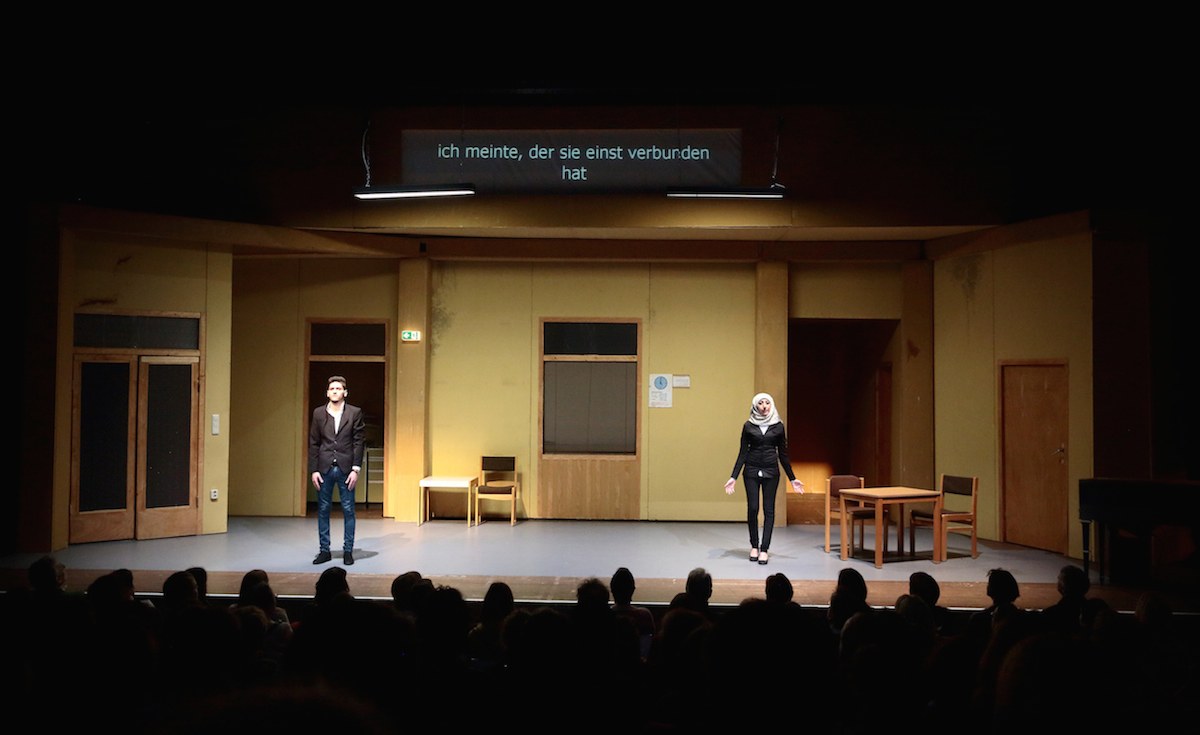
In December, about 60,000 Syrians made their way to Germany. Some went through UN agencies, while others travelled illegally; all had suffered untold hardship in their homeland. Nine of these refugees relate their experiences, describing how they have found support and a sense of purpose in Germany, not least by participating in a reimagined version of Mozart’s Così Fan Tutte alongside German opera singers. Click on the images below to read their stories

The full article here will break your heart but also give you some solace and hope. Really Worth your read and time.

source

Syrian refugees trigger child labour boom in Turkey

Thousands of young refugees are missing out on school to support families left destitute after fleeing the fighting in Syria

child worker in Kilis on the Turkish-Syrian border

Hassan, a 13-year-old from the southern Syrian town of Deraa, at work in Kilis on the Turkish-Syrian border, where many refugee children have had to become breadwinners for their families. Photograph: Murad Sezer /REUTERS

Counting in Arabic, Hamza is carefully stacking freshly-baked flatbreads on the shop counter. It is a Saturday afternoon in the southern Turkish town of Antakya, blisteringly hot. The seven-year-old boy has been working in the small bakery ever since his family of five fled from Aleppo in Syria.

“I really want to go to school, I like school,” he says, now balancing a basket full of firewood. “But my mother won’t enrol me. She says we need the money to eat.”

The oldest of three siblings, Hamza works six days a week, often up to 12 hours a day, to support his family. His mother begs on the street. “My father is hurt and cannot find work here,” he says. “Life in Turkey is very expensive.”

His two child colleagues, brothers from Hama, are 12 and 13. Both have been working in the bakery ever since they came to Turkey more than six months ago. “I would rather go to school,” said 12-year-old Nasir.

The rent for the two rooms they share with 23 family members is 750 Turkish lira (£209) a month. “We need to contribute to the family income,” says Nasir.

According to the UN high commissioner for refugees (UNHCR), about half the million Syrian refugees currently living in Turkey are children. Whereas more than 60% of children in refugee camps are enrolled in school, 73% of those outside the camps – the overwhelming majority of refugees – do not go to school. A recent Unicef report estimates that one in 10 Syrian refugee children is working – in agriculture, restaurants and shops, as mobile vendors or begging on the street.

“There is a massive increase in child labour here. It didn’t used to be that way. The authorities try to fight against it, but in many cases families have little choice,” said a Turkish human rights activist who wished to remain anonymous.

Almost 900,000 children are estimated to be working in Turkey, around 300,000 of them between the ages of six and 14, according to official figures. The legal working age is 15. Hakan Acar, a children’s rights expert from Kocaeli University, underlined that the real numbers were probably much higher: “Children working on the streets are not included in these statistics, for example – children selling water, tissues or those who are begging.”

As refugees from Syria do not receive work permits in Turkey, underage Syrian workers are not being recorded at all. “It makes them extremely vulnerable to abuse,” warned Acar. “Syrian women and children are probably amongst the most vulnerable groups in Turkey right now.”

In Kilis, a town where there are now more Syrians than local residents, child labour has soared.

Samir, 12, from Aleppo, fled to Turkey two years ago with six siblings, his mother, father and his aunt, all of whom share one small flat. He has not attended school since. In order to support his family he worked at a butcher’s for a year, and he started a job in a shoe shop in the city centre in March. Samir works seven days a week, from 8am until nightfall, earning 35 TL a week – a small fraction of the legal minimum wage.

The employer, a Turk who has owned the shop for 29 years, says that business has been booming since the Syrians came, and that Samir is a diligent worker.

Acar criticises the authorities for failing to tackle child exploitation and punish offenders: “There are too few labour inspectors, no clear procedures for what to do about child labour. Workplaces that employ children are rarely penalised.”

Muhannad al-Nader, a Syrian political activist involved in child protection in Gaziantep, explains that desperation may make refugee families complicit: “Many families might hide the fact that their children are working, because they are afraid that humanitarian organisations might reduce the aid if they find out about it.”

The lack of schools outside of refugee camps in Turkey adds to the problem of increasing child labour among the Syrians, he adds: “Schools are overcrowded. Privately-funded schools are sometimes too expensive. Many children who should continue their education thus end up working.”

While the large majority of child workers from Syria are boys, a growing number of girls can also be found working in shops, private homes and in the fields.

Aisha, 12, from Azaz, and Hatice, 13, from Aleppo, have been in Turkey for two and a half years. Both work in a clothes shop in Kilis. Hatice, who works six days a week for 50 TL, says that she dropped out of school to help her family and because the Syrian school she attended in Turkey was bad.

“In Syria I liked going to school, but here the teachers were not good, it wasn’t nice. My favourite subject was geography, but here, I didn’t learn anything.” All of her three siblings work, including her younger brother, who is nine and works at a barber’s shop.

Ridwan, 12, from Aleppo, sells biscuits from a mobile tray together with his younger brother Mahmud, 8, on the streets of Kilis, earning around 12 TL a day. His feet are covered in bloody blisters caused by ill-fitting sandals. “In Syria, my favourite subject was maths. I would love to be a doctor for children when I grow up.”

Together with his mother, Muntaha, his seven siblings and another family of eight, Ridwan lives in a small depot without hot water. His father was killed in a bombing raid on Aleppo. One corner, separated from the rest of the small, unplastered space by an old blanket, serves as both the kitchen and the bathroom. They have to pay 200 TL in rent.

“Six of my children went to school in Syria,” Muntaha explains. “How is Ridwan ever going to become a doctor? All my children were so good in school in Syria. This situation makes me very sad as a mother.”

Ahmed, 10, whose family fled their Turkoman village six months ago after an Islamic State (Isis) attack, says that he misses going to school. He is the eldest of eight children, and now works at a Syrian restaurant in Gaziantep, often up to 14 hours a day, seven days a week, for 40 TL. In the three months he has been working, he had one free day, which he spent playing football with his cousins in a nearby park.

“I want to go to school again, and learn,” he says. “I don’t want Bashar [al-Assad], I don’t want Isis, and I don’t want the Free Syrian Army. I don’t care about them. All I want is peace, and my Syria back.”

*Some names have been changed

source

Maysaloon @ refugees

SUNDAY, JUNE 22, 2014


SATURDAY, JUNE 21, 2014

The Reyhanli Diaries

You spend a week with displaced Syrian children and it gives you an insight into the Syrian crisis that is a million times better than anything Assad’s enthusiasts in the West can come up with. Child after child says the same thing, airplanes bombing their villages. Mothers, fathers, uncles and cousins killed by Assad’s snipers. Hunger, cold, fatigue. Fear and uncertainty as they cross fields and mountains to get to the relative safety of Turkey, and then a quick dash past the Turkish gendarmes and their patrol cars as they crawl down and then up the three metre ditches that have been dug along the border to prevent diesel smuggling from Syria, where it’s cheaper.

This was the second time I had been invited by the Zeitouna program for displaced Syrian refugee kids to run my workshop. Unlike last December, the children in this camp were mostly special cases and they were doing an intensive summer school program. A lot of these children hadn’t been in a proper school for over a year. I noticed that a higher number of the school children didn’t want me to read their diary entries than in December. When they did the stories were heart-wrenching. Their memories were about death, destruction and loss. They were nothing you’d want a ten year old boy or girl to ever have to know. But that is the reality that they and millions of other Syrians have had to face. Beneath the smiling cheerful facade and the noise of the playground everybody in the Salam school carries a terrible burden. That includes the teachers, who have the double burden of trying to help the children live a normal life whilst also carrying their own problems. One teacher told me of how he was held by the security services for over a month with regular beatings and interrogation. He had to hang from the ceiling by his wrists, with his toes barely touching the floor. He was kept like this for three days with no food or water or toilet breaks, and he was beaten by a thick cable. When he’d faint they would chuck a bucket of water on him and he would lick his lips to try and quench his thirst. When they took him down he couldn’t feel his hands for hours and thought he had lost their use forever. 

After that they made him hold his hands out so that they can hit him with the cables. He was told he would be hit forty times, and that each time he flinched and tried to pull his arms back they would add another five. The final count was ninety and his hands were hit so hard that his finger nails came off. When they finally released him he had lost forty kilograms out of ninety. The judge he was presented to ordered him to tell people that he had been on vacation all this time. He escaped to Turkey as soon as he had the chance. 

There is something perverse in hearing about the obscene celebrations in Assad’s areas that have been going non-stop since his sham elections, and the suffering these children told me about. I ask the girls in one class to write about the happiest day in their lives, and most of them don’t want to do that. They want to write about the saddest day in their lives. At first I’m adamant that they not do that, but then I give in. I tell them they can write about the saddest day in their lives if that’s what they want. They say they do. Then they volunteer to read to the class. They were so hungry to tell somebody – anybody – about what happened to them, and the realisation dawned on me that this was how they wanted to unburden themselves of this big weight on their chests. Far from bringing up painful memories, I felt as if we were giving each other the chance to release pent up hurt and anguish. One of the girls started reading her journal entry, and she started talking about how her cousin was killed fighting for the Free Syrian Army, and then how, a few days later, her uncle was also shot by a sniper. I was looking at the other students in the room and was also tired so I then stared out of the window. Then I realised she had stopped talking. I looked at her and she was quietly sobbing. The other students looked down, nobody said a word. Then one girl said, “May he rest in peace”, and I repeated that too. She sobbed, and then carried on reading, sharing her heartache with us in the room. It was a moment of commiseration for us all where we acknowledged our common humanity. We were grieving together. And when I think about it now maybe that is what the girls of that 12th grade really needed, somebody to grieve with and listen to how much they had been hurt. 

I asked another girl in the 9th grade to write about her last day in Syria and what she saw. She didn’t talk about planes bombing them, or about losing loved ones. She was a bubbly cheerful girl with a pink hejab and I liked her. She was one of my favourite students in the class. Then she started reading to us how she and her family were crossing cornfields and ditches to get to the safety of Turkey. I thought she was fine and she was smiling. Halfway through she started to sob and I choked up. She would give that beautiful smile and then start sobbing in between, as if the memory of her displacement was too much to bear and she was doing everything possible to keep up the facade of a happy girl in her early teens. I almost cried in front of everybody but I kept a straight face. My eyes burned. 

The stories came non-stop and it’s only now, a few days after I have come back, that I can write a little about this past week. It was beautiful, human and warm to be with the children and the teachers, and we all said tearful goodbyes on the final day. One boy came back to hug me three times, and I could feel his chest heave as he cried. I patted him on the back and whispered to him to stay strong and be patient. Inside I was dying. Last week, just briefly, we all shared something wonderful. Maybe in times of war that can make all the difference.

Self Reflection

We don’t know how the future will see what we did here. Whether we were right, or whether we will even succeed in building the life that we want. I felt despair, sadness and longing, but I didn’t let myself get swept by events this time – even though a lot of people did. I didn’t lose my head. I didn’t let the craziness get to me. Somebody has to stay sane to remind everybody what it’s like. I hope that somebody was me.

 .

A Split Second

The courtyard is chaotic because the children are on their break. I am sitting on the floor leaning against the wall. The bell rings and they are all climbing up the steps in front of me to get to their classroom. Amidst the chaos just one girl stands out for a split second. She has the most wonderful smile I have ever seen in my life. I didn’t have my phone out to take a picture. It was as if for a split second there was light only on this one little girl and her pigtails. She’s a little older than a toddler. Then she vanished back in the crowd. I closed my eyes to rest them for a few seconds before going to the next of my workshops.

 .

“This won’t take a minute”

They asked me if I have a moment and I said yes. I walked with the dentists to one of the classes and the kids were sitting “jalseh si7iyeh” – a healthy stance – behind their desks. I was asked to put on a fresh pair of rubber gloves for each child and then to apply fluoride coating to their teeth after the dentist had examined them. I remember that their teeth were so small.

 .

Moments

I have a mental image of a pretty girl with light brown hair wearing a white and blue dress. She’s skipping with her friend and her ponytail bounces up and down with each step. She was in my journal writing class and I hope that some of the exercises I gave her might have sparked an interest in writing.

Later we are on the bus driving back to the hotel. I’m tired and thirsty, I forgot to take a bottle of water from the caretakers fridge before we leave. It’s hot and dusty. I look out of the window, ignoring the chatter of my colleagues and looking forward to dipping into the cool pool in our mediocre hotel. I see the girl walking past the local Turkish graveyard on her way home. The blue and white of her dress stand out vividly from the dusty drab streets and the hard faces of other pedestrians. She is making her way daintily down from the high pavement and is looking to cross the street. I sit up in my seat and peer out of the window, I tap my hands on it but we’ve already moved on. We drive away and she is still looking to cross the road. A delicate flower in the middle of a drab dusty town in the middle of nowhere.

The next day I see her in the school courtyard. She smiles and recognises me. I say to her that I saw her going home the other day and she nods her head. I ask her name. She says it is Walaa. I think to myself what a coincidence it is that her name is the same as that other girl I met in Atmeh camp last December. They are almost the same age. They are both wonderful, both full of life. I’ve left them there. One is somewhere in a refugee camp in Syria, the other is somewhere in a border town in the middle of nowhere, in the middle of a region that is going nowhere, in a maelstrom. They are lost in a sea of desperate humanity.

source

Zeitouna Kids: In their Own Words


Syrian Refugees at Al-Salam school in Reyhanli, Turkey.
https://www.facebook.com/CampZeitouna
http://karamfoundation.com/

Blog at WordPress.com.

Up ↑