Search

band annie's Weblog

I have a parallel blog in French at http://anniebannie.net

Category

Syria

Not In My Name: The Syrian Uprising Through Palestinian Eyes

“Have you ever protested against the massacres in Syria?”, asked Israeli police officer Yossi Peretz as he was detaining me along with other activists on our way to an anti-occupation demonstration in Bil’in. “Bashar al-Assad murders tens of Syrians every day and you are silent.”

It was an atrocious day: The security apparatus of the “only democracy in the Middle East” showcased its full force and flexed its muscles to prevent a bus carrying non-violent protesters from reaching an unarmed demonstration; we were detained for three hours in the Givaat Ze’ev police station on a dreary, freezing morning; we couldn’t march alongside the courageous villagers in Bil’in as they commemorated the seventh anniversary of popular resistance against the apartheid wall. What exasperated me the most was the cynical attempt of a man charged with enforcing brutal occupation and military despotism to exploit the blood of Syrian martyrs and feign concern for the victims of Assad’s deplorable atrocities. Ironically, a few days earlier during an anti-Assad protest in occupied Jerusalem, a Palestinian man scolded us for “not participating in a single demonstration against the massacres in Gaza.”

As the Syrian intifada for dignity, freedom and justice enters its second year without showing any sign of succumbing to the regime’s callous, pernicious crackdown, myths continue to dominate the discourse over Syria and Palestine. One such myth is that supporting the Palestinian struggle and the Syrian intifada are mutually exclusive. It is as though Palestinians and Syrians are competing over who can claim the greater measure of victimhood and unfair media coverage. For instance, when I tweet about the flagrant human rights violations and daily crimes that Israel perpetrates against Palestinians, I get similar reactions to that voiced by the Israeli police officer: “And what about Syria?” (Justifying and covering up Israeli crimes by switching discussion to Arab tyrannies is a well-known manipulative trick used by Zionist propagandists that has unfortunately been adopted by *some* Arabs.)

Many, on the other hand, complain about the “excessive” focus of mainstream Arab and Western media on Syria and ignoring atrocities in Palestine and Bahrain. Granted, mainstream media has an agenda and a set of politically and financially-motivated priorities, and shedding light on the repression in Bahrain or Palestine doesn’t meet their agenda… or the corporate goals of mass-media conglomerates. Similarly, pro-Assad media outlets in Syria, Lebanon, Iran, etc., blather for hours about the crimes of Israel while turning a blind eye to the massacres carried out by Assad next door. Hypocrisy and double-standards in the media happen both ways. Spending all of one’s time blasting the media and Western governments for their despicable and shameful hypocrisy, selective indignation, and warped “humanitarianism”, while barely uttering a syllable of solidarity with the Syrian people is the epitome of the very hypocrisy and skewed “humanitarianism” one is trying to protest in the first place. As painful as the analogy is, reading circular debates about media coverage of Syria vis-à-vis Palestine reminds me of a football match where the supporters of both teams slam a terribly inept referee for his bias and explain his awful decisions by trotting out worn and tired conspiracy theories.

The truth is that the Syrian people are getting a taste of what Palestinians have been enduring for the best part of a century: futile Arab League summits; empty, toothless rhetoric by kings and sheikhs; lip service from the “international community”; crocodile tears; and a horribly feckless and reactionary political leadership that lags light years behind the rebellious youth. Moreover, both Palestinians and Syrians have been blessed with the all-important contribution of Kofi Annan, the undisputed master of equating between victims and executioners, an expert at calling for sham “peace” between the oppressor and oppressed amidst carnage and bloody repression.

It’s worth noting, however, that I’m perfectly aware of the significant differences between the Syrian and Palestinian situations. Palestinians have been struggling for over six decades against an expansionist settler-colonial military occupation erected upon physical and psychological walls, separation fences, and military checkpoints, maintained by the lethal combination of the military-industrial complex and deeply-entrenched institutional racism that penetrates the whole of society. Syrians are fighting a fascist, totalitarian ruling elite that has turned Syria into a private property of the Assad clan and their beneficiaries. That elite class, under Assad’s dominating influence, has acted exactly like an occupation force with a similar lack of legitimacy.

The means by which Israel attacks and suppresses the Palestinian population may be different from those used by Assad. Israel’s violence, especially in the West Bank, East Jerusalem, and within the Green line, is not as visible as the Assad regime’s – although Gaza gets more than its fair share of air strikes and missiles – but it’s equally as destructive. The silent ethnic cleansing of an indigenous population in the form of rapidly increasing home demolitions, settlement construction, strict control on the freedom of movement of Palestinians and systematic denial of basic infrastructure such as water and electricity gradually squeezes the lifeblood out of quarantined, defenceless communities. In addition, Palestinians have had to deal with the ongoing theft of their land, identity, and collective memory since the creation of the state of Israel. The discriminatory legal system and racist bureaucracy that controls the tiniest minutiae of Palestinians’ daily lives re an evil force that is not as flashy and dramatic as bombs and rockets; therefore, it will never make the headlines of the New York Times and the BBC. Conversely, the brutality of the Assad regime since the start of the uprising has been much more perceptible, graphic, and less sophisticated. However, despite these aforementioned differences, the wound of Syrians and Palestinians is one; our demands are the same – dignity, freedom and justice – and we both have to fight our battle on our own as the world stands by meekly. The Palestinian cause transcends ethnicity, religion and nationality, which explains why it has become a symbol of the oppressed throughout the region. This is precisely why we Palestinians should be the first to support the Syrian people’s intifada – not as an act of solidarity, but as recognition of our shared demands and destiny. This unconditional support for the Syrian revolution does not, however, mean approving of the Syrian National Council or any human rights abuses committed by the Free Syrian Army or any other armed opposition group in Syria. On the contrary, it is in the revolution’s best interest to condemn human rights violations, sectarianism, and corruption regardless of the culpable party. Yet, it’s also crucial not to equate between the oppressed and oppressor and to keep in mind that the Syrian regime bears full responsibility for driving the country into violence and for fomenting sectarian tensions.

The Syrian regime has done nothing to liberate the Israeli-occupied Golan Heights, let alone Palestine, but even if it were the only entity in the world capable of liberating our land, we must stand against it. You can never achieve your liberation on the blood of your brethren and with the aid of the very regime that denies your fellow men and women their most basic rights.
This is what makes the support of some corrupt Palestinian leaders, couch leftists, and Arab nationalists for the Assad regime so repellent and disgraceful. By brazenly exploiting the cause of one oppressed people to justify the oppression of another, Palestinian cheerleaders of Assad inflict irreparable damage on the Palestinian cause. Khaled Jabbareen, a veteran Palestinian activist I met during the demonstration we held in Haifa to mark the first anniversary of the Syrian uprising, told me: “I quit political activism for 15 years. What spurred me to be active again was watching an obsolete Palestinian ‘leader’ sing Assad’s praises on Syrian State TV. We have been repeatedly scapegoated because of contemptuous stances taken by self-appointed Palestinian leaders and we paid the price dearly. We cannot allow the same to happen with the Syrian intifada. We cannot sit idly as Syrians are being killed and repressed in our name.”

Jabbareen added that the Syrian intifada has unmasked the traditional Arab “Left” and exposed its moral bankruptcy. For decades, Arab leftists and modernists have been urging the masses to rise up. When the masses did rise to break the walls of fear in Syria, most of those self-proclaimed leftists and revolutionists cowered and either supported the regime in the guise of “anti-imperialism” and “Arabism” or sat on the fence, perhaps because the intifada was not attractive enough to satisfy their self-perceived intellectual superiority or because they were never revolutionary in the first place. Although those intellectuals and “leaders” are unashamedly loud in their support of Assad, and although one cannot deny that minhibbakjiyeh exist in Palestine as well, they do not represent the Palestinian people – as much as they shame me – and they do not represent the Palestinian cause. They do not represent the values and principles Palestinians are fighting for.

Palestinians chanted “Yallah Irhal Ya Bashar” in Nazareth, Haifa, Jaffa, Baqa, Jerusalem, Bil’in and Nabi Saleh. Many of us will continue to do so since it’s our duty to stand on the side of those who sing for freedom, dance, and even make jokes through the horror visited by bullets and mortar shells. A victory for the brave Syrian people over Assad’s tyranny will be a triumph for every oppressed community in the world. Such a triumph could change the discourse of resistance and turn it from a pretext to crush revolt into a leaderless, grassroots movement. Resistance is not a tyrant’s speech, and the Palestininian cause lives not in the ivory towers of intellectuals or in the dungeons of dictators. It lives in the voice of Ibrahim Qashoush, the innocent soul of Hamza al-Khatib, the heroic “Sumoud” of Homs and in the unbreakable spirit of the Syrian and Palestinian people.

—–

Budour Hassan, originally from Nazareth, is a Palestinian anarchist and feminist activist and a fourth-year Law student at the Hebrew University in Jerusalem.

source

original

Assad or We Scorch the Country (By OTW)

Posted by

First, I would like to start this post by wishing all a serene Passover and Easter. May we all celebrate next year in a Syria liberated from tyrants.

OK, so it seems that we have two different points of views on 7ee6an, both expressed eloquently and with passion and both defended and criticized strongly. At risk of extreme over simplification, the first idea may be summarized as arguing that armed resistance only aggravates the regime and provides it with excuses to inflict more violence and horror, not to mention being a failure in comparison with the “more effective” national scale civil disobedience, which should be pursued at all costs towards bringing down the regime. The second argument, and again risking oversimplification, stresses the right of people for self defense, and highlights that the regime’s use of force is independent of the level of violence exerted by any armed faction in the revolution, which in turn if sufficiently armed, will exact punitive blows at the regime’s barbarity, especially in enhancing the odds for further defection from the ranks of forces under its control.

To me, such discussion justifies all the efforts that went into launching and maintaining 7ee6an and the hard work we all have done so far to ensure a quality of discussion that distinguishes the contributions to this blog from hysterical rants of absurdity.  This discussion reflects the ongoing mental anguish many among those supporting the revolution are going through. I myself continue to have hard time making my mind regarding which option to support. But given both tracks of thinking it would seem that the advocacy for a full scale “non violent” civil disobedience, by its nature and intellectual grounding and legacy  does exclude an armed resistance track of the revolution, especially if it calls for halting any plans to arm the FSA. On the other hand, the presence of armed factions, especially one borne, as the argument goes, to protect peaceful protest, does not exclude the preparation for and the carrying out of “non-violent” actions and strategies with increasing organization all the way to the desired nationwide civil disobedience. It does however complicate that strategy and makes pursuing it much harder.

Supporters’ slogan “Assad or we scorch the country” written by Regime thugs after the looting and intimidation campaign in the upper scale neighborhood of Inshaat in Homs.

The Assad regime has pursued the “violent” option with vengeance and brutality from day one.  It may now tolerate a few non-violent demonstrations here and there primarily as a matter of setting priorities in terms of sequencing its wanton destruction of the country and scheduling its next bombardment target.  Those arguing for full exclusion of armed opposition, and for starving the FSA should be mindful of the slogan “الأسد أو نحرق البلد ” (Assad or we scorch the country) painted by the regime thugs and soldiers in every place they scorched and advertized on the walls of their headquarters and even public busses. In this slogan, the regime loyalists, which are part and parcel of the regime, declare their adherence to the Assad’s cult. The adherent of this semi religious cult are now drunk with blood and smoke after a year of relentless efforts to remove all traces of scruples that may inhibit further brutality and barbarity on their side. They need no excuses to exact their violence, which has been proven time and again as an inherent part of their cult and of the fabric that binds the regime. The shelling continues throughout the country despite of the absence of any armed resistance in most areas being shelled. Snipers, who according to loyalists on other blogs are to be excluded from Annan plan since they don’t use heavy weapons, continue to terrorize innocent civilians in many Syrian streets and the list of their victims continues to increase. Terror in regime torture dungeons never stopped and will never stop, even with the presence of international monitors, and demonstrations in Aleppo and elsewhere continue to be suppressed with increasing brutality and use of live ammunition contrary to the earlier “appease Aleppo” approach. The number of victims of regime brutality has not gone down with many murders occurring in areas where FSA is either none present or has not been very active.

All of this should put to rest the notion that the presence of FSA as an impetuous for regime violence. Violence is the hallmark of this regime with or without FSA. Such violence has been extended beyond destruction into deliberate theft and looting of areas invaded by regime forces, as happened to many areas in homs including those with large presence of certain minorities. The regime propagandists and shrill shills persistently claims that these thefts and destructions are the work of FSA or “islamist”, “saudi” funded “mercenaries. But I have strong evidence that would put the hysterical defenders of the regime to shame, if they know any, which is unlikely based on their continuing mental and ethical degeneration. Fear for the safety of friends whose homes and businesses in Homs have been ransacked and looted by regime forces is the only reason I am not sharing these evidence, which I hope to be used in a court of law in the near future.

Supporters of the argument against arming FSA and/or other rebel forces also have their own strong  case in Idlib’s country side to add to Baba Amr story book. Idlib’s country side has been turned into a wasteland by the regime’s “scorched country” policy presenting a serious refugee crisis internally as a slightly lesser one externally (yesterday more than 2500 refugees from Idlib’s country side crossed the border to Turkey). The presence of refugees, especially children from Homs and other areas is exacting its toll on the people, and at the same time is (also not addressed in Anan’s plan) will compound the situation

Regime slogans painted on a public bus in Syria. The white slogan reads “when lions come, dogs flee”, the black slogan reads “Assad or we scorch the country”.

The slogan “Assad or we scorch the country” should not be taken lightly. It is a well known slogan of Assad forces from days of the dynasty founder. It has been demonstrated repeatedly and the fact that it continues to be ignored by regime propagandists (even those pretending to be intellectual peace loving) removes any pretense to ethical grounding on their side and shows clearly that they do concur with it despite of their claims that “they are not pro regime” and that they “have some criticism of the regime”. But more important is that it tells of the mentality of the hard core loyalists. While to the ignorant shabeeh or loyalist it may simply be the result of decades of brainwashing and propaganda aiming to replace the national identity with Assad cult, it is an existential reality to the real power centers behind the regime. Many of the wealthy elites of Syria owe their wealth and privileges to the Assad clan (which includes non family members across all sects). As a class, they may have members with conscious who now side with the revolution, yet as a class, their loyalty and interests will continue to be vested in the system of corruption and coercive terror that is founded on disregard and contempt for the masses (as argued by Yassin Haj Salih in the article linked by Zenobia). There is no point in pursuing their support for the revolution, for they are part of the problem and of the regime’s power structure. Members of this elite now hide sometimes behind secularism and others behind law and order in their opposition to the revolution in both its armed resistance and non-violent form, but they know that if the regime is gone, they are to follow even if national reconciliation is to commence. Their participation as partners in the economic crimes of the regime make many of them complicit in the civil right violations and graft and intimidation against honest members of the business community in Syria and such crimes are bound to be investigated and/or exposed during reconciliation. I am eager to hear the opinion of most esteemed Son of Damascus on this point and would love to be corrected if such is possible.

Getting back to topic, given that violence was the regime’s option and strategy, it could be argued that the question is not whether FSA has caused damage to the revolution in the sense of justifying the regime’s brutality and mayhem, but that whether the current starving of FSA can have adverse effects on the revolution, and whether a regime so attached to violence can be realistically overthrown by non-violent means such as civil disobedience.

To answer this question one has to recognize that even Sharp himself warns that civil means do not guarantee success. This is perhaps most clear in Syria, where for months, the revolution maintained a non violent character, and where such character remains to date the most obvious of the revolution that is being put down with a combination of physical brute force and hysterical media campaign by the regime and its unholy band of partners and supporters (internally and externally). Then, one must also consider that unlike other countries, the size of the “government” remains huge in Syria, which complicates civil disobedience efforts as the regime has used the “state” to its advantage and has mobilized its human resources into its campaign of terror against Syrians. It is well known that many workers in regime factories have been mobilized into the regime’s gang squads “populist phalanges” either because of the bonus and high salaries received by shabeeha or because of the utter reliance on state salaries by these workers and through coercion.  The presence of the baath party and security informants in every juncture of the Syrian state will continue to greatly frustrate efforts towards wide-scale civil action in government structure unless the power of these security agencies is first weekend significantly and unless the baath party members and security informants involved in the suppression are made to fear for their own safety if they continue the practice. In all cases,  their coercive capacity should not be underestimated and their ability to maintain the critical functions of the regime running will continue to be a problem as long as the regime has the financial means of supporting them. To that effect, we must also consider the rumors that the regime is negotiating billions of dollars worth of bonds with the Chinese and Russian governments and with the Iranian regime. It should be made loud and clear to all that all dept incurred by the regime as of March 2011 will be uncollectable in hopes that such continuing financial infusion will be stopped by rational policy makers who will eventually recognize that this regime has no viable horizon to lead a healthy Syrian recovery capable of paying such wasteful dept.

An added complexity is the tragic level of unemployment in the country, which when coupled with the deliberate destruction of ethos over forty years, will sustain the regime with a supply of willing militia, again as long as the regime is capable of providing financial means. Needless to say, the added bonus of looting and unrestrained power given to regime forces will probably reduce the regime’s financial by allowing the thugs to obtain directly from the people what they have not been receiving lately from their employer. Looting, ransom, and graft are now the primary compensation mechanism for shabeeha in areas where the regime continues to exercise some control. This is not only consistent with “Assad or we burn the country”, it is part and parcel of that policy.

In summary, the Assad regime, knowing well that national scale civil disobedience is a serious threat to its survival has opted from day one to convert the struggle into an armed warfare that could be dressed in sectarian language. It has made its fall a considerable security risk by forcing the people to take arms to defend themselves and thus create a fear of undisciplined armed insurgents trough a combination of false flag operations and media hysteria along with excessive brutality to further entice more young people into carrying arms. The results of this strategy include a preview of “Assad or we scorch the country” ideological underpinning of the regime and its supporters and the conversion of swaths of the country into ungovernable areas wastelands.

How does this play out with respect to civil disobedience? The following concept was presented in a recent off-line discussion with a journalist friend who is heavily engaged in non-violent movement in Syria: Let us consider those disaster zones where the regime has shelled the area forcing most if its people out, or where the regime has confronted both civil action and/or the presence of FSA with its standard barbaric brutality. In the end, these have become no-regime zones in the sense presented by Azmi Bishara who argued that the regime’s need to push its tanks into the streets of Syria is by no means a victory but a defeat. Areas with tanks, soldiers and regime thugs are areas where the regime is not functioning as the money and graft generating scheme it is designed to be and where the regime’s claims to equating itself with the state are shown as farcical joke. They have been turned, by regime’s action, into rebellious areas where normal life is no longer possible due to murderous snipers and raids by regime thugs. As a result, swaths of several cities have in fact turned into a situation resembling the effects of “civil disobedience” in terms of halting of productive life and making these areas increasingly ungovernable by the regime’s representatives. In essence, these areas are under control but ungovernable, which is similar to the practical result of civil disobedience, but with more distinguishing characteristic of resistance against a foreign occupation than those associated with combating a dictatorship or a repressive regime. After all, only foreign occupiers have used “scorched earth” policy on such a large scale.

The centrality of the Assad figure to the regime has caused many in the opposition to receive the Annan proposal with lukewarm suspicion if not outright rejection initially. The absence of a clause stipulating the departure of Bashar al Assad or the delegation of authority to a vice president have been the primary reason for such initial rejection. However, cooler heads are prevailing, especially after the strong language from the former Secretary General regarding the continuing violence and his ability to extract a time-table from Assad. Mohamad Al-Abdallah wrote on his FB page an outstanding short article in support of the Annan’s plan. His basic premise is that Annan is no Dabi, and the UN is not the  AL. If the plan is to be implemented, then the regime will risk major demonstrations throughout the country. If the regime falters as everyone expect the pathological liar Assad to do, then the regime would have squandered the last opportunity for political solution to the crisis, a solution that was supported by both China and Russia. The regime’s failure will put the two countries in a very awkward situation in the Security Council when it will have to decide on further action against Assad and his gangs. Pessimist argue that the regime will resort to playing the “negotiation game” and will initiate, as expected, false flag operations and explosions, particularly in areas with sectarian tension in order to justify its continuing military operations. This may have already started with an unknown group threatening a large number of explosions in Aleppo. It is also expected that the careless and callous regime will redress its army and security forces in civilian clothes giving an impression of a “loyalist” demonstrations and continuing to conduct arrest and intimidation campaign at lower intensity.

It is incumbent on all armed-resistance groups to agree to the plan and to declare a halt to all operations as of April 10.  However, it is also no wonder that shrill shills on SC are now propagating hairsplitting interpretation of what “heavy weapons mean” and whether the April 10 deadline is deadline for full withdrawal or for starting the withdrawal with open ended process. This in itself is a sign of things to come and it shows that the regime and its supporters continue to think that they can outsmart the world with their pathetic sophistry aiming to drag thing long enough for them to reestablish a pre March 2011 conditions.

The Annan plan also requires a huge effort on the civilian side of the liberation campaign. Names of all detainees and missing persons must be collected meticulously and the regime’s security apparatus must be exhausted with constant demands for their prompt release and for information on those missing. Furthermore, the anticipated negotiation must be viewed not as negotiation to end the liberation campaign, but as negotiation for the departure of the regime and its symbols and for transfer of power to a legitimate authority. Such would require mass mobilization of demonstrations, especially in Damascus. The negotiators must be very careful not to view the negotiation as a trial of the regime but primarily as a hostage negotiation with a well armed brute who has taken the entire country hostage and the primary objective is to separate the brute from his victims while at the same time maintaining bereaved parents of those who were executed by the brute thug under control so that they do not complicate the situation further. It is also important that no media frenzy against international observers be conducted by the opposition. They should be approached by the liberation movement with respect, honesty, and truth, and not with contempt and derision.

Of course, the above assumes that the regime will allow the plan implementation to reach that stage. According to the plan, negotiation is not the first step. The regime has to withdraw fully, release all political detainees and allow for demonstrations to take place unmolested. With these conditions, it is well understood why Mohammad Al-Abdallah wrote: “this is a very good plan, and the worst thing about it is that it will not be implemented”. How can it be when “Assad or we scorch the country” is the operative slogan of the regime and its supporters. In the end, if they try to keep this more fundamental and the only promise they seem intent on fulfilling, one would hope that the world, including the regime’s friends will take other actions.

Yassin Haj Salih, in a recent article wrote about the “Assad or we scorch the country“: “in reality presents two choices of destruction of Syria. The first is the destruction of the country through living under Assad with no dignity, freedom, and opportunity, and the latter is the physical destruction of the country. In both cases, they are choices of destruction. Regime shills should take note of what they are defending before they shout that the revolution is destroying the country. This is a revolution and a liberation movement to build a country and to take it back from those who shamelessly proclaim their intent to burn it.

Rima Dali protesting in front of the Syrian Parliament building

[youtube http://youtu.be/VOExrlBUTB8?]

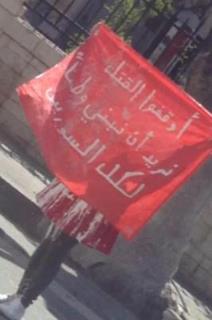
Rima Dali was arrested in front of the Syrian Parliament building in Damascus for daring to hold this sign: “Stop the killing! We want to build a nation for all Syrians!”

She has been released few hours ago by the judge. No charges were filed against her.

Homsenica 05Apr12

The below post is from the Revolutionary Council of Homs dated today and signed by Bayan Seif El Din from the Revolution Council. Below that I’ve posted the original Arabic.

Have we finally reached this point where a direct parallel between Srebrenica and Homs is possible?

========================
Revolutionary Council of Homs
April 4, 2012

Homsenica

What is happening in Syria generally, and particularly in Homs, is ethnic cleansing that is far more atrocious than what happened in the Bosnian town of Srebrenica. The Serbs forced between 50 and 80 thousand Bosnians out of Srebrenica to change the demographics of the population and replace the native Muslim population with Serbs. The Syrian regime is also carrying out an atrocious ethnic cleansing campaign in Homs by forcing more than half a million of Homs natives out of their homes and immediately replacing them with Alawites. All of this is going on while the international, Arab, and Muslim communities remain silent.

For those who do not know the demographic of the city of Homs, here is a little synopsis:
Alawites came to the city of Homs and lived on its edges starting in 1965, and initially, there were only a few families. They spread then in several areas like Nuzha, Zahraa, Akrama, and Wadi al-Thahab, near other residential areas.

What has happened in the last two months – February and March of 2012 – is that nearly half a million people who live in predominantly Sunni neighborhoods near the aforementioned Alawite neighborhoods, were forced to leave their homes. This came after the residents witnessed atrocious crimes including slaughtering women and children; burning and abusing dead bodies; group-raping women and little girls, some of whom under the age of 12; terrorizing the residents with heavy bombing and destroying their homes on top of them; cutting off water, electricity, and communications; and preventing food and medicine from reaching these neighborhoods.

After the residents left their homes, the regime immediately brought loyalist Alawite and Shia families to live in the homes that belong to mostly Sunni families. The regime’s thugs then looted the other homes that remained unoccupied and robbed their contents in an organized manner, and then they set the homes on fire. The regime had formed groups, each of which was responsible for stealing specific things. For example, a group was responsible for stealing dishes and silverware, another was responsible for stealing washer, another group was responsible for stealing propane tanks, and so forth. In this manner, it has become impossible for the displaced residents to come back to their homes.

Here are some estimates that the Revolutionary Council of Homs has obtained regarding the number of displaced residents according to neighborhoods:
Rifai: 5000
Karm al-Zeitoun and Nazeheen: 55000
Bab Sbaa, Adawiyeh, and Mrejeh: 50000
Bab Draib: 20000
Bab Tadmur: 20000
Jib al-Jandali: 25000
Ashira and Sitteen: 15000
Bayada: 40000
Khaldiyeh: 80000
Qusoor: 50000
Karabees: 15000
Baba Amr: 80000

The total estimated number of people forced to migrate exceeds half a million people, and this is the largest displacement operation known in recent history, happening right in front of the entire world and went unnoticed as if nothing had happened. Most of the displaced people have either become migrants in their own country – in nearby villages or in other cities like Damascus, Hama, and Aleppo – or refugees outside Syria.

So will there be a Homsenica or should we just forget this city?

By: Bayan Saif el-Din
Media Bureau
Revolutionary Council of Homs

https://www.facebook.com/H.R.C.HOMS

source

A Word On The Syrian Independence Flag

Maysaloon :

Several times I have heard people who support Assad derisively label the Syrian independence flag as “that French mandate” flag. For some reason these people think that this flag is a product of Syria’s former colonial masters, and that it is fitting that a revolution that they consider to be a foreign plot against the regime would choose such a flag. This is patently untrue and demonstrates a lack of knowledge in the country’s history. If anything the Syrian independence flag represents the best of everything that is Syrian, and its history gives us some startling insight into the present.

In 1933 the French colonial authorities suspended the Syrian constitution of 1930 and tried to impose an independence treaty that would have left them in control of Syria’s coastal mountains. There was an immediate uproar and widespread demonstrations and strikes. There was also immense support throughout the Arab world, with protests in what are today Iraq, Lebanon, Palestine and Jordan. This period of crisis reached its climax with the Franco-Syrian Treaty of Independence, which was the first time that a treaty was made with a recognised representative of the Syrian people, the National Bloc, under Hashem al Atassi. al Atassi, who was the prime minister of the short lived Kingdom of Syria under King Feisal, returned to Syria and was made the first president of the Syrian Republic. This independence flag was made the national flag of all of Syria, including Syria’s coastal mountains and what might have become a separate Alawite Syrian state under the French.

The main goal of the National Bloc was to achieve independence through non-violent and diplomatic means, and they succeeded. Today the Syrian opposition would do well to remember how Syria’s freedom was initially won, and how the Syrian Republic had been born. The general strike that eventually forced the French to the negotiating table paralysed the country, and could not be quashed violently. Ironically it had its roots in an event held by the National Bloc commemorating the death of another national hero of Syria’s fight for independence, and once a prominent National Bloc leader himself, Ibrahim Hanano. Hanano had fought the French and led an armed uprising, with Ataturk’s help, centred around the Idlib and Aleppo regions. It was soon crushed when the Turk’s withdrew military assistance, but it cemented Hananu’s reputation in Syrian history, having already fought for King Feisal’s Arab Army. When the heads of the National Bloc were arrested by the French, mass protests and a strike were called. The series of events culminating in the Independence Treaty of 1936 can be traced from here, and with that, the path to the new Syrian independence flag.

Today that flag has been chosen by many of the Syrian opposition as representative of those who do not wish Assad or his family to rule the country anymore, and in it they find an authentic representation and nostalgia for a better Syria where life was not governed by fear. Cynical attempts by detractors of the Syrian revolution – in both its armed and peaceful components – ignore the enormous personal bravery and conviction required for any Syrian to dare challenge Assad’s rule and stand up against his injustice. They choose to simply see things in a black and white world of power politics and a West versus the Rest perspective. In doing so they deny the Syrian people any agency, and also deny them the right to make their own mistakes and aspire for a better future for themselves and their country.

Everything about this flag, the background of the movement that made it a symbol for Syria, and the figures that fought for it to become so, is steeped in principles rooted in a hope for a better country that is free and good for all its people. Should the Syrian people decide one day to once again make this flag Syria’s official flag, then it is not because the current flag is any less legitimate, but because the independence flag represents that hope. To describe it flippantly as a “colonial” flag is an insult.

Syrian Scenarios

Lloyd Young

1. A person suffering from autism stands in front of the camera and makes us witness the scars of the whipping and electrocution on his chest, legs and arms. His eyes are swollen, his cheeks black and blue, his lips split, yet he continues to smile. He is happy to be filmed and to soak up the attention.

2. The little girl lost her mother. Everyone was preoccupied with escorting the martyr to her final resting place, with the revolution, with the slogans. The girl closed the door behind her and drew an image of her mother with chalk on the floor of the room. Beside it she wroteMummy’. She fell asleep embracing her drawing.

3. One wounded ankle is bleeding, the other is covered by a sock adorned with a red ball. A girl, four years of age, with a shoe size of 27, was not rushed to hospital. They treated her in the same way that they treated all the patient revolutionaries – at home, in hiding, and without anaesthetic. As the bullet was removed from her ankle, she screamed in pain. The doctor tried to calm her: ‘Soon the pain will be gone!’

4. A three-year-old child knew his faith and his Lord, knew his friend from his foe, knew his path from the moment they killed his mother. He led protests every day, chanting ‘Allahu Akbar, takbeer! Allahu Akbar, takbeer! The President will fall!’ And he would repeat, ‘Allahu Akbar, the People Want the Execution of the President!’ He looks in anger from the corner of his eye and inspires those present to follow his lead and to also call: ‘Takbeer! Takbeer!’

5. Hiding in underground passages, sitting on a ragged rug and shifting their weight from side to side, drinking maté, dreaming of freedom and justice, and talking in quiet and quivering voices. They discuss politics and sing; yet at every moment they are under threat of being raided and attacked, tortured, killed, and cut up into pieces.

6. The family wrapped up their martyred son, laid him on two wooden ledges, and tied the corpse with rope. They said, ‘Bismillah ur-rahman ur-rahim, In the name of the Most Gracious, the Most Merciful.’ They threw the rope to the neighbouring alleyway; the people of the alleyway pulled him along, and then they in turn threw the rope to the next alleyway. Passing in this way from neighbourhood to neighbourhood, their murdered son, shot by gunfire, tied to two ledges, and under continuous gunfire, arrived safely at his grave. In one voice all the alleyways repeated: ‘Alhumdulillah! Alhumdulillah! Thank God! thank God!’

7. Her father arrived home dead. The sound of the mother’s, aunts’ and the whole family’s wailing could be heard everywhere. A girl amongst them screamed: ‘But this isn’t my dad! My dad is more beautiful than this.’

8. Two young men remained for months in the city of wonders. One wrote lyrics and the other sang. The first would randomly write word after word without rhythm or care and the second would happily sing, both of them in harmony and mutual understanding. Hearing them, the residents of the sad city became happy. They would meet every day and gather around these young men calling for the fall of the tyrant and they clapped as they sang. One day the television announced that the singer had been killed. The people were shocked. Then they disregarded this news which did not concern them. So no-one knows how the two voices survived; one would write lyrics and the other would sing and warble.The residents of the city, whose number grew steadily less as they were killed, continued to protest and to call their slogans unceasingly.

9. When the lover was informed, she came at great speed. Pouncing without any thought, she began kissing the face and cheek of her husband’s corpse. Her tears fell; she lifted his head and buried it in her chest. Tilting her head and scolding him fiercely, then kissing his face and cheeks and stroking his skin softly. Her headscarf and coat were coming undone. Her sister called: ‘Come here!’ The woman did not hear; she was entirely unaware of her lack of modesty.

10. The young man leaping up from between the protestors, the veins on his neck bulging, his index finger raised, shouts: ‘I am not an animal.’

11. The man’s palm caresses the corpse of his murdered son. He tries to swallow his tears so that he can clearly and in a manly fashion describe the manner in which his son was killed at the protest. Yet the piercing camera sees through his attempts to compose himself. The lens does not turn a blind eye to the man’s condition as he had hoped; in fact it exposes all the tenderness in his voice, his weakness and his pain.

12. The mother looks in bewilderment on the moving casket which is carrying her son away, her eyes unbelieving, yet she continues to repeat, reassuring herself and those who hear her, from the Lord in the heavens to His creatures on earth, that her son is a martyr.

13. Exiled, far away, alone, he follows his motherland’s revolutions, wishing, craving, laughing, crying, screaming, praying – and when his loved ones are killed, he kneels down in prayer. He screams aloud with his hand covering his mouth. No one hears or sees him in this state. When he is done wailing, he washes his face and returns to his seat in front of the computer. He follows the news, wishing, laughing, screaming, praying – and when his loved ones are killed, he kneels down in prayer.

14. The person, who doesn’t understand anything of what is happening except his pain, rushes to the frontline, threatens and promises, then reprimands the world for its negligence – and when he calms down he states an opinion.

15. In his grief the distant citizen yearns to shackle the hands of the aggressors who are fiercely beating their victims, while he watches via the television screen.

16. Pupils at school are chanting with the revolutionaries as if they were adults. Their mothers are waiting at home. These pupils, or at least some of them, may not return, even though their mothers are awaiting their return so that they may bathe, have supper and sleep.

17. He abstained from international festivities. He crouched in the corner replaying all that had happened. He was overcome with sorrow. He thought he’d be able to strap himself with bombs and blow up the world. Later on, with a trembling heart, he was on the verge of surrendering to tears. By the time Valentine’s Day arrived his heart was numb and the criminals were victorious.

Manhal al-Sarraj is a Syrian novelist based in Sweden. Her first novel, As the River Must, considers the Hama massacre of 1982, and is banned in Syria.

Source

The Syrian schoolboys who sparked a revolution

Amal Hanano

Mar 30, 2012

One-page article

On March 20 last year, an intelligence officer in Damascus rounded up a group of teenagers from Daraa and told them: “You disrespected the president, but he has decided to pardon you.” The boys were surprised. They had been held by the authorities for more than a month and Bashir Abazid, who was just 15 at the time, almost refused to believe what he was hearing, because every time the boys had been told they were being released, they had been transferred to yet another intelligence branch.

Remarkably, the teenagers were sent back to Daraa later that same day. “We were terrified for the entire way home,” Bashir recalls. As they approached the city and headed towards the Baath party headquarters, they witnessed a scene they only knew from television: they saw crowds of people lining the streets.

“I thought they had prepared the square for our execution,” he says. “Our eyes filled with tears. When we got to the square, the officers ordered us to draw the curtains on the bus. That made us even more scared. The news spread to the people that we were inside. They stormed the bus. We opened the shaded windows and I saw my brothers and uncles. My mother was crying. I jumped out of the window.”

Bashir’s brother embraced him and cried: “You see all these people? They are here for you.”

•••

The southern Syrian city of Daraa has been under siege by Bashar Al Assad’s forces since April last year. Tanks encircle the area and strict curfews are enforced. Snipers occupy most of the tall buildings and the city’s main roads are cut off by checkpoints. Even so, protests remain a part of the daily routine, underlining Daraa’s dedication to the revolution it ignited a year ago.

When the uprisings started to spread across Tunisia and Egypt, a few underground activists began discussing how to bring the Arab Spring to Syria. Some of the older intellectuals believed it was too soon to contemplate an uprising on home soil. The younger men argued this was their only chance to take advantage of the events as they were unfolding in the region.

One of those activists, Mohammed Masalmeh, a construction worker in Daraa, agreed that this moment must be seized. He had already been detained by the Mezzeh Air Force in Damascus for four months before the revolution began. He knew after four decades of living under an oppressive regime that change needed to come to Syria.

While the activists discussed hypotheticals, Bashir and his young school friends seized the day. On February 16, 2011, they painted the popular revolutionary chants they had seen on satellite television – “The people want to topple the regime”; “Your turn is coming, Doctor”; “Leave” – on their school walls. In a finishing touch of both courage and naïveté, they signed each slogan with their names: “With our regards, Bashir” or “Issa,” or “Nayef Abazid.”

Masalmeh tells me this from the Arbeen neighbourhood in Daraa, which is directly across from the Arbeen School, where the walls are still covered with black blotches concealing the words that sparked the revolution. A security checkpoint sits just two hundred metres away. Like most Syrians living through the uprising, he is surrounded by the marks and stains of both inspiration and repression.

Nayef, a Year 8 student, was arrested by security forces the day after. After being tortured, he confessed and reluctantly surrendered the names of his co-conspirators. With this information in hand, the police went from home to home, threatening their parents to turn in their sons. The boys would give themselves up a few days later, after being assured that no harm would come to them. And then they disappeared.

Their parents tried in vain to find out what had happened to their sons. On February 26, some of the fathers, who hailed from Daraa’s prominent tribal families, begged the Political Intelligence branch to release their children. According to their parents, Atef Najeeb, the branch chief and a cousin of Bashar Al Assad, met with them and told the men to forget their children; to go and make new ones, before adding insult to injury with these chilling words: “If you can’t make your own children, send us your wives, and we’ll make them for you.” The men returned home, defeated, humiliated and simmering with rage.

Soon afterwards, Khaled Masalmeh, an attorney and human rights activist, told the underground movement in Daraa that a protest was being planned in Damascus by an opposition group on March 15. The demonstration would call for the release of all political prisoners. The men decided to protest in solidarity in front of the Saraya courthouse.

Around 30 activists arrived at Daraa’s courthouse on March 15 and saw Khaled standing in front of the building. They pretended they were there separately, as security forces swarmed between them waiting for any suspicious movement to begin. Mohammed Masalmeh remembers the incident very well: “We wanted to say ‘Freedom’ but we couldn’t. Khaled couldn’t say a word. But the security forces found out who we all were.”

That night they all met up in a secluded home that belonged to Ali Masalmeh Abu Hussein, a leading member of the opposition. Mohammed remembers one of their number saying, “We can’t protest on a weekday.” Some of them opposed the suggestion, reasoning that holding a protest during the week, when the streets were crowded, would ensure others would join in. The activist replied, “And what if they don’t? The security forces will catch us all.”

They decided to try again on Friday, spreading the word that the protest would begin at the Omari Mosque, but secretly agreeing that a core of 30 men would emerge from Al-Hamzeh wa Al-Abbas Mosque which was nearby. Both mosques were located in the neighbourhood where the most prominent tribal families of Daraa lived. The logic was that if something happened to any of them, they would quickly be surrounded by cousins and relatives who would defend them against the security forces. That Friday, Al-Hamzeh wa Al-Abbas Mosque’s imam told the young men that no one would be allowed to lead a protest from his mosque. They assured him they wouldn’t. Masalmeh says: “The men stood up before the end of the prayer. They were not focused on the prayer at all that day. The older fathers stood a row behind, waiting to clutch their sons and hoping to hold them back before they left.”

Ali Masalmeh moved towards the mosque’s door and cried: “Allahu Akbar, Allahu Akbar, freedom, dignity.” His cousins quickly joined in. Then a doctor and an engineer joined and the rest followed – that was Daraa’s first chant. Ali Masalmeh, whose voice broke Daraa’s silence, would be assassinated on February 23, 2012 during a raid on his home. The group walked towards the Omari Mosque and were joined by 25 more men. Security was heavy inside as someone had already tipped them off as to the activists’ plans. But because everyone was leaving the mosque at the same time, they thought the crowd of thousands were all part of the protest.

The police commissioner came to negotiate: “What do you want?” They chanted: “We want our children who are in the prisons.” He responded: “We are going to release them.” They responded: “Liars, liars.” Then they began to chant for the activists who had been detained on March 16 in front of the Interior Ministry in central Damascus, like Dana Jawabrah and Suheir Atassi, in addition to chanting the names of their children.

When the police were unable to disperse the crowds, Atef Najeeb and 300 armed men arrived at the scene. Ahmad Al Rashid Masalmeh, a fearless protester who would be killed the following month, picked up a rock and threw it at them. The authorities opened fire immediately.

Mahmoud Jawabrah and Husam Abd Al-Wali Ayyash, who was known to have previously lived in the UAE, were the first two martyrs of the Syrian revolution. Several others were injured. One of them lost an eye and another lost some of his fingers. No one had expected to face such violence.

The next day the men of Daraa began preparations for the funeral of the two martyrs. One of Jawabrah’s relatives had been threatened by the Baath party to keep the ceremony under control. He advised them to be subdued, but the men refused.

Instead, they chanted “A traitor, is [one] who kills his people,” the chant that would soon be reversed to the now well-known, “He who kills his people is a traitor.” They chanted “Ya Maher, you coward, send your troops to the Golan” and “Death before humiliation.” When Masalmeh recites the chants, he almost sings them, recalling the birth of each one. He says: “We needed nothing but our dignity.”

They were buried in what is now called the Martyrs’ Cemetery. After the funeral, the revolution’s cycle of protests, violence and funerals began. It is a cycle that has yet to be broken.

The activists soon began filming the protests, the funerals and the dead. They organised themselves based on their skills. quickly realising that the technical and media activists must be kept hidden for their own protection. Masalmeh is one of those media activists. He says: “I’d never used a computer except for AutoCAD for my work. I never knew about Facebook and had never heard of Skype.”

He got a camera and a satellite phone and began sending flash drives full of content to Damascus and to Jordan for uploading. Then they began to post the clips themselves.

“We started an operations room,” he says. “Every day we would go down to al-Wadi [which connects Daraa and Al-Mahata] to film the protests and martyrs, and then we’d come back up with the videos.” They equipped the room with Jordanian mobile phones, SIM cards, laptops and batteries to support live broadcasts when there was a power cut. The organisers of the protests prepared banners, mapped the city, and assigned photographers and videographers to specific vantage points.

This work is not without sacrifice. The men of Daraa do this despite being separated from their wives and their families for months at a time. They move around from safe house to safe house. They have formed new brotherhoods with activists across the country and sometimes across the world and have to rely on trust, an instinct that has been killed in Syrian communities by decades of repression.

•••

By the time the first group of boys were released on March 20, Bashir had been in prison for a month.

After he had turned himself in, he was sent with the others to a Military Intelligence branch in Sweida. Bashir says of his time there that it was “five days of beatings, beyond belief”. When he first got there he was stripped naked and placed in a solitary cell. When he was called in for questioning, he was allowed to wear some of his clothes, but jackets and anything with zips were forbidden. So were shoelaces because “they are scared of someone hanging himself”.

The boys were subjected to a range of typically brutal interrogation techniques. They were beaten with cables, poked with electrocution prods and subjected to continuous threats, as Bashir recalls.

“When we received food, we would be beaten; when we went to the bathroom, we would be beaten; when we were called for interrogation, we would be beaten. There was a boy who had stomach problems; when they heard that, they started beating him in the stomach. After one round of beating, he lost consciousness.” He was taken to hospital, where he was found to be suffering from internal bleeding.

“They would beat us with cables on both sides of our hands and tell us they were going to break the fingers that had written on the walls. That’s why our fingernails started splitting, breaking and falling out. Our fingers were bleeding non-stop.”

They were asked over and over: “Why did you write on the walls? Who told you to write on the walls? Who are you connected with? Who helps you from outside Syria? Who made you infiltrators on us? How much money did they give you? Are you Muslim Brotherhood? Are you Al Qaeda? Are you Salafi? Who are you to topple the regime?”

The interrogation continued until the confessions were literally beaten out of the boys and they gave up the names of their older cousins and friends, or the names of anyone, just to stop the pain. Someone told them about Ahmad Thani Abazid, 17, who was not even at the school when the other boys wrote on the wall. Nevertheless, when he was tortured he broke down and told them he was a Salafi. He confessed to writing on the wall and burning down a police kiosk. He would spend eight months in prison before being released.

Issa, 16, was accused of “attempting to overthrow the government.” He says: “They hung me from the wall and started spinning me. I was suffocating. I felt I was dying.”

The boys heard the officers say that “we should not be allowed to live.” Bashir says that all he wished for was death: “When I was inside, I regretted the moment I had written on the wall.”

They were transferred to the Palestine Intelligence branch (branch 235) in Damascus. Masalemeh says: “Every branch was competing for a turn to torture the children.” Here, the persecution was less intense, and the boys were ordered to scrub the floors and wash dishes. They were tortured in between their chores, but they were thankful for those “breaks”.

On the Sunday of their release, Bashir noticed something was different—the officers were calling them by their names instead of using their usual derogatory terms. When they later arrived in Daraa, Colonel Louai Al-Ali – who had originally rounded up the boys – was waiting to greet them. “Welcome boys,” he told them, “we are honoured to have you. I hope no one hurt you.” But they didn’t care anymore, they were free.

Crowds were waiting for them at the Omari Mosque. Bashir recalls: “We were scared. But my brother insisted we join them. They carried us on their shoulders and everyone was celebrating.”

Bashir’s voice softens with emotion: “We only wanted to spite the regime. We had no idea that there would be a revolution … When I heard there were martyrs, I said: ‘I will be with them until death, with those who died to get me out of oppression.’ I will never let go of the Syrian revolution.”

•••

The Arbeen neighbourhood, where it all began, is now the heart of the revolution in Daraa. The boys’ parents have opened their homes to activists; offering them food, internet and phone connections, and a safe place to sleep and sometimes hide from the security forces’ regular raids.Those activists often talk now of “hitting the wall”. Depending on the context, these words convey a sense of disbelief and shock, or of extreme grief and despair. I’ve heard them used when I speak to activists right after one of their friends has died. I’ve heard it when the regime’s brutality surpasses even the people’s expectations. I’ve heard it when the activists express their disappointment in the media’s bias and the world’s silence.

The revolution that emerged from the school wall sometimes feels like it’s hitting that physical barrier over and over again, because beyond the toppled walls of fear are walls of grief and brutality.

Walls that a young revolution was not prepared to destroy; walls which the regime has spent four decades constructing. Even so, the Syrian people keep tearing those walls down.

A year later, the regime’s answer to the people’s cry for freedom is clear. Every day for more than a year, people have died. Tens of thousands have been imprisoned.

Hundreds of children have been murdered and still thousands more have been orphaned. Neighbourhoods have been reduced to rubble. All because a regime refused to read the writing on the wall.

The Syrian people have answered that regime as well. Every day the thousands – with their brave stance against oppression – write, “The people want to topple the regime.” And they fearlessly sign with their blood and tears, “With regards, the Syrian people.”

Amal Hanano is the pseudonym for a Syrian-American writer who has written extensively about the Syrian Revolution.

source

Supporting the Syrian People Fighting for Their Freedom—A Response to Widespread Objections

We, the Tarabut-Hithabrut movement, support unequivocally the Syrian people in their struggle for their liberty and their rights.

There are those who say that the situation in Syrian and the wider regional reality is complex, and they are right. However, we want to directly address the various objections raised against taking a position in favor of the democratic uprising of the Syrian people:

 There are those who say that the Syrian regime is anti-imperialist and comprises the last barrier to Western domination in our region.

The Baath Party in Syria is a corrupt regime of a small group of super-wealthy and powerful people who control enormous amounts of capital, which was stolen directly out of the pockets of the Syrian people. This ruling junta is not motivated by anti-imperialist ideals and can serve neither as a model for these ideas or as a defender of socialism. Although this regime is in a confrontation with Israel and the United States, a series of event such as the Gulf War show that the regime’s positions on international affairs are not consistent or principled but opportunistic. In addition, the Cold War is long over and the regime has since become friendly to Putin’s Russia, which is, as should be emphasized, a capitalist, authoritarian government with its own imperialist ambitions in addition to being a regime supported by the new empire, China, which is equally devoid of scruples or constraints.

 Protesters against the regime are peons in an imperialist plot

The uprising in Syria started in Dar’a when a group of parents who protested when the security forces jailed and tortured their children, who dared to write “the People Demand to Depose Bashar” on their school building’s wall. Insults and humiliations directed toward the children’s parents and local leaders triggered the mass protests. The protests that spread throughout the country were inspired by the successful democratic uprisings in Tunisia and Egypt. We cannot forget this.

There are also foreign forces that are trying to take advantage of the situation and ride the wave of Syrian protesters, but this does not turn the protesters themselves into peons or agents of imperialism. The source of the protest is in the Syrian situation itself. Syria has no official statistics and no trustworthy data, but Syrians are well aware that even before the protests the unemployment rate was incredibly high and since then it has only worsened. Many people could only make a livelihood by joining the oppression and investigation apparatus of the regime or by supplementing their income by collaborating with them. Most of the population can only survive their day-to-day lives through bribery, where they must receive and take bribes in order to live and get a hold of basic good and services. Syrian voices demanding fundamental change have grown steadily louder and the masses started to shake free from the fear. The Syrian people are the source of the present protest and any consideration of this issue must begin with them, their rights, their suffering and their legitimate demands.

 The Syrian regime defends the Palestinian resistance

The Syrian regime has a special security force whose purpose is to monitor and oppress the political activism of the Palestinian refugees who live there. The regime does not allow any political organizing that does not conform to the regime. Regime dissidents are disappeared and murdered. Syria has 19 different security forces who have one goal: to eliminate any threat to the Syrian regime. From a historical point of view, the Asad family’s support of Palestinian organizations always came with preconditions. The Syrian Army massacred Palestinians several times during its wars in Lebanon (Tel AlZaatar, Tripoli) and of course, the regime acted again and again to divide the Palestinian national movement (their support for Abu Musa in Lebanon and their encouragement of the war between Hamas and Fatah are only two of the most obvious cases) and by doing this they blocked the Palestinian national movement’s ability to make decisions independently.

 The social protest is primarily a struggle between ethnic groups. The regime defends ethnic minorities and especially the Alawi group, which might suffer from a Sunni takeover.

There are inter-ethnic tensions in Syria, which sometimes result in hate crimes and revenge attacks. But the current regime is not an Alawi regime. The security force known as “AlShabiha” (literally “ghosts,” thugs that drive Mercedes cars that the regime pays for) is a security force established by the Baath party whose goal is to suppress resistance and political activity among the Alawis. Because Asad finds it complicated to use the standing army and the official security forces against his own community, he established an additional security force which is above the law. Many Alawi opposition leaders have been murdered by the regime and its agents, and many Alawis are in the opposition’s ranks today. “AlShabiha” have been trying to exacerbate inter-ethnic tensions in recent months, and this is also the purpose of the recent attacks in Christian neighborhoods, whose perpetrators are not known. This has no connection to the protests against the regime, in which members of all ethnic groups took part.

 A large part of the Syrian people supports the regime, as many as oppose it if not more.

In a dictatorial regime, there isn’t much meaning to citizens protesting in favor of the regime. Decades of dictatorial rule break social structure down and prevent the emergence of local leadership. Every citizen who shows signs of leadership is in danger of being eliminated by the government. Other citizens know this and live in fear. The same TV networks that broadcast the “support protests” also broadcast citizens kissing Bashar AlAsad’s photograph and declaring that “There is No God but Bashar” while soldiers are stepping on their backs and pointing a gun to their head. If we examine our own history, we will remember that, before the First Palestinian Intifada, Israeli TV would film Palestinian merchants and passers by in the West Bank answer “yes” to a question by an Israeli journalist about whether they are happy, and a determined “no” when they were asked if there were any political problems. To see these expressions of support as something authentic is to be blind to the deep fear and oppression in Syrian society in light of these forced expressions of support by frightened citizens.

It s important to emphasize how paralyzed the political system is, even though it is dependent on the regime: until now, after a whole year of protests, there was not a single published statement of support for the regime by any local branch of the Baath party or the artificial parties affiliated with it under the “National Progressive Front.”

 Opposition to the Asad regime is armed and therefore not popular and not legitimate

Among the protesters there are those that use weapons. However, the strongest and clearest voice that emerges from the protests in Syria from their very beginnings is one that speaks of nonviolent revolution and resistance. There are testimonies of armed groups of rebels that also commit war crimes and murder citizens—we condemn these crimes to the same degree that we condemn the regime’s crimes. Behind these crimes there may be different interests, but their background is a decades-long oppression that has prevented the establishment of a democratic political culture.

Concerning the question of the legitimacy of the armed resistance movement: let us not forget that Syria, like the countries that support it, arms and supports other armed organizations in other countries. Those who oppose the Syrian resistance because it is armed and support other armed resistance movements unconditionally are operating under a double standard.

It is not our purpose in this article to pass moral or ideological judgment as to whether the use of violence in order to rebel against an even more violent regime is justified or not, but history has proven to us numerous times that the weapons of the resistance have eventually been turned onto citizens, whether after the victory or on the way to it.

 What about international intervention?

Today, after months of widespread protest and economic crisis, the current regime is being held alive today only through the generous assistance of other states such as China, Russia and Iran. This is also a form of international intervention in the matters of the Syrian people.

We oppose international military intervention. Every place where such intervention took place, the consequences have been dire. The powers that intervene militarily do not do this out of their dedication to the good of the world’s freedom-seeking people, but rather out of economic and strategic interest. There are numerous examples in both space and time: Iraq and Libya. Nothing good comes to the world’s people from imperial military intervention, and there has never been a “Robin Hood” armed with combat jets that will faithfully prevent massacres without massacring and plundering himself. This has been true especially for the US and NATO, but not only them. Obviously, Turkish intervention would also not be for the Syrian people but rather for the suppression of the Kurds and the interests of the Turkish establishment. Different competing local organizations can invite foreign imperialist intervention—that’s the way that it’s always been. Every foreign military intervention is always under the cover of a local organization that invites them.

The question is not who is more cruel in bombing civilians—the Western powers or the local dictators. From a humanitarian point of view, all bombings are equal. But from the point of view of the long-term consequences of military intervention, the consequences of the initiation by local and foreign powers of pseudo-legitimate military activity in the region are totally different. It is a terrible blow to a people fighting for their freedom. Since at least the 19th century, Western powers have been invading different countries to save the poor indigenous peoples from themselves. The argument about the cruel locals who slaughter each other is not new. This is how it was done in Africa, in Asia and even Israel tried it. We cannot fall into the trap of foreign military intervention in the name of the humanitarian ideals of an enlightened elite.

 What will happen when the regime falls? A worse regime will rise in its place.

It is not for us to decide in the place of the Syrian people. The masses have flooded the streets and they are demanding the end of the current regime. There is no way of knowing what happens the day after the regime’s fall. It is very likely that there will be additional, painful struggles.

We too are concerned by a potential rise of an Islamic, intolerant regime or a puppet regime ruled by the US, or perhaps a regime that will continue the current state of affairs under a different cover. There is a big chance that this is exactly what will happen. However, it is the Syrian people’s prerogative to create the alternative and to judge its merit.

Many revolutions erupted to promote certain ideas, but after the revolution, a regime totally opposed to the revolution’s ideas arose. For example, the Algerian revolution ended with the establishment of an oppressive and dictatorial regime, and the revolution in Iran, which promoted freedom for Iranians, ended up being an oppressive and murderous regime. The final result does not undermine the justice of the struggle against colonial France in Algeria or the Shah’s rule in Iran.

In Syria, more than 10,000 citizens have already been murdered by the regime. This fact on its own is enough to call for this regime’s immediate end. Even if certain aspects of the current regime are better than some possible alternatives, that doesn’t mean that this regime has any legitimacy to continue to exist.

Of course, we prefer that a civilian, democratic, non-ethnic regime will be formed in Syria, one that respects the lives of its citizens and their social rights—a regime that expresses the will of the people, an independent regime free of external influence of the US, China, Russia, Turkey, Iran or others, which would express the Syrian people’s goal to free the Golan Heights from Israeli occupation and which will be friendly to the peoples of the region. But as we have said, this is the Syrian people’s decision, and only they have the authority to decide which regime and what government to have.

We are sure that a people that has bravely opposed a murderous regime will never again accept oppression and dictatorship from any new regime that arises. The Syrian people have begun a path to freedom from which there is no going back, and they will continue to struggle until they achieve their demands.

++++++

Sheila : a Syrian voice

Lifted from a comment at Walls

My brother is back. I don’t think I will be able to sleep tonight. He told me that the situation on the ground is far worse than what we are hearing. He said that the people are being slaughtered indiscriminately. They are rounding up all the young men that they can get their hands on to add them to the military ranks. They give them a rifle and uniform and throw them on the front line without a day of training. He was told from someone in the army recruiting office that they had 55,000 young men on their books that they were trying to get. They only managed to find around 5,000 of them. The rest disappeared. According to my brother, the defections are increasingly higher in number. He was told by a military officer that they were ordered to march to Maaret Misreen (Idleb province). They started with 400 soldiers. Only 100 made it to their destination. The rest defected.
My brother is livid with the position of the minorities. He said that what is happening in Syria is ethnic cleansing. He said that we have all lived together in Syria for hundreds of years, yet suddenly everybody fears the Sunnis. My brother was furious with his best friend, (a Christian), who was complaining that if the regime falls, the Islamists will take over and he will not be able to buy liquor in Syria. My brother could not believe that buying liquor was more important than basic decency to stand against tyranny and murder. He asked his friend if he felt it was ok for the regime to murder, torture, rape and destroy the country so that he can continue to buy liquor, that is if this is actually what will happen next. His friend had no answer. My brother was wondering if in the middle of everyone worrying about the minorities in Syria, they forgot about the basic human rights of the majority that is being murdered in cold blood.
He is also furious with the West and especially the US and the Democrats. Turns out, Mrs. Clinton is making the rounds to prohibit anyone from providing arms to the FSA. This comes from reliable sources.

Blog at WordPress.com.

Up ↑