Search

band annie's Weblog

I have a parallel blog in French at http://anniebannie.net

Category

Syria

Syrian voices

 From Syria Comment

Son of Damascus said:

SNK,

Who can you blame other than the regime for these bombings?

Are they not the ones in charge of security, one after another all these bombs keep going off, have they arrested anyone yet? Has one official been held responsible for these grotesque failure at securing our country?

Or is way too important for them to arrest the peaceful protestors, and let the Jihadists free, to continue empower the regimes sick narratives from day one that all the opposition is a bunch of 3ar3ouri terrorists intent on the destruction of Syria?

BTW where is your rage at the SF for what they did in Baba Amr, Idlib, Hama, Karam El Zeitoun, where is your anger at the SF for torturing to death children or raping women in jails, where is your disdain at the regime for torturing the sick in hospitals and maiming Syrians for daring to utter the word Hurrieh?

The regime has been saying from day one (Al Assad 2aw ne7riq el ballad), well here it is them burning down the country all for the sick and twisted individual that is arrogant enough to think he is our momentary master.

https://twitter.com/#!/HamaEcho/status/200557553145495552/photo/1/large

and

523. Atheist Syrian Salafist Against Dictatorships said:

@502

So let me get this straight, the video was shot by the Syriatruth reporter? Or by the terrorists who planned it, who then sold it for a profit to Syriatruth, or gave it away to get publicity because they are too dumb to post it on their own website for exclusive bragging rights? Or was it taken by someone from the regime, who just happened to be taking a souvenir video of the area and lo and behold a suicide bomber just waltzed by in his van and blow it up to make the video really memorable for the photographer?!

Another attempt to insult the intelligence of readers here?

ولك حاجة استخفاف بعقول البشر

And this goes for the latest bombings in Damascus today, too. I have been expecting the regime to start a bombing campaign since May of last year, but they (wrongly) thought they were going to be able to put down the revolution before having to go to such extremes. Now that the international community is involved -in the form of the UN observers- and it is becoming clear that the regime will be exposed for the lying, scheming, deceptive, devious bunch of murderous thieves and gangsters they truly are, they have decided to pull all the stops and go the route of spreading chaos and confusion hoping against hope to re-plant fear in the hearts of the people and the observers as well.

I promise you, though, the Assadist Mafia and Associates WILL FAIL and will fall, and the murdering Assadist gangsters will be caught and will face justice and have their day in court to answer for the crimes they committed. The people will be victorious no matter how great the sacrifice. You just watch!

والحرية أتية غصباًعن كل أسدي مجرم حقير

Syria: New political initiative launched

[youtube http://youtu.be/LlnDa4tQmEU?]

Syria : protesting in spite of shelling

Astonishing video from #Syria. Shells fall, but protesters continue to dance & sing

This is Friday in Bashar Al Assad’s Syria, still uprising after 14 months and possibly 12,000 lives have passed.

1000 GMT: Syria. Ahmad Fawzi, the spokesman for United Nations envoy Kofi Annan, has declared that the proposals for peace are still on course to be fulfilled, “The Annan plan is on track and a crisis that has been going on for over a year is not going to be resolved in a day or a week. I agree with you that there are no big signs of compliance on the ground. There are small signs of compliance.”

Annan will brief the United Nations Security Council on the Syria situation next Tuesday by video link from Geneva.

The Local Co-ordination Committees in Syria claim 16 people have died today: five in Idlib Province, three each in Aleppo and Homs Provinces, two each in Deir Ez Zor and Hama Provinces, and one in Daraa Province.

0630 GMT: Syria. According to the Local Co-ordination Committees of Syria, 32 people died across the country on Thursday at the hands of security forces.

On this day. however, it would be a specific set of casualties that would hold political significance. At least four students — the LCCS claims six — were killed when their dormitories were stormed after campus protests. The decision to attack the students brought a defiant response, with their colleagues continuing to express anger and resistance even as authorities announced classes were suspended until 13 May.

Beyond the immediacy of young people challenging the Assad regime, the decision to attack them had a whiff of desperation. Amidst the uprising from March 2011, Aleppo has had the reputation of being a city unlikely to rise up, given its business and financial interests linking it to the regime’s survival. Now security forces were having to take over its university, ending the lives of some of those who might have been expected to be among Syria’s elite.

Whether President Assad’s men can close off that incident or whether it is yet another spark for the fire of demands for significant reform or even the removal of the regime remains to be seen. However, given that the dead students do not fit the official model of the “armed terrorist groups” who must be defeated, this event has undercut Damascus’s claim of legitimacy.

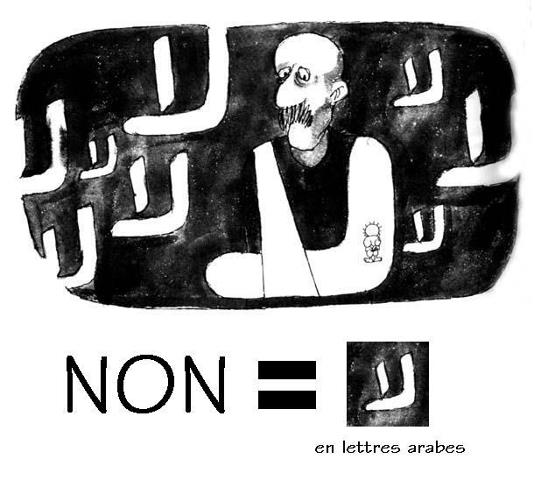
NO say the brave, heroic Syrians

The Syrian Revolution – Rana Kabbani at Cafe Diplo (March 2012)

Second part

Third part

Maysaloon : dialogue with Qunfuz

Saturday, April 28, 2012

Writing on his blog, Qunfuz expresses so well what I have felt for months:

But the written word, and in English – what use is it? To point out that the regime is barbaric, criminal and stupid? Anybody who doesn’t know this by now, after over a year of slaughter, will never know it. To change the minds of faux-leftists whose compassion ends at the borders of occupied Palestine? Such minds will not be changed. To predict the future? I see no future for Syria. I don’t mean the future is doomed, I mean my predictive powers have frozen entirely, except for the obvious, that there will be blood and chaos so long as this criminal gang remains at large. To discuss whether or not things which have happened inevitably, like the emergence of the Free Syrian Army, are good or bad things? Such a discussion would be an exercise in abstract idealism, and this is not the time for that. People are being murdered, right now, again and again and again.

Over the past year my writing stamina has ebbed and flowed, but it has never been as bad as it is these past few months. And yet I chide myself for feeling exhausted. For if I feel mentally exhausted and unable to keep writing about the murder and bloodshed in Syria, what would those people risking their lives over there be saying now? Perhaps Qunfuz is right. Perhaps this is just not our time, and we must preserve our energies for the long sprint to the finish line.

This is now a competition of the will. There is a regime prepared to dig in and wear down the population, and a people that refuse to live under a dictatorship any longer. These days I often find myself having a discussion with an invisible protagonist. He tells me, “What’s the point? The regime is not weaker, the people have suffered enough. It is hopeless.”

“No,” I reply, ” you are going about this the wrong way. Was it not just last year that the regime’s supporters were telling us that this would all be over in days? Weeks? Months? What is truly amazing is not that the regime is still there, but that the revolution still exists.”

“You are being naive”, he says. “Why do you still call this a revolution when it is quite clear that there is a foreign conspiracy against the country? And now that it is armed?”

“Please,” I say, “who are we kidding? There has always been a conspiracy against the country; always some foreign plot. That is not an excuse for shooting unarmed demonstrators, and arresting and torturing people. This is not an issue of mistakes being made, this is a disease that is endemic throughout this rotten system. And be honest, where the hell are these arms everybody is talking about when it’s clear that people are buying or stealing whatever arms they can get. There isn’t an opposition “army”, it’s just a rag-tag bunch of adventurers, deserters and desperate people, some good, some bad.”

“And besides,” I continue, “how on earth can you justify turning entire cities into war zones? This is nothing less than a war of attrition by the dictatorship and its militia, once mistakenly referred to as the country’s national army, to wear down the people, crush their spirits, and return the country into the shadows.”

He gets annoyed now. “Yes, but don’t you see. These people are not going anywhere. They live here. And you know, as well as I, what Machiavelli says about those who occupy a land not just with soldiers, but who go to live there themselves. It is next to impossible to remove them.”

“I know that” I reply, “and I’ve thought about it often. But it occurred to me, don’t the protesters and their families also live there? And are the economic hardships not suffered by all the longer this continues? If the people are also there, and the people also refuse to submit, then what use is force? What use is a tank if you just keep pounding the same piles of rubble, and if the people keep returning at night when the soldiers leave? You cannot fight ghosts. You cannot fight a swarm of bees with your fists. At some point you must learn how to behave in each other’s presence, and the oppressor must learn that they only oppress themselves when they stamp their boots on their fellows and that when they dehumanise another person they are actually turning themselves into beasts.”

“Yes, but look at the refugees” he says, “look how many have left the country. And that’s not counting those people who have flown out and are now living abroad, and those business people and rich people who have already taken their money out of the country. That is only the tip of the iceberg. Do you propose emptying the country?”

“No, I don’t…” I say, “but what kind of life is this if they return to the way things were before? What use is it if this man and his family still rule the country like their personal farm? Is it not better to seek a better life elsewhere? What use to a king is a kingdom without subjects?”

“You’re being unpatriotic now,” he says, “if you cared about our country you would know that it is better to die there than live in exile.”

“Not at all”, I reply, “I belong to this country out of choice, not necessity. I take no pride in belonging to a country which treats its people this way. Besides, being patriotic and loving your country is not just about missing having tea and manakeesh on the balcony in the morning and listen to Fairouz on the car radio. I can do that anywhere. In fact, your real country never leaves you, because you carry it in your heart. And patriotism is not singing some ridiculous national anthem or waving a silly flag. The whole point about a country is that it is a place people can call home, where they feel safe and can speak their mind without fear of repression. It is a place where the guest is always welcome, and where you can protect yourself from your enemies. That is a country for me, and it can be anywhere.”

“You’re right, but, well, I don’t know any more. He’s not going anywhere” he says, “the bloodshed will not end any time soon. And I don’t know what the future holds but I don’t feel optimistic”.

“No.” I say, “No I don’t know what the future holds either. But we cannot give up hope, even if it is a fool’s hope.”

“No, we cannot”, he says.

“No, we cannot”, I say.

Source

Not Writing About Syria

Qunfuz

Robin Yassin-Kassab

with 3 comments

picture by Paul Klee

I haven’t been writing about Syria at my previous pace. The time is not right.

This is a time for Syrian internet activists, those still surviving, to send us their videos. It’s a time for gathering evidence – although no more evidence is needed.

It’s a time for reporters to write, for committed foreign journalists to smuggle themselves inside and tell the tale. (You could call the murdered journalists martyrs, because they chose to go to a place where they knew they might die, and they did so for the sake of the truth.)

People who have specific human stories to tell should tell them. I hear the occasional story, and I might relay some of them; but I am not there. I am observing from Scotland.

This time is the beginning of a long process of creative mulling for those who will eventually produce novels and films concerned with the tragedy.

Most of all it’s a time in which people scream and suffer and die, a time to wait for the next explosion, or the next kick at the door, or for the return of the rapists, or for the next shriek of pain and humiliation from the neighbouring cell. It’s a time for burying children at night, hastily, in silence. And the suffering continues with glacial inevitability. Fate doesn’t seem to plan an end to it, not yet.

In such a context, I wonder what the use of words is. It’s not a cerebral questioning – I know words have as much or as little use today as yesterday or tomorrow; an unquantifiable amount – but a physical doubt. Words appear as pretty imposters. Today guns speak. Mortars, rockets, Scud missiles, helicopter gunships, tanks, the foul mouths of the torturers, the opened mouths in their victims’ chests – all these speak. To be specific about it, they don’t speak, they act. Trucks and cars. Sticks and whips. The wires which deliver electric shocks. And the men of the armed resistance also act. While the world outside watches and sometimes speaks froth.

The words used by the demonstrators are not drowned out. This is because their words have become deeds. Each sound they make is a defiance – defying not only the regime but the rules of reality as previously established. Each sound they make is amplified a thousand times by their astounding, ridiculous courage. To dare to chant while the killers surround you is to have made a spiritual commitment, or perhaps it is to have gone mad. (Bertolt Brecht says: “He who fights can lose, but he who does not fight has already lost.”)

But the written word, and in English – what use is it? To point out that the regime is barbaric, criminal and stupid? Anybody who doesn’t know this by now, after over a year of slaughter, will never know it. To change the minds of faux-leftists whose compassion ends at the borders of occupied Palestine? Such minds will not be changed. To predict the future? I see no future for Syria. I don’t mean the future is doomed, I mean my predictive powers have frozen entirely, except for the obvious, that there will be blood and chaos so long as this criminal gang remains at large. To discuss whether or not things which have happened inevitably, like the emergence of the Free Syrian Army, are good or bad things? Such a discussion would be an exercise in abstract idealism, and this is not the time for that. People are being murdered, right now, again and again and again.

Back to Daraa

Syria under lockdown
We travel back to Daraa, where the nation’s uprising began, to find a city under complete military control
By and , GlobalPost

In this image made from amateur video released by the Shaam News Network and accessed Wednesday, April 18, 2012, smoke billows an impact following purported shelling in Khaldiyeh district, Homs, Syria. (AP Photo/Shaam News Network via AP video) (Credit: AP)

A GlobalPost journalist, whose name has been withheld for security reasons, reported this story from Daraa, Syria. Hugh Macleod contributed reporting from Beirut, Lebanon. This article originally appeared on GlobalPost.

DARAA, Syria — In the heart of Old Daraa — the tough, tribal, farming community on Syria’s southern border with Jordan — the Omari Mosque once stood as a symbol of resistance, a gathering point for those demanding the end of the regime, and a field hospital for when they received their reply.

Global PostToday, a year after GlobalPost first visited the city where Syria’s uprising began, the mosque has been transformed into a military base. Cement rooms have been built around its walls, home to dozens of soldiers.

The snipers who picked off civilians during the siege here last year are still posted atop the highest buildings and the headquarters of the ruling Baath Party and the regime’s many security agencies.

Tanks and armored vehicles remain deployed not only inside the main city itself — in violation of the UN-Arab League cease-fire plan — but around most towns and villages where anti-regime protests have taken place.

On road signs, bridges, schools and clinics the graffiti slogan that children first scrawled back in March 2011 still stands: “The people want to topple the regime.”

Dozens of checkpoints still ring Daraa and divide its streets and neighborhoods. Soldiers and secret police mete out arbitrary humiliation, residents said, often abusing women or making locals wait an hour in the blazing sun while they leisurely finish their cigarettes and tea.

Locals said government services are running at a minimum and state employees now regularly work only one or two days a week. The shops are open again, but night markets are a thing of the past as shutters come down promptly at 7 p.m., just before the regular nightly clashes between regime troops and armed rebels of the Free Syrian Army.

Exactly one year after first visiting this city, which gave birth to the Syrian uprising, a GlobalPost reporter described Daraa as “dying,” a “demolished battlefield” where residents complain bitterly about the destruction of their livelihoods and discuss international military intervention, finding arms to fight and other means to bring down the regime.

As the first major city to suffer a full military assault, the situation in Daraa could foreshadow the fate that likely awaits Homs, Hama and other major protest centers if the regime re-exerts long-term security control over urban opposition strongholds.

“We know that if we give up now the regime will finish us later,” said Abu Rami, a member of the Zuabi tribe, one of the four big tribal families that dominate Syria’s south, a land of black basalt rock, known to locals as the Houran.

“To keep our revolution going now costs less than if we stay at home until the army or security men come and slaughter us like sheep.”

One of Abu Rami’s cousins was among the 15 schoolboys whom security forces arrested last March for spray-painting anti-regime graffiti. The boys were tortured, sparking the mass protest movement. A year later, the 40-year-old said that security forces have killed at least 70 members of the Zuabi tribe. Each one — under the local system of tribal law — represents a blood feud between the tribe and the regime.

To travel from his home in Old Daraa’s Arbaeen quarter into the city center means Abu Rami must pass through three checkpoints, his every movement monitored by snipers.

Protests still go on across the Houran most Fridays, but they are now usually small and unable to join together as they did this time last year.

And every weekend, Syrian activist groups report the endless morbid toll: Reem Abdul Rahman, 17, killed in Giza yesterday, a day after her brother; Adel Ghaleb al-Zuabi, died of wounds untreated in Taiba; Ali al-Turk, tortured to death after being arrested in Al Karak al-Sharwi eight days ago; an unknown male from Heet, detained and tortured to death; Mahmoud al-Badawi, also from Heet, whose body was discovered in the village of Sahm, bearing the scars of torture.

All of these fatalities were from Daraa, just one area of Syria. The respected Syrian Network for Human Rights (SNHR) confirmed their deaths on Sunday. All told, the SNHR found 25 people killed on Sunday in Syria, a modest toll by the standards of the past month.

Against this backdrop of everyday long-term violence, even overtly non-political residents of Daraa appear to be becoming increasingly radicalized against the regime.

Ali is a 45-year-old engineer who works for the state and lives comfortably in a big house with his wife, four children and elderly parents in Daraa’s Qusour district. For the past year, however, Ali’s middle-class status has taken a serious hit: With regular electricity blackouts lasting between 12 and 14 hours, Ali can’t keep fresh food in his fridge, and his children have to study by candle or flashlight.

If his parents need medical treatment they can no longer seek it for free at the state-run Daraa National Hospital because Ali said the facility has been taken over by the military for the treatment of injured soldiers, secret police and armed pro-regime thugs.

Instead, they must travel to Damascus and endure the one aspect of the regime’s vice-like grip on Daraa that irks Ali the most: checkpoints.

“I am an engineer and earn a good income and have no problems with the government. But when I cross any checkpoint, the security men deal with me as if I am an armed fighter,” Ali said. “They don’t respect anyone: The elderly, women, the educated, they see all people as nothing.”

Last week, as he was trying to cross a checkpoint, Ali said a young member of the secret police took his ID and slapped him in the face with it.

“He said, ‘I’ve seen you before.’ He was joking and making fun of me. I felt so angry, but what can I do? It is very easy for him to shoot me and say that I am an armed fighter. No one will investigate or hold him accountable.”

As well as IDs, residents of Daraa wishing to travel north to the capital must now show security men at checkpoints their recently paid electricity, water and phone bills, a move by the regime to counter the spread of civil disobedience in protest centers like Daraa and Hama where residents began burning their municipality bills.

With so many checkpoints choking it off, Ali said many large food companies no longer send their trucks to Daraa, creating spiraling inflation on basic commodities.

Many of Ali’s neighbors have moved to the slum-like illegal housing areas that have sprung up around Damascus over the past decade. Ali chose to stay in Daraa to continue working his government job but makes regular trips to Damascus to buy dry foodstuffs rather than pay exorbitant local prices.

And every time he travels he faces the same checkpoint humiliation.

“The military and security crackdown pushed the people to be more angry and radical but without solving any problems,” Ali said. “Personally, I used to be very supportive of Bashar al-Assad, but today I am not.”

More GlobalPost

  • Syria: How it all began

    A single act of brutality by Assad’s secret police ignited protests that swept the country
    Hugh Macleod and a reporter in Syria April 23, 2011
  • source

Douma, after the UN peace keepers left

[youtube http://youtu.be/mqrn3shGHZU?]

A comment on Walls to this clip :

Douma, and right after the UN peacekeepers left, the half man ordered his stooges to fire tear gas on the protesters, the young and old were taking cover while cursing the despicable. In the mean time, the number had risen to 50, in Hama since the peacekeeper left the city

Blog at WordPress.com.

Up ↑