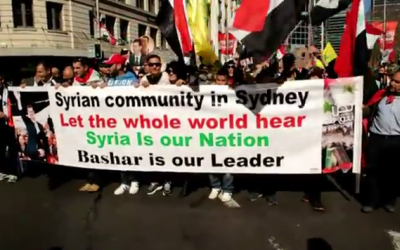
On August 6, Australian supporters of Bashar al-Assad’s murderous regime rallied and marched under the slogan “hands off Syria!”
That the Syrian regime’s sycophants should demand a “hands off” policy from Washington, London, and Melbourne is logical. They do not want any outside force to interfere with the regime’s all-out war on its own people. They do not want Western arms for the Free Syrian Army, U.S. or British efforts to block Russian warships from bringing guns, bombs, bullets, helicopter parts, and gasoline to Assad, or Western airstrikes against the regime’s tanks, aircraft, and helicopters.
What is bizarre and disturbing is that Western progressives who are fighting for the very same freedoms and rights revolutionary Syrians are being killed for wanting are adopting the same slogans and policy preferences as Assad’s defenders, namely: “hands off Syria” and “no to Western intervention in Syria.”
I am talking about people like lifelong revolutionary socialists Tariq Ali and John Rees.
The Western left has by and large adopted the Assad counter-revolution’s preferred slogans and policies as their own because they have not asked themselves (as Lenin did) who stands to gain from them? Who stands to gain from British and American imperialisms standing idly by while an unholy alliance of Russian and Iranian imperialisms,Hezbollah, and the Assad regime tries to bury the Syrian revolution? Who stands to gain from unimpeded Russian arms shipments, unimpeded Syrian tank movements, and under-armed Free Syrian Army fighters?
The answer is blindingly obvious: the Assad regime.
When our opposition to U.S., British, or other imperialisms leads us to unwittingly assist counter-revolutions in Libya, Syria, or any where else, then it is time to rethink our anti-imperialism, or rather, how we apply anti-imperialist principles to a multi-polar world crawling with imperialists of all different shapes, sizes, strengths, and orientations, a world whereevery government and 1% has its own version of the Central Intelligence Agency (CIA) and its own edition of Fox News to advance its predatory interests in every situation, at every turn.
The Russian edition of Fox News is Russia Today, the Syrian edition is SANA, and the Iranian edition is Press TV(Voltairenet, on the other hand, is the French equivalent of Glenn Beck even though it is financed by the Assad regime). All three of these outlets are favorites among Western anti-imperialists even though they provide misinformation about Syria. The reality is that all three of these outlets are just as “fair and balanced” as Fox News is, meaning they all have hidden, unstated 1% agendas. This is why Occupy-style peaceful protests in Russia, Syria, and Iran get the same treatment in their media that Occupy gets in the American media.
Protesting too long, too effectively, or too loudly in any of these countries can get you killed, as the list of Russian journalists murdered proves, but it can get you killed here too.
Think I am exaggerating? Just ask a Black Panther.
We have been spared the fate of our Syrian, Libyan, Iranian, and Russian counterparts as of late only because our organizing has been mostly ineffective and not a threat to 1% power and profits. Right now, we are more likely to be killed by rampaging psycho-cops than we are by America’s secret police or other “law enforcement” agencies.
That will change if and when we become as massive, militant, and successful as the Arab Spring.
If you think Assad and Ghadafi are bad, just imagine the Assads and Ghadafis in Washington that sit at the top of the world’s food chain of repression, armed with nuclear and other nefarious weapons, who have perfected the art of divide and rule not only at home but on a truly global scale. They have armies of advisers, armies of intellectuals, armies of lawyers, armies of spies, armies of collaborators, armies of turncoats and traitors-to-be, armies of managers, armies of bureaucrats, armies of fund-raisers, armies of spokesmen and women, armies of court scribes, armies of hackers, armies of cops, and armies of armies to do their bidding against us.
On the up side, as in Syria and Libya, the American armed forces have not been called on to use lethal force on a mass scale against our 99% for decades. There is no doubt in my mind that military personnel who are barely above the poverty line (and in some cases on food stamps) are not going to be gung-ho about shooting their own flesh and blood if, or rather when, that comes to pass. Most of them take the oath they swore to defend the Constitution with their lives very seriously, and orders from the Mitt Romneys and Barack Obamas of the future to dispense the rabble exercising their constitutional rights are not going to go over well.
Thinking about revolution and civil war here at home in this way ought to give us a bit of insight into what is really going on in far away lands like Syria and clue us in to what we should and should not do about it.
Peaceful protests in Syria broke out in spring of 2011 just as they did in Egypt, Libya, Yemen, Bahrain, and everywhere else in the Middle East and North Africa where hungry people were tired of being beaten by cops, cajoled for bribes by government officials, and forced to silently endure every indignity imaginable out of fear, sheer terror, that you or your loved ones could disappear without a trace and end up in a ditch or a river somewhere without a face, I.D. card, or teeth for identification purposes.
The millions of grievances silently accumulated by millions of people over decades under the watchful eyes of murderous police states exploded in 2011 in an outpouring of festivity, celebration, and unrelenting bravery that did not line up nicely and neatly with the pro/anti-U.S. dichotomy that divides Middle Eastern and North African governments from one another. The Arab Spring’s failure to conform to this divide divided the international left into three camps: those who supportsmashing revolutions against “anti-imperialist” regimes, those who support revolutions smashing all the regimes pro and “anti-imperialist” alike by any means necessary, and those who seek a “middle ground” between these two camps and attach terms, conditions, fine print, asterisks, and caveats to their support for the Arab Spring’s revolutionaries over issues like non-violence, Western intervention, and sectarianism.
It is the comrades in the middle like Tariq Ali, John Reeds, and Phyllis Bennis who are doing themselves and the Syrian revolution a tremendous disservice by lining up politically with the Assad regime’s supporters by demanding “hands off Syria!” and “no to Western intervention!”
We in the West should not unite for any reason with any force that supports the murderous counter-revolution in Syria that is the literally killing the country’s best shot at political freedom, democracy, progress, and a future free of bloody, debilitating sectarianism.
To those firmly in the camp of Assad’s counter-revolution: if you can watch these videos of children in Aleppo orteenagers in Damascus without feeling like running out into those streets to join their clapping, dancing, chanting, and singing, I have to question whether you are a human being with feelings and emotions much less a so-calledrevolutionary.
If you think the CIA or the Israeli Mossad trained these kids and teenagers in the fine art of revolution, if you think they can conjure that defiant, rebellious, uncompromising spirit out of thin air, at will, you are either a damn fool or on some serious drugs. Cocaine is a helluva drug but it is nothing compared to whatever you are on if you think intelligence agencies staffed by professional killers, liars, and con men can engineer popular, broad-based revolutions almost overnight that are strong enough to withstand not just getting kicked out of a park but widespread torture and wave after wave of executions.
If you think the Syrian revolution was made in or is controlled by Washington then you should nod your head in agreement the next time Mayor Michael Bloomberg or Governor Scott Walker claims “outside agitators” are responsible for our street scuffles and protests because it is the same pack of lies the 1% use no matter where they rule, what language they speak, or how they measure up on the scale of “anti-imperialism.”
Whenever the 99% begin to move and make noise, the 1% try to convince us that it is outsiders and not we ourselveswho are disturbing the thrones that rest on our backs.
The sad part is that these lies are largely recycled, reused throughout history, copy and pasted from one era to the next. The master classes have never been masters of invention or originality; they can buy both on the open market with their blood-stained dollars, euros, pesos, yuan, silver, or gold.
The Viet Nam generation heard this same song and dance from the likes of Richard Nixon, Lyndon Johnson, and John F. Kennedy: nefarious outside agitators, trained in Moscow, financed by China, backed by the full weight of world communism were infiltrating poor defenseless little South Viet Nam’s fledgling democracy, stirring up trouble, wreaking havoc, and attempting to pull the country behind the Iron Curtain. Change a few words around and you have the so-called anti-imperialist view of the Syrian revolution today: nefarious outside agitators, trained in Turkey, financed by the Saudis, backed by the full weight of U.S.-Israeli imperialism are infiltrating poor defenseless little Syria’s fledgling self-reformingmonarchy, stirring up trouble, wreaking havoc, and attempting to pull the country behind the curtain of American capitalism.
And what is even sadder is that men like Rees and Ali who lived through those days seemed to have forgotten the sound and rhythm of this all-too-familiar tune.
So what is the point of this lengthy diatribe?
The first point: disowning people in Libya or Syria because they got so desperate they begged a far away band of murderous thieves to help them get rid of the murderous thieves that were cutting their throats, torturing their kids, and doing God knows what else to them because we, as a matter of principle, are opposed to murderers and thieves is almost as criminal as it is stupid.
The second point: agitating and organizing to stop the U.S. or British governments from arming Syrian revolutionaries, blocking Russian ships filled with Assad’s weapons, or blowing his helicopters out of the sky is the single best way tostab the Syrian revolution in the back, and by stabbing them in the back, we stab ourselves in the heart because the impetus for Occupy came from the Arab Spring and not the other way around.
Occupy and the Arab Spring are one hand, and so we have a duty and an obligation to support, fight for, and aid the victory of the Syrian and all other revolutionary movements no matter how many spies the CIA sends, no matter how much Saudi money flows into the coffers of the Free Syrian Army (if they cannot afford weapons to take out Assad’s tanks and helicopters or nightvision goggles that could help them protect Syria’s nightly peaceful protests the amounts are underwhelming), no matter what political or sectarian mistakes they make, and no matter what side the U.S. decides to back in which country for whatever reason. All of that is secondary to our primary task: helping them win.
If the only thing you can focus on or see is one bunch of murderous thieves in Tel Aviv and Washington and their weaker rivals in Moscow, Tehran, and Beijing edging each other out of influence in Syria, Libya, Yemen, Bahrain, and Jordan you are missing the most important thing: the 99% are waking up, rising, moving, organizing, and where they have to, arming, fighting, and bombing their oppressors into the dustbin of history.
Either lead, follow, or get out of their way.
source