Search

band annie's Weblog

I have a parallel blog in French at http://anniebannie.net

Category

Syria

The Secular Idiot’s Guide to Syria’s Jihadist Groups

The proliferation of radical Islamist groups fighting in Syria is beginning to resemble the Jihadi Olympics in the words of one observer. (Me). They span the entire political spectrum, from extreme militant Salafist to Nihilist Al-Qaeda franchise. But to the untrained eye it’s difficult to tell them apart or know what each stands for. So we prepared this brief but handy guide to help you differentiate between The Lions of Damascus Brigades and The Damascus Lions Brigade. As a general rule, the more hard consonants there are in a group’s name, the more hardcore they are. Groups with 3 vowels or more are often dismissed as ‘liberals’.

Jabhat Al-Nusra

No doubt the jewel in the crown of all Jihadi groups. Except that they don’t approve of jewels. Or crowns. Or embellishments of any kind. Sometimes they are mistakenly referred to as Jabhat Al-Nusra Front, which literally means The Nusra Front Front. But that makes them sound ridiculous. And if there’s one group you don’t want to piss off it’s the Jabhat Al-Nusra. In fact, don’t piss any of them to be on the safe side.

Liwa’a Al-Tawheed

Liwa’a Al-Tawheed or the Unity Brigades is a splinter group formed out of a spin-off group of members that quit the Free Syrian Army. I know, but irony isn’t their thing.

The Lions of Damascus Brigades

Animal names are popular among Jihadi groups, but mostly lions and eagles, not so much giraffes and hedgehogs. The names are chosen to symbolise their ferocity but also their sympathy with nature and wildlife. The Lions of Damascus is also a semantic device to appropriate the name of President Assad which means ‘lion’ in Arabic. Many Jihadi groups are influenced by post-structuralist theory.

The Damascus Lions Brigade

Before you start making jokes of the “Judean Liberation Front” variety, it’s worth understanding the nuance in this group’s name that distinguishes it from The Lions of Damascus Brigades. There are some things about Jihadi groups that might appear nonsensical or irrational but… (we didn’t find a way to finish that sentence).

The Islamic Dawn Movement

Times of the day are also very common in group names’, particularly ones symbolising newness and beginnings, dawn, morning, mid-morning, that sort of thing. Which is somewhat at odds with groups that draw inspiration from ancient times and have a strong sense of nostalgia about them, but as we have already established semantic consistency isn’t the Jihadists’ strong point.

The Ummah’s Shield Brigade

Shields, swords, sabres and other paraphernalia from Islamic history are quite common among these groups, but for some reason not astronomical instruments , medical implements or any of the multitude of devices that Islamic scientists produced in the past. One might argue that it’s the result of a selective and militarised interpretation of Muslim history but one better be at a safe distance before making such argument.

Sultan Mohamed Battalion

Some might ungenerously assume that this group was named after the Ottoman Sultan because it is sponsored by Turkey, but such cynical conspiratorial interpretations have no place in the modern Jihadi world. In fact the group’s name commemorates the Sultan’s main achievement, conquering Constantinople and defeating the Byzantine Empire. This austere battalion is deeply offended by the Byzantines, “spending hours putting those puzzles together”. (We think they mean mosaics.)

The Free Men of Syria Brigade

Freedom is a strong theme among Jihadist groups, although you need to disassociate it from its Euro-centric meaning in the sense of freedom to drink alcohol, vote or read modern poetry. Freedom here refers to the freedom to impose the righteous way on other people, a human right than is totally ignored by the West. The Free Men of Syria practice what they preach, and they have taken the liberty to destroy several shipments of alcohol already.

We hope this guide was helpful, come back for updates as the groups constantly change shape, reform and split according to their own internal logic. (Nothing to do with where their financial support is coming from as some cynics might argue.) And to the Jihadi groups we say, we’re just doing a public service here, don’t shoot the messenger. I mean, you’ve been known to do it in the past.

source

Bashar Is bombing us.

Dec 11

Posted by OFF THE WALL

I am not good at that. I mean, I don’t know how to collate news round-ups despite of the many available modern gadgets that make that easy. May be I don’t like to do that, or perhaps, it is nowadays harder for me to do so as my main source of news ceased being news-papers and blogs and became fast tweets, rapid shots of rss-feeds, and Facebook posts coming from all over Syria telling me and a cynical world where a mortar shell has just fallen and where the most recent massacre-by-barrel has taken place decimating a neighborhood block and absurdly ending many potentials of greatness, mediocrity, and just plain normal living.

It is also harder to be opinionated nowadays, especially regarding the rapidly unfolding events in Syria, which while appearing to occur in a rapid succession, do nonetheless betray a slow, constantly flowing lava-like wall of brutality, suffering, and unimaginable misery. Friends are wounded with no well-organized medical relief to take care of them, and when relief is available, it is mostly controlled by a single group with a viciously selfish and opportunistic political agenda whereby aid is dispensed only to those who belong in their allegiance to the group or to its battalions, most of which consist of fighters and leader who are neither indoctrinated, nor deeply religious, but are pragmatic in meeting the needs of the moment, be it a case of ammunition, a few gallons of fuel, or some food to sustain their fighters.

Aleppo-Destruction

Destruction in Aleppo due to Assad regime criminal bombardment of civilian areas

What permeate the atmosphere in Aleppo are the genetic prints of the culture of despotism, nurtured and fed through corruption and terror by two generations of Assads. Despotism is evident among some armed groups, especially in Aleppo where stories of abuse, theft, corruption, lack of coordination, greed, vengeance, betrayal, and selfishness continue to surface every day. A majority of these stories can be attributed to the hordes of Shabee7a, who when abandoned by Assad, decided to form their own military battalions or to join other groups under the banner of the free Syrian Army. But other stories can be attributed to young men, now carrying weapons, and are entrusted with maintaining peace and order in liberated areas, but fail to understand that this revolution is all about ending abuse and behave the only way they have seen men with arms and authority behave, and that is being abusive with a sense of entitlement. The regime, as expected, continues its wanton “burn the country” vengeful madness as it bombs infrastructure including power stations, bakeries, and hospitals, as well as civilian neighborhoods as the most wanted target on its list of mayhem. Power outages, water cuts, and full deterioration of basic services made life unbearable in a city used to abundance, and during forty years, has been devoid through premeditated malice by the Assads and their goons of civil society institutions to maintain social cohesion in times of disasters. A city plagued, like all of Syria, with a state that is indistinguishable from the brutal regime who had as described by Yassin Haj-Salih, used the state to cement its brutal sectarian rule, and gradually eradicated it and turned it into a mere extension of itself. Yet it shed it the moment the state became a liability to the small gang of bloody Assads and their sectarian criminal circle.

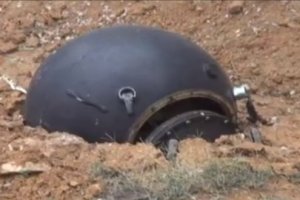
Naval-Mine

Naval mines dropped as highly destructive cheap killing and destruction instruments In Damascus country side, where Assad has been bombarding civilians for the past few days in hope to slow down the revolutionary forces’ progress toward Damascus.

It is natural, therefore, that some residents of Aleppo’s liberated areas complain about FSA in their midst. The lack of basic services, the severe bread crisis, weeks’ long black-outs, and water outage, and constant bombardment gets to you. But is that a sign that FSA is losing public support? Or that the regime is gaining more supporters? Frankly, I believe that only a fool, completely detached from the facts on the ground, would think that the regime can gain any public support. Same fool of course might even think that this criminal gang of thugs cares about gaining public support at this stage.  The Assads and their band of thugs and criminals (both physically and economically) have combined brutality, corruption, despotism, fatalism, and sectarianism, to create a witch’s brew of absurdity at an inhuman scale and qualities. Within such severely deformed prism, facts don’t matter, and whether one believes his own lies or not is irrelevant, for suspension of disbelief is no longer a requirement, what matters is only fear and spiteful vengeance. Both are the hallmarks of this inhuman horde that had ruled my Syria for most of my life-time.

In the midst of suffering and lack of coordination among FSA groups in the north emerge groups of highly disciplined fighters. Jihadist in their practices, and yet, of unclear origin, these groups are now coalescing under Jabhat Alnusra (Support Front). I have argued in the past that this group is highly likely made up by the regime. But the front and similar groups seem to have taken an increasingly more visible role as the most effective of the anti-regime armed groups. There are visible campaigns to bestow a legendary stature on the front as it continues to be present in almost all recent successes of the FSA against the regime, and with that, control over much of the spoils in weapons and ammunitions captured from regime forces. Groups not directly affiliated with the front, but wanting to get access to the same source of support the front has are starting to copy-cat the front’s behavior, albeit against the citizens instead of against the regime such as the fools who declared the establishment of the virtue brigades, with calls for the cleansing of Syria from Alawite and the band of battalion leaders war-lords wannabe who declared an Islamic Emirate in the north in a desperate effort to oppose the newly formed coalition, which they feared will centralize funds and leave them out to dry if they don’t shape up.

Arguably, the presence and ascendancy of Jihadi groups has played a double edge sword. On the one hand, they are making it easier to wipe out the security apparatus in the post-assad era as they have managed to close many of its branches, scare its informants into hiding, and intimidate its collaborators, sometimes through outright execution style assassinations especially at the local level. At the same time, they have made defection of much needed officer corps harder than it would have been without their practices and ignorant pretend “I am a Jihadist attitude”. In fact, as expected, pushing their luck, some of the groups have now scared the US and some other nations into the edge of declaring them terrorist organizations, which even if right, further complicates the on-going liberation of Syria, hinders much needed relief efforts, and the jeopardizes the immediate post-assad political process.

I have not commented on the formation of the new Coalition. Many have argued that the coalition suffers the same ailment of its largest component (SNC), which has been controlled by an opportunistic and cynical group of the Assad opponents, the Muslim Brotherhood. The coalition, however, presents a reasonable platform for now. It seems to be successfully led by a charismatic and respected leader, who still needs to do much more to stem the monopoly the Muslim Brothers have over much of the aid resources available. This monopoly continues to place honest people, who are willing to work within SNC in bad situations. Today, the Kurdish National Council decided to join the coalition, which is bound to reduce the influence of the MBs, and with more groups to join as the coalition becomes recognized as the legitimate interim representative of the Syrian people, there may be a hope for some improvement on the political front. Power plays are bound to affect it, like any ad hoc political coalition formed in response to external pressure and facing brutal regime that has succeeded, through brutality, in making relief work become the measure of performance instead of political or even military successes of its opponents.

Likewise, militarily, also under external pressure, there seems to be a trend for coordination. A meeting was held recently in Antalya, Turkey between representatives of many of the armed revolutionary groups. Once more a new central command was announced, albeit in complete isolation from the political coalition, at least for the time being.

Criticism of the FSA is coming from several sides. I will of course dismiss that coming from the band of loyalists and regime propagandists. But I will not discount criticism coming from the revolution quarters. Some of the criticism is fair and some is not, but in all, it is a very healthy sign that has thrown some of the personnel and leaders off balance and has caused the FSA to try to ameliorate some of the problems, albeit through sharia courts, which on many occasions add fuel to the fire instead of calming things down. I would argue that once the regime air force and artillery are silenced, hopefully soon, civil society will emerge and will thrive in short order. It is the regime’s criminal destruction and murder that continues to hinder the emergence of effective local council and the evidence of the inherent and capacity to produce healthy community governance was well articulated earlier on NPR

Overall, the picture is grim. Syrians are now recalling what their great grandparents have once told their parents about the great years of famine and misery. The time of Safar Barlek, when the Ottomans forcibly drafted the men of all ages for their war efforts, confiscated most agricultural products, and left the women, the children, and the elderly to fend for themselves during one of the harshest cold spells in the elders’ memory. The Syrian tragedy resembles no one for never in recent and past history have rulers shown such contempt to their own people. The Syrian Misery extends throughout the region. Children have died in the cold of most inhumane refugee camps in Jordan. I have been told that the Jordanian authorities tax every single item by confiscating a third of the shipment intended for the camps, notwithstanding that on several occasions, what was left after confiscation, never really made it to the camp. There is no worst story to tell of the horror than that of children. Even the lucky ones who have made it, through family members into the safety for homes in Egypt or one of the gulf states continue to suffer.  A face book post illustrated this most vividly by telling the story of a little girl,  brought to safety in the United Arab Emirates by her uncle, and was taken for an outing during the celebration of the UAE national day.  The poor girl when hearing fireworks, she put her hands over her ears, and started shouting hysterically, Bashar is bombing us, Bahsar is bombing us.

It is for this child, it is for Hamza’s memory, for the Qashoush, for nearly fifty thousand Syrians, young and old, who were murdered in such cold blood by the Assad gangs, accompanied with the fanfare barked by ugly and cruel herds of mindless loyalists, it is for the victims, for Syria, and above all for humanity that Syrians can’t lose hope. We can’t afford to lose it, even knowing that this regime might and can easily resort to mass murder weapons in its arsenal. There is nothing that the regime has done that demonstrates that its arsenal of weapons, which by definition are lethal was prepared for anything but for its survival one more minute, even if that meant the utter destruction of a beautiful country, and the death of all of its inhabitants. Anyone who thinks that there is a shred of humanity or of rationalism in the Assad gang is a fool who has blinded himself to forty years of history leading to two years of anti-historical nightmare. No one is responsible but the regime, and anyone claiming otherwise is complicit in the great Syrian Genocide. The list of regime crimes include, in addition to the evil murder of tens of thousands of Syrians, the torture of hundreds of thousands, but most vile of this contemptible gang’s crimes is the attempted murder of their souls and of their humanity.  To the scared child I say, sweet child, they have been bombarding us for forty two years. Little by little, they destroyed our heritage of civility. But my sweet child, we will get that back. Granted, we may lose some of our innocence, but from you dear child, we will learn it again.

Note: Dear 7ee6anis. I think by now, most of you already know of SYRIA DEEPLY. It is an outstanding new site on Syria that combines smart commentary, intelligent design, and for the tech-freak mundass some incredible tools such as defection tracker, regime relation mapping, and an updated map of incident on the ground. The site also feather Syrian Stories, with two so far written by the wonderful Amal Hanano.  You may want to read this article about Syria Deeply describing how the site Outsmarts The News, Redefines Conflict Coverage.

Doctors are suffering silently as Syria’s crisis continues


One-page article

Three weeks after the massacre in the Syrian town of Daraya on August 27 – the bloodiest single day of carnage in the Syrian uprising – villagers made a gruesome discovery: 33 dead bodies had been tossed into the bottom of a well at a nearby farm.

The victims had apparently been pushed into the well with their hands tied behind their backs. They were then blown to pieces by explosives tossed down on top of them. The remains were later brought to the area’s hospital by a resident.

The story of these people’s suffering was retold to me by a Syrian doctor who recently left the country. Anwar Herata, who had been an orthopaedic specialist at the National Daraya Hospital since the beginning of the uprising, offers a rare first-hand account of the bloodshed in that town.

His account is consistent with videos and other reporting from activists and journalists in the region.

It appears that about 1,000 people were killed in the strategic town less than 10 kilometres from Damascus. In October, activists said 100 bodies were found in the hospital of people summarily executed.

A day before the massacre began, Dr Herata said in a recent interview, military vehicles and troops rolled into town. Security forces began asking for identity cards; they would send those back down the motorway if they were not from the town. Hospital personnel were also sent back and the hospital was closed; some believe it was used by government snipers during the killing.

“The next day the massacre took place,” he said. “In Solaiman Al-Dairani Mosque alone, 122 people were killed after residents took refuge from the shelling.”

Even then, murder was no stranger to Daraya. In the early months of the uprising, National Daraya Hospital received six to eight patients with serious gunshot wounds on most Fridays, and one or two on other days. “A gunshot in the head, a penetrating chest gunshot,” Dr Herata told me. “Most of them would die or be taken away by security forces.”

Victims would be brought to the hospital by civilian cars – ambulances were not allowed to transfer patients from protest areas. If victims survived, they would then be taken away by security forces to face their fate – sometimes even before their medical situation improved.

Dr Herata remembers one victim well – Mohammed Al Dabbas, an activist from Daraya who was dragged away from the hospital’s emergency room while he was still anaesthetised. During one protest he was shot in the chest and shoulder.

According to the doctor, Mr Al Dabbas had been wanted by the regime for five months because of his activism. His crime? Placing the revolutionaries’ flag on the local municipality building and taking part in protests.

“The security forces took him from the emergency room while cussing and cursing the doctors for attempting to treat him,” he said. “They took him to the military hospital, which is essentially a graveyard for wounded protesters.”

The daily horrors Dr Herata witnessed in the hospital underline not only the regime’s extreme violence but also the thuggish nature of the regime’s affiliates. But it also highlights something else: the impossible situation of many of those who are still working in the country’s government institutions.

Although many of his colleagues sympathise with the uprising and the protesters, Dr Herata said, they hide their feelings or risk being reported. Some of the doctors are regime supporters who question their colleagues if they try to treat wounded protesters. “We would tell them this is our job,” he said.

He says one of his friends, who worked for Al Mujtahid Hospital in Damascus, was killed after security forces thought he had provided bandages to field hospitals. Bandages bearing the hospital’s name were found in a raid of the field clinic. The security forces asked who from the area worked for Al Mujtahid.

“He was gunned down without an investigation,” Dr Herata said, “although he has nothing to do with field hospitals.”

In another instance, two security personnel came to the hospital from a nearby checkpoint to be treated for flu. One of the soldiers asked for extra medicine for his colleague and when the doctor refused to do this without checking the patient, the officer warned him not to be “big-headed”. When the doctor insisted, the officer called his superior and six soldiers came to the hospital and took away the doctor along with a colleague who tried to help him.

This environment, Dr Herata says, is creating a climate of fear; medical professionals are leaving the country although they are desperately needed. Those who stay face special scrutiny from the regime’s forces.

Haidar Ali Al Fandi, a doctor I knew during my university studies in Damascus, was killed in the provincial capital of Deir Ezzor in September after security forces raided his home and shot him because he had turned his house into a field hospital.

Medical professionals in Syria are squeezed no matter where they turn: threatened if they stay, ostracised if they go. A health disaster is looming in their country and doctors, above all, need to be given the chance to be trained or continue their training. At the very least, Syrian refugees in neighbouring countries could use their services while Syria’s crisis continues. Efforts should perhaps be made to link doctors who have fled the violence with their countrymen in camps on the border.

Perhaps one day Dr Herata will be able to help Syrians with medicine. Until then, his recollections of Syria’s horrors is the best he can do.

hhassan@thenational.ae

On Twitter: @hhassan140

Syria’s Very Private Schools of Shame

بواسطة

admin

– 2012/12/08نشر فىEnglish

MARTIN MAKINSON : all4syria

“You must forget about this story. Now go and pay for your visa.
We had just had a cup of Turkish coffee in the office of Syria’s chargée d’affaires in France, Shaghaf Kayali, a career diplomat then sent as Syrian ambassador to Jordan. She had spoken hurriedly, with a smile of embarrassment on her face. This was the second time she had received me at the embassy, in the upper class “Septième” district of Paris. I could perceive a slight element of fear in her words, in her brown eyes, behind her rimmed glasses. What had led an educated and apparently kind diplomat, whom I had met because of her interest in archaeology – and European archaeological missions in Syria were then living through a golden age – to express herself in this way ??

December 2006. I am spending the Christmas break in London, where my parents live since my father retired from UNESCO in Paris. The phone rings, and an unknown woman’s voice in broken English asks me, with very little in terms of introducing herself, if I would like to teach at the recently-opened private school in Homs, Al-Hikma (“Wisdom”, a name that reminds customers of its namesake in Ashrafiyyeh, Beirut, where generations of Lebanese were educated).

How on earth had Rasha Faysal gotten my number in London, which is not even where I usually reside? Rasha Faysal, daughter of Lina Faysal, ex-Mayor of Homs, and Rachid Faysal, owner amongst other things of an entire street with upmarket trendy restaurants in this drab city, now the epicentre of Syria’s revolution… In any case, my PhD was unwritten (forget about jobs in research…). I had already committed to working as an archaeological tour guide in Muammar Khaddafi’s Libya for MagicLibya, an operator run by a Syrian based in Belgium, which caters to European agencies like Intermèdes and Nouvelles Frontières.

 I therefore replied that I couldn’t be available at short notice (Faysal wanted me for a fortnight later), but I mentioned that I was interested in the possibility of working in the fall of 2007 in a bilingual school (“international” was actually the word used by her).
I then remembered that in 2005 I had vaguely commented to a pharmacy student living in Damascus of my wish to teach in the “new Syria”, to watch how a country was slowly modernizing infrastructure and services, and to witness if or not Syria could pull out of the Stalinist ideological quagmire of Assad’s iron-fisted rule.

 Rasha Faysal had also studied pharmacy with that Damascus acquaintance: maybe an explanation for how I was approached.

I had travelled to Syria since 1992, had participated as a student in archaeology to excavations in the remotest areas of what looked back then as the Middle Eastern version of Ceaucescu’s Rumania. Yet I had learnt to love that country. I had been invited to partake in villagers and workers’ meals in the now gone shining alabaster mud-brick houses of Tell Banat, on the Euphrates. I had gazed at Mount Lebanon’s tallest mountains from the Canaanite and Phoenician mound of Tell Kazel, an AUB-sponsored excavation a stone throw away from Lebanon’s northern border. I had cleared the top of a royal tomb with seven chambers going back to 2500 BCE, a grave now rebuilt in the gardens of the Aleppo museum.

 I had painstakingly uncovered an Assyrian cuneiform and Aramaic alphabetical archive at a site on the Euphrates, near the border with Turkey, a batch of tablets belonging to an official whose identity was multiple, blended, whose lifestyle revealed how Syria was a cultural mix already 2,700 years ago.

 I had previously been residing in the country for three years, between 1999 and 2002, and enjoyed exploring places and receiving smiles, from Kurdish ‘Ain Diwar on the Tigris to Druze Sweida, and from Armenian Kassab near Antakya to Bedouin Abou Kemal…

Whenever I thought about Syria in dark history libraries or while looking at Paris’ grey, rainy skies, I would think of a day of sunshine above Lake Assad, contemplating Jebel ‘Aruda, Syria’s earliest colony, a Sumerian outpost created when the city of Uruk, the world’s earliest city, which needed metals from Anatolia around 3,300 BC.

Or I would remember sunsets from my “cockpit”, from the window-paneled living room of my apartment half-way up the Qassioun mountain: with fascinated eyes, upon the Old City of Damascus when fading to purple, then navy blue, while mosques at prayer call would lighten their minarets in fluorescent neon green.

I should have been more aware, more mistrustful. This school, a pink modern, spacious but tasteless building on Homs’ southern outskirts, had no idea of how I taught. It had no idea of my experience. Its owner knew not if the children I had taught the French curriculum to in Seyyun, in Yemen’s fascinating Hadramawt, in 2005-2006, had learnt efficiently. I was just a “foreigner”. A foreigner who had been spoken of as a “surprise” to parents assembled at a school meeting with the administration, in June 2007.

Homs of the brave, Future Land of the Free
Homs. Not much left of Julia Domna and crackpot Roman Emperor Heliogabalus there. A city Lonely Planet describes in offish, sarcastic terms, emphasizing that “the most refined thing about it is its oil”. A city of perhaps 800,000 people, where a sizeable portion of them share the same famous surnames: Atassi, Jandali and Farqouh. A city which still, despite all odds, retains an old town made of black basalt blocks, a maze of streets that one enters through Souq al-Hamidiya, a market with the same name as the main bazaar of Damascus. A city that has known better days. The old houses have gradually been pulled down, replaced by grey or colourless homes for poorer people (though this process had already started in the 1950s).

Part of the homes that survive have been gradually transformed into restaurants, like Beit al-Agha and Beit Julia, following a pattern which Asma al-Assad, Bashar’s wife, has set in motion from the moment she has become the First Lady: to transform the choicest bits of Syrian urban heritage into boutique hotels and expensive dining places for her elite acquaintances.

The rest was to be demolished by Gulf money and the governor’s decisions. Image, appearance, hiding the grim reality of the “New Syria” behind glamour, behind the smiles and the ahleens of Syria’s “desert roses”: I will come back to that, since this what Bashar’s reforms have partly consisted of, since he has taken power in June 2000. Lebanese cosmopolitan glitz to cover up “New Syria”’s corruption and intimidation. “Make us look good [for foreign investors]” was the motto that had led Omar Abdelaziz Hallaj, an Aleppo architect responsible for the Old City, to leave his job for another in Hadhramawt. But that’s another story…

Yet Homs, which foreigners have usually given a miss or slept in for one night on their way to the Krak des Chevaliers, the world’s most famous Crusader castle, or to the sandstone columns of Palmyra, was bustling not so long ago. A Syrian doctor mentioned that in the early 1960s, seventeen newspapers were published every week in the city. It was the home of a sizeable middle class, now living behind the Karama stadium, the Ghuta (yes, again, a green oasis on the Orontes, like the one surrounding the Barada river of Damascus…), or in the neighbourhoods of Inshaat or al-Waar.

Christians, Alawis near the al-Baath University, and Sunnis all living together peaceful, if somewhat segregated lives.

When I arrived, I discovered an industrial city encircled by a tahweel, a ring-road, whose northern neighbourhoods smelt of industrial alcohol (sugar factories) and whose other parts reeked of burnt rubber when the western winds would blow through the corridor linking the city with the coast (a smell due to al-Masfai, a Soviet-style refinery which is one of Syria’s largest ecological disasters).

The city had already been punished by the Assad regime, perhaps for founding too many political parties after Syria’s independence in 1946, for being too full of intellectuals, doctors, lawyers, engineers, writers who could think and expose their views. For being the city of Syria’s imprisoned president, Noureddine al-Atassi, who had consistently refused to forgive Hafez al-Assad for his November 1970 coup. For being so strategic, in the very centre of the country. Or even for having a dry, sardonic sense of humour. Homsis are subject to jokes all over Syria. But beware, appearances of silliness are deceptive. Especially in this case…

Now Homs has been punished again, relentlessly, Hama 1982-style, because it is the centre of Syria’s Arab spring, it is the place of the fearless, where women, teenagers and men alike took to the streets for freedom, knowing that they might never reappear, aware that the shabiha thugs might drag them from their homes in the middle of the night for having dared to defy the Assad clan and their cronies…

And cronies there are many in Homs, not just the Faysals and Rifai’s, but also the Anbubas, who have a major share of Syriatel. Homs is the city where the regime has been trying to instigate sectarian hatred, like an arson spraying gasoline and then playing the fireman saving the nation.

Back to School

August 14th, 2007. I am visiting Syria (again) with the daughter of a famous poet, who has invited me to her home in Beirut and to her father’s villa in Qassabeen, a village half-way between the Mediterranean and the mountain ridge of the coastal range, the Jebel al-Ansariyeh. Homs is a convenient stop-over, my prospects of earning a living in France are low and the school still wants me to work there, for 2000 US dollars a month and a home.

 I visit Al-Hikma, talk to Rasha Faysal, visit a first grade with kind kids spelling “butterfly” in English, like in stories written in manuals about the first day at school. I see a swimming pool in construction behind the classrooms and a green used as a playground between fields. A soothing breeze is blowing despite the summer, and Mt Lebanon above Besharre and Deir al-Ahmar is clearly visible. Why not work there then?

My friend warns me to be more prudent before taking a decision. My plane-ticket to come back is paid for in cash, my return is planned for September 15th, when school starts. This happens after a mock lesson, with a mock plan asked by the “mock” Lebanese headmaster, who had imagined I was travelling with my university diplomas.

A bogus interview, because Rasha Faysal, al-Hikma’s owner, has already made up her mind long ago to hire “the foreigner” into her mock school.

September 2007.

I am back in Homs after a Turkish Airlines nightly flight. Straight into the first bus to Homs. I reach the Duwar Tadmor turnabout, with – again – mock kitschy Palmyra imitation of the ancient city’s tetrapylon. And I go straight to the school, into teaching, with my 20-kg suitcase. I haven’t slept at all. No manuals, they will arrive when the Ministry of Education gives permission (eventually). I improvise.

After a few days in a dreary, dirty hotel behind the stadium where I am put up, I finally move into an apartment in al-Ghuta.

Rasha Faysal’s husband, Mr al-Rifa’i, drives me around town, pays for the apartment in cash. We pass by his home, he opens his car boot, where a pump gun is put away. “To shoot birds, it’s autumn”, he says with a smile…

The rent is paid for until May 31st, the end of the academic year, not in my name (foreigners are an excuse for more money into Bashar’s coffers, umm sorry, tax), but in the name of some school bus driver I know not of.

The year goes by. Winter winds blow through the Homs corridor. The seven-o’clock bus picks me up every day from a roundabout at 7 a.m, we drive towards the looming clouds, down the Damascus highway, to the school.

 The children are funny, creative, easy to get on with and in general want to do well and show it. Two second graders, from not-so-wealthy backgrounds, talk to me, want to please and work hard. Their assiduity reflects the efforts of their parents to give them an education. No problem on that front.

I am motivated to see most improve their skills, to make a difference… The parents are mostly encouraging, and see me as an opportunity. If they get too personal, I explain that as a teacher, I have to keep distance and treat everyone the same. But everything stems from good intentions, and they just want to make me feel welcome. “Habab”, as they say in Homs when addressing someone you like…

Yet the higher the form, the grade, the weaker many children are in English. In fourth grade, many eleven-year olds barely know how to read words on the photocopied manual written for UK pupils who speak fluent English at home. What had they learnt the previous three years? Many parents want good grades (“ ‘ilameh”), and to compensate for this, demand private lessons.

As a teacher, I cannot do this. Most also understand that good grades require attention in class and hard work. That you do not assess a school simply by grades, but by what the children really know and how they use it.

Rasha Faysal does not. After a science exam where there are only few good marks, she throws the exam papers to my face, slams the door and walks out turning off the lights, with me, bewildered, still in the classroom. But she can’t afford a resignation, it would look bad on the school, I guess. She calls school buses to find out where I am, to request me to rewrite the exam.

My answer: “as many times as you want, but treat me like this again and I walk straight out”. End of my working relationship with Rasha Faysal. I work, but secluded from the rest of staff, under distant scrutiny…

I am on the black, despite the promise of an iqama, of a residence permit which enables a foreigner to work legally, to buy a car and stay for more than several months: none of that after waiting for weeks and raising the question several times with Faysal.

I then discover that foreign teachers in private schools work on tourist visas, illegally, but of course with full knowledge of the authorities and the Syrian mukhabarat. I also learn that nothing has been done for me to get one in the first place. A cause for frustration…

Why stay in Homs? Why not finish my long delayed PhD? Why not believe in myself, that I am capable of getting a job in archaeology, in research, despite the odds, despite my age. In the process, I have been engaged to a Syrian Christian girl. It starts with Spanish conversation lessons (I am half Argentine) and ends up with an engagement party at the Safir Hotel.

I am silly, I feel silly, not fully in control of events in this traditional society, but I am with a modern, intelligent, intellectually curious and caring lady. I guess I like her, if not more…. And feel protected by a family of 300 people, with ramifications in the Qalamoon region, in Damascus, in the USA, the Emirates, Egypt and Brazil (many Homsis and Qalamoonis have emigrated to South America, they like to sip mate, the Argentinian tea I myself drink to keep awake). Syrian families can make you feel you’ve been adopted as one of their own. Besides, she is a perfect travel companion: she has been with me to snowboard in Faraya, Lebanon, to Istanbul, to Aleppo, to the Euphrates, to Andarine, a Byzantine Pompei of the steppe east of Hama… We have watched spring poppies blossom on the volcanic crater topped by Shamamis castle, a dark shade of basalt built by the Assassins of the Ismaili sect, in the age of Saladin and the Second Crusade… We have walked the steppe in the Byzantine Pomepei of the badia, the Syian desert, at Khirbet al-Andarin, where black and white walls stare at you, where churches bears lintels in Greek reminding one of an Arab Ghassanid Ozymandias.
Later, the Lebanese headmaster gets the sack, after a small argument with Rasha Faysal. Firing is immediate: so much for job security in “socialist” Baathist Syria… A new man, 32-years old, Muhammed Utmeh, is hired from Damascus. He has worked in the Gulf, has ideals, wants to educate the young in a more open atmosphere.

 Despite being religiously conservative, he knows very well that the good old basm (learning by rote methods) does not work. He experiments, implements, sometimes relays orders, sorry “instructions”, from Rasha, but generally gets the approval and admiration of most teachers. Apart from a few discussions, we get on well. I just work at the school, have minimal communication with Rasha, and carry on with my job, referring to Utmeh whenever needed.

May 2008.

The exams are approaching. Two of them have to be written for each class, for each subject. During the year, teenagers in ninth grade have been growing restless, often even disruptive. Yelling and banging is common in the corridors.

I then learn how little Mr Utmeh, the headmaster, can do when things have gone far too far in a classroom. No detention. No extra homework. No expulsion from the school. One day, Mr Utmeh disappears. Gone. Where? For an entire week, no one knows.

I then receive a text message on my Syriatel number. “You were entirely right about the school”. Mr Utmeh is in Damascus after a few days in hospital. He had punished a teenager, the son of the owner’s cousin, with push-ups in the playground. The pupil’s father barged into his office after hours, with a bodyguard and a driver. The headmaster was manhandled, thrown to the floor. “We can kill you, we can hurt your wife, your family. Ana malik al-balad, I am the owner of this town”.

Welcome to “Assad’s Syria” on border signposts means “welcome to His Majesty’s private property”: a very effective role model for the rich… Mohammed Utmeh flees to his Damascus suburb, only to be threatened by Rasha Faysal’s brother of being “buried” if he speaks of the school. He later reveals that he had been followed, that during the year he was authorized to give his cell phone number to no school parent, indeed to no one living in Homs…

No one of the staff talks about the matter. I look at teachers who had waxed lyrical about their admiration for Mr Utmeh. One says: “I don’t know whom to believe, his story is not so credible”. A Syrian-American English teacher answers: “let us handle this our own way”. An administrator of the school asks me not to talk about the issue: ahsan lak, “it’s better for you…”; the best comment comes from a Mexican-American teacher from El Paso, who uses the school to handpick pupils for private lessons at her home near the Safir Hotel, in the afternoon: “you are biting the hand that feeds you; my policy is to speak no evil, see no evil and hear no evil…”

Rasha Faysal then barges into the teacher’s room, screaming in Arabic: “we do not beat up people, and whoever spreads this rumour will get the sack. We will have a meeting now with the teaching staff in my office. “Teaching staff” means everybody except me. “Tell us at least your version of events, what happened”, is what I ask. The answer is swift: “I am not talking to you”, and the door is slammed… This is May 17th, 2008. The academic year will be over in two weeks.

This is too much to bear. I leave a class. I walk into an office she is in at that moment, in the early afternoon. I ask: “please do not talk to me in this way” and she smiles, scornfully, then slams the door in my face. I open it again, forcefully, and she falls to the ground. The reaction is just as quick: “Do you know who I am? I can put you in jail; leave this country immediately”. Bus drivers and administrators start kicking me, spitting at me, insulting me in Arabic (the most polite word being oula). The process lasts twenty minutes, and I am pushed out of the school, and left on the Damascus-Homs highway where I hitch-hike a ride to the city in a small truck.

 I am still engaged with my Syrian fiancée. She gets a call from the same bus drivers, and they ask her about my whereabouts. They are waiting by my home. In fact, this girl saved me from big trouble. Had she not been there, they would have broken in, thrown everything about, maybe wounded me and expelled me immediately. Without the landlord knowing at all, a landlord who called me in utter surprise, emphasizing that he had not been informed of my expulsion and that I could stay.

 I leave for Damascus the same day. The driver, an acquaintance of my fiancée’s family, asks me before driving the 180 km stretch through the steppe: shou jabak la-hone? (“what brought you here in the first place?”)

Two years later, a well-connected but unhappily married American teacher who has lived in Syria for 21 years tells me: “let me find out more about what happened and who are the Faysal’s”.

Two days later: “don’t do anything about this matter. They are connected to the first circle of power. You are a foreigner, this saved your life. Had you been a local, you might have been killed or maimed. These people launder money”.

The French embassy: “do not complain about what happened to you… they will pay people, their bus drivers, to give false testimonies, to say you attacked this woman”.

A French-educated lawyer in Homs: “there’s nothing you can do. They are powerful, and they didn’t give you working papers”. The only thing I got in terms of “help” is being questioned by a mukhabarat officer at my fiancée’s family home on why I had left Homs so suddenly (Europeans residing in Homs: six at the time…)

“No child left behind”

Maybe al-Hikma is an exception. Maybe it’s a bad apple in a decent pile. I had not been planning to work there after the end of the academic year… In April 2008, I had gone through an interview at Choueifat, a Lebanese school with an international curriculum, belonging to a network called SABIS, which prints its own textbooks. I wanted to stay in Syria, despite the rough experience.

 Besides, finding a teaching job was easy. A multinational of schools that has spread into Egypt, the Emirates, Saudi Arabia, Oman, Jordan and even Iraqi Kurdistan (yes, there is one in Erbil….) cannot be that bad.

 I get shown around after a comprehension and grammar exam given by the Australian headmaster, Neil Smooker. Things look serious, I have taught a “social science class” as a demo lesson, and was quite successful in doing so. Or so it appeared…

Serious and spacious and luxurious premises in Sahnaya, beyond Hajar al-Aswad and Nahr ‘Aisha, the hotbeds of the Syrian revolt, slums for the new urban destitute where the regime has massacred hundreds…

The grounds of Choueifat School are huge, spreading around the south Damascus neighbourhood of Sahnaya. A sprawl of buildings, a football stadium, a basket ball field, even a library (not the priority of Syrian private schools…). Wow! Who cares if Rami Makhlouf, cousin of Bashar and money-maker of the “family”, is the owner.

He owns everything in Syria anyway. A current joke in the country speaks of Assad meeting Mubarak in 2006: Mubarak says that he has engaged in khaskhassa, “privatization”; Assad answers that in Syria, it’s a little different, it’s called “Ram-rama”. Another one says that Rami Makhlouf owns only one property in Syria: a stretch that spreads all over from Damascus to Lattakia. Which is untrue: oil companies in the Jazira, the RAMAK duty frees at the airport and on the Jordanian and Lebanese borders are also his. RAMAK: their buses are used to transport schoolchildren to and from Choueifat. Who knows, they might have been used lately for bringing shabiha, the dreaded gangster militia, into the besieged cities of Homs, Hama and Deir ez-Zor…

“So you’re the new social studies teacher. They’re desperate, you know”, says shy-looking Madeleine Babbili, a Syrian 26-year old who spent most of her life in Oxford.

Choueifat turns out to be a short stint. Smooker (the Australian headmaster)’s sermons, become more and more repetitive. An Anglo-Saxon mukhabarat, making sure communication goes up vertically, not horizontally between teachers… Imagine if professors would comment on quasi-physical assault by teenagers, sons of the security elite of the country… the latter “will hang you by the feet if you react” is what I get told by a Lebanese chemistry teacher. No child gets left behind in this kingdom of learning by rote: fail a test, go through a retake. Curse a bus that drives off without you as you exit class, and you end up in Smooker’s office, being lectured on PR, McDonald’s style.

Write the thirty-or-so B45, B36, B13 coded infractions on a paper to the people in charge of discipline when you want detention, who knows, after six months of being abused, you might be successful… And please note that Arabic teachers never talk in the common room, never discuss anything, and never complain… I decided to leave this “kingdom of eternal academic harmony” after three months of grinding, grueling teaching

The Three Sisters

A year later, in 2009. Let’s move higher up. Above Damascus, to where the top brass of the army, mukhabarat and ministries live: Qoura al-Assad. Where the family of the president goes to school. Let’s forget about Hadeel al-Hussein’s “Montessori” institution, her premises for revolutionary teaching. Let’s forget her propaganda, her hairstyle and expressions modeled on the “Rose of the Desert”, “Emma” al-Assad, the celebrated Queen of Syria of Vogue and of Czech Airlines in flight magazines. Let’s go directly to a school with a message: Bashaer. Let’s go to one of the places administered by three “sisters” from old Damascene families. The Kassab-Hassans, the Sukkars amongst them. But who pulls the strings of the school, surprise surprise !

I soon learn how to see beyond the varnish of normality when I teach French. I soon learn that in fact nothing is normal when “handling” classes of three siblings of the Shawkat family who, despite being thirteen, have the literacy proficiency of second graders. I soon learn that exam marks must be written in pencil, because they are subject to “encouraging enhancement”. I soon learn that their papers can be written during exams that can last as long as they need, and that corrections and grades have to be given five minutes after the end. I soon learn that it is normal for children to throw the teacher’s copybook into a dustbin (just a joke, I probably don’t should get a sense of humour…), to enter class systematically twenty minutes late, if at all (after all, the lesson lasts for forty…). I also learn that speaking of classes with colleagues and exchanging information about academic performance is mamnou’a, forbidden. I witness the sacking of an American teacher, her fears of getting beaten by Shawkat’s bodyguards on their way to school following one of his sons’ calls, and the child’s apologies when the Shawkats figure out her abusive husband did business first with Khaddam, then with Maher.

Maher, who sorts out family disputes with Shawkat by pulling out a pistol and pumping bullets into his stomach (Assef Shawkat was flown to Paris then, a pattern that was to be repeated by Boshra’s trips to France for medical treatment…).

I also finally see that these schools are part of a system. They follow the “Cham City center” syndrome. Open a school, open a language centre (less profitable, you can’t charge 6000 US dollars a year for tuition, something well beyond the means of average Syrians…), open a shopping center, in the end it’s all the same. Profits have to be pouring into the pockets of countless Assads and Makhloufs. Get fired and get intimidated if you dare speak about the institutions you worked for in the upper class cafés of Rawda or Abou Rummaneh…

The Bigger Picture

These are anecdotes… But they are also part of a larger image. They are details of what it was to experience Bashar’s “New Syria”, a theatre stage of normality, a hastily set up bootleg of Lebanon post-2005. A laboratory for the reproduction of Syria’s “elites” (a misnomer, but a term I use for lack of other equivalents…). The seven years leading to Syria’s popular uprising were those of pervasive corruption, of the cooptation of some rich families smiling and getting rich while providing an aura of respectability and westernization to a country where “Unity, Freedom and Socialism” became a myth, an ugly signpost at the borders with neighboring countries, welcoming visitors to “Assad’s Syria”.

These were years when Assad (sorry, I mean Wahash, the family’s real name…)’s one party state became nothing more than private property, and when the courageous people from the countryside and Damascus or Aleppo’s grey slums became the ra‘iya, i.e., flocks of cattle…

Buy your perfume at Ramak. Send your kids to a private school. Send the eldest to Qalamoun or Arab International or al-Wadi or any other private “university”. Make Syriatel or MTN calls. Eat at Gemini’s or Sahara with your friends. Buy your clothes at Aishti’s in the Four Seasons Hotel. Fetch a friend at the airport with a Julia Domna taxi, paying 40 US for the 18 km ride, for lack of better choice. And then just check out how much money the Assads, the Makhloufs, the Daabouls, the Hamchos and the Khoulis have made from you. And istaghfer Allah, when you learn how much has been milked by the “armed gangs” (aka these three families), never, never, never complain…

source

Bunker mentality in Syria

THE DAILY TELEGRAPH:
décembre 07 2012, 05:24 | 0 Comment(s)

DEVASTATION: Residents stand among debris near buildings damaged when a Syrian air force fighter jet loyal to Syria's President Bashar al-Assad fired missiles at Binsh, near the northern province of Idlib, on Saturday. Picture: REUTERS

DEVASTATION: Residents stand among debris near buildings damaged when a Syrian air force fighter jet loyal to Syria’s President Bashar al-Assad fired missiles at Binsh, near the northern province of Idlib, on Saturday. Picture: REUTERS

WITH one miscalculation after another, President Bashar al-Assad has reduced Syria to a charnel house and his regime to a bloodstained gang with no aim save survival. Judging by their stark warnings, officials in the UK and the US genuinely fear he could crown his litany of crimes and misjudgments by unleashing Syria’s chemical weapons against his enemies.

Assuming he is a rational actor, concerned for personal survival, there should be no question of him choosing such a course.

But there remains a nagging fear that he could have passed beyond the bounds of rationality. By now “bunker syndrome” might well have taken hold in Damascus, where al-Assad’s armed forces have been reduced to fighting for control of the international airport; for a few days last week, all telephone and internet connections with the rest of the world were abruptly severed.

Even if al-Assad remains rational, no one can be sure that he still controls Syria’s chemical arsenal, which is one of the largest in the world.

As history shows, a dictatorial regime is most dangerous when its final convulsions begin.

SOURCE

Syrians call for protests against any UN peacekeepers

December 6, 2012  

Syrian activists called online for nationwide protests on Friday to reject any future UN deployment of blue helmets in the strife-torn country, as rebels inched closer to the capital amid raging violence.

“No to ‘peacekeeping’ forces in Syria,” was the slogan announced for weekly Friday protests, according to the Syrian Revolution 2011 Facebook page.

Ever since the outbreak of a popular revolt against President Bashar al-Assad in March 2011, thousands of protesters have taken to streets in towns and cities across Syria to call for the fall of the regime.

As Syria’s conflict has evolved, weekly slogans agreed by activists have been designed to express the mood among dissidents.

Last week, international peace envoy to Syria Lakhdar Brahimi said the country “very, very urgently” needed a ceasefire and a large peacekeeping force.

Anti-regime activist Omar Shakir said “the notion of a peacekeeping force as a solution for Syria has been in the air for some time.”

“We want to deliver a message not only to the international community but also to the Syrian political opposition that nobody on the ground would accept the deployment of blue helmets.”

“Peacekeepers would mean Syria would be split in two, into pro and anti-regime areas. We are against the partition of Syria.”

“The [rebel] Free Syrian Army is advancing at high speed towards the capital. If blue helmets are deployed, that would enable the regime to stay in power.”

As violence has intensified, the number of protesters taking to the streets on Fridays has waned, but demonstrations have nevertheless continued to take place.

-AFP

For the latest developments on Syria, follow @NOW_Syria on Twitter or click here.

To read more: http://www.nowlebanon.com/NewsArticleDetails.aspx?ID=464282#ixzz2ELgHceAV
NOW Lebanon’s articles can make a great addition to your website, newsletter or blog. To republish material from NOW Lebanon, the following requirements are mandatory: Only 25% of a given NOW Lebanon article can be republished. Read more: http://www.no

Rif Dimashq yesterday

The Price of Principle: Abd al-Majid Abushala

By Amal Hanano

Well over 100,000 Syrians have cycled through the Assad regime’s dungeons since the beginning of the revolution for a variety of crimes: speaking to foreign journalists, participating or filming a protest, or looking guilty at a checkpoint. These detainees, and their families who suffer with them, are but the latest victims of a brutal police state that has shattered countless lives over four decades of totalitarian rule.

Abd al-Majid Abushala, a prominent electrical engineer from Aleppo, is just one example. In 1970 he was instructed to inspect a construction site for a mansion in Mediterranean city of Latakia. He must have felt nervous, for this was not just any standard inspection for just any mansion, this was the future Latakia palace of Syria’s new president, Hafez al-Assad, who had just taken over the country in a military coup. But Abd al-Majid was not one to shirk responsibility; he was a man of principle, known for his integrity and honesty. He would pay dearly for the crime of upholding these principles and demanding them from everyone around him, from his children to his president.

During the inspection, he discovered a plan to supply the excessive electricity needed for the palace by diverting power from a nearby, government-owned cement factory (one of two in Latakia). As Technical Director, Abd al-Majid’s signature was needed to approve this illegal rerouting, but he refused. He asked, “Is it even conceivable to close down an entire cement factory so Hafez al-Assad’s wife has her electricity? I cannot approve this inspection.” After returning home to Aleppo, he joked, “She used to ride a donkey and now she wants an electric car to ride around in her house?”

After aggravating the fresh, self-appointed tyrant, Abd al-Majid was relieved from his nine-year post and would spend the next decade being juggled across the bureaucracy. At each new job, he would discover evidence of corruption and would responsibly write up detailed reports. Finally, in 1980, he was put in jail.

Abd al-Majid was born in Aleppo, in the distinguished Jalloum neighborhood within the walls of the old city. An extremely bright student, he achieved the highest marks in the country in the Baccalaureate exams in 1946, and was granted a scholarship to study at the École Polytechnique in Lausanne, Switzerland. He returned in 1952 and married his best friend’s sister, daughter of a prominent Aleppian merchant. During his influential Switzerland years, he embraced being a modern intellectual and distanced himself from religious traditions.

He was a handsome man. His speech was polite, he never swore or used improper expressions. He treated everyone with respect and was not won over by wealth or social status. But when he witnessed intentional deception or purposeful mistakes, his hot temper flared.

From 1961-1970 he set a positive example at the directorate for all his employees, arriving to work at 7:45 every morning before the employees and leaving after everyone else had left. He expected high standards of performance from all his employees, even the janitors. Under his watchful eyes, the Industrial Directorate became known for its cleanliness and organization.

His modest government salary guaranteed Abd al-Majid would never be a wealthy man. Yet, he provided the best life possible for his family; living in a rented apartment in the respectable Muhafaza neighborhood, taking his family on summer vacations every year, and making sure his children received an excellent education. In those days, such a true middle class life was still possible in Syria. At home, he was a loving and generous, but strict father. His only unbreakable rule: lying was forbidden.

Abd al-Majid’s everyday life was rigidly structured: every morning he would exercise for ten minutes, make his breakfast, make coffee for himself and his wife, and go to work. Taking care of his wife was his first priority. While in prison, he would ask about her and become elated knowing that she was fine. The guilt he felt for his wife was a heavy burden; he worried about her being alone, mistreated, or judged by a harsh society which doesn’t look kindly upon wives of prisoners.

Politically, Abd al-Majid was not a member of a specific party. He did not trust political organizations, but he believed in the rights and freedom of the people. He disliked Abd al-Nasser and viewed the short-lived union with Egypt as an Egyptian occupation of Syria. The Ba`th Party takeover of Syria in 1963, however, left him, like many others, disappointed and disillusioned. They were struck by the viciousness of the military coup after the peaceful separation with Egypt. His daughter says, “People were dumbfounded, like now, how we are dumfounded by the crimes we are witnessing.”

Then came the war with Israel in 1967 when Syria lost the Golan Heights, what is known as the nekseh, or defeat. “Every person felt a stab to their hearts, because in the morning they told us we destroyed Israel, and by the evening we found out that we were the ones who were destroyed,” his daughter remembers. Abd al-Majid’s classification of the Ba’th Party shifted from oppressor to traitor. Political analysis began to weave itself into every conversation he had, consuming all other interests. “My whole life I never knew any conversation in our house except politics. No talk about singers or dancers, no social gossip, only politics, she said. He kept a journal from his university days to his prison years, unemotional, detailed accounts of everyday events. His daughter calls his notebooks a “documentation of history.” The next 13 years would prove to be a personal nekseh to Abd al-Majid, marking the slow decline of both his country and his career.

On Wednesday, March 26, 1980, Abd al-Majid Abushala was arrested. He was 53 years old.

This prison narrative does not compare to the nightmarish accounts of physical torture and abuse we usually hear about. Instead, it is a much more common story of the breaking of a man who endures a grossly unjust punishment for standing for what he believed. Abd al-Majid’s story exposes the pettiness, stubbornness, and calculating brutality of Hafez al-Assad. This is the story of how the best and brightest are treated in Syria. Abd al-Majid was a natural born leader, honest and incorruptible, and he, like many before him and after him, was punished for his threatening attributes: his unwavering principles.

During the turbulent political climate of 1980, Hafez al-Assad was fighting the threatening internal resistance of the Muslim Brotherhood. In an attempt to expose any other potential opposition or secular voices of dissent, he allowed rumors to spread about holding “free elections” in the naqabat, professional unions in Syria. Abd al-Majid was excited to participate in an effort to balance the Ba`th-infested union boards, where corruption, cronyism, and rigged elections reigned.

People warned him, asked him to stay silent, begged his wife to convince him that it was a trap. But he, along with other engineers, lawyers, and doctors, was convinced that the intention was sincere, that this was an olive branch from the regime to the people who were clearly not part of the Muslim Brotherhood. He disregarded all warnings and told his wife, “I am not doing anything, I am only talking.”

Abd al-Ra’uf al-Kasem, the Prime Minister, encouraged them to proceed with discussions and planning, which they did openly, for four months within the walls of the union. Al-Kasem, a close friend of Abd al-Majid, assured them that if “the president does not grant these elections, I will go out on the streets and protest with you.” Of course, he never protested. Abd al-Majid’s daughter sent him a letter, years later, accusing him of betraying the men, and asking for his resignation from his newly acquired position as Prime Minister.

The trusting Abd al-Majid never doubted his friend’s sincerity. One day, al-Kasem brought in the group to discuss the “free elections.” He recorded the meeting, handed the tape cassette to the mukhabarat, Syria’s feared intelligence agents, and prepared a report that incriminated the entire group as traitors. That day, Abd al-Majid must have felt something amiss during the meeting; he went home, packed a small suitcase and hid it in his bedroom.

The next day, the mukhabarat arrived at the union with orders to arrest Abd al-Majid. He promised to cooperate, asking to leave the building and enter the car unassisted. He also told his young relative to go home and bring his suitcase. In a strange act of politeness, the mukhabarat waited until the suitcase arrived. Then they took him away.

His family was lost, like most families who face these circumstances. When a family member vanishes, they do not know where they were taken, who has taken them, who to talk to, or even where to start looking. There is always a fear of exposing yourself to the wrong people and exacerbate an already dire situation. An uncle asked a neighbor who was a part of the intelligence’s political branch (often times the mukhabarat you know turn out to be the most helpful). He heard that he would be released in a few days and delivered extra clothes to him.

He spent the next nine years in prison.

It took two extremely connected men, his brother, an army officer and his cousin Zuheir `Aqiq, a personal secretary to Hafez al-Assad, a month to find out that Abd al-Majid, along with five other members of the union board, was in al-Sheikh Hassan prison in Damascus. In 1980, al-Sheikh Hassan had a reputation for being a mini-Tadmor, in other words, “terrifying.”

What was he accused of? “Nothing. It is exactly like what is going on today, any person who opposes the regime, they will find an accusation for him,” his daughter said. His cellmates were professionals, prisoners of conscience, but they were often mixed with alleged Muslim Brotherhood members. They were not charged, they had no trial, they had no sentence. They were just placed in a cage, “tirbayeh,” to serve as an example to everyone outside.

Two months after his arrest, his family was allowed to visit every two weeks. In the beginning, when his brother was still an officer, they were allowed to visit him in the guard’s room. But soon after they were separated by a wired barrier, and then by a double barrier of two wired partitions with one meter of space in between.

The family began their almost decade-long cyclical journey back and forth from Aleppo to Damascus, a five-hour trip by bus, scorching hot in the summer and freezing cold in the winter. Twice a month they carried food, fresh clothes, and hope, and returned with a heavy load of laundry and sadness.

The first couple of years the union prisoners slept on the floor in the overcrowded cells. Later in ‘83, after the “events” of Hama, they were upgraded to bunk beds with thin coiled mattresses. He met many of the accused young men in prison, and he sent messages and letters to their families with his family. Often, these messages were delivered to families who had no idea where their sons were or if they were even still alive.

He existed in limbo, between hope and despair, within the perpetual promises of release, promises that were never fulfilled. Because of the visitation privileges, the union men were not subjected to physical torture, but they suffered torture that did not mark their bodies, such as malnutrition (sometimes living on one egg a day or a can of sardines) and psychological abuse. They were also constantly transferred between prisons, from al-Sheikh Hassan to al-Qal’ah, to ‘Adra, revisiting al-Sheikh Hassan every time there was internal (hunger strikes) or external (political unrest) turbulence to the system.

His wife spent the years preparing his favorite Aleppian dishes for days in advance, knowing he would probably not even taste them. The guards would inspect the food to check for contrabands and weapons, slashing open the mihshi, destroying the kibbe, gleefully humiliating her as they smashed the tightly rolled grape leaves into unappetizing mush. When he would finally get what was left, it would be a fraction of what she sent, but many times, he would get nothing at all.

Shahir Arslan, a prominent Aleppian attorney, once asked Hafez al-Assad: “Our generous Leader, won’t you grant them a trial?” hoping the union men could at least receive definite sentences to serve. Hafez al-Assad responded, with his cold-blooded stare: “Would you like me to put them on trial?” The attorney understood the implied threat. If there was a trial, the punishment would be worse, executions or life sentences, so he held his tongue. “No, we don’t want a trial, we just ask for your infinite mercy.”

In March 1989, after suffering from a cold that had lingered for six months, the prison doctor discovered Abd al-Majid was already at the end stages of stomach cancer. He was moved to the prison hospital, in extreme pain, suffering from internal bleeding. His daughter remembers the next twenty days feeling “like twenty years.”

She was told her father’s only chance to survive was for her to submit a “letter of mercy” to the president, delivered by hand to the presidential palace. The first draft of her letter was harsh, and she was told to “soften” the tone and add, “We wait for your mercy because you are al-ab al-rahim, the merciful father, the father of Syria.” After days of following the letter through connections and mukhabarat channels, they heard that it was rejected. Desperate, she decided to write another one. She did not have a pen or paper at the hospital, so she went to the store and bought some stationary and stood there writing the letter, starting “Your Excellency, the President of the Syrian Arab Republic” while the shop owner looked at her as if she were mad or playing a bad practical joke. She took it to the presidential guards and said: “I am not leaving until I know that this letter is in the hand of the president. And I want the answer today!” They stared at her in shock, and decided she must be very connected to be speaking with such force and confidence. So they took it in to Hafez’s office. The next day, Abd al-Majid Abushala received a presidential pardon.

Although he was pardoned, he was still considered a “flight risk” and was heavily guarded as he was transferred from the prison hospital to a private hospital for his operation. When his son, an accomplished doctor, arrived from the U.S., he was taken immediately to the political intelligence branch and interrogated for three torturous hours, during which the mother and daughter were paralyzed with fear, thinking they had taken the son to replace his father in prison.

The operation was of no use, the cancer had metastasized. Abd al-Majid was released and the guards were finally removed. He was sent home to Aleppo to live his last days. He died on the 21st of August, 1989. Before dying, his last wish was granted: tosee his son married. At his wedding, Abd al-Majid said in his speech to the guests, “I wish for this country; a better future.”

The aftermath of Abd al-Majid’s fate still affects his family until this day. His daughter says they speak of him daily, especially now. She remembers being honored that her father was in prison for his beliefs. She emphasizes that they only felt sadness, but never despair. It is a sadness that must linger with his son, a celebrated doctor in Saudi Arabia, who saves lives every day, but could not save his father.

Most of his cellmates — the union prisoners — were released after eleven years in 1991.

In Years of Fear: The Forcibly Disappeared in Syria, Syrian human rights activist Radwan Ziadeh writes: “The story of those missing in Syrian prisons is the story of a country that has devoured its own sons.” What makes Abd al-Majid Abushala’s story remarkable, is precisely how unremarkable it really is. It represents thousands of stories of people we will never know because their stories disappeared with them. It also reveals how tolerant we became toward the regime’s blatant abuse of our people. If we feel less compassionate towards the fate of this man and his family because it is not as gruesome, not as horrifying, as other prison stories, it is because Abd al-Majid’s story became the norm, the level of cruelty we, as a people, were willing to tolerate, trading our principles for security, devouring our sons for stability.

Abd al-Majid could never forgive Hafez al-Assad because in his unflinching eyes he was a traitor to Syria. And to him, betrayal of country was unforgivable. The war between the dictator, Hafez, and the engineer, Abd al-Majid, was a war of principle. What would he think of the Syrian youth chanting and fighting on the streets for freedom today? The death and destruction in Syria would definitely sadden a man who dedicated his life to building his country, yet the pain inflicted on Assad’s army and militias must have satisfied some visceral desire for retribution.

His daughter wishes he could have been here to witness a real protest in Syria against Bashar al-Assad. She imagines him sitting in heaven, perched in the clouds, “his heart fluttering with happiness,” watching them with pride, as they fight the war of principles that he had died for.

source

Syria : too Little Too Late

Rime Allaf

Rime Allaf is a Syrian writer. She is on Twitter.

December 5, 2012

In August, when President Obama first stated that Bashar al-Assad’s use of chemical weapons would be a “red line,” the message to Assad was loud and clear: Everything else was permissible.

More than three months and many more thousands of Syrian victims later, Obama has inexplicably reiterated this objection. But by warning against the use of chemical weapons, he has once again merely reassured Assad that barrel bombs, missiles, cluster bombs and bullets are acceptable tools to slaughter his people.

Whether by design or by mistake, the Obama administration’s hedging has diminished U.S. influence over Syrians.

What could have been interpreted as political caution in a pre-election climate must be considered in a different context now that Obama has settled comfortably into his second term. In fact, his latest statement sounds rather like a promise: If Assad doesn’t change the current parameters, the U.S. won’t either.

Semantics aside, it is clear that his refusal to increase pressure on the Assad regime, which many had expected would happen in November, means that Obama is encouraging the status quo. Indeed, the only pressure the U.S. seems to have been exerting recently has been on its allies.

The U.S. has done everything it could to impede actions that could have tipped the balance against Assad. From urging its Gulf allies to refrain from arming the resistance, to holding back a fellow NATO member, Turkey, from responding even when the Assad regime shot one of its fighter jets, to refusing to immediately recognize the coalition that the Syrian opposition finally managed to put together, every overt or covert U.S. action has been a protraction of its first response to the uprising, in March 2011. This is when the secretary of state, Hillary Rodham Clinton, said members of Congress had described Assad as a reformer, just days after the massacre of dozens of peaceful demonstrators.

Far from being indecisive on Syria, the U.S. has demonstrated that it is consistent, albeit with a questionable rationale, when it comes to letting Syrians fight it out among themselves before deciding to swoop in, perhaps, when the country is at a breaking point. With most cities destroyed beyond recognition, with some five million refugees and displaced Syrians, with hundreds of thousands disappeared in Assad’s jails and well over 40,000 killed by the regime, and with extremist factions fighting their own battles to boot, it seems that we are now close to such a breaking point.

Could this explain the sudden buzz about chemical weapons? It is peculiar that the U.S. would still rely on the “weapons of mass destruction” line, à la Iraq, to justify intervention of some kind after having lost the moral high ground and allowed the bloodshed to continue unhindered. If the U.S. were counting on eventually playing a leading role at this late stage, it should have factored in Syrians’ current reactions. Whether by design or by mistake, the Obama administration has diminished any influence over Syrians it once had.

Syrians fighting the regime were at first perplexed by Obama’s attitude. With time, they have become more indignant and more determined. Oddly, it was the realization that no help would come without U.S. approval that gave revolutionaries their impetus, bringing the battle to the regime’s ultimate stronghold, Damascus. After the brutality he unleashed all over the country, the horror Assad will try to impose on the capital is certain to reach unimaginable levels. Had the U.S. allowed others to help restrain Assad, the outcome could have been different.

Russia and Iran have actively supported the Assad regime, but the U.S. allowed the massacre to go on. On Monday, Obama said: “Today I want to make it absolutely clear to Assad and those under his command: The world is watching.” Indeed, as Syrians fight for survival, the world is watching — and forming its own opinions.

source

Blog at WordPress.com.

Up ↑