
Whether it takes a week, a month, a year or a decade, it does not matter, Assad’s latest initiative is his final political act. By appearing so out-of-touch with reality, Assad has shown that he is not in control of his own regime. He, in fact, is the puppet, his bubble long burst. The question, therefore, is: who’s really running the show at this stage? And what do they want?
Sunday January 6, 2013
Today’s Death Toll: 101, including 2 children and 10 women: 28 martyrs were reported in Damascus and its Suburbs, 22 in Aleppo, 14 in Daraa, 13 in Homs (most of them in Tasneen), 10 in Hama, 10 in Deir Ezzor, 3 in Idlib and 1 in Lattakia (LCCs).
Points of Random Shelling: 294: 7 points were shelled with warplanes, 2 points with cluster bombs, 122 points with mortars, 111 points with artillery and 51 points with missile shelling (LCCs).
Clashes: The Free Syrian Army clashed with the regime’s army at 150 points where they managed to block the regime forces’ attempt to storm Bustan neighborhood in Aleppo (with the defection of several personnel from the Police Academy). They also gained control of the Soldier’s Hotel in Khan Al-Assal and shelled Jarah Military Airport in Maskana in Aleppo. In Deir Ezzor the FSA surround the Political Security branch and dismantled several military machines and in Damascus Suburbs they blocked an attempt by regime’s army to storm Eastern Ghota, through Hteitet Al-Turkman road, and destroyed more than 15 military vehicles and 4 tanks. In Hama, they seized a lot of ammunition and a food unit on the agricultural road connecting between Soqailbiya and Tal Burhan. Also, they destroyed several military vehicles and captured several regime army personnel throughout Syria (LCCs).
Reports from local activists confirm that the son of the newly appointed Minister of Defense, Rustom Ghazali, one of the few Syrian officials accused in plotting the assassination of former Lebanese PM, Rafic Al-Hariri, has been kidnapped by rebels from his hometown in Khirbet al-Ghazali. This development led to increase in the intensity of clashes in the area, and throughout the Daraa Province. Authorities used loudspeakers threatening local of dire consequences should the Minister’s not be returned unharmed. Ghazali had only days ago replaced Mohammad Al-Shaar as Minister of Defense. Minister Al-Shaar had been injured in a rebel attack, received treatment in Beirut then returned to Syria where he disappeared from public view amidst increasing reports that he passed away.
News
Syria’s Assad rejects dialogue with “puppet” opposition Syrian President Bashar al-Assad announced what he described as a peace plan on Sunday, calling for a reconciliation conference with “those who have not betrayed Syria”, to be followed by the formation of a new government and an amnesty. “The first stage of a political solution would require that regional powers stop funding and arming (the opposition), an end to terrorist operations and controlling the borders,” he said in a speech in central Damascus, his first public comments in months. “We will not have dialogue with a puppet made by the West,” he said.
Defiant Assad’s peace plan rejected by rebels In his first public speech in six months, Assad laid out terms for a peace plan that keeps himself in power, ignoring international demands to step down and pledging to continue the battle “as long as there is one terrorist left” in Syria.
Defiant Assad Says Syria ‘Accepts Advice but Not Orders’ he offered no new acknowledgment of the gains by the rebels fighting against him, the excesses of his government or the aspirations of the Syrian people. Mr. Assad also ruled out talks with the armed opposition and pointedly ignored its central demand that he step down, instead using much of a nearly hourlong speech to justify his harsh military crackdown… Mr. Assad’s speech was a disappointment for international mediators and many Syrians who say they believe that without a negotiated settlement, Syria’s conflict will descend into an even bloodier stage.
Syrian opposition dismiss Assad call for talks amid attack on ‘western puppets’ Rebels say Syrian president offered no meaningful concessions in his first public speech in seven months.
Morsy backs Syrian calls for al-Assad to face war crimes trial “The Syrian people through their revolution and through the movement will — when the bloodshed stops — move to a new stage where they will have an independent parliament and a government of their choosing,” Morsy, Egypt’s first freely elected leader, told CNN’s Wolf Blitzer in Cairo. “And then they will decide what they want to do to those who committed crimes against them. It is the Syrian people who decide.”
Israel warily watches shifts across its frontier with Syria Trenches lined with coils of razor wire have been dug along the Israeli side of the Golan frontier, and a new 15-foot-high steel fence is under construction, with plans to extend it the length of the boundary with Syria. Surveillance of the Syrian side, aided by cameras, also is being stepped up… Replacing a lower electronic warning fence, the imposing new barrier, encased in rolls of barbed wire, is intended to serve as a bulwark against infiltrators.
Special Reports
While there’s a common perception in Western capitals that the regime is on its last legs, there are plenty of signs on the ground that it remains very much intact—and very dangerous. Assad’s security forces have been forced to relinquish control of many rural areas and have even ceded the impoverished peripheries of a number of Syrian cities, but it has escalated its attacks on areas under rebel control in recent months, deliberately imposing a heavier toll in humanitarian suffering. And rebels in many areas appear desperately short of funds and military resources, despite promises of expanded support from outside powers.
He wants to negotiate, but with whom, and over what?
By appearing so out-of-touch with reality, Assad has shown that he is not in control of his own regime. He, in fact, is the puppet. The question, therefore, is: who’s really running the show at this stage? And what do they want?
Assad’s words provide few clues, but the subtext to his speech, the body language and apparent nervousness in delivery, his clear concern for how his speech will be viewed by his supporters as denoted by his repeated assertions that he is not giving up the fight against the “terrorists,” his dismissal of the external opposition coupled with his readiness to negotiate with their backers… all these things point to the presence of a radical camp inside the regime that seems to have taken charge of the day-to-day management of the crackdown, keeping Assad as a necessary window dressing.
What does this radical camp want? At this stage, and judging by developments on the ground, the only possible interpretation is that they want to buy enough time to draw the borders of their coveted enclave, while exacting revenge against the Sunni population all over the country through continued recourse to scorched earth policy.
In short, our descent into hell continues.
Video Highlights
Shortly after the speech delivered by Assad, clashes took place in several neighborhoods in Damascus City http://youtu.be/UvUNATTlasY , http://youtu.be/la_qMCdIlRM
Clashes in Deir Ezzor City intensified http://youtu.be/wyi8VPOugSY , http://youtu.be/mPr0xxS2N5Y , http://youtu.be/S_GNs-OMBh0 , http://youtu.be/O5AtC3IY2tA
Intense clashes took place in the town of Basr Al-Harir, Daraa as well http://youtu.be/f7jfaou4plI , http://youtu.be/hbGDSh9zhFs , http://youtu.be/dAxaNYkyVIc , http://youtu.be/JYFZpf0JhB0 , http://youtu.be/uAsLA2aWE58 Rebels take control of a BMP http://youtu.be/Bo4KM2HmHuk
Intense clashes took place in several neighborhoods in Homs City as well http://youtu.be/XAinJ2fUE1o
Clashes took place around the Police Academy in Aleppo City as well http://youtu.be/yMI1JAmefyk
Leaked video documents the use of missile launchers in the pounding of restive cities by pro-Assad militias http://youtu.be/O-djiFPf_qs
But Assad’s fighter jets kept dropping barrel bombs on Kuweirus Airport where rebels are positioned http://youtu.be/TPFkWEVVpa0
Posted by Ammar Abdulhamid at 1:05 AM
Jan 7, 2013
The world still blinks every time that Bashar Al Assad speaks, as if it has not learnt anything from 21 months of violence.
 After all this misery, how can Syrians live together again?
In his speech yesterday – his ninth since the uprising began – the dictator offered a plan that would include a lengthy, complicated process of gradual change and “truth and reconciliation”. That would, in theory, lead to a new coalition government and a new constitution.
The speech was preceded by an aggressive two-week diplomatic campaign by the regime’s allies and the UN envoy Lakhdar Brahimi. That renewed push for diplomacy followed 140 countries’ recognition of the National Coalition as the sole representative of the Syrian people, Nato Patriot missiles and military personnel that were dispatched to Turkey’s border, and pledges of increased support for the opposition.
The diplomatic overture by the regime is part of a Russian-backed plan that would keep Al Assad in power until presidential elections in the summer of 2014. And the diplomacy appears to have succeeded in slowing down aid to the rebels, with reports that arms supplies are drying up. But the speech yesterday should remind the world that this dictator has no place in a future Syria and that support for the rebels is the only way forward.
Russia probably pressured on Al Assad to announce a plan of reconciliation. But the speech sounded more vindictive, dismissive and exclusivist than even his previous bombast. For example, he said the plan was directed at only segments of the opposition, and that “those who reject the offer, I say to them: why would you reject an offer that was not meant for you in the first place?” In other points, he emphasised vengeance rather than reconciliation. He also blamed the rebels for the destruction of infrastructure and for cutting off electricity and communications.
“Syria accepts advice but never accepts orders,” he said. “All of what you heard in the past in terms of plans and initiatives were soap bubbles, just like the [Arab] Spring.”
It was clear that he tried to sound steadfast, but his voice betrayed him several times. And before his departure from the room, the crowds chanted “may God protect you” – a chant that is used when someone is threatened. The usual party line is “with our soul and blood, we sacrifice ourselves for you”.
Why would the regime offer a plan now, when it has not made a single meaningful concession since the beginning of the uprising? The violence would never have reached such staggering levels had Al Assad offered reasonable reforms from the beginning. Any hope that he can engineer an end to the violence is an illusion, which will only prolong and worsen the crisis. If anything, the speech showed that the regime will not change its policies except under duress.
The aim seemed to be threefold: to create the impression that the rebels refuse political settlements; to add to the world’s reluctance about arming the rebels; and to question the legitimacy of the National Coalition as the sole representative of the Syrian people.
The proposal of a new constitution is merely a red herring. Syrians did not rise up against the constitution, nor have they demanded constitutional change. People rose up against brutality, and the fact that the existing constitution was never honoured – the mukhabarat apparatus has dominated almost every aspect of Syrian life. The immediate cause of the uprising in Deraa was the mukhabarat, who arrested and tortured school boys for writing anti-regime graffiti and then humiliated their families.
Nor did Syrians rise up to be included in a coalition government. Any government that includes these same criminals will be no different.
[youtube http://youtu.be/oCcy3KkB2Js?]
and Part II
[youtube http://youtu.be/aXrKukKtHvw?]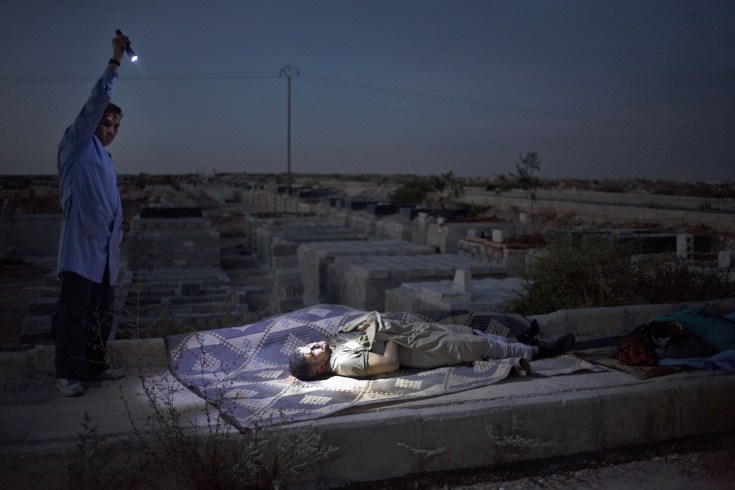
Maysun—EPA / Oct. 13, 2012
Maysun
“I was taking pictures at Dar al-Shifa Hospital. Every day was a slaughter, and still is. Only three of the nine floors of the building are usable. On the ground floor is a small room that served as a morgue. There were two bodies that had not been identified — one didn’t have a head. After several days, they were loaded into the back of an old van and driven to a large cemetery.
We barely had light. There was no one to bury them, so they decided to leave the bodies on the ground, covered with a blanket. As we were driving back to the hospital, Ahmad, an FSA fighter, couldn’t stop telling me, ‘Ya haram! Ya haram! We must bury them! Dogs will eat them!’
We returned to the cemetery at nightfall. While trying to bury them in a mass grave, a plane made several passes over us. We had to turn off all the lights — a flashlight and the glow from our cell phones. The bodies were buried as quickly as we could, without names or ceremonies or mourning.
Several days later, I found out Ahmad went missing after the Syrian army bombed the hospital.”
Read more: http://lightbox.time.com/2012/12/10/photographing-syrias-agony-the-images-that-moved-them-most/#ixzz2H5EtH6ZM
Syria has always been a tough place to cover for journalists. Confidently authoritarian with a ruthlessly formidable security and intelligence apparatus, Syria has long been one of the most policed of Arab police states. So when some Syrians defied their government to take to the streets in the southern city of Dara‘a in March 2011, the temptation to cover the story was overwhelming for many, including myself.
The story of the Syrian uprising is ultimately the tale of regular citizens silencing the policeman in their heads, breaking their own personal barriers of fear to speak, to demonstrate, to demand, to reject, to no longer be afraid, to live in dignity. It’s about what these people will do, what they will endure, and what they are prepared to become to achieve their aims.
It is also the story of a significant portion of the population that considers the regime of President Bashar Assad the country’s best option, because they believe in its Baathist secular ideology or directly benefit from its patronage or don’t have confidence in Assad’s opponents and fear what may come next. Understanding what this segment of the population will accept in terms of state violence, the narratives they choose to believe and their concerns is a critical component of the story, though one that is harder to obtain, given the paucity of press visas issued by Damascus.
The only way to tell the Syrian story, really tell it, is to be on the ground with the men, women and children who are central to it, whether in Syria on in the neighboring states that many Syrians have fled to. It isn’t easy to do — the Committee to Protect Journalists, based in New York City, has dubbed Syria the “most dangerous place for journalists in the world” — but it is essential. Nothing beats being there. There is no compensating for seeing, feeling, touching, capturing, living the story.
The images here are a testament to the power of being on the ground, of sharing and capturing a moment for posterity, of translating an element of a person’s life through imagery.
Take a look at the photos. Can you place yourself in these situations? Can you imagine what it must be like? What do you feel when you look at the images? Are you drawn into them, or are you repulsed? Can you relate to them, or are they too alien? This is the power of translating on-the-ground reporting to an audience. This is why we must and will continue to document the Syrian uprising from inside the country when we can, and we — members of the foreign press corps — are not alone. Sadly, as is often the case, local journalists (both professional and citizen) have disproportionately borne the brunt of the casualties in this crisis. Still, this story is not about members of the media and what we go through to tell it; it’s about the Syrians who entrust their testimonies, their experiences, their hopes, their fears, their images to us in the hope that they will help explain what is happening in one of the most pivotal states in the Middle East.
—Rania Abouzeid
This collection of testimonies is the third in a series by TIME documenting iconic images of conflict. See “9/11: The Photographs That Moved Them Most” and “Afghanistan: The Photographs That Moved Them Most” for more.
Abouzeid is a Middle East correspondent for TIME. Reporting by Vaughn Wallace.
Syria’s president, Bashar al-Assad, has warned that Western action against his country would cause an “earthquake” that would “burn the whole region”.

President Assad admitted that ‘many mistakes’ had been made by his forces in the early part of the uprising, but insisted that only terrorists’ were now being targeted Photo: EPA


In his first interview with a Western journalist since Syria‘s seven-month uprising began, President Assad told The Sunday Telegraph that intervention against his regime could cause “another Afghanistan”.
Western countries “are going to ratchet up the pressure, definitely,” he said. “But Syria is different in every respect from Egypt, Tunisia, Yemen. The history is different. The politics is different.
“Syria is the hub now in this region. It is the fault line, and if you play with the ground you will cause an earthquake … Do you want to see another Afghanistan, or tens of Afghanistans?
“Any problem in Syria will burn the whole region. If the plan is to divide Syria, that is to divide the whole region.”
Thousands of anti-government demonstrators took to the streets in two Syrian cities on Friday to demand the imposition of a Libyan-style no-fly zone over the country. According to the United Nations, at least 3,000 civilians, including 187 children, have been killed during protests against the regime. Thousands more have been imprisoned. The government says 1,200 members of the security forces have also died.
President Assad admitted that “many mistakes” had been made by his forces in the early part of the uprising, but insisted that only “terrorists” were now being targeted.
“We have very few police, only the army, who are trained to take on al-Qaeda,” he said. “If you sent in your army to the streets, the same thing would happen. Now, we are only fighting terrorists. That’s why the fighting is becoming much less.”
On Friday alone, however, opposition groups claimed that 40 people were killed by the regime, and government troops shelled a district of Homs, a centre of opposition.
Seventeen soldiers also died in overnight clashes with suspected army deserters in the city, which foreign journalists are forbidden to enter.
Syria was condemned yesterday by Arab League foreign ministers for its “continued killings of civilians”.
The number of protesters appeared to fall earlier this month, but has increased again after the death of Col Gaddafi gave opposition groups new heart. A general strike affected much of the southern part of the country.
President Assad insisted that he had responded differently to the Arab Spring than other, deposed Arab leaders. “We didn’t go down the road of stubborn government,” he said. “Six days after [the protests began] I commenced reform. People were sceptical that the reforms were an opiate for the people, but when we started announcing the reforms, the problems started decreasing e_SLps This is when the tide started to turn. This is when people started supporting the government.”
Some Damascus-based opposition leaders say the reforms, which include laws ostensibly allowing demonstrations and political parties, are a start, but not enough. However, the leaders of the main protests say they are meaningless and President Assad must go.
“The problem with the government is that their dialogue is shallow and just a tool to gain time,” said Kadri Jamil, of Kassioun, a Damascus-based opposition group. “They have to act to begin real dialogue because the security solution has failed. We have one to two months before we pass the point of no return.”
One Homs-based opposition activist said: “Killing people is not an act of reform. We aren’t calling for economic or even political reform under Assad, but for the departure of this bloodstained president and free elections.”
President Assad said: “The pace of reform is not too slow. The vision needs to be mature. It would take only 15 seconds to sign a law, but if it doesn’t fit your society, you’ll have division … It’s a very complicated society.”
He described the uprising as a “struggle between Islamism and pan-Arabism [secularism], adding: “We’ve been fighting the Muslim Brotherhood since the 1950s and we are still fighting with them.”
In interviews in Damascus, some without government minders, secular Syrians and members of the country’s substantial Christian and Alawite minorities said they supported the Assad regime for fear of their positions under a new government. Those attending a large demonstration in support of the regime last Wednesday did not appear to be coerced, according to independent observers.
However, interviews, even some with minders present, revealed widespread and vocal discontent over corruption and living standards.
Borzou Daragahi, lundi 31 décembre 2012, 17:34 ·
This is my guide for Syria analysts and journalists who want to defend Bashar Assad while continuing to retain their credibility in the West.
1. Keep mentioning Jubhat al Nasra and other Islamic jihadi groups without mentioning that the vast majority of armed groups are not nearly as extreme, are mostly locally based folks defending their towns and villages.
2. When referring to the armed opposition keep using the magic word: AL QAEDA
3. Make cursory mention of the regime’s brutality (you won’t have any credibility if you don’t) but avoid resurrecting the roots of the conflict in peaceful opposition to Bashar’s dictatorship. Avoid mention of wanton use of air power against civilians in bread lines and in their homes.
4. Keep talking about NATO, the Gulf countries and Western support for opposition; that will boost Bashar’s anti-imperialist creds among the campus leftists.
5. Focus on faults of incompetent and disorganized Syrian opposition abroad instead of networks of activists and homegrown civil society already establishing governance inside.
6. Frame Russia as an honest broker trying to peacefully resolve conflict instead of a shrewd chess player that doesn’t give a damn about Syrian civilians and murdered tens of thousands of Chechens in an attempt to put down a rebellion in the 1990s.
7. Keep warning about consequences of Syria state’s collapse: sectarian war, refugees in Europe, rise of an Islamist state.
8. Keep raising rare instances of rebel misconduct and faked videos and frame them as emblematic of the overall opposition.
9. Make the opposition look intransigent; they’re the ones who won’t agree to a peaceful settlement, not the president who did no reforms for 10 years and dispatched shabiha to murder peaceful protesters when they spoke out.
10. Pray to God (even if you are an athiest) that the rebels don’t get to Damascus, open up the files and find out what you did for the regime, the details of conversations on how you got your visas and your access to officials.”

