Search

band annie's Weblog

I have a parallel blog in French at http://anniebannie.net

Category

Syria

Syrian Refugees A snapshot of the crisis – in the middle east and europe © Mohamed Salman

Assad : Smacks of Desperation

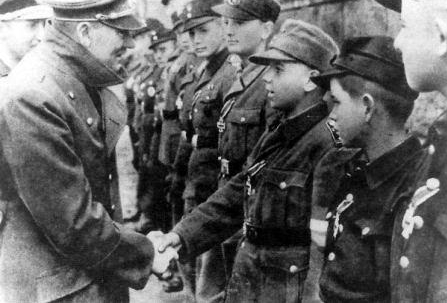
When I saw the video above the first image that came to mind was this one:

This doesn’t look at all like a regime that is going to survive for much longer – and I know there are people who now think Assad might make it through this because it has taken two years. But this is irrelevant.In the last days of the Third Reich, the Nazis desperately tried to stave off defeat by recruiting child soldiers to fight in the streets of Germany’s cities. No doubt regime enthusiasts will contrast the high profile presence of unveiled women fighting in Assad’s army against the bearded men of the various rebel groups.

But this action has less to do with equal opportunities and emulating America’s recent decision to allow women into fighting roles and more to do with a desperate and undermanned (pun not intended) army trying to make up its numbers. I’m not much of an expert on military affairs, but the women in the video above are not fighters, and I doubt they will make much of a difference in the face of groups like Jabhat al Nusra. The precedent of such things is not promising for Assad either – when Gaddafi was murdered there was not a single member of his famous female bodyguards in sight.

The only thing I felt when I saw that report from Russia Today was the same thing I felt the first time I saw the picture of Hitler’s child soldiers, pity. Once more innocent people are being thrown into the furnace in a last ditch attempt to protect yet another “Father” of the nation.

source

Syria : Harasta in shambles

[youtube http://www.youtube.com/watch?v=Fp5iKwQJj8c&feature=share&list=UUNye-wNBqNL5ZzHSJj3l8Bg?]q

Why the Killing in Syria Is Just the Beginning

The international community’s failure on Syria limits its power to act against the even bigger bloodletting that’s likely to happen down the road.

BY CHRISTIAN CARYL | JANUARY 25, 2013

Earlier this month, the United Nations announced its assessment that 59,648 people have died in Syria’s two-year-old civil war. That headline figure is grim, but U.N. human rights commissioner Navi Pillay made a point of noting that the real number is almost certainly higher. The overwhelming majority of those people were civilians. Far too many of them were children.

Why do I say that? Because the fateful wheel of atrocity and reprisal, so familiar from past civil wars, is gathering momentum. It could hardly be any different, considering the scale of the killing so far. The Assad regime bears full responsibility for launching the carnage. But it does not bear sole responsibility for all the crimes that have been committed, and it will not bear sole responsibility for the crimes that are yet to come.

There can be little question that the complex ethnic and sectarian makeup of Syria is exacerbating the situation as the bloodshed goes on. Assad family rule in Syria over the past 40 years has rested primarily on the country’s ethnic and religious minorities: above all the Alawites (adherents of an offshoot of Shiite Islam), as well as some Kurds and Christians. Members of the Sunni majority have been largely excluded from power. As those who have borne the brunt of the regime’s injustices, they now form the largest force in the opposition.

Divides are deepening. Though it’s understandably hard to get precise reports, Human Rights Watch has recently documented attacks by opposition forces on a Shiite place of worship and two churches on the outskirts of the city of Latakia, the stronghold of Syria’s Alawite population. The rebels have been criticized in the past for committing abuses against prisoners taken from the pro-Assad armed forces or militias (the notorious shabiha). The growing prominence of jihadist groups among the rebel Free Syrian Army is another source of concern. The worry is that radicals in the opposition are now actively targeting civilians from the groups that have been allied with the government.

Let’s consider the potential scale of the problem: There are some two million Kurds in Syria, plus roughly the same number of Christians. There are two and a half million Alawites. They have been schooled by regime propaganda to believe that they will become the victims of pogroms and ethnic cleansing should their side lose the war. That probably wasn’t true back when their fellow Syrians were peacefully demonstrating for change, but now it’s on the way to becoming a self-fulfilling prophecy. Sunnis account for at least 12.6 million of the population. (They actually make up the bulk of the Syrian regular army’s soldiers, who are right now held at bay by Alawite officers and the shabiha.) As soon as the Assad regime loses the advantages of its air power and its heavy weapons, the Sunnis will be able to make their superior numbers count. Their enemies won’t stand a chance.

The desire for revenge is understandable: the instinct to repay killing with more killing is deeply embedded in the human psyche. But that doesn’t make it right. Retribution and justice are two different things. The first perpetuates the cycle of violence; the second offers at least the hope of wrongs righted in a way that benefits society. And the logic of collective punishment is always fatally flawed. Not everyone in a group behaves according to the instincts of the majority.

But that’s easy for me to say, right? My family hasn’t been shredded by a cluster bomb before my eyes. And you could hardly blame Syrian oppositionists for rolling their eyes when they hear a well-meaning Westerner plead the virtues of non-violence. After all, my government has done virtually nothing to help restrain Assad’s attack dogs. Where do I get off lecturing the Free Syrian Army about right and wrong?

This is, in some ways, just the problem. If the international community had found some way to undertake meaningful action against the Assad regime from early on, we would have far greater credibility with the opposition today, and we would be in a much better position to argue for de-escalation. As things stand now, indications are that the fighters of the Free Syrian Army and their supporters increasingly regard Western governments with contempt. Many see us as de facto allies of the Damascus regime. We should hardly be surprised.

I decided to ask Simon Adams about this. He’s the director of the Global Centre for the Responsibility to Protect, a New York-based organization founded in 2008 to combat genocide and mass human rights abuses around the world. Last year, he published a commentary in the New York Times arguing that the international community should bring constructive pressure to bear on the Syrian opposition to ensure that atrocities are not committed against groups or populations allied with the regime.

Some critics, as Adams puts it, “raised an eyebrow” at his article, suggesting that he was implying a false equivalence between aggressor and victim. He rejects this, insisting that his group has consistently regarded the Syrian government as the main perpetrator in the conflict, and has assailed its crimes accordingly. “But let’s be clear,” he says. “We’re not on the side of Assad and we’re not on the side of the rebels. We’re against mass atrocities.” And the past inaction of the U.N. Security Council — thanks above all to Russian and Chinese intransigence in opposing any efforts to sanction or condemn Assad’s regime — cannot serve as an excuse for continuing passivity on this score in the months to come.

Adams is not a supporter of military intervention, the consequences of which, he believes, could well end up outweighing the evil it is intended to cure. But he believes that there’s a great deal that can yet be done besides stepping into the fight. Above all else, the Americans, the Europeans, and their allies should start concerted action to establish a mechanism for investigating and punishing abuses once the war is over — applicable to everyone. “You can’t say, ‘War crimes are really bad when committed by our enemies.’ You have to say that they’re bad when committed by anyone. All perpetrators will be held accountable.”

Moreover, the Friends of Syria Group, as well as the countries that are directly aiding the rebels, should make a point of urging the opposition and its fighters toward full compliance with international humanitarian law (not least as a way of distinguishing the rebels favorably from the government). Adams notes that the Free Syrian Army has already created its own unit for war crimes investigations. So far the group has focused on abuses committed by the government, of course, but it could be expanded to provide accountability for the FSA’s own forces as well. Western countries, says Adams, should offer full assistance and support to such efforts, even while pushing for them to be broadened.

I really do wish him the best of luck with that. But it’s hard to be optimistic. As Adams himself points out, the original architects of the expanded international anti-genocide principles back in 2001 — known as the “Responsibility to Protect,” or R2P — foresaw that it would be extremely hard to against mass atrocities in cases where U.N. Security Council members were opposed to acting. That, of course, is exactly what’s now come to pass in the case of Syria.

In any case, it’s time to acknowledge that one consequence of the international community’s failure to press for stronger action in the past is that it leaves us ill-equipped to make the case for preventing the revenge killings that are likely to come. Let’s hope that the Syrian rebels have the wisdom to see the rationale for restraint as the war enters its next phase. They certainly have little cause to listen to our advice.

source

Iran Shoots Itself in the Foot

By Robin Yassin-Kassab

In August 2012 Egyptian President Muhammad Morsi attended a meeting of the Non-Aligned Movement (NAM) in Tehran. His presence at the conference was something of a diplomatic victory for the Iranian leadership, whose relations with Egypt, the pivotal Arab state, had been at the lowest of ebbs since the 1979 revolution.

Egypt’s President Sadat laid on a state funeral for the exiled Iranian shah. A Tehran street was later named after Khalid Islambouli, one of Sadat’s assassins. Like every Arab country except Syria, Egypt backed Iraq against Iran in the First Gulf War. Later, Hosni Mubarak opposed Iranian influence in Iraq, Syria, Lebanon and Palestine, worked with the US and Saudi Arabia against Iran’s nuclear program, and was one of the Arab dictators (alongside the Abdullahs of Jordan and Saudi Arabia) to warn darkly of a rising “Shi’ite cresent”. Not surprisingly, Iran was so overjoyed by the 2011 revolution in Egypt that it portrayed it as a replay of its own Islamic Revolution.

Iran also rhetorically supported the revolutions in Tunisia and Libya, the uprising in Yemen, and, most fervently, the uprising in Shia-majority Bahrain.

In Syria, however, Iran supported the Assad tyranny against a popular revolution even as Assad escalated repression from gunfire and torture to aerial bombardment and missile strikes. Iran provided Assad with a propaganda smokescreen, injections of money to keep regime militias afloat, arms and ammunition, military training, and tactical advice, particularly on neutralising cyber opponents. Many Syrians believe Iranian officers are also fighting on the ground.

Iran’s backing for al-Assad is ironic because at a certain point the Syrian revolution was the one that most resembled 1979 in Iran – the violent repression of demonstrations leading to angry funerals leading to still more in a constantly expanding circle of anger and defiance; the people chanting allahu akbar from their balconies at night; women in hijabs joining women with bouffant hair to protest against regime brutality.

It was also a massive miscalculation, a lesser cousin to the miscalculations made by Bashaar al-Assad, and one which stripped the Islamic Republic of the last shreds of its revolutionary legitimacy. Like the Syrian president, Iran was popular among Syrians until twenty two months ago, even among many sectarian-minded Sunnis. (So too was Hizbullah, now widely reviled. In 2006, the Syrian people – not the regime – welcomed into their homes a million south Lebanese refugees from Israeli bombing.) It now seems very unlikely that any post-Assad dispensation in Syria will want to preserve Iranian influence. The Free Syrian Army, the anti-Assad Islamist militias, and the Syrian National Coalition all see Iran as an enemy of Syria, not as an honest broker that could help negotiate a transition.

Iranian popularity has also collapsed in the wider Arab world, where its pro-Assad policy has undercut its position more effectively than American or Israeli messaging could ever have done. (James Zogby’s poll was conducted in June 2011, too early for revulsion over Syria to have fully developed, but it nevertheless shows a dramatic decrease in favourable attitudes to Iran.)

Back in August, President Morsi (whose foreign policy has been much more intelligent than his domestic governance) chastised his hosts on the Syrian issue. “We should all express our full support to the struggle of those who are demanding freedom and justice in Syria,” he said, “and translate our sympathies into a clear political vision that supports peaceful transfer to a democratic system.” The Iranian leadership was embarrassed enough to censor this part of Morsi’s speech from its state TV broadcasts.

Morsi also offered the Iranians the following deal: Egypt would develop a warm economic and political relationship with Iran to the extent of championing Iran’s nuclear energy program and opposing sanctions in the international fora. In return, Iran would pull back from its support of the Assad regime.

By its continued support for Assad, Iran in effect rejected the deal. Nevertheless, Morsi set up a four nation contact group – Egypt, Turkey, Saudi Arabia and Iran – which has foundered not only on Iranian intransigence but also on Saudi absences from meetings. (Saudi Arabia has offered rhetorical support and some light weapons to the Syrian resistance; it also sent troops to Bahrain to help put down the democratic uprising there.) Egyptian-Iranian consultations on Syria continue.

Morsi was actually offering something substantial to the Iranians. It’s difficult to see how negotiations involving the Americans could produce better results so long as the US, bound up as it is with Israel’s self-perceived interests in the region, insists on sanctioning Iran’s nuclear program.

This is a great shame. Alongside Russia, Iran is the only power to exert any real influence on Bashaar al-Assad. It is to be hoped that, as the fall of the Assad regime becomes more apparent, wisdom will eventually prevail in Tehran. A volte face even at this late stage would strengthen Iran in its battles with the West and would temper rising anti-Shia sentiment in Syria and the wider Arab World.

– Robin Yassin-Kassab is the author of The Road From Damascus, a novel, co-editor of the Critical Muslim, a quarterly journal which looks like a book, and of www.pulsemedia.org. He blogs at www.qunfuz.com

source

Syria : an urgent appeal

‎| An important and urgent appeal from the field hospital district Babaamr | Brothers in coordinating Doctors Homs In the medical committee and health office and all of whom they work in medical and relief sector .We write to you this letter at the time the regime sectarian troops of the alawite sectarian pro-regime villages in Homs have started their barbarian brutal attacks on Baba Amr .The Baba Amr field hospital can’t bear with number and kind of cases flooding to hospital.It has yesterday more than 150 cases with ( 3 patients need respiratory apparatus which is not available, 8 cases require a vascular surgery and are in danger of losing their extremeties as vascular surgeons are not available,5 cases require surgeries in abdomen however we could manage to conduct it for only 3 of them due to big number of cases requiring surgery,8 cases of sever facial disfigurement , one case of a fracture in vertebral column of an old man ,5 cases of comminuted fracture ( fragmented bone fracture) in upper and lower limbs, 2 cases with injuries in eyes and requi urgent surgery.
We appeal to you to help us with saving lives of many wounded innocents specially tha more than 23 people have been killed so far and number is expected to rise.
We have used all what we have of medical supplies here and we are running out of it and you must know how hard is to bring medical supplies into this hospital. Since 2 months we have only received 20 bags of drugs from The Coordination of Doctors in Homs.
Help us that the massacre of Deir Balba doesn’t happen again here in Baba Amr.
remember , we don’t have surgeons here , we don’t have surgical teams. We have called on many surgeons to come over but no one responded. We call you again and again , we need surgical teams here in Baba Amr field hospital in Homs.
By Director of field hospital in Baba Amr.

Conversations: The Architecture Student from Aleppo

As part of our effort to highlight civilian stories, below is a conversation between Syria Deeply and an architecture student from the University of Aleppo. She is in her final year and working on her graduation project. This conversation predates the latest blast at the university’s architecture school. Luckily, she was absent on Tuesday, January 15, the day of the tragic incident. At her request, we are not disclosing her name. The text has been edited for clarity.Yesterday, I saw four different traumatic scenes on my way to the university. These four scenes have shaken me deeply.

The first scene was when I was passing near a neighborhood, which is inside the area that sees heavy clashes. It is considered to be a hot spot. There were over one hundred people gathered in one corner, waiting for the right moment to cross the area. A woman watching the crowd told me that residents just evacuated their homes, but they want to go back to bring some of their essential belongings.

There were old men, women, and children waiting in the crowd. It looked like a border checkpoint…

Credit: Syrian Revolutionary Memory Project

The second scene still troubles me. There was an old and powerless man sitting on the sidewalk, putting his arms around himself, crying continuously. He was not a beggar. He didn’t open his hand and he didn’t accept any money. Only God knows what was his suffering or his loss!

People were passing by him, ignoring him. I curse the day an old man under the sky of my country would come to this miserable situation…

Then, on my way back home with my friend, I saw tens of children, women, and men carrying bottles and gallons of water. The children were laughing; the women were depressed, while the men looked broken.

The forth scene was a man and woman in their fifties walking hand in hand beside me on the same sidewalk. They looked very worried and sad. I heard them speaking about their children living abroad for work, or to escape military service, or just for safety. Meanwhile, the couple were staying alone watching over their home. That was the moment I felt guilty for thinking to leave the country and continue my studies abroad.

Four scenes made me pale like a wall, and I still bear that defeated spirit till this moment. How worse can it get than what we are suffering now?

The answer to her question didn’t wait too long. The latest blast in her faculty claimed the lives of more than 80 students and wounded hundreds. The conflict in Syria proves each day, that there is always worse than bad.

Does Anyone Give a Damn About Syria?

Rabbi Shmuley Boteach

Rabbi and Writer

Posted: 01/16/2013 10:51 pm

It’s hard to believe that every day the news reports have Syrians dying like flies and noone seems to give much of a damn. The report yesterday that 80 students were blown to smithereens was particularly galling. They were studying at their University in Aleppo when, apparently, death rained down from the sky, either through a missile or a bomb. One image had a female hand with a pen still in it, dismembered from the rest of her body. She apparently died while doing school work.

I was a Rabbi at a University. If 80 students had died in a military attack it would have shaken the foundations of the academic world. Professors everywhere would have condemned this violation of the sacred halls of academia. But in Syria it’s just another day of indiscriminate slaughter.

The United States is the world’s strongest nation with the loudest voice. Can’t President Obama speak out? I know we’re not ready to invade Syria or impose a no-fly zone. Americans don’t have the stomach for another war, or an invasion. But does that absolve us from simply condemning the slaughter in the strongest possible terms? What would it cost, in blood and treasure, for President Obama to fly up to New York and address the United Nations with a simple declaration: “President Assad, I’m here today to tell you that the long arm of international justice will catch up with you. Today you’re a brutal dictator killing men, women, and children in order to stay in power. But one day, in the not too distant future, we will catch up with you. You will be arrested for crimes against humanity and tried for your butchery and mass murder. It may not happen today or tomorrow. But I assure that you one day, in the not too distance future, in the dead of night when you least expect it, it will happen. Soldiers of civilized nations will apprehend you and take you to the International Court of Justice at The Hague where you will stand trial before the world for your cruelty. And you will be held accountable for your appalling crimes.”

Isn’t that what the UN is for? It’s bad enough that China, and especially Russia, are protecting Assad and refusing to allow international action against him. But the American president is the very symbol of democratic freedoms and human rights to the entire world. He dare not remain silent.

Atlantic columnist Jeffrey Goldberg recently reported that President Obama said that Israelis don’t know what’s good for them. Bibi wants to build in Jerusalem but doesn’t realize that he is isolating Israel further in the international community.

I appreciate the president’s concerns. No doubt Israelis are especially grateful for the American president’s ability to divine Israel’s security needs even better than their chosen leaders. But perhaps our president should focus less on construction of apartments and homes and do something instead about the bombs and rockets that are killings tens of thousands of innocent Arabs. Syria is arguably the greatest humanitarian crisis that President Obama has had on his watch and he is, respectfully, failing miserably in doing anything about it.

The Arab leaders have proven even less reliable. While President Morsi of Egypt decries Jews as descendants of apes and pigs, he seems fairly oblivious to the indiscriminate slaughter of his Arab brothers in Syria. But it’s become fairly obvious that it’s not the Jews who are the enemy but brutal Arab dictators who will kill as many Arabs as is necessary to stay in office.

The Emir of Qatar, Sheikh Hamad bin Khalifa, seems much more interested in forking over to Al Gore half a billion dollars to buy Current TV for Al Jazeera than taking out full page ads in the worlds’ leading publications alerting them to the Arab children who are dying in Damascus.

In the book of Genesis God asks Cain where his brother Abel is. Cain has just killed him and in effort to protect himself famously asks, “Am I brother’s keeper?” God’s response is ferocious. “What have you done? Your brother’s blood cries out to me from the ground.”

We who witnessed the repeated genocides of the 20th century — from Armenia and the Holocaust to Cambodia and Rwanda — will one day be called to account for our silence in the face of dead students and children.

Shmuley Boteach, “America’s Rabbi” whom The Washington Post calls “the most famous Rabbi in America,” has just published his newest best-seller, “The Fed-up Man of Faith: Challenging God in the Face of Tragedy and Suffering.” Follow him on Twitter @RabbiShmuley.

source

Uprooted by Syria’s war: ‘Is there a worse way to live than this?’

For the videos go to article here

By Joe Sterling, CNN
January 14, 2013 — Updated 1221 GMT (2021 HKT)
Watch this video


(CNN) — Sharifa lost her foot when the Syrian jets swooped down and fired missiles at the house.

Now the hijab-clad girl sits jaded in a dirty, hardscrabble displaced persons camp near Turkey, growing up fast, confused and far from home.

CNN special coverage: Syria’s refugees

She needs crutches to move around and weeps for her lost limb.

“I can’t get it back,” she said.

Photos: Showdown in Syria Photos: Showdown in Syria

Refugee: When the phone rings, I worry

Syria’s scarred children

Orphan of Syria’s civil war

But like many youth, Sharifa is resilient.

She teaches the younger kids at the camp mosque and, inshallah, wants to go back to her home village and do it there.

Her life has been hijacked. She’s consumed by hope and grief, determination and despair.

“I just want to walk again,” she says. “I just want to walk.”

Watch more of Sharifa’s story

Sharifa is one of a lost generation uprooted by Syria’s civil war.

She’s one of the casualties of what the International Rescue Committee is calling a “regional humanitarian disaster,” the widespread displacement caused by nearly two years of civil strife and war in Syria.

The IRC, one of the world’s major refugee agencies, issued a chilling report Monday about the plight of refugees and internally displaced people.

More than 2.5 million Syrians have been uprooted, the IRC says.

Of those who have had to leave their homes, about 600,000 have fled, mostly to Jordan, Turkey, Lebanon and Iraq, which border Syria.

It’s a replay of the population flight out of war-torn Iraq last decade. It conjures the wrenching flight in the 1940s during the birth of Israel, also next door to Syria.

“The Middle East is once again facing a human displacement tragedy,” the IRC’s commission on Syrian refugees said.

The IRC interviewed refugees in the border nations and got a grim view of life in the country.

Killings, attacks, arbitrary arrests, torture, abductions, rape, bombings and sexual violence. Loss of infrastructure and health care. Dwindling supplies of food, water and electricity. No school.

More: Children scavenge for food

Inside the life of a Syrian rebel

Syrian refugees face frigid temperatures

Report ties Syrian rebels to al Qaeda

More than 60,000 people have died since the regime of Syrian leader Bashar al-Assad cracked down on peaceful protesters, a stance that set in motion what has become a nightmare, a civil war between the unyielding government and tenacious rebels.

The fighting has taken a sectarian overtone. The government is dominated by Alawites. The opposition, largely by Sunni Muslims.

People from other groups and religions in the diverse country have been caught in the crossfire. Some have joined the rebels. Others support the government.

Many sit tight and hope it ends. Others have fled to higher ground in Syria. Some to other countries.

People have embarked on treacherous journeys to safety outside Syria, scurrying from Homs and Hama to Lebanon, Daraa to Jordan, Aleppo and Idlib to Turkey, and Syrian Kurdish neighborhoods to Iraq.

Many live in camps, but most are “urban refugees,” scattered through villages, towns and cities seeking shelter anywhere it is available.

Some live with host families but others are packed into small, dingy and poorly maintained apartments. Some are squatters, staying put in schools, public buildings and unused spaces.

“Every time it rains, we live in a pool of mud,” said a 60-year-old woman from Daraa, interviewed by the IRC. She and seven others in Jordan share a room with a dirt floor and leaky roof.

Women and girls have gone from the frying pan to the fire. Rape is a main reason why many refugees fled, but there is “an alarming lack of medical and counseling services” in their new homes, the report said.

“They face unsafe conditions in camps and elevated levels of domestic violence, while reports of early and /or forced marriage of women and girls are increasing,” the report said.

Children are traumatized. “Abuse, neglect and exploitation” are risks that are right around the corner.

In Turkey, 8-year-old refugee children make drawings, just like kids everywhere. The images? Scenes from home of bombs and terror.

“Many teachers in host schools are ill-equipped to assist traumatized children — as are their parents. Many children exhibit violent aggressive behavior,” the report said, citing an IRC counselor in Jordan.

“Others have stopped eating, talking and sleeping.”

More: Life in the camps

The IRC is telling the world it urgently needs solutions.

Humanitarian aid must be increased. Borders must remain open. More assistance is needed for internally displaced Syrians. Urban refugees need more attention, and women and girls need better protection.

The world also must prepare for fallout and instability, even if the al-Assad government is toppled.

“The international community must quickly plan for a displacement crisis that could last well beyond the end of the Assad government and persist regardless of the political outcome of the conflict,” the report said.

Now winter is here. Aid agencies are bracing for more misery.

One refugee in Lebanon said his family has spent the year living in a sheep shed. Now they face the punishment of winter: winds, cold, rain and snow. Even flooding.

“I cry in my heart. I feel depressed. It’s unjust,” he said. “Is there a worse way to live than this?”

In a camp near Turkey, Abdul Qadr al-Hasan’s daughter, Siham, succumbed amid the frigid air.

More: What’s next for Syria?

“She was not sick. She didn’t have any problems at all. We were up late that night and we were playing with her,” al-Hasan said, speaking in a tent.

“We woke up the next morning, her mother checked on her. She was curled into a ball from the cold.”

Also near Turkey, Sharifa struggles on.

More: How it all started

She says it is “God’s will this happened.”

“The situation is hard here, nobody can bear this.”

Sharifa may be a limping casualty of war, but she and other young traumatized Syrians — living in tents, crammed in apartments and hiding in villages and towns — are now the country’s future.

They will limp home after the war ends to rebuild their land.

“I don’t want to play again,” she said. “I just want to walk.”
Blog at WordPress.com.

Up ↑