CLICK ON IMAGE

CLICK ON IMAGE
Statement, published in Socialist Worker (US), May 1, 2013
Introduction:*
A group of Syrian, Arab and international activists launched the Global Campaign of Solidarity with the Syrian Revolution at the World Social Forum in Tunis last month to create an open and diverse platform to support the Syrian revolution. The World Social Forum was an opportunity to create organic relationships with progressive intellectuals and social movements. In addition, it was an important moment to re-inscribe the Syrian revolution in a larger framework of popular struggles against oppression and authoritarianism. It was an occasion to reassert the Syrian people’s right to self-defense and resistance against despotism and dictatorship.
The following statement, signed by intellectuals, academics, artists and activists from more than 30 countries, reminds the world that what is happening in Syria today is a people’s revolution for freedom and dignity–and for that reason, it should be supported by all means. The campaign has called for a day of solidarity on May 31, during which groups in various cities around the world are invited to organize protests, cultural events and other symbolic actions in public squares and in front of Syrian embassies, as well as online. Groups based in different countries will choose the most effective strategies to support the Syrian revolution and remind the world that:
– The massacre of the Syrian people must stop now.
– Assad must step down and be brought to justice.
– All countries or groups must end all financial and military support to the Syrian regime.
– All Syrian regime embassies must be closed down. Complicity with the Assad regime will not be tolerated.
– The Syrian representative must be expelled from the United Nations.
– Aid must be sent to all Syrian refugees and internally displaced.
* This published introduction above is unsigned and its relation to the statement below is not evident. In contrast to the statement, the introduction contains a string of wrong-headed proposals that fit comfortably with the U.S. et al-led drive to install a pro-imperialist puppet regime in Syria, including the closure of Syrian embassies, expulsion of Syrian representatives from the United Nations and diversion of aid away from institutions of the Syrian regime. The introduction also gives the U.S. and its allies a carte blanche to ‘bring to justice’ Syrian leader Bashar al-Assad. The world is all too familiar with the kind of ‘justice’ that the U.S. has brought to Iraq and Afghanistan… –RA
***************
We, the undersigned, stand in solidarity with the millions of Syrians who have been struggling for dignity and freedom since March 2011. We call on people of the world to pressure the Syrian regime to end its oppression of and war on the Syrian people. We demand that Bashar al-Assad leave immediately without excuses so that Syria can begin a speedy recovery towards a democratic future.
Since March 2011, Assad’s regime has steadily escalated its violence against the Syrian people, launching Scud missiles, using weapons banned by the Geneva Convention such as cluster bombs and incendiary munitions, and using aerial bombardment. The regime has detained and tortured tens of thousands of people and committed untold massacres. It has refused political settlements that do not include Assad in power, and it has polarized the society through strategic acts of violence and by sowing seeds of division. The regime has also, since the early days of the uprising, sought to internationalize the crisis in order to place it within geopolitical battles that would only strengthen the regime.
Staying true to the logic of an authoritarian regime, Assad could never accept the legitimate demands of the Syrian people for freedom and dignity. Thus, there is no hope for a free, unified, and independent Syria so long as his regime remains in power.
This is a revolt that was sparked by the children of Deraa and the sit-ins and demonstrations of the youth in the cities, the peasants of the rural areas, and the dispossessed and marginalized of Syria. It is they who rallied nonviolently through protests and songs and chants, before the regime’s brutal crackdown. Since then, the regime has pushed for the militarization of the Syrian nonviolent movement. As a result, young men took up arms, first out of self-defense. Lately, this has resulted in attempts by some groups fighting the regime to force a climate of polarization, and negation of the Other, politically, socially and culturally. These acts that are in themselves against the revolution for freedom and dignity.
Yet the revolution for freedom and dignity remains steadfast. It is for this reason that we, the undersigned, appeal to those of you in the global civil society, not to ineffective and manipulative governments, to defend the gains of the Syrian revolutionaries, and to spread our vision: freedom from authoritarianism and support of Syrians’ revolution as an integral part of the struggles for freedom and dignity in the region and around the world.
The fight in Syria is an extension of the fight for freedom regionally and worldwide. It cannot be divorced from the struggles of the Bahrainis, Egyptians, Tunisians, Libyans, Yemenis and other peoples who have revolted against oppression and authoritarianism as well as against those seeking to usurp or destroy the uprisings and divert them for their own agendas. It is connected to the Palestinians’ struggle for freedom, dignity and equality. The revolution in Syria is a fundamental part of the North African revolutions, yet it is also an extension of the Zapatista revolt in Mexico, the landless movement in Brazil, the European and North American revolts against neoliberal exploitation, and an echo of Iranian, Russian and Chinese movements for freedom.
The Syrian revolution has confronted a world upside down, one where states that were allegedly friends of the Arabs such as Russia, China, and Iran have stood in support of the slaughter of people, while states that never supported democracy or independence, especially the U.S. and its Gulf allies, have intervened in support of the revolutionaries. They have done so with clear cynical self-interest. In fact, their intervention tried to crush and subvert the uprising, while selling illusions and deceptive lies.
Given that regional and world powers have left the Syrian people alone, we ask you to lend your support to those Syrians still fighting for justice, dignity and freedom, and who have withstood the deafening sounds of the battle, as well as rejected the illusions sold by the enemies of freedom.
As intellectuals, academics, activists, artists, concerned citizens and social movements, we stand in solidarity with the Syrian people to emphasize the revolutionary dimension of their struggle and to prevent the geopolitical battles and proxy wars taking place in their country. We ask you to lend your support to all Syrians from all backgrounds asking for a peaceful transition of power, one where all Syrians can have a voice and decide their own fate. We also reject all attempts of any group to monopolize power, and to impose its own agenda, or to impose unitary or homogenous identities on the Syrian people. We ask you to support those people and organizations on the ground that still uphold the ideals for a free and democratic Syria.
What you can do:
* Find out more about the Global Campaign of Solidarity with the Syrian Revolution on its Facebook page.
* There is also information on Facebook about the global day of solidarity set for May 31.
* Sign a petition in solidarity with the struggle for freedom in Syria.
– – – – – – – – – – – – – – – –
source

Hezbollah Secretary General Hassan Nasrallah stated clearly in his recent speech that his party has and will continue to fight in Syria next to the regime forces. His reasoning remained purely political: he linked it to Syria’s role as a strategic regional partner. However, within the Shiite community in Lebanon, this political rhetoric has no real value, as more dead bodies of ‘martyrs’ come back from Syria.
A different kind of narrative was needed to convince Hezbollah’s constituency why the enemy is now on the other side of the border. In Shiite villages and towns, the rhetoric has little to do with “foreign powers aiming to destroy Syria as a country, people, and army, and canceling its regional role,” as he mentioned in the speech. Hezbollah’s leaders managed to quell public discontent by adding a sacred element to their involvement in Syria: Karbala. The divine narrative has been invoked, yet again.
In the beginning of the 1980s, Hezbollah built its rhetoric to tie together political and historical narratives to gradually form a Shiite collective memory. The Party of God employed the memory of the battle of Karbala, when an army sent by the Sunni Umayyad caliph Yazid I defeated Al Hussein bin Ali, grandson of the prophet Mohammad. This battle marks the root of the historical schism between Sunnis and Shiites.
When Hezbollah decided to take over resistance in Lebanon and eliminate the National Resistance Front, the act of resisting Israel was intertwined with Hussein and his family’s resistance to Yazid.
The family Hussein suffered and were eventually martyred in order to preserve the Shiite faith, and Hezbollah invoked this martyrdom in reference to its ‘divine victory’ in the 2006 July War. In fact, tales of Hussein and his family’s spirits helping Hezbollah fighters in the battles against Israeli soldiers are still told and have been merged with the collective Karbala memories.
Today, as Hezbollah’s involvement in Syria can no longer be kept secret, this memory is being exploited again. Many of its symbols are being used by Hezbollah’s leaders to tie their fight in Syria to a scared mission. This time, it is not only to defend Shiites in Syria, or Lebanese on the borders, or even Shiite shrines for that matter; the real mission Hezbollah is marketing to its community is to save the Shiite existence exactly as Hussein bin Ali did in the year 680.
“It is a sacred battle and a religious duty,” their leaders tell them. “The Shiites in Syria are suffering death, torture, and thirst, exactly as Hussein and his family suffered before them. Their fault is that they loved Hussein,” states many of their Facebook pages and websites.
Recently, whenever Syria is mentioned, Hussein bin Ali and his family are brought up. Syria is no more a war between the regime that supports resistance and fighters that wish resistance to end. Instead, this war is painted as a divine battle to defend the Shiite faith and pave the way for the appearance of the “awaited” Al Mahdi, the twelfth Imam for the Shiites. People are recounting old forgotten tales of Mahdi’s appearance and now it is believed that he and his army are going to appear soon in Damascus with yellow flags to conquer and restore peace.
Hezbollah has realized that this collective memory is the only way to drag the Shiites again to a battle decided by Iran, which serves only Iran. But when more dead bodies come back from Syria and the promised “victory” is not fulfilled, Shiites will eventually realize that the divine narrative is not always a guaranteed recipe for power and victory. Hezbollah will then lose its last recourse, and eventually the collective memory will probably collapse and take down both the party and its popular base. Unfortunately, it will be too late for the Shiites as they will be in a bloody and violent confrontation with Sunnis in Syria and Lebanon.
But Hezbollah seems to have dropped Lebanon from its strategic map. In his speech, Nasrallah cast off all Lebanese-related issues and stated before he concluded that there is no time to discuss these as they are not significant. Lebanon is not important to the Party of God. When he declared war against the international community by saying that “Syria has real friends in the region and across the world that will not let the country fall into the hands of the US, Israel, or takfiris,” Nasrallah certainly did not have Lebanon’s interest in mind.
If Lebanese Shiites do not realize that they are being exploited in a war that serves Iran, not Lebanon, then they will have to face a civil war in which neither Hussein bin Ali, nor his family, can save them.
Hanin Ghaddar is the managing editor of NOW. She tweets @haningdr
An artist’s rendering of the 680 Battle of Karbala. (Image via AbbasShalai.com)
“Tales of Hussein and his family’s spirits helping Hezbollah fighters in the battles against Israeli soldiers are still told.”
 Syria. Syrians are essentially seen either as a menace, or as weaklings likely incapable of countering some menace in their midst.
“He inserted a rat in her vagina. She was screaming. Afterwards we saw blood on the floor. He told her: ‘Is this good enough for you?’ They were mocking her. It was obvious she was in agony. We could see her. After that she no longer moved.”” (BBC News – Syria ex-detainees allege ordeals of rape and sex abuse.)
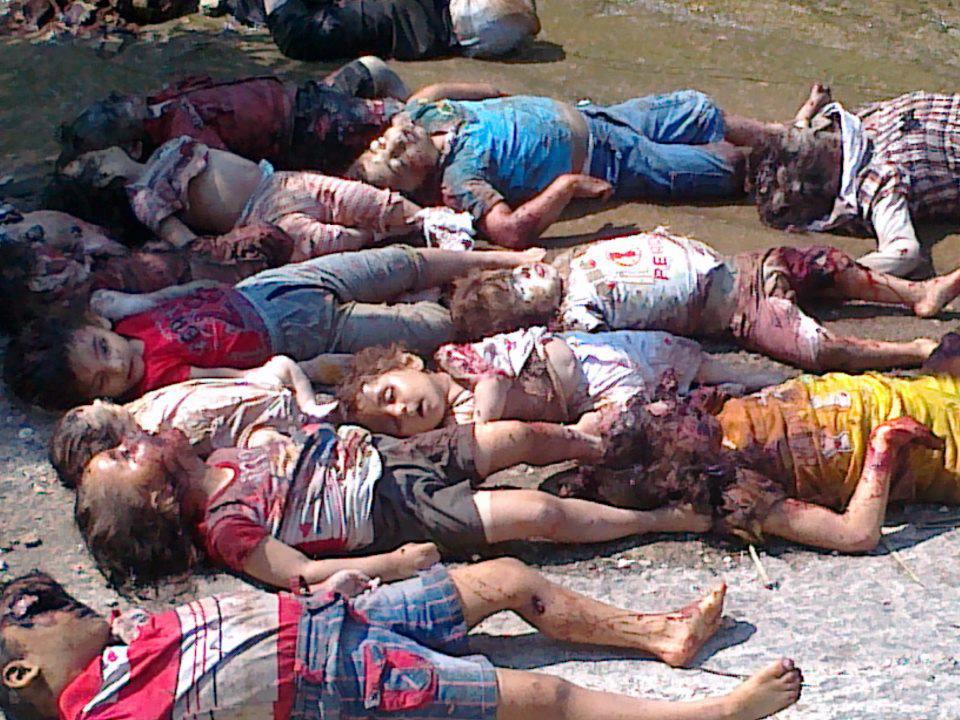
Again and again the Syrian revolution is condemned as some kind of foreign “conspiracy” that is aimed against the self-described bastion of Arab resistance to Israel. Last night’s Israeli attack against an Assad regime research facility in Damascus has brought out of the wood work all sorts of individuals who, silent in the face of the massacre in the coastal city of Banyas for the past three days, have suddenly found their voices. The similarity in the pictures we saw coming out of Banyas this past few days were truly horrific, and reminiscent of the images we saw from the Sabra and Chatilla massacres during the Lebanese civil war. Yet these self-styled anti-imperialists did not retweet and angrily condemn these murders. They chose silence and wilful ignorance instead.
Today they are trying to portray the Israeli air raids last night as an attack on Syrian sovereignty, as if that is not what Assad has been doing to Syrians for the past two and a half years. Apart from the evident hypocrisy of this position, there are also two fallacies underlying their argument. Firstly that the Syrian regime represents Syria, and that an attack on it is an attack on the country and its people, and the second is that Israel did this in support of the Syrian revolution.
With regards to the second point most Syrians, including those who support the revolution, are missing the fact that Israel hasn’t got the slightest concern about the Syrian revolution or the Syrians who are dying. It is focused first and foremost in its battle with Iran and Hezbullah, and has consistently stated that it will not let the more advanced weaponry in Syria’s arsenal falling into Hezbullah’s arms. When it attacks Assad’s bases and arsenals, it is doing so with a clear strategy.
Syrians supporting the revolution should neither cheer nor lament the involvement of Israel’s attacks on Assad’s arsenal. From a practical point of view it is very much an advantage to the revolution (armed as well as peaceful), as it is far better for the regime’s arsenal and advanced divisions to be obliterated than that they be used against Syrian towns and villages. We have seen the piles of bodies in Banyas and countless Syrian villages and cities, on a week so close to the anniversary of the Houla massacre perpetrated by Assad regime thugs, and these images will forever be engraved in the collective memory of Syrians. Never again must we allow ourselves to be in such a position, that Syrians be slaughtered like sheep in an abattoir.
To cheer for Israel’s attack on Assad, apart from being misguided, makes the mistake of siding with one oppressor against another. How different is it, then, that people would side with Iran simply because it claims to be fighting for the Palestinians? This is a fallacy, and more importantly the answer is not to wag the finger at Israel and claim that once we finish with Assad we will drive over and liberate Jerusalem in a Golgotha of blood. International law, human rights, and morality are with us as they are with the Palestinian people, and it is through this path that we can then achieve true justice for all and make good cause with good people across the world.
True Syrian sovereignty begins with us as people and not as a regime. It is when we realise this simple political fact that we can decide how best to champion the cause of oppressed people the world over. We as Syrians, and the Syrian transitional government should take note, have a unique opportunity to right the wrongs of the past, and to be a shining beacon of human rights and democracy not just to the Middle East but to the world. We can and should create a national self-belief that we are a unique mix of people who will never accept might as right. A Syria committed to human rights and the rule of law will protect itself from Israeli missiles and warplanes far better than expensive, and largely ineffective, Russian S-300 air defence systems. When we become the change that we have fought for so fervently, we will become far better champions for the downtrodden than all the divisions of Hezbullah and Iran put together.

