Search

band annie's Weblog

I have a parallel blog in French at http://anniebannie.net

Category

Syria

The novelist vs. the revolutionary: My own Syria debate

A Syrian novelist on military strikes, extremism and other questions facing in her country.

Syrian novelist and journalist Samar Yazbek.

By Samar Yazbek, Published: September 13 E-mail the writer

Samar Yazbek is the author of “A Woman in the Crossfire” and the winner of the 2012 PEN/Pinter Prize for international writer of courage. This essay was translated by Ruth Ahmedzai Kemp.

I am two women. They stand head to head, at loggerheads.

The revolutionary in me joined what started as peaceful demonstrations against the Syrian government in March 2011.

The novelist in me fled to France that July.

The revolutionary, who has several times since then furtively crossed the border back into her country, is steeped in the smell of blood. She wipes the dust off the corpses of children disfigured by violence, stops to wring out her heart, then carries on.The novelist struggles to close her eyes to the atrocities: She can’t take any more. She begs the revolutionary to stop walking through Syria’s circles of hell.But the other voice rebukes her: “It is up to you to step into this hell, to bear witness to it, darling novelist. It is up to you to work against all that is dark and violent, everything that is leading your country to ruin.”

The novelist, living in exile, in the world of politicians and diplomats, far removed from falling shells and sudden death, wonders whether Syria should be hesitant about welcoming military strikes from the West. She argues that no country has the right to interfere in the affairs of another, that independence and national sovereignty are sacred. And she questions whether hitting military targets without taking down President Bashar al-Assad, especially while Russia and Iran continue to support him, will bring a shift from the inhumanity that the regime has imposed.

The revolutionary, moving among guerilla fighters and civilian activists, stands by those who are living under the regime’s bombardment and dying at the hands of its military machine. She argues that sovereignty shouldn’t mean the freedom to kill one’s own people, to displace them or to force a sectarian wedge between them. She notes that the soldiers she overheard speaking Farsi when the rural town of Haish was annihilated are evidence that international intervention happened long ago. She adds that Syria is not the Assad regime. Syria is the Syrian people.

The novelist looks on with bewilderment at the religious extremism of groups supposedly representing the opposition: preventing women from going out in public, carrying out arrests, threats and killings, all in the name of Islam.

The revolutionary, who has met with leaders of Jabhat al-Nusra, Ahrar al-Sham and other influential jihadist battalions, is gripped by fear at what they represent. But she believes that Assad has encouraged them, knowing that an unsavory alternative to his regime makes the international community hesitant to intervene. She has interviewed dozens of jihadists who told her they had been in Assad’s prisons until they were suddenly released at the beginning of the revolution. She believes that Assad’s violence gives them legitimacy and that only the elimination of the regime can rescue Syrians from the increasing threat of extremism.

This same woman has witnessed the presence of moderate fighters and heroic civilian activists who have not received the support they need. And she recalls long talks with Syrian families who reject the exclusion of women and with the mothers who keep walking their children to school, despite the continual shelling by Assad’s warplanes.

The novelist regrets that the opposition movement has evolved from its peaceful origin. She refuses to condone, let alone applaud, armed uprisings. “Isn’t political opposition the better alternative?” she meekly suggests.

The other woman laughs in her face and rejects her logic. “What are you waiting for, you futile scribbler, when more than 100,000 people lie dead and thousands are imprisoned or missing? When hospitals are being shelled and doctors targeted, when there are massacres in bakeries and people are deprived of water and electricity? What more do you ask of your people? What kind of justice is it that you’re after?”

These two women crash about beneath my skin, colliding at every twist and turn of this unfinished narrative. But there’s one thing they agree on: Anything that might bring a definitive end to the murderous Assad and his regime is a force for good. The question is: Does the world really want to stop these atrocities, or is it happy to stand by and watch?


Also in this week’s Outlook section: Art critic Philip Kennicott explores why images of suffering don’t galvanize public outrage, author and filmmaker Sebastian Junger says sometimes being anti-war requires embracing force, Eliot Cohen debunks five myths about cruise missiles and William Dobson reviews a book on how presidents go to war. Read more from Outlook, friend us on Facebook, and follow us on Twitter.
source

Aziz’s Story

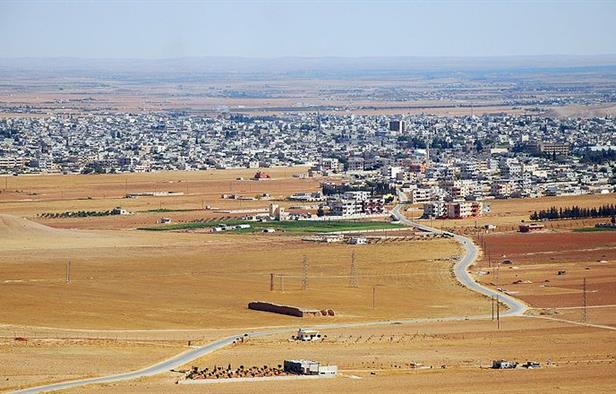
Landscape of Al-Salamiyah. (Google image)

September 14, 2013

aziz cell

This was published at NOW

The Syrian city of Selemiyyeh lies to the east of Hama, where the fertile crescent becomes barren. The ruins of Shmemis castle, dating to the late Hellenistic period, cling to the cone of an extinct volcano nearby. The major historical site in the city itself is a shrine containing the tombs of Imam Taki Muhammed and Radi Abdallah. Some believe that Imam Ismail, the foundational figure of the Ismaili sect, is buried here too.

Although it’s an ancient city, with ancient links to the Ismaili faith, the ancestors of its present population were 19th and 20th Century migrants from Ismaili hill towns to the west, places such as Qadmous and Misyaf. The town, which also houses significant populations of Sunnis, Twelver Shia and Alawis, has long been a model of sectarian co-existence. Its secularism has been real – a genuine popular tolerance for difference, not the debased, propagandistic ‘secularism’ of the regime.

Along with Homs, Darayya, Dera‘a and Kafranbel (each one for different reasons), Selemiyyeh has become one of the capitals of the Syrian revolution. As a predominantly non-Sunni community which has since the start stood solidly for freedom and against the regime, its example proves both the mendacity of Assad’s sectarian narrative and the oversimplified western media discourse which portrays the fight as one between Sunni extremists and minority-secularists.

As part of its divide-and-rule strategy, the regime has spared Selemiyyeh the aerial bombardment and rocket attacks it has visited on majority-Sunni areas, but the city has suffered as much as anywhere from detentions and disappearances. Its revolutionaries, like all revolutionaries in regime-controlled areas, live underground.

Selemiyyeh has also bled (in January and February) from bomb attacks, probably organised by Jabhat an-Nusra, which targetted the regime’s shabeeha militia but also killed many innocent civilians. Despite such provocations, Selemiyyeh’s revolutionaries have cooperated with the Salafists of Ahrar ash-Sham, who have brought food aid to the city. And the community has done a great deal to house and feed its brothers and sisters of all sects fleeing violence in Homs and Hama. Pioneers of the early non-violent protests, many of Selemiyyeh’s residents are now engaged in the armed struggle.

When I met Aziz Asaad, an activist from Selemiyyeh, across the Turkish border in Antakya, I asked him why the community was so revolutionary, why it hadn’t been scared into fencesitting or even grudging support for Assad by the Islamist element of the opposition. His answer: “We read a lot. We’ve always read books.”

It’s certainly true that the city’s sons and daughters are renowned for their education and culture. Just one example: the great poet, satirist and screenwriter Muhammad al-Maghut grew up here. His verse, more cynical and less romantic than that of the slightly more popular Nizar Qabbani, was attuned to the ugly tone of the times:

Lebanon is burning – it leaps, like a wounded horse, at the edge

            of the desert

and I am looking for a fat girl

to rub myself against on the tram,

for a Beduin-looking man to knock down somewhere…

Why did Selemiyyeh rise? For the same basic reason as the rest of Syria – in reaction against the terrible decades-long oppression of the Assad regime. Here, as illustration, is Aziz’s personal story.

When he was 19 he was a student of Information Systems Engineering, as eager as any of his townsmen to earn academic qualifications. He was also a young man with a passion for aeroplanes. When he met an Iraqi ex-pilot he was spurred to research and write a long article on the role of air power in the Iran-Iraq war. He managed to publish the article in “Avions”, a specialist magazine in France.

That was his mistake. He thinks something in the article must have upset the Iranians, Assad’s closest allies. He was arrested and tried for the crimes of “seeking to undermine national unity, and the disclosure of military information.” He was sentenced to two and a half years’ imprisonment. After the first year, and after paying a thousand-dollar bribe, his parents were able to pay him a two-minute visit. During this agonisingly brief encounter they were insulted by the guards, but at least they knew their son was alive.

Aziz spent four months of his detention in solitary confinement, in the dark. Mercifully, he forgot his sense of smell. Sight was irrelevant.

The cell was 90 cm wide and 180 cm long. It included a toilet and a tap. The terrible humidity caused mould to grow on his skin. He caught scabies from his filthy blanket. Sores filled with puss developed all over his body. Unable to see, he explored these with his fingers.

How did he survive? By exercising his memory. He remembered his parents, his brothers and sisters, his aunts and uncles, and he laughed and cried. He was tormented by guilt for hurts he’d inflicted on his loved ones, and moved to tears by their remembered kindnesses.

But imagination didn’t always help. One day (we can’t specify morning or evening, because he had no way of distinguishing), Aziz awoke in great pain. He touched his right shoulder. An insect emerged from the skin there. He grasped the thing and judged it a cockroach, but it seemed larger than a cockroach. For a timeless stretch after that he was gripped by panic. He threw himself against the walls. He imagined his face being eaten. When despairing calm returned, he considered suicide, but could think of no way to commit the act: he could find nothing sharp, nothing to make into a rope. These were the worst moments of his life.

Some days later he was taken from the cell for yet another interrogation. Because the interrogating officer couldn’t stand the smell, he ordered hot water and Aziz was able to wash. In the light for the first time, he had visual proof of his sores. The swellings, particularly those in the abdomen and thighs, held the shapes of subcutaneous worms.

At some point after that he was called again from the cell. Alcohol was thrown on his body. It stung terribly, but he knew it would help to cleanse his wounds. Then the guard brought out a lighter and set fire to Aziz. Aziz ran. Aziz screamed.

This torture did in fact get rid of the parasites. Eventually Aziz was moved to a shared cell, anointed with disinfectant in the mornings, and placed two hours daily in the sun. Until his physical wounds had healed.

Some die. In September 2008 Aziz saw a young Christian man perish under torture in the Faiha branch of the Political Security.

But what doesn’t kill you makes you stronger.

“I bore it,” he says. “I told myself to be patient, that I would get out and assert my rights some day or another. And the beautiful thing is, I didn’t have to be patient for so long. Less than a year after my release the revolution began.”

Since the outbreak of revolution, so many have been killed under torture, so many adults, so many children. Children have been raped in front of their parents; parents have been raped in front of their children. Such abuses have been a key counter-revolutionary strategy, and they have been perpetrated on an enormous scale. But as Aziz’s story makes clear, sadism has always been a normal part of the regime’s repertoire.

Given this knowledge, we must ask if it is lack of humanity or lack of imagination which makes some condemn the Syrian people’s struggle. And what kind of simplemindedness assumes that Syrians need Gulf or Western provocateurs to prod them towards rebellion? The relevant question isn’t why a community would revolt against such oppression, but why not?

Today Aziz is tormented by the fact that he was unable to complete his education. As for the revolution, he recognises that hard times lie ahead, yet he’s sure of the final victory. For that he thanks the regime. “They made us strong,” he says. “They trained us to withstand any torture.”

source

Al-Bayda: Anatomy of a War Crime

An excellent report from Channel 4 on the al-Bayda massacre, one of hundreds of massacres in Assad’s Russian-backed genocide.

Syria crisis: Elite Assad troops of ‘Unit 450’ accused of hiding chemical arsenal

Syria crisis: Elite Assad troops of ‘Unit 450’ accused of hiding chemical arsenal

Regime’s formal offer to meet terms of weapons treaty could be undermined by alleged activities of ‘Unit 450’

New York

Saturday 14 September 2013


A man helps a boy through rubble in the eastern Hama countryside
Reuters

The authenticity of Syria’s offer to relinquish its chemical weapons arsenal was being tested today as the top envoys of Russia and the US, Sergei Lavrov and John Kerry, held a second day of talks in Geneva aimed at getting the process started.

As the Syrian regime formally asked for technical assistance to help it meet the treaty’s obligations, scepticism about its real intentions was deepened by reports that an elite group fiercely loyal to President Bashar al-Assad known as Unit 450 has been dispersing his chemical weapons stockpile to as many as 50 different sites all across the country, just one day after the regime said it would join the Chemical Weapons Convention. This would present new difficulties in both implementing the plan now under discussion in Geneva or, were it to fall apart, launching a US bombing campaign that could be effective.

The Syrian ambassador to the United Nations, Bashar Jafaari, said his country was “legally speaking” bound by the Convention by submitting papers to join it on Thursday. Russian President Vladimir Putin welcomed the move. He said last night it was “an important step towards the resolution of the Syrian crisis, this confirms the serious intention of our Syrian partners to follow this path”.

However, a statement from the main Western-backed Syrian opposition group, the Syrian National Council, said the regime’s move “comes as too little, too late to save civilians from the regime’s murderous intent”. It said the regime must not be allowed to use diplomacy “to indefinitely stall international action while it continues its policy of widespread violence against civilians”.

John Kerry shakes hands with Lakhdar Brahimi

Syria seemed to be at pains to bolster the credibility of its acceptance of the Russian proposal for it to hand over its arsenal and avoid American strikes. A spokesman for the Office of Prohibition of Chemical Weapons (OPCW) in The Hague confirmed that Syria’s deputy foreign minister, Faisal Mekdad, had contacted it with a request for technical assistance.

But there were new warnings in Washington that although it is running with the Russian proposal to rid Syria of its weapons, the US has not taken strikes

John Kerry shakes hands with Lakhdar BrahimiJohn Kerry shakes hands with Lakhdar Brahimi

off the table.

In a Bloomberg Television interview due to be aired on Sunday, House Democratic Whip Steny Hoyer said President Barack Obama may have a stronger hand to strike if the talks fall apart, even without explicit congressional approval for them. “People would say, ‘Well, he went the extra mile, he reached out, he took the diplomatic course that people had been urging him to take – and it didn’t work,’” he said. “And therefore… the only option available to us to preclude the further use of chemical weapons and to try to deter and degrade Syria’s ability to use them is to act.’”

UN Secretary General, Ban Ki-Moon, told reporters this evening that a UN inspectors’ report due to be released on Monday will be “overwhelming” in identifying chemical weapon use in the Syrian conflict, which has claimed the lives of more than 100,000 people. He did not say if the regime was responsible for the 21 August attacks nor whether the report would assign blame, which was not part of the inspectors’ remit. But he noted that Assad had “committed many crimes against humanity”.

In Geneva, Mr Kerry and Mr Lavrov in principle agreed to resume trying to convene a peace conference involving the regime and the different rebel groups to be dubbed ‘Geneva 2’ and said they would discuss it again on the sidelines of the United Nations General Assembly in 10 days time. Mr Kerry said however that the prospects of a conference “will obviously depend on the capacity to have success here in the next day, hours, days, on the subject of the chemical weapons”.

*  The FBI has issued an alert to  petroleum storage operators to be on the alert for “potential terrorist activities” at – or close to – their plants, the Petroleum Marketers Association of America told its members yesterday.

source

The Syria documentary film “Not Anymore: A Story of Revolution”

Publiée le 12 sept. 2013

The award-winning documentary film about Syria, Not Anymore: A Story of Revolution, directed by Matthew VanDyke. Keep reading to learn how YOU can help Syria NOW: This film has won more than a dozen awards and is an official selection in more than 60 film festivals around the world – http://www.syrianrevolutionfilm.com Director Matthew VanDyke has released the film online for free and without any ads on it weeks ahead of schedule because NOW is the critical time for YOU to take action in support of Syria. This is YOUR film. NOW is the time to mobilize and tell your country’s leaders that you want intervention in Syria to stop the bloodshed and bring freedom to 20 million people. If you support freedom in Syria then do your part each day this week: 1. This page will soon be attacked by supporters of the Assad regime who will post negative and defamatory comments so that when people around the world read those comments they will believe there is little support for the Syrian revolution. If you support the cause of freedom in Syria please leave YOUR comments below the video and be heard. People around the world will be reading them! 2. Each day, mobilize on social media to make this film go viral. Tweet, post, share it everywhere you can think of. Use Reddit, LinkedIn, blogs, email lists, everything possible to use this film to help move public opinion in favor of supporting the Syrian revolution. This is a critical time for the revolution – world leaders are listening to the public and Congress has been flooded with phone calls about Syria. We must change public opinion and this film is a powerful way to do that. 3. Each day, tweet and email the link for this film to members of Congress, the White House, and leaders around the world. They should see this film and hear the words of Nour and Mowya before making their decisions on Syria. A DVD of “Not Anymore: A Story of Revolution” has been sent to each of the 535 members of the United States Congress, but they are far more likely to watch the film if you tweet the link to them and encourage them to watch the film online, or to watch “the disc on their desk”!
Subscribe to this channel for more videos from Syria coming soon, and possibly another film in the future. This is YOUR film and YOUR channel. Be a part of the movement for a Free Syria. Get updates about the film and Matthew VanDyke’s continuing work in Syria by following him on his website: http://www.matthewvandyke.com Twitter: https://twitter.com/Matt_VanDyke Facebook: https://www.facebook.com/pages/Matthe… Google+: https://plus.google.com/1047939858539…
“Not Anymore: A Story of Revolution” is a 15 minute documentary film about the war in Syria, directed by American Matthew VanDyke (a former prisoner of war and combat veteran of the Libyan Revolution in 2011 – http://www.matthewvandyke.com), and produced by Matthew VanDyke and Nour Kelze (a Syrian journalist who is also the star of the film). The film tells the story of the Syrian struggle for freedom as experienced by a 32 year old rebel commander, Mowya, and a 24 year old female journalist, Nour Kelze, in Aleppo, Syria. The film clearly and concisely shows why the Syrian people are fighting for their freedom, told through the emotional words of two powerful characters whose lives have been turned upside down and torn apart by war. This documentary film was a very personal project for director Matthew VanDyke. Having fought in the Libyan Revolution in 2011, he identified with Syrian Revolution and was compelled to make a film that would show the world who the Syrian rebels are and what they are fighting for. In this spirit, he hopes to eventually release the film in 20 languages so that people around the world can truly understand the fight for freedom in Syria. Filming in Syria was dangerous and difficult. VanDyke and Kelze faced aerial bombardment, artillery, mortars, snipers, and the persistent threat of kidnapping. In addition, VanDyke was branded a terrorist by the Assad regime on the Syrian State TV channels. This will take a continuous effort. Please step up and join the team. Each of you must do your part each day to spread this film and its message if it is going to have the impact it was created to have. If you care about Syria, about humanity, about the right of men and women to choose their own leaders and destiny, about liberty and justice for ALL, then this is YOUR film. Use it to make your impact on this revolution!

The shared struggle for Syrian freedom

September 11, 20131:30PM ET

Commentary: A Syrian-American argues that the U.S. should take sides against the Assad regime
 
 note: The author has decided to write under a pen name, to protect associates in Syria from possible reprisals.

To Americans following the news on Syria:

This is not how we Syrians wanted to introduce ourselves to you. We did not want you to meet us via a television screen split between Secretary of State John Kerry speaking about America’s newfound duty to stop Bashar al-Assad from using chemical weapons on his own people and the piles of dead children who were gassed on Aug. 21, 2013. We did not want you to feel the need possibly to embrace a proposal from Russian President Vladimir Putin — a dubious plan to recover Syria’s chemical weapons from an active war zone without a strong enforcement mechanism to ensure compliance— to find a political settlement that would avoid an unpopular military strike.

We would have rather you met us 30 months ago, when this turmoil began, on March 15, 2011. That day Syrians decided that they would no longer accept oppression in silence and that they were willing to die to live with freedom and dignity. And die they have — more than 100,000 and counting. To their chants for reform and cries against tyranny, the Syrian regime responded with bullets and cluster bombs. And for more than two years the world watched and said nothing.

As an American, I want to remind you that we have been here before, at this very crossroads in the struggle for freedom and justice. Though we did not live that history ourselves, still we feel its ripple effects on our lives every single day. Although our democracy is flawed, would you dare ask if the freedom won from the American Revolution, the Civil War or the civil rights movement was worth it? Such a question would offend the memory of the countless Americans who gave their lives for those causes.

As a Syrian I want to tell you that we have been here before. Syria has thousands of years of history, with its share of violent wars as well as the flowering of religions, cultures and ethnicities. In recent years, we suffered the consequences of the Iraq War seeping through our borders. We are entangled in the unending regional conflict between Palestine and Israel. But in the last two years, we have also witnessed the citizens of neighboring Arab countries rise up against their tyrannical governments.

As a citizen of the world, I want to tell you that we have been here before. We have witnessed chemical weapons attacks, ethnic cleansing, torture and genocide. We also have watched peoples overcome unimaginable losses and survive mass violence and destruction.


You may be able to live with your inaction, but will you be able to forget what you have seen?

What is happening in Syria is not new. It is one of humanity’s oldest stories: a people fighting to free itself from a brutal regime that is willing to massacre foes and innocents alike to stay in power. For the past two and a half years, Syrians have asked the international community for support. No answers have come save excuses: The opposition is too fragmented; extremists have made the conflict too messy; there is no good to be gained from intervening in a protracted sectarian war; there are too many other more important problems at home to get involved in yet another Middle Eastern conflict. These excuses have prolonged Syria’s agony and bought Assad and his allies many months to kill tens of thousands of innocent people.

In the spring of 2011, Syria’s revolutionaries believed that it was time to join the millions of people across the region chanting, “Freedom!” for the first time, without fear. Aren’t all revolutionaries naive optimists? How could it not be silly to think that thousands of people could dismantle a brutal regime with hopeful chants? To take up small arms against tanks and warships? To try to remake society while Scud missiles and mortars rain down? To face the horror of toxic gas attacks like the one that killed more than 1,400 people last month? They are paying a heavy price for their ideals.

The Obama administration sold military intervention in Syria as a moral and humanitarian choice. We were told that the strikes would be “limited” and will “degrade” Assad’s ability to launch another chemical weapons attack. And now that plan appears to be stalled. But Syrians are not naive. Like you, we have grown jaded since 2011. The staggering numbers — including 2 million refugees, 6 million internally displaced and the loss of a third of all Syrian homes by last spring — will harden any idealist. Syrians know that intervention, if it ever comes, is not about a moral choice. It is about America’s credibility, a president’s legacy and maintaining authority in the global power struggle.

It would be very easy for America to avoid being involved in Syria. It is easy to ask, “Remember Iraq? Remember Afghanistan?” It is easy to say, “It’s too messy, too far away, too complicated.” But you will never be able to say that you did not know what was going on, that you did not see the devastation with your own eyes. This revolution has been thoroughly documented. The videos of the suffering will never be erased, the images of corpses will never disappear, and the bloodstains will never wash away from the clothes of those who looked the other way, toward the wrong side of history. You may be able to live with your inaction, but will you be able to forget what you have seen?

You have been here before, faced with difficult choices. But you should not forget that at one time, other nations made these same choices for you — back when you were a colony of naive, idealistic revolutionaries who believed you could build a new world with sheer determination and calls for freedom.

Now Syrians stand at a similar crossroads. What does Syria mean to you? Whether you have watched Syrians die for the past two and a half years or have just been introduced to the horrors of parents wrapping their children in white shrouds, you must ask yourself where you stand. Would you deny to Syrians the same freedoms you have claimed for yourselves? Or do you see Syrians participating in the same struggle — one that we all share together?

source

A Cry for Help

September 10, 2013 § Leave a Comment

shroud

Yassin al-Haj Saleh, from the suburbs of the eastern Ghouta, writes this plea at the New York Times.

THE story is simple. Here in Syria, there is a regime that has been killing its subjects with impunity for the last 30 months. The notion that there is a mysterious civil war that is inextricably linked to the nature of the Middle East and its complicated sectarian divisions is far from the truth.

The primary perpetrator of violence is the government of Bashar al-Assad, which controls public resources, the media, the army and the intelligence services. The civilians who rose up against that regime, first peacefully and then through armed resistance, constitute a broad spectrum of Syrian society.

When a government murders its own citizens and they resist, this can hardly be called a civil war. It is a barbaric campaign of the first degree.

During the revolution’s first year, Syrians demanded international protection. First we asked for no-flight zones or humanitarian corridors, and later for weapons and military aid for the Free Syrian Army, but to no avail.

Not a month went by without some American or NATO official expressing little appetite for intervention. Realizing that this attitude was not about to change, the regime escalated the violence. It attacked the rebels with everything it had: first with rifles, then with tanks, helicopters, jet fighters, missiles and toxic gases.

Meanwhile, Western powers masked their diplomatic inertia with empty rhetoric about a “political solution.” Yet they have failed to coax the regime — which has not once indicated that it is ready to abandon its “military solution” — to the negotiating table.

Inaction has been catastrophic. While the world has dithered, Syrians have experienced unprecedented violence. Around 5,000 Syrians were killed in 2011. About the same number are now being killed each month. The regime has targeted lines outside bakeries; it has used Russian cruise missiles to bomb densely populated areas; and local activists say they have documented 31 occasions when it has used chemical weapons (United States officials have confirmed only some of these attacks).

Countless Syrians, among them women and children, have been subjected to arbitrary detention, rape and torture. A staggering seven million people — one-third of Syria’s population — are now displaced, either internally or externally.

These violations have all been documented by international organizations, including Human Rights Watch and the United Nations Human Rights Council. These organizations have repeatedly attempted to refer the Syria file to the International Criminal Court, but Russian and Chinese barriers have stood in their way.

Russia and China have used their veto privilege on three occasions, blocking Security Council resolutions condemning the regime’s war crimes and crimes against humanity. Russia continues to provide arms and diplomatic cover to a regime that is becoming more dangerous by the day.

In the West, reservations about supporting the Syrian rebels that once seemed callous and immoral are now considered justified because of the specter of jihadism. But this view is myopic.

Jihadist groups emerged roughly 10 months after the revolution started. Today, these groups are a burden on the revolution and the country, but not on the regime. On the contrary, their presence has enabled the regime to preserve its local base, and served to bolster its cause among international audiences.

It is misguided to presume that Mr. Assad’s downfall would mean a jihadist triumph, but unfortunately this is the basis for the West’s position. A more accurate interpretation is that if Mr. Assad survives, then jihadism is sure to thrive.

What Syria needs is a legitimate government that is strong enough to delegitimize militias, to disarm and integrate them, and to enforce adequate policies to confront them. The Assad government does not have popular legitimacy. Only its demise can signal the beginning of the end of nihilist jihadism, and thus the beginning of Syria’s recovery.

Justice and humanity demand that the Assad regime be punished for its crimes. Even though the Russians and the Chinese have managed to impair the Security Council, it is still possible for an international and regional coalition to carry out this task.

A half-hearted intervention will not be enough. The United States and those who join it must not simply “discipline” the regime for its use of chemical weapons alone, without making a decisive impact on events in Syria. To do so would be a waste of effort and send the wrong message.

We Syrians are human beings of this world, and the world must stop the Assad regime from killing us. Now.

Yassin al-Haj Saleh, a writer and activist, was a political prisoner from 1980-96.

source

Obama Admin Keeping Syrian Rebel Leader Out of DC, Congressional Sources Say

   Posted By John Hudson, David KennerMonday, September 9, 2013 – 6:16 PM

As skepticism mounts in Congress over a proposed military strike in Syria, hawks on Capitol Hill are questioning why the Obama administration isn’t using one of its most powerful advocates for intervention: General Salim Idriss, commander of the rebels’ Supreme Military Council.Long heralded as the poster child for Syria’s moderate rebels, Idriss has yet to travel to Washington to make his case for U.S. intervention — and it’s not for lack of trying. Congressional sources and members of the Syrian opposition tell The Cable that the Obama administration has delayed or cancelled at least three scheduled trips for Idriss to come to Washington since March.”The White House has stepped in at the eleventh hour to cancel planned trips in which tickets were bought and hotels were booked for Gen. Idriss to come to Washington,” a frustrated Congressional aide tells The Cable. “It’s beyond me why the administration is trying to prevent a very articulate person from answering the fundamental question that almost every lawmaker wants to know: Who the Hell is the opposition?”

A German-trained engineer with moderate views, Idriss has attracted the West with his nonsectarian outlook ever since he defected from the Assad regime last summer.

To trip planners in the Syrian opposition, the State Department keeps coming up with new excuses to call off planned trips. In March, Idriss sent letters to U.S. officials asking for night vision goggles, humanitarian aid and training. Afterwards, the department blocked a trip to Washington telling opposition leaders it didn’t want to the bring the opposition’s military leaders to Washington before welcoming its political leaders, such as Sheikh Ahmed Moaz al-Khatib. In late June, after the administration determined that the Assad regime used chemical weapons against the rebels, the department blocked another planned trip. “We were told that they didn’t want Idriss to come yet because they didn’t think they could send him back with anything [i.e. weapons]” said a Syrian opposition source, who spoke on condition of anonymity.

Following the alleged chemical attack on Aug. 21 in which hundreds were killed, another effort to bring Idriss to Washington was again delayed by the State Department. “They thought it wasn’t necessary because there was enough momentum behind the vote,” said the opposition source.

But whatever momentum there may have been seems to have grinded to a halt. Preliminary whip counts show mounting opposition to a Syria strike in Congress, especially in the House of Representatives. Polls uniformly show that Americans are hostile to an assault on President Bashar al-Assad’s regime: The latest survey, by CNN, found that 72 percent of Americans believe that an attack would not achieve anything for the United States.

Now, more than ever, advocates of intervention say Idriss’s presence is needed to boost the case for surgical strikes. “People need to see that this is the leader of the armed opposition,” Mouaz Moustafa, executive director of the Syrian Emergency Task Force, told The Cable. “He is the only one who has the ability to reassure members of Congress that the armed opposition is moderate and that the extremists can be marginalized.”

It’s still possible that Idris will find his way to Washington for a last-minute charm offensive. Just last week, Secretary of State John Kerry told Congress that Idris “is prepared” to travel to Washington to speak with Congress. At the time, the general was making his case in Germany and London. But opposition sources say those plans have yet to materialize.

The White House and the State Department did not reply to requests for comment, but there may be other reasons the administration wants to keep Idris at arm’s length. While his Supreme Military Council has gained a great deal of international exposure, it remains of limited influence among fighting groups on the ground, which has led some officials to prefer that he focus on building stronger networks in Syria rather than yuck it up in Washington.

“The Supreme Military Council does not have a lot of traction on the ground,” said Washington Institute for Near East Policy senior fellow Andrew Tabler. “[T]hey haven’t been supported with arms, and they’re spending a lot of time in Western capitals, instead of inside the country spreading their influence.”

Still, some hawks in Congress say those tactical concerns should take a backseat to the job of convincing lawmakers to authorize a strike in Syria. “Lawmakers, especially Republicans need to know more about the opposition,” said the congressional aide. “How many are radical? What percentage is politically-predisposed to hating the West? You saw that question from lawmakers all last week.”

Syrian activists, meanwhile, find themselves on the defensive — forced to beat back a litany of criticisms about the proposed U.S. mission in Syria and the opposition itself. Farah Atassi, a Syrian-American activist who supports intervention, says the media’s constant attempt to paint the uprising as a bout of sectarian bloodletting misrepresents the conflict.

“What strikes me most in this debate is the amount of misinformation and ignorance when it comes to the roots of the Syrian revolution,” she says. “Many people are under the illusion that a civil war is going on in Syria. This revolution was started by ordinary Syrian citizens — not by radicals, extremists, or Islamists.”

The Obama administration has relied on Kerry to address Congressional concerns about extremist elements within the Syrian opposition – primarily the al Qaeda-linked Jabhat al-Nusra and the Islamic State in Iraq and al-Sham (ISIS). Kerry played down the importance of such groups during Congressional testimony last week, saying that only 15 to 25 percent of rebels belonged to extremist groups and that more moderate forces are getting stronger by the day.

The success of the administration’s pitch will become clearer after this week’s vote in the Senate. But as the “no” votes stack up, some hawks wish they had Idriss on their side right about now.

source

Fox News Anchor’s Bloody Hand Drips With Hypocrisy

Blog at WordPress.com.

Up ↑