Friday, June 3, 2011
Hillary Clinton urged other Arab states, Russia and China to join in protesting the violence. But the Obama administration still wasn’t quite ready to give up on Mr. Assad…. For more than two years, Mr. Obama’s foreign-policy team has tried to woo Mr. Assad away from America’s regional nemesis, Iran, and persuade him to resume peace talks with America’s regional friend, Israel. For more than two years, Mr. Assad has frustrated the U.S. with the promise of reform and the practice of repression. At one point Sen. John Kerry, the president’s informal envoy to Mr. Assad, even secretly negotiated an agreement with the Syrians to restart peace talks with Israel, according to people briefed on the matter. Having harbored such lofty aspirations, the Obama administration is finding it hard to cut loose the 45-year-old, London-trained ophthalmologist… …
The Syrian president had suggested to U.S. officials a willingness to break his military alliance with Tehran, forge peace with Israel and diminish Syrian support for the militant groups Hezbollah and Hamas. The White House put in place a foreign-policy team with vast experience dealing with Mr. Assad and his late father, President Hafez al-Assad. And in Mr. Kerry, chairman of the Senate Foreign Relations Committee, the White House found a key ally in pursuing Mr. Assad: In repeated trips to Damascus, the Massachusetts Democrat had established something approaching a friendship with Mr. Assad.
Mr. Obama quickly ran into opposition from lawmakers who argued that Mr. Assad was only feigning interest in U.S. outreach. Now they worry that the administration has waited too long to seek his ouster. “One of the game-changers for the Middle East is the fall of Assad,” says Sen. John McCain (R., Ariz.). “It’s just baffling to me how it’s not in the U.S.’s interest to seek the removal of Bashar Assad.”…
“He probably has the wherewithal to be sitting in the palace for quite some time,” said a senior administration official.
U.S. relations with Syria were at a low when Mr. Obama took office pledging to re-engage Damascus. The George W. Bush administration had accused Mr. Assad of facilitating the flow of al Qaeda fighters into Iraq … … President Obama’s early signals were mixed. In March of 2009, Messrs. Kerry and Assad and their wives dined together in the ancient heart of Damascus, just down the street from where the head of John the Baptist is thought to be entombed. For hours the men talked bilateral relations and Mideast peace, forging a strong working relationship, according to Syrian officials and congressional aides. Mr. Kerry says he acted independently but coordinated the visit with the White House….
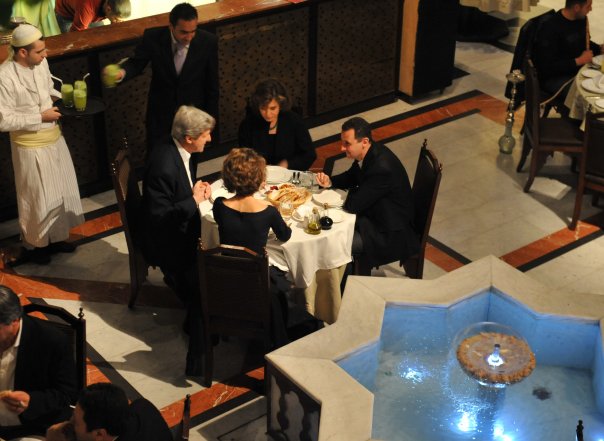
Mr. Kerry, meanwhile, became Mr. Assad’s champion in the U.S., urging lawmakers and policymakers to embrace the Syrian leader as a partner in stabilizing the Mideast. At a dinner in Washington in late 2009, Mr. Kerry described how the Syrian leader bemoaned the growing conservatism in his country. Mr. Assad’s London-born wife, Asma, had to wear a head-scarf when visiting Damascus’s historic Umayyad mosque, while his mother hadn’t decades earlier, Mr. Kerry recounted Syria’s leader saying. “He doesn’t want to lead a religious-based country,” Mr. Kerry told the audience… …
In the second half of last year, Mr. Kerry began shuttling between the Syrians and the Israelis, according to people briefed on the diplomacy. The senator believed the talks were progressing so well that last fall he and Mr. Assad’s aides secretly drafted terms they hoped would allow for the resumption of direct Israeli-Syrian peace talks, according to people familiar with their work. The plan: Israelis would agree to resume talks and commit to returning all Syrian lands seized during the 1967 Six Day War. Mr. Assad would pledge to distance himself from Iran and Hezbollah…. This January, however, the U.S. diplomatic pursuit of Damascus began to fray. American officials and French President Nicolas Sarkozy had pressed Mr. Assad to help stabilize Lebanon. But that month, Hezbollah and Syria’s other Lebanese allies engineered the ouster of Prime Minister Saad Hariri, a close Western ally. Mr. Kerry was booked into Damascus’s Four Seasons Hotel in anticipation of his seventh meeting with the Syrian leader. But days before the senator’s trip, the White House and French government intervened to block the meeting, according to U.S. and European officials. They didn’t want to give Syria’s strongman the stamp of approval that a visit from the powerful senator would imply….”
Sarakenos
| KABOBfest, June 2, 2011When he entered the topic of Syria, Nasrallah was unusually reading verbatim from his notes. Anyone who has routinely watched Nasrallah’s speeches would know it is not his style to read. This is the one and only excuse I could find for him, to explain his incredible hypocrisy and his utter disregard for the thousands of victims detained, tortured, injured, and killed by the Syrian regime these past few months.This is coming from someone who has openly supported Hezbollah and admired its charismatic leader for as long as I can remember. What is it that he owes to the Syrian regime that he had to back-stab the Syrian people? Are they not part of our Ummah (nation), as he himself reiterates? Of course he knows that! Some have argued that he sold out his Syrian brothers and sisters for a greater cause for the Ummah, i.e. by defending the Syrian regime it would somehow, in the long term, prove to save more lives, in addition to our freedom and dignity, than if it falls. But to stand with a tyrannical regime, you have already forsaken all dignity and all freedom.Nasrallah’s words show that he was aware that people would find it hard to buy his defense. At one point he stated that: “When we worry about Syria, we worry about its regime and about its people, not only the regime.” Also, he spent twenty minutes explaining the “elements” that his position of support was based on.
In the first element, he talks about all the gratitude that the Lebanese (and all Arabs in general) owe to the Syrian regime for saving Lebanon from division and stopping the bloodiest civil war in its history. Of course, he conveniently disregards the fact that Syria was part of that civil war which it allegedly helped stop, not to mention the Syrian army’s massacres (which he refers to as mistakes) of Palestinian refugees in the very same years he evokes. In the second and third elements, he brings up Syria’s position in the region as part of the resistance axis. Does he not know that Syria’s position of so-called resistance is only a political strategy to get a better deal with Israel and the US? Did the Syrian regime not cooperate with the US in hunting down “terrorists” and in securing the Syrian-Iraqi border? Did he forget that it was Hafez al-Assad who refused Jadeed’s directive to intervene in Black September and save the Palestinian guerrilla fighters in Jordan? In the fourth element, Nasrallah distinguishes the Syrian regime from those of Libya, Egypt, Yemen, Bahrain, and Tunisia in that the Syrian regime is very serious about reforms and fighting corruption, and therefore they should be given a chance to enact those promised reforms “through dialogue, not clashes.” Well who’s the one rolling tanks into besieged cities, cutting off their water, electricity, and food supplies? Does he not see who’s the one doing the clashing? Of course he does, and that makes him a hypocrite and a liar. In the fifth element, he affirms that the majority of Syrians (based on trusted information) are still supporting the regime and believe in Bashar’s ability to deliver on his promises for reform. He then asks rhetorically “Who/where are the Syrian people so we can stand by them?” It is only in the last two elements that he provides the true reason for his support of the Syrian regime: “What happens in Syria has its consequences in Lebanon and the whole region. We must take this into consideration…. Lebanon has commitments and treaties with Syria, starting from Al-Taef Agreement to all other mutual interests.” Based on these elements, Nasrallah said that the Lebanese are obligated (stressing that this is simply his point of view; that the Lebanese people can choose to disagree) to take the following positions towards what’s happening in Syria: 1. To be assiduous towards the stability and safety of the Syrian regime, army, and people. During the entire segment on Syria, which Nasrallah spoke with great enthusiasm and loud voice, there was no applause or cheers from the massive crowd in attendance. Perhaps even the people there thought the same as what many Arabs around the world who love Hezbollah thought: “I wish you did not talk about Syria at all!” Not even the most cunning Zionist plan could have come up with a way to discredit Nasrallah the way he did to himself! This is a big blow (perhaps the biggest) to his image and influence as the greatest Arab leader since Gamal Abdul-Nasser (some even say since Salahuddin 1000 years ago). Regardless of the disagreements in ideology and the specifics of the overall Arab and Islamic cause, he was loved and supported by millions around the world, up until this speech on May 25, 2011 in commemoration of the liberation of the South of Lebanon. I don’t know how would he recover, unless he comes out in public and apologize for disregarding (and silently supporting) the brutal torture, incarceration, and murder of thousands of Syrians. As for those Syrians and other Arabs who accuse the Syrian protesters of being part of a Zionist/American plot (thankfully Nasrallah did not openly stoop to that level), since when does peaceful protesting get punished with brutal torture and shots to the head? If you guys wish to support the regime in Syria after all the crimes it had committed, then at least have the decency to pretend to be ashamed of yourselves. |
Two friends have given feedback on the second day of the Syrian Opposition meeting in Antalya.
 Syria: Opposition Drafts Declaration in Antalya
Both were impressed by the constructive nature of the second day. George Washington was not born, they conceded, but hard decisions were made.
The Muslim Brothers and Islamists were under intense pressure to accept the notion of a secular government where religion and state would be separate. They resisted this most of the day but ultimately conceded at the eleventh hour. We do not have the statement or wording on this “secular” statement. But the MB accepted to not contest the separation of state and religion in the conference statement. I will publish as soon as I can get the wording of the conference statement.
According to some, Amr al-Azm (son of Sadiq) Amr Miqdad (presumably from the large Deraa family), and Muhammad al-Abdullah all played an important role in mediating and facilitating the discussion. They worked very hard to get the secular statement accepted.
The young guys were impressive. “Anyone in Damascus who doesn’t take these guys seriously is stupid,” my source explained. They are no where near where they should be, but for a first meeting this was impressive.” There were many arguments between the young, new leaders and the old, established leaders who have been in exile for decades. The young leaders had no patience for the committees and bureaucracy of the older generation. They are getting communication lines in place, developing networks between towns and did not have time for the endless haggling of the older generation.
About 70 Kurds showed up which surprised everyone. Also the number of tribal leaders was impressive. They were wearing heir dish dashers and kafiyyas.
“People have just had enough of being treated like shit. They want to be treated like real human beings – this was what it was all about,” one person explained. They have given up on talking with the regime. They don’t want the Assad family anymore.
Another important accomplishment was the establishment of an executive board and an election. They voted on a 31 member executive body, nine of whom will be full time. Two different lists of 31 people were presented, then they voted on which of the two lists would be picked. There was a lot of argument about who would be on the lists. It looks like they have agree on the people.
When the National Salvation Front was constructed in 2006, ex-V.P. Abdal Halim Khaddam waltzed in and took charge without a proper election. It was not a democratic opposition. At the very least, this opposition effort is proceeding by some sort of democratic procedure and there are elections.
Another aspect of the meeting that people liked was that the organizers of the conference excluded Farid Ghadary, Abdal Halim Khaddam, and Rifaat al-Assad because they are too tainted. The conference came out with a statement refusing foreign intervention and proclaiming the integrity and inviolability of Syria’s boarders. “Everything must be done to preserve Syria’s unity and territorial integrity,” their statement read.
“I want those people in Damascus to feel threatened,” said one friend. “This meeting is more impressive than anything the Baath has accomplished in the last 40 years. When have they ever had a real election? This is a start. There was a real young group of people working on the road to Damascus”
They issued a statement that Alawis should feel safe. No group would be targeted.
The Antalya group will start their own Facebook page tomorrow.
Hamza on facebook
Hamza is a 13 years old boy from Syria , he lived with his parents in a village called “Al Jeezah” or “Al Giza” in Daraa governorate. His tragedy started when he marched along his family in a rally to break the siege of the city of Daraa. He was detained among hundreds of Syrian during the massacre of Siada , I remember this massacre from couple of weeks ago and how horrible it was. According to my knowledge the detainees were hundreds and they were detained in schools and even football playgrounds.
[youtube http://youtu.be/ev3xy7VetXg?]

( Alastair Grant / Associated Press ) – Demonstrators calling for a free Syria protest outside Buckingham Place as U.S.President Barack Obama who is on a State visit to Britain is staying inside the palace in London, Tuesday, May, 24, 2011.
By Associated Press, Published: May 25
BEIRUT — More than 25 children, some of them tortured, are among the victims of the Syrian government’s deadly crackdown on an uprising that has killed more than 1,000 people over the past two months, an opposition group said Wednesday.
The Local Coordination Committees in Syria, which helps organize the protests against President Bashar Assad, identified the children and the circumstances of their death. Syria has blocked media access in the country, making it impossible to verify the reports independently.
Some of the children died “under severe torture,” the group’s statement said.
The children ranged in age from 5 and 17. Many appeared to have been killed in crossfire, such as Mahmood Alkadree, 12, who was struck by four bullets when he went out to buy bread for his family in the Damascus suburb of Douma, the statement said.
The body of 15-year-old Ahmad Radwan was found in the orchards of the coastal town of Banias, shot once in the stomach and once in the chest. Majd Ibrahim Alrfaee, a 7-year-old girl from the southern province of Daraa, died from a gunshot to the abdomen, the report said.
The statement said that 13-year-old Saleh Ahmad Alkhateeb was kidnapped by security forces on April 29 in Daraa, only to be found dead the next day “covered with the effects of severe torture.”
Assad appears determined to crush the revolt, which is posing the most serious challenge to his family’s 40-year ruling dynasty. The harsh crackdown has triggered international outrage and U.S. and European sanctions, including an EU assets freeze and a visa ban on Assad and nine members of his regime.
On Wednesday, the state-run Tishrin newspaper quoted Assad as promising reforms are in store.
This week, the government announced lower gasoline prices and promised to loosen media controls. Protesters have brushed off similar pledges by Assad in the past, demanding that he step down.
The protests have continued, taking place in the largest numbers after Friday prayers.
In addition to the Friday protests, many activists in Syria are opting for nighttime protests and candlelight vigils — aiming for a time when the security presence has thinned out.
Rami Nakhle, a prominent Syrian now living in exile in Beirut, says people have gotten better at manipulating security forces.
“They gather in smaller groups but in several areas, almost simultaneously. By the time police arrive to one protest site, the protesters would have already dispersed and gone elsewhere. They are trying to wear down the security forces,” they said.
The darkness of the night also offers the protesters some protection from snipers on rooftops, he said.
Nakhle is in close touch with Syrian activists on the ground and regularly provides the media with live updates and material on demonstrations in Syria.
Video posted on YouTube on Tuesday showed a small group of women marching at night in an outdoor market in Damascus, carrying anti-government banners as stunned shoppers looked on.
Another showed a group of young men in Aleppo marching with candles and banners and shouting, “Why are you scared? God is with us!”
The central cities of Homs and Hama are also witnessing nightly demonstrations. On Tuesday they were shouting, “Bye Bye and goodnight Bashar” and “The people want to topple the regime!”
___
Associated Press Writer Zeina Karam contributed to this report.
By Suleiman al-Khalidi
|

:: Article nr. 78103 sent on 27-may-2011 09:55 ECT
Link: www.reuters.com/article/2011/05/26/us-witness-syria-torture-idUSTRE74P2VD2011052
6
Click on image for slide show
Video will follow shortly