Search

band annie's Weblog

I have a parallel blog in French at http://anniebannie.net

Category

Syria

Syria: Six Months After the Tyrant’s Flight – Tangible Hopes, Lingering Challenges

Rime Allaf

It’s our 6th monthiversary. If you’ve just joined us, here are a few key points on where we stand, from my perspective at least, since the genocidal maniac fled Syria precipitately on December 8. [TLDR: the situation is encouraging, despite real dangers from foreign enemies and domestic machos, as we wait for reconstruction.]

• The big bloodbath that so many warned would happen did not materialize, despite Iran’s best efforts through Assad regime remnants, and despite the March massacre. There has been no “Afghanization” either, and the new regime is unlikely to lean that way.

• Regional and international support has been immediate and impactful; the sanctions have been lifted, financial aid has been pledged, and Sharaa is being treated as a head of state. I hope this does not lead to complacency from our side.

• The restoration of regular services (electricity and water above all), the building of basic infrastructure, and the provision of a livelihood to more Syrians is still the most urgent priority, as is the facilitation of refugee returns. I think most Syrians will agree it should take precedence over a Trump Tower or the like.

• The machinations of Iran are still the biggest danger to Syrian stability, while the absurdity of Israel’s belligerent actions hurts them as much as it hurts us. They are the only two countries in the region actively working to prevent Syria from stabilizing, and we will not see peace until they are prevented from interfering.

• In the realm of Syrian officialdom, things are still slow and unclear, and the lack of gender representation is unacceptable: there are way too many men and way too few women in practically every decision-making circle. I also think that women are the best placed to describe their own role and place in society, and there is no need for mansplaining 2.0.

• Religious or ideological interference in civil matters is just as unacceptable. For example, there have been scattered checks on men and women seen together in public: their relationship is nobody’s business. Don’t allow these men to harass and badger free Syrians: rein them in.

• The Great Umayyad Mosque has survived 13 centuries without needing the current administration’s stupid measures to separate men and women. Stop being so ridiculous and don’t infringe on our rights to enter our public places, holy or otherwise, as we always have.

• One notably positive impression Sharaa and his team give is that they are listening to others. In most meetings, he holds a pen and jots down notes, and he seems aware of public discontent about various issues. That said, appointments and decisions have been centralized, but I think it is understandable at this stage.

• However, many Syrians are fed up with the lack of transparency and the lack of a clear communication process. They don’t want to have to look for news, rumors and statements on miscellaneous Telegram channels. Get official spokespeople already, and do not let your ministers give what they think are press conferences – they are not. Upgrade your written comms too, it’s still too reminiscent of SANA.

• It is heartening to see real efforts towards progress from several ministers and ministries, especially those who speak directly to the population and measure their promises and manage expectations. Personally, I find poetry less actionable.

• The absence of one component of Syrian public life over the last few months has me wondering why they are all suddenly so quiet. Where is the political opposition? Where have they all disappeared? Why are the Syrian people not being addressed with political agendas, manifestos, ideas, principles? Are they waiting until the 11th hour just before the elections in less than 5 years?

• So far, freedom of speech and freedom of assembly have been overwhelmingly respected. We must ensure they remain a civil right protected by the constitution along with all the other personal rights, and not a temporary exception.

Onward and upward.

*****************************************

As fate would have it, I had finished writing 90% of my book when Assad fled and the regime collapsed, with two chapters left before sending the manuscript to my publisher. Nothing changed except the last chapter, written after a few weeks to take in our momentous emotions, and our collective fears and aspirations. The book relates why and how Syrians got to where they are today, their patient and painful quest for dignity and freedom, and the regional and global factors that triggered their descent into the hell from which they now must emerge, together.

To be published in Autumn 2025: https://www.hurstpublishers.com/book/it-started-in-damascus/

Aucune description de photo disponible.

QUNFUZ

The Background

Security prisons, and the terror they inspire in the Syrian population, have underpinned the Assad regime’s rule from the start.

The history of such prisons stretches back before Hafez al-Assad’s seizure of power in 1970, though his regime expanded and intensified the system. From 1946 on, Syria was racked by a series of military coups and counter-coups, interspersed with brief episodes of parliamentary democracy. Whenever a coup succeeded, the new rulers would round up the previous government and its supporters and detain them in prison.

The numbers of people held in security prisons increased during the United Arab Republic (UAR) of 1958 to 1961, and the conditions of detention worsened. The UAR brought the Syrian and Egyptian states together under the dictatorship of the Egyptian president, Gamal Abdul Nasser. Abd al-Hamid al-Sarraj, Nasser’s preferred Syrian secret policeman, is credited with introducing two particular torture methods to Syrian prisons during this period: the doulab, or tire, in which victims are stuffed, and then whipped; and the shabah, or ghost, by which victims are strung by their wrists from the ceiling for hours or days. Both methods are still applied in the Assad regime’s prisons today. ISIS inherited them from Assad, and also routinely applied such tortures in its own security prisons.

The UAR was widely seen as an economic as well as a political disaster, and was soon ended by a coup led by conservative army officers. When, in turn, a secret Military Committee of Baathist officers seized control in March 1963, it quickly set about rounding up and detaining those it considered a potential security threat. These included first the conservative officers who had seceded from Abdul Nasser’s UAR, then supporters of Abdul Nasser, then anyone who dissented from the ruling party’s line. As the Baathists had banned all media and all forms of civil organization beyond Baath Party control, this category covered many members of civil society.

READ ON HERE

Free Syria’s First Days: Good, Bad and Ugly

Qunfuz

Robin Yassin-Kassab

leave a comment »

This was published at the New Arab (link here)

We feared the regime’s end would be accompanied by a bloodbath. Thank God, that hasn’t happened. In the end the regime collapsed without a fight, even in its supposed heartland on the coast.

There has been some looting in Damascus, which has been somewhat more chaotic than the northern cities, perhaps because there has been a smaller rebel presence. Otherwise, the news coming from liberated Syria has been surprisingly good.

On the social level, Syrians are talking the language of reconciliation. One typical video shows a bearded rebel admonishing surrendered regime fighters for standing with the side that slaughtered women and children. Then he tells them, “Go! You are free!” The rebels have issued a general amnesty for military personnel. This does not extend to those guilty of war crimes and crimes against humanity. The intention is to hold those people to account.

Meanwhile, Muhammad al-Bashir, who was the prime minister in Idlib’s Salvation Government, has been appointed to form a Transitional Government in Damascus. The Salvation Government ruled in HTS territory, but was civilian, largely technocratic, and fairly independent. It looks as if a similar logic is going to apply to the Transitional Government.

Having shed his nom de guerre, Abu Muhammad al-Jolani is now known by his real name, Ahmad al-Sharaa. Instead of ‘leader of HTS’, he has been rebranded as ‘commander of military operations’. He wants to be seen as a national figure rather than a Sunni jihadist. Some fear that he will change direction as soon as western states stop branding him a terrorist, but for now at least his direction is tolerant and democratic. Rebels have been told not to interfere in women’s clothing choices, for instance. And prominent opposition figures say that UN Resolution 2254 will be implemented. This will involve drafting a new constitution and holding free and fair elections under UN supervision.

So far so good. All of it inspires confidence in Syrians at home as well as the millions who were driven from their homes. Huge streams of people are leaving the tented camps on the country’s borders, and returning from Turkey and Lebanon, where so often they were subjected to racist abuse and violence. The result is thousands of emotional reunions between siblings, or between parents and children, who in many cases haven’t seen each other in over a decade. This is a blessing that nobody expected a fortnight ago, and it culminates a drama that has lasted almost 14 years. In 2011, millions of Syrians screamed Irhal! – Get out! – at Assad. His response was to drive them out instead. But today, at last, the Assad family are the refugees.

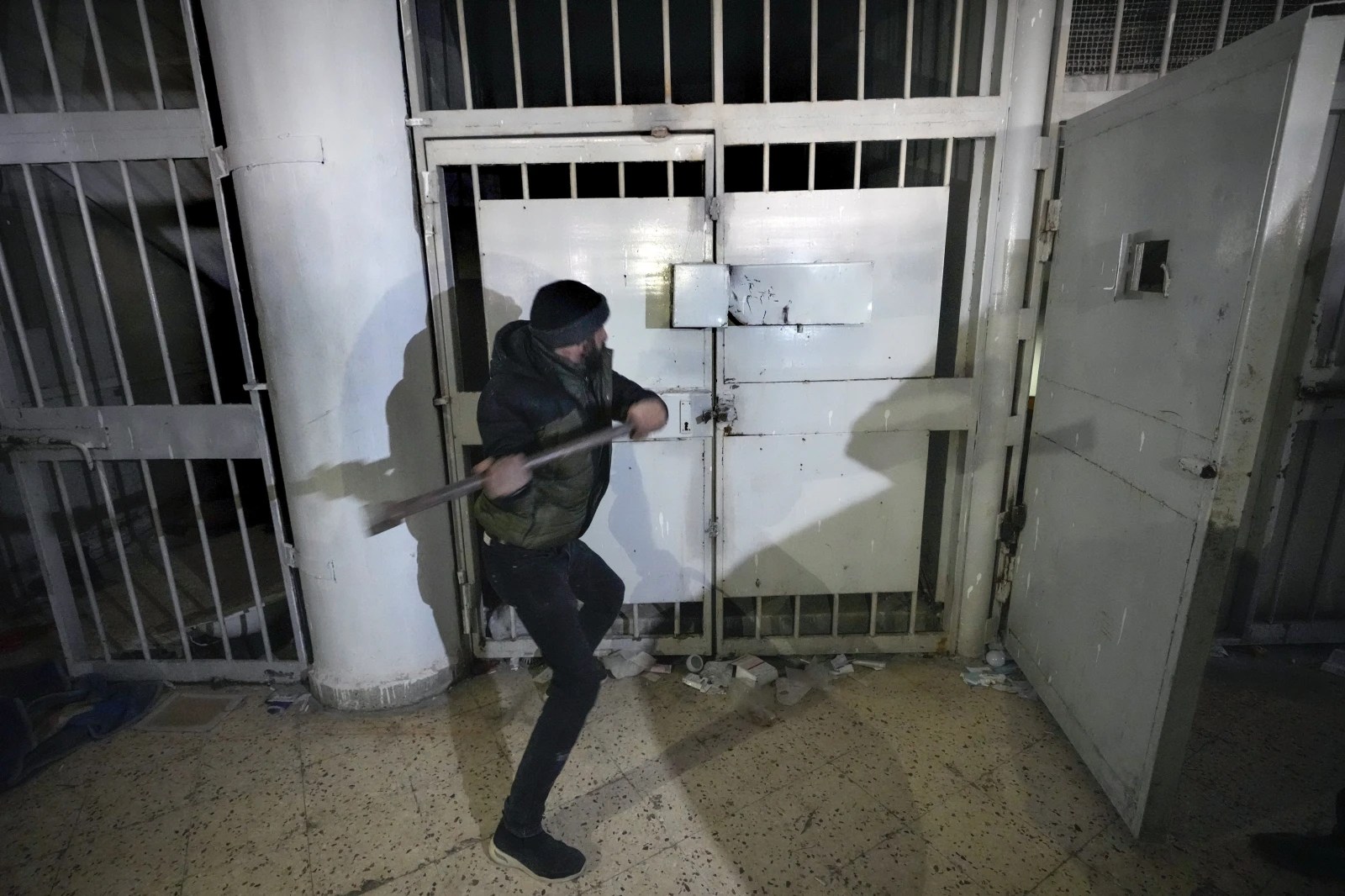
It’s also very good that tens of thousands of prisoners have been liberated from Assad’s dungeons. But it’s bad – profoundly depressing, in fact – that so many are in such a bad state. Lots of women and children have been found behind bars. The children were either arrested by the regime along with their parents, or were born in these dungeons to mothers who had been raped.

Some people have been found who were presumed to be dead. Many Lebanese have been liberated, and Jordanians and Palestinians, including Hamas members. Some of the prisoners had been “behind the sun”, as Syrians say, for over four decades. Some who were liberated thought Hafez al-Assad was still president (he died in 2000). Many of those coming blinking into the light are emaciated or disabled by torture. Some seem to have lost their memories or their sanity.

The worst images are coming from Sednaya Prison. Amnesty International called Sednaya ‘the human slaughterhouse’, and estimated that between 5,000 and 13,000 people were extra-judicially executed there between September 2011 and December 2015 alone. It now seems the total numbers of murdered are much higher than that.

At least 130,000 people were estimated lost in the Assadist gulag. Fadel Abdul Ghany, head of the Syrian Network for Human Rights, said yesterday (December 9) he believes that the vast majority of prisoners have been murdered.

The well-known activist Mazen Hamada has been found dead in Sednaya. Rooms full of discarded clothes and shoes, presumably belonging to the murdered, have been discovered. One room was filled with bags of noosed rope, for hangings. An ‘execution press’ for crushing bodies has been found, and a mass grave packed with bodies partially dissolved in acid. Piles of corpses have also been uncovered at Harasta Military Hospital. It is thought that these people were murdered at Sednaya, and then their bodies moved. It seems that very many were murdered very recently, even as the regime was collapsing.

After over half a century, Syrians are finally emerging from the horror of one of history’s worst torture states. The legacy of death camps like Sednaya is added – along with the cratered economy and the war-ravaged infrastructure – to the list of traumatizing challenges facing the country. Syrians need help, solidarity and understanding from the rest of the world.

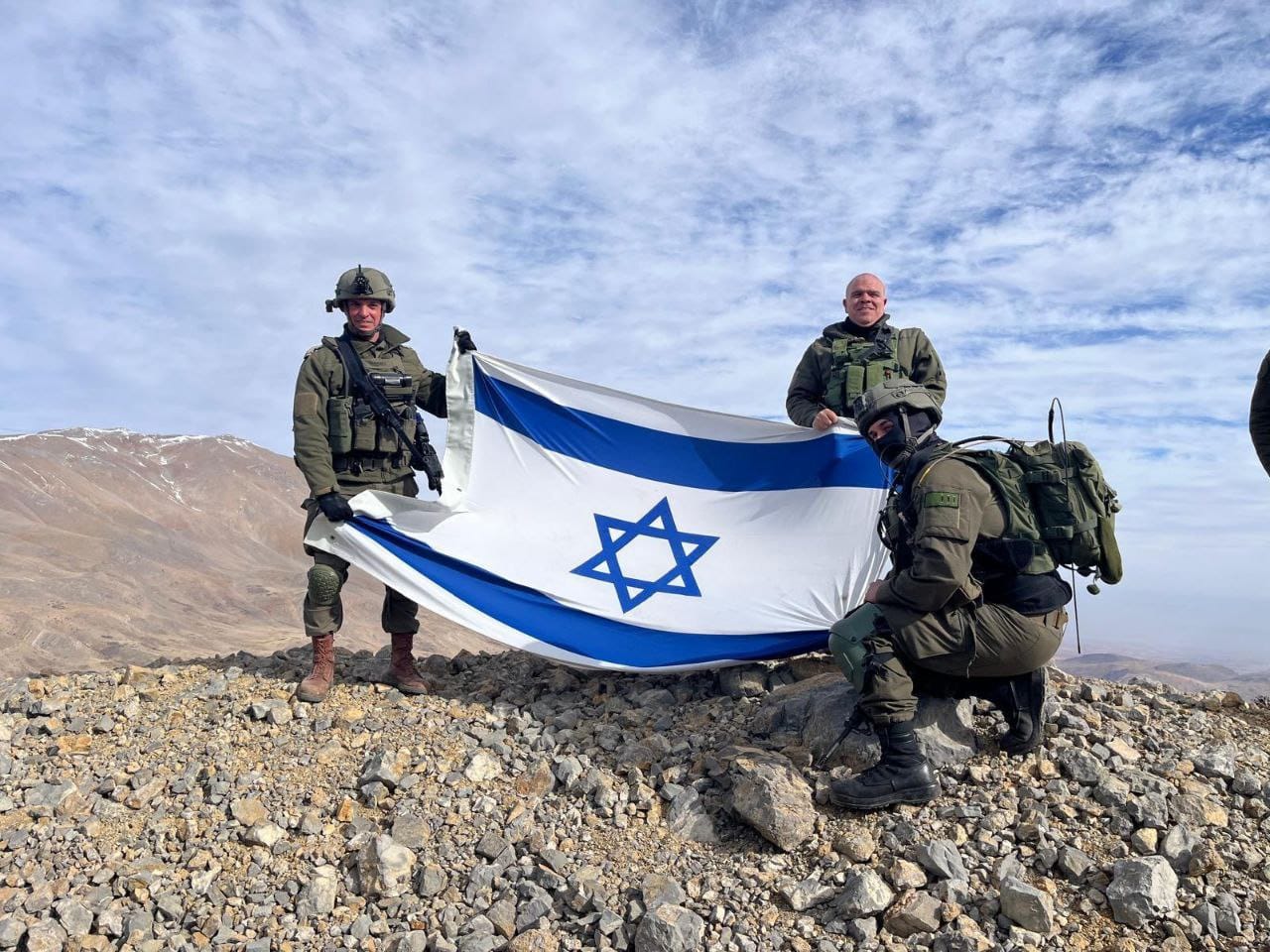
Zionists advancing into Syria.

But what is the ill-named ‘international community’ giving Syrians instead?

Israel – armed by the US, UK, Germany and others – is giving them crazy bombing. The Zionist state has struck hundreds of targets, not only weapons sites – so that a free and independent Syria will be defenceless – but also buildings containing documentation. It aims to destroy, one must presume, evidence of its collaborations with the regime, and perhaps its American ally’s collaborations too.

Israel is also advancing further into the Golan Heights, creating ‘a buffer zone’ to protect the illegally occupied territory which Bashar’s father Hafez al-Assad withdrew from without a fight in 1967 (he was defence minister at the time). The Assad regime under both father and son protected Israeli security on the border better than the states which had signed peace agreements with Israel. The regime also locked up any Syrian who organized against Zionism in any way at all. One of the prisoners freed yesterday was Tal al-Mallouhi. Tal was arrested in 2009, aged 19, merely for writing poems and blog posts which urged solidarity with Palestine. This is why the fall of Assad has enraged Israel.

No western power has condemned Israel’s unprovoked assault on free Syria. They have made their enmity to Syrians clear from the first minutes of the liberation. And this potentially makes all of our futures not just bad, but very ugly indeed. May the Syrian people prevail.

Share this:

Genocide justifying itself by genocide

Image du logo du site
Qunfuz
Robin Yassin-Kassab

leave a comment

The most repulsive thing I saw yesterday was a Zionist justifying the genocide of Palestinians by reference to the genocide of Syrians. Three points.
One: One genocide doesn’t make another OK. Obviously.

Two: Israel was a major reason why the US stopped serious weapons reaching the Free Army. Other than a few rhetorical comments, the US worked with Iran (doing a deal) and Russia (welcoming it into Syria to ‘solve the chemical weapons problem’, which of course it didn’t) to save Assad. This, according to what American officials told Syrians lobbying for weapons, was because Israel was worried about ‘instability’, especially about Syrians having anti-aircraft missiles and heavy weapons. So hundreds of thousands of Syrians were murdered, millions expelled, and the country utterly destroyed, for the sake of the apartheid state’s ‘stability’.

Three: Israel is doing exactly the same to Gaza as what Assad/Iran/Russia did to Homs, Aleppo, the Ghouta, etc: it is destroying the civilian infrastructure, imposing starvation sieges, hitting schools, hospitals, residential blocks, bakeries. Its aim is the same – to remove or annihilate the civilian population. Its genocidal rhetoric is the same, but it seems to be far more deeply spread amongst Israeli Jews than it is amongst Assad’s ‘loyal’ Alawi community. The difference in method is that Israel does the killing faster and more efficiently, with more advanced western (American and German) weapons.

So Israel does the same as Assad/Iran/Russia, only faster, and Israel contributed to the disaster in Syria anyway, and you can’t justify your fascist genocide in the south of bilad ash-sham by pointing to the fascist genocide in the north. You are all fascists, and the people of the region in their overwhelming majority despise you both. There will be no peace until both of your ideologies and murderous power systems are dismantled.

It is because the Assad regime (murderer of tens of thousands of Palestinians, which kept the border with the occupied Golan quiet for decades and silenced all Syrian political organisation) and Israel have so much in common that they have protected each other over the decades.

The Zionist line on this is : ‘look how Assad committed a real genocide, whereas Israel does its best to protect civilians.’ These people are worse than liars. They are propagandising to cover a clear genocide, whose sole aim is to destroy civilians. It’s ‘look at the savages doing genocide, whereas we are civilised people doing gentle, civilised police work.’ But you, if you are Zionists, are perpetrating genocide, murdering the children first, in order to defend an apartheid state built on land stolen from another people.

(Meanwhile, there are also ‘leftists’ and supposed ‘anti-Zionists’ who say, against all evidence, that Assad/Iran/Russia are anti-imperialists working to stop Israel. Such people are ignorant at very best, fascists laughing at the slaughter of Arabs and Muslims at worst. Don’t trust them.)

Maybe it was German Zionists who invented the ‘look at the Syrian genocide’ tactic, because their usual argument is ‘because of our genocide of Jews, we should also commit genocide against Palestinians’. They are used to justifying one genocide by referring to another. (And this is their genocide, their weapons, their arrests of protesting Jews and Muslims, their visa bans, their racist hysteria against Arab immigrants. This genocide is being perpetrated by the US and Germany as well as Israeli Jews, and the UK, France, Canada, and many others are complicit. This is the worst thing the west has done in half a century, and it changes everything.)


Source : Genocide justifying itself by genocide

Rime Allaf recaps 20 years of Bashar’s rule


I wrote this thread of 30 tweets on the occasion of Bashar Assad’s ascent to the Syrian throne 20 years ago. Thank you for reading. (For retweets, Twitter link Rime Allaf @rallaf)

20 years ago today, I was at a Damascus hair salon when an assistant rushed to tell us Hafez Assad had died. What I saw and lived in the next days and years is set in stone in my memory. This thread is but a glimpse of life in #Syria then and the slow descent into implosion. /1

Hafez started preparing the ground for 2nd son Bashar in 1994 when original heir Bassel was killed in a car crash. While Bashar’s meteoric rise in army ranks and early public appearances in late 90s prepared people, Hafez was busy clearing regime ranks of potential contenders. /2

Big names Syrians had grown up fearing, from Hekmat Shehabi to dreaded head of intelligence Ali Douba, were officially retired to ensure only the most loyal and least ambitious men stayed. Bashar never had to fight an “old guard” in later years as some clueless media claimed. /3

Within an hour of Hafez’s death, parliament held a special televised session to amend the constitution. In 5 minutes, the required age for the presidency was lowered from 40 to 34, Bashar’s age. We all watched in stunned silence: we expected it, but it was still humiliating. /4

When Bassel died, Hafez Assad forced the entire country to shut down & mourn for 40 days. So when Hafez died, Syrians went into self-preservation mode: within a couple of hours, streets emptied & shops closed, with people at home glued to TVs, trying to interpret developments. /5

Turns out Bashar couldn’t care less if people grieved “the eternal leader” as long as they cheered “the hope” – the cute moniker his folks spread for us to repeat. Bashar was devoid of emotion, even flippant at the funeral, a bit ungrateful considering his hefty inheritance. /6

The formalities of Bashar’s “election” took place the following month, and many would have wanted the story to end with “and we all lived happily ever after” … but we didn’t. To begin with, the personality cult imposed under Hafez paled in comparison to what Bashar demanded. /7

Hafez liked being feared but Bashar was desperate to be admired. Over the years, he sidelined any Syrian personality who came even close to being popular or, God forbid, to outshine the king. Old wooden Baathist dinosaurs are still his core ministers & advisors for a reason. /8

To be admired, Bashar strived to be cool. The rumors about work ethics, love of technology and humble demeanor, the wife, the living quarters, the interviews, the cafes, the modernity, the posters magically appearing “against his will” – all meant to drip with coolness. /9

Before Hafez died, I was one of the first few thousand Syrians to buy a mobile phone. For that privilege, in addition to the cost of the phone (illegal to bring one from abroad) + various fees, I paid $1,200 to Syriatel just to have a number. That’s how Rami became cool too. /10

As portfolio manager of the Assad and Makhlouf clans, Rami was the most visible and most powerful “businessman.” But all the children of the Hafez buddies became the new business people of the Bashar era – not that it’s a feat of entrepreneurship with no competition allowed. /11

The so-called economic opening was merely an erratic crony capitalist economy so a few could live it up. As they watched mounting obscene wealth around them, Syrians were beginning to face rising prices, diminishing means, a dismal housing situation and a transport nightmare. /12

From the start, Bashar claimed the economy would be reformed; if this was reform, imagine the rest. There were a couple of private banks, some media, a few private schools – none of which had an effect on the lives of ordinary Syrians. On the political front, empty words. /13

Some dared to call Bashar’s bluff. In September 2000, 99 brave Syrian intellectuals signed a statement asking him to lift the state of emergency (in place since 1963), free political prisoners, allow freedom of speech … if you know Syria, you know where this is going. /14

Syrians waited for these basic freedoms and rights for an entire decade, and paid dearly for it. While Rami scooped up every possible penny made in or coming into Syria, Bashar was scooping up Syrians who dared to speak out and populating jails with prisoners of conscience. /15

The Damascus Spring, as we call it, turned rapidly into a Damascus Winter. Many old opposition figures who the world discovered in 2011 had been prisoners of conscience for years – under father and then son – for “weakening national sentiment.” Defying Bashar was verboten. /16

Abroad, Bashar played statesman with disastrous effect, giving absurd interviews pontificating on world affairs. A mansplainer of the first order, he tediously denied claims about any action by saying “it’s not logical.” He riled up the US by sending fighters to Iraq … /17

… even though he voted for Resolution 1441 on his Security Council stint, giving the US the unanimity it had sought and the justification it needed to invade Iraq a few months later (Bashar always wants to be wanted, and if that doesn’t work he makes trouble to be noticed). /18

And then there was Lebanon, which he had been messing up since the day he inherited his realm. In 2004, he forced the Lebanese parliament to extend then-president Emile Lahoud for 3 years (unconstitutionally), and in February 2005, with his ever stronger ally Hezbollah, … /19

… he killed Rafic Hariri, setting in motion a sequence of further assassinations and upheaval, and the forced retreat of Syrian soldiers who had been there since the 1970s. When brave Syrians dared to stand with their Lebanese counterparts, he threw them in jail, again. /20

Syrians watched Lebanese protesters publicly insult Bashar, shaking the regime for the first time. That is when the “menhebak” (we love you) posters started appearing, and when the regime began peddling Syrianism (basically, Syria First) to replace Baathist Arabism. /21

After the hasty Lebanon retreat, Bashar promised Syrians big changes were coming. We were not holding our breath, but when he then convened a Baath Party Congress (the first since 2000), some again dared to hope the regime had finally learned its lesson. Silly them. /22

The Congress declared that the economy (officially socialist for people, capitalist for ruling elite) would henceforth be known as a “social market economy,” whatever that means. Poverty continued to rise, the velvet society continued to sip frappuccinos at the Four Seasons. /23

Ostracized by the entire region and the world, Bashar was saved by Hezbollah’s infamous May 2008 assault on Beirut which led to a reconciliation agreement sponsored by Qatar, leading itself to his reintegration into the international community and an invitation to Paris. /24

The bigger Bashar’s head got on a regional level, the more his actions increased Syrian despair and disparity. And when he declared in early 2011 to WSJ that Syria was immune to the Arab spring, the children of Deraa pointed to the naked emperor and wrote: it’s your turn. /25

Syrians endured suffocating hardship over decades of Assad tyranny before they started the revolution – a revolution in every sense of the word. To understand this seemingly sudden unleashing of the free Syrian spirit, you need to know about the decade that preceded it. /26

This thread merely scratches the surface of the trajectory of Bashar Assad and Syria, which I researched for years at Chatham House, and wrote and spoke about in hundreds of articles, talks and interviews. Expertise on Syrian affairs is needed, above all from Syrians. /27

Hafez Assad bequeathed him a hereditary republic; Bashar took this massive trust fund and destroyed it over the course of 20 years, little by little at first through reckless abandon, and then with every weapon of mass terror and destruction. /28

This gluttonous, incompetent, barbaric regime is unreformable, proving repeatedly it will use all means at its disposal to maintain its violent power, 50 years on and counting. Since March 2011, most Syrians have sacrificed everything to liberate themselves, with little help. /29

As the world rethinks its selective commitment to fighting injustice and upholding human rights, after the exposure of horrific crimes on unarmed civilians, it should help Syrians get justice too. For that to happen, Bashar Assad’s 20th anniversary in power must be his last. /30


Apocalyptic Scenario Beginning In Syria

With with 77 Killed; Over 150K Displaced
REPORTfrom Union of Medical Care and Relief Organizations Published on 04 May 2019
FOR IMMEDIATE RELEASE

Geneva, Switzerland – In the past 72 hours there has been a surge in airstrikes, barrel bomb attacks and artillery strikes in Idlib and Hama, Syria. At least 77 civilians have been killed and over 150,000 IDPs displaced in the past seven days. Most cities in Northern Hama are almost completely evacuated. The areas are already over populated and lack in camps and housing for the newly displaced, leaving large numbers with no shelter, exposed to the elements. Five medical facilities and five schools were also bombed and put out of service this week. Many hospitals and schools have suspended operations. There are over 3.5 million people in Northwestern Syria including 350,000 people living in refugee camps. The region already suffers from severe shortages in healthcare, food, shelter and sanitation and cannot withstand further destabilization.

The five medical facilities that were targeted and put out of service include: Al Latamna Hospital, Qalaat Al-Madiq Hospital, Al Habeet Primary Health Care Center, Qastoon Primary Health Care Center, and the Surgical Unit in Kafr Naboodha. No casualties were reported from these attacks and one nurse was injured in the Kafr Naboodha attack. Earlier today a Syrian Civil Defense Worker (White Helmet) was killed as he was rescuing people in an attack. The former administration officer of Sham Hospital, a prominent actor in the Hama Health Directorate, and current accountant at the Al-Madiq Hospital, was killed as a missile struck his car near Al Madiq hospital.

“If these attacks are allowed to continue, we will witness the apocalypse in Syria. It will be like nothing we have seen in the past 7 years of war. Specifically, the genocide of thousands of civilians and the displacement of millions to surrounding countries. The battle of Idlib and the refugee crisis it will create will threaten global peace and security. The UN Security council, mandated with upholding global peace and security, along with world at large, must take proactive steps to ensure the battle of Idlib is deescalated and resolved peacefully immediately. Right now, hundreds of thousands of people are being pushed into smaller and smaller areas and will inevitably be slaughtered. We know how this story plays out; the bombing of schools and hospital, indiscriminate barrel bomb attacks, chemical weapon attacks and scores of children brutally disfigured and killed. WE CANNOT LET IT HAPPEN AGAIN!” Said Dr. Hussam Al Fakir, Chairman of UOSSM International

In the strongest terms, UOSSM urges all parties to the conflict to find a peaceful resolution. We urge the UN Security Council and the international community to implement UNSC resolution 2286 for the protection of medical facilities and aid workers. We urge the international community to release emergency humanitarian funding for medical aid, shelter, food, water and sanitation.

Media inquiries and interviews please contact :

Name: Avi D’Souza
Director Of Communications, UOSSM Intl.
Phone: (647) 528-5029
Email: press@uossm.org

About UOSSM :
UOSSM (Union des Organisations de Secours et Soins Médicaux) provides free medical aid to the people of Syria regardless of nationality, ethnicity, gender, religion or political affiliation. UOSSM international, founded by Syrian Doctors around the world, started in 2012 and operates 12 major hospitals and supports 120 clinics inside Syria. UOSSM has performed over 1,000,000 medical treatments inside Syria since inception.

source

Russia and Syria vow to ‘wipe out terrorists’ in Idlib

source www.aljazeera.com

Humanitarian fears grow as Russian and Syrian FMs signal all-out attack on last rebel-held stronghold is imminent.
The Syrian government and its major ally Russia have signalled that an all-out offensive to retake the last rebel-held province in Syria is only a matter of time, raising fears of a major humanitarian crisis.
Speaking at a press conference in Moscow with his Syrian counterpart Walid al-Muallem following a closed-door meeting, Russian Foreign Minister Sergey Lavrov stated that the majority of Syria had been “freed of terrorists”, save for Idlib, a northeastern province bordering Turkey.
“What we need to do now is to wipe out those terrorist groups which persist, particularly within the de-escalation area of Idlib,” he said.
“It is unacceptable that those terrorists particularly al-Nusra Front are using the de-escalation area of Idlib to attack the Syrian army and to also attack through drones the Russian military bases in the area,” he added referring to Hay’et Tahrir al-Sham (HTS), which is dominated by a rebel faction previously known as al-Nusra Front before renouncing its ties to al-Qaeda.
For his part, al-Muallem said the Syrian forces will “go all the way” in Idlib but added that the army will do everything possible to avoid civilian deaths.
Humanitarian concerns
Idlib is home to nearly three million people, up to half of whom are rebels and civilians transferred en masse from other areas such as Aleppo, Eastern Ghouta and Deraa after they fell to Syrian pro-government forces following heavy fighting.
The situation on the ground is further complicated by the direct presence of Turkey, which backs certain rebel groups in the area and operates as a guarantor power to ensure a “de-escalation zone” agreed upon with Syrian President Bashar al-Assad’s allies Russia and Iran at a meeting in Kazakhstan’s capital, Astana.
In recent weeks, Turkish-backed opposition groups in Idlib have attempted to unify into a new coalition, with some 70,000 fighters pledging to fight against forces loyal to Assad. But HTS, the most dominant rebel force in Idlib and in control of about 60 percent of the province, has not joined the coalition.

A major military operation in Idlib would pose a particularly threatening humanitarian situation because there is no opposition territory left in Syria where people could be evacuated to. Observers have previously warned as many as 2.5 million Syrians could try to flee to the closed Turkish border, creating a new refugee crisis.
“The question is how costly the assault on Idlib is going to be,” said Al Jazeera’s Rory Challands, reporting from Moscow.
“It’s not a question of if it will happen, it is a question of when and the severity of it,” he added, noting that the Russian and Syrian governments believe that the seven-year war will largely be over if they capture Idlib.
Hundreds of thousands of people have been killed and millions displaced since Syria’s war started in 2011 with the brutal repression of anti-government protests.
Warnings and reconstruction
Speaking at the press conference, Lavrov called on the international community to join in the reconstruction process of Syria and “actively get down to work on modernising the infrastructure which has been devastated”.
“We can see that there is a very swift mobilisation of the international community taking place particularly with regards to the return of the refugees and the revival of socioeconomic assets and facilities to make sure the country gets back to working order,” he said.
“The Russians know that as the pre-eminent military force in Syria, some of the responsibility of rebuilding Syria falls on them,” Challands said, “but they don’t want to shoulder all the bill, so they’re encouraging as many foreign powers as they can to chip in essentially and get the country back on its feet.”

Syrian oppositions prepare defence line due to Assad government’s potential military offensive against Idlib [Anadolu Agency]

Al-Muallem said Russia and Syria are united in their views regarding the next stage of rebuilding Syria.
“It’s natural to think about Syria to find a reconstruction programme and to find a role for our partners in Russia to play a key role and priority in this,” he said, adding that both countries are very near to “putting an end to terrorism” in the country.
Both ministers warned against any “act of aggression” from Western countries, particularly from the United States, citing staged chemical attacks by “provocateurs” such as the Syrian civil defence group the White Helmets being used as a pretext for such assaults.
“This kind of provocation is being staged as to complicate the whole issue of combatting the terrorists in Idlib,” Lavrov said. “We have warned our Western partners clearly that they should not engage in this kind of activity.
Al-Muallem accused the US and its allies of preparing for “another aggression to save al-Nusra Front” and protract the Syrian conflict.
“We will practise our legitimate right in defending ourselves, but the consequences of the aggression will hit the political process definitely and everyone will be [affected],” he said.

Nature of offensive unknown
Turkey, which hosts some three million Syrian refugees, has already stated that it will not open its borders to accept further refugees in the event an assault takes place.
The Syrian government said that it will open “humanitarian corridors” for civilians to evacuate, but according to Al Jazeera’s correspondent Zeina Khodr, many of the residents do not trust the government and remain fearful of their fate.
“Many of these people are considered terrorists or are wanted by the state simply because they engaged in opposition activities,” Khodr said, reporting from Lebanon’s capital, Beirut. “Being a medic according to the Syrian government is terrorism.”

Earlier on Thursday, UN Syria envoy Staffan de Mistura warned that a potential “perfect storm” is looming over Syria’s Idlib province, and expressed his willingness to “personally and physically” involve himself to ensure a corridor to evacuate civilians would be feasible.
While it is not yet clear what kind of offensive the Syrian government will engage in Idlib, Khodr said that there are still “behind the scenes negotiations between the Russians and the Turks” on this matter.
“What we understand from some sources is that Turkey is trying through its contacts in Idlib to convince Hay’et Tahrir al-Sham to disband itself to prevent this all-out offensive,” she said.
“We even heard Lavrov tell the Syrian government ‘we are talking about the need to reconcile with some groups’ telling them in one way or another that there will not be a wide-scale attack.”
Russia pushing forward
According to Alexey Khlebnikov, an expert with the Russian International Affairs Council, creating another refugee crisis will be contrary to Russia’s main priorities and interests.
“This is why Russia is now trying to negotiate with Turkey to reach a compromise on the deal to minimise damage inflicted on the population in Idlib,” he told Al Jazeera.
“Now, Russia’s message to the West is to get on board and join in the reconstruction process and humanitarian aid [which] basically goes in line with that message of retaking Idlib and not creating another refugee flow.”
But Khodr said that Western countries are not prepared to join in the reconstruction, insisting first on a “meaningful, credible, political transition” to Syria.
“[The Russians] have sidelined the political transition which will involve the Syrian government sharing power with the opposition,” she said, noting that Russia is trying to cement Assad’s hold onto power.
The narrative for Russia and Syria is that they have won the war and now want to talk about rebuilding the country and returning the refugees, she said.
“They’ve appealed to the international community, particularly to the West, to give them money to rebuild the towns so that refugees will return and leave Europe but it seems they do not have the support as of yet,” Khodr said.

to be continued here

Creating a New Syria: Property, Dispossession, and Regime Survival

 — by Erwin van Veen

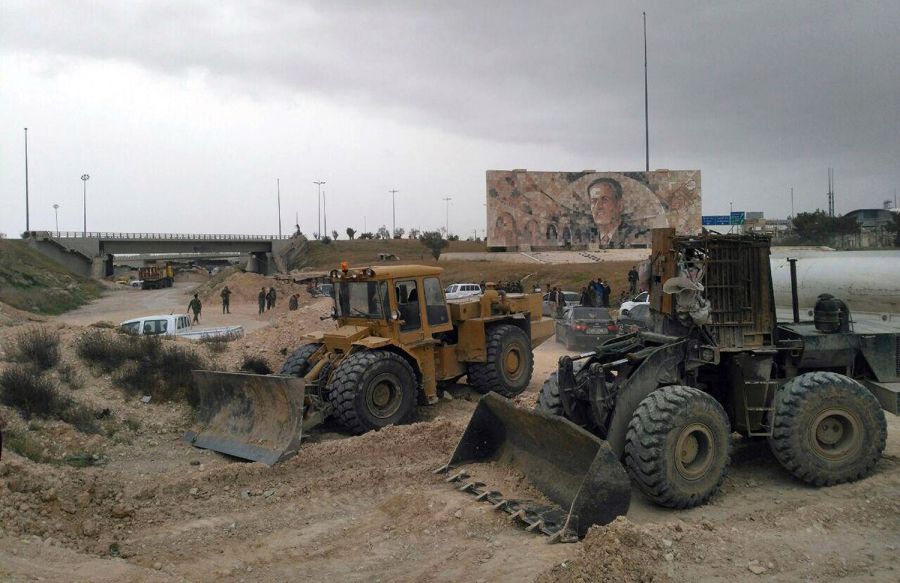
bulldozers removing barriers from a road in the town of Harasta, east of the capital Damascus, Syria, Saturday, March. 24, 2018, where thousands of opposition fighters and members of their families are expected to use to head to northern Syria. The planned departure toward northern Syria comes a day after an agreement was reached between Faylaq al-Rahman and the Russians to evacuate the second of three pockets held by opposition fighters in eastern Ghouta. (SANA via AP) Hafez Hafiz al-Assad Asad

Bulldozers remove barriers from a road in Harasta, east of Damascus (SANA via AP)


By Erwin van Veen

While all eyes were fixed on the US-led military response to the alleged chemical attack in East Ghouta, a little-noted event occurred that could potentially have a much greater impact on Syria’s future. About 10 days ago, President Assad’s regime passed Law no. 10. The law foresees the creation of local administrative units in each district of regime-held territory that will be in charge of reconstruction efforts. All Syrians will be required to register their private properties with these units by providing proof of ownership, in person or through legal representatives. This must be done within roughly the next two months. The risk of noncompliance is that the Syrian state will take possession of the unregistered properties.

With half the Syrian population displaced and many property transfers prior to 2011 having been done informally, this will be a mission impossible for many. Depending on the implementation and enforcement of the law, its most likely consequence is that the Syrian state will acquire a substantial amount of property in the near future—land, buildings, and other immovable assets—within the territories it currently controls. The real implication here is twofold. Most importantly, President Assad’s regime will lay its hands on the assets it needs to finance the country’s reconstruction and reestablish its power base, preserving its long-term viability and independence. Moreover, it will dispossess hundreds of thousands of Syrians—possibly millions—who escaped the fighting or forced recruitment. Law no. 10 is a Faustian masterstroke—both in its injustice and its ingenuity.

The background is this: The World Bank has estimated the tab for reconstructing Syria at upwards of USD $200 billion. The Syrian regime has been broke for some time, kept financially afloat by the Iranian Central Bank and assorted Lebanese banks. Russia and Iran have neither the will nor the funds to finance Syria’s reconstruction. The Gulf countries, United States, and European Union have made it clear that likewise they will not carry Syria’s reconstruction without a “meaningful political transition”—a reference to their desire for real political concessions in the future governance of Syria. Most who are familiar with the conflict expect such a transition to happen when hell freezes over.

And yet, reconstructing Syria is essential to President Assad’s regime. This is not because it cares about restoring basic services like healthcare and housing to a decent level, or about the return of Syrian refugees. Figures like Syrian Major General Issam Zahreddin (since killed in battle) made it abundantly clear some time ago that returning refugees should not count on a warm welcome.

No. Rather, reconstruction is essential to the regime’s survival because it must reward the networks of businessmen, military, and militia leaders that helped it win the war. Reconstruction is also vital to the regime’s autonomy because it must re-establish its powerbase and independence vis-à-vis its international backers who will expect the future loyalty of a faithful Syrian ally when this conflict is over. Iran, for example, is already working to establish a long-term social, religious, and military presence in the country.

The imperatives of regime survival and autonomy mean that its reconstruction logic will echo its warfighting logic: indiscriminate punishment of disloyalty to impose fear, selective co-optation, and deal-making with opposition groups where this offers a low-cost solution on regime terms and safeguards core regime interests. Initial urban reconstruction efforts of the regime in Damascus, Homs, and Aleppo, on the basis of Decree 66 (2012), already show how the regime uses high-end property developments to generate funds and reward loyalists through forcible dispossession below market rates, as well as the use of regime-linked real estate and construction companies. The nationalization of property enabled by the closely-related Law no. 10 will take this approach to a new level.

An additional consequence of Law no. 10 is that it will enable large-scale demographic engineering by reallocating appropriated property to new owners. This will not necessarily be sectarian in nature as the majority of both Syrians and regime-loyalists are Sunni. Rather, it will create large loyalist urban centers to underpin the regime’s power base and limit the return of refugees, who are largely not perceived as supporters of President Assad.

In addition to remaking urban centers as areas of repopulated loyalist concentration, the strategy will probably also involve undoing the existence of impoverished Sunni-belts around Syria’s main cities from which so many rebels were recruited. Insofar as these poorer suburbs are currently depopulated due to rebel recruitment, casualties, and flight, the regime is likely to use Law No. 10 to appropriate the land (in many such areas, property rights were not well established even before the war) and to then prevent their resettlement if and when refugees return. Any Sunni populations that have not fled but are still living in such suburbs at present will also be at risk of forced displacement and dispossession commensurate with the extent of their perceived disloyalty to the regime. It is clear that the regime has no problem initiating displacement on a large scale when it suits regime interests. Dealing with the suburban belts in this fashion will remove a source of resistance against the regime once and for all.

Though these are the primary aspects of the strategy, Law no. 10 may very well additionally facilitate small-scale sectarian demographic engineering in a few strategic areas. The “four-town deal” that swapped the population of two Sunni villages with two Shi’i ones west of Damascus suggests that the Syrian-Lebanese border could be such an area. Incidentally, this particular deal was enabled by Qatar as the price for release of their captured royal hunting party in Iraq.

If the re-entrenchment of the Syrian regime was not already a sad enough finale, the emerging parallels with the plight of many Palestinians are uncanny and will constitute a further source of international concern. Not only is the relative size of the Syrian diaspora growing fast, but Law no. 10 may well have an effect similar to the Israeli Absentee Property Law, which effectively nationalized Palestinian lands whose owners had fled after November 1947. The Israeli/Palestinian problem still haunts the world’s conscience 70 years later, though apparently not enough to end its neglect and resolve the problem.

In 2017, Pearlman quotes Talia—a fleeing TV correspondent in Aleppo—regarding a sad but remarkably poignant moment: “I waited for the driver outside. I kissed the walls on the street, because I knew that I was never coming back to them.”

Law no. 10 just brought this scenario one step closer to reality.

___________________________________________________________________

Erwin van Veen is a senior research fellow at Clingendael, the Netherlands Institute of International Relations. Follow on Twitter.

Syria: ‘Absentees law’ could see millions of refugees lose lands

Legislation could allow government confiscate properties of displaced Syrians unless they prove ownership in 30 days.

by

An estimated 150,000 residents of Eastern Ghouta have evacuated to northern Syria [Reuters]

As thousands of Syrians flee their homes in Eastern Ghouta to escape a fierce air and ground offensive led by pro-government forces, President Bashar al-Assad has introduced a new law which can potentially see the state confiscating the lands of millions of displaced people.

Law Number 10, introduced earlier this week, calls on Syrians to register their private properties with the Ministry of Local Administration within 30 days.

Titleholders must either provide proof of ownership documents themselves, or ensure a relative does so on their behalf. Otherwise, they face having to relinquish their properties to the state.

read on here

Blog at WordPress.com.

Up ↑