Search

band annie's Weblog

I have a parallel blog in French at http://anniebannie.net

Category

science

Dr Michio Kaku: Cosmic Time 1/6

wmedianl — 2 mars 2010 — Throughout history, one thing has never changed – time. It is something we rely on to plan our lives, and it is consistent, regular and ceaseless. But is it? High in the Alps, Michio encounters a mystery – tiny particles called muons which shouldnt exist. They dont last long enough to be detected on Earth – and yet here they are. The answer to this mystery lies in one of the greatest discoveries of all time – Einsteins theory of relativity. The faster you travel, the slower time ticks. So time is not fixed at all.

More from Michio Kaku and other SCI-FACTS on http://notcool.nl

Stephen Hawking: Aliens definitely exist “Into the Universe with Stephen Hawking”

yet …

Human Ancestors Were an Endangered Species

By Ann Gibbons
ScienceNOW Daily News
19 January 2010

With 6.8 billion people alive today, it’s hard to fathom that humans were ever imperiled. But 1.2 million years ago, only 18,500 early humans were breeding on the planet–evidence that there was a real risk of extinction for our early ancestors, according to a new study. That number is smaller than current figures for the effective population size (or number of breeding individuals) for endangered species such as chimpanzees (21,000) and gorillas (25,000). In fact, our toehold on the planet wasn’t secure for a long time–at least 1 million years, because our ancestral stock was winnowed with the emergence of our species, Homo sapiens, 160,000 years ago or so and, again, with the migration of modern humans out of Africa. “There’s this history of a precarious existence not just for our species but for our ancestors,” says co-author Lynn Jorde, a human geneticist at the University of Utah in Salt Lake City.

read on

Johann Hari: The age of the killer robot is no longer a sci-fi fantasy

CHRIS COADY

You can’t appeal to robots for mercy or empathy – or punish them afterwards

In the dark, in the silence, in a blink, the age of the autonomous killer robot has arrived. It is happening. They are deployed. And – at their current rate of acceleration – they will become the dominant method of war for rich countries in the 21st century. These facts sound, at first, preposterous. The idea of machines that are designed to whirr out into the world and make their own decisions to kill is an old sci-fi fantasy: picture a mechanical Arnold Schwarzenegger blasting a truck and muttering: “Hasta la vista, baby.” But we live in a world of such whooshing technological transformation that the concept has leaped in just five years from the cinema screen to the battlefield – with barely anyone back home noticing.

read on

Space Station Marathon

July 3, 2009: If you’ve never seen a spaceship with your own eyes, now’s your chance.

stephen-OMeara1_strip

The International Space Station (ISS) is about to make a remarkable series of flybys over the United States. Beginning this 4th of July weekend, the station will appear once, twice, and sometimes three times a day for many days in a row. No matter where you live, you should have at least a few opportunities to see the biggest spaceship ever built.

Check NASA’s ISS Tracker for flyby times.

read on

Mystery of the Missing Sunspots, Solved?

sdo_med 06.17.2009

June 17, 2009: The sun is in the pits of a century-class solar minimum, and sunspots have been puzzlingly scarce for more than two years. Now, for the first time, solar physicists might understand why.

At an American Astronomical Society press conference today in Boulder, Colorado, researchers announced that a jet stream deep inside the sun is migrating slower than usual through the star’s interior, giving rise to the current lack of sunspots.

Rachel Howe and Frank Hill of the National Solar Observatory (NSO) in Tucson, Arizona, used a technique called helioseismology to detect and track the jet stream down to depths of 7,000 km below the surface of the sun. The sun generates new jet streams near its poles every 11 years, they explained to a room full of reporters and fellow scientists. The streams migrate slowly from the poles to the equator and when a jet stream reaches the critical latitude of 22 degrees, new-cycle sunspots begin to appear.

Continued

Salmonella Spills its Secrets on the Space Shuttle

May 6, 2009: Salmonella, what’s gotten into you?
salmonella_med

Researchers have been asking themselves this question ever since Salmonella bacteria grown on board the space shuttle returned to Earth 3 to 7 times more virulent than Salmonella grown on the ground under otherwise identical conditions. Figuring out why could help safeguard astronauts from disease and lead to new treatments for food poisoning and other common ailments on Earth.

see captionNew research by Cheryl Nickerson (Arizona State University) and colleagues explains not only why Salmonella gets “revved up” in space, but also how to calm it down again.

“We think space travel tricks Salmonella into behaving as if it is in the human gut,” Nickerson says. “It’s a mechanical phenomenon having to do with ‘fluid shear.'”

READ ON

ISS Spacewalkers Test Planetary Protection Concept

03.20.2009

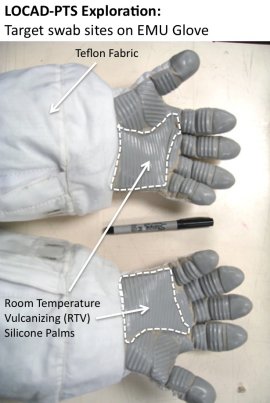
March 20, 2009: On March 19th, astronauts onboard the International Space Station checked themselves for microbes before stepping outside on a space walk. It was a first-ever test of planetary protection technology that, one day, could keep humans from contaminating the sands of Mars.

palms_med

“We conducted the tests using LOCAD-PTS, a miniature biological lab for space travelers,” explains Jake Maule, principal investigator for the experiment. LOCAD-PTS stands for Lab-On-A-Chip Application Development Portable Test System.

READ ON and see video

Kepler Mission Rockets to Space in Search of Other Earths

Above: Liftoff of the Delta II rocket carrying NASA's Kepler spacecraft. Image credit: NASA/Jack Pfaller

March 6, 2009: NASA’s Kepler mission successfully launched into space from Cape Canaveral Air Force Station, Fla., aboard a United Launch Alliance Delta II at 10:49 p.m. EST, Friday. Kepler is designed to find the first Earth-size planets orbiting stars at distances where water could pool on the planet’s surface. Liquid water is believed to be essential for the formation of life.

“It was a stunning launch,” said Kepler Project Manager James Fanson of NASA’s Jet Propulsion Laboratory in Pasadena, Calif. “Our team is thrilled to be a part of something so meaningful to the human race — Kepler will help us understand if our Earth is unique or if others like it are out there.”

READ ON

Blog at WordPress.com.

Up ↑