Search

band annie's Weblog

I have a parallel blog in French at http://anniebannie.net

Category

Saudi Arabia

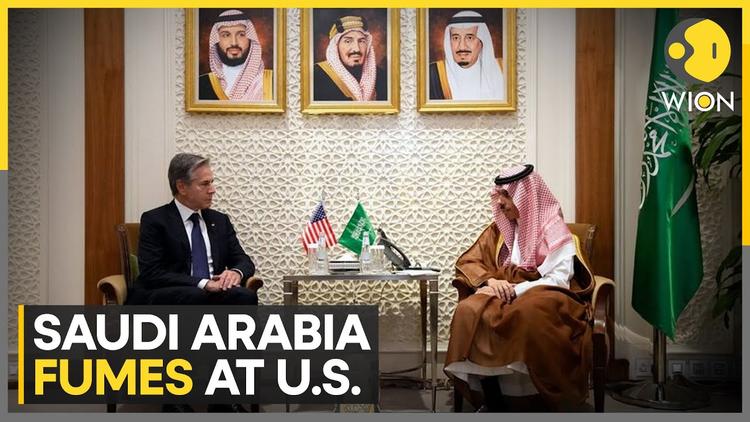
Saudis Contradict Blinken: Want Actual Palestinian State now, not Vague ‘Peace Process’

FARHANG JAHANPOUR 02/08/2024

Oxford (Special to Informed Comment; Feature) – On Tuesday afternoon (6 February 2024), U.S. Secretary of State Antony Blinken took part in a joint press conference with Qatari Prime Minister and Minister of Foreign Affairs Mohammed bin Abdulrahman Al Thani in Doha. The press conference was mainly about the war in Gaza and the possibility of a new pause in the fighting and exchange of hostages and prisoners.

However, Blinken was also asked about his recent meeting with the Saudi Crown Prince Mohammed bin Salman and the possibility of normalisation of relations between Saudi Arabia and Israel. Blinken said (as quoted by the US Department of State): “But with regard specifically to normalization, the crown prince reiterated Saudi Arabia’s strong interest in pursuing that. But he also made clear what he had said to me before, which is that in order to do that two things are required: an end to the conflict in Gaza and a clear, credible, time-bound path to the establishment of a Palestinian state.”

In other words, the Saudis are strongly in favour of normalisation but, in addition to ending the conflict in Gaza, they believe that there should be a “clear, credible, time-bound path to the establishment of a Palestinian state.” This paints a fairly rosy and optimistic picture of Israel-Saudi negotiations and the prospects for normalisation of relations.

Shortly after that press conference, the Saudi Ministry of Foreign Affairs issued a statement which puts the record straight and which seems to contradict the main thrust of what Blinken said. The difference between what Blinken said and what the statement of the Saudi Ministry of Foreign Affairs stresses is stark and revealing.

There has been a “clear, credible, time-bound path to the establishment of a Palestinian state” for the past 30 years, called the Oslo Accords. However, despite that process, which has been as long as a piece of string, the Israelis and especially Israeli Prime Minister Netanyahu have opposed it and prevented its implementation.

What the Saudis are clearly saying is that they are not happy with a similar process, but want to go back to the Saudi Plan for the establishment of a Palestinian state with East Jerusalem as its capital, as well as a reference to the Palestinian refugee problem and the right of the Palestinians to return to their occupied land.

That plan was adopted unanimously by all the members of the Arab League in 2002 at their summit in Beirut. Subsequently, it was also approved by all 57 states of the Organisation of Islamic Cooperation (formerly known as the Organisation of Islamic Conference) at a summit meeting that was held in Riyadh, including Iran which was represented by President Mahmud Ahmadinezhad. The Palestinian Authority led by Yasser Arafat immediately embraced the plan.

In 2015, Israeli Prime Minister Benjamin Netanyahu also expressed tentative support for the Initiative, but in 2018 he rejected it as a basis for future negotiations with the Palestinians. In his infamous speech at the United Nations’ General Assembly on 22 September 2023 in New York, he held a map of “The New Middle East”, with Palestine completely wiped out. The elimination of Palestinian territories from the map of the Middle East angered the Palestinians and was one of the reasons that led to the 7th October attack by Hamas militants on Israel. Since the start of the Gaza war, Netanyahu has emphatically opposed the establishment of a Palestinian state and has even said that it will reoccupy Gaza for the foreseeable future.

The statement by the Saudi Ministry of Foreign Affairs clearly shows that the Saudis are not happy with Israeli policies and that there will be no prospect of normalizing relations with Israel under the current circumstances.

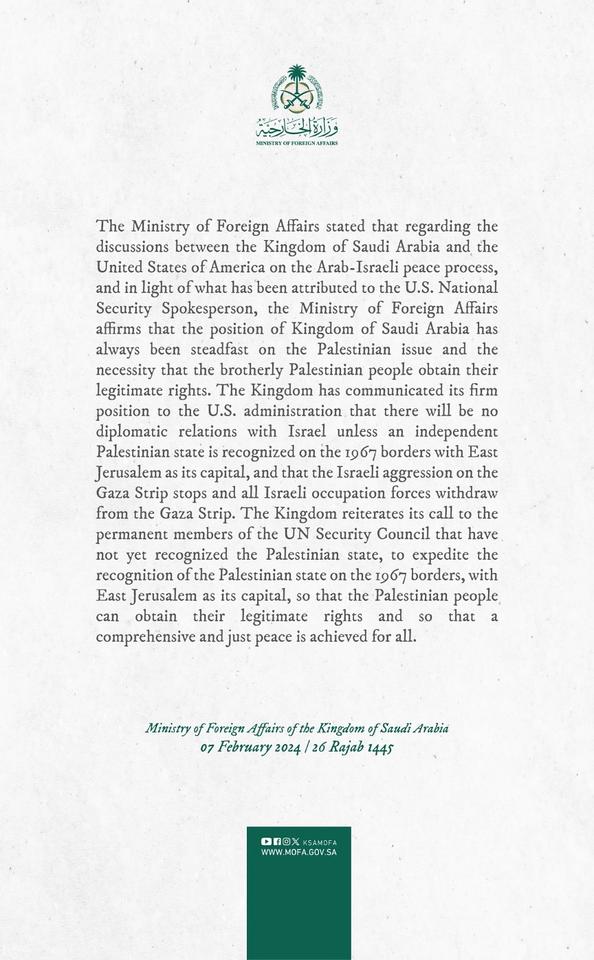
It states: “The Kingdom has communicated its firm position to the U.S. administration that there will be no diplomatic relations with Israel unless an independent Palestinian state is recognised on the 1967 borders with East Jerusalem as its capital, and that the Israeli aggression on the Gaza Strip stops and all the Israeli occupation forces withdraw from the Gaza Strip. The Kingdom reiterates its call to the permanent members of the UN Security Council that have not yet recognized the Palestinian state, to expedite the recognition of the Palestinian state on the 1967 borders, with East Jerusalem as its capital, so that the Palestinian people can obtain their legitimate rights and so that a comprehensive and just peace is achieved for all.”    

Video: “Saudi Arabia: No Israel ties without recognition of Palestinian state” | Latest English News | WION

Abraham Accords

Towards the end of the Trump Administration (between August 2020 and January 2021), a series of agreements were reached between the UAE, Bahrain, Morocco, Sudan and Israel to normalise their relations, which came to be known as the Abraham Accords. The ceremonies were held with great fanfare on the Truman Balcony of the White House, hosted by President Trump, flanked by Secretary of State Mike Pompeo and his son-in-law Jared Kushner, in order to give the impression that they represented major and historic peace agreements. It should be stressed that at least the first three countries on the list were not at war with Israel and in fact had covert cordial relations with her.

A close examination of the Abraham Accords shows that they were a series of cynical moves to bribe some Arab regimes to normalise relations with Israel by bypassing the Palestinians. Israel’s long-term plan to isolate and bypass the Palestinians by reaching agreements with Arab regimes outside the immediate neighbourhood was enthusiastically championed by Pompeo and Kushner, and behind them by Netanyahu.

The UAE wanted to buy some advanced US weapons, including F-35 fighter jets. They were promised that they would be able to buy them if they normalised relations with Israel. After doing so, the United States reneged because Congress opposed the sale of those sophisticated weapons to the UAE. Once the UAE decided to normalise relations with Israel, little Bahrain also decided to follow suit.

In 1993, Sudan was first added to the list of states that sponsored terrorism, but the overthrow of President Al-Bashir in April 2019 improved relations between Sudan and the United States and in December 2019 the two countries announced their intention to exchange ambassadors. Sudan’s Ambassador to the United States presented his credentials in September 2020.

US government promised to remove Sudan from the State Sponsor of Terrorism (SST) list if the Sudanese government agreed to normalise relations with Israel. Sudan agreed, and on 14 December 2000 the US Government removed Sudan from the SST list, just in time for Sudan to normalise her relations with Israel and to join the Abraham Accords. Of course, after the breakout of the latest civil war in Sudan between various army factions, the situation has gone from bad to worse.

There has been a long-lasting conflict between Morocco and the Polisario Front, backed by Algeria, about the ownership of the Western Sahara. Large parts of Western Sahara were controlled by the Moroccan Government and known as the Southern Provinces, whereas some 20% of the Western Sahara was controlled by the Sahrawi Arab Democratic Republic (SADR), the Polisario state with limited international recognition.

The United Nations officially considers Morocco and the Polisario Front as the main parties to the conflict and has called on them to reach a negotiated settlement. The Obama administration disassociated itself from the Moroccan autonomy plan in 2009 and put the option of an independent Western Sahara on the table. Clearly, the issue had to be settled by the UN negotiation through consultation with both sides. However, Trump unilaterally and illegally gifted the Sahara to Morocco if she normalised relations with Israel.

Then it was the turn of Saudi Arabia, which came under enormous pressure to normalise relations with Israel but, even before the events of 7th October, Saudi Arabia refused to join the Abraham Accords without the acceptance of the two-state solution by Israel. The latest statement by the Saudi Ministry of Foreign Affairs shows that Saudi normalisation of relations with Israel is dead in the water, at least for the time being.

Of course, genuine peace between Israel and the Arab states would be very Welcome, provided that it brought with it positive gains for both sides and was not at the expense of the Palestinians.

Instead of rejecting those phony agreements and pushing for some real and lasting solutions to the Arab-Israeli conflict, the Biden Administration supported those agreements and even pressured Saudi Arabia to join them. The realization of total US support, created a feeling of impunity among the Israeli right-wing government and was responsible for excessive demands by Netanyahu’s latest extreme right government, which contributed to the disastrous terrorist attack on 7th October and Israel’s indiscriminate war and genocide in Gaza.

Given the events of the past four months and the collective punishment that Israeli government has inflicted on Gaza and the West Bank, it would be highly unlikely that any Arab government would dare to normalise relations with Israel due to their fear of their own populations.

A Statement from the Ministry of Foreign Affairs regarding the discussions between the Kingdom of Saudi Arabia and the United States of America on the Arab-Israeli peace process:
Filed Under: FeaturedIsrael/ PalestineJoe BidenSaudi ArabiaUS Foreign Policy

Source : Informed Comment

Jamal Khashoggi: What the Arab world needs most is free expression

www.washingtonpost.com


Jamal Khashoggi (Illustration by Alex Fine for The Washington Post)

A note from Karen Attiah, Global Opinions editor

I received this column from Jamal Khashoggi’s translator and assistant the day after Jamal was reported missing in Istanbul. The Post held off publishing it because we hoped Jamal would come back to us so that he and I could edit it together. Now I have to accept: That is not going to happen. This is the last piece of his I will edit for The Post. This column perfectly captures his commitment and passion for freedom in the Arab world. A freedom he apparently gave his life for. I will be forever grateful he chose The Post as his final journalistic home one year ago and gave us the chance to work together.

I was recently online looking at the 2018 “Freedom in the World” report published by Freedom House and came to a grave realization. There is only one country in the Arab world that has been classified as “free.” That nation is Tunisia. Jordan, Morocco and Kuwait come second, with a classification of “partly free.” The rest of the countries in the Arab world are classified as “not free.”

As a result, Arabs living in these countries are either uninformed or misinformed. They are unable to adequately address, much less publicly discuss, matters that affect the region and their day-to-day lives. A state-run narrative dominates the public psyche, and while many do not believe it, a large majority of the population falls victim to this false narrative. Sadly, this situation is unlikely to change.

The Arab world was ripe with hope during the spring of 2011. Journalists, academics and the general population were brimming with expectations of a bright and free Arab society within their respective countries. They expected to be emancipated from the hegemony of their governments and the consistent interventions and censorship of information. These expectations were quickly shattered; these societies either fell back to the old status quo or faced even harsher conditions than before.

My dear friend, the prominent Saudi writer Saleh al-Shehi, wrote one of the most famous columns ever published in the Saudi press. He unfortunately is now serving an unwarranted five-year prison sentence for supposed comments contrary to the Saudi establishment. The Egyptian government’s seizure of the entire print run of a newspaper, al-Masry al Youm, did not enrage or provoke a reaction from colleagues. These actions no longer carry the consequence of a backlash from the international community. Instead, these actions may trigger condemnation quickly followed by silence.

As a result, Arab governments have been given free rein to continue silencing the media at an increasing rate. There was a time when journalists believed the Internet would liberate information from the censorship and control associated with print media. But these governments, whose very existence relies on the control of information, have aggressively blocked the Internet. They have also arrested local reporters and pressured advertisers to harm the revenue of specific publications.

There are a few oases that continue to embody the spirit of the Arab Spring. Qatar’s government continues to support international news coverage, in contrast to its neighbors’ efforts to uphold the control of information to support the “old Arab order.” Even in Tunisia and Kuwait, where the press is considered at least “partly free,” the media focuses on domestic issues but not issues faced by the greater Arab world. They are hesitant to provide a platform for journalists from Saudi Arabia, Egypt and Yemen. Even Lebanon, the Arab world’s crown jewel when it comes to press freedom, has fallen victim to the polarization and influence of pro-Iran Hezbollah.

The Arab world is facing its own version of an Iron Curtain, imposed not by external actors but through domestic forces vying for power. During the Cold War, Radio Free Europe, which grew over the years into a critical institution, played an important role in fostering and sustaining the hope of freedom. Arabs need something similar. In 1967, the New York Times and The Post took joint ownership of the International Herald Tribune newspaper, which went on to become a platform for voices from around the world.

My publication, The Post, has taken the initiative to translate many of my pieces and publish them in Arabic. For that, I am grateful. Arabs need to read in their own language so they can understand and discuss the various aspects and complications of democracy in the United States and the West. If an Egyptian reads an article exposing the actual cost of a construction project in Washington, then he or she would be able to better understand the implications of similar projects in his or her community.

The Arab world needs a modern version of the old transnational media so citizens can be informed about global events. More important, we need to provide a platform for Arab voices. We suffer from poverty, mismanagement and poor education. Through the creation of an independent international forum, isolated from the influence of nationalist governments spreading hate through propaganda, ordinary people in the Arab world would be able to address the structural problems their societies face.

Read Jamal Khashoggi’s columns for The Washington Post

Ali Mohammed al-Nimr : ‘If I die I’ve had a happy life’

‘If I die I’ve had a happy life’: Astonishing bravery of the boy who faces being beheaded then crucified in Saudi Arabia for taking part in protest when he was 17

  • Ali Mohammed al-Nimr arrested for participating in protest in Qatif in 2012
  • He will be beheaded and his body will be crucified in public for three days 
  • Source close to family said Ali, 21, remains optimistic in the face of death
  • They say government is making an example of Ali in wake of social unrest 

Ali Mohammed al-Nimr was, by all accounts, a regular 17-year-old boy who loved cars and hanging out with his friends when he was sentenced to death simply for protesting against Saudi Arabia’s government.

Any day now, he will be publicly beheaded and his body will be crucified and left to fester out in the open for three days despite worldwide condemnation.

Even in the face of certain death, a source close to his family told MailOnline he ‘has not lost hope’ of surviving this dreadful situation.

From inside his prison cell, the courageous activist told them: ‘I will get out. And if I die, I’ve lived a happy life.’

MailOnline’s source claimed the government is ‘making an example’ of Ali because of the actions of his uncle Sheikh Nimr al-Nimr, a Shi’ite cleric who was also sentenced to death for speaking out against them.

Capital punishment: Ali Mohammed al-Nimr (pictured) was arrested for taking part in an anti-government protest and sentenced to death in May 2014

Capital punishment: Ali Mohammed al-Nimr (pictured) was arrested for taking part in an anti-government protest and sentenced to death in May 2014

Courageous: Ali (pictured) will be beheaded and crucified any day now, but a source close to his family says the activist has 'not lost hope' that he will survive this ordeal

Courageous: Ali (pictured) will be beheaded and crucified any day now, but a source close to his family says the activist has ‘not lost hope’ that he will survive this ordeal

Missing him: Ali's father, who MailOnline's source has described as a 'broken man', tweeted this picture of Ali's brother and sister hugging a painting of him

Missing him: Ali’s father, who MailOnline’s source has described as a ‘broken man’, tweeted this picture of Ali’s brother and sister hugging a painting of him

Activist: The source believes the government is taking revenge on Ali because his uncle Sheikh Nimr al-Nimr (pictured wounded in the back of a police car after his arrest in 2012) who spoke out against them

Activist: The source believes the government is taking revenge on Ali because his uncle Sheikh Nimr al-Nimr (pictured wounded in the back of a police car after his arrest in 2012) who spoke out against them

Ali, now 21, was a high school student when he was arrested for taking part in a pro-democracy rally in the eastern governate of Qatif, where police brutally clamped down on demonstrators in 2012.

He was charged with attending the protest, teaching first aid to demonstrators, using his Blackberry phone to urge more people to join and possessing a gun – the only accusation his family strongly denies.

The country’s Specialised Criminal Court – which tries suspected terrorists and human rights activists – sentenced him to death in May 2014.

The decision was condemned by activists and human rights groups around the world, who argued he was being put to death for a crime he committed as a child and he was tortured into giving a false confession.

Despite facing an agonising wait to be yanked from his cell and beheaded by a state-sanctioned executioner, he remains incredibly stoic.

The source close to his family, who spoke to Ali over the phone, said: ‘He was so optimistic. He wasn’t scared. Even after he was given the death penalty, he never showed any fear.’

The lives of his family members, who live in constant fear that he will be executed at a moment’s notice, have been ripped apart by what they deem an act of vengeance.

‘They feel sad, they feel hopeless – helpless. They lie awake at night thinking about how he’s doing in prison, wondering if he is thinking about the death penalty,’ MailOnline’s source said.

‘His father is a very strong man but I can feel that he’s not acting normal any more – he is broken.

‘And his mother loves him so much. She says forget about it, don’t worry, but I can see that she is worried a lot. They are going to kill their child – nobody can handle that.’

Cruelty: MailOnline's source said Ali (pictured) was a regular 17-year-old boy who liked cars and hanging out with his friends when he was arrested and detained without trial in 2012

Cruelty: MailOnline's source said Ali (pictured) was a regular 17-year-old boy who liked cars and hanging out with his friends when he was arrested and detained without trial in 2012

Cruelty: MailOnline’s source said Ali (pictured) was a regular 17-year-old boy who liked cars and hanging out with his friends when he was arrested and detained without trial in 2012

Fearless: MailOnline's source said Ali (pictured) remains 'optimistic' even in the face of death, adding: 'Even after he was given the death penalty, he never showed any fear'

Fearless: MailOnline’s source said Ali (pictured) remains ‘optimistic’ even in the face of death, adding: ‘Even after he was given the death penalty, he never showed any fear’

Death penalty: A human rights group told MailOnline that the crucifixion sentence in Saudi Arabia entails beheading, then a public display of the body

Death penalty: A human rights group told MailOnline that the crucifixion sentence in Saudi Arabia entails beheading, then a public display of the body

Some family members cannot sleep at night because their thoughts are plagued by his impending death.

The source said: ‘They can’t stop thinking about Ali’s case. I think about what his mother and father must be feeling reading news articles that he’s going to be executed. This is their life – it’s ruined now.’

Ali once had a passion for photography and dreams of studying psychology when he finished high school.

He now only dreams of getting out of prison, the family source told MailOnline, adding: ‘The last time I spoke to him, he told me he was going to get out and continue his studies.

‘He doesn’t think about the death penalty or prison or the miserable life he has now – he just tries to get through to the next day.

‘Otherwise he said he’d be broken all day, just thinking about death. But if he thinks about the future, he’s going to live a happy life and he knows that.

There are fears that the Saudi government  ordered Ali’s arrest and killing because they wanted to take revenge on his activist uncle, Sheikh Nimr al-Nimr.

He was sentenced to death last year for disobeying the ruler, inciting sectarian strife and ‘encouraging, leading and participating in demonstrations’.

Policemen shot and wounded Sheikh al-Nimr, a vocal critic of the ‘harassment’ of Shi’ite Muslims, during his arrest in July 2012.

The evidence of the charges against him came from religious sermons and interviews attributed to the cleric but Amnesty International claimed he was ‘exercising his right to free expression and was not inciting violence’.

Renowned: ASaudi anti-government protester carries a poster with the image of jailed Shiite cleric, and Ali’s uncle, Sheikh Nimr al-Nimr

Revenge: There are fears that the Saudi government ordered Ali's (pictured) arrest and killing because they wanted to take revenge on his activist uncle, Sheikh Nimr al-Nimr

Revenge: There are fears that the Saudi government ordered Ali’s (pictured) arrest and killing because they wanted to take revenge on his activist uncle, Sheikh Nimr al-Nimr

MailOnline’s source said: He [Sheikh al-Nimr] didn’t kill anyone, he didn’t hurt anyone, he just did and said what all the other Saudis were thinking. We were all afraid, but he said it.

‘He would tell people, you should not be scared of the government, they should be scared of us.

‘If you say anything about freedom, say anything against them [Saudi government], they want revenge. This is not the way governments should treat people.’

Ali’s impending execution has been met with global outrage. France and the United Nations have ordered Saudi Arabia not to kill him and Labour party leader Jeremy Corbyn has urged Prime Minister David Cameron to intervene.

Many argued that he should not be executed for an alleged crime he committed when he was just 17, and legally considered a child.

Human rights groups also argued that his lawyers were denied access to evidence and that the final appeal against his execution took place in secret and without his knowledge.

A Change.org petition calling for a stop to the crucifixion has gained 12,000 signatures, another one started by human rights group Reprieve has nearly 14,000 and one urging UK’s government to put pressure on the Saudis has around 3,500.

United Nations experts on arbitrary executions, torture and child rights have urged Saudi Arabia to halt the execution – saying ‘confessions obtained under torture cannot be used as evidence’.

They said Saudi Arabia has executed 134 people this year, which is already 44 more than the total for the whole of 2014.

Anger: A Bahraini protester carries a lit palm branch during clashes with riot police following a protest against the death sentence of Sheikh Nimr al-Nimr in October 2014

Anger: A Bahraini protester carries a lit palm branch during clashes with riot police following a protest against the death sentence of Sheikh Nimr al-Nimr in October 2014

In a joint statement, the experts said: ‘Such a surge in executions in the country makes Saudi Arabia a sad exception in a world where States are increasingly moving away from the death penalty.’

The experts also said imposing the death penalty on children violates the UN Convention on the Rights of the Child, which Saudi Arabia signed up to.

Finally, they said: ‘Al-Nimr did not receive a fair trial and his lawyer was not allowed to properly assist him and was prevented from accessing the case file.

‘We call upon the Saudi authorities to ensure a fair retrial of Ali Mohammed al-Nimr, and to immediately halt the scheduled execution.’

Maya Foa, head of the death penalty team at Reprieve, told MailOnline: ‘The Saudi government’s plans to “crucify” Ali al-Nimr are nothing short of an outrage.

‘He was imprisoned, tortured into a bogus “confession”, denied access to a lawyer and sentenced to death by crucifixion.

She called on countries like the UK and United States, who are allies of Saudi Arabia, to intervene to ‘save his life’ and urged Britain’s Ministry of Justice to withdraw its bid to provide ‘services’ to the Saudi prison system.

Reprieve told MailOnline that the crucifixion sentence in modern Saudi Arabia entails beheading and then publicly displaying the body.

A spokesman said: ‘The sentence is actually quite unusual, even for Saudi Arabia, particularly given the lack of any real evidence against Ali.’

Read more: http://www.dailymail.co.uk/news/article-3253285/If-die-ve-happy-life-Astonishing-bravery-boy-faces-beheaded-crucified-Saudi-Arabia-taking-protest-17.html#ixzz3nIDiD98g 
Follow us: @MailOnline on Twitter | DailyMail on Facebook

Blog at WordPress.com.

Up ↑