Search

band annie's Weblog

I have a parallel blog in French at http://anniebannie.net

Category

Revolution

Syria Top Goon: Diaries of a Little Dictator

571. Tara said:

Aboud was the first who cones the name Besho.  The name is going regional

http://www.cbsnews.com/8301-503543_162-57341297-503543/top-goon-puppet-show-takes-aim-at-syrias-assad/

Puppet characters from “Top Goon: Diaries of a Little Dictator.” Syrian President Bashar Al-Assad is on the right. (Credit: Masasit Mati) This post originally appeared on Global Post. It was written by Hugh Macleod and Annasofie Flamand.
BEIRUT, Lebanon – The whip cracks against the prisoner’s back as the man with the moustache and the military uniform repeats his accusation: “You want freedom, right? Freedom?”

The whip comes down again and the prisoner punches the wall in pain.

“What kind of freedom is it you want?” demands the torturer. The freedom the puppet protester seeks, he tells his torturer, is “one where you and I wouldn’t be here. You’d be with your kids and I’d be with my family.”

And then a reply that explains why this small scene from a series of dramatic vignettes played out by finger puppets is among the boldest works of art to have grown out of the unprecedented upheaval in Syrian society.

“You bastard!” retorts the man from Assad’s security services. “I am here because of you.” But the protester has understood the paradox: “You are here because you are not free,” he says. “You are imprisoned just like me. I’ll leave prison in a month or two. But you’ll stay here. Because you are afraid to take your freedom.”

Since its launch on YouTube two weeks ago, the series, “Top Goon: Diaries of a Little Dictator,” has received more than 40,000 views and garnered lavish praise and occasional furious outbursts from audiences stunned by its unprecedented and very personal lampooning of Syria’s struggling president, Bashar al-Assad. And, importantly for the country’s increasingly polarized society, by its refusal to indulge in easy answers.

In a Syria divided between regime and opposition, between mainly Sunni Muslim protesters and the Allawite Shiite Muslims who dominate Assad’s security services, between aggressor and victim, the perspective presented in this upcoming episode of Syrian theater group Masasit Mati’s groundbreaking drama is a rejection of black and white views.

The shabih, or pro-Assad thug, is seen not simply as the oppressor — though he most clearly is that — but also as another kind of victim of the regime, while the protester, though enduring a whipping, is by no means simply a victim, but rather a figure of strength, as he says, “a free Syrian who refuses humiliation.”

“The idea for this dialogue came from a real life example,” Jamil, Masasit Mati’s director told GlobalPost, which was shown a preview of the seventh episode of the series, due for release on Sunday.

“But it was actually the other way around: A friend of ours was in prison and heard the interrogator telling a prisoner, ‘Why are you doing this to us? You are forcing us to stay here. You are imprisoning us.’ We wanted to say that even the shabiha are brought up like slaves to serve the regime.”

A collaboration between a group of 10 artists from inside Syria and named after the straw used to drink mati, a herbal tea popular among Syrians who sip it over lengthy conversation, Jamil said the aim of Top Goon’s finger puppets was to bolster audiences in the best tradition of black comedy, even as blood continues to be spilled in the regime’s unrelenting crackdown on pro-democracy protesters.

“Comedy strips things bare and gives you the strength to fight. Of course, with black comedy the laughter gets stuck in your throat. It makes you laugh and cry at same time,” Jamil said. “But we will not allow the regime to turn us into victims that just cry and stay at home all the time.”

The emergence of Masasit Mati’s series comes amid a critical stage in what the International Crisis Group aptly describes as Syria’s “slow motion revolution,” by far the most drawn out of this year’s Arab uprisings.

The United Nations now estimates at least 4,000 Syrians have been killed since the crackdown began in mid-March, but human rights group Avaaz, which has researchers inside Syria, says it has registered more than 6,500 killed, with at least 20,000 arrested or disappeared, including last week a high profile 30-year-old female blogger, Razan Ghazzawi.

In a report released last month, Human Rights Watch said the regime’s crackdown against civilians in the central city of Homs, including systematic torture, constitutes crimes against humanity.

Last week Avaaz reported the kidnap of 14 Sunnis, including six women, in Homs as they traveled by bus near an Allawite neighborhood, with a senior Western diplomat in Damascus warning a sectarian war in the city is already underway.

Finding ways to make its largely Syrian audience laugh amid all the bloodshed and violence is no mean feat, but Masasit Mati has tapped a rich vein of satire in its portrayal of Syria’s president.

Bashar, or Beeshu — a kind of baby name he is known by in the series — swings wildly between the character of a child suffering attention deficit disorder and the spoiled autocrat in his nightcap, comforted to sleep by his most trusted thug, in the episode Bishou’s Nightmares.

“The regime has fallen,” cries Beeshu, waking from his nightmare as his shabih opens fire on unseen opponents. “Shabih you moron!” screams Syria’s dictator. “It was only in my dream!”

Later Beeshu is seen flying into a rage on a game show, Who Wants to Kill a Million?, angered that his assertion of crushing the protesters is not the right final answer. Later his son and daughter challenge him over the killing of Syrian children and he responds by calling on his goon to put down this domestic uprising.

“We only kill our own people, but on the Golan Heights [Syrian territory occupied by Israel] we are a peaceful army,” Beeshu assures his audience during the episode, Talk Show, modelled on a famous talk show on Al Jazeera.

The direct and confrontational story lines, seeking to expose the lies by which the Assad regime has depicted its 41-year dictatorship as the choice of the Syrian people and a sacrifice in the name of Palestinian freedom from Israeli occupation, has won Masasit Mati rave reviews.

“It’s so good it’s driving me crazy,” posted one fan on the group’s Facebook wall. “I want to see a Masasit Mati TV station.” “It’s very good work and we watch it with our kids,” posted another, adding irreverently: “All we want to know is which finger you put Bashar on.”

Not everybody has greeted the series with such acclaim, however. Among the outpourings of praise, a few viewers have taken deep offense and posted threats that are unpublishable but tend to center on sexual violence against the mothers and sisters of Masasit Mati’s members.

“It’s kind of obvious it comes from the security apparatus,” said Jamil, who uses a pseudonym and did not wish to reveal his whereabouts.

The threat to the safety of those who would ridicule Syria’s president in words or pictures is all too serious. In July, a man identified as Ibrahim Kashoush was found with his throat slit in Hama after leading carnival-like street songs ridiculing the president.

A month later masked gunmen attacked Syria’s best known political cartoonist days after he published a cartoon showing Assad hitching a lift out of town with Libyan dictator Muammar Gaddafi. The attackers fractured Farzat’s arm, left him with a black eye and symbolically broke two of his fingers.

In the Top Goon series, the voice of Bishou mimics the president’s lisping pronunciation of the letter S and shows the president giggling inappropriately and telling bad jokes while delivering rambling speeches on reforms, such as the Law of Gravity that he says will put an end to the so-called ‘flying protests’ — spontaneous and short demonstrations by the opposition.

The series got an unexpected boost last week with the broadcast of an interview with Assad on US network ABC in which the president denied all responsibility for the killing of protesters, telling ABC’s Barbara Walters that Syria’s security forces “are not my forces,” despite, as president, he is constitutionally sitting as commander of all Syria’s armed forces.

“We don’t kill our people,” Assad said. “No government in the world kills its people, unless it’s led by a crazy person. Most of the people that have been killed are supporters of the government.”

“We used to worry that people outside Syria might think the things we show in Top Goon are exaggerated,” Jamil said. “But after we saw Assad’s interview we decided to run it on its own as episode five and a half because the interview was more comic than we could have imagined. We didn’t even have to make something up.”
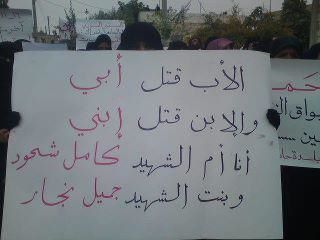
Liberté “Liberty” – Syrian story simply put in a creative way – Free Syria

[youtube http://youtu.be/upAYUCyy8KA?]

A family of martyrs

“The FATHER killed my father.
The SON killed my son.
I am the mother of martyr Kamel Shahoud,
and the daughter of martyr Jameel Najjar”

(12.09.2011) Nemer | Daraa | Large protests in support of Homs, Friday of “Strike For Dignity”

[youtube http://youtu.be/PRjvLj0-Wqk?]

Syria

Heroic Tahrir

Must listen; impressive determination and courage. Click on image

Listen also to this Battlefield America: U.S. Citizens Face Indefinite Military Detention in Defense Bill Before Senate

To Bashar: It is the People, Stupid…

“She complained to me that she was beaten and sexually assaulted by Central Security Forces,” Mr. Jaffar said. “But what did she expect would happen? She was in the middle of the streets, in the midst of clashes, with no press card or form of ID. The press center had not given her permission to be in the streets as a journalist. The country is in a sensitive situation. We are under threat. She could be a spy for all we know.”


Col. Islam Jaffar of the Egyptian Security Forces, acknowledging Egyptian-American journalist’s Mona Eltahawy accusation. (NYT November 25, 2011).

In his brief, maddeningly callous statement Col. Jaffar’s, epitomize all that is wrong and despicable in the Autocratic regimes of the Arab world. The overarching premise of all those regimes is that the average citizen is nothing more than a cog in a machine of the state serving strictly the interests of those in power. And when those cogs show signs of life and refuse to be simple inanimate objects, the leaders elevate them from inanimate objects to despicable subhuman creatures, rats (Gaddafi) or germs (Bashar), to be subjected to immediate extermination. Even when the citizens are occasionally allowed to assume human forms, they are, at the slightest hint of dissent, labeled as traitors and thus deserving the harshest of punishment. And so it is in Syria where the regime sends out it’s media “shabeeha” (thugs) to declare on the air that all who go against the eternal president of Syria are traitors who deserve to die.

It is the lowly policemen or security men who beat and groped Mona and have abused and killed hundreds of other unarmed protesters in Egypt. The same holds true of the killing and mistreatment of protesters in Syria, Yemen, Bahrain and Saudi Arabia. The real guilt, however, lies squarely on shoulders of the likes of Col. Jaffar and his superiors who in their words and actions encourage and excuse the behavior of their subordinates. Ultimately, General Tantawi is directly responsible for the recent deaths and abuse in Tahrir square as is Bashar Al Assad responsible for the thousands of deaths, disappearances, detentions and abuse of prisoners perpetrated by the forces he ultimately commands.

Before any of the niceties of democratic governance, the citizens of the Arab world urgently need and deserve a much more basic human right: the right to be treated with dignity and respect. It is the lack of this fundamental right that has ignited the Arab uprisings and it is the unrelenting daily toll of deaths and abuse that fans the flames of rebellion. In the United States, the pepper spraying of Occupy protesters sparked outrage and was relentlessly covered by the media for a week, the video of the incident replayed (in slo mo) ad nauseum. Meanwhile, after a week of mayhem and the killing of forty one protesters, all the Egyptian government can come up with is a lame apology, quickly negated by statements similar to that of Col. Jaffar. The Bahraini government, to its credit, and without excusing any of its past and ongoing transgressions, appointed an independent commission and actually allowed it to publicly present damning evidence of abuse and torture by government forces. This is the first step towards transparency and accountability.

We will not see such transparency any time soon in Syria under the leadership of a very myopic eye doctor in chief. Bashar and his propaganda machine, in complete denial, continue to lament the loss of life of the abusers never seeming to care about the abused, his own citizens. The heart wrenching lament of a middle aged Syrian protester who appears on one of the hundreds of Youtube videos sums it up best: His voice trembling and on the verge of tears he cries out “I am not an animal, I am not an animal! I am a human being!” and pointing to all the people around him he adds “we are all human beings and deserve to be treated like human beings”. It is a very simple and very basic request and it this demand for dignity and respect that is at the heart of all the popular uprising from Tunisia to Bahrain.

And so to president Bashar Al Assad I say: “It is the people, stupid!”. It is not about salafists, or terrorists or imperialist designs…. It is not about secterianism or the Hariri-KSA-Zionist plot… It is not about pan-Arabism or resistance or Baathist ideals. It is about about the people asking for their most basic rights.

Posted by Abu Kareem at 11:08 AM

Besieged Homs: Carving Freedom With Our Blood

 November 24, 2011  |

Today, the Syrian revolution has spread far across the country, but one city stands out from amongst the rest. The besieged city of Homs is not only central to the Syrian uprising, but as one who calls Homs home, it is central to my life.

The Homs I knew was the safest place you could visit. A city I would spend my summers eating shawarmas late into the night, going from wedding to wedding, and walking up and down share’ al-mal’ab. Life was sweet but simple. The only fear we ever had growing up on our holidays in Syria was if we slipped up and spoke Assad’s name. We dared not speak of, or about him. It was simple. To live freely you had to play by the rules, conform and act as though you worshipped the president.

But is that really living in freedom? The fear of Assad’s regime is not something that came about eight months ago when the revolution began; rather it is something that has been instilled in every single Syrian since infancy. It is only now that the world is witnessing the brutality of Assad’s regime, as he massacres and tortures before our very eyes. We see brave men risking their lives, risking everything, to march through the streets; their voices and demands for freedom echoing and resonating through the city. Syrian men are shielded with an armour of bravery, forged by a trust in God. That is all they have. A faith in God, with hope and determination that this revolution will continue until it sees the only way out – a free Syria.

So what can we say about the thousands that claim to support Assad? I could fit any Assad supporter into one of four categories.

The first is personal benefit, because the success of many Syrians, if not all, is in some way or other tied down to the government. The rule in this sick game is that you cannot succeed without Assad and his cronies. These people support Assad because they believe that going against him means losing everything they own.

The second is fear and pressure. Having seen what Assad and his thugs have done, having heard of and witnessed the barbaric torture being implemented, it is only reasonable to expect that many will fear for themselves. For such reasons, many act as though they love Mr. President, to remain as far and safe as possible from any torment coming their way. Furthermore, many people are coerced and pressured by security forces to attend pro-government protests, threatened with torture, losing their jobs, or even their lives if they do not attend – they have little choice but to comply.

The third is ignorance. When I was in Damascus a few months ago, I met so many people who went on these marches, blinded by the propaganda. I recall a lady telling me not to believe the lies I saw in the news, that it was all a façade and that the blood we see dripping from people on-screen is actually ketchup. It was the most absurd thing I had ever heard but some Syrians, despite seeing such footage of torture, were adamant that this was all some kind of minority plot against Assad to cause trouble. Denial is what these people were so engrossed in, but I guarantee today, four months on, their views will have drastically changed.

And finally, the fourth reason is a lack of conscience. I include this because I would personally question the moral conscience of anyone that decides to side with a murderer; a cold-blooded murderer, responsible for the death of thousands and carrying the blood of every Syrian martyr. My cousin in Homs once said, “we are carving the word ‘freedom’ with our blood” – and as sickening and heart breaking as this is, it is so very true.

Today, my family and any Homsi will tell you that they are living in a prison. I was on the phone to one of my cousins recently and her entire family was huddled together in their parents’ bedroom. They took shelter away from their windows to avoid stray bullets. I wept as she reassured me that this had become the norm; the image of my relatives hiding in their own home haunts me to this day. I write this article for my family, for those abducted and tortured, for those who continue to fight and, most importantly, to remember the thousands that have lost their lives: Hakam Draak Al-Sibai, Hadee Al-Jendi, Rami Fakhouri, Hamza Al-Khateeb, to name but a few.

As I sit here, observing the brutality and destruction being wreaked upon the innocent citizens of Syria, I am positive and hopeful that these lives have not been lost in vain. I am a British Syrian woman, and I firmly stand against Assad and his regime. Anything corrupt is destined to crumble. It is only a matter of time before Syria joins Tunisia and Libya, in freedom.

source

After Syria’s year of revolution, the end of Assad is in sight | Rana Kabbani

 The Syrians have suffered a litany of horrors. Their resistance to Assad’s regime will stand as an exemplar of human courage

Rana Kabbani · 21/11/2011 · guardian.co.uk

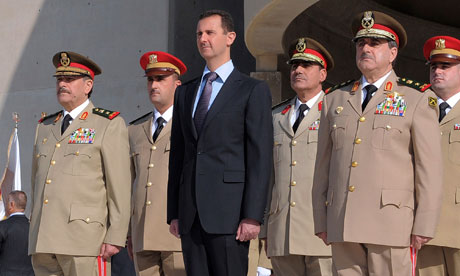
Bashar Assad and Syrian generals at a ceremony to mark the 38th anniversary of the October 1973 Arab-Israeli war. Photograph: Ho/APBashar Assad and Syrian generals at a ceremony to mark the 38th anniversary of the October 1973 Arab-Israeli war. Photograph: Ho/AP

‘Be careful what you wish for” will be scribbled on the totalitarian tombstone of the Assad regime. For eight months Bashar has squirmed to justify abominable crimes against peaceful protesters calling for long-overdue reform by obsessively rehashing that he is at war with “armed gangs”. These “bugs” were out to punish him for his “steadfast stance”, he announced to that zoo of appointees that goes by the brazen misnomer of parliament. His official media then went into overdrive as there was a lot to cover up, since mass graves were being uncovered with women and babies in them.

We Syrians have been witness to everything ghoulish in this year of our revolution, which is set to stand as one of history’s rousing exemplars of human courage. The castration of children, and the pulling out of their fingernails; hospitals, schools and football stadiums used to incarcerate more than 60,000 people, as the vast Hades of Assad’s prison system – always standing room only – quickly became packed beyond its own elastic limits; the profiteering of Assad’s shabiha (armed gangs) from a trail of thievery, torture and mayhem; trade in the organs of prisoners; the besieging and communal punishment of entire towns and cities; scorched-earth tactics in the countryside; bombardment of our coastline towns with naval gunships; the use of military planes to shell our inland cities; armoured tanks that are commanded to raze entire neighbourhoods; brutal house-to-house searches to harvest our young men and women; and the outrageous use of municipality rubbish trucks to collect their dear corpses.

As I watch the city of Homs (where many of my school friends have been bombed in their gracious homes or killed in a Syrian city renowned for its fabulous sense of humour and its delicious cheese kunafa) turned into a latter-day Grozny, I curse Vladimir Putin, the Russian leader, for helping in its wanton destruction, as he uses his veto to protect murderers, and supplies submarines and state-of-the-art weapons to kill yet more innocent Syrians. We Syrians recognise the type only too well. Vainglorious, brooking no dissent, buoyed up by financial mafias and laying on putrid cold war rhetoric, which leaves us even colder.

Even the affluent neighbourhoods of Damascus are trembling from the onset of winter, because heating fuel has become as scarce as freedom; the regime’s thugs have monopolised its use and are hoarding it, to give the soft, conservative capital a small taste of the discomforts and disasters for which it should brace itself if it joins the rest of the country in revolt – which it is already doing. Rebellious Mu’adamiyya on the outskirts of Damascus, where most of the city’s day labour comes from, has had no electricity or fuel for months, and has seen its impoverished houses emptied of their menfolk, as they are rounded up and taken away to join the 40,000 disappeared or 4,600 dead across the country.

I, for one, can remember a Syria where we bought lupins or myrrh incense or green almonds in our sublime ancient souks, unbothered by the big brother stare of endless Assads; a Syria where religion was still safely lodged in the house where it belonged, along with the wine-coloured prayer rug, the amber rosary and the manuscript Qur’an on its mussadaf stand. A Syria before Jamil Assad – Bashar’s uncle – allowed Iranian officials to enter our borders gleefully with their sackfuls of cash to recompense conversions.

In our recent misery, we have seen Revolutionary Guards aiding and abetting Assad’s torturers and snipers, and Iranian oil and money – needed far more in Iran by its long-suffering people who, like us, must bear the keen whip of totalitarianism and the innumerable privations of grave economic crisis – flowing in to succour Tehran’s political extension in Damascus. A military airport has sprung up on our Syrian coast, financed by Iran, to ease the flying in of those who would sow sectarian discord and hatred by such methods.

The consequences of 40 years of the policies of Hafez al-Assad and then his son Bashar – which turned our national army into a sectarian mafia family’s private militia, and our state’s coffers into that family’s piggy bank to be raided at whim – have been the tit-for-tat sectarian crime that has so revolted the vast majority of Syrians, who have seen post-occupation Iraq martyred by sectarian killing fields, and the government of Lebanon become hostage to an armed state within a state.

As rumours fly around that Bashar has been offered asylum by the UAE, and has allegedly bought property in Dubai for $60m to live in, we see the end in sight for the “banality of evil”. It’s been a long and painful time coming.

source

Blog at WordPress.com.

Up ↑