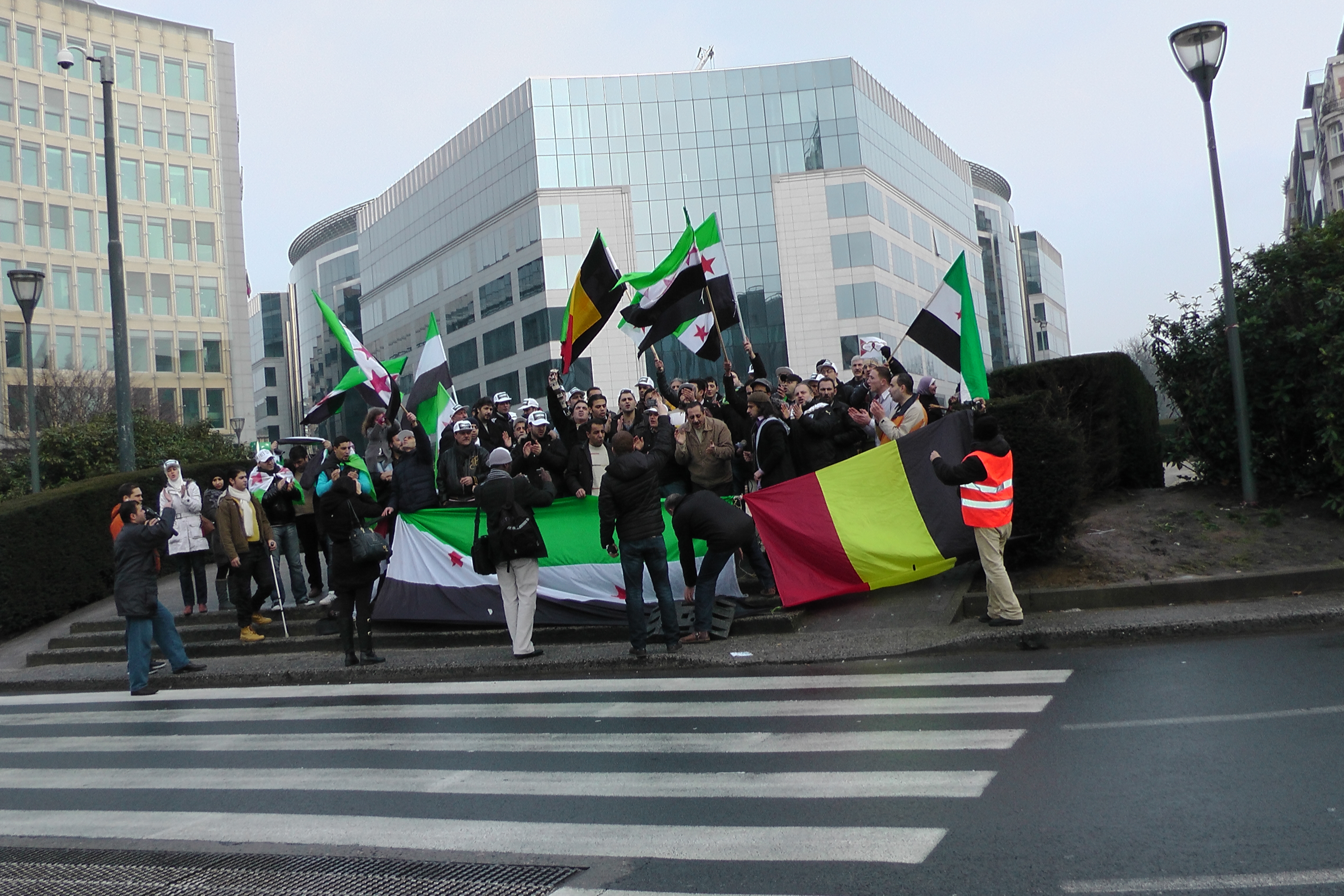
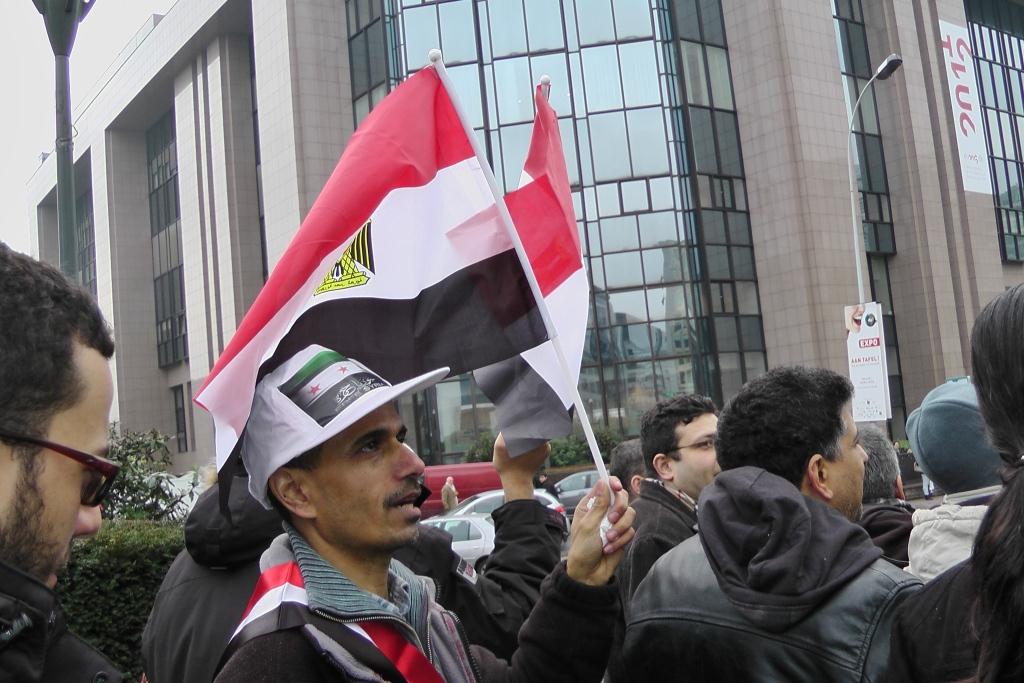
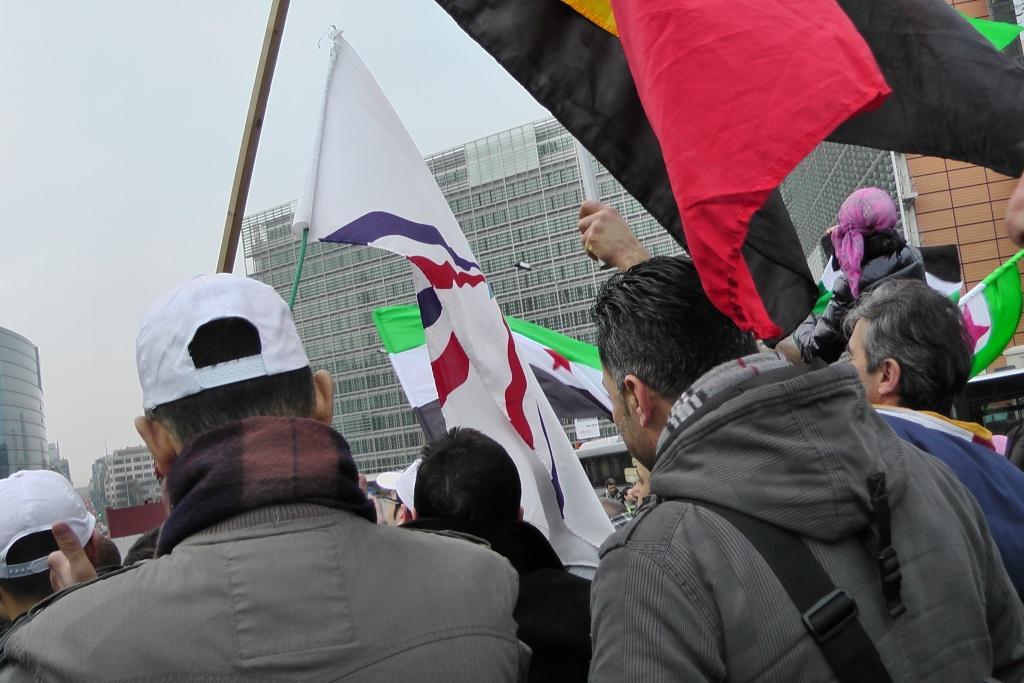
Funeral at Mezze (Damascus) yesterday , 18/02/11
See this also here : http://www.ustream.tv/channel/kafarsousah1 at Mezze
an arrest and guess what is expecting him in jail ?
If Mezzeh, Duma, Daraya, Jdeidet Artuz, Zamalqa, Harasta, Arbeen, Barze, Tadamoun are waking up, what remains with the regime?
Only Jaramana, Old Town, Abbassiin, Abu Rumaneh and Malki. And of course the MOUKHABARAAT and SHABBIHA.
This caricature from Aamouda in Syria is one of the smartest, if not the smartest caricature I have ever seen from and/or about the Syrian revolution: A drilling rig trying to reach the sea of the freedom at the bottom, drills through the different layers above it.
Making the way to the bottom, is powered by the red blood tank in the machine. This street art is better than any analysis in any article…
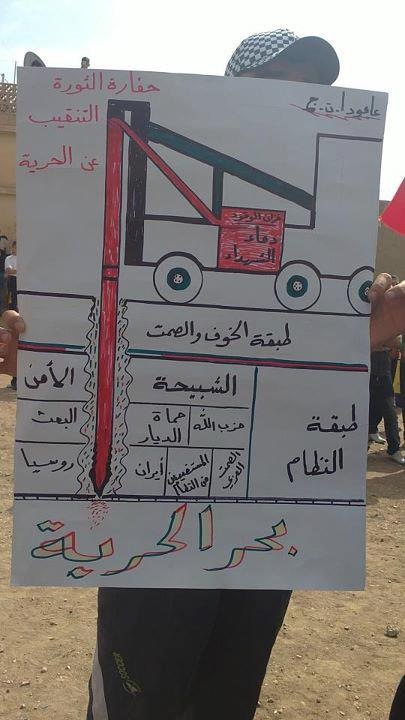
source : http://lebanonspring.com/2012/02/13/caricature-of-day-a-smart-one-fromabout-the-syrian-revolution-regime/
Posted By Nate Wright  Friday, January 20, 2012 – 1:27 PM
  Share
Share

On the top floor of a towering apartment block in Cairo, half a dozen Syrian activists are hunched over their laptops. Each man organized demonstrations in his home town before escaping the Assad regime’s intelligence agents in the last few months. Now, armed with a list of trusted contacts that stretches across the borders from southwest Syria to Lebanon and Jordan, they have become a key link in the supply chain of an opposition movement that is struggling to outmaneuver a brutal crackdown. Donations collected from Syrians and well-wishers in Cairo are used to purchase cell phones, satellite communications equipment, medicine, and money, which is smuggled to friends and family members on the inside. In turn, protesters send out video evidence of attacks, which the men in Cairo catalogue, upload to YouTube, and forward to media outlets.
The men work with close contacts in their own villages and neighborhoods, independently of organizing committees or opposition bodies. Abdel Youssef fled from Ad Dumayr, a city northeast of Damascus. Syrian authorities went door to door there searching for military defectors on Wednesday night and he spent the day following their movements through eyewitness accounts. As he tells the story of how he fled, a Skype window flashes up on his screen. A woman he knows tells him that security forces attempting to arrest a man have captured his daughter instead. “Now I’m looking out the window,” the message reads. “She is being beaten up by the security forces because she is saying ‘Allahu Akhbar’.” Abdel Youssef passes on information like this to a contact in the Free Syrian Army, who he says use this information to block roads and set up ambushes in an attempt to protect demonstrations.
“In our area, the Free Syrian Army is very well organized,” says Abdel Youssef, who acts as a communications hub for demonstrators in his city. He knows the location of the seven government roadblocks in Ad Dumayr. In one video, a friend holds up a pad of paper with the names and birth dates of those killed so that family members can claim the bodies.
He forwards his information to Omar Idlibi, a spokesman for the Syrian National Council, as well as international media outlets. But he works independently. Like the other activists in this safe house, six men in their 20s and 30s when I visited, Abdel Youssef only coordinates with his city. Abdel Rahman, from Damascus, works with his neighborhood and Omar, from Yabroodi, is in touch with his friends. All three gave only their first names to protect family members still in the country. Wary of people they don’t know and unimpressed with the politicians talking shop in Turkey, they work around the clock on the regional logistics of localized resistance. “I know about Damascus. Others know about other places,” said Abdel Rahman. “When we come together we know about everywhere in Syria.”
Turkey remains the political center for the opposition in exile, but Cairo is emerging as a vital logistical hub for the supply of dissidents within Syria and the dissemination of videos emerging from the country. They have come to Cairo for many reasons. As Foreign Policy reported in November, Assad’s allies are hunting Syrians in Lebanon. In Istanbul, activists say the Turkish intelligence wants to sign off on any political activities. “Because I am Syrian, the Turkish government wanted to know everything I did,” said Abdel Rahman, who flew to Istanbul before coming to Cairo. He pointed to the men with him in the safe house: “We couldn’t do this in Turkey.”
Syrian intelligence operatives are keeping a low profile here, but activists are not taking any chances. In November, the wife of Syrian television presenter, Thaer al-Nashef, was kidnapped in Cairo. He received text messages threatening to slit her throat and throw her in the Nile. She was later dumped, bruised but alive, in the street. When Syrian MP Emad Ghalioun arrived in Cairo, Akram Abdel Dayam took four cars to pick him up and drove through back streets to see if he was being followed. “Syrian intelligence is here, but it’s not as extreme,” said Rami Jarrah, a Syrian activist who spoke to journalists under the pseudonym Alexander Page before he fled to Cairo.
The promise of safety, cheap prices, and a supportive local population that cheered on Syria’s revolution after ousting their own president in February, make Cairo an attractive destination for opposition members able to reach the country. With no land borders, activists are flying in and getting visas at the airport. Those who escaped without passports, like military defectors, are forced to go to elsewhere and most head to Turkey, according to Jarrah.
The Syrian National Council has noticed. Lina Tibi, a press officer working with the Council in Cairo, hopes to have a media center up and running in the city next week. Burhan Ghalioun, who heads the Council, flew in on Friday to meet with Secretary General of the Arab League, Nabil al-Araby, a day before the League meets to discuss the results of its monitoring mission in Syria. “We are here in Cairo because the Arab League is here,” said Walid al-Bunni, the Syrian National Council’s director of foreign affairs.
While Syria’s opposition struggles to form a united front, most of the coordination with activists inside the country is happening through small, ad-hoc command and control centers like the safe house where Abdel Rahman, Abdel Youssef, and Omar live and work. Toby Cadman, a British lawyer engaged by the Syrian Emergency Task Force, has been working with activists to document crimes committed in Syria. He hopes to build a case to bring to the International Criminal Court. “The activists in Cairo have been extremely influential in this process,”he said. “A lot of what I obtain comes directly or indirectly from Cairo.”
Jarrah, who is not connected to the activists in the safe house, says weapon smuggling into Syria has already begun. But Omar insists his group is holding off on supplying arms, for now. “As soon as the Free Syrian Army was created, it began communicating with the local coordinating communities,” he said. “The Syrian National Council does nothing. It is all the local councils.” Abdel Youssef, Abdel Rahman, and Omar agreed that their patience was wearing thin. “If no one from the outside helps, if the Arab League keeps giving [Assad] time, then we will arm ourselves,” said Abdel Rahman. They say that March 15th, a year from the first major demonstrations in Daraa, is their deadline. “There will be a war if he has not stepped down by the anniversary of the revolution.”
Nate Wright is a journalist in Cairo. He writes for the Times of London and Middle East Report. Read his blog at www.themelian.com and follow him on Twitter at @nwjourno.
We must admit, this is the Syrian people’s finest hour. It is not our finest hour.
By Aner Shalev
What is the red line that if crossed will make the world say, Enough? If Syrian blood is so cheap, perhaps the injuring of Arab League observers is a red line? Or mortar fired directly at a group of foreign correspondents and the death of a French journalist? What is the exchange rate for the blood of different nationalities?
 |
Syrian protesters marching in Homs in late December. A heroic uprising that Israel hopes will fail. |
| Photo by: Reuters |
Of all the revolutions in the Arab world, the Syrian uprising is depicted as being the most impressive and heroic. In Tunisia and Egypt, the army sided with the protestors within a relatively short time and forced almost immediate regime changes that gained American support. In Libya, the struggle took longer but even from its early stages seemed like a civil war with protestors using a range of weapons and later on receiving military assistance from NATO.
In no Arab country except for Syria has such restrained protest encountered such violent suppression, so determined and so cruel. In no other Arab country have protestors been abandoned by the enlightened world like they have been in Syria. And despite the tremendous risk, the many casualties and the uncertain chance of success, these protestors go out to the streets every day, without weapons, without support, armed only with faith. Yes, it is permissible to be moved by a heroic struggle for freedom and impressive displays of courage even in an enemy country.
Less impressive is the Israeli response to events in Syria. Defense Minister Ehud Barak posed as usual as a fortune teller and predicted that Bashar Assad would fall within a few weeks. Since then many weeks have gone by and Assad is still in power and still slaughtering. In the Israeli defense establishment, however, the prevailing sentiment seems to be panic over the possibility that the struggle to obtain freedom will succeed and the Syrian regime will fall.
Chief of Staff Benny Gantz spoke of a stream of Alawite refugees potentially flooding into Israel in such a scenario, and of Israel Defense Forces preparations for such an eventuality. Gloomy predictions of the transfer of dangerous Syrian weapons to Hezbollah are being made around the clock.
It is possible to read between the lines – Israel is not interested in Assad’s downfall. Israel is secretly rooting for Assad. Israel is silently praying that the murderous Syrian dictatorship hangs on, a dictatorship that means quiet on the Golan Heights without any threat of peace. As always, Israel prefers the status quo, the world of yesterday.
The world of tomorrow does not interest us, even if it may contain possibilities and dramatic change. Perhaps the fall of Assad will actually lead to the weakening of Hezbollah and Iran in Lebanon and in the entire region? Who cares? We’ll take the threats. The Syrian uprising has already prompted Hamas to move from Damascus to other Arab capitals and made it more moderate. But it seems that we prefer an extremist Hamas.
The present Israeli leadership consists of the people of yesterday, who look forward to the past, swim against the tide of history and hastily flee from any change. The familiar is preferable to what is good and right. Who knows, perhaps the stream of Alawite refugees they are predicting for us here will also include Assad and his family. If we are already rooting for Assad, why don’t we give him political asylum?
We must admit, this is the Syrian people’s finest hour. It is not our finest hour.
The tension that is building up in Syria will, I suspect, shortly reach a climax. I have never seen the Russians appear as adamant about their position regarding any country in the world as they are now with regards to Syria. Arms shipments and the threat of vetoing any security council resolution condemning the Syrian regime and potentially leading to armed intervention there, are all providing the regime with the diplomatic cover it so desperately needs in order to ensure its survival. The counter-revolutionary rhetoric, what with people citing dubious polls claiming Assad still has the support of 55% of the Syrian people, or horror stories of sectarian strife, are all reaching fever pitch and I suspect this is in anticipation of some new development that we can expect.
Obama’s latest statement condemning the Syrian regime and asking it to step down, and after such a long period of quiet, might be a sign from the White House for another diplomatic bout of thrusting and parrying with the allies of the Assad regime. Watch the Turks and the Saudis closely for further statements in the next few days, and probably another attempt to get something pushed through the security council. I don’t know how wise it would be to push for such a resolution with Russia guaranteeing it will veto anything and everything that might endanger Assad’s rule internationally.
On other front’s, al Jazeera is once again claiming that it’s signals are being jammed from locations in Syria and Iran, which I suspect is true as Gaddafi’s regime had also tried to jam the station’s satellite broadcasts. This is probably meant as a way to hassle to the station, which has been condemned by the Syrian regime and those who sympathise with it that it is now merely a propaganda channel. Ultimately, it is unlikely that any foreign intervention in Syria is going to take place any time soon, and even if it does take place, I’m not so sure how much better it will be for the country.
The other alternative, civil war, is being played out slowly but surely. The so-called Free Syrian army has been mounting bolder attacks, and has been maintaining a stout defence in Homs, the heartland of the Syrian revolution, as well as in the Zabadani and Madaya suburbs of Damascus more recently. It’s not clear how much longer they can maintain this, but I think the steady trickle of defections that are happening could start turning into an avalanche if this situation continues. On another front, the Syrian currency has recently sunk to a jaw-dropping low of 70.5 Syrian pounds to the dollar. Any more than that and the Syrian economy will start to go into free-fall.
I think all this discussion and condemnation of international intevention is a moot point. If this situation continues the way it is any longer, without one side trying to end the stalemate in its favour, then this regime could implode. Hezbullah daren’t get itself embroiled into a Syrian civil war and stretch itself with Israel lurking just south of the border, and Iran, with all its enthusiasm, is too far from Syria to do anything more than token support and advice. We’re not going to see divisions of the Quds brigade airlifted to Damascus just to prop up Assad, though we could start seeing a bigger spurt of suicide bombings, explosions and assassinations. Still, the country is crumbling under the political crisis, and whilst Assad is preparing to dig himself deeply for a long fight, he might find himself a prisoner in his own palace, as he faces not just defected Syrian soldiers, but the economic influence of the wealthy, bourgeois, Syrian diaspora who are enthusiastically supporting the Syrian revolution.
In the meantime, the Syrian regime has utterly failed in crushing the demonstrations that have been the lifeblood of this revolution. I’m watching further demonstrations in Deraa, the town where this all started, on al Jazeera right now. At the start of the Syrian revolution the Syrian army carried out a brutal operation that was meant to punish the rebellious inhabitants, and yet the people there are now demonstrating again. Assad can’t impose his will on the country anymore, and there are few places where he or his father’s statues or posters are hung up without risk of defacement. If Assad does survive this period, then it will be as a warlord, and not as a president.

Rime Allaf is an associate fellow at Chatham House in London. She is a regular contributor to Media Monitors Network (MMN).
“Syrian women have also been essential components of the now famous flash mobs that have so angered the regime with their speed and their efficient messages. Often, women will join the group and start chanting while wearing a headscarf, then separate at the first sign of the infamous “shabbiha” and yank their hijabs off their heads as they melt into the crowd.”
On January 10, while President Bashar Assad addressed his supporters in Damascus, Syrian authorities handed the tiny tortured body of a four-month old baby girl to her uncle in Homs. Arrested with her parents a few days earlier, one can only assume, knowing the Syrian regime’s documented brutality, that baby Afaf had been thrown into a cell with her mother and submitted to horrific treatment, terrorizing her and her mother and leading to her untimely death.
In its violent repression of the uprising, the Syrian regime has made no distinction between men and women or between adults and children. There has been equality in oppressing, and equality in suffering. But there has also been equality in protesting, albeit in varying degrees of visibility and in different forms.
For the last ten months of the Syrian revolution, many skeptics have repeated the tired refrain that women have been absent from the uprising and that it seems to be a male- dominated (read “Islamist-leaning”) protest movement. Such generalizations, meant to discredit the revolution, do much injustice to the women who have lived the uprising from the start at the side of their compatriots.
It is true that the initial Friday-centric demonstrations were, by default, overwhelmingly comprised of men. With no other possibility to gather freely, protesters met at the mosque and grouped at the end of Friday prayers to start marching and chanting, and week after week the presence of women in these demos was negligible. Moreover, there is little doubt that the sheer brutality of the regime, with its blind random shootings, would have led many men to insist that their female relatives remain at home in an attempt to keep them out of harm’s way.
In this, the Syrian revolution may have differed from others where women were visible from the start, especially as most other revolutions have begun in big cities. But no other revolution has been suppressed with the ferocity of the Syrian regime, nor has any other country (save for Libya after the military intervention started) endured so many casualties. Declaring the Syrian uprising to be woman-less, therefore, would reflect a rather skewed view on the situation and a superficial understanding of how the Syrian regime acts.
As repression got more brutal, the demonstrations spread throughout the country and extended beyond Friday prayers. This resulted in a noticeable increase of women on the streets of Syria, chanting alongside the men and running under fire alongside men. Some organized women-only demonstrations, others mingled in the mixed crowds and some took microphones to lead gatherings’ defiant chants, such as the woman who electrified Homs when she shouted to a roaring crowd that her children would not attend a school that had been used as a torture center.
Even when they weren’t taking to the streets, women’s participation in the revolution has been constant. They have made signs, helped give first aid to the wounded, and run charity networks to distribute aid to the neediest families under siege from the army. While these activities were not undertaken exclusively by women, they played an important role in the logistics behind the protests.
At the same time, civil activism began to develop into new forms, unveiling Syrian creativity and a pressing urge to raise the voice of the revolution. Initiatives included numerous film clips of women in nondescript interiors, their faces hidden with masks and scarves to protect their identity, holding signs that often centered around a single message that the viewer discovered as the camera went around the room. Such events made the rounds of the social networks in the most YouTubed revolution of the “Arab spring”, letting the internet amplify the power of these peaceful protests.
Syrian women have also been essential components of the now famous flash mobs that have so angered the regime with their speed and their efficient messages. Often, women will join the group and start chanting while wearing a headscarf, then separate at the first sign of the infamous “shabbiha” and yank their hijabs off their heads as they melt into the crowd.
Examples of such varied participation are plentiful enough and put to rest the shaky theories about women in Syria’s revolution. In fact, when considering the number of prominent female activists, Syria seems to be a leader rather than a follower, rightfully boasting of the women active in civil society and in revolution. Activists such as Suheir Atassi and Razan Zeitouneh, veterans on the socio-political underground scene at the grassroots level, and writers such as Samar Yazbek, have been part and parcel of the civil society movement challenging the regime openly from inside Syria. Since the revolution began, more women have become focal points for the protest movement, including actresses May Skaf, who was one of the first artists to participate in protests and to be arrested, and Fadwa Suleiman, who has been chanting defiantly from the heart of embattled and besieged Homs.
Moreover, the women who have been politically vocal and active in opposition, including in the main organized groups, seem to easily outnumber, especially proportionally, those in other revolutionary countries. There have been numerous Syrian women discussing Syrian affairs on pan-Arab media, and most are well-known among their compatriots.
While they never imagined that their children would be such easy prey for the regime nor intended them to be part of the movement, Syrian women have from the start been an integral element in the revolution. There is no doubt that they will also be an integral component of post-revolution Syria.
—————————————–
* First published by the bitterlemons.org
taken from here
 band annie's Weblog