Search

band annie's Weblog

I have a parallel blog in French at http://anniebannie.net

Category

resistance

THE SYSTEM full length trailer

[youtube http://youtu.be/CRogIxbrXTo?]

from :

I don’t know any of the participants in this trailer – they all seem to me pretty ordinary people. Yet, it is clear that each of them posses more wisdom than our entire political system.

I guess that the meaning of it is simple. The revolution is here.

“War is when the government tells you who the bad guy is. Revolution is when you decide that for yourself.”

Rafeef Ziadah – ‘Shades of anger’, London, 12.11.11

A Man in Tunisia, a Movement on Wall Street, and the Soldier Who Ignited the Fuse

 …a letter from Michael Moore

Saturday, December 17th, 2011

Friends,

It’s Saturday night and I didn’t want the day to end before I sent out this note to you.

One year ago today (December 17th), Mohamed Bouazizi, a man who had a simple produce stand in Tunisia, set himself on fire to protest his government’s repression. His singular sacrifice ignited a revolution that toppled Tunisia’s dictator and launched revolts in regimes across the Middle East.

Three months ago today, Occupy Wall Street began with a takeover of New York’s Zuccotti Park. This movement against the greed of corporate America and its banks — and the money that now controls most of our democratic institutions — has quickly spread to hundreds of towns and cities across America. The majority of Americans now agree that a nation where 400 billionaires have more wealth than 160 million Americans combined is not the country they want America to be. The 99% are rising up against the 1% — and now there is no turning back.

Twenty-four years ago today, U.S. Army Spc. Bradley Manning was born. He has now spent 570 days in a military prison without a trial — simply because he allegedly blew the whistle on the illegal and immoral war in Iraq. He exposed what the Pentagon and the Bush administration did in creating this evil and he did so by allegedly leaking documents and footage to Wikileaks. Many of these documents dealt not only with Iraq but with how we prop up dictators around the world and how our corporations exploit the poor on this planet. (There were even cables with crazy stuff on them, like one detailing Bush’s State Department trying to stop a government minister in another country from holding a screening of ‘Fahrenheit 9/11.’)

The Wikileaks trove was a fascinating look into how the United States conducts its business — and clearly those who don’t want the world to know how we do things in places like, say, Tunisia, were not happy with Bradley Manning.

Mohamed Bouazizi was being treated poorly by government officials because all he wanted to do was set up a cart and sell fruit and vegetables on the street. But local police kept harassing him and trying to stop him. He, like most Tunisians, knew how corrupt their government was. But when Wikileaks published cables from the U.S. ambassador in Tunis confirming the corruption — cables that were published just a week or so before Mohamed set himself on fire — well, that was it for the Tunisian people, and all hell broke loose.

People across the world devoured the information Bradley Manning revealed, and it was used by movements in Egypt, Spain, and eventually Occupy Wall Street to bolster what we already thought was true. Except here were the goods — the evidence that was needed to prove it all true. And then a democracy movement spread around the globe so fast and so deep — and in just a year’s time! When anyone asks me, “Who started Occupy Wall Street?” sometimes I say “Goldman Sachs” or “Chase” but mostly I just say, “Bradley Manning.” It was his courageous action that was the tipping point — and it was not surprising when the dictator of Tunisia censored all news of the Wikileaks documents Manning had allegedly supplied. But the internet took Manning’s gift and spread it throughout Tunisia, a young man set himself on fire and the Arab Spring that led eventually to Zuccotti Park has a young, gay soldier in the United States Army to thank.

And that is why I want to honor Bradley Manning on this, his 24th birthday, and ask the millions of you reading this to join with me in demanding his immediate release. He does not deserve the un-American treatment, including cruel solitary confinement, he’s received in over eighteen months of imprisonment. If anything, this young man deserves a friggin’ medal. He did what great Americans have always done — he took a bold stand against injustice and he did it without stopping for a minute to consider the consequences for himself.

The Pentagon and the national security apparatus are hell-bent on setting an example with Bradley Manning. But we as Americans have a right to know what is being done in our name and with our tax dollars. If the government tries to cover up its malfeasance, then it is the duty of each and every one of us, should the situation arise, to drag the truth, kicking and screaming if necessary, into the light of day.

The American flag was lowered in Iraq this past Thursday as our war on them officially came to an end. If anyone should be on trial or in the brig right now, it should be those men who lied to the nation in order to start this war — and in doing so sent nearly 4,500 Americans and hundreds of thousands of Iraqis to their deaths.

But it is not Bush or Rumsfeld or Cheney or Wolfowitz who sit in prison tonight. It is the hero who exposed them. It is Bradley Manning who has lost his freedom and that, in turn, becomes just one more crime being committed in our name.

I know, I know, c’mon Mike — it’s the holiday season, there’s presents to buy and parties to go to! And yes, this really is one of my favorite weeks of the year. But in the spirit of the man whose birth will be celebrated next Sunday, please do something, anything, to help this young man who spends his birthday tonight behind bars. I say, enough. Let him go home and spend Christmas with his family. We’ve done enough violence to the world this decade while claiming to be a country that admires the Prince of Peace. The war is over. And a whole new movement has a lot to thank Bradley Manning for.

Yours,

Michael Moore
MMFlint@MichaelMoore.com
@MMFlint
MichaelMoore.com

Join Mike’s Mailing List | Follow Mike on Twitter | Join Mike’s Facebook Group | Become Mike’s MySpace Friend

A colourful uprising in Damascus #Syria

Activists in Syria’s capital are using covert methods to show their opposition to Bashar al-Assad’s continuing rule.

New methods of creative civil disobedience are flourishing in Syria’s capital [Calendar of Freedom]These days, it is not extraordinary in Damascus for flyers calling for freedom to be blown on the breeze, or for garbage bins to bear banners calling for the collapse of the ruling administration.

This is the work of youths in the city in the belief that, with creativity, they could cause the government of President Bashar al-Assad to falter – along with its security apparatus. Apparently inspired by MK Gandhi, scholar Gene Sharp and other progenitors of non-violent civil disobedience, they formed a movement named “The Calendar of Freedom” and planned and executed pioneering forms of civil disobedience.

“We do the regime a big favour when we move in a direction they expect, when we protest in a typical way and we show up from a predictable location”

– Mouhannad, Calendar of Freedom Movement

These Damascus dissidents began their work as mass protests broke out in March, but only recently has the movement become more organised, with membership swelling from the tens to the hundreds.

“The media always asks: ‘Where is Damascus in the uprising?’” Mouhannad, a member of the movement, told Al Jazeera. ”This is an unfair question. Just because there are no large-scale street protests in Damascus, that does not mean that the city is dead. Our methods are different from the rest of the cities because this is the capital. It’s tightly controlled by security forces and shabiha [pro-government militia].”

Small protests have taken place in the heart of Damascus, but have failed to take hold – as they have in the suburbs and in other restive cities. Hundreds of plainclothes police roam the capital’s districts, ready to disperse and arrest gathering crowds. Meanwhile, the army has effectively locked down the peripheries to prevent the daily anti-government protests in the suburbs spilling into the centre of town.

Anti-government youth have had to find other ways to express their dissent. To avoid the crackdown, they have attempted to be one step ahead of government’s forces – and to constantly surprise them.

“We do the regime a big favour when we move in a direction they expect, when we protest in a typical way and we show up from a predictable location,” said 26-year-old Mouhannad. “The security forces will be able to catch us easily and still boast [of their] strength, intelligence and brutality. Therefore, the surprise factor is important for us.”

Fountains of ‘blood’

One of the movement’s first schemes was adding red dye to the waters of the city’s seven major fountains, making them flow scarlet, symbolising the blood of the estimated 4,000 people killed by security forces across the country.

One fountain sat directly in front of one of the headquarters of one of the most feared intelligence services.

“Imagine that: With all their perceived might, all their heavy weapons they use to kill protesters, the government forces stood helpless and confused in front of merely coloured water,” said Salma, a 24-year-old activist.

Activists dyed seven fountains red [Calendar of Freedom]“The main aim of this action was to raise the morale of the freedom seekers, to crush the morale of the government forces and distort the prestige of the security apparatus.”

Another time, activists aimed a strong laser light, bought from a party supplies store, at the presidential palace. They posted a video showing what appears to be a laser light beaming from one hill to another, where the palace is located. Activists claimed that armed guards frantically fired into the air, confused about the source or the nature of the laser.

“The message we wanted to deliver here is that neither Bashar nor his forces scare us. We wanted to show him that the Syrian people do not respect him,” Salma said.

The youth of the movement surprised Damascus residents once again when they stuffed cassette players and speakers in black garbage bags and threw them into trash bins in crowded streets and universities. Minutes later, a well-known anti-Assad song would blare from the bin. Its singer, Ibrahim al-Qashoush, was killed and his throat cut – allegedly by security forces – after he chanted the song in a protest in the central city of Hama.

Syrian state television broadcast pictures of the speakers – alongside grenades and ammunition – claiming the materials were seized from “terrorists”.

“This shows you that our simple, peaceful methods are as dangerous for this insecure regime as weapons. This gives us more motivation to carry on,” Mouhannad said.

Small acts of sabotage

Activists have also gone street to street, changing signs by affixing stickers bearing the names of people killed by security forces in the city. They have covered neighbourhoods including Barzeh, Mashrou’ Dummar, al-Midan, Rukn el-Deen, al-Salhiyeh, Daraya, al-Qadam, al-Qaboun and Zamalka.

The sign on a street in Barzeh area, for example, was changed to: “Eid Abdel Kayem Allou Street. Died at the age of 40. Married with four children, the youngest of whom was born 40 days after his death.”

“Creative ideas could only be fought back with ideas, something that this decaying unimaginative regime lack”

– Salma, Calendar of Freedom Movement

The Damascus dissidents’ campaign has extended to other ideas and small acts of sabotage, including glueing the door locks at a government building, releasing “freedom balloons” into the sky, spraying walls with anti-government graffiti, and calling on residents to collectively switch off their lights at a certain hour.

Salma said that the movement’s power lies in its simplicity, encouraging those who are still hesitant to join the ranks of the Syrian uprising.

“Our campaign was particularly effective in universities,” Salma said. “We had called on students to wear black clothing on certain days as a gesture of support for the Syrian revolution against Assad. The response was amazing. Students loved the fact that they could express dissent for this ruthless regime with the least risk of getting arrested.”

The youths also focused on awareness campaigns. Using home printers, they printed and distributed newsletters discussing the uprising. They created educational videos on non-violence and interviewed Erica Chenoweth, a professor and a co-author of a book on non-violent civil disobedience.

To avoid being arrested, the youth group said that they carefully study the security risks of each activity before embarking on it. Many of the members do not even know each other. They communicate and make logistical arrangements anonymously through Facebook.

Salma said the movement was planning more projects that aim at “driving the government crazy”.

“Creative ideas could only be fought back with ideas, something that this decaying unimaginative regime lack,” she concluded. “This is why we know that we will eventually win this battle.”

Follow Basma Atassi on Twitter: @Basma_
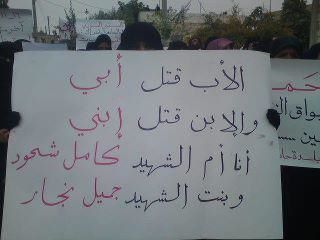
A family of martyrs

“The FATHER killed my father.
The SON killed my son.
I am the mother of martyr Kamel Shahoud,
and the daughter of martyr Jameel Najjar”

Syria

Arrest of Palestinian Freedom Rider Fadi Quran

Al Walaja 11 13 2011

Submitted by Jalal Abukhater on Sun, 11/13/2011 – 23:51

Before I start, it is worthy to note that the following two incidents took place only in the last three days. The following is just another example of life under Israeli occupation.

What Press Freedom?

On Sunday morning in al-Walaja village near Bethlehem, Palestinians protested Israel’s illegal building of the Apartheid Wall around the village. The soldiers were planting explosives and dynamite on the cliff to pave the way for another installment of the Apartheid Wall which will isolate Walaja village from the rest of the occupied West Bank. In the meantime, Palestinian activist Mazin Qumsiyeh was arrested for holding a camera and filming Israeli soldiers’ crackdown on Palestinian and International protestors. Arrest is at 3:05 marker in this video:

[youtube http://youtu.be/v_GE16wmcAo?]

Three days ago in Nabi Saleh village near Ramallah, where weekly demonstrations take place against the expansion of nearby illegal settlements, Palestinian photojournalist and B’TSelem volunteer Bilal Tamimi was also arrested while documenting Israel’s brutal crackdown on the protest. In that day, Israeli soldiers heavily used tear gas, rubber bullets, and dirty-water cannons to disperse the protestors, one man was hit with a rubber bullet in his eye from close range of 30 meters.

Arrest of Bilal Tamimi is at 6:40 marker in this video:

[youtube http://youtu.be/9l4LcqVKIi0?]

The Vision of the Local Coordination Committees on International Protection

par لجان التنسيق المحلية في سوريا, mercredi 2 novembre 2011, 07:05

More than eight months have passed on the Syrian Revolution. Entire towns and villages have moved against a state of despair and absence of hope, due to the rampant mishandling of public affairs by the Syrian regime on all levels, and in particular on the political level. Thousands of citizens demonstrate each day, as part of grassroots social movements, using all forms of peaceful demonstration. They claim rupture from the existing authoritarian and family-based system of government, and they aspire to lay the foundations for the values of freedom and dignity to all citizens in Syria. The Syrian regime has confronted this revolution of values with an insistence on unaccountability, an attempt to stir up strife among the various components of society, and the use of the most repulsive forms of repression.

Every day tens are killed by the Syrian regime’s security and military apparatus and by the regime’s thugs. Every day, hundreds are wounded, arrested and tortured, and similar numbers are deemed disappeared. Reports of the United Nations and other international human rights organizations have recorded various types of systematic violations of human rights and international humanitarian law, against peaceful demonstration. These include willful killing of demonstrators including children; imprisonment and other severe deprivation of physical liberty; torture and inhumane treatment; enforced disappearance of persons; and other inhuman acts intentionally causing great suffering to civilians, such as directing attacks against hospitals and the arrest, torture and killing of the wounded therein; and directing attacks against religious building and dwellings. Such reports have established that such acts are committed as part of a widespread or systematic attack directed against civilian populations in Syria, with knowledge of the attack, and that they may therefore amount to crimes against humanity.

Considering the grave and systematic violations of human rights and international humanitarian law, including through the violent repression of peaceful demonstrators, directly and indirectly by the Syrian authorities, with incitement by the regime’s media outlets, and the prohibition of independent and international press from working in the country, we set out our vision for the requirements of any international move to stop such violations:

  1. We affirm that respect of basic citizen rights is a defining attribute of sovereignty and statehood. Furthermore, respect of human rights is an essential element of a responsible sovereignty. The Syrian regime confronts the aspiration of the Syrian people to freedom and dignity with the commission of crimes against humanity. The Syrian regime has shot all doors on all inquiries into such violations, and on holding their perpetrators to account in an objective, fair and firm manner. Accordingly, such regime is not entitled to rely on the principle of Sovereignty to confront its own people. If it does so, it unsheathes yet another arm in the face of its own people, thereby exacerbating the bare condition of the Syrian people.
  2. We affirm the right of the Syrian people to freely determine, without external interference, the form of its political governance, and to pursue economic, social and cultural development of the Syrian society. The Syrian people has a right of self-determination, which is directly derived from Articles (1) and (55) of the United Nations Charter, when the ruling regime fails to meets its international responsibilities, and when it persists in its violations of individual rights and human dignity.
  3. As we insist, in the present very special circumstances, on the direct right of the Syrian people to affirm its right of self-determination before the international community, we assure that all calls based on the ground of “droit d’ingérance,” “devoir d’ingérance,” “humanitarian intervention” or “responsibility to protect” should not hinder the aspiration of the Syrian people to cause peaceful change by its own forces; or lead to dealing with the Syrian people as yet another sphere of influence in the game of nations. Every day, the demonstrators in Syrian towns and villages chant the motto “The People Wants…” The People Wants emancipation from authoritarian rule. It wants to take and hold the initiative in decision making in public affairs, in an independent and peaceful way, in order to determine all aspects of its public life freely and deliberatively. It also wants to maintain friendly relations among nations. The Syrian People does not want to substitute authoritarian rule by submission to foreign influence. The Syrian People extracted its independence and founded its modern State. It aspires to liberate all its lands and chiefly the Golan. It aspires to continue supporting the struggle of peoples for self-determination, and chiefly that of the Palestinian People. As the Syrian People is revolting against its oppressive rulers, it will not hesitate to revolt against all forms of foreign domination.
  4. We affirm that as the Syrian Revolution has been creative in its peaceful, incessant, and resilient movement, in the face of unparalleled repression, any international support, in light of the regime’s closure of any opportunities for national political solutions, must also be creative and unparalleled. It must be premised on the imperative of maintaining the unity of the Syrian soil, as well as the unity of Syrian society, in all its religious, sectarian and ethnic components.
  5. We consider that the objectives of international protection must be limited to ensuring the safety of peaceful assembly and demonstration, so as to enable the Syrian people to freely exercise self-determination, by its own peaceful forces, towards transition to a pluralistic, secular and democratic system of governance, based on public freedoms, as well as legal and political equality among all Syrians.
  6. We consider that the means for international protection, which must be approved by the Security Council, acting under Chapter VII of the United Nations Charter, must be limited to the following:
    1. To ensure proper conditions for peaceful assembly in accordance with the various human rights instruments in which Syria is a party. These include:
      1. To request that all member States of the United Nations shall take the necessary measures to prevent the supply of arms and all related materials to the Syrian regime.
      2. To force the Syrian regime to immediately lift restrictions on all forms of media.
      3. To force the Syrian regime to ensure the safe passage of all United Nations humanitarian agencies to all Syrian towns and villages, in order to enable them to supervise an immediate halt of killing and violence, release of detainees, uncovering of the fate of disappeared persons, withdrawal of armed forces, and removal of checkpoints from towns, villages and roads, to operate an uninterrupted international monitoring of all peaceful assemblies, especially those organized against the Syrian regime, and to report on any violations in their respect.
    2. To ensure proper conditions to carry out an impartial and objective investigation into the acts which are believed to be crimes against humanity, committed on Syrian soil as from March 15, 2011, and to refer their perpetrators to a fair trial. These include:
      1. To force the Syrian regime to receive an independent international commission of inquiry with a mission to investigate all allegations of human rights and international humanitarian law, to establish the facts and circumstances of such violations and to identify their perpetrators.
      2. To request all member States of the Unites Nations to enforce a travel ban and an assets freeze on all persons who are believed to be implicated, directly or indirectly, by way of incitement, participation or financing, in the commission of crimes against humanity in Syria, without prejudice to the principle of presumption of innocence.
      3. To refer the situation in Syria since March 15, 2011 to the Prosecutor of the International Criminal Court; and to force the Syrian regime to cooperate fully with the Court and the Prosecutor, and to provide all necessary assistance to enable the Court and the Prosecutor to discharge their respective functions.
    3. To ensure proper conditions to embark upon a nation-wide political process, as shall be agreed between all political and social forces composing the Syrian people, which should lead to achieving the desired democratic transition. These include:
      1. To ensure proper political conditions that allow a deliberative process to take place among all components of the Syrian people in respect of the transitional period and its constitutive procedures.
      2. To ensure proper political conditions to enable the Syrian people to carry out voting by universal suffrage and transparent, fair and free elections at all levels, as shall be required in the transitional period to achieve the desired democratic transition.
      3. To provide training and capacity building assistance to the Syrian armed forces and security services to increase their awareness of human rights and international humanitarian law, and to effect a change in their doctrine from protection of the regime to protection of the country, without prejudice to the unity of the army.
  7. The recalcitrance of the Syrian regime to meet its international obligations in terms of respect of human rights and international humanitarian law, may require, in this particular moment, that the international action contemplated above be supported by the sending of a United Nations observers mission, to be approved by a resolution of the Security Council acting under Chapter VII of the United Nations Charter. The mandate of the observers mission must emphasize prevention and assistance in building appropriate political conditions to achieve a peaceful democratic transition in Syria. The observers mission must comprise civilian components holding nationalities of countries known historically for their neutrality, and under the direct supervision of the Secretary General of the United Nations, in cooperation with the League of Arab States. The observers mission’s staff members must be in such numbers as to allow them to be present in or reach any town or village at any time, to monitor and report to the United Nations Secretary General, on any violations of human rights and international humanitarian law, as well as on progress of the political process to achieve a peaceful democratic transition pursuant to appropriate constitutive procedures as shall be solely determined by the Syrian People.
  • We affirm the priority of using dialogue and peaceful persuasion, including the use of non-coercive and non-violent measures. Yet we have no illusions as to the Syrian regime’ obstinate responses and its attempts to buy time. Experience has shown that the granting of time has not rendered the Syrian regime less resolute in committing yet further violations of human rights and international humanitarian law. Such time costs the Syrian people more killing and destruction. Every day that passes means more people killed, and Syria finds itself even more remote from any possibility to find political solutions.

Blog at WordPress.com.

Up ↑