Search

band annie's Weblog

I have a parallel blog in French at http://anniebannie.net

Category

repression

Assad’s Hapless Heroes

Wednesday, December 21, 2011

I’ve heard that the Syrian army has carried out more live fire exercises to test their readiness against any external aggressors. Of course we all remember how ready the Syrian army was in 1967, when it lost the Golan Heights without putting up a fight, or when the Syrian Air force lost eighty planes over Lebanon in one day because their planes are rubbish, or, more recently, when the Israelis bombed a suspected nuclear installation in 2007, or when Israeli planes breached Syrian airspace shortly afterwards, or when the American special forces carried out a helicopter raid from Iraq and killed Syrian citizens on Syrian soil, or when the Mossad assassinated a Syrian general in Lattakia, and Imad Mughniyeh in Damascus – all without a single response from the Syrian regime, which says it has the right to respond at a time and place of its choosing, ie never.

To be honest with you, the first time I realised that Syria even had a navy was when I heard that it was being used to shell parts of Lattakia. Of course, when we say Navy in Syria, what we really mean is a bunch of hill-billy yokels on some rusty fishing boats equipped with missile launchers and some big guns. We’re not exactly talking about a Syrian carrier group or something.

Who are we kidding? The Syrian army consists of a rag-tag bunch of undertrained, non-motivated, ill-equipped conscripts, along with a hardcore of heavily armed, fanatically loyal thugs who are concerned only with protecting a dictatorship and who have not hesitated once to use their weapons against Syrians. But this is not a novel invention of Assad’s Baath. Back when the Baath party was a party of crackpots who were oppressed and banned, the first Syrian president to use the Syrian army as an instrument of butchery, rather than for the defence of the realm, was the fascist Adib al Shishakli against the Druze community. Since then, the Syrian army’s greatest triumphs have been against Syrian civilians, or in repressing and extorting Lebanese people at checkpoints.

So the next time you hear about the brave and noble Syrian ‘army’ carrying out live fire exercises, just remember to put this bunch of incompetent and ineffective thugs in perspective. Here are some examples of how brave the Syrian army is in the face of ferociously unarmed, half-naked, Syrian civilians with their arms tied behind their backs

source

Syrian Regime Signs with Bullets, 150 Day 1, 220 Day 2

 1:00 AM Damascus Time

For Prompt Release and Distribution

الأن تحصل مجزرة

حصري_إدلب _كنصفرة: استشهاد أكثر من150مدني في كنصفرة نتيجة قصف مركز على تجمعات النازحين المدنيين في المزارع بين الزيتون ..كانوا هاربين من مداهمات الامن و الشبيحة و هم من القرى التالية كنصفرة, كفرعويد, المزره 13 شهيد منهم من عائلة واحدة من بيت الحاج علي 4 شهداء أخوة

… القرى الان مكلومة و تدفن شهداءها تحت القصف و العدد مرشح للزيادة..أغلب الجثث وصلت متفحمة..

للعمل على إيقاف هذه المجزرة الآن: انشر هذا الخبر أيها القارئ الكريم في كل جروب أنت مشترك فيه، وفي صفحات الأخبار كلها

A massacre is ongoing right now.

Idlib, Kensafra, More than 150 civilians were murdered in Kensafra as a result of the targeted bombing of the gathering of refugees in between olive orchards. in several villages (Kensafra, Kafar-oueyd, Mazra). There are 13 martyrs from one family 4 brothres.

Villages are in mourning now and they are burying he martyrs. The number is increasing and most corpses arrived burned like charcoal.

Please distribute this on Facebook and in every news site.

بيان من برهان غليون

استغل النظام السوري التوقيع على بروتوكول المراقبين العرب في اطار المبادرة العربية للقيام بهجوم وحشي لا سابق له على المدن والاحياء السورية الثائرة.لقد بلغ عدد الشهداء في اليوم الاول لهذا التوقيع مئة وعشرين شهيدا وهو يتجاوز اليوم الثلاثاء المئتين وعشرين شهيدا اضافة الى مئات الجرحى والمفقودين.

ادعو الامين العام للجامعة العربية السيد نبيل العربي والامين العام للامم المتحدة بان كي مون للتدخل فورا لوقف المجازر التي يرتكبها النظام السوري بحق المدنيين العزل متسترا بتوقيعه على بروتوكول المراقبين كما ادعو الراي العام والمجتمع الدوليين للتظاهر والاحتجاج وعمل كل ما بوسعهما لاعلان تضامنهما مع الئعب السوري والعمل بجميع الوسائل لوضع حد لمجازر النظام السوري وفضح اعماله الوحشية.

A Press Release From Burhan Ghalyoun

The Syrian regime is using its signing on the observers’ protocol within the AL initiative to conduct a barbaric vicious attack on dissident villages and towns. The number of martyrs reach 120 on the first day, and today it is exceeding 220 martyrs in addition to hundreds of wounded and missing.

I call on the Secretary General of the Arab League, Mr. Nabil Al-Arabi and the Secretary General of the UN to interfere immediately to put a halt to the massacres being commited by the Syrian regime against unarmed civilians hiding under its signature of the observers’ protocol. I also call on the international community and the international public opinion to demonstrate and protest and do everything they could to declare solidarity with the Peoples of Syria and to spare to method to halt the massacres committed by the Syrian regime and to expose its barbaric actions.

Palestinian Bloggers and Activists’ Statement in Solidarity with Razan Ghazzawi

 Dec 14 2011 by Jadaliyya Reports

[Image from unknown archive.] [Image from unknown archive.]

[The following statement was issued on 14 December 2011 by various Palestinian bloggers and activists in support of Razan Ghazzawi, a Syrian activist that was recently detained by the Syrian security forces and sentenced to fifteen years.]

We, a group of Palestinian bloggers and activists raise our voices loud and clear in solidarity with all the prisoners of the Great Syrian Revolution. We stand with all the prisoners, activists, artists, bloggers and others, all who are shouting in the streets or on various platforms demanding freedom and justice, while decrying the huge amount on injustice and oppression practiced by the Syrian regime for more than four decades.

We issue this statement in solidarity with all those Syrian activists, and with the blogger Razan Ghazzawi who was arrested on December 4th, on the Jordanian-Syrian crossing border. Razan was adamant in her support for the Palestinian cause. She was the first to stand in solidarity with the Palestinian bloggers who were not granted a visa to enter Tunisia in order to participate in the Arab Bloggers Conference. Razan posted a blog in 2008 during the massacre on Gaza titled, “The Idea of Solidarity with Gaza.” She wrote, “I understand when Cubans, Brazilians, and Pakistanis stand in solidarity with Gaza. But what I do not understand is when Syrians, Lebanese, Jordanians, and also Palestinians in exile stand in solidarity. What is the meaning of solidarity in this context?”

Not only do we stand in solidarity with Razan and the other prisoners, but we also affirm that our destiny is one, our concerns are one, and our struggle is one. Palestine can never be free while the Arab people live under repressive and reactionary regimes. The road to a free Palestine comes with a free Syria, in which Syrians live in dignity. Freedom to all of the prisoners in the Syrian regime’s cells. Long live the Syrian Revolution, free from dictatorship, sectarianism, and foreign intervention.

source

Syria Top Goon: Diaries of a Little Dictator

571. Tara said:

Aboud was the first who cones the name Besho.  The name is going regional

http://www.cbsnews.com/8301-503543_162-57341297-503543/top-goon-puppet-show-takes-aim-at-syrias-assad/

Puppet characters from “Top Goon: Diaries of a Little Dictator.” Syrian President Bashar Al-Assad is on the right. (Credit: Masasit Mati) This post originally appeared on Global Post. It was written by Hugh Macleod and Annasofie Flamand.
BEIRUT, Lebanon – The whip cracks against the prisoner’s back as the man with the moustache and the military uniform repeats his accusation: “You want freedom, right? Freedom?”

The whip comes down again and the prisoner punches the wall in pain.

“What kind of freedom is it you want?” demands the torturer. The freedom the puppet protester seeks, he tells his torturer, is “one where you and I wouldn’t be here. You’d be with your kids and I’d be with my family.”

And then a reply that explains why this small scene from a series of dramatic vignettes played out by finger puppets is among the boldest works of art to have grown out of the unprecedented upheaval in Syrian society.

“You bastard!” retorts the man from Assad’s security services. “I am here because of you.” But the protester has understood the paradox: “You are here because you are not free,” he says. “You are imprisoned just like me. I’ll leave prison in a month or two. But you’ll stay here. Because you are afraid to take your freedom.”

Since its launch on YouTube two weeks ago, the series, “Top Goon: Diaries of a Little Dictator,” has received more than 40,000 views and garnered lavish praise and occasional furious outbursts from audiences stunned by its unprecedented and very personal lampooning of Syria’s struggling president, Bashar al-Assad. And, importantly for the country’s increasingly polarized society, by its refusal to indulge in easy answers.

In a Syria divided between regime and opposition, between mainly Sunni Muslim protesters and the Allawite Shiite Muslims who dominate Assad’s security services, between aggressor and victim, the perspective presented in this upcoming episode of Syrian theater group Masasit Mati’s groundbreaking drama is a rejection of black and white views.

The shabih, or pro-Assad thug, is seen not simply as the oppressor — though he most clearly is that — but also as another kind of victim of the regime, while the protester, though enduring a whipping, is by no means simply a victim, but rather a figure of strength, as he says, “a free Syrian who refuses humiliation.”

“The idea for this dialogue came from a real life example,” Jamil, Masasit Mati’s director told GlobalPost, which was shown a preview of the seventh episode of the series, due for release on Sunday.

“But it was actually the other way around: A friend of ours was in prison and heard the interrogator telling a prisoner, ‘Why are you doing this to us? You are forcing us to stay here. You are imprisoning us.’ We wanted to say that even the shabiha are brought up like slaves to serve the regime.”

A collaboration between a group of 10 artists from inside Syria and named after the straw used to drink mati, a herbal tea popular among Syrians who sip it over lengthy conversation, Jamil said the aim of Top Goon’s finger puppets was to bolster audiences in the best tradition of black comedy, even as blood continues to be spilled in the regime’s unrelenting crackdown on pro-democracy protesters.

“Comedy strips things bare and gives you the strength to fight. Of course, with black comedy the laughter gets stuck in your throat. It makes you laugh and cry at same time,” Jamil said. “But we will not allow the regime to turn us into victims that just cry and stay at home all the time.”

The emergence of Masasit Mati’s series comes amid a critical stage in what the International Crisis Group aptly describes as Syria’s “slow motion revolution,” by far the most drawn out of this year’s Arab uprisings.

The United Nations now estimates at least 4,000 Syrians have been killed since the crackdown began in mid-March, but human rights group Avaaz, which has researchers inside Syria, says it has registered more than 6,500 killed, with at least 20,000 arrested or disappeared, including last week a high profile 30-year-old female blogger, Razan Ghazzawi.

In a report released last month, Human Rights Watch said the regime’s crackdown against civilians in the central city of Homs, including systematic torture, constitutes crimes against humanity.

Last week Avaaz reported the kidnap of 14 Sunnis, including six women, in Homs as they traveled by bus near an Allawite neighborhood, with a senior Western diplomat in Damascus warning a sectarian war in the city is already underway.

Finding ways to make its largely Syrian audience laugh amid all the bloodshed and violence is no mean feat, but Masasit Mati has tapped a rich vein of satire in its portrayal of Syria’s president.

Bashar, or Beeshu — a kind of baby name he is known by in the series — swings wildly between the character of a child suffering attention deficit disorder and the spoiled autocrat in his nightcap, comforted to sleep by his most trusted thug, in the episode Bishou’s Nightmares.

“The regime has fallen,” cries Beeshu, waking from his nightmare as his shabih opens fire on unseen opponents. “Shabih you moron!” screams Syria’s dictator. “It was only in my dream!”

Later Beeshu is seen flying into a rage on a game show, Who Wants to Kill a Million?, angered that his assertion of crushing the protesters is not the right final answer. Later his son and daughter challenge him over the killing of Syrian children and he responds by calling on his goon to put down this domestic uprising.

“We only kill our own people, but on the Golan Heights [Syrian territory occupied by Israel] we are a peaceful army,” Beeshu assures his audience during the episode, Talk Show, modelled on a famous talk show on Al Jazeera.

The direct and confrontational story lines, seeking to expose the lies by which the Assad regime has depicted its 41-year dictatorship as the choice of the Syrian people and a sacrifice in the name of Palestinian freedom from Israeli occupation, has won Masasit Mati rave reviews.

“It’s so good it’s driving me crazy,” posted one fan on the group’s Facebook wall. “I want to see a Masasit Mati TV station.” “It’s very good work and we watch it with our kids,” posted another, adding irreverently: “All we want to know is which finger you put Bashar on.”

Not everybody has greeted the series with such acclaim, however. Among the outpourings of praise, a few viewers have taken deep offense and posted threats that are unpublishable but tend to center on sexual violence against the mothers and sisters of Masasit Mati’s members.

“It’s kind of obvious it comes from the security apparatus,” said Jamil, who uses a pseudonym and did not wish to reveal his whereabouts.

The threat to the safety of those who would ridicule Syria’s president in words or pictures is all too serious. In July, a man identified as Ibrahim Kashoush was found with his throat slit in Hama after leading carnival-like street songs ridiculing the president.

A month later masked gunmen attacked Syria’s best known political cartoonist days after he published a cartoon showing Assad hitching a lift out of town with Libyan dictator Muammar Gaddafi. The attackers fractured Farzat’s arm, left him with a black eye and symbolically broke two of his fingers.

In the Top Goon series, the voice of Bishou mimics the president’s lisping pronunciation of the letter S and shows the president giggling inappropriately and telling bad jokes while delivering rambling speeches on reforms, such as the Law of Gravity that he says will put an end to the so-called ‘flying protests’ — spontaneous and short demonstrations by the opposition.

The series got an unexpected boost last week with the broadcast of an interview with Assad on US network ABC in which the president denied all responsibility for the killing of protesters, telling ABC’s Barbara Walters that Syria’s security forces “are not my forces,” despite, as president, he is constitutionally sitting as commander of all Syria’s armed forces.

“We don’t kill our people,” Assad said. “No government in the world kills its people, unless it’s led by a crazy person. Most of the people that have been killed are supporters of the government.”

“We used to worry that people outside Syria might think the things we show in Top Goon are exaggerated,” Jamil said. “But after we saw Assad’s interview we decided to run it on its own as episode five and a half because the interview was more comic than we could have imagined. We didn’t even have to make something up.”

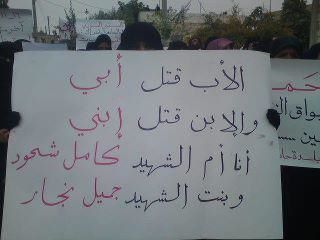
A family of martyrs

“The FATHER killed my father.
The SON killed my son.
I am the mother of martyr Kamel Shahoud,
and the daughter of martyr Jameel Najjar”

Why Syria’s arrested blogger, Razan Ghazzawi, is one of my heroes |

 Jillian C York

A consummate activist, let’s hope my friend’s belief in the power of people is well placed and helps secure her freedom

Jillian C York · 05/12/2011 · guardian.co.uk

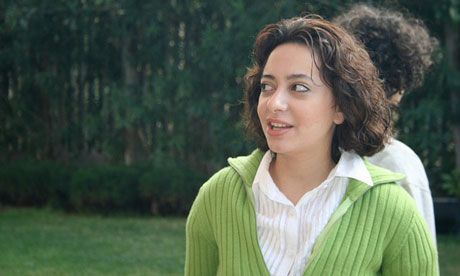
Razan Ghazzawi, a Syrian blogger, has been arrested. Photograph: Jillian C York

Razan Ghazzawi, a Syrian blogger, has been arrested. Photograph: Jillian C York

I got an urgent instant message from my good friend Razan Ghazzawi last Tuesday night. Having tweeted and blogged against the Syrian regime for the past several months under her real name, from inside Syria, Ghazzawi was concerned that she had become a target.

Always prepared, she sent me her contingency plan: close her online accounts. Syrians who have been arrested and detained over the past nine months have reported having their passwords demanded by authorities. Though closing her accounts wouldn’t help her, it could protect her friends – that’s the kind of person Ghazzawi is.

Those close to her say that she was on her way to a workshop in Jordan organised by her employer, the Syrian Centre for Media and Freedom of Expression, when she was arrested. Though it’s difficult these days to understand anything the Syrian regime does, her blog may have been the impetus for her arrest, or it may not have, but in either case her outspoken writing could very well make things worse for her.

By birth, Ghazzawi is an American citizen – though she would undoubtedly resent the idea of that being used to free her. In any case, it is unlikely that the US government could have any pull with the Syrian regime at this point.

I met Ghazzawi in 2008 at a conference in Europe. We only connected briefly – she was working on her master’s thesis – but we kept in touch and when I visited Syria the next year, reconnected. She is a consummate activist, never content to let something slide, always thinking, sometimes too much. She is passionate about LGBT and gender rights, Palestine and, of course, her beautiful Syria.

Though Ghazzawi had blogged under her own name for several years, at the start of the Syrian revolution she had a change of heart, changing her name on Twitter and locking down her Facebook account. I never asked, but I assumed she was scared. She left for a while for Lebanon, then Egypt, but ended up back in Syria soon after; I can only assume she felt compelled to return.

Eventually, she decided against anonymity, returning to her former outspoken nature and tweeting, her opposition to the regime coming across loud and clear.

What I appreciate and respect the most about Ghazzawi (and what I suspect is what irks a lot of other people about her), however, is her honesty and humanity. Though a staunch supporter of Palestinian rights, she has denounced the double standards of Palestinian resistance groups that have expressed support of the Syrian regime. She has not been afraid to speak up against those she disagrees with, even her friends. For that, she is among my heroes.

She has also been pragmatic, sceptical even, of the role of social media in Syria and throughout the region, consistently claiming that “online activists are overrated”. Bemused, annoyed even, at all of the invitations she’s received to represent Syrian digital activists at conferences, she has taken a pragmatic approach to the effect of digital tools in Syria, where access to the internet hovers at around 20% and DSL is mostly unavailable outside of Damascus.

Last time I saw her, at the Third Arab Bloggers Meeting in Tunis, she drove the point home: after learning that Palestinians had been denied visas to attend, she slapped a sign on her back that read: “OK, [Palestinians] denied entry. Let’s not just tweet about it!”

It is ironic then, that her own online outspokenness may be the cause of her arrest.

In respect to the Syrian opposition, Ghazzawi has been thoughtful, nuanced, writing about her love of Syria and her desire for a simultaneously free and peaceful Syria. On her blog, she recently wrote:

“Colonisation made us all a bunch of nationalists [fighting] for a label [rather] than for a value. I want to be living hand in hand with all of you, and this cannot be done if we see ourselves as ‘majorities’ and ‘minorities.’ The foundation of this logic lies in nationalism.”

But if there is one thing that represents Ghazzawi more than anything, it is her belief in the power of people – not politicians, not parties, but individuals. “It’s time for people’s self-determination to rule the region, you just wait and watch,” she wrote in October. Let’s hope that her prophecy is correct.

Chasing terrorist children

[youtube http://youtu.be/-jnb6z5HZ34?]

Exclusive pictures from Syria’s Homs

[youtube http://youtu.be/GHA0EFDFCUQ?]

Syrian refugees tell of rape, murder and destruction

Watch Kholood and Qotayba tell their stories about the Syria refugee crisis

Newsnight’s Shaimaa Khalil hears testimony in Lebanon from Syrians who have fled their country after protests which have reportedly left 1,100 people dead, hundreds more injured and thousands under arrest.

KHOLOOD – A PROTESTING MOTHER

“You have to cover my face and change my voice otherwise they’ll know it’s me,” Kholood says.

“They have been watching us and they have my name on the wanted list for protesting.”

Kholood (not her real name) is a mother of four who, like thousands of other Syrian refugees, fled the border town of Talkalakh into the Wadi Khaled region in northern Lebanon after the Syrian army and security forces began their crack down on protesters.

Arida, the Lebanese village where Kholood and her family are now staying is only a stone’s throw away from the Syrian border.

You can see Syrian flags fluttering in the breeze and Syrian army personnel patrolling across the border – too close for the refugees’ comfort.

“When we saw what happened in Deraa, Banyas and Talbiseh, and how the people came out like they did we thought, ‘why not us? We should come out too!’ and we did and called for the fall of the regime.”

But the situation turned deadly when the Syrian security forces arrived in Talkalakh last month with tanks and armoured vehicles to crack down on protesters.

“There was non-stop shooting. When I looked out of the window I saw destruction all around. Glass everywhere. They had bulldozed some houses to the ground.”

Kholood continues: “That night we decided to flee. I crossed the bridge with my husband and youngest son.”

“We were all so scared. Some of the people that fled with us were shot on the way. Some were badly wounded and some died before reaching Wadi Khalid.”

Kholood was also fearful of being raped:

“I left Talkalakh to protect my honour. When we talk to our relatives in Banyas, Homs and Talbiseh they tell us horrifying stories. They told us that so many women were raped. These men don’t fear God.”

When I ask her about her three sons, aged 16 to 21 who chose to stay behind in Syria, Kholood bursts into tears.

“I’d be lying if I told you I didn’t want them here with me. I want to tell them to come here, but instead I tell them they should stay and be strong and fight.”

“They are my children. I love them, but we have to sacrifice if we want victory. This is much stronger than a mother’s love,” she cries.

When I ask if she hopes to one day return to Syria, Kholood looks at me defiantly.

“When the regime falls,” she says. “And it will fall, inshallah.”

QOTAYBA – A SOLDIER WHO SWITCHED SIDES

“They gave us orders to fire heavily at unarmed civilians,” Qotayba al Akkari tells me.

“There was random shooting at people, no distinction between women, children, armed or unarmed men. Many, many were killed, many unarmed civilians.”

A Syrian army soldier, he fled to Lebanon and is now sitting among a group of Syrian activists.

“Our commanding officer would say: ‘There’s so much ammunition, no one is going to ask you where it went. Fire!'”

“I would fire in the air or at empty buildings because I knew that if they found out I wasn’t firing they’d detain me or kill me.”

“At first, I felt like I was having a nervous breakdown I was so surprised at all that was happening around me but after a while I got used to it and all the dead bodies.”

“Soldiers have no idea what goes on in Syria. They don’t allow us to watch any news channels except Syrian TV. They would accuse us of treachery if they caught us watching Al-Jazeera, Al-Arabiya or BBC.”

“There was also no contact between soldiers and their families, the mobile phone coverage was so bad. But even when the soldiers did manage to speak to their families, the families wouldn’t dare say that anything was wrong. The soldiers would ask ‘is everything ok?’ and the families would say ‘Yes, all fine.'”

Qotayba says that he now feels free, but that one day he will return to Syria, to fight with other soldiers who have defected.

“I’m not afraid anymore,” he tells me.

IBN TALKALAKH – A SHOP OWNER TURNED ACTIVIST

“Call me, Ibn Talkalakh,” the young textile shop owner tells me.

The name means ‘The son of Talkalakh’.

Ibn Talkalakh is also a Syrian activist who has recently come out of prison.

“When the people of Deraa moved I thought ‘that’s it!’ we have to do something.”

“It was very difficult in the beginning. People were scared. The tanks came and they started shooting everywhere and destroying homes. They were arresting people who went out to demonstrate and they came for me.”

“It was my brother and I in the house and from the moment they (the security forces) came in they did not stop beating us. They beat us with electric batons and tied our hands behind our backs and made us kneel in front of them, insulting us the whole time.”

“They blindfolded me and took to prison. They put me in a small cell. We were about 50 people in that cell, it was so crowded.”

Ibn Talkalkh was in prison for 20 days and says he was regularly beaten and tortured.

“Once they beat me so hard on the back of my head blood filled my eyes, I couldn’t see anything. When they interrogated me they would tie my wrists and leave me hanging for hours.”

He shows me the marks on his wrists.

“They put me in a room where I could hear others being tortured. I’d hear their screams, their pleas and it would fill me with fear.”

“I’ll never forget, during one interrogation, I was hanging with hands tied up and the interrogator came up to me and said: ‘Listen boy, it is Bashar al-Assad or no-one. We’ll never hand Syria over to you.'”

Yet despite the horrific time that Ibn Talkalakh had while in prison he tells me that he also found it inspiring.

“I met so many people with a much stronger will than mine. I met people from all walks of life – doctors, farmers, lawyers – many people who are willing to go out and take to the streets and keep asking for our rights even if it meant going to prison again.”

“It filled me with hope that justice will come and that this regime will fall. It made me more determined to come out and keep fighting.”

These interviews were conducted in Wadi Khaled on the Lebanon-Syria border on 16-17th June 2011. The BBC cannot verify the authenticity of these testimonies.

Blog at WordPress.com.

Up ↑