Search

band annie's Weblog

I have a parallel blog in French at http://anniebannie.net

Category

racism

Details of ‘rape by deceit’ conviction surface

JERUSALEM (Ma’an) — In July, an Israeli court sentenced a Palestinian, Sabar Kushur, to 18 months imprisonment for obtaining consensual sex by failing to reveal he was not a Jewish bachelor.

The Israeli weekly magazine HaIr on Friday published testimony given in court by the complainant.

Kushur was initially charged with rape by force, and the conviction of “rape by deceit” was a plea bargain formulated and agreed to by the prosecution and defense. According to the report in HaIr, Kushur’s lawyers initiated the “rape by deceit” charge.

After the conviction, Israeli press reports on the court’s verdict were quickly picked up by the international media, which cited the court’s decision as an example of discrimination against Israel’s Arab citizens.

According to the woman’s testimony in court, declassified at the request of HaIr, Kashur brutally raped her and left her half naked, bleeding and beaten in a stairwell.

She told the court “he said that if I stay silent and I don’t resist, then it would end faster and it wouldn’t be like, he wouldn’t use force. I still resisted him and it was forced,” HaIr reported.

Immediately after the incident she was taken by ambulance to Shaarei Tzedek Hospital, her testimony said, and from there she was taken to Kfar Shaul psychiatric hospital, the report said.

In her testimony, the woman clarified that she was taken to Kfar Shaul because the hospital had a ward for women who had been sexually abused, HaIr said.

According to the report, the initial rape charge was reduced to “rape by deceit” to avoid further traumatizing the woman, who had come under aggressive questioning about her history of being sexually abused, and her former occupation as a sex worker.

The defense had demanded the woman testified again against previous complaints she had made, some of which had led to indictments. To avoid putting the woman on the stand again, the prosecutor agreed to the defense lawyer’s suggestion of a plea bargain, he told Ha’Ir.

The testimony sharply contradicted media reporting of the incident.

Following his conviction, Saber Kushur was interviewed on television, radio, and by several publications.

In an interview with the British newspaper The Observer, the interviewer reflected that the incident did not cast either party in a favourable light, and in a blog post on the website of sister publication The Guardian described the charge as a case of revenge by a lover.

The incident was variously referred to as a “casual fling,” a “brief encounter,” an “afternoon quickie,” and a “quickie on the roof of a nearby office block.”

Journalists also speculated that by having sex with a stranger the woman may not have sent “the right message.”

A reporter blogging on the website of the Qatar-based TV network Al-Jazeera suggested the woman had reported the rape when she realized Kushur was “never going to call her” and she “wasn’t the woman of his dreams.”

Commenting on reporting of the verdict, Tel Aviv-based journalist Lisa Goldman noted that not all the information was available to journalists at the time, as the court documents were sealed.

HaIr’s request for the court documents, however, was made through standard legal channels and was granted in one day, she said.

In a polarized society, there is a tendency to “judge situations according to political ideology” without thorough examination, Goldman added.

Ten days after the verdict, Kushur’s defense appealed to the High Court for an acquittal, arguing that “the facts described in the updated indictment shouldn’t result in charges of rape by deception.”

The Supreme Court has yet to set a date for Kushur’s appeal, but agreed to delay his sentence and eased his remand conditions.

A spokesman for the Justice Ministry responded that the prosecution was “especially surprised” by the appeal for acquittal, given that the charge was the basis of the plea bargain the defense formulated with the prosecution and signed, HaIr reported.

source

Fury in Austria at anti-mosque game

Far-right party launches online video that allows players to shoot down minarets and muezzins.

The game allows players to shoot down minarets and muezzins with a ‘Stop’ button

A far-right party in Austria has sparked outrage by launching an online video game which allows players to shoot down minarets and muezzins calling for prayer.

The game, called “Moschee Baba”, or “Bye Bye Mosque”, gives players 60 seconds to collect points by placing a target over cartoon mosques, minarets and Muslims and click a “Stop” sign.

It is being used by the Freedom Party (FPOe), which has a link to the game on its website, to encourage voters to elect Gerhard Kurzmann, the party’s candidate in the picturesque region of Styria.

“Game Over. Styria is now full of minarets and mosques!” it says at the end of a session, before inviting players to vote for Kurzmann on September 26, when local elections are being held.

The website then invites viewers to take part in a survey which asks them whether the construction of minarets and mosques should be banned in Austria, and whether Muslims should sign a declaration in which they accept that the law takes precedence over the Quran.

According to the Austria Press Agency there are no mosques with minarets in Styria, where 1.6 per cent of the population is Muslim, and only four such buildings in the entire country.

Religious hatred’

Anas Schakfeh, the leader of Austria’s Islamic community, has described the game as “tasteless and incomprehensible”.

“This is religious hatred and xenophobia beyond comparison,” he told Austrian broadcaster ORF.

Austria’s Social Democrats and Green Party have joined the Islamic community in condemning the video.

“The FPOe is targeting minarets that don’t even exist,” Werner Kogler, the Green candidate in Styria, said.

The game also appears to have divided the FPOe camp, with its deputy, Manfred Haimbuchner, quoted as saying the party should “seek attention with substance, not with constant provocations”.

However Herbert Kickl, the party secretary, defended the game saying it did not involve any real shooting, but rather “the pushing of a stop-button to halt a bad political decision.”

European debate

The Islamic community and the Green party filed complaints for incitement of hatred and degrading of a religion on Wednesday, which can be punished with prison sentences of up to two years.

Prosecutors in Graz, the capital of Styria, have launched an inquiry and will decide whether to take the game off the Internet.

Islamic buildings and dress have sparked debates in many European countries recently, with French and Belgian MPs voting to outlaw the niqab, and Swiss voters backing a ban on building minarets.

Austria’s Freedom Party wants a special vote on banning mosques with minarets and Islamic face veils.

Heinz-Christian Strache, its leader, has said he wants to see anti-Muslim protests similar to those in New York over the building of a Muslim cultural centre near the World Trade Center site.

The debate isn’t just coming from the right. In Germany central banker Thilo Sarrazin, a Social Democrat, has provoked uproar for saying that Muslim immigrants undermine German society, refuse to assimilate, and sponge off the state. He has also said “all Jews share a particular gene” angering people across the German community.

The Freedom Party said its “Bye bye Mosque” game was in part in reaction to Sarrazin’s comments saying they would prefer to have “Sarrazin rather than muezzin,” in Austria. Freedom wants to “deal with a situation which has already long been widespread in Europe,” Kurzmann said. He said young people needed to be informed about the problem.

With its catchy slogans and youthful leader, the Freedom Party enjoys strong support from young people in Austria, polling 17.5 percent of the vote at a national level in 2008.

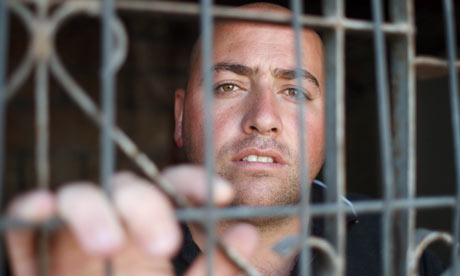
Saber Kushour: ‘My conviction for “rape by deception” has ruined my life’

Saber Kushour insists the partner of his casual sexual encounter was willing and never showed any interest in his background. Photograph: Emil Salman /Haaretz

Saber Kushour apologises as he asks his guests to move the plastic chairs on his breeze-block balcony a little closer to the door to his house. If he were to sit where they are now, he explains, the electronic tag attached to his ankle would set off an alarm.

Kushour’s edginess is understandable – he is recalling a 15-minute encounter almost two years ago which he says “has destroyed my life”.

Last week the married father of two from east Jerusalem was sentenced to 18 months in jail for the “rape by deception” of a Jewish woman who claimed she would not have had sex with him had she known he was an Arab. What might have been a tawdry episode – casting neither Kushour nor the woman in a favourable light – exploded into a debate in Israel about racism, sexual mores and justice.

“I am paying the price for a mistake that she made,” Kushour, 30, told the Observer. “I was shocked at the sentence – it shows a very vivid and clear racism.” The message from the judge, he says, was that “because you are an Arab and you didn’t make that clear, we are going to punish you”.

In his verdict, Judge Zvi Segal conceded that it was not “a classical rape by force”. He added: “If she hadn’t thought the accused was a Jewish bachelor interested in a serious romantic relationship, she would not have co-operated. The court is obliged to protect the public interest from sophisticated, smooth-tongued criminals who can deceive innocent victims at an unbearable price – the sanctity of their bodies and souls.”

At his home in Sharafat, where he is confined while awaiting an appeal, Kushour tells a different story. The woman has not been identified and has not gone public with her account.

Kushour was buying cigarettes in September 2008 when an unexpected opportunity presented itself for a casual sexual encounter. “Any person in my shoes would have done the same thing,” he says.

A woman in her 20s struck up a conversation as he left the shop to return to his job delivering legal papers around Jerusalem by scooter. “She said ‘you have a nice bike’ and other things which I don’t remember.” Within minutes, he says, he realised that her interest was not confined to small talk.

Kushour speaks fluent, unaccented Hebrew, as do many Palestinians living and working in Jerusalem. The woman asked his name and Kushour replied “Dudu” – a common Israeli name. “Since I was a kid everyone calls me Dudu – even my wife calls me Dudu. It’s a nickname.” At no point, he says, did the woman – who gave her name as Maya – ask if he was Jewish, although he has acknowledged that he said he was single.

The pair went to a small roof area in a nearby office block. “When we were having sex, she was worried that someone would see us, but she never told me to stop. She was more than willing – she initiated it.”

It has been suggested that Kushour presented himself as a bachelor interested in a long-term relationship. If that had been Maya’s concern, Kushour points out, she might have asked him more about his background. After the brief encounter, Kushour tapped Maya’s mobile number into his phone and left. “I didn’t treat her like garbage – this is what she wanted.”

Unknown to him, Maya contacted the police after the encounter to lodge a complaint. Kushour says he doesn’t know how or when she realised he was not Jewish. The woman was given a medical examination, presented in court, which showed, according to Kushour, no signs of force or injury.

Six weeks later Kushour was idly flicking through numbers in his mobile’s address book. “I saw ‘Maya’ and I thought ‘who is Maya?’ I had already forgotten about her. I rang the number to see who it was, and then I realised it was the girl. I said ‘Can I see you?’ and we arranged to meet.”

Maya didn’t show up and didn’t respond to Kushour’s calls and texts. But, crucially, she now had a vital piece of information for the pursuit of her complaint – his contact details.

Three days later Kushour received a phone call from the police. “They told me I had a problem and to come to the police station.” He was interrogated for five to six hours, without a lawyer.

In the final hour of questioning, the police began to mention a rape claim. Eventually Kushour was handcuffed and taken to a cell. Over three days the questioning continued. “This was the hardest moment of my entire life,” says Kushour. “I didn’t have a clue what they were going to do.” On the third day, Kushour was taken to court – by this time represented by a lawyer found by his brother – and charged with rape. He spent the next two months in prison and since then has been electronically tagged and confined to his home. The case came to court last week. His lawyer has told him that, because of the publicity surrounding the case, the appeal may be expedited. In the meantime, says Kushour, “I can’t leave the house, I can’t work, I can’t feed my children.”

Kushour’s conviction has transfixed Israel. Some see echoes of a primeval – and racist – instinct to protect “our” women against outside marauders. Others are outraged at what they see as a blatant injustice, pointing to a backdrop of widespread, systematic and – some say – growing discrimination against Arabs who make up 20% of Israel’s population.

“This is a most amazing decision by the court,” says Tamar Hermann of the Israel Democracy Institute. “Deception is one thing – but to be convicted of rape?” It has, she says, “struck a sensitive chord in the Israeli mainstream of Arabs pretending to be Jews.”

The issue of identity is paramount in a land where both communities regard each other with suspicion and hostility.

Yuval Yonay, a sociology professor at Haifa University, in one of Israel’s few mixed cities, says Kushour’s behaviour “might be improper but it is not rape”.

He says that in 16 years of teaching at a university where 20-25% of the student population is Arab, he has “never even heard of a mixed relationship”. Discrimination against Arabs is, he says, evident at all levels.

Some have defended the verdict. “We all have different characteristics, and it is a person’s right to have sexual relations with a person knowing the facts about those characteristics,” Dana Pugach of the Noga Centre for Victims of Crime told the Israeli daily Haaretz.

Kushour says he has had a lot of support over the past week from Israeli Jews. “The problem is not with the people themselves, but those in power,” he says. “I just want justice.”

Whatever the outcome of his appeal, his brief encounter with Maya has turned his life upside down. His relationship with his wife has been severely tested. “I asked her last night to forgive me. She said yes, but I can see the pain and hurt in her eyes.”

Arab guilty of rape after consensual sex with Jew

Jerusalem's old city walls Jerusalem's old city walls. Arabs constitute about 20% of Israel's population, but relationships between Jews and Arabs are rare. Photograph: Uriel Sinai/Getty Images

A man has been sentenced to 18 months in prison after telling a woman that he was also Jewish

A Palestinian man has been convicted of rape after having consensual sex with a woman who had believed him to be a fellow Jew.

Sabbar Kashur, 30, was sentenced to 18 months in prison on Monday after the court ruled that he was guilty of rape by deception. According to the complaint filed by the woman with the Jerusalem district court, the two met in downtown Jerusalem in September 2008 where Kashur, an Arab from East Jerusalem, introduced himself as a Jewish bachelor seeking a serious relationship. The two then had consensual sex in a nearby building before Kashur left.

When she later found out that he was not Jewish but an Arab, she filed a criminal complaint for rape and indecent assault.

Although Kashur was initially charged with rape and indecent assault, this was changed to a charge of rape by deception as part of a plea bargain arrangement.

Handing down the verdict, Tzvi Segal, one of three judges on the case, acknowledged that sex had been consensual but said that although not “a classical rape by force,” the woman would not have consented if she had not believed Kashur was Jewish.

The sex therefore was obtained under false pretences, the judges said. “If she hadn’t thought the accused was a Jewish bachelor interested in a serious romantic relationship, she would not have cooperated,” they added.

The court ruled that Kashur should receive a jail term and rejected the option of a six-month community service order. He was said to be seeking to appeal.

Segal said: “The court is obliged to protect the public interest from sophisticated, smooth-tongued criminals who can deceive innocent victims at an unbearable price – the sanctity of their bodies and souls. When the very basis of trust between human beings drops, especially when the matters at hand are so intimate, sensitive and fateful, the court is required to stand firmly at the side of the victims – actual and potential – to protect their wellbeing. Otherwise, they will be used, manipulated and misled, while paying only a tolerable and symbolic price.”

Gideon Levy, a liberal Israeli commentator, was quoted as saying: “I would like to raise only one question with the judge. What if this guy had been a Jew who pretended to be a Muslim and had sex with a Muslim woman?

“Would he have been convicted of rape? The answer is: of course not.”

Arabs constitute about 20% of Israel’s population, but relationships between Jews and Arabs are rare. There are few mixed neighbourhoods or towns, and Arabs suffer routine discrimination.

Israeli MPs are considering a law requiring prospective Israeli citizens to declare loyalty to Israel as a “Jewish, democratic state”. Many Arabs would balk at swearing allegiance to a state which they see as explicitly excluding or marginalising them.

Dan Meridor, a deputy prime minister in Binyamin Netanyahu’s government, is opposed to the proposal. “Why does every bill need the word ‘Jewish’ in it – to show the Arab citizens that it doesn’t belong to them? Then we’re all shocked when they radicalise their stance.

“The majority doesn’t need to remind the minority that it is in fact a minority all the time,” he added.
source

The Heart and Soul of Israel : Sad Saga of Azad Restaurant

Israeli woman points and screams at an Arab man near Azad.

Tim King Salem-News.com

The discrimination that these Israeli citizens exhibit is akin to the pressure put on so many groups over the years, including their own ancestors in Germany during the 1930’s.
Azad protest

(HAIFA / SALEM) – Nationalism is a dangerous product in the wrong hands, and when you toss in a dose of religious extremism, the kind that leads to the genocidal decimation of an entire culture, you are on dangerous ground.

Welcome to Israel. This is a place where you can’t run your own business; the Israeli military runs it. The IDF, according to Israeli law apparently, can decide what dress codes can be enforced, but only for Palestinian restaurant owners.

That is the story of Azad Restaurant, where a simple ‘No Uniform’ policy long in effect, has led to a closure notice from the city of Haifa.

But that’s not enough. Indignant to the bone that a Palestinian would “dare” not serve an Israeli soldier in uniform, demonstrators gathered in front of Azad looking less like a protest and appearing more like a big ugly mob.

read on

The video

Gaza’s youth not ‘superfluous’

The Boston Globe

By Yousef Munayyer
March 3, 2010

‘TO CUT down on gang-related crimes, policies could be put in place to curb the African-American population growth in places like Harlem and Compton. The government could consider cutting off welfare benefits for families in these urban areas to discourage births of blacks and cut down the supply of ‘superfluous young men’ who have nothing else to do in their lives but be preyed on by criminal gang leaders who give them a sense of belonging. Ultimately these policies are an effective way to limit gang related crimes.’’

read on

Defamation – A Yoav Shamir Film

See Gilad’s article

German convicted of Muslim murder

Al Jazeera English – Europe – German convicted of Muslim murder

Posted using ShareThis

Don’t Ask Me About Hasan

Seven messages and counting on my voice mail from different Bay Area reporters, all wanting to know the Muslim community’s reaction about the recent heinous killings of Nidal Malik Hasan. All wanting to know what had driven a 39-year-old Muslim to go on a killing rampage, murdering 13 people in Fort Hood, Texas. “He had it all,” someone said, “he’s an educated man, he’s a doctor.” Why did he do it?

Apparently, I fit the profile of someone who has these answers: I am a Muslim Palestinian American: I must know what one out of the 1.5 billion Muslims around the globe is thinking at any given time.

“Hey, Jamal…sorry to disturb you so early. But you know the Hasan story is big, and I was wondering if you’re willing to come for an interview and talk about how it feels being a Maahzlem (Muslim) and all,” a television producer says to me on my cell, while I was driving to work.

“How did you feel being a Christian, with Timothy McVeigh and Adolf Hitler being Christians?” I fired back.

Silence… I probably should not have said that, but there it is.

I’m sick and tired of these kinds of questions from media outlets whenever some kooky Muslim decides to commit a random act of violence…or in this case when a GI psychiatrist goes psycho. At the same time, I’m also sick and tired of self-appointed Muslim experts and spokespersons who jump at every miserable opportunity like this one to try to explain Islam.

“Islam is a religion of peace,” they say.

No, it’s not. Not anymore than Christianity is a religion of love. They’re just religions, and what you do with them is all up to the believer. More people have died in the name of religion than in any other catastrophe or plague.

Here is what I know about Hasan:

He was a disgruntled GI who wanted to leave the military for whatever reason: his conscience, his religion, or for personal reasons. He could have left peacefully. He could have quit and paid the price without hurting others, just like Muhammad Ali, who refused the draft to serve in Vietnam but did not feel the need to go on a killing rampage. Instead, he was stripped of his heavyweight title and served time in jail.

Hasan is a coward…not only for committing this heinous act, but for counting on being killed or taking the gun on himself, leaving behind his family and the entire Muslim community to account for his despicable actions.

Read more

Blog at WordPress.com.

Up ↑