Search

band annie's Weblog

I have a parallel blog in French at http://anniebannie.net

Category

Qunfuz

Syria : finally, Leadership

Qunfuz

Robin Yassin-Kassab

with 2 comments

l-r: Saif, Atassi, Khatib (Reuters photo)

Following my previous comment on the astounding failures of Syrian political elites, I must report some optimism. The Syrian National Council has accepted its place within the new Syrian National Coalition (it makes up a third of the new body), and the Coalition has won recognition by the Arab League, France, Japan and others.

The Coalition’s choice of leaders is the most inspiring sign, one which suggests both that the Coalition is no foreign front, and that another, much more positive aspect of Syria is finally coming to the fore.

President Ahmad Muaz al-Khatib is a mosque imam, an engineer and a public intellectual. He is Islamist enough for the Islamists and less extreme Salafists of the armed resistance to give him a hearing, but not Islamist enough to scare secularists and minority groups. He has written books on the importance of minority religious rights and women’s rights in a just Islamic society. His speeches since assuming his position have reached out to minorities and to the soldiers in Asad’s army, who he described as victims of the regime.

Vice President Riyadh Saif is a businessman, former MP, and a liberal democrat.

And Vice President Suheir al-Atassi, daughter of foundational Ba’athist Jamal al-Atassi, is a human rights activist, a secular feminist, a founder of the Syrian Revolution General Commission, and a key activist of the grassroots Local Coordination Committees. She is the sort of person who should have been representing the Revolution at the highest level from the very start.

All three leaders have been active participants in the revolution inside Syria, and all three have suffered imprisonment. All three are known and respected by Syrians inside the country.

The Local Coordination Committees have joined the Coalition, and noises of optimism are bubbling up from revolutionaries inside and outside. As a minor anecdote, I notice that a pro-revolution Alawi friend of mine is expressing optimism about the future for the first time in a long while.

But in some quarters the bickering and sniping continues unabated. Rim Turkmani of the Building the Syrian State group complained to the Guardian that the Coalition was formed in response to outside pressure. This is partially true, and it’s a great shame, a stain on Syrian political elites, that it took threats, promises and cajolements from Qatar, France, Britain and America to achieve this compromise. Yet urgency – the suffering of the people – demands that all strands of Syrian opposition support the Coalition. Though there is still a very long way to go, Asad is losing on the battlefield. By force of arms, areas of the country have been liberated (or partially liberated, as they still suffer terrible bombing). To allow the splintered military leadership to rule in these areas without any central coordination and advice, without any common system of law, would open the way to a warlord-riven and sectarian future (Asad opened this door initially; there’s no need for political elites to push it further open).

Seemingly insistent on Syrian self-reliance, it is a contradiction for Rim to also say that the ‘international community’ should first agree on Syria, +36and that Syrians should then take their lead from this foreign consensus.

The real unity which matters right now is not that of the political opposition, but that of the international community. Once an international consensus is agreed it is going to be much easier to unite the opposition, and more importantly, end the regime. Russia and China are going to view this group as hostile to them. They are key players in this conflict, and you simply can’t solve a conflict if you do not involve all the players.

This strikes me as totally unrealistic. There is never going to be international consensus on Syria, no more than there’s ever going to be consensus on Palestine. In the one case Russia backs an unworkable regime; in the other America backs its unreasonable ally. When coupled with the notion of negotiations with the regime, which Building the Syrian State also subscribes to, Rim’s stance becomes almost criminally unrealistic. It has been obvious for over a year that the regime has decided (as its shabeeha scawl on the walls) “al-Asad or we’ll burn the country.” The ceasefire plans of the Arab League, Kofi Annan and al-Akhdar Ibrahimi have come and gone, and Asad’s campaign of torture, shooting, shelling, and aerial bombardment has escalated steadily. After two years of burning, staring into the abyss of Somalisation, Syria does not need to wait for further proof of the regime’s inability to compromise. There should be negotiations with representatives of people and communities who are scared by the revolution (and this will be facilitated by the fall of the regime, when such people will finally be able to represent themselves), but not with criminals who don’t want and aren’t capable of negotiations, who use talk of negotiations to buy more killing time. The only subject for negotiations with the regime is the terms of its surrender, and negotiations can only be held after it has stopped its violence and released the prisoners.

I met Rim Turkmani in London (and she’s intelligent, principled and highly educated as well as friendly and civilised – I hope she’ll forgive me for disagreeing with her in public) and heard her make this analogy: “We have to negotiate with the regime just as the parent of a kidnapped child has to negotiate with the hostage taker, because the child’s survival is of paramount importance.” If I can twist the metaphor somewhat, I would respond that the regime has kidnapped ten children and has already killed eight while negotiations continue. It’s killed eight in gales of laughter, and given interviews to the newspapers about how good the killing felt. It’s time not for a negotiator, but for a marksman.

Rim also says the Coalition doesn’t represent all of the fighters or people on the ground. Of course this is true. That’s why the Coalition has a great deal of work to do. It may be too late (after nearly two years of elite bickering) for a political leadership to assert control over many of the fighters, particularly the Salafis, but someone has to try. Efficiently coordinating funds and weapons deliveries would be a great start, and would stop the rise in importance in Gulf-funded al-Qa’ida types. As for the unarmed revolutionaries, many don’t wish to be ‘represented’ by any body. What they want is for the regime to be neutralised, and then to be able to express themselves in democratic elections. It’s the Coalition’s job to achieve these two aims. With forty thousand dead and the country in ruins, there is no more time to waste.

source

The Revolution Becomes More Islamist

Robin Yassin-Kassab

with 11 comments

photo by reuters/ zain karam

Like ‘armed gangs’, armed Islamists are one of the Syrian regime’s self-fulfilling prophecies. Most grassroots organisers and fighters are secularists or moderate Islamists, but the numbers, organisational power and ideological fervor of more extreme and sectarian Islamists are steadily rising. So why is the revolution taking on an increasingly Islamist hue? Here are some points in order of importance.

First, the brute fact of extreme violence. As the saying goes, “there are no atheists in foxholes.” Not only is faith intensified by death and the threat of death, and by the pain and humiliation of torture, but tribal and sectarian identities are reinforced. We want to feel like we when in death’s presence, not like I, because I is small and easily erased. So in Syria at the moment many Sunnis are identifying more strongly as Sunnis, Alawis as Alawis, Kurds as Kurds, and so on. This is very sad and it immeasurably complicates the future task of building a civil state for all, but it is inevitable in the circumstances. The violence was started by the regime, and the regime is still by far the greatest perpetrator of violence, including aerial bombardment of villages and cities, and now the liberal use of child-killing cluster bombs.

Second, beyond patriotic feelings for Palestine and Iraq and an unarticulated sense that their government was corrupt, two years ago most men in the armed resistance were apolitical. Finding themselves having to fight, and suddenly entered onto the political stage, they search for an ideology within which to frame their exciting and terrifying new experience. At present, the most immediately available and simplest ideology on offer is Salafism. As well as for their stark message, Salafists are winning recruits because of their organisational and warfaring skills honed in Iraq and elsewhere, and because of their access to private funds from the Gulf. If this were the sixties, the revolutionaries growing beards would have had Che Guevara in mind (and if much of the ‘left’ in the world were not writing off the revolution as a NATO/Saudi/Zionist conspiracy, the left might have more traction). At present, Salafism is in the air. It’s unfortunate, but it’s the historical moment. And why were all these young men apolitical before the revolution? Why hadn’t they learned more of debate and compromise? Simply put: because politics was banned in Asad’s Syria.

Third, the perception that Alawis (and to varying extents other minorities too) are siding with the regime as it destroys the country and slaughters the masses has produced a Sunni backlash. To a large extent the perception is correct. The regime’s crucial officers, its most loyal troops, and most of the shabeeha in Homs, Hama and Latakkia are Alawis. It’s true that some prominent Alawis have joined the revolution, that Alawis were targetted by Asad’s sectarian propaganda from the start, and that Alawis have good historical reasons to fear the rule of the majority, but all this is academic to some of the men in the firing line. The situation has been made much worse by the lining up of supposedly ‘Shia’ forces in defence of the criminal regime. Iran, Iraq and Hizbullah each have their own (horribly mistaken) strategic reasons for opposing the revolution, but a fighter with no time for geostrategic analysis sees only a Shia alliance opposing his life and freedom. By their words and actions, Iran and its clients have confirmed the discourse of anti-Shia propagandists. Many Syrians who now chant threats against Hassan Nasrallah previously loved the man, and scorned those who muttered about his heresy or Iranian loyalties. Like racism, sectarian hatred is not something inherent in a society or in an individual’s heart. It is generated by propaganda and political reality. (Please someone tell this to Joshua Landis). So we have to worry about the Sunni backlash, but we also have to blame the propaganda and bad politics which catalysed the backlash.

Next, in the ears of many Syrians the phrase ‘Islamic government’ doesn’t signify ‘amputations’ or ‘women in burkas.’ Many Syrians hear the phrase as ‘just government’ or ‘clean government.’ Leftist and rightist Islamophobes made a fuss of the news that certain liberated areas of Syria have set up sharia courts, but this development isn’t necessarily as scary as it sounds. Family law was already run according to sharia in Asad’s Syria. In places where the state has collapsed, where corrupt officials have fled or been arrested, it is logical that local fighters and organisers would recruit respected clerics to practise a law which everyone understands. In rural Syria in particular sharia is more trusted than civil law, because the experience of civil law in Asad’s Syria has been an experience of grotesque corruption.

Then the regime went out of its way to kill or detain secularist or anti-sectarian activists. Secularist activists are in some ways the greatest threat to the regime, because their existence contradicts the regime’s sectarian propaganda. There are tens of thousands of disappeared, and amongst them many civil society organisers. We don’t know how many are still alive, but if and when these people leave prison their ideas will be reinjected into the revolutionary debate.

Finally, some units of the resistance that have recently grown beards and thrown a more Islamic twist on their videos are really only pretending. They are wearing Islamic clothing in the hope of attracting weapons and money from the Gulf. They are doing so out of necessity. This is what the regime’s violence has reduced the country to.

Is the increase in radical Islamism a problem? Of course it is. There is no reason to think that post-Asad Syria, once united and fed (for these will be the first tasks), will accept an undemocratic Islamism, but in the perhaps very long gap between here and there, radical Islamism poses a great threat. It makes it much more difficult to start building a civil state for all. It scares minority communities. It scares the West (which, anyway, is doing almost nothing to help). It means that at some point there will have to be a showdown between the majority of fighters who want a Syrian democracy and the small minority who want an emirate on the path to a global ‘caliphate’.

Should we refuse to support the resistance for fear of its Islamism? Absolutely not. The factors generating scary forms of Islamism are factors introduced by the criminal regime. The situation will continue to deteriorate until the regime is made inoperative.

 source Qunfuz here

The Fall of the House of Asad, a rerun with interesting comments added

Qunfuz

Robin Yassin-Kassab

with 5 comments

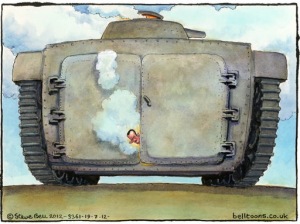
steve bell’s asad

This review of David Lesch’s book was written for the Scotsman.

Until his elder brother Basil died in a car crash, Bashaar al-Assad, Syria’s tyrant, was planning a quiet life as an opthalmologist in England. Recalled to Damascus, he was rapidly promoted through the military ranks, and after his father’s death was was confirmed in the presidency in a referendum in which he supposedly achieved 97.29% of the vote. Official discourse titled him ‘the Hope.’

Propaganda aside, the mild-mannered young heir enjoyed genuine popularity and therefore a long grace period, now entirely squandered. He seemed to promise a continuation of his father’s “Faustian bargain of less freedom for more stability” – not a bad bargain for a country wracked by endless coups before the Assadist state, and surrounded by states at war – while at the same time gradually reforming. Selective liberalisation allowed for a stock market and private banks but protected the public sector patronage system which ensured regime survival. There was even a measure of glasnost, a Damascus Spring permitting private newspapers and political discussion groups. It lasted eight months, and then the regime critics who had been encouraged to speak were exiled or imprisoned. Most people, Lesch included, blamed the Old Guard rather than Bashaar.

“I got to know Assad probably better than anyone in the West,” Lesch writes, and this is probably true. Between 2004 and 2008 he met the dictator frequently. His 2005 book “The New Lion of Damascus” seems in retrospect naively sympathetic. He can be forgiven for this. Most analysts (me included), and most Syrians, continued to give Bashaar the benefit of the doubt until March 2011.

The most visible result of the early reforms was the rise of a new crony capitalist class. There was economic growth, but not enough to keep pace with population growth, or to withstand the shocks of recurrent drought and the 2008 financial crisis. The regime’s socialist pretensions collapsed, and by 2011 Syria’s working classes were as discontented as Egypt’s or Tunisia’s. Still, almost every observer predicted that Syria would weather the revolutionary storm. The Assadist state was expected to survive because of its (false) image as a ‘resistance regime’ amid a sea of cowering Arab puppets, because of the crushed and divided opposition, the unity of the government with military and security agencies, the threat of sectarian splintering, and a deeply-rooted popular fear of repression.

There was a great deal of truth to this perception. Calls for protests in January and February failed to mobilise the people. It was regime stupidity and barbarism, its failure to recognise the historical moment, which finally brought crowds to the streets. (“Bashaar is the real leader of the revolution,” a Syrian recently told me.) In March children scrawled subversive graffiti on the walls of the drought-struck city of Deraa, and were arrested and tortured. A few hundred relatives demonstrated for their release. Soldiers opened fire, killing four. The next day 20,000 protested. Soldiers killed still more and water and electricity were switched off. Protests then spread around the country.

Lesch blames the miscalculation on inertia and instinctive violence as well as Bashaar’s increasing hubris since 2005, by which time he’d survived Syria’s forced withdrawal from Lebanon and the threat of Bush-doctrine regime change. A man who was “unpretentious, even self-deprecating” betrayed by 2007 “self-satisfaction, even smugness.”

At first the protests were uncoordinated, and local grievances were as important as national. Nobody called for the downfall of the regime, only for reform. Yet, crucially, the fear barrier was falling. Lesch quotes an activist on the catharsis felt by many: “It was better than joy, it was better than love. What was amazing was that suddenly everyone felt like family.”

Bashaar still had time, but it was rapidly running out. He waited a week after the first bloodshed before addressing the rubber stamp parliament. Lesch calls the speech “pathetic”, and so it was. Not wanting to appear weak, or to concede to pressure as Mubarak and Ben Ali had done in vain, he blamed the upheaval on foreign conspiracies. In fact, the West, the Gulf and Turkey were willing to wait for Assad to offer real reforms and stabilise the situation. He did mumble about reforms, but stressed he’d been planning them since 2005. Disastrously, he giggled throughout the speech. In the new context his “childlike laugh” no longer provided a charismatic touch.

The vicious circle set in – demonstrations, killings, larger demonstrations, worse repression – until the current crescendo of over 20,000 dead, thousands (including children) tortured and raped, and the major cities bombed by tanks and planes. State violence brought unstoppable momentum to the uprising. Lesch quotes another activist: “If we had known it would reach this point, we probably wouldn’t have dared oppose the regime. But we did it, and now we can’t stop, because if we do they will kill us all.”

Lesch gives a good overview of the various opposition organisations, the grassroots Local Coordination Committees, and the burgeoning Free Syrian Army. He describes the international forces supporting and (ineffectually) opposing Assad, and the ultimately irrelevant international diplomacy.

Lesch finished writing before the FSA became more effective, before the high-level defections and assassinations of top figures. His book inevitably suffers slightly from the gaps and editorial lapses of a book rushed out in haste. It is also difficult to read that Lesch still holds Assad’s spokeswoman Bouthaina Shaaban “in high regard” (“Do you think this system would accept torture?” she asked Channel 4 in outraged tones).

Stephen Starr’s excellent “Revolt in Syria: Eyewitness to the Uprising” offers a more street-level account, but the strengths of Lesch’s book are his solid analysis and his previous access to the top which, while not providing any particularly new insights, does add an interesting layer of personal observation. Lesch’s disillusion echoes that of ordinary Syrians, and he is therefore ideally placed to chart how the dictator’s smugness has pulled Syria, this ancient country, into the abyss.

Written by Robin Yassin-Kassab

October 11, 2012 at 10:12 am

Posted in book review, Syria

Tagged with

5 Responses

Subscribe to comments with RSS.

  1. […] Read more of this post Robin Yassin-Kassab | October 11, 2012 at 10:12 am | Tags: David Lesch | Categories: book review, Syria | URL: http://wp.me/pytsp-ww Share this:FacebookTwitterLike this:LikeBe the first to like this. […]

  2. An excellent piece. Accurate and beautifully written.

    So why am I clutching my head in exasperation while reading it?

    It’s because you wrote: ” Most analysts (me included), and most Syrians, continued to give Bashaar the benefit of the doubt until March 2011.”

    Then comment: ” It was regime stupidity and barbarism … which finally brought crowds to the streets.“

    Exactly! But why is the the true nature of the regime treated as a discovery?

    It has confounded and appalled me since 2000 that anyone could accept, at any level, that Bashar Assad should be automatically elevated to lead Syria and then taken seriously. And that the situation was likely to be sustainable.

    A hereditary dictatorship in the 21st century? End of story. And one as inept and sinister as they come.

    The bleak inevitability of today’s nightmare from the day Hafez Assad seized power was summed up with crystal clarity by Burhan Ghalioun in a speech at the LSE last month:

    “…the Syrian regime is not a political regime. It’s not even a nationalistic patriotic regime. It’s actually acting only through blood and authority of occupation. The Syrian regime came to power through violence. It never sought to integrate or actually have any sort of participatory approach towards its own people, even in a partial way. It never answered to any political standard.

    …“It’s only through violence or sometimes they resorted to manipulation. The way they always played and exploited any contradictions that are there in Syria, any fractions that are already there. They always manipulated it to rule. “

    (I recommend in full the speech in London at the LSE on 20 September by Dr Burhan Ghalioun, Université Sorbonne Nouvelle and Former Chairman of the Syrian National Council –

    http://www2.lse.ac.uk/middleEastCentre/Events/Event%20Transcripts/Ghalioun.Keynote.Transcript.pdf)

    What were Lesch and others thinking? That Planet Assad was ‘normal’? That Assad was the Syrian people? That the Syrian people weren’t human beings like everyone else?

    Calling it naivety is being kind. I think a sharp recalibration of his moral compass is required if Lesch wants to be regarded as a grown up.

    SL

    October 12, 2012 at 9:20 pm

    • I remember when hafez died there was an atmosphere of barely suppressed panic amongst many syrians. people were terrified of a return to the coups. i think many, perjaps most, syrians welcomed bashaar not wholeheartedly, certainly not beuase they liked the hereditary president idea, but as the least worst option. aand the late 90s, early 2000s looked a hell of a lot better than the 80s in syria. so many people hoped. I too (and obviously i was completely wrong) hoped. i think hafez, though undoubtedly a ruthless tyrant and a domestic mismanager, had a strategic intelligence. for instance, he immediately understood the ramifications for syria of the collapse of the soviet union. i thought perhaps some of that strategic intelligence might survive in the regime and that the family would recognise the new historical moment – 2011, the arab uprisings, etc – and respond more intelligently so that syria could have had a staged route to democracy with guarantees for all etc. i was wrong, i was wrong. (i would say that your characterisation of the baath is too simplistic, although it’s cetainly true that the regime was always based in violence and never in a genuine mass movement. it did however represent a movement of rural sunnis and minorities to the urban centres and a share in power, whatever we think of how it was done and what happened to other social groups. i mean, it had some kind of social base at first, some kind of natural constituency. since bashaar and the crony capitalism (and really since the late 70s when the gloves came off) it hasn’t had that.

      Robin Yassin-Kassab

      October 12, 2012 at 10:50 pm

  3. Qunfuz,

    Usually leaders are given 100 days in office as a grace period. Assad was given 11 years.

    Don’t be too hard on yourself regarding this. Would it had made much difference if you had wanted Assad gone years ago? Was there any credible alternative after the Damascus Spring was beaten down? Not really. The Assads did not allow any alternative except the mosque to raise its head in Syria. So the only real alternatives for someone what cared about Syria were either to go into a pessimistic funk or optimistically hope that Assad will change. If you want to fault yourself for anything it should be for being too optimistic despite the evidence. But that is not more than an epistemology misdemeanor.

    If I may ask, at what point did you reach the conclusion that the Assad regime was not really a resistance regime? How would you define a resistance regime?

    AIG

    October 16, 2012 at 2:14 pm

    • I would define a resistance regime as one which resists zionist occupation and aids the palestinians to resist apartheid. if that’s the AIG i think it is, you won’t agree, especially with the apartheid bit – but let’s not fight about it now. Theoretically a resistance regime could resist in any of a variety of ways – diplomatically, politically, militarily, even culturally. I’ve never liked the term and I never thought the asad regime was really interested in resistance, but it did seem to me at one point to nearly fit as a result of its help to hizbullah – which it seems i was also wrong about. But I still respect the past version of hizbullah for its work for the lebanese shia and for its military resistance to israel. asadist help to hizbullah is outweighed by its slaughter of palestinians in lebanon and its useless attempts over the decades to coopt and divide palestinian political and military organisations.

      Robin Yassin-Kassab

      October 16, 2012 at 6:55 pm

The Fall of the House of Asad

steve bell’s asad
by Robin Yassin-Kassab

This review of David Lesch’s book was written for the Scotsman.

Until his elder brother Basil died in a car crash, Bashaar al-Assad, Syria’s tyrant, was planning a quiet life as an opthalmologist in England. Recalled to Damascus, he was rapidly promoted through the military ranks, and after his father’s death was was confirmed in the presidency in a referendum in which he supposedly achieved 97.29% of the vote. Official discourse titled him ‘the Hope.’

Propaganda aside, the mild-mannered young heir enjoyed genuine popularity and therefore a long grace period, now entirely squandered. He seemed to promise a continuation of his father’s “Faustian bargain of less freedom for more stability” – not a bad bargain for a country wracked by endless coups before the Assadist state, and surrounded by states at war – while at the same time gradually reforming. Selective liberalisation allowed for a stock market and private banks but protected the public sector patronage system which ensured regime survival. There was even a measure of glasnost, a Damascus Spring permitting private newspapers and political discussion groups. It lasted eight months, and then the regime critics who had been encouraged to speak were exiled or imprisoned. Most people, Lesch included, blamed the Old Guard rather than Bashaar.

“I got to know Assad probably better than anyone in the West,” Lesch writes, and this is probably true. Between 2004 and 2008 he met the dictator frequently. His 2005 book “The New Lion of Damascus” seems in retrospect naively sympathetic. He can be forgiven for this. Most analysts (me included), and most Syrians, continued to give Bashaar the benefit of the doubt until March 2011.

Read more of this post

Robin Yassin-Kassab | October 11, 2012 at 10:12 am | Tags: David Lesch | Categories: book review, Syria | URL: http://wp.me/pytsp-ww

Blasphemy

Qunfuz

Robin Yassin-Kassab

with one comment

“Is the Prophet who is being insulted in Syria not the same Prophet who is being insulted in America?”

This video is not suitable for children nor for those of a nervous disposition. I include myself in the latter category. At first I couldn’t watch it, then I made myself do so in order to hear the words. Before the usual “Freedom? You want freedom?” the torturee is forced to declare that Bashaar al-Asad is his ‘lord’ (the Arabic word ‘rabb’, which means God). The violent (but very small) protests which have swept the Muslim world in response to a ridiculous low-budget smear of the Prophet Muhammad are in part the expression of a deeply humiliated people who remember Western support of Zionism and Muslim dictatorships, Western invasions of Iraq and Afghanistan, and so on. They are in part the result of the failure of Arab and Muslim dictatorships to build functioning education systems, and a symptom of a profound and generalised despair that requires wounded symbols through which to manifest itself.

Most importantly, they are signals of an opportunistic power play by the extreme right-wing Salafist minority. It’s a case of extreme right-wing Islamophobes, Zionists, Coptic extremists and American Republicans on the one hand and extreme right-wing Islamists on the other, feeding off each other. The furore has made the ridiculous anti-Islam film a Youtube hit. Nobody would have heard of it had Egyptian Islamists not publicised it, and had the American ambassador to Libya, apparently a friend of the Arabs who was critical of US policy on Palestine, not been murdered. As with all the episodes in the ‘culture wars’, it’s an enormous diversion from the really serious issues.

The torture video here was first pointed out by the Syrian activist Wissam Tarif. He asked a simple question. Where are the furious demonstrations against this blasphemy? Why have no Syrian embassies been burnt following the repeated bombing of mosques and churches, the murder, rape, torture and humiliation of tens of thousands of Syrian Muslims?

Here are some Syrian responses to the mess. Here’s Libyan novelist Hisham Matar on the violence in Benghazi. Here’s Matt Duss on the Islamophobic entertainment industry. And here’s Hamid Dabashi drawing lessons from the Iranian revolution. (The Syrian regime, meanwhile, organised its own small demonstration against the film. These people have been taking chutzpah lessons from Zionism).

To Kill, and to Walk in the Funeral Procession (reposted with p.s.)

with 4 comments

photo by Razan Ghazzawi

The Syrian regime is now perpetrating crimes against humanity at a pace to match its crimes in Hama in 1982 and at the Tel Za’atar Palestinian camp in 1976. All of Syria is a burning hell. Savage aerial bombardment (such as that causing the apocalypse here in Kafranbel, which held such beautifully creative demonstrations) and continuous massacres have raised the average daily death toll to well above two hundred, most of them in Damascus and its suburbs. The other day 440 people were murdered in twenty four hours.

The worst hit area has been the working class suburb of Darayya. I visited people in Darayya some years ago, and once bought a bedroom set for a friend’s wedding in the town. I remember it as a lively, friendly, youthful place. Last year Darayya became a cultural centre of the revolution. Ghiath Matar and others developed wonderful methods of non-violent protest there. When security forces arrived to repress demonstrations, Darayya’s residents handed the soldiers flowers and glasses of water. But Matar was murdered, and Darayya has been repeatedly raided, its young men detained and tortured, its women and children shot and bombed. Nevertheless, for some months the regime was kept out of Darayya. The town ruled itself in a civilised manner, successfully keeping a lid on crime and sectarianism.

The recent pattern is already well established (remember the massacre at Houla), but this time has played out on a larger scale. The regime bombed Darayya for days, mainly from artillery stationed on the mountains overlooking Damascus. Once any armed resistance had retreated, soldiers and shabeeha militia moved in, with knives and guns. This stage reminds one of Sabra and Shatila. It seems there was a list of suspected activists and resistance sympathisers, but the field executions included old men, women and children. About three hundred bodies have been counted so far, found in the street or in basements or in family homes.


The next stage is to mock the victims. The film below is the al-Dunya (a regime propaganda channel) report on the massacre. The actress/journalist (not a good actress, for she mistakes the scene; while waxing poetic and prettily outraged, she forgets to simulate fear and horror) shows the viewers what the ‘terrorists’ have done. She interviews a wounded woman. The wounded woman responds as if she’s facing interrogation, which of course she is. Terrified women in the back of a pick-up praise the regime army. The reporter is accompanied by the army that has just murdered the women’s neighbours. From 4.20 the reporter compounds the trauma of a little girl who is lying terrified beside her dead mother. It is perhaps the most disgusting thing you’ll ever see.

[youtube http://youtu.be/uRBnM8tmMuw?]
 

Postscript. The appalling Robert Fisk (I know he used to be good but since 2005 he has been an awful journalist, self-obsessed, ignorant, fawning over warlords or their wives, pretending to speak Arabic when he obviously doesn’t) has done his own version of the al-Dunya propaganda in Darayya. Admittedly, his report isn’t quite as obscene as al-Dunya’s, or rather it exists within a tradition which is slightly less obscene than al-Dunya’s. But it’s still obscene. Here it is. It will make the intellignet, informed or humane reader vomit. (A few days before, Fisk fawningly interviewed the criminal Walid Muallem. Muallem whined about anti-Syrian conspiracy, and Fisk, instead of using his access to say “But surely the revolution is motivated and mobilised by regime repression?” he said, “But isn’t it all about Iran?” In other words he believes the regime propaganda, and the balnket thinkers, and is entirely ignorant about what happens on the ground in Syria, just as he’s been ignorant about Lebanon for many years. What else can we expect from an area ‘expert’ who thinks the arabic word umma (nation or community) means ‘mother’?

Anyway, the Local Coordination Committees, who understand the requirements of ethical journalism better than the Independent, have responded, very politely, to this shambles of a journalist. Here is the response:

Daraya Coordination Committee

Press Release

Robert Fisk’s report about the massacre of Saturday 25/08/2012

On Wednesday 29 August 2012, Mr. Robert Fisk of The Independent wrote a report on the Daraya Massacre that was perpetrated only 4 days earlier. Mr. Fisk is a world-famous journalist known for his balanced opinion pieces and ground-breaking reports especially from the Middle East. The people of Syria especially remember Fisk for being the first foreign reporter to enter the city of Hama after the 1982 massacre and relate to the world the horrors he saw there. Thus, we were absolutely astonished by the above-mentioned report and would like to make sure that certain points in it are not left uncorrected. We do this out of respect to the fallen heroes and to make sure the voice of the victims is heard.

Anyone who watched the infamous and insolent report made by the state-favored Addounia TV, would notice the obvious similarities between the two reports.

One major concern that would invalidate any statement taken from the victims is the presence of army personnel as admitted by Mr. Fisk himself. Anyone with the slightest knowledge of the Syrian regime would know the degree of intimidation this would incur in the hearts and minds of witnesses. The army does not need to spoon-feed the statements to the witnesses as fear is more than enough to make them repeat the narrative propagated by the government about armed militias and radical Islamists.

Moreover, the article is headlined and predicated on the government’s unbelievable prisoner-swap story. The question that begs to be asked is the following: Even if there was a prisoner exchange and it failed, does the Assad regime have any grounds at all for this level of retaliation? Were there similar failed rounds of negotiation before the massacres of Muaddamiya, Saqba etc. In fact, what has been happening in the towns of the Damascus Countryside Governorate, and indeed all of Syria, follows a similar scenario that begins with shelling and ends with massacres of civilians.

A seemingly strong point in Mr. Fisk’s report is his mentioning of real names of people telling their real stories. However, the Coordination Committee of Daraya has been in touch with some of these people and the following corrections need to be made.

1- The story of Hamdi Khreitem’s parents. The witness must have been too intimidated to identify his parents’ killers. Our reliable sources from the field hospital of Daraya confirm that both of them were targeted by a sniper (from the Assad army of course).

2- The story of Khaled Yahya Zukari. The witness was actually in a car with his brother and their wives and children. They were shot at by government forces and his wife and daughter (Leen) were hit. The baby girl’s head was almost split in half and a bullet penetrated the mother’s chest. The mother became hysterical as a result of the shock. Later she died as the field hospital had to be evacuated prior to an army raid. The Assad army told the people that the FSA raped and killed the woman.

The fear and intimidation of witnesses is reflected sometimes in their refusal to name a guilty side. Moreover, Mr. Fisk should know better than reporting conjecture such as this: ‘Another man said that, although he had not seen the dead in the graveyard, he believed that most were related to the government’s army and included several off-duty conscripts.’ The implicit accusation is of course directed against the FSA and this method of reporting resembles Syrian state propaganda par excellence, something that we wish Mr. Fisk had not done.

The revolution committee would finally like to stress also that Mr. Fisk did not meet any member of the opposition in Daraya and that he merely depended on the narrative of his ‘tour guides’ in reporting on such a horrific massacre, the ugliest Syria has seen in the 17 months of the revolution

Syria : Blanket Thinkers

Qunfuz

Robin Yassin-Kassab

with 2 comments

Yarmouk camp demonstrates

One of my infantile leftist ex-friends recently referred to the Free Syrian Army as a ‘sectarian gang’. The phrase may well come from Asa’ad Abu Khalil, who seems to have a depressingly large audience, but it could come from any of a large number of blanket thinkers in the ranks of the Western left. I admit that I sometimes indulged in such blanket thinking in the past. For instance, I used to refer to Qatar and Saudi Arabia as ‘US client states’, as if this was all to be said about them. I did so in angry response to the mainstream Western media which referred to pro-Western Arab tyrannies as ‘moderate’; but of course Qatar and Saudi Arabia have their own, competing agendas, and do not always behave as the Americans want them to. This is more true now, in a multipolar world and in the midst of a crippling economic crisis in the West, than it was ten years ago. Chinese workers undertaking oil and engineering projects in the Gulf are one visible sign of this shifting order.

(My talk of ‘infantile leftists’ does not include the entire left of course. Simon Assaf of the Socialist Workers, for instance, understands what’s happening. So does Max Blumenthal. And many others.)

The problem with blanket thinkers is that they are unable to adapt to a rapidly shifting reality. Instead of evidence, principles and analytical tools, they are armed only with ideological blinkers. Many of the current crop became politicised by Palestine and the invasion of Iraq, two cases in which the imperialist baddy is very obviously American. As a result, they read every other situation through the US-imperialist lens.

Qaddafi had opened up Libyan oilfields to Western exploitation, he bought Western weapons, and he tortured rendered suspects for the CIA. Inspired by uprisings in Egypt and Tunisia, the Libyans rose against the tyranny with incredible courage. When Britain and France, for their own reasons, helped to hasten the end by degrading Qaddafi’s mercenary forces (important but not decisive help – Qaddafi’s fall was effected by a rising in Tripoli and an influx of fighters from the Jebel Nafusa), blanket thinkers very insultingly painted the popular revolution as a foreign plot. Some even retrospectively raised Qaddafi to the rank of anti-imperialist hero. And since the fall of the old regime they’ve done everything they can to paint Libya as a failed state, a site of genocide, a new Iraq. It’s pretty insulting to Iraq as well as to Libya.

The fact that politics and civil society were effectively banned for decades, and the fact that Qaddafi imposed a civil war on his people, traumatising them and causing thousands of young men to take up arms, means that the new Libya faces imense problems. This is not news. Whenever a dictatorship ends violently, all the problems which have been repressed will burst forth. It’s like taking the lid off a steam cooker: all the good and evil in the society, all the intelligence and stupidity that was previously hidden, will spill out. This is not an argument for keeping the dictatorship. Several hundred have been killed in Libya since the fall of Qaddafi, mainly in battles between rival militias. Sometimes this has had a tribal or revenge aspect, but there has been no Iraq-style ethnic cleansing. There is a small separatist movement in the east. Fringe Islamist extremist groups have made a lot of noise. Many of the armed young men are reluctant to give up their arms. But there has been a very successful election. If the new government is able to absorb the militias into a national army and to resolve tribal, regional and other disputes within an accepted political process, Libya can look forward to a much better future. Opinion polls and conversations with Libyans show that an overwhelmingly large majority are happy that Qaddafi has gone and are optimistic about the future. But what does Libyan opinion matter to blanket thinkers?

After 17 months of slaughter in Syria, there is no no-fly zone. The extent of Western and ‘client’ intervention is this: Saudi Arabia and Qatar may be providing a small amount of light weaponry. The Turks may be helping to coordinate the weapons deliveries. The CIA appears to have a few men on the ground watching where the weapons are going and hoping (vainly) to ensure that they’ll never end up in the hands of anti-Zionist militants. On the other side stands a nakedly sectarian regime which considers its people slaves and murders them and destroys their cities with Russian weapons. Imperialist Russia, which has oppressed Muslims in the Caucuses and central Asia, and which bears half the blame for all the Cold War hot wars in Africa, is resupplying the regime with attack helicopters, tank parts and ammunition as the death toll surpasses seventeen thousand. Russia also protects the regime from condemnation at the UN security council. It plays the same role with regards to Syria that the United States plays with Israel. But how do the blanket thinkers see the situation? For them it’s yet another clear cut case of American imperialist aggression against a noble resistance regime, and once again the people are passive tools.

At best they are passive tools. They are also depicted as wild Muslims, bearded and hijabbed, who do not deserve democracy or rights because they are too backward to use them properly. Give them democracy and they’ll vote for the Muslim Brotherhood, and slaughter the Alawis and drive the Christians to Beirut. The blanket thinkers search for evidence of crimes committed by the popular resistance, and when they find them (usually on very flimsy evidence) they use them to smear the entire movement. They demand the resistance negotiate with a regime which has proved again and again that its only strategy is slaughter. They demand that the people remain peaceful as their children are tortured, their women raped, their neighbourhoods levelled. Leftist blanket thinkers do not apply the same criteria to the popular resistance of the Palestinians. It’s Zionists who do that.

To call the Free Syrian Army a sectarian gang is tantamount to calling the Syrian people a sectarian gang. It betrays a willed ignorance of reality. The FSA was formed in response to the sickening violence perpetrated by the Syrian regime, which at this stage is certainly a sectarian gang. Its Alawi military units work with armed Alawi civilians to slaughter Sunnis. This is a disaster for the Alawis and everyone else; it sows the seeds of a potential war which would destroy the country for generations, and it’s one of the first reasons why the regime must go as soon as possible. But the FSA is in reality hundreds of local militias which sometimes cooperate. It consists of defected soldiers (these people are heroes – they fled the army at huge personal risk because they were unable to stomach murdering their people; most soldiers who try to defect are killed before they leave base) and local men who have taken up arms to defend their neighbourhoods. Because the FSA is made of ordinary men, it covers an enormous range of political opinion. Some fighters are disillusioned Baathists, some are secularists, some leftists, some support the Muslim Brotherhood and some are attracted by extremist Wahhabi rhetoric. Some, I’m sure, are criminals, because some of the Syrian people are criminal. Some will be in it in the hopes of financial or sexual profit, because that’s the way people are.

Most are apolitical people, except for the fact that they want to bring down the tyranny. They fight because they have no choice. Of course, there is a huge danger that apolitical people will be easily manipulated by sectarian rhetoric, especially given that their enemy instrumentalises sectarianism. This is certainly a difficult period for revolutions in the Muslim world and internationally. The collapse of leftist thinking and reach, and the shrinking of public debate by dictatorships and consumerism, has left the way open to retrograde forms of religious or nationalist politics. Some of the battle videos labelled ‘Free Syrian Army’ look and sound depressingly similar to jihadist videos from Iraq. But for now it’s mainly a problem of style and ignorance, and it can easily be misinterpreted by an orientalist eye. Most Syrian people are religious, whether we like it or not. But most Syrian people are also aware that a sectarian war would produce no winners. The Allahu Akbar chant expresses a faith which is necessary to overcome the fear of being shot. It doesn’t autmomatically mean ‘Kill the Kuffar’. (But who am I talking to? The Palestinians use religious rhetoric and talk about ‘the Jews’ rather than ‘the Zionists’, and it doesn’t bother the blanket thinkers for a moment).

The longer the necessary fight goes on the more brutalised the people will become, and the more likely that vengeful sectarian voices will dominate. It is the duty of any right-thinking person, leftist or otherwise, to support the oppressed people in their struggle. Anyone who does so, and who respects the Syrians enough to base their comments on knowledge rather than assumption, will have earned the right to offer political advice to the Syrians.

The FSA is inevitably disorganised and outgunned. But it’s a lot more organised than it was a few months ago, and it is liberating territory. It fights with commitment and incredible resilience. Today the battle is in inner Damascus.

And a few days ago it was in the Yarmouk and Palestine refugee camps, which brings me finally to the strange fact that blanket thinkers persist in thinking of the Syrian regime as in some way a threat to Israel. It’s true that Syria helped Hizbullah stand firm, and this is not a small thing. It’s also true that the Syrian regime has massacred Palestinians in Tel Zaatar and other Lebanese camps, that since 1973 the border with the occupied Golan has been quieter than borders with states enjoying peace agreements with Israel, and that Syria has never even tried to shoot at the Israeli planes which have bombed its territory since Bashaar inherited power. But things have become clearer since the uprising began. Rami Makhlouf told the New York Times that Israeli security depended on the Syrian regime’s security.

Paul Woodward at War in Context quotes Reuters on the regime’s recent transportation of chemical weapons: An Israeli official said however the movements reflected an attempt by President Bashar al-Assad to make “arrangements to ensure the weapons do not fall into irresponsible hands”.

“That would support the thinking that this matter has been managed responsibly so far.”

Woodward then comments: So, while the word from Damascus is that “terrorists” armed with “Israeli-made machine guns” conducted the massacre in Tremseh yesterday, the word from Tel Aviv is that Syria’s chemical weapons are nothing to worry about so long as they remain in the responsible hands of the government.

There might be a certain amount of truth in that statement. Still, it’s not exactly the rhetoric one might expect from a representative of an alliance that is supposedly gunning for Assad’s downfall. On the contrary, it reflects the fact that Israel would be much happier to see Assad remain in power.

Here’s a simpler proposition for the blanket thinkers: Hizbullah won victories because it respects its people, because it is of its people. A regime which murders its people and destroys the national infrastructure, which plays with the dynamite of sectarian conflict and puts the whole people’s future in question, would be incapable of winning a victory even if it wanted to.

On Friday tens of thousands protested against regime barbarism in the Palestinian camps of Damascus. Regime forces opened fire, murdering eleven. Many more were dragged from their homes to be tortured in detention. Professional liar and regime spokesman Jihad Maqdisi then described Palestinians as ‘impolite guests,’ outraging Syrians and Palestinians, who are the same people, now more than ever.

Blog at WordPress.com.

Up ↑