Search

band annie's Weblog

I have a parallel blog in French at http://anniebannie.net

Category

Qunfuz

Something Worse?

leave a comment »

An edited version of this article was published by al-Jazeera.

Down with ISIS, from Kafranbel

Down with ISIS, from Kafranbel

In a hotel lobby on the Turkish side of the Syrian border, Yasser Barish showed photographs of his bombed family home in Saraqeb, Idlib province. One room was still standing – the room Yasser happened to resting in on September 15th 2012 when the plane dropped its bomb. The other rooms were entirely obliterated – ground level rubble was all that remained. Yasser’s mother, grandmother, sister and brother were killed.

Saraqeb is a much fought over strategic crossroads, invaded wholescale by Assad’s army in August 2011 and March 2012. Since November 2012, the regime has had no presence in the town (though its artillery batteries remain in range). At first the Local Coordination Committee provided government, but through the spring of 2013, the al-Qa’ida-linked Islamic State of Iraq and Syria (ISIS) gradually increased its presence in the town.

Yasser told me how they took over Saraqeb. At first only ten representatives came, and they brought with them large amounts of medicine and food. They were humble and generous, and warmed the local people’s hearts. They also brought money, with which they recruited ammunition-starved and hungry local fighters. Then reinforcements arrived – “Libyans, Algerians, a lot of Iraqis, some Afghans and Turks, one white Belgian and one white American” – enough to frighten thieves into good behaviour, which at first increased the organisation’s popularity. But in May 2013 they whipped two men in a public square for an infringement of Islamic family law. In June they took absolute control, forbade drinking and smoking, and made prayer compulsory.

Yasser is part of an independent team which publishes magazines for adults and children – a sign of autonomous revolutionary success in terribly difficult circumstances. The slogan “I have the right to express my opinion” graces the cover of Zeitoun wa Zeitouna, the children’s magazine. Since the culling of his family, Yasser doesn’t care if he lives or dies. But so long as he’s here, he’s dedicated himself to improving local lives – teaching children how to read and encouraging them to tell stories and draw pictures. (The local schools, of course, are closed, and most of the teachers killed or fled.)

But even these simple aims are difficult to achieve, even in the regime’s absence. ISIS closed one printing press (a second ran at a secret location), and arrested and beat Yasser for ‘taking photographs of women’ (the ‘women’ in question were girls under the age of thirteen participating in one of his workshops).  In July 2013 he witnessed ISIS attacking Saraqeb’s media centre and its abduction of a Polish journalist.

ISIS should by no means be considered part of the revolutionary opposition. It has fought Free Army divisions as well as Kurdish groups, assassinated Free Army and more moderate Islamist commanders, and abducted revolutionary activists. It serves the regime’s agenda by terrifying minority groups, deterring journalists, and influencing the calculations of men like former American ambassador to Syria Ryan C. Crocker who writes (from a deficit of both information and principle, and with stunning short-sightedness): “We need to come to terms with a future that includes Assad – and consider that as bad as he is, there is something worse.” Indeed, many Syrians are convinced that ISIS is an Assad creation, or even a collaborative work of Assad and the great powers. Why else, they ask, does Turkey, a NATO member, make it so easy for foreign militants to cross the border? Why has the regime bombed the schools and marketplaces of Raqqa (a city in the north east held by ISIS for half a year), but not the well-known ISIS headquarters?

Apparently Ryan Crocker’s assumptions are shared by the British airport police. On the first stage of my trip to the Turkish-Syrian border, I was stopped at Edinburgh airport and examined under Schedule Seven of the UK’s Terrorism Act (2000).  I was led to an interview room and asked which of the sides in Syria I supported. I explained that there are by now at least three sides, and I perhaps gave a fuller reply than expected. The question as posed seemed to demand an either/ or response: either the regime or the jihad. I suspect the safe and simple option for a Briton with a Muslim surname heading for the border areas is to say that they support the regime – that is, the side which rapes and tortures children on a vast scale, which bombards residential zones with barrel bombs, scud missiles and sarin gas. That way they’ll tick the ‘no further threat’ box.

But while the West writes off Syria as a security problem, the Syrian revolution is getting its house in order. In early January a long-brewing counterstrike wiped out the mini-states set up by ISIS along much of the Turkish border, strategic positions from which it controlled the passage of men and weapons. The attack responded to anti-ISIS demonstrations all across the north, and was led by the Mujahideen Army and the Syrian Revolutionary Front – groups associated with the Free Army. But many of the anti-ISIS fighters are also Islamists, also fighting for a shareea state, from both Jabhat an-Nusra, (also al-Qa’ida affiliated but more intelligent and disciplined in its dealings with the people) and, more importantly, the Islamic Front.

This alliance of seven leading Islamist factions was cobbled together over the autumn, and so far seems much more disciplined, certainly better armed, than the Free Army ever was. Its eclipsing of the secular Free Army happened not despite Western policy (as much journalism insists, misleadingly describing the Free Army as ‘Western-backed’) but because of it. The vanishing of Obama’s ‘red line’ and his handing the Syria file over to Putin after the mass Sarin gas attacks of August 21st catalysed the Islamist realignment, and probably a burst of Saudi largesse.

Samer, a pro-Front medical worker injured when the regime bombed a field hospital in the Damascus suburbs, stressed the practical importance of Islamist unification: “These are the best, most organised fighters. They aren’t expecting anything from the West. If they work as one, they can defeat the regime.” November’s progress in the eastern Ghouta and the strong defence against Assad and Hizbullah’s offensive in the Qalamoun region may be early proof of this.

Many democratic revolutionaries support the Front because they see it as the force most likely to roll back Assad’s war machine and because they hope its success will undermine more extreme groups – but their support is expressed through gritted teeth. They note that the Islamic Front’s most prominent leaders were released from the regime’s Seidnaya prison in the early days of the revolution, at the same time that secular activists were being hunted down and killed, and point out that ‘Islam’ is not a slogan which minority groups – large sections of which must be won to the anti-Assad cause if Syria is to remain one country – can stand behind. Ahrar al-Sham, the largest organisation in the Front, was implicated by Human Rights Watch in the slaughter in Lattakia province last August – so far the only documented large-scale massacre of Alawi civilians. The organisation denies involvement. Islamic Front leader Zahran Alloush has promised protection to minorities (which implies no automatic equality of citizenship) while also vowing to cleanse Damascus of Shia influence. Furthermore, the Islamic Front says that it is fighting not for democracy but for a shareea state, and therefore rejects popular sovereignty as expressed through democratic elections.

This was put to a man called Qutaiba (like Samer he fears for his family in regime-controlled areas, and doesn’t want his surname used), who is close to several of the Front’s leaders – that it’s for the people, not an armed group, to decide the nature of future government. Qutaiba responded with the medieval concept of ahl al-hal wal-aqd, or ‘those who loose and bind’, as a substitute for democracy – an assembly of clerics and businessmen who would elect and guide a caliph. This sounds a little like British democracy in the nineteenth century – perhaps an advance on Assadist totalitarianism but not a model likely to long satisfy the working classes politicised by the revolutionary process.

“But will they force it on the people?” asked Qutaiba in reply. “These are sons of the people, not dictators. They have laid out how they think the future should be. They haven’t said they’ll impose it by arms.”

Many find hope in the fact that the footsoldiers of the Islamist brigades are often not motivated by ideology but by the need for discipline and weapons, even food – which the Islamists can supply far better than the Free Army. At first sight, it is bewildering that Ahrar ash-Sham and Jabhat al-Nusra liberated two churches in Raqqa from ISIS and removed the black flags that had been posted from their spires. According to local activist Abu Maya, “God willing, the churches will be restored and used again by Christians in Raqqa.” But this is explained by the fact that Jabhat al-Nusra in Raqqa is manned by ex-Free Army fighters.

Something else to consider is this: just as ‘Islamic state’ connotes repression in Western ears, to many Arab ears it sounds like ‘justice’, ‘decency’, ‘the rule of law’. It means something better than what they lived with under Assad. The concrete definition of what the state would mean in practice is a matter of fierce dispute which can only be resolved by elections.

By now everbody knows that the world isn’t coming to save Syria, that Syria must save itself. The present stage of this process involves finishing ISIS as well as confronting the regime. After that, either the people in at least most regime-controlled areas will welcome the revolutionary militias, or the revolutionary militias will fail to make meaningful progess. Most people in regime controlled areas are terrified of ISIS, not just minorities (who comprise a third of the population anyway) but also very many Sunni Arabs, including working class ones. The presence of Islamist extremists makes it strategically impossible to defeat Assad, as illustrated recently when Deir Attiyeh was briefly liberated. ISIS arrived with the liberating forces and mistreated Christians. As a result, many people there (Muslims too) were actually pleased when the regime retook the city.

Once ISIS has gone, liberated Syria must continue to arrange its affairs. The Islamic factions (and everyone else, but in particular Jabhat an-Nusra and Ahrar ash-Sham) must continue to increase their discipline so no abuses against minorities or dissenters occur. The Islamic Front must also be publically persuaded to democratise its programme. As a major player, it is entitled to call for a shareea state, but it must clarify that it is the Syrian people who will decide on the nature of their future state in democratic elections/ referenda – not a group of men armed with weapons and a great deal of conviction. Because Syria has been there before.

The Syrian revolution rose first against Assad and now against ISIS. There is every reason to believe that it will continue confronting tyrants. All should take note.

source

Revolutionary Gardening

Qunfuz

Robin Yassin-Kassab

the radishes are at ground level

the radishes are at ground level

For a long time it’s been too late for a happy ending in Syria. The longer this process continues, the less we can hope for.

How do you fight a monster without becoming a monster? How, particularly when the monster’s chief strategy is to make a monster of you? How, when the world’s most powerful storytellers depict you as a monster? How, when monsters hiding behind human facades walk by blindly as you are tortured, raped, humiliated, maimed, murdered?

I don’t really know. I’d welcome a reading list, if anyone has one.

I know this monster must be fought, even if we become monsters while fighting it. I know we must fight both internally and externally. I know the greater and lesser jihads must be fought simultaneously.

At some point, somehow, this stage will be replaced by another. Most probably that stage like this one will be bumbled through blindly. Human beings seldom or never achieve control over their larger social movements. Still, it’s pleasant to imagine that Syrians will be able to defuse the sectarian tensions which have existed at least since ibn Taymiyyeh, which were immeasurably exacerbated by Sykes-Picot and the French occupation’s construction of an ‘army of minorities’, and then set afire by Assad’s gang and its allies. It’s good to hope too that a new constitution will guard against any party, clique or ideological police imposing its straitjacket on the plural people.

Beyond religion and politics, environmental factors should also be taken into account.

It’s interesting to note that Jared Diamond’s three factors of civilisational collapse (deforestation, soil erosion, water management problems) have been present in Syria since late Ottoman times, and rampant in the last couple of decades. People my age who grew up in Damascus remember that in their childhoods the Ghouta still consisted of orchards and streams, that summer temperatures almost never climbed above the mid to high thirties. Wasn’t Damascus the city the Prophet refused to enter, fearing to sin by imagining himself prematurely in paradise? The dicatorship’s corruption (anyone with connections or money could build in the green zone) put paid to that. Stupidly grand development schemes repeated the pattern all over the country (Lake Assad, like Lake Nasser, was an environmental and social disaster – see Omar Amiralay’s film A Flood in Ba‘ath Land – a wonderful exercise in quiet irony). People’s lack of control over the public space meant they were alienated from it, and threw black plastic bags all over it (this explains the discrepancy between people’s spotlessly clean homes and the filth in the streets outside). Over the decade before the revolution erupted, a million climate change refugees, according to the UN, left the desertifying north east for the impoverished outskirts of Dera’a, Homs, Damascus and Aleppo. This, combined with the effects of Bashaar’s crony capitalism, provides the backdrop to the uprising. The revolutions to the west, and the monster’s extreme violence, provided the spark.


in Atmeh camp

in Atmeh camp

When the next stage comes, every Syrian city (except two, Tartus and Lattakia – but they may well be burnt in the near future) will have to be rebuilt.

Rebuilding them to incorporate gardens for food security is an excellent idea, and surely not so difficult. All it requires is a return to tradition and a rejection of recent perversions. Damascus and Hama already incorporate fields into the inner city. Go back 40 years and the interconnection of agriculture and urbanity was much more evident.

In Atmeh camp I found refugees who’d lost everything growing herbs around their tents. At Hamood’s house in Kafranbul, where I spent a night, a rocket had punctured a wall. Beneath the damage, Hamood pointed to his flourishing radishes. His face lit up in repeatable wonder as he showed me these leaves. Despite the destruction, the people are planting seeds.

Here’s Permaculture Arabia’s website. In a region facing an imminent thirst crisis, you’d think there’d be more inerest in this. Whoever inherits Syria (please God, let that be the people themselves) needs to think about this very hard.

A Cry for Help

September 10, 2013 § Leave a Comment

shroud

Yassin al-Haj Saleh, from the suburbs of the eastern Ghouta, writes this plea at the New York Times.

THE story is simple. Here in Syria, there is a regime that has been killing its subjects with impunity for the last 30 months. The notion that there is a mysterious civil war that is inextricably linked to the nature of the Middle East and its complicated sectarian divisions is far from the truth.

The primary perpetrator of violence is the government of Bashar al-Assad, which controls public resources, the media, the army and the intelligence services. The civilians who rose up against that regime, first peacefully and then through armed resistance, constitute a broad spectrum of Syrian society.

When a government murders its own citizens and they resist, this can hardly be called a civil war. It is a barbaric campaign of the first degree.

During the revolution’s first year, Syrians demanded international protection. First we asked for no-flight zones or humanitarian corridors, and later for weapons and military aid for the Free Syrian Army, but to no avail.

Not a month went by without some American or NATO official expressing little appetite for intervention. Realizing that this attitude was not about to change, the regime escalated the violence. It attacked the rebels with everything it had: first with rifles, then with tanks, helicopters, jet fighters, missiles and toxic gases.

Meanwhile, Western powers masked their diplomatic inertia with empty rhetoric about a “political solution.” Yet they have failed to coax the regime — which has not once indicated that it is ready to abandon its “military solution” — to the negotiating table.

Inaction has been catastrophic. While the world has dithered, Syrians have experienced unprecedented violence. Around 5,000 Syrians were killed in 2011. About the same number are now being killed each month. The regime has targeted lines outside bakeries; it has used Russian cruise missiles to bomb densely populated areas; and local activists say they have documented 31 occasions when it has used chemical weapons (United States officials have confirmed only some of these attacks).

Countless Syrians, among them women and children, have been subjected to arbitrary detention, rape and torture. A staggering seven million people — one-third of Syria’s population — are now displaced, either internally or externally.

These violations have all been documented by international organizations, including Human Rights Watch and the United Nations Human Rights Council. These organizations have repeatedly attempted to refer the Syria file to the International Criminal Court, but Russian and Chinese barriers have stood in their way.

Russia and China have used their veto privilege on three occasions, blocking Security Council resolutions condemning the regime’s war crimes and crimes against humanity. Russia continues to provide arms and diplomatic cover to a regime that is becoming more dangerous by the day.

In the West, reservations about supporting the Syrian rebels that once seemed callous and immoral are now considered justified because of the specter of jihadism. But this view is myopic.

Jihadist groups emerged roughly 10 months after the revolution started. Today, these groups are a burden on the revolution and the country, but not on the regime. On the contrary, their presence has enabled the regime to preserve its local base, and served to bolster its cause among international audiences.

It is misguided to presume that Mr. Assad’s downfall would mean a jihadist triumph, but unfortunately this is the basis for the West’s position. A more accurate interpretation is that if Mr. Assad survives, then jihadism is sure to thrive.

What Syria needs is a legitimate government that is strong enough to delegitimize militias, to disarm and integrate them, and to enforce adequate policies to confront them. The Assad government does not have popular legitimacy. Only its demise can signal the beginning of the end of nihilist jihadism, and thus the beginning of Syria’s recovery.

Justice and humanity demand that the Assad regime be punished for its crimes. Even though the Russians and the Chinese have managed to impair the Security Council, it is still possible for an international and regional coalition to carry out this task.

A half-hearted intervention will not be enough. The United States and those who join it must not simply “discipline” the regime for its use of chemical weapons alone, without making a decisive impact on events in Syria. To do so would be a waste of effort and send the wrong message.

We Syrians are human beings of this world, and the world must stop the Assad regime from killing us. Now.

Yassin al-Haj Saleh, a writer and activist, was a political prisoner from 1980-96.

source

In Atmeh Camp

Qunfuz

Robin Yassin-Kassab

Malek

Malek

This account of my visit to Atmeh camp was published at Foreign Policy. In deference to their new paywall, I’ve waited a week before posting it here, and I haven’t posted the edited version, which for a change is better than the original, and which includes a brief commentary on the proposed intervention after the chemical weapons attacks. (I think you can read a certain number of articles at FP before paying – though if you can pay, do. FP is a great resource. I may give up my subscription to the sadly orientalist London Review of Books and subscribe here instead).

At the north eastern corner of the Mediterranean lies what used to be called the Sanjak of Alexandretta. Historically part of Syria, the French Mandate awarded the territory to Turkey in the late 1930s. The Turks named the area Hatay, after the Hittites. The extreme Turkish nationalism of the time held that the Hittites, like the Sumerians and other ancient peoples, had been proto-Turks, and that the Hittite ruins in the area justified its annexation to the Kemalist republic. The Arab population of the province produced their own mythology in response. Zaki Arsuzi, one of the founding ideologues of the Ba‘ath Party (its slogan: One Arab Nation Bearing an Eternal Message), did much of his agitating in Antioch, the provincial capital. Ba‘athism appealed particularly to non-Sunni minorities throughout the Levant. Today a debased version of the creed provides ideological cover for Syrian president Bashaar al-Assad’s campaign of slaughter.

Reyhanli (Reyhaniyeh in Arabic) is a town in Hatay right on the Turkish-Syrian border. Its population of Turks and Alawi, Sunni and Christian Arabs has recently doubled with the arrival of Syrian refugees. The crisis has boosted the local economy but also brought tragedy – a car bombing on May 11th, almost certainly the work of Assad’s intelligence services, killed 51 people. It was the worst terrorist atrocity in Turkey’s history.

A hotel in Reyhanli served as my base in late June while I worked with refugees on the other side of the border. A pleasant respite from the dust and trauma of the camp, it felt something like the setting of a Graham Greene novel. Saleem Idriss, chief of staff of the Supreme Council of the Free Syrian Army, wandered in one evening. Expatriate Syrians, charity workers or weapons smugglers, smoked shishas in the courtyard. And an American called Eric, with no surname, introducing himself as ‘a researcher’, visited the charity offices outside.

The back streets feature Syrian women being promenaded in their wheelchairs. It happens frequently that you shake a hand and realise that fingers are missing. One of my first friends there was Malek, an eleven-year-old boy from rural Hama with a big smile, a scar on his cheek, and only one leg. The hotel staff included Muhammad from Kafr Zeita, who escaped Syria after a year and a half’s imprisonment and torture.

DSCI0044With well over a quarter of a million refugees now lodged in Turkish camps, displaced Syrians are no longer allowed to cross over. Instead they shelter in the fields and at roadsides nearby, including at the Atmeh camp, planted exactly on the border. The entrance from Turkey involves no passport control but only a gap in the barbed wire fence, where cars deliver the wounded into Turkish ambulances and, in the other direction, trucks of food and medical aid are unloaded and repacked into vans headed for Aleppo and Idlib. Unemployed men hoping to work in Turkey mingle here with kerosene smugglers and fighters from the various Free Army and Islamist militias.

One morning a Syrian jet bombed a village on a nearby hillside, then soared close to the camp. The crowded entrance space cleared in a matter of seconds. A war novice may wonder at the uselessness of running to flimsy tents for shelter, but the point is to disperse, so as not to offer a densely-packed target.

In a sense, Atmeh is Syria in microcosm. Over a quarter of Syrians are now persisting in similar or worse conditions – fled to neighbouring countries or displaced inside their own, living under trees, in abandoned apartments, in mosques and schools – making this a far larger crisis than the Iraqi tragedy of 2006/2007.

The camp currently houses 22,000 refugees from shelling, aerial bombardment, gunfire, torture and rape. They come mainly from the Idlib, Hama and Aleppo regions. Most are rural people, but there are middle class urbanites too. Some come from further afield. One man I met was from Adra in the Damascus suburbs. After four regime rockets struck his home, he moved his family in with neighbours. When the regime attacked the area with poison gas, he gave up on Damascus and moved north.

The camp isn’t an easy place. In the summer it’s cursed by a hot, dust-laden and energy-draining wind; in the winter knee-high rivers of mud flood the temporary homes.

Some tents are fire resistant, some are plastic, some are concoctions of canvas, blanket and mat. Some have been distributed by the UNHCR, some by Turkish and expatriate Syrian charities. There are tents pitched between the silvery olive trees, around some of which herbs have been planted. The area closer to the barbed wire, where tents are set unshaded on the baked and stony earth, is much grimmer. There are toilets (unpleasant, and not nearly enough of them), rough shower blocks, and daily deliveries of clean water. But there are also streams of green liquid filth, which the children fall into as they play. Many children have something that sounds like a bad smoker’s cough but is most probably tuberculosis, a disease, like typhoid and leishmaniasis (this last transmitted by the sand flies which breed in uncollected rubbish), once defeated in Syria but now resurgent.

There’s a ‘main street’ with stalls set up in tents selling cigarettes, cola and sandwiches for those who can afford them, and barbers in tents, and of course a tented mosque. A ‘ready meal’ breakfast is sent in by the Turks each morning, and a simple lunch – lentil soup, for instance – is prepared in communal kitchens and distributed in buckets around the camp. There’s no dinner.

Most impressively, a civil society infrastructure has been established – something which was effectively forbidden in Assad’s Syria. From the first days of the revolution, Coordination Committees were established in Syrian cities and villages to provide services the state wouldn’t, and to organise protests and media work. And the Atmeh camp too has its Committee. Over half the assembled members and speakers at the meeting I attended were women, a fact which illustrates both the expanded social role of women in the revolution and the disproportionate numbers of women (and children) in Atmeh, because so many men are dead, imprisoned, or fighting. The Committee addresses urgent logistical needs, works with charities based outside the camp, and manages the Friday demonstration. It also helps to set up schools for the camp’s children.

Revolution House School

Revolution House School

I saw three schools: the Revolution House school in a single-room concrete shack; the Ghurabaa (Strangers) school, run by Salafist-Islamists, and disapproved of by many because it entirely ignores the old Syrian curriculum in favour of a purely ‘Islamic’ education; and the Return School (the name a tragic reminder of the Palestinian expulsion), which serves 500 children, cramming 40 at a time in stifling tent classrooms. This was the school where I gave my storytelling workshop as part of the Maram and Karam Foundations’ Camp Zeitouna project, which included workshops in calligraphy, art, dental care and football skills. We were assisted by some of the school’s twenty unsalaried teachers, and inspired by the laughing and shouting children. Some of these have had only one month of schooling in the last two years. Some are physically scarred and emotionally traumatised. They responded well to the workshops, and of course to the football pitch and playground constructed by Maram. They responded best of all, simply, to attention.

One of the trip’s highlights was sitting in the dust on the new football ground being sung to by a group of boys and girls – a surreal mix of revolutionary nationalist, jihadist and romantic songs. One of the low points was meeting Manar, a woman whose two children died in a tent fire caused by a fallen candle. Another woman said she’d prefer to be dead than living in such conditions. Every teenager says such things in English, and it means nothing much. In Arabic it means a great deal.

Tamador the volunteer psychologist does her rounds. She advises a woman whose husband has abandoned her for another wife, but still turns up to take her money. She hears about a man who sexually abuses his son’s wife (the family shares a tent). Pre-existent social problems have been immeasurably exacerbated by war trauma, unemployment, entrapment, and the forced proximity of the extended family.

Muhammad Ojjeh, our football coach and professional photographer, went down on one knee with his long lens to shoot a picture of a child. The child screamed in terror, turned and ran. His mother shouted after him, “It’s a camera, stupid, not a gun.”

A woman welcomed us to her tent shamefacedly. “We’ve become Beduins,” she apologised. Deprived for so long of influence on the public space, Syrians of all classes take inordinate pride in their carefully ordered homes. Now this too is denied them.

An angry man reacted badly to the playground under construction. “What’s the use of this?” he complained. “We don’t want to stay here. The insects are eating us! We want to return to our homes. We need weapons. We need help.”

It’s probable that people like him will become still angrier in the coming months. Betrayed by a media which portrays the revolution not as a majority struggle for freedom against a genocidal minority regime, but as an equal fight between two equally barbaric armies – one Alawi, one Salafist – and by a global left which for the most part thinks only in terms of geopolitical chess, it’s unlikely that Syrians will receive any serious support soon.

DSCI0129Now that Hizbullah is openly fighting on the regime’s side, the West expresses an intention to aid the opposition just enough to ‘restore the balance’ – a balance which was anyway slaughtering a hundred Syrians a day. In any case, Britain, France and the US have failed to match their tepid rhetoric with weapons.

Part of the problem is Western fear of the opposition’s greatly exaggerated Islamist-extremist element. The irony is that the longer the tragedy lasts, the greater the empowerment of formerly irrelevant jihadist forces.

Atmeh village, on a hill behind the camp, has been turned into a barracks for the foreign fighters of Hizb ut-Tahreer, who are not, apparently, fighting the regime but waiting for ‘the next stage’. Syrians, including democratic Islamists, refer to them derisively as “the spicy crew” and shrug off the risk they represent. One assured me it would take “two minutes” to expel them once the regime falls. But sectarian hatreds, instrumentalised by the regime’s propaganda, its Alawi death squads and assaults on Sunni heritage, are certainly rising. This deliberate attack on the social fabric is perhaps the regime’s greatest crime. When tyrants light the fuse of sectarian war, they are unleashing passions which extend beyond politics. They are killing people who have not yet been born.

The Sunni backlash is apparent in the camp. We met a man whose wife and eleven children were killed in an airstrike, who plans to marry again and produce eleven more children, “just so I can teach them to kill Alawis”. There’s a teenager who boasted that “afterwards, we won’t leave a single Alawi alive.” There’s the commonly-heard argument that “We don’t hate them, but they have an ancient grudge. It’s in their upbringing to hate us.”

On the other hand, Shaikh Muhammad, an authority in the camp, told me how he’d accompanied Free Army militias as they overtook Alawi villages, how the men were investigated for membership of shabeeha militias and the women and children were left alone. “We aren’t Assad,” he said. “We’re better than that.” (Though some Alawi villagers, fearing revenge, have fled from the approach of the Free Army, there has been no mass slaughter of Alawi civilians to mirror the sectarian massacres and ethnic cleansings perpetrated by the regime.)

Aziz, an Ismaili from Selemiyyeh – a minority community which has been solid in its support for the revolution – was guardedly optimistic. “The regime will go, that’s certain. Then we’ll face a very difficult year, perhaps five years, perhaps even ten. After that we’ll live together as we did before, but better than before. We’ll live in freedom.”

Written by Robin Yassin-Kassab

September 5, 2013 at 9:46 am


Journey to Kafranbel

Robin Yassin-Kassab

This account of my trip into Syria’s partially liberated Idlib province was published by the Guardian.

DSCI0172To cross the border I had to climb a wall three times my height. It was the most frightening part of my trip into liberated Syria.

At Atmeh camp (where I’d been working, just inside Syria on the Turkish border) there’s no passport control but only a gap in the barbed wire. On the day of our journey, however, the Free Syrian Army and PKK-linked Kurds were facing off nearby and the Turkish authorities blocked access as a result. This meant we had to go through the official border at Bab al-Hawa. Two of our party possessed Syrian passports, and were waved through. Two of us didn’t, and so were smuggled across by Kurdish teenagers.

We skirted a deserted shack which our escorts pretended was a policeman’s house. One disappeared for a while, pretending to pay an expensive bribe. Our winding path led through a red-soiled olive grove, far away from the border post, but then wound back towards it, and to the wall. I could see the backs of soldiers through the trees, smoking not patrolling.

There were no security cameras. The boys told me they’d taken Chechens across like this.

At wallside a whispered negotiation ensued. We soon haggled a price for their service. The next part was more difficult – They wanted us to scale the wall into what was obviously still the Turkish border post.

I looked at my fellow smugglee. “Do you believe this?” I asked in English.

“I don’t know. Talk to them some more.”

So it went on, until at last Abdullah, one of our hosts inside Syria, phoned to advise me to do as the boys said.

So I climbed too fast for vertigo to strike, scissored my legs over the railings, dropped onto concrete, rolled, picked myself up, then endeavoured to walk across the neatly-trimmed lawn with a nonchalant but entitled and entirely legal air. I strolled through the airconditioned duty free zone and rejoined my companions to wait for the bus through no-man’s-land. (No private cars have been allowed here since a car bombing in February killed thirteen). Sitting in front of me on the bus: a fattish version of Che Guevara, in curls, beard and black beret, but with nogodbutgod printed on the beret.

On the Syrian side a fighter from the Farouq Battalion glanced at the passports. Behind him, unthreatening men milled about with kalashnikovs. They were of various militias, bearded and clean-shaven, wearing mix-and-match military, sports and farming gear. Behind them, a 6th-Century Byzantine triumphal arch announced in its own way our passage into Syria, a land which possesses an unbroken archeological heritage, from Sumerian times to the present.

But this was Syria as I’d never seen it. Something unthinkable a year and a half ago: a territory liberated and defended by poorly armed armed volunteers and defectors. Instead of Assad’s blue-eyed visage, therefore, the Free Syrian flag was painted on a barrier. Revolutionary grafitti flourished at the roadside, from Freedom Forever through Zero Hour Approaches, O You Dogs of Assad to Death to the Enemies of God. The triumphalism of the slogans was immediately crushed by the onrush of the small but shocking Bab al-Hawa camp, tents of bright blue flammable plastic planted direct on concrete, a surface which burns in the sun and floods under the merest shower.

Two ambulances whizzed past towards Turkey, both caked in mud as camouflage from airstrikes.

At this point we expatriate Syrians were squeezed into a car with friends from Kafranbel, our destination, a rural town in the south of Idlib province become famous for the witty English-language slogans on show at its weekly demonstration. Our driver was Ra’ed Fares of the town’s Revolution Committee. Following the logic of the mud-caked ambulances, we switched off our foreign phones.

At first the strangest sensation was the normality of the surrounds. A hot and breezy afternoon ran past the windows – stubbled wheat fields, rocky outcrops, smooth-topped tells. But the villages seemed much poorer than before, some of their roads gnarled up by tanks. In one hamlet, Jabhat an-Nusra’s logo was printed on the walls. Our secular hosts explained that the Jabha (designated a terrorist organisation by the US) had liberated this stretch.

We diverted to avoid al-Fu‘aa, a Shia village still held by the regime, and drove on towards Taftanaz, where the scale of the damage wrought by shelling and aerial bombardment became terribly apparent. We passed streets of crumpled buildings, long banks of debris, shopfront shutters buckled by the vacuum bombs which suck in and ignite the air to create fireballs.

White paint on the walls warned: Watch out – Taftanaz Airfield Ahead!

DSCI0146The airfield was liberated in January after two months of siege. The resistance lost many men here – the burnt and cratered fields around offer no cover whatsoever. Now ruined tanks and lopsided helicopters rest inside the perimeter, and Free Army militia sit guard at the entrance.

Next we drove into Saraqeb, a city of significant size, again notable for its war damage, and victim of a chemical attack in April. We stopped in the busy centre so one of us could vomit into roadside rubbish, while the others (one an uncovered woman) entered a café to eat Haytaliyeh, a local speciality. The Jabha runs a Sharee‘a court here. Its black flag flies atop the famous TV mast. Nevertheless, nobody looked twice at our friend’s unveiled hair. Saraqeb felt not like the Taliban’s Afghanistan but like Syria minus the regime: socially conservative but largely tolerant of difference.

*

The media image of the liberated areas suggests the regime has been replaced by heavy-handed militias. At least in Idlib province (Aleppo has suffered much more from thuggery, corruption and Islamist fanaticism, a fact much lamented by the activists and fighters I spoke to), it’s not like that at all. No checkpoint stopped us. The men with guns were locals, and were considered protectors, not oppressors.

Very many men have fought. They fight for a while, then take time off to visit their families in the camps or to harvest the fields (those which haven’t been burnt). Most have no political aim other than defending themselves by ending the regime. Some are Islamists, usually moderate and democratic. One such is Abu Abdullah, who, before his leg injury, fought with Liwa al-Islam in Douma in the Damascus suburbs. He shocked me with his statement, “We aren’t fighting for freedom, but for Islam,” but the follow-up was more reassuring. “Europe,” he said, “is implementing Islam without being aware of it. It educates its people, it respects their rights, there’s one law for all.”

This is an Islamist who shakes hands with unveiled women and opines that Christians often have more self-respect than Muslims. He doesn’t fight for ‘freedom’ because to him the word means people doing anything they like, regardless of the rights of others. His vision of an Islamic state is one compatible with democracy; it wouldn’t enforce dress codes or ideological allegiances because (he quotes the Qur’an) “there is no compulsion in religion.” His idealist conception of the future is one free of crime. He illustrated this by example of today’s Douma, where, he assured me, nobody steals, despite the opportunities provided by bombing.

DSCI0204As for the foreign fighters, Abu Abdullah, like everybody I spoke to, views them with disdain. Syria has enough men, he told me. Syria needs weapons, not men. Foreigners only cause problems. They increase the sectarian element, as Assad and Iran want. They ruin the revolution’s reputation. In any case, most of them aren’t fighting but resting, waiting for ‘the next stage’.

He muttered against the Turks who, on the one hand, collaborate with the Americans to hold back the heavy weapons which the Free Army so desperately needs (this was certainly true until late June), yet on the other, do nothing to stop the flow of foreign jihadists. “It’s a plot so America can do to us what it did to Afghanistan.” It wasn’t difficult to sympathise with his conspiracy theory. I’d seen how easy it was to cross the border illegally.

*

After Saraqeb comes Ebla, an excavated city of the third millenium BC, and after Ebla the once beautiful town of Ma‘arat an-Nou‘man. Here the Crusaders resorted to cannibalism, and here Assad’s forces engage in savage bombardment. Abutting the ongoing battle for control of the Hama-Aleppo motorway, many of Ma‘ara’s apartment blocks are sheared into ragged slices. Shelling resumed shortly after we passed back through the next day.

The town used to house one of Syria’s finest museums, a collection of Byzantine mosaics in an Ottoman caravanserai. For months the museum stood between the regime barrier and the resistance, and was looted and bombarded by both. Ma‘ara was also once home to Abu Ala’a al-Ma‘ari, the 11th-century atheist and poet, one of the most important of the classical tradition, whose statue was beheaded – to great popular outrage – by Salafist militiamen last February.

We turned west over heights where fir trees are bent by the wind, and through villages built of breezeblock or local white stone, some depopulated, some overcrowded, according to the vicissitudes of battle.

DSCI0158We slowed when we reached Kafranbel to note the walls almost everywhere cratered by bullets, a pancaked mosque, and the blasted remains of a secondary school which the regime had used as a barracks until its forces were expelled. Ra’ed pointed out two sites of mass slaughter and a list of martyrs engraved on a plinth at the central roundabout (this reminded me of similar memorials in Palestine). Since the regime was driven out last August, a central stretch of wall has been painted in revolutionary murals. Perhaps the cleverest is a cartoon heart reading ReLOVEution.

Evening passed pleasantly, surreally, in the Revolution Committee building, on a terrace studded with potted plants overlooking olive trees and a jostle of fat-tailed sheep. There was a waxing midsummer moon, a cool breeze, and the usual Syrian night sounds: animated conversation, laughter, tunes from the ’oud, and a noise like thunder which was the regime launching missiles from Wadi Deif, twelve kilometres away. A safe distance. Kafranbel hadn’t been bombed in all June.

We ate apples and deliciously sweet plums. Food still tastes better in Syria than anywhere else, at least when you can get it. Manar Ankeer, a young Syrian who refuses to join his family in the Gulf, with kind, sad eyes, and energetic to the point of tension, runs a free bakery which feeds 40 villages. Without this aid (the bakery is funded by expatriate Syrians), some families would starve. (In Turkey I met an activist from Selemiyyeh, a solidly revolutionary Ismaili town, who showed me a photograph of his last meal in Syria – a trapped hedgehog.)

As we talked, chewed and smoked, Kafranbel’s activists uploaded films, updated Facebook statuses, and planned and painted slogans for the next day’s demonstration. The Free Army’s local commander dropped by for tea and conversation. The woman who drives the Karama (Dignity) Bus from school to shell-shocked school decided which cartoons to screen the following week, which stories to read aloud.

People are doing what they can. On the ground the revolution continues, not only the fight against the regime but also the protests against Salafist militias in Raqqa and the Kurdish PYD militia in Amouda, as well as the daily effort to self-organise and survive. In the absence of government, not the militias, not the absent Syrian National Coalition, but civil society has stepped into the breach. Not many inside have even heard of the Coalition, whose representatives spend their time in Istanbul hotels instead of with their people on the ground.

Much more relevant than those outsiders are the grassroots activists, both the locals and those – a photographer and a writer – who’ve escaped from regime-held Damascus. (One of our party had just left the capital, where everyone is off the streets by 8pm. Here people were out walking and playing in pool halls at one in the morning.) The expatriate presence was bolstered by a group of young Syrian American women, Muslim and Christian, so much braver than the elites of the external opposition.DSCI0201

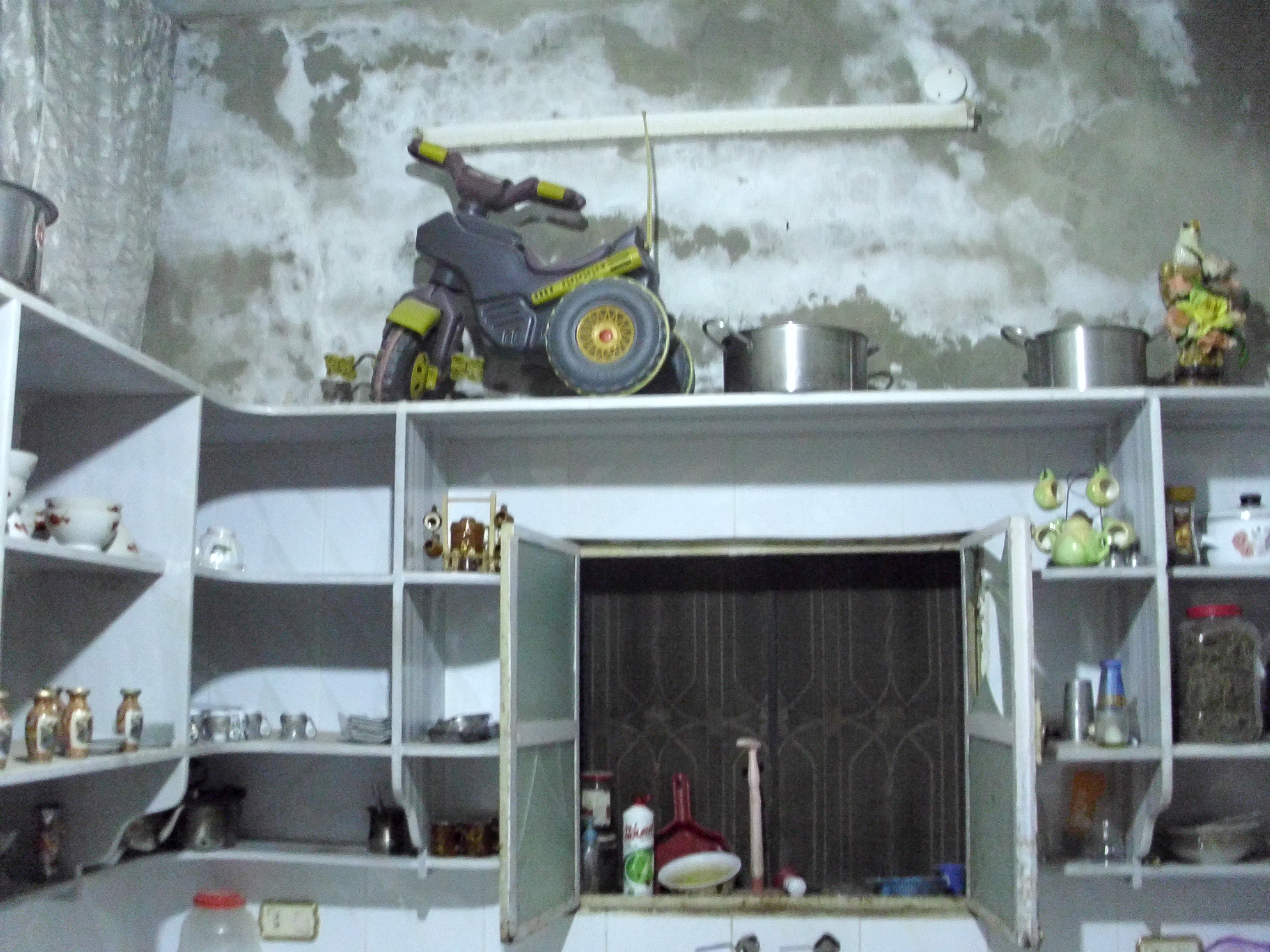
I slept in Hamood’s house. One wall is raggedly punctured where a rocket struck, and the interior walls, still pitted by shrapnel, have been scrubbed back to the concrete after being blackened by fire. He shows me the damage, then shows off his radishes and parsley, newly planted and vigorously flourishing. The sight of a child’s toy bike on a shelf in the kitchen made me sadder than the rocket damage. Hamood’s wife, children and parents are in a camp inside Turkey.

Next door a family of ten, displaced from a worse place, share a doorless, windowless building with snakes and rats.

*

Before the liberation, the residents held their demonstrations in the fig orchards outside town. After the liberation, the post-Friday prayer gathering became a target for shelling. So this Friday Ra’ed scheduled the protest for 11am, before prayers, and in a sidestreet, so as not to draw a crowd. (He was stopped later by a townsman angry that he’d missed the demonstration). “What’s the point of attracting disaster?” Ra’ed asked. “At this stage, the most important aspect of the protest is the media aspect.”

It’s this canny media awareness that has made obscure Kafranbel one of the unlikely focal points of the revolution. Each week produces witty and topical slogans in English as well as Arabic. The first, in April 2011, declared Freedom Emerged From Under the Fingernails of Dera‘a’s Children. One threatened to “spank” Kim Jong-Un for his “childish attempt” to deflect attention from Syria. One punned on a Shakespeare quote (O Judgment! Thou Art Fled Brutish Beasts, And UN and Annan Have Lost Their Reason). One, which went viral, offered condolences to the people of Boston after the bombing there, and reminded the world that such things happen in Syria every day.

This week the slogans read:

Obama! You Send Us “Weapons” To Only Continue This Conflict?! Send Us Weapons To Win Our Revolution Once And For All!

And, referring to the sudden death of actor James Gandolfini: We Are So Sorry That Tony Soprano Is Dead. We Wish Assad, the Syrian Mafia Boss, Had Died InsteadDSCI0169

A cartoon entitled Negotiations Forever depicted the Regime and Free Syria flags hanging above Israeli and Palestinian versions. Another, alluding to the media popularity of the rebel liver-eater video, showed Putin and Assad stirring a pot of blood, and Putin saying, Let’s say…. FSA are cannibals.

*

After the protest an activist drove me outside town. Standing on a red pile of rocks, he traced a frontline in the blue distance between the Alawi mountains and the liberated Ghab valley. In the absence of a serious effort to arm the Free Army, it’s likely that the line will remain static for the forseeable future.

Despite Kafranbel’s stirling efforts, the larger media war has been lost. The Western narrative is that this is no longer a revolution but a civil war, a conflict with its roots not in Assad’s repression but in the theological disputes of the ninth Century. Since the regime and Hizbullah’s joint conquest of al-Qusair, the Syrian people are struggling against the odds.

The regime probably will eventually fall. If it had fallen a year ago there might have been a happy ending. But by now over a quarter of the population is displaced and far more have been traumatised. The social fabric is torn. If Syria remains one nation, it will be a nation of orphans and widows, of the maimed, the raped, the tormented. How does a country return from this?

*

DSCI0161We ate a quick lunch before Ra’ed drove us back north. We stopped in Hass to talk to a pharmacist about Leishmaniasis, a disease spread by sand flies now rampant in the country. Abu Farouq complained that he had the syringes (treatment involves injections into the skin ulcers caused by the disease) but not the medicine to fill the syringes.

Mercifully, Atmeh was open, which saved us from climbing that wall once again. As we approached the camp through the olive groves, we asked Ra’ed a final, uncomfortable question. “If you’d known what would happen, would you have still joined the revolution?”

“No,” he said, matter-of-fact. “The price was too high. Just in Kafranbel we’ve had 150 martyrs. As many as that are missing; they’re probably dead too.”

He rubbed his massive nose.

“As for me, I can’t cry anymore. I don’t feel properly. I’ve taken pictures of too many battles. I’ve photographed the martyrs.”

Hands on the wheel, he shrugged his shoulders.

“But it’s too late now. There’s no going back. We have to finish what we started.”

BBC Newsnight (09 July 2013) Debate: Should we arm the Syrian op

Qunfuz

Robin Yassin-Kassab

Here’s a Youtube recording of a full BBC Newsnight episode on Syria, in which I participated. The debate was about serious help for the resistance. The help isn’t coming.

Yassin-Kassab versus Landis

Qunfuz

Robin Yassin-Kassab

Thanks to Joshua Landis for posting (at Syriacomment) this dispute, which originally took place on Sultan Saoud al-Qassimi’s facebook page. I earlier took issue with Syriacomment’s coverage here.

Sultan Sooud: Great read by Joshua Landis on Obama’s three options on Syria. The one, two and three state solutions.

Racan Alhoch: I love orientalist solutions. They are always a modified version of the Sykes-picot. The best solution would be for people like Landis to fuck off.

Joshua Landis: Rocan, I am not sure what is orientalist about these possible outcomes. If Assad hangs on to the south is Syria and the rebels hold the north it will not be because of the west. It will be a Syrian solution. If the rebels are able to conquer Damascus it will probably be thanks to help from the West.


Ruba Ali Al-Hassani: Joshua, a solution and an outcome are two different things. Not all outcomes are solutions to the problems which created them. The current civil war is not an outcome of deep divisions amongst Syrians. Rather, it is an outcome of external meddling in a conflict between the people and their dictator. Foreign militants have been brought in, recruiting a few Syrians, with the funding of external players, pitting them against each other on the basis of sectarianism. This is what escalated matters.
Borders in the Middle East have a long history with being drawn and redrawn by colonial powers, or in resistance to them. Therefore, it is Orientalist to come along and tell Syrians that they cannot solve their problems, and that the best way is to keep them apart from each other through another attempt to redraw their borders. Only when the Syrians ask for that kind of “solution” will it ever be okay…

Robin Yassin-Kassab: this is not at all a great read, for several reasons. the first is that it contains a plain untruth. the coastal region does not have an alawi majority. the mountains of the coastal region have an alawi majority, though there are also christian and sunni communities. the coastal cities have sunni majorities.

Joshua Landis: Robin, so do Lebanon’s coastal cities have a majority Sunni population. I am not sure what your point is. The Ottoman legacy is that there is a Sunni majority in the cities and the plains. In 1920 Alawites and Sunnis shared no town of over 200. Demographic segregation was very stark. There is much greater mixing today. It is hard to see where this bloodshed ends. That is the problem. There are no good solutions. Do you think the US should pump in the weapons until Sunni rebel militias have conquered Damascus and the coast?

Dick Gregory: “Do you think the US should pump in the weapons until Sunni rebel militias have conquered Damascus and the coast?” – I think not calling the FSA a Sunni rebel militia would be a start. I assume the point is that to create a mini-Alawite state would require the ethnic cleansing or cowing of the majority, and so is an even more impractical alternative to a revolution for all Syrians.
The suggestion that Obama could get the F̶S̶A̶ Sunni militias to fight one war against Assad and another against radical Islamists simultaneously is also highly questionable, and that they are likely to massacre non-Sunnis en masse in the event of victory re-writes the history of the conflict. Not a well written article

Robin Yassin-Kassab: i am not sure what landis’s point is. so what if lebanon’s cities have majority sunni populations? i never argued for the separation of lebanon from syria (I wasn’t here, obviously). lebanon is lebanon, with its own sectarian set up, and even with that set up, it isn’t supposed to be a shia or druze or maroni or sunni or alawi state. landis writes in his article that there is an alawi majority in the coastal region. i pointed out that this is not true. that’s my point: the truth. the importance of not twisting facts to fit our poor arguments. beyond that, i do not think that setting up an alawi state is a good idea or an acceptable outcome. it would involve a massive ethnic cleansing of sunnis from tartus, banyas and lattakia, and of alawis from homs and damascus. it would also leave syria without a port. it would also destabilise turkey. if it were under the control of this criminal family, it would be a threat to humanity. so far there has been no mass slaughter of alawi civilians, no ethnic cleansing of alawis to mirror the massacres and ethnic cleansings perpetrated by the regime. yet landis keeps on scaremongering. the revolution certainly has a sectarian aspect now, after the best efforts of assad and his allies, setting up sectarian death squads, attacking sunni heritage, etc. landis has been painting it as sectarian from the very start, however, ignoring the coordination committees in favour of salafists. thankyou, Dick, for your comment. it’s a slander to call the fsa a sunni militia. yes, it has a sunni majority (like syria) and a sunni character. i’ve just been in syria and turkey where i spent time with ismailis and christians amongst others. the ismaili was telling me in detail about the armed struggle (led by ismailis) around selemiyyeh. yes, i think the us, europe, the arabs, japan… should allow the syrian people to arm themselves to defend themselves from genocide and to end this child nmurdering regime. because the child murderers represent a tiny majority of the population, they lose as soon as the other side gets any sort of weapons supply. i don’t agree that it would take forever for the resistance to liberate damascus. or the coast for that matter – but the coast could be ‘won’ by negotiation once the people there see the regime has no future.

Robin Yassin-Kassab: you always say, ‘i don’t know what your point is.’ when you reported hussain harmoush’s tv post-torture ‘confession’ as if it meant something, and even discussed it… ‘hmm, harmoush says he was paid by the muslim brothers, and by the martians… very interesting’, and then i complained, your answer was something like…’everyone who reads syria comment is well educated and they understand that he was tortured and that his words don’t mean much.’ that’s a great response. so when you write that the coastal region has an alawi majority, it doesn’t matter that it isn’t true because you expect your audience to be intelligent enough to understand. you should write that the fsa is a communist organisation backed by nepal, just for fun, because your audience is clever enough….

Joshua Landis: Robin, lots of accusations. Let’s take the first one – the ethnic or religious population of the Coastal region. Can you tell me what the religious make up of the Coastal region is? Until 1960, when the last census was taken that listed Syrians by religion the Coastal region was predominately Alawite. Of course this depends on where you draw the line in the East, but your argument is that the Sunni majority in the coastal cities is larger than the Alawi majority in the Mountains. This has never been true so far as I know, but I welcome being corrected by any statistics you can provide. I quote the following from something I wrote in 1997. I highlight the sentence most important for our discussion:

“Although Alawites constituted roughly seventy percent of the region’s population [The Alawite state created by the French] of 350,000, they held sway over no town with more than 1000 inhabitants. “

“When the French arrived in the Alawite territory in 1920, the separation between the Alawite and Sunni communities could hardly have been more profound, a fact used to justify their policy of dividing the region from the rest of Syria. In the “Dawla al `Alawiyyin” (the State of the Alawites) established in 1922, not one Alawite was registered as a permanent resident of Latakia, the regional capital (26,000 inhabitants in 1935), or in the other Sunni dominated coastal cities: Jablah (6,300), Tartus (4,500), and Banyas (2,170). The only city that permitted Alawites to live within its walls was Safita, a Christian town high in the Alawite Mountains (total population 2,600, with 300 Alawites).

Although Alawites constituted roughly seventy percent of the region’s population of 350,000, they held sway over no town with more than 1000 inhabitants.

The division of urban and rural populations along sectarian lines in the Alawite region was almost absolute. The Sunni population was entrenched in the cities, where it exercised a monopoly on political power, education, and prestige. Sunnis, Weulersse writes, lived like “parasites” off the Alawites who were scattered in small hamlets throughout the countryside and mountains. Even in 1945, the year the muhafaza of Latakia was finally united with Syria, the number of Alawites who lived permanently in major Syria cities was minuscule. Latakia had a population of only 600 Alawites; Aleppo had 480, and Damascus only 40. These numbers indicate the extent to which the Alawite community remained a closed society, inward looking, and cut off from the main currents of Syrian intellectual and urban life right up to independence.

Today, most Alawites over the age of 45 can recount personal stories of Sunni school children throwing stones at Alawites as they walked to or from school. The alienation of Alawites from Sunni society and their bitter experience of persecution made creating a common sense of nationalism particularly difficult following independence. Even within the most progressive political parties which took shape during the 1940s, tension and mistrust between Alawites and Sunnis was never far below the surface and often threatened to rise to the surface.”

Robin Yassin-Kassab: i don’t know why you are telling me about the historical persecution of alawites. as you know, i have myself written about this on several occasions. I have often pointed to this as necessary historical context to the sectarianism of the assad regime. you don’t need to prove yet again your emotional ties to the alawi community. it’s perfectly obvious and always has been. yes, i would presume that an urban majority constitutes more people than a rural majority. that seems like plain logic to me. in any case, you yourself on previous occasions have described the coastal region as having a sunni majority. i’m sure that if you were to draw a line around the mountains you could find an alawi majority, but i don’t think that would be in the interests of alawis, sunnis or anyone else…..it’s always important to recognise past oppressions, but these do not justify present genocides or ethnic cleansings, nor carving up countries on ethno-sectarian lines. the holocaust does not excuse slaughter in sabra and shatila or gaza. the safavids do not excuse saddam hussain. saddam hussain does not excuse the exclusion of iraqi sunnis. ibn taymiyya does not excuse assad.

Robin Yassin-Kassab: in any case, in perfect orientalist style you are ignoring contemporary history in favour of the distant past. ‘alawis’ have been in charge for over 40 years.alawis have been living in the cities, making friends with sunnis, in some cases marrying sunnis. in this time the regime actually oppressed alawi ulama and community leaders and deliberately kept sectarian hatreds bubbling for divide and rule reasons. they had four decades to address the problem, to manage a public conversation and reconciliation. they chose to do the opposite. and when challenged by a democratic movement for secular rights, they deliberately lit the fuse of sectarian conflict by implicating alawis in their death squads and massacres, and by their propaganda.

Joshua Landis: Robin, I couldn’t agree with you more about oppression. I in no way wish to defend the Assad regime, which is guilty of brutal and indiscriminate killing of the worst kind. I have emotional ties to all Syrians. My point is about the demographic realities of Syria. If one draws a line down the Eastern side of the Alawite mountains, where the Alawite majority population gives way to a predominantly Sunni majority and counted the religious distribution of all those to the West of that line, the Alawites would be the majority. That is my simple contention. It does not mean that they deserve a state or could maintain one or that it would be fair for the Sunnis of the coastal cities. I am simply trying to establish some basis for understanding the region. Would you agree to that simple statistic?

Joshua Landis: Robin, You are absolutely correct about the deeply sectarian nature of this regime and its response to the uprising. In fact, my first article for the Economist, dated, Jun 14th 2011, was entitled “Deeply Sectarian.” We are in perfect agreement about the sectarian nature of the regime and ensuing mess it has created.

Robin Yassin-Kassab: joshua, i think of you as a well-meaning person, but i can’t help but think too that your skewed commentary on the revolution has helped assad confuse the issue in the west. no, i don’t think i would agree with your simple statistic. i think the sunni majority in the cities probably outweighs the alawi majority in the mountains – but of course i can’t prove it, and it may be that now, at this precise moment, there is a slight alawi majority because so many alawis from damascus and homs have moved to tartus to flee violence.

Robin Yassin-Kassab: ruth – i very nearly ‘liked’ your comment but didn’t for the simple reason that most alawis have not actually benefitted from the regime. some certainly have, but many more haven’t. they’ve been terrified by regime propaganda and implicated in the regime’s crimes. now they are losing thousands of young men fighting for this monster. most are victims of the regime. if over the last decades the community had been allowed to develop itself, to produce its own leaders, to initiate its own dialogue with sunnis, it (and all of us) would not be in this situation now

Joshua Landis: Why don’t we leave this on the happy note that you consider me “well meaning.” I, of course, do not think my analysis has been skewed. On the contrary, my warning that this struggle would end up much like Iraq or Lebanon — i.e. going sectarian — has proven to be the case. You have argued from the beginning that my commentary has caused this, but I would humbly suggest that is to give me much too much agency and importance. I have simply described what I believe to be the reality of the Syrian situation. I believe that I have been fairly accurate. Of course, I have made my share of mistakes, but not, for the most part, on the big things. I wrote early that this would go sectarian, that the regime was deeply sectarian, and would turn this into a sectarian struggle because Alawites feel persecuted and have a history of being persecuted, which they have not gotten over. I have tried to inject as much history into this as possible – and I think the history is important and not just some distant baggage that should be ignored. The Alawites should have gotten over their persecution and “minority complex” and Assad should have given up power in the first weeks of this uprising in favor of a constitutional convention, but he did not.

So we are where we are, which is very ugly. Sunnis now feel like a persecuted minority, and with good reason, they have been persecuted. I doubt there will be an “Alawite state” – even one with a big Sunni minority residing in it – established on the coast. Most probably the “status quo” will prevail for some time.

The status quo is the division of Syria into a revolutionary forces controlled North and North-East and government controlled South and Southwest. This will leave the Assad government ruling over a large Sunni majority and Damascus, which will be very unstable. I suspect the North will also be very unstable because the FSA and other militas agree on little beyond their desire to rid themselves of the oppression of the regime.

The US and the West wants to hurt Hizbullah and Iran, but I am not sure if it has “Syria’s” interests uppermost in its calculations. My essay about the three possible scenarios is meant to underline this. I try not to pick “a best scenario”, but simply point out the difficulties with each.

Maxwell Ryder: Robin, you are a sharp knife in a drawer full of dull knives. Thank you for each post. I couldn’t agree more, though I did not like the “dick” part.

Robin Yassin-Kassab: of course i don’t think your commentary caused this. i think (like you, it seems) that assad and his allies caused this. i think your commentary (indirectly) helped assad get his sectarian message across to the west from the earliest days. you didn’t so much bear witness to the ways in which assad lit the sectarian fuse as focus on the sectarianism of the opposition, even at the start when the remarkable thing was how a sectarian society was able to produce such a non-sectarian discourse. you focussed on obscure salafists rather than the central local coordination committees. you are probably right about the status quo, which is a disaster for syria and, increasingly, for the region and the wider muslim world. my contention is that the opposition has the vast majority on its side. it has been able to conquer vast swathes of the country for this reason, despite being so poorly armed. therefore i believe that a serious effort to arm the opposition would allow it a reasonably speedy victory. then syria could start the difficult process of picking up the pieces. because commentary like yours is dominant, however, there probably won’t be a serious effort to arm the opposition, and the status quo will continue. even now after hixbullah’s open involvement, the west and the arabs are only talking about ‘restoring the balance’. in other words, let syria bleed. let the wound expand.

Robin Yassin-Kassab: Maxwell – thanks. the ‘dick part’ was not the insult you think it was. i was referring to my friend Dick Gregory, who commented above.

Joshua Landis: I agree that Alawites, to the extent that we can generalize, are oppressed and have little if any freedom of choice. Assad treats Alawites as he treats the rest of Syrians, as his slaves. But I would caution that this does not mean that Alawites will turn against the regime any time soon. They feel like the knife is at their throat. At least that is what many say, now that this struggle has become very sectarian. Almost every Alawite i have talked to gives me a five minute soliloquy on how he or she is not an Assad supporter and how Assad has gotten them to this terrible situation, but then they go on to reproduce the Assad line about Sunni extremism and how they must defend themselves, etc. I think understanding their dilemma is important to any solution. One cannot just dismiss their fears or this war will drag on for a very long time.

Robin Yassin-Kassab: i agree with that. we must also remember the brave minority of alawites who, despite their well-founded fears, are working for the revolution in public or in private. during my recent trip i heard about alawis secretly providing food and medicine to the besieged areas.

source

Burning the Mosques

Qunfuz

Robin Yassin-Kassab

The Umawi mosque in Aleppo has burnt. Its thousand-year-old minaret has fallen. The minaret of Dera‘a’s Omari mosque, built in the seventh Century by Caliph Omar ibn al-Khattab, has been destroyed. And today the Khalid ibn al-Waleed mosque in Homs, built around the mausoleum of the famous Muslim general and companion of the Prophet, was shelled and burnt. These are ancient mosques of enormous significance to Muslims, and they are world heritage. They were. They survived the Mongols, but not Assad.

It’s clear the Western media does not understand the religious, cultural and historical importance of these sites. Assad’s cultural vandalism and civilisational provocations are worse than the Taliban’s assault on the Bamiyan Buddha. Am I wrong to think that an attack by rogue elements of the Syrian resistance on a major Shia shrine would raise a far greater noise?

Many Muslims too are strangely quiet. If the Israelis were to hit a mosque of such vast symbolic resonance, you can bet there’d be furious demonstrations from Casablanca to Jakarta, from London to Lahore.

What’s happening is no secret. The shabeeha write it on the walls: “Al-Assad or We’ll Burn the Country.” The world worries about Islamists, about hypothetical future persecutions, about the chess game between America and Russia, Israel and Iran. Meanwhile the country burns. The people and their history burn. And the flammable poison of sectarian hatred seeps out from Syria, to east and west.

Woman in the Crossfire

leave a comment »

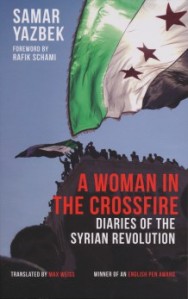
womaninthecrossfire_72A Woman in the Crossfire: Diaries of the Syrian Revolution’ by novelist Samar Yazbek is part journalism, part personal memoir, and all literature. It’s literature of the instantaneous sort, a staggered snapshot of the first four months of the revolution, a public history of  “a country succumbing to the forces of death,” and an interior history too. Yazbek tells us about her headaches, her insomnia and Xanax addiction, her crying fits, her fears for her daughter and herself, her constant panic. How sometimes in the speeded-up context the rush of information precedes all feeling: “The daily news of killing,” she writes, “was more present inside of me than any emotion.”

Samar Yazbek has always been problematic. Having consecrated herself “to the promise of a mysterious freedom in life,” she left home (in Jableh, on the coast) at sixteen, later divorced her husband and lived in Damascus, a single mother, working in journalism and writing sexually controversial novels. When Syria rose up against the Asad regime she publically supported the victims and their cries for freedom. And she’s an Alawi, a member of the president’s largely loyalist sect, of a well-known family. As an unveiled and obviously independent woman, a secularist and daughter of a minority community, her support for the revolution proved the lie of regime propaganda, which characterised the uprising as Salafist from the start.

So leaflets slandering her were distributed in the mountains. She was called a traitor, made  recipient of death threats, publically disowned by family and hometown. Naturally she was visited by the mukhabarat and made to experience, vicariously at least, the domestic wing of regime propaganda – for the theatre of blood is as important inside Syria as the projection of civilised moderation used to be abroad – by being walked through a display of meat-hooked and flayed torturees.

The Samar Yazbek of these diaries is an imposing presence but not one who crowds the reader. Indeed a reader who isn’t in Damascus, who hasn’t experienced the strangeness first hand (and what strangeness! – a known city, a home country, transforming into a death zone) requires a strong character through whom to experience and understand, just as he would if reading a novel. But beyond locating the reader, Yazbek more often plays her “favourite role, pretending not to know anything in order to learn everything,” and she gives most space over to the accounts of others.

Through these reports we learn of the horrors of detention and torture, of the pleasures and pains of protesting, of the plights of conscripts and refugees. Yazbek interviews secret sympathisers of the revolution, a state TV employee for instance, or a soldier who shot his own foot to escape the order to kill his countrymen, as well as committed revolutionary activists, the kind of people who are still very influential on the ground in Syria despite the inevitable arming of the revolution and the consequent rise of resistance militias. While the armed men fight, the activists are organising liberated and besieged areas.

One of the book’s most useful sections describes the early development of the Coordination Committees, the revolution’s backbone. Yazbek describes a spontaneous meritocracy in which talents are distributed into political, medical, media, even arts and culture committees, an organisational process entirely opposite to Asad’s corrupt, sectarian and nepotistic state.  She also very usefully describes the non-ideological compromise secularist activists made with the religious culture of the masses, recognising religion’s centrality to many people’s experience of existence, as well as its obvious mobilisational power.

Her informants’ accounts illustrate how from the revolution’s earliest days the regime instrumentalised sectarian hatred, particularly in the coastal cities, Banyas, Jebleh and Lattakia, and the surrounding countryside, areas shared between Sunnis and Alawis. Rumours of roving Sunni mobs intent on murder were spread in the mountains and reinforced by false flag operations carried out by shabeeha. If this nonsense hadn’t largely worked, its memory would be comical. In Jebleh the alarm was frequently raised that an ‘infiltrator’ was at large in a neighbourhood, so the people would come out to catch him. When the same infiltrator was captured twice, each time in different neighbourhoods, a bystander was prompted to advise security to use different bait next time, if they still wished to be believed.

For the historian and analyst Yazbek’s diaries also provide important local information of a strategic nature, details often missed by newspaper articles, such as the fact that the Maydan and Qaboon areas of Damascus came out against the regime early because of the residents’ kinship ties to Dera’a, the revolution’s cradle.

But the main reason to read the book is for the immediacy and breadth of perspective (religious or not, Sunni, Alawi, Christian, of various class backgrounds) it offers, for the human element, and for its sense of shock:

“I stared into his eyes, which were like every other murderer’s eyes that have appeared these days, eyes I had never seen before in Damascus. How could all those murderers be living among us?”

It’s a narrative brimming with stark images. One, for example, of security forces attacking a funeral, shooting and critically injuring three pallbearers, causing the mourners to flee, leaving the coffin alone on the ground in an empty but blood-spattered street. It’d be a great image for a novelist to dream up, but reality got there first; reality in Syria outstrips imagination.

After four fraught months Yazbek and her daughter fled to Paris. She’s written about visits to liberated parts of Syria since, and like every Syrian inside or outside, like everyone connected to Syria, she sits and she wonders what terrors or glories the future might hold. “Fire scalds,” the book finishes. “Fire purifies. Fire either reduces you to ash or burnishes you. In the days to come I expect to live in ashes or else to see my shiny new mirror.”

The translation is by Max Weiss, and is excellent.

source

Blog at WordPress.com.

Up ↑