Search

band annie's Weblog

I have a parallel blog in French at http://anniebannie.net

Category

Qunfuz

QUNFUZ

The Background

Security prisons, and the terror they inspire in the Syrian population, have underpinned the Assad regime’s rule from the start.

The history of such prisons stretches back before Hafez al-Assad’s seizure of power in 1970, though his regime expanded and intensified the system. From 1946 on, Syria was racked by a series of military coups and counter-coups, interspersed with brief episodes of parliamentary democracy. Whenever a coup succeeded, the new rulers would round up the previous government and its supporters and detain them in prison.

The numbers of people held in security prisons increased during the United Arab Republic (UAR) of 1958 to 1961, and the conditions of detention worsened. The UAR brought the Syrian and Egyptian states together under the dictatorship of the Egyptian president, Gamal Abdul Nasser. Abd al-Hamid al-Sarraj, Nasser’s preferred Syrian secret policeman, is credited with introducing two particular torture methods to Syrian prisons during this period: the doulab, or tire, in which victims are stuffed, and then whipped; and the shabah, or ghost, by which victims are strung by their wrists from the ceiling for hours or days. Both methods are still applied in the Assad regime’s prisons today. ISIS inherited them from Assad, and also routinely applied such tortures in its own security prisons.

The UAR was widely seen as an economic as well as a political disaster, and was soon ended by a coup led by conservative army officers. When, in turn, a secret Military Committee of Baathist officers seized control in March 1963, it quickly set about rounding up and detaining those it considered a potential security threat. These included first the conservative officers who had seceded from Abdul Nasser’s UAR, then supporters of Abdul Nasser, then anyone who dissented from the ruling party’s line. As the Baathists had banned all media and all forms of civil organization beyond Baath Party control, this category covered many members of civil society.

READ ON HERE

Racaille

Qunfuz

Robin Yassin-Kassab

 arrestation_1

with 8 comments

Segolene Royal has been much criticised for warning that the French ‘banlieu’ will riot if Sarkozy, the interior minister who called banlieu inhabitants ‘racaille’ (‘scum’), is elected president. The banlieu is prone to riot anyway. Why?

Well, here are a few personal anecdotes. The stories are 15 years old, so are not directly relevant to Sarkozy, but they explain something of the racist background to France’s social problems.

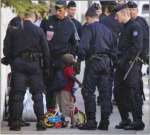
One: One evening in Paris I was walking with an upper-middle class English friend whose mother is Malaysian. I’m an English Arab, but white-skinned and blue-eyed. Out of nowhere arrived two policemen. With no warning they grabbed my friend, threw him against a wall, then pushed a truncheon against his throat until he was choking and weeping. They took me round the corner and asked why I was walking with him.

Two: I had a French girlfriend of Algerian origin, also white and not noticeably Arab, who was being harassed by an insane neighbour. She was scared, so we went to the police station to inform them of the situation. The police were polite and concerned. They wrote everything down. But when they asked my girlfriend’s name, their tone changed radically. They scrumpled up the report sheet, told us no offence had been committed, and advised us to get out immediately.

That girlfriend remembered her old maths teacher ordering her to the back of the classroom with the rest of the Arabs and Africans because, as the teacher explained, “I’m employed by the French state to teach French children.”

Her father had escaped from the extreme poverty of his (French-occupied) Algerian childhood to France, where he spent a lifetime as a migrant labourer, suffering casual and brutal violence from foremen and police – and then inflicting some himself, in his impotence, on his own family. When they finally settled in an industrial town, he found work in a factory where he would train white teenagers to do his dangerous, lowest-of-the-low job, and then watch them promoted after a couple of months to brighter and better things.

In Paris I had an African friend who for a time lived in a slum building with other African families. One day a skinhead threw a teargas canister into the corridor where children were playing. The police weren’t interested. They clearly had more important things to do with their time. The same friend was stopped almost every day by police on his way to work, insulted, and ordered to show his papers.

These scorned and abused French citizens, the blacks and beurs who work in the worst jobs for the lowest pay, who live in the ‘rabbit cages’ of the urban wasteland, who constitute 70% of the prison population, who have the least representation, whose voices are not heard, are supposedly the omnipotent Islamic fiends who threaten to destroy French secularism, the whole French way of life, and whose clothing choices must therefore, for the sake of freedom, be sanctioned by the state. (To his credit, Sarkozy did not support the ban on hijab in schools. Update: he has since identified the niqab or face veil as a pressing danger to France, although only 367 French women wear it – that precise number was provided by French intelligence.)

The fact that the French were still using torture and prison camps for civilians in Algeria in the 60s, and that an ex-Vichy police chief (Maurice Papon) at the same time dealt with demonstrating pro-independence Algerians in Paris by tying their feet and throwing them into the Seine, suggests that France has got savage racial prejudice to blame, primarily, for its social problems. The bodies-in-the-Seine incident happened in October 1961. At least 200 civilians were murdered, a crime in which the French media collaborated by its silence and concealment.

It’s certainly the case that many young French Arabs and Africans are somewhat raggamuffin, but extreme alienation and marginalisation tends to do that to you. Besides, if white men in France have a couple of years off the rails they are not in danger of being shot by the police. When I was there, beurs and blacks were shot in the back every couple of months. This was considered normal. It certainly didn’t result in soul-searching by the white population.

It is the complex of racism and class oppression which has made the French innercities unbearable. The real ‘racaille’ are those who blame the victims.


Update August 2016: Now – after a serious of ISIS-linked atrocities and the continuing rise of the far right, things are becoming much, much worse. See the ‘burkini’ controversy. ‘Mainstream’ politicians and state officials describe the burkini as ‘a symbol of the groups attacking France’. This is a bit like saying beards should be banned because terrorists have beards, except this is directly targeted at Muslims (though, so I read, it isn’t only Muslim women who wear the burkini. Women with easily burnable skin use it too). Armed men forcibly undressing women, snarly whites cheering the while. I fear this is a sign of things to come. The West’s liberal age is over – the ‘left’ as likely as the right to indulge in racist sterotyping and conspiracy theories. We are heading into incredibly dangerous territory.

source

Inland American Conspiracies

Qunfuz

outside Colorado Springs

A shorter version of this piece was published at the New Arab.

From the canyon walls of Manhattan island to science-fiction California, coastal and urban America is more diverse and sophisticated than almost anywhere else in the world.

As for inland America, the stereotypes are true, but other things are also true.

In April we were travelling to talk about our Syria book, in New Jersey, then Boston, then over to LA. From there inland to Colorado, high desert at the mountains’ beginning where you can suffer sunstroke and frostbite in the same afternoon.

The cities here exemplify American modernity. They are clean, bright, spacious, and architecturally befuddled. At the same time they bear an emotional trace of the recent Wild West past. One of our talks was in a town called Golden (for the metal, and the craze), at the Colorado School of Mines.

Another was at a liberal arts college in Colorado Springs, a conservative city boasting a US Airforce Academy, lots of retired soldiers, weapons factories, and a concentration of evangelical churches. It also houses the 47-acre HQ of Focus on the Family, a media and lobbying organisation which militates against abortion and gay marriage and promotes creationism instead.

Before we spoke a woman came up and introduced herself as “an international poet”. She told us she cared about Syria very much. “And it’s so obvious what the solution is! An international Sunni-Shia peace conference.”

Later a crag-faced man pursued the same theme. “They have to solve their religious problems,” he decreed. “At base, this is about Sunni and Shia. It’s the same conflict that’s raged since the start of Islam.”

I tried to explain that the conflict at base was between a revolution and a tyrant, and it didn’t go back all those centuries, though of course powerful actors on all sides had instrumentalised sectarianism to serve their interests, particularly in the regime’s case, to divide and rule. Those in power will always exploit communal tensions when they need to disarm a challenge, and every society suffers such tensions. “In America, for example, there are racial divisions. Isn’t that so?”

A profound and lasting silence in response to my question. Wrong audience for this.

My co-author Leila overheard a conversation at a shop front. “That guy’s bringing Syrians in,” said one man, perhaps referring to Obama, under whose rule a mere 2500 Syrians have been granted shelter. “Well they won’t be coming here,” his companion replied. “And if they do we’ll soon make them wish they were back at home in Syria.”

In the city council, councilor Andy Pico had proposed a resolution declaring “opposition to the relocation of refugees to the city.” “We have a responsibility to our citizens to ensure their safety,” he said. “We need to be sure the people coming here have been screened.”

And so he did his bit to feed the election season hysteria that has cast every Syrian, every Muslim, every immigrant as a potential criminal or terrorist.

This version of WASP America was not at all comforting, yet we were staying with friends who didn’t fit the ethno-ideological bill, and who were happy living there, moving unharrassed within their own networks. It seemed to sum up America: even inland, very different people coexist. Communities and their subgroups, in one way at least, enjoy more autonomy than they would in Europe. There’s a suburb of Colorado Springs called Manitou Springs, once home to hippies, now less counter-cultural but still full of crystal healing shops and (legal) marijuana dispensaries.

Next we flew to Chicago, brutally post-industrial, wind howling between its towers. Between the gusts you can hear the ghosts of the proletarians washed up here from Poland, Russia, Ireland, the American South. Parts (not Downtown) looked like parts of London or Manchester. A kind of normality, as far we were concerned, until we caught the bus to Madison, Wisconsin.

We were hosted very kindly, and in way that seemed deeply protestant. “Thank you for your witness,” one woman told me, though she didn’t attend our talks and therefore didn’t know precisely what we were witnessing.

We gave a talk in a radical bookshop, then answered questions.

The first came from somebody who believed the United States had installed Ayatollah Khomeini in Tehran. Another speaker focused on the New Yorker’s recently published report on documents incriminating the Assad regime in war crimes. “Why are they talking about it now?” she wanted to know. “They’re planning something. It’s boots on the ground, regime change, something…” This habit of thought – whereby the real torments of far-away people are dwarfed in significance and impact by the imaginary machinations of the only state that matters, the American one – is depressingly common.

A third speaker argued (against my cynicism) that you don’t need to believe in conspiracy theories, you only have to read the documents published by the Project for a New American Century. These writings call for Syria to be dismantled. Surely that’s the cause of what’s happening there now.

It’s a strange analysis that prioritises the fantasies projected by a neo-con, Zionist thinktank (which folded in 2006) over the current concrete acts of millions of Syrians (and Russia and Iran). Strange and part-way racist, as if white people’s (especially Jewish) words enter the cosmic fabric so inevitably as to determine brown people’s history for years to come. The writings, protests and battles of Syrians mean nothing in comparison.

That’s what I said in response. The speaker left the bookshop.

Our hosts took us for a drink, kept bending our ears. “Most Americans don’t realise that they live in a dictatorship,” one said, “that every move they make is being watched.” Someone warned Leila to beware of Amtrak (the train company), because once you’ve been in one of their carriages they have your image, they follow you everywhere. Someone else drove off in a car with ‘9/11truth.org’ stuck on its bumper.

A few days later Democracy Now, America’s flagship leftist channel, spent an hour sycophantically interviewing journalist Seymour Hersh, a man who can’t be bothered to make up sensible names for those who feature in his conspiracy theories (Hersh told Russian TV that Syria’s rebels are led by a group called ‘shawarma al-shawarma’, or ‘the meat sandwich of the meat sandwich’).

Of course, conspiracism is not just an American problem. After a talk in Montreal, Canada, a student approached: “Why didn’t you talk about the Rothschild bank?”

“What should we have said?”

“That the Rothschild bank controls all global finance, and Assad refused to do business with them, so they attacked him.”

Wrong on so many levels, I didn’t know where to start. I said something about Assad’s neo-liberalism, his obvious desire to do business with the world’s banks.

The boy’s reply was swift: “Why didn’t you talk about the Qatari pipeline?”

Neither is conspiracism an issue only with rustic, or poorly-educated, or youthfully enthusiastic types. The bourgeois-intellectual pages of the London Review of Books, at least when they treat the Middle East, are dripping with it too.

Much of the British left is convinced that the revolutionary communities of Damascus gassed themselves in August 2013, that there’s a Western regime-change plot afoot against President Assad, that Putin is the victim in the Ukraine, that the Turkish coup attempt was a false flag operation. It was the left which spread the idea that Syrian revolutionaries were ‘all al-Qaida’ before the right applied the slur to Syrian refugees. And the right is as prone to its hyper-nationalist and Islamophobic conspiracies as ever. To some extent the Brexit vote was mobilised by such myths as the supposedly imminent arrival on British shores of 70 million Turks.

Arabs and Muslims are notoriously vulnerable to conspiratorial thinking, in part because in a previous generation so much politics was actually done by conspiracy, and in part through intellectual laziness. It’s always been simpler to blame ‘the Jews’ or ‘the Shia’ for all ills than to actually address the ills. But not really simpler. Conspiracy theories don’t merely promote complacent inaction, they create new tragedies too. In north western Pakistan, for instance, where word spread that the polio innoculation was a UN poison to render Muslims infertile, a new generation has been stunted by the disease.

Perhaps there’s more excuse for conspiracism in regions where the people are subject to the traumas of poverty, dictatorship and war. If so, its increasing prevalence in the educated, prosperous West is more difficult to explain.

Could it be that technical and economic developments are undermining not just our political culture but even our intelligence? The huge expansion of media production, moving our fantasy worlds as well as our historical and personal memories onscreen and online, means we need use less of our brains. No need to remember a phone number or a line of poetry, no time to mull over a novel. We follow updates and let the algorithms do the thinking. Because most of us are more comfortable now with mobile phones and websites than books. Books are generally fact-checked before publication, while internet success is measured only in clicks. Books demand reflection and sustained concentration, an attention to nuance. With the new technology, by contrast, gratification – informational, emotional, sexual – is only a thumb-click away.

There’s nothing more gratifying than a total theory which explains the whole world in under a minute. And nothing easier. You don’t need to study detail, there’s no need for rigorous logic, not even for coherence. As with Trumpism (or Trumpery?), you only need a slogan, a meme.

The internet is growing into our collective brain. An internet search for ‘the illuminati’ provides almost 13 million results. ‘Syrian revolution’ comes up with about half that (and half of those will be conspiracist approaches). This is the problem we’re up against.

 

Reinvention versus Trumpism

malcolmx

Malcolm X

This was first published at the New Arab.

While we were in New York to talk about “Burning Country”, I visited the 9/11 Memorial, a commemoration of the spectacle that arguably set the tone for the 21st Century. I was advised to visit by a friendly progressive professor, the host of one of our events. He said the attached museum was a good example of America’s self-portrayal as the world’s supreme victim. He wasn’t alone. Philip Kennicott in the Washington Post described the museum as “an oversized pit of self-pity, patriotic self-glorification and voyeurism.”

I didn’t really agree about the museum, and the memorial to the day when the twin towers were hit and almost three thousand civilians killed seemed to me tasteful and correct.

At the precise site of each tower’s base there are two-tiered pools of falling water. These enormous bottomless basins are inversions of the towers, the very opposite of phallic triumphalism. Each implies absence and a hidden abyss. In a way they are beautiful, superficially calming, and their noise nearly drowns the rush of the city around. But ultimately they are terrible, because gravity’s incessant pull on the water, the sound and sight of continuous descent, is a reminder of the terror of jumping, falling people, those who chose to plunge rather than burn, and of the tumbling shoes, the floating paper, the towers themselves collapsing, so many tons of metal and concrete, so many volumes of dust and smoke.

In the museum the focus is on the trauma experienced by the victims. There are first-hand accounts played on audio, and photographs and films of shocked New Yorkers gazing skyward, or running for their lives, or trudging slowly, whitened by dust. A shock, literally out of the blue, for an America almost entirely untouched on its own soil by war, at least since its civil war (though native-Americans and African-Americans must be excluded from this peaceable account of history).

Read the rest of this entry »

Written by Robin Yassin-Kassab

July 18, 2016 at 5:55 pm

Five Year Reflection

leave a comment »

picture from anadolu agency

Russian bombing in the eastern Ghouta. picture from Anadolu Agency

The Guardian asked ten Arab writers to reflect on the revolutions five years on (or in). My piece is here below. To read the rest too (including Alaa Abdel Fattah from Egyptian prison, Ahdaf Soueif, and notable others), follow this link.

Five years ago the Guardian asked me to evaluate the effects of the Tunisian uprising on the rest of the Arab world, and specifically Syria. I recognised the country was “by no means exempt from the pan-Arab crisis of unemployment, low wages and the stifling of civil society”, but nevertheless argued that “in the short to medium term, it seems highly unlikely that the Syrian regime will face a Tunisia-style challenge.”

That was published on January 28th. On the same day a Syrian called Hassan Ali Akleh set himself alight in protest against the Assad regime in imitation of Mohamed Bouazizi’s self-immolation in Tunisia. Akleh’s act went largely unremarked, but on February 17th tradesmen at Hareeqa in Damascus responded to police brutality by gathering in their thousands to chant ‘The Syrian People Won’t Be Humiliated’. This was unprecedented. Soon afterwards the Deraa schoolboys were arrested and tortured for writing anti-regime graffiti. When their relatives protested on March 18th, and at least four were killed, the spiralling cycle of funerals, protests and gunfire was unleashed. Syria not only witnessed a revolution, but the most thoroughgoing revolution of all, the one that has created the most promising alternatives, and the one that has been most comprehensively attacked.

In 2011, I wrote that Assad personally was popular, and so he remained until his March 30th speech to the ill-named ‘People’s Assembly’. Very many had suspended judgment until that moment, expecting an apology for the killings and an announcement of serious reforms. Instead Assad threatened, indulged in conspiracy theories, and, worse, giggled repeatedly.

I underestimated the disastrous effects of Assad’s neo-liberal/ crony-capitalist restructuring during the previous decade. I was soon to be wrong about many other things too. In April the regime made conciliatory gestures to Islamists and Kurds. At first I thought this showed how hopelessly out of touch it was – the protest movement at this stage was pan-Syrian and non-sectarian. Then I understood its misinterpretation was deliberate. In the following years the regime would stick to reading the revolution through ethnic and sectarian lenses; and largely due to its own efforts, these eventually came to dominate the field.

“Bashaar al-Assad is the leader of the revolution,” one young Damascene told me. “Every time he kills someone, every time he tortures, he creates ten more men determined to destroy him.” At first the regime’s resort to the ‘security solution’ made me think I’d overestimated its intelligence. Then I realised I’d underestimated it. Knowing it couldn’t survive a genuine reform process, it provoked a civil war.

First the savage repression of peaceful, non-sectarian activists. Tens of thousands were rounded up, tortured, killed or disappeared. At the same time jihadists were released from prison.

Then, in response to the revolution’s inevitable militarisation, the regime applied a scorched earth policy. Soldiers burnt crops and killed livestock. Civilian neighbourhoods were blasted by artillery, fighter-jets, Scud missiles, barrel bombs and sarin gas. A string of regime-organised sectarian massacres in 2012 irretrievably hardened the mood.

The Syrian people’s supposed ‘friends’ failed to seriously arm the revolution, or to protect the people from slaughter. With Assad’s indirect aid, foreign jihadists stepped into this vacuum. Until July 2014 the regime and ISIS enjoyed an unstated non-aggression pact. Even today, when ISIS is fighting the Free Army, the regime (and Russia) bombs the Free Army.

An arsonist posing as fireman, Assad tells the world his survival is indispensable to defeating jihadism. Too many commentators agree with him, perhaps because commentary in general has tended to ignore the travails and achievements of the Syrian people in favour of the terrorism story and proxy-war chess. As a result the general public in the West seems to think Syria’s choice is between, as a man recently told me, “President Assad” and “the nutters”.

Since 2011 I have learned to distrust the grand pre-existent narratives of both left and right, to fear the dead(ly) ends of identity politics, and to focus instead on the human facts. Like the 300,000 dead and eleven million displaced (the worst refugee crisis since World War Two) – the vast majority at Assad’s hand. Plus the more positive realities, like the revolutionary local councils, usually democratically elected, which do their best to keep life going and which should be part of any settlement. Or like the revolution in culture which has produced groundbreaking music, poetry, critical radio stations and newspapers.

The people practised democracy where they could. Yet by August 2013, counter-revolution seemed to have won both regionally and globally. In Egypt that month’s Rabia massacre began the liquidation of the Muslim Brotherhood, then the repression of everyone else. In Syria, as Obama’s chemical ‘red line’ vanished, Assad killed 1400 people with chemical weapons. Assad continued to receive Russian weapons; the Egyptian army received theirs from America.

Iran and then Russia rescued the Assad regime from military collapse, although in a way it has collapsed already, subcontracting its powers to foreign states and local warlords. And it has lost four-fifths of the country. Some of ‘liberated Syria’ is held by beleaguered democratic-nationalists, Arab or Kurdish, and a lot is strangled by trans-national jihadists.

The crisis increases exponentially. The only thing sure about Russia’s invasion is that it is expanding the war in space and time.

So, a five-year accounting: Friends and relatives have lost homes, witnessed atrocities, been forced into clandestine migration. Nothing unusual – every Syrian family, from whatever side, has trauma tales to tell. Most are mourning their dead. I will never show Palmyra’s temples or Aleppo’s Umawi mosque minaret to my children – these monuments that survived earthquakes and Mongol invasions are now razed, and the complex social fabric of the country irreparably torn.

Syria has witnessed the depths of human depravity. Syrians have also demonstrated the most inspiring creativity and resilience in the most terrible of circumstances.

Change in Syria and the wider region is running at breakneck pace, and heading in contradictory directions. As to the final results, this time I’ll say it’s far, far too early to tell.

source

From Deep State to Islamic State

Qunfuz

Robin Yassin-Kassab

with 2 comments

deep1An edited version of this piece was published at Newsweek Middle East edition.

In 2011, according to the ASDA’A Burson-Marsteller Arab Youth Survey, “living in a democracy” was the most important desire for 92% of respondents. A mere four years later, however, 39% of Arab youths believed democracy would never work in the Arab world, and perceived ISIS, not dictatorship, as their most pressing problem.

Powerful states seem to share the perception, bombing ISIS as a short-term gestural response to terrorism, re-embracing ‘security states’ in the name of realism – concentrating on symptoms rather than causes.

How did the bright revolutionary discourse of 2011 turn so fast to a fearful whisper? Jean-Pierre Filiu’s “From Deep State to Islamic State” – a passionate, sometimes polemical, and very timely book – examines “the repressive dynamics designed to crush any hope of democratic change, through the association of any revolutionary experience with the worst collective nightmare.”

For historical analogy, Filiu evokes the Mamluks, Egypt’s pre-Ottoman ruling caste. Descended from slaves, these warriors lived in their own fortified enclaves, and considered the lands and people under their control as personal property. Filiu sees a modern parallel in the neo-colonial elites – militarised elements of the lower and rural classes – who hijacked independence in Algeria, Egypt, and Syria (and, in different ways, in Libya, Iraq, Tunisia and Yemen).

The medieval Mamluks claimed spiritual authority by protecting (actually holding hostage) the heir to the defunct Abbasid Caliphate. Their modern proteges claim the authority of the popular will, also held hostage, as periodically demonstrated by staged plebiscites.

At first the neo-Mamluks redistributed wealth from the old oligarchy, but then closely guarded the spoils. Both their privatisations and nationalisations are more correctly described as expropriations.

Perhaps more useful than the Mamluk parallel is an image Filiu borrows from 1990s Turkey: the ‘deep state’ of the title – a power nexus of organised crime, business, and the military-intelligence security sector, which solidifies most obviously in response to revolutionary challenges.

Opaque military budgets facilitate profiteering, as do military adventures – Egypt in 1960s Yemen, for instance, or the Syrian ‘locusts’ during the occupation of Lebanon. The PKK’s heroin labs in the Bekaa valley provided a particularly lucrative perk for Syria’s ‘shabeeha’ – regime-approved smugglers then, counter-revolutionary paramilitaries now. Closed borders (as between Morocco and Algeria) may be bad for development, but they boost smuggling revenues and so benefit the ruling clique.

As protection-racketeers, the “security mafias” profit from peace as much as war. The Egyptian army receives American billions in return for its truce with Israel. Syria, meanwhile, milked both the USSR and the Gulf for being a ‘frontline state’ respecting the rules of the regional game.

They offer both their own subjects and the West a security deal against demons of their own invention, and the West has long been consistent in its support for the false stability they market.

After driving Saddam Hussain’s army from Kuwait in 1991, the US nevertheless permitted Saddam’s use of helicopter gunships to repress a popular uprising.

Later that year the Algerian regime cancelled elections which the Islamic Salvation Front (FIS) was poised to win. The state armed pro-regime militias, banned the FIS, arrested its leaders, killed hundreds of protestors, and rounded up opponents, secularists included, accusing them of ‘terrorism’. In this climate the jihadist Armed Islamic Group (GIA) emerged; it slaughtered thousands of innocents. The army was accused of “military complicity or waging a ‘dirty war’ against the population”. At least 100,000 died. The experience “transformed profoundly an Algerian public who had learned in the hardest manner possible how to stay docile”.

It is an oft-repeated pattern. The Mamluks will provoke chaos, even civil war, to guard their thrones.

Filiu describes the rebound of Egypt’s deep state in 2011/12 – a “tripartite alliance between militarised intelligence, politicised judiciary and criminal gangs” which manoeuvred to defend its priviliges while neutralising the revolution’s democratic urges.

Mubarak-era grandees funded the liberal-led Tamarod movement, whose protests against the (Muslim Brotherhood’s) incompetent and authoritarian President Morsi culminated in General Sisi’s July 2013 coup. This counter-revolution was achieved with millions on the streets, Air Force planes painting smoke hearts in the skies above them. Cairo’s chronic power cuts and gasoline shortages, Filiu writes, “disappeared with a speed that gave credit to the thesis of an organised destabilisation.”

August 2013 was a pivotal moment: before it, revolutionary hopes for dignity and freedom; after it, despair, terror, and rising jihadism. In Egypt the Rabia massacre marked the start of the liquidation of the Muslim Brotherhood, then repression of leftists, liberals and workers. Sisi’s rhetoric associated all opposition with jihadism in the Sinai – a threat greatly exacerbated by the army’s iron fist tactics against the marginalised Beduin there. And on August 21st, Sisi’s ruthlessness was exceeded by the Syrian regime’s, when it murdered 1400 Damascenes with sarin gas.

No action was taken against Assad, who continues to enjoy his sponsors’ largesse. Sisi likewise, though Filiu warns, “the tragic spiral into which he is dragging Egypt, and possibly Libya, could prove more devastating than all the previous Mamluk adventures.”

In Libya, using the same war-on-jihadism rhetoric, the Sisi-backed Tobruk government has until recently attacked distant Tripoli but ignored nearby Derna, held by ISIS. And in Syria, Assad and Russia, mouthing the same words, focus their fire on democratic-nationalist rebels but generally leave ISIS alone.

The Assad regime has long played this game. In the early months of the revolution, while it was assassinating peaceful, non-sectarian activists, it released hundreds of jihadists from prison – including Abu Muhammad al-Jolani, leader of Jabhat al-Nusra. Now Assad – an arsonist dressed as a fireman – offers his tyranny’s collaboration against terrorism. Far too many are taking the offer seriously.

It should be clear by now. In Algeria, Egypt, Syria and elsewhere, the alternative to popular participation is not ‘stability’ but terror. The alternative to democratic Islamism is not secularism, but jihadism.

We need an approach like Filiu’s – less naive, more attuned to context, less willing to fall for the tyrants’ tricks. An approach which recognises that sovereignty belongs to people, not to states or the gangsters who seize them.

The Dissolution of Past and Present

Qunfuz

Robin Yassin-Kassab

with one comment

Baal-Shamin,PalmyraAn edited version of this piece was published at the National.

Zabadani, a mountain town northwest of Damascus near the Lebanese border, was one of the first Syrian towns to be liberated from the Assad regime (in January 2012) and one of the first to establish a revolutionary council. (The martyred anarchist revolutionary Omar Aziz was involved in setting up this council, as well as the council in Barzeh). Zabadani has been besieged and intermittently shelled since its liberation. And since July 3rd this year it has been subjected to a a full-scale assault by (the Iranian-backed) Lebanese Hizbullah, alongside continuous barrel bombing. Apparently the town’s 800-year-old al-Jisr mosque has been pulverised. Human losses are in the hundreds, and beyond the numbers, incalculable.

In other news, Daesh (or ISIS) has bulldozed the 1500-year-old monastery of Mar Elian in al-Qaryatain and blown up the beautiful 2000-year-old temple of Baalshamin in Palmyra. The temple once mixed Roman, Egyptian and Mesopotamian styles. Today its rubble is further evidence that there will be no resumption of Syrian normality. The people, monuments, even landscapes that Syrians once took for granted, that they assumed their grandchildren would enjoy, are disappearing for ever.

Palmyra – Queen Zenobia’s desert city – is a world heritage site and perhaps Syria’s most precious cultural jewel. Remarkably intact until recently, it provided a tangible link to antiquity and a breathtaking proof of the region’s civilisational wealth. Nationalist Syrians, whether secular or Islamist, feel the importance of such sites for communal pride and identity. Rational Syrians can at least understand their utilitarian benefit to any future tourism industry.

Neither Bashaar al-Assad nor (Daesh ‘caliph’) Abu Bakr al-Baghdadi are nationalists. Al-Baghdadi is explicit about it: “Syria is not for the Syrians,” he says, “and Iraq is not for the Iraqis.” Al-Assad’s rhetoric is still nationalist (and sectarian), but his war effort is managed by a foreign power now pushing towards the nation’s partition. Though not nationalists, both are certainly fascists obsessed with reinforcing their respective totalitarian states and eliminating any independent intellectual influence. Thus, in a flesh-and-blood echo of its slaughter of Palmyran history, Daesh tortured and publically beheaded Palmyra’s head of antiquities, 81-year-old Khaled al-Assa‘ad, perhaps because he’d refused to reveal the location of hidden treasures.

Read the rest of this entry »

An Account Syncopated by Death: Littell’s Syrian Notebooks


with one comment

This review was published at the National.

Book review: Syrian Notebooks: Inside the Homs Uprising
 The Kindly Ones, one of the 21st century’s great novels, is an epic inquiry into the intersection of state power and human evil. Its narrator is supremely civilised but also – and somehow without contradiction – an SS officer engaged in industrial-scale murder. The novel is set in the battlefields and death camps of the Second World War.

The author, Jonathan Littell, previously worked for humanitarian agency Action Contre La Faim (Action Against Hunger) in various war zones including Chechnya, in whose fate he sees Syrian parallels. In 1996 Chechnya won de facto independence. Then collusion between Russian security services and religious extremists weakened Chechen nationalists, made the country too dangerous for journalists, and drained international support. This facilitated Russia’s 1999 reinvasion and the total destruction of the capital, Grozny. The Russian strategy is echoed today in what French foreign minister Laurent Fabius describes as the “objective complicity” between Bashar Al Assad and the militant group ISIL.

There are Second World War parallels too. Aleppo is the most bombed city since that conflict. Syria’s refugee crisis is the greatest since 1945. And the Assad regime, like Hitler’s, produces “thousands of naked bodies tortured and meticulously recorded by an obscenely precise administration”.

Perhaps these commonalities explain why Littell chose to bring his clear sight to bear on Syria’s war. He went in, for 17 days in January 2012, with renowned French photographer Mani. The experience led to a series of reports in Le Monde in February, and now to a book: Syrian Notebooks: Inside the Homs Uprising.

Reporting from Syria has been cursed by journalists who embed with the regime’s army or fall prey to regime-planted conspiracy theories. Littell mentions an article penned by Georges Malbrunot for Le Figaro blaming the Free Army for journalist Gilles Jacquier’s death “on the basis of an anonymous source in Paris citing an anonymous source in Homs”.

Similar blame-the-victims hoaxes were retailed by Assad’s useful idiots after the Houleh and Ghouta massacres.

Littell’s account is unembedded, and his narrative – pared down to the physical, psychological and political details – is never gullible. He records an informational chaos in which contradictory versions swirl, and remarks, for example, on revolutionaries feeding Al Jazeera a false report of captured Iranian officers – they turned out to be engineers working at a power plant. The civilian media office of the revolution, then still clinging to the uprising’s non-violent image, persistently obstructs Littell’s investigations. The armed resistance is more helpful, although it too betrays anger that foreign coverage doesn’t translate into solidarity.

“The period when we showed things is over,” complains one officer. “If your peoples haven’t understood for eleven months, there’s no point.”

Littell travels not by permission of the regime’s security grid, but via the “counter-grid” that circumvents it, a network including revolutionary Christians, an Alawi resistance fighter, and a woman who, having lost three sons to Assad, has vowed to cook for the fighters daily. He drinks with a man who “believes in Karl Marx the way others believe in Jesus or Mohammed”, and affectionately finds the Free Army to be “novice guerrillas; novices in PR, above all”. Littell crosses from Lebanon’s Tripoli with a driver called Fury, a former carpenter, who keeps a grenade beside the steering wheel. His first stop is Qusayr, the liberated border town that the regime would eventually claw back in May 2013. Assad’s forces in that battle were led by Lebanon’s Shia militia Hizbollah, making it a key stage in the conflict’s sectarianisation.

From Qusayr then, to Homs, Syria’s third largest city. Formerly known to Syrians as a nondescript sprawl beside an oil refinery, and the butt of a thousand jokes, in 2011 Homs was rethought as the capital of the revolution. Goalkeeper Abdel Baset Al Sarout and (Alawi) actress Fadwa Suleiman sometimes led its large and carnivalesque protests. On April 18, 2011, a huge crowd occupied the central Clock Square, which briefly became Syria’s Tahrir. The resulting regime massacre tolled an early bell for the death of peaceful protest as a realistic strategy. Homs was where the conflict first militarised.

By Littell’s visit, the citadel and university are regime fortifications; revolutionaries must move through a maze of basements, gardens and abandoned apartments. Holes are punched through walls, large ones for the passage of men, smaller ones for the snouts of guns. Cars speed across avenues, lights out, to confuse the snipers who aim at vehicles, adults, children, cats. Skirmishes alternate with singing and boredom. There’s “a curiously unreal feeling to it all”. The surrealism intensifies under bombardment: “We hear a loud impact … Everyone laughs.” This during the bitter cold of the Levantine winter, a pale sun shining through fog. Death syncopates the account.

A hospital in Bab Al Sba’a is regularly raided, its doctors systematically targeted for arrest. It accepts only emergency cases because it can offer no protection from the regime’s constant gunfire. The walls and windows are pocked with bullet holes; if they stack sand bags they’re accused of sheltering activists. The makeshift hospitals in private homes are still more perilous. The regime has no sense whatsoever of medical neutrality; by illustration, a Red Crescent nurse is told angrily at a checkpoint: “We shoot at them, and you save them.”

Worse still, and a sign of the regime’s inconceivable cruelty, hospital wards are sometimes used as torture chambers, state doctors and nurses implicated in the crimes. Littell criss-crosses the city, from besieged, working-class Baba Amr to Insha’at, which seems “a thousand miles” away – there are people in the streets here, traffic, open shops, and no piles of festering rubbish, though still there are snipers and competing checkpoints.

In less-conservative Khalidiyeh, where women mingle with men, the Free Syrian Army guards access to the main square, renamed The Square of Free Men. Here there’s a wooden copy of the old Clock Tower plastered with photos of the martyrs. It prompts Littell to reflect on the function of the protests:

“It’s a collective, popular jubilation, a jubilation of resistance. And they don’t just serve as an outlet, as a moment of collective release for all the tension accumulated day after day for eleven months; they also give energy back to the participants, they fill them every day with vigour and courage to continue to bear the murders, the injuries, the grief.” And the chants, “like the Sufi dhikr whose form they take – generators and captivators of force”.

Sectarian hatred is the grim counter-force. Littell witnesses the aftermath of a whole family’s slaughter – Sunnis on an Alawi street – children with throats cut or shot at point-blank range. Such killings are premonitions of the string of sectarian massacres through the summer of 2012. “It’s a form of ethnic cleansing,” one Homsi says, and after its victory at Qusayr the regime would indeed burn the Homs Land Registry and hand Sunni property to Alawi loyalists.

Littell hears of Sunnis killing Alawis too – people whose relatives have been raped or murdered, who think they therefore have the right. The book gives the sense of a situation hurtling into the abyss.

Littell meets Abd Ar Razzaq Tlass, who claims to head the Baba Amr military council – although this is disputed. Tlass originates from Rastan in the Homs countryside, a rural Sunni constituency and traditional military recruiting ground. His family includes Hafez Al Assad’s co-conspirator General Mustafa Tlass, and his sons Firas, a tycoon, and Manaf, a general in the Republican Guard. All three had left Syria by 2012, the latter making a public defection. Abd Ar Razaq is Manaf’s cousin, and an important resistance commander until his implication in a sex scandal (the regime bugged his Skype calls). The Tlass defections demonstrate the extent to which the Baath’s old cross-sect peasant alliance had collapsed.

Only 26 when interviewed, Tlass seems immature on several counts, not least his threat to call for jihad if the world failed to help. The civil activists disagree vehemently: “Our revolution is not a religious revolution, it’s a revolution for freedom.” Another predicts that jihad would “internationalise it, bring in Saudi Arabia, Iran … Lots of foreign groups would like to come fight here, the revolution would get out of the hands of the Syrian people”. This speaker wants Nato intervention and a no-fly zone. The protesters call for that too.

Baba Amr fell on March 2, 2012, the rest of Homs by May last year. International intervention never arrived. The revolutionaries’ “joyful despair” lost its joy entirely. Jihad won out. Littell’s burning anger at this outcome animates his book.

Robin Yassin-Kassab is the author of the novel The Road From Damascus. He is writing a book with Leila Al Shami on the Syrian revolution.

source

Ukraine: From Propaganda to Reality

November 25, 2014 § Leave a comment

Timothy Snyder explains the crisis in Ukraine.

Since February, the world’s eyes have been on Ukraine as Ukrainians rebelled against rising authoritarianism in their own country and were met in return with a Russian invasion of Ukraine’s southern and eastern provinces. Yale University’s Timothy Snyder is the world’s leading historian of Eastern Europe. His series of articles in the New York Review of Books has been hailed as the definitive analysis of this crisis. Join him as he clarifies the stakes.

source

Blog at WordPress.com.

Up ↑