Search

band annie's Weblog

I have a parallel blog in French at http://anniebannie.net

Category

Palestine

Free Gaza and SS Liberty sail to Gaza

By Ramzi Kysia in Cyprus

“Come, my friends / ‘Tis not too late to seek a newer world. / Push off, and
sitting well in order smite / The sounding furrows; for my purpose holds / To
sail beyond the sunset…”
–TS Eliot, “Ulysses”
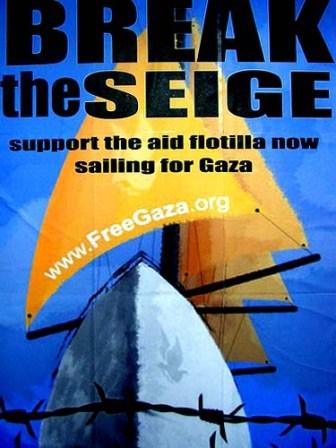
Limassol, Cyprus – In a few, short days, the Free Gaza Movement, a diverse group of international human rights activists from seventeen different countries, will set sail from Cyprus to Gaza in order to shatter the Israeli
blockade of the Gaza Strip. I’m proud to stand with them. Over 170 prominent
individuals and organizations have endorsed our efforts, including the Carter
Center, former British Cabinet member Claire Short, and Nobel Peace Prize
laureates Mairead Maguire and Desmond Tutu.

Adam Qvist, a 22 year old student and filmmaker from Copenhagen, Denmark, is
one of the human rights workers sailing to Gaza. He explains his participation
in the project in this way:

“I’m interested in telling narratives and advocating people’s existent
feelings. The idea of sailing to Gaza is kind of crazy, but it’s also very
straight-forward. The whole idea of having just one Palestinian who’s been
forced off their land and who is able to return to Palestine – this is
something that could demolish the whole Zionist venture. And it just has to be
one person. If one person can do it, then others can do it. This project, this
boat, is about giving people the freedom to take responsibility. You
shouldn’t expect something from others if you can’t do it yourself, and
this is true both on a very personal but also on a political level.

“This mission is an amazing opportunity to have a huge impact on this
hard-locked, heart-locked, crisis. I’ve never been to Gaza, myself, but I
know that Gaza is the forgotten little brother of the Middle East, or at least
of the Israeli-Palestinian crisis. Everything about this crisis is clearer in
Gaza. The Israeli occupation strategy is much clearer in Gaza, because it’s
not specifically about taking more land. It’s mostly about completely
destroying a people.”

Over two years ago, in an election process advocated by the United States, the
party of Hamas was elected to power in Occupied Palestine. In response, Israel
and the United States imposed a near total blockade on the people of Gaza in an
illegal act of collective punishment.

For more than two years, Israel has blocked Gaza’s access to tax revenues,
humanitarian aid, and even family remittances from Palestinians living abroad.
Predictably, Gaza’s economy has completely collapsed, and malnutrition rates
have skyrocketed. Today, because of the blockade, eighty percent of the people
of Gaza are dependent on United Nations’ food aid just to be able to eat.

This is intolerable.

U.S. Presidential candidate Barack Obama often speaks about the “audacity of
hope.” But hope can never be a passive emotion. Centuries ago, St. Augustine
wrote that Hope has two, beautiful daughters: Anger and Courage. To hope for a
better world is to be angry at the injustices that prevent that world from
emerging, and it requires the courage to stand up and create newer worlds for
ourselves.

Tom Nelson, a lawyer from Welches, Oregon, is sailing to Gaza to seek that
newer world. According to Tom:

“Americans are terribly ignorant of the human effects of what they support. I
think this boat is one of the most effective means of raising consciousness –
particularly American consciousness – about the problems caused by American
foreign policy. Americans have to know the consequences of these policies …
I’m sixty-four years old, my children are grown, and my affairs are in order.
I think about Rachel Corrie, and about what Israel may do to us. I know it’s
risky, but I take a risk when I ride a motorcycle, and I think that if we’re
really going to change things then somebody has to begin putting something on
the line for that change to happen.”

Eliza Ernshire is a thirty-two year old schoolteacher from London. Her reasons
for sailing to Gaza are much the same:

“For years and years – seeing place in the world that were being totally
destroyed, and people that were being totally destroyed by other people and
governments – I thought there’s nothing that I could do. But I realized that
we can change things in small ways, and we have a responsibility to do this.

“No one is paying attention to what’s happening in Gaza. No one is
listening to Palestinians. They are slowly being strangulated by Israel, and no
one is even listening. I can’t sit outside of this and just let it happen …
We as human beings have an obligation to stand up, and I can’t be passive
about it. You can’t stand up in London and just say that you don’t agree.
We need to find ways to connect people in the Middle East, particularly young
people, to people and groups in wealthier countries. Together we can inspire
each other, and together we can be much more than we are alone.”

Eliza speaks a powerful truth. Politicians and pundits often complain that the
conflicts in the Middle East are complex and intractable, but two things are
absolutely clear: One is that the use of violence – and, in Israel’s case,
overwhelming violence – has not helped any side to achieve peace or security.
And the other is that our governments, across our entire world, have completely
failed to do anything productive to address this crisis.

It’s time we the people stand up for ourselves against unjust laws, wanton
violence, criminal blockades, and the hardness of heart that makes these thing
possible. It’s time we stand against fear-mongering and war-mongering, and
build connections, for ourselves, with our sisters and brothers in the Middle
East. Our politicians have long since failed us. Now it’s our turn to stand
up and seek a newer world for ourselves.


Ramzi Kysia is an Arab-American writer and activist, and a member of the Free
Gaza Movement. You can receive regular updates on their efforts to break the
siege of Gaza by signing up for their newsletter. If you’d like more
information, or if you’d like to donate to their efforts, please visit their
website at FreeGaza.org.


The laureate of all Arabs

by Ahdaf Soueif

Ahdaf Soueif

Mahmoud Darwish is dead, but the voice of the Palestinian resistance will live on in all of us

* The Guardian,
* Tuesday August 12 2008

None of us really thought he’d die. Our loss is great, we tell each other. In our minds we think of Edward Said, of Haider Abdel-Shafi, of Faisal Husseini, and even – yes – of Yasser Arafat. The “big men” of Palestine. And now, Mahmoud Darwish.

He was seven when – in the Nakba of 1948 – he fled from Birweh, his village in the Galilee. At the age of 12, living in Deir el-Asad, in what had become Israel, with a reputation as a precocious child poet, he was asked to compose a poem for a public reading. The occasion was the celebration of Israel’s “Independence Day” and the poem he read described the feelings of a child who returns to his town to find other people sleeping in his bed, tilling his father’s lands. He was summoned to the military governor who told him that if he continued to write subversive material his father’s work permit would be revoked. That incident set the tone, I think, for Darwish’s life.

READ ON

Darwish: again, and again

from Angry Arab

Darwish’s prose is as beautiful as his poetry, but in different ways. What I love about him is that this poet speaks Arabic in a very concise way when being interviewed. I watched an interview with him from 2002, and he was magnificent. He said that while Israel imposes a siege on the Palestinian people, the U.S. (after Sep. 11) imposes a siege on the world. He talked about his poem State of Siege. He made me re-read it: it is incredible. There is a passage there when he calls on the occupier to try to some Arabic coffee: and you read the passage and it is a poetic expression of that famous section about master and slave in Hegel’s Phenomenology of Mind. He said that it is not possible to make peace with a state that have not been able in 60 years to make peace with “its” Arab citizens of the state. He said that Israel only extends its tanks and jets. He said that the debate in the Knesset about the use of his poetry in school curricula indicated that weakness of the identity of the state. He also made the important point about the culpability of Israeli society: that Israelis democratically elect those governments that practice war crimes as a matter of policy. I have always believed this to be true: Israel its supporters can’t have it both ways. Can’t insist on bragging about the democracy of Israel (for its Jewish citizens only of course) and yet expect us to absolve the voters of Israel from the moral, ethical, political, and even legal responsibility for the crimes that are committed by the successive governments of Israel.
Posted by As’ad at 7:22 AM

And also, later : Instead of writing about shoes and Arab culture, why don’t these foreign correspondents write about the place of poetry in Arab culture? At least classical Orientalists, like Philip Hitti (who I still like to read), used to write about that. I can’t imagine a funeral like that for a poet in the U.S. Is Donald Rumsfeld considered a poet?

I would add Scotts to Arabs for their love of poetry but may be not on the same scale.

Dicing with death for Gaza: Day 12

Wed, 13 Aug 2008 11:51:02 GMT
By Yvonne Ridley, Press TV

By the time you read this, our two boats, the Free Gaza and SS Liberty should
be sailing from Chania’s old port in Crete despite a gloomy forecast of storms
ahead.

Our captains have decided it is time to quit our dock for security reasons and
so we are heading along the Crete coastline on our way to pick up the rest of
our passengers who have been waiting patiently in Cyprus.

We could be in for a rough ride, but without going into too much detail, we
probably are more at risk by not moving.

Israel has a history of using Mossad and Kidon to sabotage and destroy peaceful
operations designed to help or show solidarity towards Palestinians.

From Crete we will head towards larnaca, Cyprus to pick up the rest of our
group and then we are bound for Gaza to break the medieval siege imposed by
Israel.

Media interest is once again gathering momentum and there are those who want to
join us on board while others are considering hiring their own boats … the
more the merrier. Wouldn’t it be great if we had a huge flotilla?

However, there are concerns from the media because Israel has a history of
shooting, killing, and arresting journalists who try to report the truth about
the brutal occupation of Palestine.

I was reminded of this only this morning as I read a release a few minutes ago
from Reporters Without Borders. The human rights group was condemning today’s
announcement by the Israeli Occupation Forces (IOF) to detain Ibrahim Hamad, a
soundman employed by the Palestinian news agency Ramattan, for six months
without bringing charges and without taking him before any court.

Hamad was arrested by Israeli soldiers at his home in Qalandiyah, near the West
Bank city of Ramallah, on July 15. “The Israeli military may not under any
circumstances arrest journalists or media assistants without giving a
reason,” Reporters Without Borders said.
“If they think a journalist has done something wrong, they must say what it
is and they must explain why they are arresting him. We call for Hamad’s
immediate release.”

When reached by Reporters Without Borders, the management of Ramattan firmly
condemned his arrest and called for his release.

They also called on the Israeli authorities to explain why they are holding
him. “This is not the first time that one of our employees has been arrested
by the Israeli military,” the agency said.

Israeli boasts it is a democracy … these are not the actions of a democratic
state. These are the actions of a brutal state which tries to crush those
dedicated to telling the truth about the full horrors of the Zionist regime and
its determination to see through its deliberate and slow genocide of the
Palestinian people.

We will be able to see in a few days time exactly how the Israelis react to a
group of peaceful activists who want to sail into Gaza armed with nothing more
than love and support for their Palestinian brothers and sisters.

If Israel is really a free and open democracy then its Navy will let us past,
Mossad will stop trying to sabotage our journey and all of the journalists on
board, including myself, will be able to report the truth about what is
happening in the world’s largest open air prison called Gaza.

In the meantime, I would urge the IOF to release our brother Ibrahim Hamad and
allow him to continue his media work.

Mahmoud Darwish : As’ad’s eulogy

From angryarab.blogspot.com

Mahmud Darwish. I should write something about Mahmud Darwish. I have translated quite a few of his poems here. I like his oldest Diwan very much and have read it repeatedly over the years. My taste in Arabic poetry is rather old-fashioned: I like the classical ones, and I like the modern Iraqi poets, but have always appreciated Darwish. I was perhaps avoiding writing about Darwish because there is so much emotions involved. His death is a big deal in the Arab world: a Mauritanian poet was talking to AlJazeera about the sadness in Mauritania. His death in the Arab context is comparable to the death of say, Pushkin for Russian, or like the death of Victor Hugo in France when people roamed the streets yelling that Victor Hugo has died. At the personal level (as I knew a lot about him), I did not like him. At the political level, I did not like him at all. But at the literary level: he is peerless. It is a joke that Naguib Mahfouz won that silly Nobel Prize. He is our greatest living writer of Arabic, but he is not Egyptian and did not like the Egyptian-Israeli peace treaty. My friend Sinan was telling me that so many of the Arab eulogies were annoying, and I could not agree more. Saudi media hated him, and to his credit, and despite all my political disagreements with him (not that he knew about them or cared), he really never liked the Gulf regimes and did not visit there to my knowledge. He had that visit to Iraq, and Al-Watan Al-`Arabi reported at the time that he called Saddam “the knight of Arabism” but other people who knew him well said that it was not true, and that he was not pleased with the visit. But his relation with Arafat was very problematic. He could not break with Arafat at all, and wanted to have it both ways: to pretend that he was some independent Palestinian intellectual while maintaining that poisonous relations with that awful figure of Palestinian national politics. There is so much that can be said about his literary genius, but for me his major accomplishment were: 1) that he was able to extricate himself artistically from the adulation of the masses: he once said in the early 1970s in a major reading in Beirut–according to a witness who told me–something to the effect: please spare me that love; 2) that he was courageous in expressing himself poetically without regard to mass taste. No matter how much we wanted him to go back to the early years of direct political poetry, he continued ot develop his own style as if living in his own world. That is his greatest fete as a poet. Compare that, say, to the poetry of Sa`id `Aql (as much as I like it) or to Samih Qasim who stagnated poetically. Adonis is a different story as his early poetry was better than his later ones when he thought he was being profound. 3) his prose is not much appreciated. If he was being interviewed, I used to be mesmerized. Nobody I know uses Arabic prose or write it as he did. It was incredible. I have many favorites in Darwish’s poetry, but his poem after the fall of Tal Az-Za`tar is one of my favorites (Ahmad Az-Za`tar–I translated most of it before here).

Mahmoud Darwish : State of siege

Under Siege

By Mahmoud Darwish (1942-2008 )

Mahmoud Darwish, poet

Here on the slopes of hills, facing the dusk and the cannon of time
Close to the gardens of broken shadows,
We do what prisoners do,
And what the jobless do:
We cultivate hope.

***
A country preparing for dawn. We grow less intelligent
For we closely watch the hour of victory:
No night in our night lit up by the shelling
Our enemies are watchful and light the light for us
In the darkness of cellars.

***
Here there is no “I”.
Here Adam remembers the dust of his clay.

***
On the verge of death, he says:
I have no trace left to lose:
Free I am so close to my liberty. My future lies in my own hand.
Soon I shall penetrate my life,
I shall be born free and parentless,
And as my name I shall choose azure letters…

***
You who stand in the doorway, come in,
Drink Arabic coffee with us
And you will sense that you are men like us
You who stand in the doorways of houses
Come out of our morningtimes,
We shall feel reassured to be
Men like you!

***
When the planes disappear, the white, white doves
Fly off and wash the cheeks of heaven
With unbound wings taking radiance back again, taking possession
Of the ether and of play. Higher, higher still, the white, white doves
Fly off. Ah, if only the sky
Were real [a man passing between two bombs said to me].

***
Cypresses behind the soldiers, minarets protecting
The sky from collapse. Behind the hedge of steel
Soldiers piss—under the watchful eye of a tank—
And the autumnal day ends its golden wandering in
A street as wide as a church after Sunday mass…

***
[To a killer] If you had contemplated the victim’s face
And thought it through, you would have remembered your mother in the
Gas chamber, you would have been freed from the reason for the rifle
And you would have changed your mind: this is not the way
to find one’s identity again.

***
The siege is a waiting period
Waiting on the tilted ladder in the middle of the storm.

***
Alone, we are alone as far down as the sediment
Were it not for the visits of the rainbows.

***
We have brothers behind this expanse.
Excellent brothers. They love us. They watch us and weep.
Then, in secret, they tell each other:
“Ah! if this siege had been declared…” They do not finish their sentence:
“Don’t abandon us, don’t leave us.”

***
Our losses: between two and eight martyrs each day.
And ten wounded.
And twenty homes.
And fifty olive trees…
Added to this the structural flaw that
Will arrive at the poem, the play, and the unfinished canvas.

***
A woman told the cloud: cover my beloved
For my clothing is drenched with his blood.

***
If you are not rain, my love
Be tree
Sated with fertility, be tree
If you are not tree, my love
Be stone
Saturated with humidity, be stone
If you are not stone, my love
Be moon
In the dream of the beloved woman, be moon
[So spoke a woman
to her son at his funeral]

***
Oh watchmen! Are you not weary
Of lying in wait for the light in our salt
And of the incandescence of the rose in our wound
Are you not weary, oh watchmen?

***

A little of this absolute and blue infinity
Would be enough
To lighten the burden of these times
And to cleanse the mire of this place.

***
It is up to the soul to come down from its mount
And on its silken feet walk
By my side, hand in hand, like two longtime
Friends who share the ancient bread
And the antique glass of wine
May we walk this road together
And then our days will take different directions:
I, beyond nature, which in turn
Will choose to squat on a high-up rock.

***
On my rubble the shadow grows green,
And the wolf is dozing on the skin of my goat
He dreams as I do, as the angel does
That life is here…not over there.

***
In the state of siege, time becomes space
Transfixed in its eternity
In the state of siege, space becomes time
That has missed its yesterday and its tomorrow.

***
The martyr encircles me every time I live a new day
And questions me: Where were you? Take every word
You have given me back to the dictionaries
And relieve the sleepers from the echo’s buzz.

***
The martyr enlightens me: beyond the expanse
I did not look
For the virgins of immortality for I love life
On earth, amid fig trees and pines,
But I cannot reach it, and then, too, I took aim at it
With my last possession: the blood in the body of azure.

***
The martyr warned me: Do not believe their ululations
Believe my father when, weeping, he looks at my photograph
How did we trade roles, my son, how did you precede me.
I first, I the first one!

***
The martyr encircles me: my place and my crude furniture are all that I have changed.
I put a gazelle on my bed,
And a crescent of moon on my finger
To appease my sorrow.

***
The siege will last in order to convince us we must choose an enslavement that does no harm, in fullest liberty!

***
Resisting means assuring oneself of the heart’s health,
The health of the testicles and of your tenacious disease:
The disease of hope.

***
And in what remains of the dawn, I walk toward my exterior
And in what remains of the night, I hear the sound of footsteps inside me.

***
Greetings to the one who shares with me an attention to
The drunkenness of light, the light of the butterfly, in the
Blackness of this tunnel!

***
Greetings to the one who shares my glass with me
In the denseness of a night outflanking the two spaces:
Greetings to my apparition.

***
My friends are always preparing a farewell feast for me,
A soothing grave in the shade of oak trees
A marble epitaph of time
And always I anticipate them at the funeral:
Who then has died…who?

***
Writing is a puppy biting nothingness
Writing wounds without a trace of blood.

***
Our cups of coffee. Birds green trees
In the blue shade, the sun gambols from one wall
To another like a gazelle
The water in the clouds has the unlimited shape of what is left to us
Of the sky. And other things of suspended memories
Reveal that this morning is powerful and splendid,
And that we are the guests of eternity.

-Translated by Marjolijn De Jager.
Source

Mahmoud Darwish is dead

from Al Jazeera
Mahmoud Darwish, the renowned Palestinian poet, has died after open heart surgery at the Memorial Hermann medical centre in Texas.

Darwish's poetry has been translated into more than 20 languages [GALLO/GETTY]

Ann Brimberry, Memorial Hermann’s spokeswoman, confirmed to Al Jazeera that Darwish died at 1.35pm (1835GMT).

Siham Daoud, a fellow poet and friend of Darwish, 67, had asked not to be resuscitated if the surgery did not succeed.

She said Darwish departed for the US ten days ago for the surgery, and he had undergone two operations for heart problems before Saturday’s surgery.

Best known for his work describing the Palestinian struggle for independence, the experience of exile and factional infighting, Darwish was a vocal critic of Israeli policy and the occupation of Palestinian lands.

Many of his poems have also been put into music – most notably Rita, Birds of Galilee and I yearn for my mother’s bread, becoming anthems for at least two generations of Arabs.

“He felt the pulse of Palestinians in beautiful poetry. He was a mirror of the Palestinian society,” Ali Qleibo, a Palestinian anthropologist and lecturer in cultural studies at Al Quds University in Jerusalem said.

READ ON

Strange lights were spotted in Israeli Sky

Found the article below at sott.net preceded by a very unflattering introduction about the land of sour milk and poisened honey which I dare not reproduce here since, as we all know, freedom of expression is limited in our democratic countries. The article is a translation of an original in Hebrew published in the JP. Here goes :

Our readers from the Center district and as far as Ashkelon in the South have noticed several bright trails in the sky. Witnesses reported that the “weird lights” were seen in the sky for more than 15 minutes.

Tal Rabinovski

Many residents that took a look at the sky yesterday (Saturday) noticed a couple of strange lights. The sighting was spotted from Ashkelon in the South, to Haifa in the North. The bright lights were also visible in the coast area and Jerusalem area in the East. IDF reported of no unusual recent activity.

READ ON HERE

Sami al Arian

You can read about the Al-Arian case here

Sami Al-Arian Subjected to Worst Prison Conditions since Florida
Despite grant of bail, government continues to hold him
Dr. Al-Arian handcuffed

Hanover, VA – July 27, 2008 –

More than two weeks after being granted bond by a federal judge, Sami Al-Arian is still being held in prison. In fact, Dr. Al-Arian is now being subjected to the worst treatment by prison officials since his stay in Coleman Federal Penitentiary in Florida three years ago.

On July 12th, Judge Leonie Brinkema pronounced that Dr. Al-Arian was not a danger to the community nor a flight risk, and accordingly granted him bail before his scheduled August 13th trial.
Nevertheless, the Immigration and Customs Enforcement (ICE) invoked the jurisdiction it has held over Dr. Al-Arian since his official sentence ended last April to keep him from leaving prison.
The ICE is ostensibly holding Dr. Al-Arian to complete deportation procedures but, given that Dr. Al-Arian’s trial will take place in less than three weeks, it would seem somewhat unlikely that the ICE will follow through with such procedures in the near future.

Not content to merely keep Dr. Al-Arian from enjoying even a very limited stint of freedom, the government is using all available means to try to psychologically break him.
Instead of keeping him in a prison close to the Washington DC area where his two oldest children live, the ICE has moved him to Pamunkey Regional Jail in Hanover, VA, more than one hundred miles from the capital. Regardless, even when Dr. Al-Arian was relatively close to his children, they were repeatedly denied visitation requests.

More critically, this distance makes it extremely difficult for Dr. Al-Arian to meet with his attorneys in the final weeks before his upcoming trial. This is the same tactic employed by the government in 2005 to try to prevent Dr. Al-Arian from being able to prepare a full defense.

Pamunkey Regional Jail has imposed a 23-hour lock-down on Dr. Al-Arian and has placed him in complete isolation, despite promises from the ICE that he would be kept with the general inmate population. Furthermore, the guards who transported him were abusive, shackling and handcuffing him behind his back for the 2.5-hour drive, callously disregarding the fact that his wrist had been badly injured only a few days ago.
Although he was in great pain throughout the trip, guards refused to loosen the handcuffs.

At the very moment when Dr. Al-Arian should be enjoying a brief interlude of freedom after five grueling years of imprisonment, the government has once again brazenly manipulated the justice system to deliver this cruel slap in the face of not only Dr. Al-Arian, but of all people of conscience.

Make a Difference! Call Today!

Call Now!

Last April, your calls to the Hampton Roads Regional Jail pressured prison officials to stop their abuse of Dr. Al-Arian after only a few days.

Friends, we are asking you to make a difference again by calling:

Pamunkey Regional Jail: (804) 365-6400 (press 4 then 3001 to speak to the administration, then ask to leave a message for the superintendent; after working hours, press 0). Ask why Dr. Al-Arian has been put under a 23-hour lockdown, despite the fact that a federal judge has clearly and unambiguously pronounced that he is not a danger to anyone and that, on the contrary, he should be allowed bail before his trial.

– If you do not reach the superintendent personally, leave a message on the answering machine. Call back every day until you do speak to the superintendent directly.
– Be polite but firm.

– After calling, click here to let us know you called.

Don’t forget: your calls DO make a difference.
See original article with the links here

Blog at WordPress.com.

Up ↑