Search

band annie's Weblog

I have a parallel blog in French at http://anniebannie.net

Category

Palestine

Hamas would recognise Israel within 1967 borders’

Thursday, January 29, 2009

PARIS/OCCUPIED-AL-QUDS: Hamas would recognise Israel if it withdraws to its pre-1967 borders, a French writer said this week after meeting the exiled leader of the Palestinian Islamist movement, Khaled Meshaal.

“He told me that Hamas was prepared to recognise Israel on the lines of June 4, 1967. He told me so several times,” Marek Halter told AFP on Monday.

The date refers to Palestinian demands for an end to Israeli occupation of the West Bank, Gaza Strip and East Jerusalem, captured in the 1967 war.

Halter’s meeting with Meshaal took place in Damascus last month, on the eve of Israel’s 22-day offensive, which left more than 1,330 Palestinians dead, according to Gaza medics, and vast swathes of the territory in ruins.

The writer said he informed Israeli Prime Minister Ehud Olmert and Foreign Minister Tzipi Livni of Meshaal’s comments at the start of the Gaza conflict, which ended January 18 as Israel and Hamas declared unilateral ceasefires.

“Now they will have to decide,” whether to talk to Hamas, said Halter, who said Meshaal had newly decided to support peace negotiations with Israel, for fear of “becoming irrelevant”.

Israel, Washington and the European Union all refuse to recognise Hamas’ democratically elected government, branding it a terrorist organisation.

Meshaal called in a speech aired on Arab satellite televisions last week for Western powers to lift a ban on contacts with his movement.

Middle East peace envoy Tony Blair has said the diplomatic Quartet—Europe, Russia, the United States and United Nations—would deal with Hamas if it accepts a two-state solution to the Israeli-Palestinian conflict.

Meanwhile, France on Wednesday summoned Israel’s ambassador after Israeli troops fired warning shots as European diplomats were blocked at a Gaza border crossing.

Israeli troops halted a diplomatic convoy carrying France’s consul general Alain Remy at the Erez crossing on Tuesday and held it for six hours as it left the Gaza Strip and returned to Jerusalem, the foreign ministry said.

“The convoy, which included other European diplomats, was subject to two warning shots from Israeli soldiers,” ministry spokesman Eric Chevallier told reporters.

Foreign Minister Bernard Kouchner summoned Israeli Ambassador Daniel Shek “to protest this unacceptable incident and demand an explanation,” he said.

In a related development, US Middle East envoy George Mitchell said on Wednesday it was critical to consolidate a ceasefire in Gaza by ending hostilities, opening borders and ending smuggling into the enclave.

“The prime minister and I discussed the critical importance to consolidate the ceasefire including a cessation of hostilities, an end to smuggling and reopening of the crossings based on 2005 agreements,” Mitchell told reporters after meeting Prime Minister Ehud Olmert.

On his maiden trip to the region since being appointed by new US President Barack Obama, Mitchell said:

“The US will sustain an active commitment to reaching the goal of the two states living side by side in peace and security.” And he reiterated that Washington “is committed to Israel’s security and to its right to defend itself.”

His trip comes more than a week after the end of Israel’s devastating war on the Hamas-run Gaza Strip that left more than 1,300 Palestinians dead, according to local medics.

A senior Israeli official said Olmert told Mitchell that the government would observe a ceasefire around the Hamas stronghold only if there was a “total calm and an end to rocket fire and terror activities and the arms smuggling.”
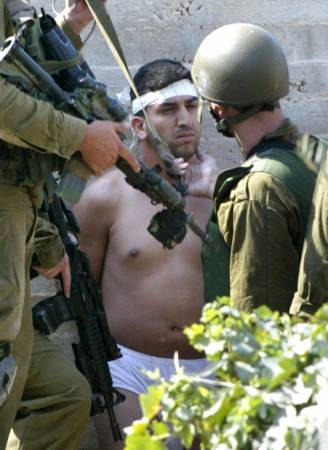
SOURCE

Vittorio Arrigoni from Gaza

here the link to the article published the day 24 to Il Manifesto:

PO-GAZA-VIOLENCE-20041013
——
I crossed the threshold of my house in Almina, facing Gaza City port, after several days of absence. Everything was exactly as I had left it – the gas cylinder still anorexic (feeding it is too expensive) and the electric current cut off by foreign shears. The once pleasant panorama outside my window has changed and no longer gladdens my spirits from the misery of living under siege. On the contrary, it now rubs salt in the wound, a trauma that won’t heal with its reminder of a massacre. Twenty metres from my front door, where the fire station once stood, a huge crater now gapes wide enough for children to mess around in, as if to expel their parents’ demon.

The afternoon call to prayer no longer has the same comforting quality of the muezzin’s chant that I had grown accustomed to. I wonder where he’s gone, if he managed to survive at the top of one of the few minarets that were left intact. The last time I listened to him, this anonymous muezzin had to interrupt his solemnly chanted liturgy because of a chesty cough. It’s an affliction I’m familiar with myself, as the gases of the bombs in Gaza have spared no one. I found a note at the foot of the French window looking onto a small balcony, as if it had been put there by a friendly hand. The street and garden were littered with these same leaflets. They had been dropped from Israeli airplanes warning the Palestinians to stay alert, and be aware that the walls had ears and eyes.

“At the slightest threatening action against Israel we’ll be back to invade the Gaza Strip. What you’ve seen these days is nothing compared to what awaits you.” Some kids in the streets had picked up the leaflets and folded them into paper airplanes, seemingly sending the message back to its destination.

Ahmed told me on the phone about a new kids’ game – until a few days ago, they amused themselves by relighting the fires, simply by kicking the fragments of white phosphorous bombs found scattered all over the Strip. The debris left by these devices with high chemical potential has very long-lasting inflammable properties. Even when picked up several days after their detonation, it still catches fire if shaken about. The Al Quds hospital paramedics speak of how they gave up trying to put out the fires provoked by these illegal bombs – their flames seemed to feed off the water being thrown at them.

“The consequences of all the shit that’s been thrown at us in these last three weeks will surface in the near future, with new cancer cases and deformed babies”, Munir, a doctor at Al Shifa hospital told me. Even Gaza’s neighbours seem to be worried by this massive use of weapons forbidden by all international conventions. In Sderot, and likewise in Ashkelon, Israeli citizens have formally asked their government for clarifications regarding the weapons that have been used to torment us. It’s obvious that impoverished uranium and white phosphorous scattered in such a criminal manner all over the tiny patch of land that is Gaza won’t discriminate between Jews and Muslims when it comes to provoking generic illnesses.

The truce ought to have started by now, but today I was woken in my bed by the deafening rumble of cannon shots from the war ships, exactly like a few days ago. Some brave Palestinian fishermen had ventured from the port on their tiny boats equipped with fishing nets. The Israeli Navy pushed them back. Nowadays, the only edible fish found in Gaza are the Egyptian cans of tuna that came through the tunnels months ago. Yesterday, yet two more casualties of “collateral damage” were caused by Israeli bombs. East of Gaza City two children were blown up when playing with an unexploded device. The witnesses we heard spoke of active mines in front of the Tal el Hawa houses’ ruins. Some bomb disposal experts sent over by Hamas defused them and, judging by the care with which they loaded them onto an off-road vehicle, I think the al qassam brigades will soon return that message of death directly to its lawful owner.

Looking from Naema’s roof, the Israeli-Palestinian border has never seemed so easy to pick out. On one side lie the green hills which are constantly watered by the Israeli kibbutzim, on the other you see the parching thirst of a land robbed of its water springs and herds. Naema wished to tell me all about her last few days – a tactile, aural and olfactory account of the massacre, considering that Naema is blind. The soldiers threateningly ordered her fellow villagers to evacuate their homes only a few minutes before storming the place. The men loaded smaller children onto their shoulders and ran away, along with their women. Naema chose to stay so as not to slow down their escape. She took refuge in her own house, believing herself to be safe, and welcomed her neighbours, who had nowhere to go: three women, an elderly lady and a paralyzed old man. The tanks and bulldozers then trespassed and started spreading death and destruction, devouring acre by acre, until they stopped in front of Naema’s house. Standing on a small hill, the building she inhabits is the tallest in the village, and the soldiers of Tsahal, who found it was strategically positioned, let themselves in and occupied it for two weeks.

“They came in and pointed their weapons at us, pushing us into a small room, where they locked us up for eleven days.” Naema continues her story: “During that entire time they brought us water to drink only twice, and food came in the form of the soldiers’ rations’ left-overs. They never let us go to the bathroom, so we had to go to the toilet in one corner of the room.

They wouldn’t let us talk amongst ourselves, and they would come in and beat us when at night, huddled in a circle, we tried to gather some strength in prayer. Sometimes they’d come over and, intimidating us by touching our bodies with the cold metal of their weapons, they threatened us with death to confess our support for Hamas. I gave them my cell phone, so they could check my phone book and the calls I’d made. Even this gesture didn’t mellow their spite.”

At the end of the eleventh day of imprisonment, the international Red Cross finally arrived and released the six prisoners from their jailers. “They didn’t allow us to pick up anything, not even my sunglasses”, Naema brings her story to a close, adding that when they came back to her house, they found out about the thefts that had been carried out by the soldiers. They had taken all their gold trinkets and hidden savings, after having destroyed their few possessions, two TV sets, a radio, a fridge, and the solar panels on the roof. I saw tears in this woman’s eyes, hidden behind her new dark glasses. They seemed the most vivid I had ever seen. In fact, what Naema “saw” is a lot more that any young woman her age will ever get a chance to see, if she had the bad luck of being born in this tormented land.

Stay human

(Translated from italian by Daniela Filippin)

Behind the Bloodbath in Gaza

Foiling Another Palestinian “Peace Offensive”

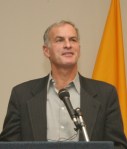
By NORMAN FINKELSTEIN

norman_finkelstein_suffolk1

Early speculation on the motive behind Israel’s slaughter in Gaza that began on 27 December 2008 and continued till 18 January 2009 centered on the upcoming elections in Israel. The jockeying for votes was no doubt a factor in this Sparta-like society consumed by “revenge and the thirst for blood,” where killing Arabs is a sure crowd-pleaser. (Polls during the war showed that 80-90 percent of Israeli Jews supported it.) But as Israeli journalist Gideon Levy pointed out on Democracy Now!, “Israel went through a very similar war…two-and-a-half years ago [in Lebanon], when there were no elections.”

READ ON

From the Real News : Gaza

McClatchy’s John Walcott discusses Gaza and the likelihood of peace.

http://www.mcclatchydc.com/226/story/60853.html

60 minutes

http://www.cbsnews.com/video/watch/?id=4752349n

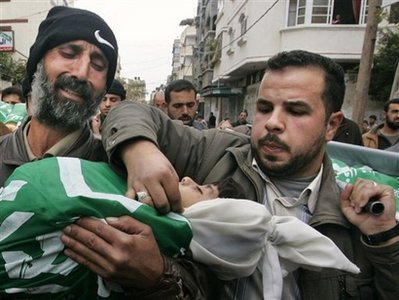
Never forget

APTOPIX MIDEAST ISRAEL PALESTINIANS

SOURCE

In Gaza, only the dead have seen the end of war

by Vittorio Arrigoni

For the living, no truce can make up for the daily battle for survival. They have no running water, gas, electrical power, and no bread and milk to feed their children. Thousands of people have lost their homes. Humanitarian aid seeps through the passes in drips and drabs, and you get the feeling that the benevolence of the killers’ accomplices is only temporary. Tomorrow, Ban Ki-Moon, the UN’s Secretary General will travel to Gaza, and we’re pretty sure that John Ging, Chief of the Palestinian Refugees’ Agency, will have many stories to tell him after Israel bombed two UN schools, assassinated 4 of their workers, bombed and destroyed the UNRWA centre in Gaza City (which reduced tons of medicine and food supplies destined for the civilian population to ashes).

Gaza’s mountains of rubble continue to spit corpses back up to the surface. Yesterday, between Jabalia, Tal el Hawa in Gaza City and Zaitun, the Red Crescent paramedics, with some help from the ISM volunteers, have pulled out 95 corpses from the ruins, many of which are in an advanced state of decay. Walking through the streets of the city and no longer feeling constantly terrified by the thought of a bomb surgically aimed to decapitate me, I still tremble at the sight of stray dogs gathering in a circle, imagining what could reveal itself before my eyes as their meal. The relieved men go back to hang out in their mosques and cafés, but their attitude of feigned normalcy is easy to detect. Many of them have lost a relative or have nowhere to live.

They pretend to go back to their everyday routine to boost their wives and children’s spirits – somehow, even this catastrophe must be dealt with. This morning we drove with some ambulances to the most devastated neighbourhoods in the city, Tal el Hawa and Zaitun. Questionnaire in hand, we went door to door and compiled a list of the damage suffered by the buildings , and wrote down the families’ most urgent requirements: medicine for the elderly and sick, rice, oil and flour, basically the essentials to feed themselves. All that we’ve been able to give them so far are metres of nylon, to be used in lieu of their shattered windowpanes to block out the cold.

ISM colleagues in Rafah informed me that the municipality has handed out a few thousand dollars – mere pennies – to the families who’ve had their houses completely razed to the ground by the bombs, the very same that according to Israel, had been dropped to destroy the tunnels. After the end of the conflict with Lebanon, Hezbollah donated millions of dollars in cheques, to refund the homeless Lebanese citizens. In Gaza, under siege and embargo, Hamas is barely able to refund its people with what “will scarcely be enough to rebuild a barn for livestock”, says Khaled, a Rafah farmer.

The truce is unilateral, hence Israel unilaterally decides not to respect it. Khan Yunos, a Palestinian boy, was killed yesterday, and another was injured. East of Gaza helicopters have showered a residential area with white phosphorous. The same happened in Jabalia. In Khann Younis today, the war ships fired their cannons at an open plain, thankfully without harming anyone. But while I write, the news of storming tanks has just reached me. We’re not aware of any Palestinian rockets having been fired in the last 24 hours…

International journalists are clamouring for news all along the Strip, as they only managed to get in today. Israel granted them a pass only now that the massacre is winding down. Those who got here in the thick of the battle have seriously risked being killed, as I was told by Lorenzo Cremonesi, a correspondent for Corriere della Sera. Israeli soldiers shot potholes into the car that he was traveling in . Standing by the blackened skeleton of what remains of Al Quds hospital in Gaza City, an astonished BBC reporter asked me how the army could possibly have swapped the building for a terrorists’ den.

I said: “For the very same reason that children running away from a burning building were put in sight of the snipers on the roofs, who don’t hesitate to kill them, spreading their grey matter all over the road”, to which the journalist furrowed his brow further. The enormous difference between us eye-witnesses and first-hand victims of the massacre, and those who hear about it through our stories, is now further highlighted. From Rome I’m told that the EU intends to freeze the funds assigned for the reconstruction of Gaza as long as it’s governed by Hamas. The European Commissioner for External Relations, Benita Ferrero-Waldner, has made her point clear on this score. “The aid for the reconstruction of the Strip”, stated the European diplomat, “will only arrive if Palestinian President Abu Mazen will once again re-establish his authority over the territory.”

For Gaza’s Palestinians this is an explicit invitation from the outside to engage in civil war, or in a coup d’état. It’s equivalent to legitimising the massacre of 410 children, who died because their parents chose democracy and freely elected Hamas. “The EU is diligently echoing the criminal policy of collective punishment imposed by Israel. Why not entrust the funds to the UN? Or some governmental organisation?” “The Unites States are free to elect a war-monger like Bush, Israel can choose leaders with bloodied hands like Sharon or Netanyahu, but we, the people of Gaza, aren’t free to chose Hamas…”, suggested Mohamed, a human rights activist who never voted for the Islamic movement himself. I have no arguments to contradict him.

The surviving Palestinians learn from their dead; they learn to live while dying, right from the tenderest age. Truce after truce, the general perception here is that of a macabre pause between one massacre and another during which to count the dead, and peace has never felt so elusive. Scouring Gaza City on board an ambulance with the siren switched off for once, the war is still everywhere, among the ruins of a city robbed of its smiles and now populated only by frightened gazes, eyes that insist upon scanning the sky for planes still endlessly flying overhead. Inside a home we visited with some paramedics, I noticed some pastel drawings on the floor. It was clearly a child’s hand that had abandoned them after evacuating the house in a mad rush. I picked one of them up – tanks, helicopters and a body in pieces. In the middle of the drawing a child with a stone had succeeded in reaching the sun’s height and was damaging one of the flying death machines. It’s been said that in a child’s drawing, the sun represents his desire to be, to appear. The sun I saw was crying tears of blood in red pastel. Is a unilateral truce enough to heal such traumas?

Stay human
Vittorio Arrigoni
By mail from Free Gaza

Gaza in Ruins: A news special

Part 2

Part 3

Some scenes from Gaza

Saturday, January 24, 2009
Source : Scenes from Gaza at Angry Arab

Mideast Israel Palestinians

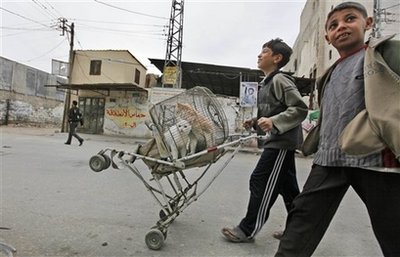
“A Palestinian boy carries rescued cats inside a birdcage, on a stroller on a street in Gaza City in the Gaza strip, Friday, Jan. 23, 2009.”
(AP Photo)

MIDEAST ISRAEL PALESTINIANS
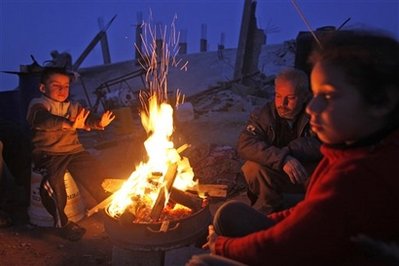
“Members of the Palestinian Khadr family gather around a fire next to a tent in the rubble of their house destroyed in the recent Israeli military operation in the devastated area of east Jebaliya, in the northern Gaza Strip, Saturday, Jan. 24, 2009.”
(AP Photo)

APTOPIX MIDEAST ISRAEL PALESTINIANS

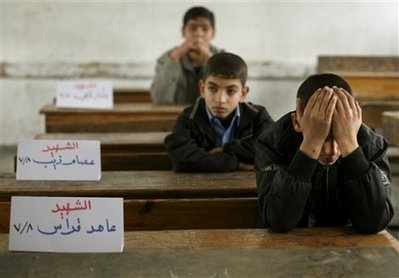
“Palestinian boy Mohammed Kutkut, 14, right, covers his face as he sits next to the name sign of his killed friend Ahed Qaddas in the Fakhoura boys school in Jebaliya, northern Gaza strip, Saturday, Jan. 24, 2009. Three friends of his class where killed when the Israeli army shelled Jebaliya in the past weeks. Tens of thousands of children have flocked back to schools throughout the Gaza Strip, days after Israel ended its fierce military operation against the territory’s rulers.”(AP Photo)

Posted by As’ad at 2:47 PM

Blog at WordPress.com.

Up ↑