It was strangely uplifting to spend two nights and three days in the Galilee, North Palestine. We visited good friends, made new friends, saw 3000 year old olive trees, walked in the ruins depopulated villages, and shopped and ate in Palestinian towns which survived 62 years of colonial apartheid. We crossed from Bethlehem to occupied East Jerusalem with a wave of an Israeli soldier’s hand (who did not bother to check papers of an Israeli car. A few minutes later we crossed the Green line (borders before 1967) that is neither marked or guarded. The imaginary green line had long disappeared since Israeli colonies go deep into the occupied West Bank. But in the areas of West Jerusalem, we could still see many signs of the three dozen Palestinian villages depopulated since 1948. Then taking “route 6” north. This highway was built on newly confiscated Palestinian village lands.
Over 530 Palestinian towns and villages were depopulated. The remaining 130 villages and towns had most of their land taken and now the remaining Palestinians who comprise 20% of the Israeli population live on about 2% of the land while the Jewish population controls the rest (which is mostly Palestinian property). When we take the whole of Palestine (West Bank and Gaza included), we see that Palestinians who remained (some 50% of the population is restricted to less than 10% of historic Palestine. Thus access to land is nearly 9 folds more to the Jewish population (most of it not native) even without the return of refugees.
We visited devastated Palestinian villages like Iqrit (a catholic christian community of which only the church remains), Al-Zeeb (a fishing muslim community where the mosque and the few remaining buildings are converted for recreation of Israelis), and Al_Bassa (that used to be a thriving mixed town of Christians and Muslims and was filled with Jewish immigrants initially from Bulgaria and is now called Shlomi).
But we also visited still heavily populated (and growing) Palestinian towns like Arrabe, Sakhnin, and Acre. One is tempted to feel sad at the inability of the Zionist Jews to see that they could have lived with the natives instead of at their expense. I was saddened to see how Jewish settlements throughout the Galillee are built on Palestinian lands instead of on the very many open spaces. I was saddened to see how these Jewish communities live behind guarded perimeters (gated communities). Palestinian towns, impoverished but still open to visitors.
Throughout the trip we met a few of the 1.5 million Palestinians who remain steadfast and work to reject the schemes of Judaicizing the Galilee (and the Negev, hopefully my next trip). These are inspiring people in everything they do. I am humbled by their dedication. I kept thinking of Tawfiq Ziyad’s poem Unadikum (I call upon you) which was rendered into patriotic songs of love of land and people. It says in part,
I call upon you
I press on your hands
I kiss the land
under your shoes
I gift you the light of my eyes
the beats of my heart
and I sacrifice myself for you
as I share with you…
The trip is chronicle in this short video in which I included singing Ziyad’s song.
For more information see
Abnaa Al-Balad Movement http://www.abnaa-elbalad.org/
article just published in Haaretz by Ahmed Tibi on http://www.haaretz.com/hasen/spages/1…
reality of Palestinians inside the state of Israel
For Al-Bassa http://www.palestineremembered.com/Ac…, and video on Al-Bassa by Uri Zakhem http://www.youtube.com/watch?v=O4or6g…
For Iqrit http://www.palestineremembered.com/Ac…
For Al-Zeeb http://www.palestineremembered.com/Ac… and video http://www.youtube.com/watch?v=iE2BLn…
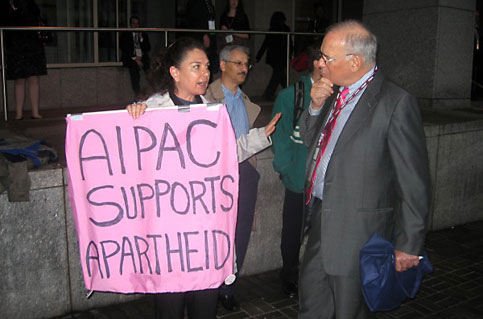
Stephanie Westbrook, The Electronic Intifada, 1 April 2010
Activists protesting outside the AIPAC policy conference carried signs highlighting Israel’s rights violations.
The theme of this year’s annual policy conference for the American Israel Public Affairs Committee (AIPAC) lobby group was “Israel: Tell the Story.” And it was quite a story that AIPAC wanted to tell. The conference aimed at imparting to the more than 7,000 attendees “an intimate understanding of the many ways that Israel is making the world a better place,” with a focus on peacemaking and innovation.
read on
On Tuesday March 30th, 2010, hundreds of women with their children, nearly 300 high school students, many university students, and teachers joined farmers and activists at the town of Beit Sahour, near Bethlehem, Southern West Bank, to mark Land Day. Full Story at http://www.imemc.org/article/58325
thank you Mazin Qumsiyeh, PhD
A Bedouin in Cyberspace, a villager at home
http://www.qumsiyeh.org
See also Palm Day March here
29 March 2010
Transmission of today’s BBC Radio 3 Wigmore Hall lunchtime recital, given by the Jerusalem String Quartet, was abandoned after a group of anti-Israeli protesters infiltrated the hall and disrupted the performance with shouts, chants and bursts of song. The concert continued once the demonstrators had been removed, but the broadcast was replaced by a performance of the same repertoire by the Salomon Quartet.
Wigmore Hall director John Gilhooly told CM that there had been pickets outside the hall earlier in the morning, so some sort of disturbance was not entirely unexpected, especially in the light of a similar protest that took place when the Jerusalem Quartet appeared at the Edinburgh festival a few years ago. ‘But today’s demonstration was evidently extremely well planned,’ he said.
‘The protesters must have bought their tickets for the concert a long time ago, because they were all sitting in individual seats in different parts of the hall. One stood up and started singing and shouting, and while we were removing him another one started up somewhere else, and so on.’
The quartet continued to play and completed its programme – Mozart’s String Quartet in D K575 and Ravel’s String Quartet in F. ‘The concert took an hour and 20 minutes instead of an hour, and the atmosphere in the hall was very tense,’ said Mr Gilhooly.
The Radio 3 broadcast was truncated ‘in order to deny these people publicity’, and replaced with a performance of the same repertoire by the Salomon Quartet. The Jerusalem players stayed on afterwards to re-record some sections of the music and a patched version of the recital will be broadcast in Saturday’s repeat slot.
Posters to the Radio 3 Performance message board reported that the protest had been announced on Sunday in a Twitter message urging protesters to join an ‘urgent demo against Jerusalem Quartet 12.30 Wigmore Hall’ to ‘boycott ambassadors of apartheid Israel’.
According to a report in the Jewish Chronicle, the protesters were accusing the players of being ‘cultural ambassadors for the state of Israel, promoting the interests of Israel and all its policies against the Palestinians, to the British public’.
However, in response to the incident Mr Gilhooly said: ‘I want to make the point very strongly that we can’t possibly condone any kind of disturbance to an artistic event. Wigmore Hall is a totally non-political organisation, and by disrupting performances the protesters completely take away the whole meaning of an artistic event, which is something that transcends politics.’

