ISM , July 15, 2010
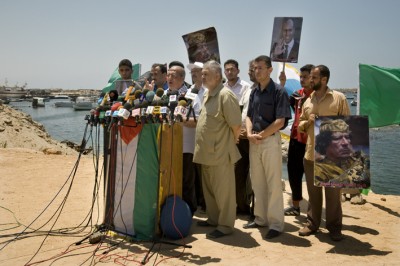
In a press conference at the port of Gaza city yesterday government officials, fishing associations, non-governmental organisations and civil society groups reiterated their support for the attempts by international activists to break the Israeli siege of Gaza by sea.
Yesterday (July 14th 2010) many people amassed at the Gazan port to urge on the latest attempt by activists to enter the strip, this time by a Libyan chartered aid ship. It was the first serious attempt to enter Gaza by sea since the horrifying attack by the Israeli navy on the Free Gaza Flotilla and the Mavi Marmara which saw 9 Turkish activists killed.
Mahfouz Kabariti, President of Palestine Sailing Federation and Palestinian Association for Fishing and Maritime Sports, was communicating with the Amalthea as it neared Gazan waters: “The last contact we had with them was at midnight and since then communication was cut by the Israeli navy. They told us the boat was surrounded by Israeli gunships, but that they were determined to attempt to dock in Gaza and not take the option offered by the Egyptian government to dock in El Arish.”
According to Mahfouz the roll of the Freedom Flotilla missions are two-fold: “First is the arrival with aid, and materials such as construction supplies still banned by the blockade. The second is to put a spotlight on the suffering of the people here. Even if they are attacked, the second message highlights even more the extent to which Israel will go to keep us in Gaza isolated from the rest of the world with this illegal blockade of our people.”
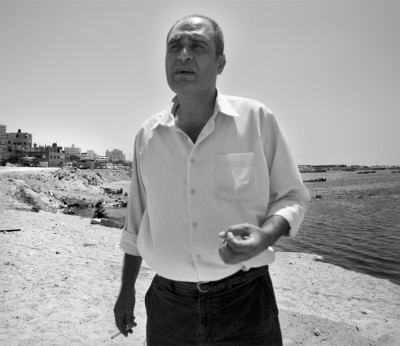
Amjad Shawa, Gaza Coordinator for Palestinian NGOs: “It is not enough to demand some kind of minor reduction of this illegal siege.”
As well as government representatives and the Popular Committee to Break the Siege, Amjad Shawa, Gaza Coordinator for Palestinian Non-Governmental Organizations (PNGO) was present. He emphasised the importance of international civil society persisting in trying to break the siege.
The need is especially acute because so far Israel’s response has only been to reduce the blockade on Gaza by a tiny fraction. The European Union, the United Nations, countless human rights groups and the International Committee for the Red Cross have all expressed the need for a return to the free flow of goods and people in and out of the Gaza Strip. This must include construction materials which are sorely needed to help rebuild the 17,000 houses severely damaged in the 3 week attack over the New Year period of 2009 that left over 1500 dead including over 400 children.
“Nothing has changed here,” says Amjad. “Just some more consumer products…but 80% of the people here still depend on humanitarian aid. It is not enough to demand some kind of minor reduction of this illegal siege. But we are thankful that the siege on Gaza has not been forgotten, and that our people are still in the minds of the world. These kinds of solidarity actions are very important for Gazans, we see that others share with us the values of justice and the principals of human rights.”
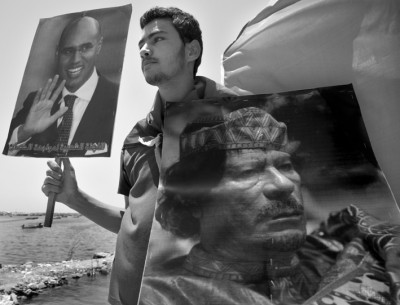
A Gaza resident holding pictures of Saif al-Islam Gadhafi – whose charity sponsored the aid ship – and his father, Libyan leader Muammar Gadhaf
When asked about the role of the international community to pressure Israel, Amjad is more critical: “We are so sorry that the international community until now has made no real intervention, put no real pressure on Israel to lift the siege totally or exerted pressure on Israel to have a transparent and accountable international inquiry into the Israeli crimes on the freedom flotillas.
“Still today we’re waiting for real international pressure from the international community. We hope that Israel will not use this silence as a chance to commit more crimes against the Palestinian people and international solidarity workers.”
The Libyan chartered boat was eventually forced to dock in El Arish, Egypt, after a wall of Israeli gunboats blocked its passage through to Gaza. But the Palestinians remain heartened by these attempts and the further missions planned this September. Says Mahfouz: “People here feel grateful to those internationals who try to arrive at the Gaza beach, it’s so important to us that other people worry and support us.”
Updated on July 15, 2010
:: Article nr. 67973 sent on 16-jul-2010 13:27 ECT
http://www.uruknet.info?p=67973
:: The views expressed in this article are the sole responsibility of the author and do not necessarily reflect those of this website.
Shir Hever is an economic researcher in the Alternative Information Center, a Palestinian-Israeli organization active in Jerusalem and Beit-Sahour. Researching the economic aspect of the Israeli occupation of the Palestinian territories, some of his research topics include international aid to the Palestinians and Israel, the effects of the Israeli occupation of the Palestinian territories on the Israeli economy, and the boycott, divestment and sanctions campaigns against Israel. He is a frequent speaker on the topic of the economy of the Israeli occupation.

By Ned Parker and Nadeem Hamid
The transfers come as American forces prepare to end their control of the sole remaining U.S. prison facility in Iraq.
July 14, 2010
Reporting from Baghdad —
The United States has handed over 29 members of Saddam Hussein’s government to Iraqi custody in recent weeks, including Tariq Aziz, the urbane, cigar-chomping official who served as the regime’s global spokesman, Iraqi officials and Aziz’s relatives said Wednesday.
The U.S. military confirmed that it transferred 26 former regime officials Monday and three others last month. It added that it continued to hold eight high-ranking members of Hussein’s government and his ruling Baath Party.
Both Aziz’s son and the Iraqi government said the former foreign minister and deputy prime minister has in an Iraqi prison since Monday.
His son, Ziad Aziz, said his father, who suffers from heart disease and diabetes, called him Wednesday and complained that he was now being held in a tiny cell and deprived of his medications. His son said the former official described the situation as “hard circumstances.”
“He hasn’t taken his medicine in three days. There’s no place to sit. He hasn’t seen a doctor,” Ziad Aziz said. He added that his father has been in a wheelchair in recent months after suffering a stroke. A medical report sent to the family by the International Committee for the Red Cross listed Aziz as also suffering from dementia and slurred speech.
Iraq’s deputy justice minister, Busho Ibrahim, denied that Aziz or any other detainees were being mistreated.
“This is street talk,” Ibrahim said. “The Ministry of Justice doesn’t have anything to hide, whether with former regime officials or former terrorists. Each has his rights and [the ministry has] duties to fulfill according to the international standards.”
Iraq’s detention facilities have been plagued by poor living conditions and allegations of abuse by guards. The justice, defense and interior ministries have implemented human rights inspections, but violations still occur. A U.N. human rights report released last week raised concern about abuses committed against detainees.
Tariq Aziz first gained notoriety in 1990 after Iraq’s invasion of Kuwait. He continued to promote Hussein’s views to the international community in the run-up to the U.S.-led invasion in 2003. Fluent in English and well-educated, the former foreign minister came to symbolize Hussein’s regime in the West. He was Iraq’s senior-most Christian official.
In March 2009, an Iraqi court sentenced him to 15 years in prison for his role in the 1992 execution of 42 merchants who had been accused of price-fixing. He received another seven-year sentence in August 2009 for the displacement of Kurds in 1980.
In addition to the 29 detainees handed over by the Americans, Ibrahim said 26 other high-ranking former regime officials had been transferred to Iraqi custody about eight months ago.
The latest transfers come ahead of the end of American control of Camp Cropper at Baghdad’s international airport, the sole remaining U.S. prison facility in Iraq. On Thursday, the U.S. military will hand over a final 1,600 detainees, while another 200 prisoners will be held under joint Iraqi-U.S. custody, Ibrahim said.
The shutdown of U.S. detention facilities marks a major step as American forces wind down their formal combat mission in Iraq and reduce their troops to 50,000 by the end of August. All remaining U.S. soldiers are scheduled to leave Iraq by the end of 2011.
The United States will continue to hold in joint custody with the Iraqi government eight high-ranking members of the old regime, including Hussein’s half-brothers Watban Ibrahim Hassan and Sabawi Ibrahim Hassan. Both men have been sentenced to death by Iraqi courts.
The most controversial case remains that of Hussein’s former defense minister, Sultan Hashim Ahmad Jabburi Tai. Jabburi Tai was sentenced to death in 2007 for his role as a general in the north during the Hussein regime’s 1980s Anfal military campaign against the Kurds.
Jabburi Tai has been spared execution because Iraqi President Jalal Talabani, himself a Kurd, has refused the orders. Talabani has argued that Hashim should be spared for his contacts with the Iraqi opposition before 2003. It has long been rumored that Jabburi Tai helped to stand down the Iraqi army during the U.S. military invasion.
But many Shiite leaders, including Prime Minister Nouri Maliki, have pushed for his execution.
Ibrahim hinted that the Iraqi authorities were pushing for Jabburi Tai and the remaining seven regime officials to be transferred over as soon as possible.
“There are no negotiations,” the deputy justice minister said. “Whoever we want, we just inform the American side. We are running Iraq right now. The Americans are supporting us.”
– ned.parker@latimes.com
Hamid is a Times staff writer.

The U.S. Supreme Court was requested to review the constitutional validity of the Antiterrorism and Effective Death Penalty Act of 1996.
Introduced by Speaker of the House Newt Gingrich, the bill was adopted by an overwhelming majority in response to the Oklahoma City bombing and enthusiastically signed into law by President Bill Clinton.
One of the clauses prescribing that a terrorist suspect can file only one petition for a writ of habeas corpus (a protection against illegal imprisonment) came under heavy fire. In its decision Felker versus Turpin (1997), the U.S. Supreme Court confirmed that the limitation was not in breach of article 1 Section 9 paragraph 2 of the Constitution. True, in itself, it does not constitute an extension of the temporary detention even if, after a first appeal rejection, there is no mechanism to prevent the temporary detention from becoming permanent.
Another stipulation of the law was subject to further comment. It prohibits the willful provision of support of whatever nature – with the exception of medical assistance or a religious service – to any foreign terrorist organization. Following pleas by successive administrations – those of Clinton, Bush and Obama – in the past 12 years the courts have ruled that this applies to an association that provided legal advice to the PKK and to the Tamil Tigers even though such advice envisaged a peaceful solution to the Kurdish and Tamil conflicts by bringing the cases before the United Nations. In its decision Holder versus Humanitarian Law Project, of 21 June 2010, the Court held:
That the terms of the law are sufficiently clear to ensure that a person awaiting trial is in no doubt as to what is prohibited;
That this interdiction does not infringe a person’s freedom of speech, as nothing prevents a subject from expressing his support for causes defended by terrorists;
That neither does this interdiction violate his freedom of assembly as it does not prohibit meeting with terrorists or conversing with them.
Traditionally, the US Supreme Court takes a puritanical view of mankind. Just as puritans prohibit assisting a sinner in distress as long as he has not specifically renounced sin, the Court prohibits providing assistance to terrorists as long as they have not repudiated armed activity. In its view, those who assist them legally, educationally, culturally, socially or in any other manner, enable them to conserve their energy for the commitment of Evil.
Moreover, in United States law a terrorist organization is not an organization that has been sentenced for precise criminal acts but a group designated as such on political grounds by the State Department.
In consequence, all types of activity may be punished as “terrorist” by US courts. This is the case, for example, with the provision of UN food aid to Gaza if it is distributed by local councillors who are members of Hamas.
Thank you tlaxcala and have a look at its new look
My question is, which nations are they referring to? Israel and Palestine or Israel and the USA??
An excellent meeting
Two statesmen met in Washington on Tuesday who are looking smaller and smaller, who are taking smaller and smaller steps.
By Gideon Levy
It really was an excellent meeting: The chance that a binational state will be established has improved as a result; relations between Israel and the United States are indeed “marvelous.” Israel can continue with the whims of its occupation. The president of the United States proved Tuesday that perhaps there has been change, but not as far as we are concerned.
If there remained any vestiges of hope in the Middle East from Barack Obama, they have dissipated; if some people still expected Prime Minister Benjamin Netanyahu to lead a courageous move, they now know they made a mistake (and misled others ).
The masked ball is at its peak: Preening each other, Obama and Netanyahu have proved that even their heavy layer of makeup can no longer hide the wrinkles. The worn-out, wizened old face of the longest “peace process” in history has been awarded another surprising and incomprehensible extention. It’s on its way nowhere.
The “warm” and “sympathetic” reception, albeit a little forced, including the presidential dog, Bo, the meeting of the wives, with the U.S. president accompanying the Israeli prime minister to the car in an “unprecedented” way, as the press enthused, cannot obscure reality. The reality is that Israel has again managed to fool not only America, but even its most promising president in years.
It was enough to listen to the joint press conference to understand, or better yet, not understand, where we are headed. Will the freeze continue? Obama and Netanyahu squirmed, formulated and obfuscated, and no clear answer was forthcoming. If there was a time when people marveled at Henry Kissinger’s “constructive ambiguity,” now we have destructive ambiguity. Even when it came to the minimum move of a construction freeze, without which there is no proof of serious intent on Israel’s part, the two leaders threw up a smoke screen. A cowardly yes-and-no by both.
More than anything, the meeting proved that the criminal waste of time will go on. A year and a half has passed since the two took office, and almost nothing has changed except lip service to the freeze. A few lifted roadblocks here, a little less blockade of Gaza there – all relatively marginal matters, a bogus substitute for a bold jump over the abyss, without which nothing will move.
When direct talks become a goal, without anyone having a clue what Israel’s position is – a strange negotiation in which everyone knows what the Palestinians want and no one knows for sure what Israel wants – the wheel not only does not go forward, it goes backward. There are plenty of excuses and explanations: Obama has the congressional elections ahead of him, so he mustn’t make Netanyahu angry.
After that, the footfalls of the presidential elections can be heard, and then he certainly must not anger the Jews. Foreign Minister Avigdor Lieberman is pressuring Netanyahu now; tomorrow it might be Likud MK Danny Danon, and after all, you can’t expect Netanyahu to commit political suicide. And there you have it, his term in office is over, with no achievements. Good for you, Obama; bravo Netanyahu. You managed to make a mockery of each other, and together, of us all.
Netanyahu will be coming back to Israel over the weekend, adorned with false accomplishments. The settlers will mark a major achievement. Even if they don’t not admit it – they are never satisfied, after all – they can rejoice secretly. Their project will continue to prosper. If they have doubled their numbers since the Oslo Accords, now they can triple them.
And then what? Here then is a question for Obama and Netanyahu: Where to? No playing for time can blur the question. Where are they headed? What will improve in another year? What will be more promising in another two years? The Syrian president is knocking at the door begging for peace with Israel, and the two leaders are ignoring him. Will he still be knocking in two years? The Arab League’s initiative is still valid; terror has almost ceased. What will the situation be after they have finished compromising over the freeze in construction of balconies and ritual baths?
Two statesmen met in Washington on Tuesday who are looking smaller and smaller, who are taking smaller and smaller steps. They have decided not to decide, which in itself is a decision. When the chance of a two-state solution has long since entered injury time, they have decided on more extra time. Get ready for the binational state, or the next round of bloodletting.
As President Barack Obama and Israeli Prime Minister Benjamin Netanyahu meet, a report reveals 42 per cent of territory is controlled by settlers
By Catrina Stewart in Jerusalem and David Usborne
Wednesday, 7 July 2010
Jewish settlers, who claim a divine right to the whole of Israel, now control more than 42 per cent of the occupied West Bank, representing a powerful obstacle to the creation of a Palestinian state, a new report has revealed.
The jurisdiction of some 200 settlements, illegal under international law, cover much more of the occupied Palestinian territory than previously thought. And a large section of the land has been seized from private Palestinian landowners in defiance even of an Israeli supreme court ruling, the report said, a finding which sits uncomfortably with Israeli claims that it builds only on state land.
Drawing on official Israeli military maps and population statistics, the leading Israeli human rights group, B’Tselem, compiled the new findings, which were released just as the Israeli prime minister, Benjamin Netanyahu, arrived in Washington to try to heal a gaping rift with US President Barack Obama over the issue of settlements.
Related articles
“The settlement enterprise has been characterised, since its inception, by an instrumental, cynical, and even criminal approach to international law, local legislation, Israeli military orders, and Israeli law, which has enabled the continuous pilfering of land from Palestinians in the West Bank,” the report concluded.
Mr Obama’s demand for a freeze on illegal building has caused months of friction between his administration and the Israeli government. But the US president, facing mid-term elections in November, appeared eager to end the dispute with Israel yesterday.
He said the country was making “real progress” on improving conditions in the Gaza Strip and was serious about achieving peace.
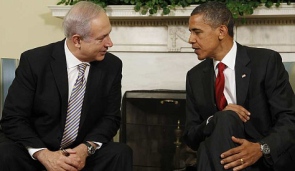
The two men made a joint public appearance, carefully choreographed to convey mutual ease and friendship.
When Mr Netanyahu last visited the White House, in March, US anger at his refusal to end construction meant the Israeli premier was denied a joint appearance with Mr Obama before the cameras. This time the photo-op was granted and the two men afterwards shared a meal – although not a state dinner but a working lunch.
“Reports about the demise of the special US-Israel relationship aren’t premature, there are just flat wrong,” Mr Netanyahu said, in response to a reporter’s question about the perceived tensions. Playing to the same script, Mr Obama said that the “bond between the United States and Israel is unbreakable”.
But the revelations in the B’Tselem report suggest that despite Mr Netanyahu’s stated desire for peace, his policy on settlements remains a dangerous obstacle to the establishment of an independent Palestinian state and therefore to a durable peace.
They cast an uncompromising spotlight on Israeli practices in the Palestinian territories that have long drawn international criticism for establishing “facts on the ground” hampering the creation of a viable Palestinian state.
While most of the Jewish settlement activity is concentrated in 1 per cent of the West Bank, settler councils have in fact fenced off or earmarked massive tracts of land, comprising some 42 per cent of the West Bank, B’Tselem said.
And despite the outlawing by Israel of settlement expansion on private Palestinian land, settlers have seized 21 per cent of land that Israel recognises is privately-owned.
B’Tselem alleged that Israel had devised an extensive system of loopholes to requisition Palestinian land.
At the same time, Israel has built bypass roads, erected new checkpoints, and taken control of scarce water resources to the benefit of the settlers. The measures have effectively created Palestinian enclaves within the West Bank, the report said.
Under international law, any Jewish settlements built on occupied territory are illegal. These include all the settlements in the West Bank, and thousands of Jewish homes in East Jerusalem, the Arab-dominated sector of the city annexed by Israel after the 1967 Six Day War. The international community still regards East Jerusalem as occupied territory. Despite firm commitments from successive Israeli governments to dismantle illegal outposts built after 2001 and to cease expansion of the settlements, Israel has provided millions of dollars worth of incentives to encourage poorer families to move into the West Bank. Some 300,000 settlers live in the West Bank.
Settlers immediately attacked the report, claiming it was timed as a spoiler to the Washington meeting.
In Washington, no concrete breakthroughs were announced but Mr Obama said that he believed the Israeli leader was ready to move towards direct talks with the Palestinians. Indirect talks began earlier this year, mediated by special US envoy George Mitchell.
Mr Netanyahu showed signs of responding to the pressure. “Peace is the best option for all of us and I think we have a unique opportunity to do it,” he said. “If we work together with [Palestinian] President [Mahmoud] Abbas then we can bring a great message of hope to our peoples, to the region and to the world.”
The Palestinians continue to refuse direct talks with Israel while new settlement construction is allowed. Settlement activity continues in East Jerusalem, which Palestinians aim to include in a new state.
With US-Israel ties already frayed, Mr Netanyahu postponed a visit to the White House last month in the aftermath of Israel’s deadly raid on a Turkish-led flotilla trying to deliver humanitarian goods to Gaza.
For Mr Obama, the danger is clear that any long-lasting record of animosity towards Israel could translate into lost votes at the mid-term elections.
Syria is host to the third largest number of refugees in the world, and the greatest number in the Arab world. Will that situation last, asks Bassel Oudat in Damascus
A decade ago, the UN General Assembly chose 20 June to mark World Refugee Day. On that day we are encouraged to focus on the problems and issues of refugees and others internally displaced in their home countries. According to statistics from the UNHCR, the UN refugee agency, Syria is first among Arab country and number three worldwide — following Iran and Pakistan — in terms of hosting refugees. At present it accounts for six per cent of the world’s refugees, mostly Palestinians and Iraqis, but also from Sudan, Afghanistan and Somalia. In fact, 10 per cent of Syria’s population are refugees.
Ten years after opening its doors to Arab refugees, especially Palestinians and Iraqis, these communities have noticeably grown in number inside Syria, putting strain on those providing them with assistance. Over the years, especially during tough times, these communities have been a burden on the Syrian government in terms of assimilating them and meeting their basic needs.
The first wave of refugees to Syria was in 1948 after the creation of the State of Israel, when hundreds of thousands left or were forced to leave Palestine. Syria received 85,000 Palestinian refugees at the time, according to the UN Relief and Works Agency for Palestine Refugees (UNRWA). This was followed by several waves of refugees after the 1967 war, bloating the number of Palestinians in Syria to more than 450,000.
Syria was also host to tens of thousands of the Iraqi opposition who fled Saddam Hussein’s regime. Starting in 2003, after Saddam’s regime was toppled, Syria became the destination of 1.5 million Iraqi refugees who were either fleeing the US war and unsafe conditions in Iraq or fleeing persecution and arbitrary detention.
Over the past few decades, several thousand refugees from a variety of other Arab states have entered Syria, including Sudan and Somalia. A few hundred Afghanis and Ahwaz from Iran also sought refuge in Syria, bringing the number of refugees to nearly two million. The problems of Arab refugees in Syria are directly connected to their home countries, and their numbers fluctuate depending on security conditions back home. Palestinian refugees, for example, are directly linked to Arab-Israeli peace and inter-Palestinian relations. As for Iraqi refugees, their situation depends on the security situation in Iraq and political conflicts amongst Iraqis.
The Syrian government has dealt with the issue of refugees in a special way, taking into consideration national bonds and humanitarian conditions on the one hand and political interests on the other. Meanwhile, Syria’s security apparatus closely monitors the movements of all refugees within its borders.
Palestinian refugees are prohibited from acquiring the Syrian nationality in order to uphold Palestinian identity. Around 25 per cent of these refugees live in 10 official refugee camps, while another 25 per cent reside in three unofficial camps that Syrian security forces are in charge of guarding. The remaining 50 per cent of refugees live in various Syrian cities. Palestinian refugees have the right to attend government schools and universities for free, and are entitled to free healthcare in government hospitals. They are permitted to work in both the public and private sectors, and become civil servants. They perform their military service with the Palestine Liberation Army, in liaison with the Syrian armed forces. They are allowed to own one residence, but no agricultural land. Altogether, they have almost all the rights of Syrian citizens, including holding senior government posts other than political positions. Damascus has also given them permanent residency without the need for renewal, as well as special passports making Syria their guarantor while travelling abroad.
The Iraqis, on the other hand, are allowed to own property and invest in the economy, but they are not given permanent residency and they are required to renew their stay every three months and in some exceptional cases once a year. Iraqi students can attended Syrian schools for free, and are eligible for free healthcare in government hospitals. However, they need work permits for employment. The UNHCR has opened special offices to assist them in all aspects of life. In fact, the UNHCR opened the largest refugee camp in the world in Duma in eastern Damascus.
Syria is also responsible for ensuring the proper infrastructure is in place to support two million transient residents. Consequently, it has endured electricity and water shortages as a result of large numbers of Iraqis arriving over a short period of time. Meanwhile, the education and job sectors have suffered from an overload of large numbers of unexpected beneficiaries.
While Syria’s rationale for taking in Arab refugees who have suffered from wars is rooted in humanitarian and Arab nationalist reasoning, Damascus has tried to reap some political gains from this. It wants to become a regional powerhouse with influence on issues pertaining to these refugees. On the Palestinian issue, it has become a main player, especially that the leaders of most political and military Palestinian factions chose to set up shop in Damascus. These include the Palestine Liberation Organisation (PLO), the Democratic Front for the Liberation of Palestine, the Popular Front for the Liberation of Palestine, and general leadership, and later Hamas, the Islamic Jihad and other Palestinian resistance groups. Most of these groups, with the exception of the PLO, closely coordinate their political and public policies with Damascus.
Syria has rejected US pressure to expel the leadership of Palestinian resistance groups from its land, insisting that their media, political and social work in Syria is part of their expression of the ambitions of the Palestinian refugee community. Syria has also hosted leading figures from Iraq’s Baath Party that oppose the US occupation of Iraq and the incumbent Iraqi regime. Also, a large number of Iraqi tribal elders and senior officers from the dissolved Iraqi armed forces were allowed to continue their activities in Syria, and remain politically coordinated with Damascus once they returned to Iraq to participate in the political process there.
Today, Syria has influential allies inside Iraq, and has vehemently refused to hand over to the incumbent Baghdad government any members of the Iraqi Baath Party or leaders of the former Iraqi army that are accused of plotting military operations inside Iraq.
No doubt, Syria has carried the burden of hosting two million Arab refugees and has given some of them rights that they would not receive in any other country. It welcomed them with open arms and did not force them to leave, despite their large volume that has strained the Syrian economy and living conditions.
The return of the Palestinian refugees from Syria to Palestine has become a complicated issue, and their case represents an uphill struggle towards any possible solution. The same is true of Iraqi refugees, some who have been in Syria for seven years. The Syrian burden continues to grow, and although Syrian hospitality has been extended, this does not mean that Damascus may not change its posture towards them. This is especially true if their continued presence threatens Syria’s national security.

