Rémi Brulin, an adjunct professor at New York University who is completing his dissertation entitled “The US Discourse on Terrorism Since 1945, and how The New York Times has Covered the Issue of Terrorism” (more here), sent us the following in response an article that ran in the New York Times Travel section last Sunday – When History Speaks in Israel:
The article in question is “When History Speaks in Israel,” and is one of the starkest examples of a complete erasure of the Palestinian from the history of the region that I have seen in a long time. I actually did a word search of the article and the word “Palestinian” doesn’t appear once! It is very much reminiscent of old claims that the Palestinian people “don’t exist,” that Israel was ” a land without a people for a people without a land”, etc…
Just read the lede:
CHAIM KAHANOVICH, an 18-year-old Polish Jew, caught his first brown glimpse of the Holy Land from the deck of a steamer in November 1924. He would never leave. Dark-haired, short and solid, Chaim brought with him a teenager’s blazing passion and an ideologue’s stubborn commitment to a cause. The long, slow journey had taken him from Warsaw by train to the Black Sea port of Constanta, then by ship through the Bosporus Straits and across the Mediterranean to Palestine. There at last, rising like the back of an ox from the blue water of Haifa Bay, was the sere ridge of Mount Carmel — the Promised Land.
From his boyhood study of Torah, Chaim would have known that Carmel was the place where the prophet Elijah faced down the pagan priests of Baal and fled the wrath of Queen Jezebel. But he had not come to Palestine to study Torah. He and his comrades were called halutzim — pioneers — and they had made aliyah (literally the ascent) to the Holy Land to plow the soil, plant grapevines and citrus groves, raise chickens, tomatoes and children, and to found a new nation.
I know the details of Chaim’s life and circumstances because he and his wife, Sonia, were relatives of mine (my maternal grandfather was their first cousin), and I recently went to Israel with my oldest daughter, Emily, for the first time to retrace their journeys and uncover what I could about our family’s story — a story of immigration shared by thousands of others. What made this trip especially inspiring was that I was able to cover so much of Israeli history: in this ancient but recently conceived nation, the founders lived just a generation ago. It’s as if the children and grandchildren of Washington, Jefferson and Adams were around to give interviews and point out historical sights.
I am usually quite critical of the New York Times in its coverage of many issues that have to do with foreign policy, but even for the Times this is particularly obscene.
I was shocked by this article especially because, with my class at NYU, I am currently using Sandy Tolan’s The Lemon Tree, the premise of which is precisely that so many Israelis ignore everything about their past, and especially about the fact that Palestinians lived for generations in those villages that became Israeli villages in 1948.
He was fourteen during the Six Day War, and soon after his parents took him to see the newly conquered Occupied Territories. “We were so proud going to see Rachel’s Tomb [in Bethlehem] and we just didn’t see the Palestinians. We looked right through them, like they were invisible,” he says. “It had always been like that. We were passing as children so many ruins [of Palestinian villages that had been ethnically cleansed in 1948]. We never asked: ‘Who lived in this house? Where is he now? He must be alive. He must be somewhere.’ It was part of the landscape, like a tree, like a river.
Journalist Lauren Booth was on the first Free Gaza voyage and stayed to work in Gaza after the boats left. Her heartfelt letter to the people of Israel should be read by everyone who hopes for peace in the Middle East. This stunning video tribute to her words was designed and produced by the Free Gaza movement.
On November 15, 1988 the Palestine National Council (P.N.C.) meeting in Algiers proclaimed the Palestinian Declaration of Independence that created the independent state of Palestine. Today the State of Palestine is bilaterally recognized de jure by about 130 states. Palestine has de facto diplomatic recognition from most of Europe. It was only massive political pressure applied by the U.S. government that prevented European states from according to Palestine de jure diplomatic recognition.
Palestine is a member state of the League of Arab States and of the Islamic Conference Organization. When the International Court of Justice in The Hague—the so-called World Court of the United Nations System—conducted its legal proceedings on Israel’s apartheid wall on the West Bank, the World Court invited the State of Palestine to participate in the proceedings. In other words, the International Court of Justice recognized the State of Palestine.
Palestine has Observer State Status with the United Nations Organization, and basically all the rights of a U.N. Member State except the right to vote. Effectively, Palestine has de facto U.N. Membership. The only thing keeping Palestine from de jure U.N. Membership is the implicit threat of a veto at the U.N. Security Council by the United States, which is clearly illegal. Someday Palestine shall be a full-fledged U.N. Member State.
From a world-order perspective, the 1988 Palestinian Declaration of Independence created a remarkable opportunity for peace with Israel because therein the P.N.C. explicitly accepted the U.N. General Assembly’s Partition Resolution 181(II) of 1947 that called for the creation of a Jewish state and an Arab state in the Mandate for Palestine, together with an international trusteeship for the City of Jerusalem, in order to resolve their basic conflict:
Despite the historical injustice inflicted on the Palestinian Arab people resulting in their dispersion and depriving them of their right to self-determination following upon U.N. General Assembly Resolution 181 (1947), which partitioned Palestine into two states, one Arab, one Jewish, yet it is this Resolution that still provides those conditions of international legitimacy that ensure the right of the Palestinian Arab people to sovereignty and national independence.
The significance of the P.N.C.’s acceptance of the Partition Resolution in the Palestinian Declaration of Independence itself could not be over-emphasized. Prior thereto, from the perspective of the Palestinian People the Partition Resolution had been deemed to be a criminal act that was perpetrated upon them by the United Nations Organization in gross violation of their fundamental right to self-determination as recognized by the United Nations Charter and general principles of public international law. The acceptance of the Partition Resolution in their actual Declaration of Independence signaled the genuine desire by the Palestinian People to transcend the past century of bitter conflict with the Jewish People living illegally in their midst in order to reach an historic accommodation with them on the basis of a two-state solution.
The very fact that this acceptance of Partition Resolution 181 was set forth in their Declaration of Independence indicated the degree of sincerity with which the Palestinian People accepted Israel. The Declaration of Independence was the foundational document for the State of Palestine. It was intended to be determinative, definitive, and irreversible. As the P.N.C. well knew at the time, their Declaration of Independence was not something that could be amended or bargained away.
Nonetheless, the Palestinians have now fruitlessly spent the past twenty-two years trying to negotiate in good faith with Israel over the two-state solution set forth in Resolution 181. They have gotten absolutely nowhere. Israel has never demonstrated one iota of good faith when it came to negotiating a comprehensive Middle Peace settlement with the Palestinians on the basis of a two-state solution. Even the 1993 Oslo Agreement was nothing more than an Israeli-drafted interim Bantustan arrangement for five years that was rejected in Washington, D.C. by the Palestinian Delegation to the Middle East Peace Negotiations for that precise reason. Both Israel and the United States now want to make the Oslo Bantustan permanent and, incidental thereto, destroy the right of the Palestinian refugees to return to their homes as required by U.N. General Assembly Resolution 194 (III) of 1948 and general principles of public international law.
In this regard, shortly before he died on September 24, 2007, I called up the former Head of the Palestinian Delegation to the Middle East Peace Negotiations, Dr. Haidar Abdul Shaffi at his home in Gaza in order to review the entire situation with him. According to Dr. Haidar: “The Zionists have not changed their objectives since the Basel Conference of 1897!” In other words, the Zionists want a “Greater” Israel on all of the Mandate for Palestine together with as much ethnic cleansing of Palestinians out of Palestine that the Zionists believe they can get away with internationally.
After twenty-two years of getting nowhere but further screwed to Israel’s apartheid wall on the West Bank and strangulated in Gaza, it is now time for the Palestinians to adopt a new strategy, which I most respectfully recommend here for them to consider: Sign nothing and let Israel collapse! Recently it was reported that the United States’ own Central Intelligence Agency predicted the collapse of Israel within twenty years. My most respectful advice to the Palestinians is to let Israel so collapse!
For the Palestinians to sign any type of comprehensive peace treaty with Israel would only shore up, consolidate, and guarantee the existence of Zionism and Zionists in Palestine forever. Why would the Palestinians want to do that? Without approval by the Palestinians in writing, Zionism and Israel in Palestine will collapse. So the Palestinians must not sign any Middle East Peace Treaty with Israel, but rather must keep the pressure on Israel for the collapse of Zionism over the next two decades as predicted by the Central Intelligence Agency. The correct historical analogue here is not apartheid South Africa, but instead the genocidal Yugoslavia that collapsed as a State, lost its U.N. Membership, and no longer exists as a State for that very reason.
All the demographic forces are in favor of the Palestinians and against the Zionists. The United States government is tired of its blank-check support for Israel because this policy seriously undermines and conflicts with America’s imperial objective to obtain the oil and gas lying beneath Arab and Muslim states by hook or by crook. Israel is ridden with and paralyzed by so many internal contradictions and conflicts that they are too numerous to list here.
Indeed, from the very moment of its inception as a direct result of the Zionists’ genocidal al Nakba in 1948, Israel has been the proverbial failed state, and still is so today. Israel would have never come into existence without the support of Western colonial imperial powers throughout the twentieth century. And the same is true today. Without the political, economic, diplomatic, and military support provided primarily by the United States, and to a lesser extent by Britain, France, and Germany, Israel would immediately collapse. The international Campaign for Boycott, Divestment, and Sanctions (B.D.S.) against Israel is quickly whittling away Israel’s domestic support in those countries. Israel’s own serial barbarous atrocities perpetrated against the Palestinians and the Lebanese have revealed the true face of Zionism for the entire world to see: genocide.
In fact, Israel has never been a State but just an Army masquerading as a State — a Potemkin Village of a State. Israel is the archetypal Great Band of Robbers described by St. Augustine in Book 4, Chapter 4 of The City of God:
Kingdoms without justice are similar to robber barons. And so if justice is left out, what are kingdoms except great robber bands? For what are robber bands except little kingdoms? The band also is a group of men governed by the orders of a leader, bound by social compact, and its booty is divided according to a law agreed upon. If by repeatedly adding desperate men this plague grows to the point where it holds territory and establishes a fixed seat, seizes cites and subdues peoples, then it more conspicuously assumes the name of kingdom, and this name is now openly granted to it, not for any subtraction of cupidity, but by addition of impunity….
All of these political, economic, military, diplomatic, sociological, psychological, and demographic forces are working in favor of the Palestinians and against Israel and the Zionists in Palestine. It will take a few more years for these historical forces to predominate and then to prevail. But the proverbial handwriting is on the wall for the Zionist Enterprise in Palestine for the entire world to see, including and especially the C.I.A. Even large numbers of Zionists living in Israel have already prepared their parachutes, and their exit plans, and their landing zones to go elsewhere in the world. There is no reason for the Palestinians to give the Zionists a new lease on life in Palestine by signing any sort of peace treaty with Israel.
It is obvious that soon Zionism will enter into Trotsky’s “ashcan” of history along with every other nationalistic “ism” that has plagued humankind during the twentieth century: Nazism, Fascism, Francoism, Phalangism, Stalinism, Maoism, etc. The only thing that could save Zionism in Palestine is for the Palestinians to conclude any type of so-called comprehensive Middle East Peace treaty with Israel. It is for precisely that reason then that the Palestinians must sign nothing and let Israel collapse of its own weight over the next two decades.
Millions of Palestinians have waited in refugee camps since 1948 in order to return to their homes, that is for 62 years. They can wait a little longer until Israel collapses within 20 years. Otherwise, for the Palestinians to sign a comprehensive peace treaty with Israel means that they will never be able to return to their homes as required by Resolution 194 of 1948. History and demography are on the side of Palestine and the Palestinians against Israel and the Zionists. But the Palestinians must allow history and demography a little bit more time in order to produce the collapse of Israel and Zionism in Palestine. Twenty years is but the blink of an eye in the millennia-long history of the Palestinian People, who are the original indigenous inhabitants of Palestine. God had no right to steal Palestine from the Palestinians and give Palestine to the Jews to begin with. A fortiori the United Nations had no right to steal Palestine from the Palestinians and give Palestine to the Zionists in 1947.
In the meantime, the Palestinians must keep up the pressure on Israel, Zionism and the Zionists in Palestine. The Palestinians have a perfect right under international law to resist an illegal, colonial, genocidal, criminal, military occupation regimé of their lands and of their homes and of their People that goes back to 1948 so long as it is done in a manner consistent with the requirements of international humanitarian law. Simultaneously, the Palestinians must continue to build their state from the ground up as they have been doing successfully since the first Intifada began in 1987 with its grassroots Unified Leadership of the Intifada.
Internationally, the Palestinians must continue their diplomatic and political and legal offensive against Israel. Palestine has gained enormous ground since November 15, 1988 when the P.N.C. proclaimed the independent State of Palestine. Palestine will continue to gain more support internationally over the next two decades, including the accelerating B.D.S. campaign that will delegitimize Israel and Zionism all around the world. At the same time, Israel will continue its rapid descent into pariah state status along the lines of the genocidal Yugoslavia that collapsed as a state and no longer exists. Israel will meet the same fate as the genocidal Yugoslavia provided the Palestinians do not sign any type of international peace agreement with Israel.
When Israel collapses, most Zionists will have already left or will soon leave for other states around the world. The Palestinians will then be able to claim all of the historic Mandate for Palestine as their State, including the entire City of Jerusalem as their Capital. Palestine will then be able to invite all of its refugees to return to their homes pursuant to Resolution 194.
Some Jews will remain in Palestine either voluntarily or involuntarily. Palestine and the Palestinians will treat the remaining Jews fairly. Palestine and the Palestinians will not do to the Jews what Israel, Zionism, and the Zionists have done to the Palestinians.
The Palestinians must sign nothing and let Israel collapse!
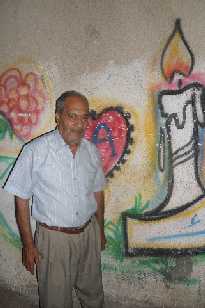
This is the life story of Jum’ah Arouq (Abu Akram), 67, a 1948 refugee from Hamama village living in Gaza.
“Who reads what you write? The Jews are afraid of those who write. They have killed Majed Abu Sharar [in Rome], Ghassan Kanafani [in Beirut] and… and… and they have almost killed Bassam Abu Shareef [in Beirut]… you can remember better than me!
“I swear! I swear by God! They forced us to leave in 1948… I swear! I swear by God! We did not abandon our village voluntary! It is the truth! I remember every single detail like I see you now. I was 5 years old.
“Write! I’m Jum’ah Hassan Arouq, from Hamama village. I was born in 1943. When the war started in Palestine in 1948 we heard boom! boom! and airplanes and shots. We left our home and we went to our orchard… not only us, all the inhabitants of the village went to their orchards to take shelter under the trees.
“We remained there for some days… two or three days… but we were afraid the airplanes would come to bombard the orchards too. So we left… We wanted to go to Gaza.
“We stopped in a small village near El-Majdal called El-Khasas. We spent there two or three days under the trees. We had with us three or four chickens from our orchard. My father killed them and we ate them.
“I was with my parents… my father was 40… three sisters and three brothers. No, there were only two sisters… the third one was born in Gaza later! One sister was 1-year old and the other one 8. My brother Mohammad was 3-year old, one was 11 and the oldest Ali was 18. We didn’t know where to go… We were scared by the airplanes and the bombings.
“When we left Hamama my parents took a cow, its son and a donkey, three or four blankets, some food and three or four chickens. The children were put on the donkey.
“Do you know where was Hamama? Do you know where is El-Majdal? It is called Askalan by the Jews. Hamama was located some five km to the north of El-Majdal… or perhaps more.
“I cannot tell you the day when we left… the month… At that time I was 5-year old or 5 and a half, I didn’t know what was September and October. It was maybe in June or July but I’m not certain… or maybe in May. I remember it was not cold and not hot, maybe it was spring or autumn.
“Came the Jewish soldiers in El-Khasas. There was not what nowadays is called Israel. We only knew there were Jewish soldiers. ‘What are you doing here?’ ‘ We are afraid of the war.’ ‘You should go to El-Majdal otherwise we will shoot you. Go! Go!’ We said OK and we left.
“Many Majdalis had already fled. Many houses were empty there, in El-Majdal. We found a lonely old woman in a house, from the family Masawabeh. Her family had already escaped to Gaza. We stayed with her one or two weeks… I don’t remember exactly.
“The soldiers then came, they knocked on the door. ‘Hello! What’s the matter?’ ‘You have to go to El-Majdal Square.’ ‘We are eating!’ ‘No, no, it’s only for 5 minutes.’
“It was around 8 a.m. My mother had a clay tray… like this bowl, but it was very large. She had cooked rice with shariya… how do you call it in English? Shariya… very thin broken spaghetti… rice with small spaghetti. And it was very hot… So my mother was pushing the rice with her hand towards the edges of the tray. She was moving the rice like this… you see!
“The soldiers said: ‘You should go!’ Outside there was a donkey and a dog. They shot dead the donkey and the dog. We left… We had no time to taste the food cooked by my mother!
“We went to El-Majdal Square. Give me a pen… where can I write? This was the Square. Here there was an area on the right and here an area on the left, both enclosed by barbwire. ‘Where do you come from? From El-Majdal? Go to the right! From Beit Daras, Jura, Hamama? Go to the left!’ They asked the Majdalis to return home… and they brought trucks, not buses, big trucks for the transport of cows and animals and they pushed us in the trucks and deported us to Gaza.
“Two or three km to the north of Beit Hanoun the dropped us on the road and they said ‘Go to Gaza!’ Among us were elderly who couldn’t walk. Strong men had to carry them on their backs. At a certain point there was a broken bridge in Deir Sneid village. We had to go down and to go up. Now Deir Sneid is in Israel.
“We were walking all together on the road. Soldiers were controlling the march. All those we didn’t walk on the road were fired at. No one could leave the path… After six months they expelled the Majdalis to Gaza, including my maternal grandmother. [On 4 November 1950 no one Palestinian remained in El-Majdal, according to the Zionist version of Benny Morris.]
“Once in Beit Hanoun we didn’t find a suitable place to stay. We continued to walk towards Gaza City. We reached Gaza and my father searched for some accommodation. He found one… but it was not a house… it was the public Turkish bath. There we met my uncle with his family and with one blanket for the children. We had left our three or four blankets in El-Majdal! We arrived in Gaza with absolutely nothing, only the clothes we were wearing and at that time the clothes were very bad. During the night one child was pulling the blanket toward him and another child was pulling the blanket toward him! I swear! It’s the truth!
“Do you know where is the Turkish bath? Not far from the Gold Market in Ez-Zeitun. It is still functioning nowadays… It belongs to the Samra family. We slept inside, on the floor.
“In the morning where to go? We couldn’t remain in this place. We heard there was a forest. We went to the forest and many people went there too. Where there is El-Ansar today, Thalatini, the Islamic University, where was El-Muntada of Arafat… The forest covered all this area from the beach to Ez-Zeitun.
“People cut trees and built some shelters to protect us from the sun. Who? The refugees! They used the wood to make fire for cooking. A number of them sold wood to make some money, even to the Turkish bath! And they build shelters for the families too.
“My oldest brother Ali and my father returned to El-Majdal. They came back the same day with the cow, its son and the donkey and half a bag of flour. What to do with the animals? We sold them to buy some food. I still remember the price of the donkey. Do you know how much? We sold it for 50 piaster, that is half a pound. The cow and its son were sold for 25 pounds.
“It was extremely dangerous. Scores of refugees tried to return to El-Majdal or to their villages to retrieve some belongings, some clothes, food or gold or money. In every refugee family they can tell you at least one or two or even three were killed. One of my uncles was killed. A cousin lost his sight and his fingers when he fell on a mine. Some people had not the courage to return there. They paid others to go. It was very dangerous.
“We remained a month or so in the forest, not more. My father then went to down town Gaza and bought a tent and we erected the tent near the [old] port. Two or three weeks later the UN gave us a new tent and they started to distribute UN food to the refugees.
“For the 1st class I went to school near Firas Market. You know where is Firas Market… Every day we were going on foot to school from the Beach refugee camp distant 4 or 5 km, and we were barefoot. The name of the school is El-Imam Esh-Shafihi. All of us were children. I was 6.
“A couple of years later a new school was opened, it was called Er-Rimal. At the beginning the residents studied in the morning and the refugees after 12:00 because there were not enough schools. Today it’s called El-Carmel School… near Esh-Shawwa Center. This was my new school. After another two years they moved us to a newly built school in En-Nasser St, near the Swedish Clinic, the New Gaza Preparatory School.
“In 1970 we returned to visit Hamama. One year after the 1967 war the Jews let us go wherever we wanted. Before we reached our orchard I said to my small brother Mohammad: ‘Now, we will find a tree called sycamore in our orchard!’… because I wanted to show him I was still remembering. And the sycamore was there! The orchard was like before… but not a single house remained in the village! The place was full of threes and bushes. You would never believe if you saw the place that once stood a village there.
“In our village only two or three houses were made of stone, the rest were made of mud and clay. In El-Majdal, the houses were in stone.
The orchards were to the east of the sea and the village 2 km to the east of the orchards. In our orchard we had grapes, figs, tomatoes, cucumbers, melons, watermelons and berries. In Hamama many were fishermen.
“We never returned to our village. My father passed away 20 years ago and my mother 22 years ago. My father build many shelters in the Beach camp.
“My oldest brother Ali was killed in Rafah during the 1956 war [when Israel occupied for a number of months the Sinai and the Gaza Strip]. He was a soldier in the Egyptian army [in a Palestinian battalion]. Plenty were killed at that time.
“The second brother Abder Rahim was a soldier like Ali. The Egyptians had captured alive 4 or 5 Israeli pilots. They were exchanged with 4,000 Palestinians and Egyptian soldiers, including Abder Rahim. The Jews didn’t take them on the battle field, but found them in houses… They had spies… Maybe some of them where indeed captured at the Rafah border, in Gaza, in Rafah town, in El-Arish, in the Sinai…
“After that arrived the Swedish troops in Gaza [under Egyptian administration]. I left the school at that time, at the 8th grade at the age of
14, because we could make good money with the Swedish and the people were very poor at that time. In the same period I got married with the daughter of my uncle… I was obliged… I was not like today!
“The Swedish troops were based in El-Ansar. I opened there a small shop of souvenirs, a bazaar, and I sold fruit too. In the Strip came also contingents from Norway, Denmark, Finland, Indonesia, India, Canada, Brazil. Every six months they left and fresh troops came. They were controlling the border with Israel. The Canadian and Brazilian forces were based in Rafah. The blue helmets remained in Gaza till 1967, they were called the United Nations Emergency Forces. Their HQ was in Abu Khadra in central Gaza City.
“Abu Khadra was destinated to be a hospital, but he has never been a hospital. When the UNEF departed in 1967, the Jews seized Abu Khadra and it became their HQ.
“In 1965 I enrolled in the Palestinian army and my brother Mohammad replaced me in the shop. It was called Jesh El-Tahkhir El-Falastini, the Palestinian Liberation Army. Till 1967 I was in El-Arish, Khan Younis and Rafah. We were called also the soldiers of El-Shoukeiri because at the beginning Ahmad El-Shoukeiri was the head of PLO. Following the 1967 war Ahmad El-Shoukeiri left for Lebanon and there was no anymore Palestinian Army in Gaza [which fell under Israeli military occupation].
“I escaped to Egypt by sea with a number of soldiers. I left in Gaza 5 children, 2 boys and 3 girls. Afterwards, due to certain problems, the Palestinians soldiers were sent to Lebanon and Jordan and after being called the soldiers of El-Shoukeiri they were called the soldiers of Arafat. I returned to Gaza in 1969 with the Red Cross.
“From Gaza many Palestinian soldiers fled in 1967 to Egypt on foot or by sea like me. The Jews gathered the Gazans and asked where were the soldiers. The soldiers were captured and sent to Egypt. Some were able to return only after 18 or 20 years.
“I worked in Israel in the building sector from 1971 to 1975 or 1976. I rapidly learnt masonry and the Hebrew language. I build scores of houses in Israel, in the Beach camp, in Jabalia camp, in Sheikh Radwan.
“When my father and brothers worked as fishermen from 1953 to 1960 our living conditions improved. We had plenty of fish every day at home, in addition to the money. They returned from the sea with 5 to 10 kg of fish. We couldn’t eat all, we gave it to our relations and even we sold it. Every day they fished 2 or 3 tons… all kinds of fish. Now we cannot buy it. It was good fish and good money. At that time the fishermen can go after El-Arish in Egypt and till Port Said… 5 km before Port Said. I went there to fish for a time.
“Now the Jews are on the sea. Nobody can go here or there. It’s a prison on the sea. A few days ago a fisherman was fired at on the chest and died shortly afterwards.
“The fishing zone is very narrow now… there is no fish… Everywhere there is the siege. My father was bringing fish at home more than they fish at present! If they could fish only the quantity my father used to bring daily at home they would be very happy today. The son of mt brother is a fisherman. Now, when I ask him how was the day, he replies: ‘Today was a good day. We got 5 or 6 kg of fish!’
“I sold my mini-grocery in the Beach camp and also my house which was very small and 18 years ago I bought a plot of land on the outskirts of Jabalia town. I built this house myself with my son Amin: the ground floor and 3 stories, each one with two flats.
“All my children are now married. I have seven boys and seven girls. The boys live in this building with their respective families. At present, here, I have 28 grandchildren. In total, I don’t know how many grandchildren I have… they are over 80.
“My wife Um Akram passed away two years ago. After two months I married a young lady from El-Majdal. She is now 35. Yes, she is beautiful, but she is very difficult!!!
“I don’t know exactly my age. When we left Hamama we didn’t take any papers with us… not only us, all the people. I know I was born in 1943 because they said my cousin was born the same week. Once a teacher asked me my date of birth. I said 1944 and since then in all my papers it’s written 1944, but actually I was born in 1943. We had no birthday certificates… no birthday parties… Now we celebrate the birthday of the children!
“I experienced four wars in my life: 1948, 1956, 1967 and the latest one in early 2009. That time, at every bombing, we expected our building to be the next target. The danger was coming from the sky, the sea, the ground, the border!
“The most beautiful time in my life was when the Swedish troops were in Gaza because I was young and I earned money. I had many friends among them. I saw them when they departed on the first day of the 1967 war. They were waiting for a boat at the [new] harbor. They were taken to Lebanon. I was a soldier at that time and was coming from Rafah.
“When my father and my mother didn’t find their home and the whole village of Hamama in 1970, what could they say? In 1948, they expected to return after one month or after a long time… something like six months. We are still waiting after 60 years… no, now 62 years! It’s enough!
“The Return… I don’t know… It is up to Allah… We hope, but it is very difficult… The Return! Nowadays we are afraid they will drive us out of Gaza!!
“Now Israel discusses the fate of the Arabs in Israel [the Palestinians citizens of Israel]. What’s his name? What’s his name?… Lieberman! [the Israeli MFA] He wants to transfer the Arabs of Israel to the West Bank!
“In El-Majdal, in 1948, they told us after five minutes we will be back. When will end these five minutes? After 500 years? Were we terrorists at that time?
“The international law says everyone should defend his country. We have done that and they call us terrorists. What can we do?… This is America… America says OK for everything Israel wants!
“There is something else… I’m surprised by what is happening in the world. I know that the UK people, the French people, the Swedish people are good peoples, like the west in general. They love Law and Right and they have spread freedom in the world. So why do they agree with Israel? This is the problem! Israel is a lawless state and the irony is that the west supports Israel! I don’t understand!
“I’m ready to meet the Jewish soldiers of that time, of 1948… the soldiers who pulled us out of our home. If they read this interview… if i say something in the interview that is incorrect or is untrue, I want to hear from them…
“If these soldiers are still alive today, I’m ready to meet them any time… because I say the truth. I’m sure they are not ready to meet us because they know we say the plain truth!”
– Flora Nicoletta is and independent French journalist living in Gaza. She is currently working on her fourth book on the Palestinian question.
Israel punish us in the beginning of the olive harvest and prevent us from reaching our lands inside the apartheid wall.
since more than two years specially since the wall building started in our town ni’lin israel didn’t give anyone any permit to reach the lands inside the wall to farm it and harvest the olive groves.so today in the first day of october and in the tenth anniversary of alaqsa intifada the people of ni’lin village made a peaceful demonstration organized by ni’lin popular committee against the apartheid wall and settlements.
After the praying under the olive trees which the israeli military consider it as a close military zone.the people of ni’lin with many internationals activests and israeli activests run toward the concrete wall which built on our lands and stole it Chanting slogans against the wall and the punishment of ni’lin people,and chanting slogans in solidrity with the palestinians political prisoners in jeneral and ni’lin’s political prisoners in special the coordinator of ni’lin popular committee mr.ibrahim amireh and mr.hassan mousa and zaydoon srour.
Since the demonstrators reached the gate of the concrete wall they started screaming and asking the israeli soldiers to open the gate because we wants to go to our lands to farm it,and also because it’s the time for the olive harvest,and you didn’t allow us to reach our lands since more than two years.all this to punish us but we will not stope our protest until we tear down this illegal wall and reach our lands again.
Then the demonstrators went to the other part of the wall to rais the palestinian flag on the fence and started telling the soldiers to look at the picture of the little boy ahmed mousa who been killed by the israeli soldiers in one demonstration against the wall in 29.07.2008 without any reasons.they shot him in his head at that time with a live bullet.
While the demonstrators were talking to the israeli military and telling them to stope thir crimes and to start with anew life with real peace and to end their crimes against us in ni’lin,no one shot any bullet because they were planing to catch us and arrest us.But the people of ni’lin discovered the plan of the israeli occupation forces and they could leave and be in the safe side without any loseing or injuring.
After that the soldiers opened the gate and started running toward the demonstrators to catch them and arrest them and they started shooting tear gas bomb at the demonstrators then one person from the village suffered from the tear gas inhalation .The soldiers continue running toward the village until they reached it.
The demonstration continued until 1:30 pm without any one getting shot or arrest
Something new is happening in Palestine. I saw and heard things today that are relatively rare in my experience. I saw conflict erupt in the village between those who wanted to throw stones at the Israeli soldiers and generate more violence, as in the past, and the no less passionate people who intervened fiercely to prevent this from happening. I heard tough words of peace and hope. I saw the most dignified and brave demonstration I’ve ever seen. I also saw the army react with its usual foolishness, which I’ll describe, and I saw the soldiers hold back when they could easily have started shooting. It wasn’t an easy day by any means, but it was good.
An-Nabi Salih is a hard place. When Ezra heard me say yesterday, in Sheikh Jarrah, that I was going to the village, he said, “Take a helmet. They’re violent there, all of them” (he meant: settlers, soldiers, and villagers). Yesterday, at the usual Friday demonstration in the village, the soldiers fired rounds of live ammunition along with rubber-coated bullets and tear gas and stun grenades. I was expecting more of the same today.
The village, north and west of Ramallah, has the great misfortune of having the hard-core settlement of Halamish as its unwanted neighbor. An-Nabi Salih lost some of its lands to the settlement along with access to a fresh-water spring, a precious thing in this arid, sun-scorched landscape; the settlers stole the spring, but the villagers were not prepared to surrender it, so there have been many violent clashes, spread over years. The settlers do whatever they can to make the villagers’ life miserable, with much success, and the soldiers, as always, back them up. All this is standard practice.
The old lie that palestine was dry desert waiting for a people is just that–a lie. This clip for all people to see the Beauty of the Palestinian People before they were ethnically cleansed and murdered and made into refugees by the State of Israe.
Music Joaquin Rodrigo, lyrics Helmut Lotti, sung by Lotti
All Photos (b&w) from http://fai.cyberia.net.lb/