Search

band annie's Weblog

I have a parallel blog in French at http://anniebannie.net

Category

Palestine

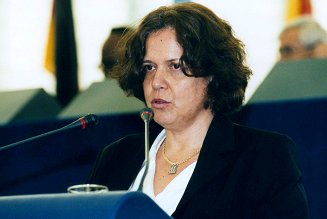
Israeli mother Addresses European Parliament

Nurit Peled-Elhanan

Dear Friends,

Dr. Nurit Peled-Elhanan is the mother of Smadar Elhanan, 13 years old when killed by a suicide bomber in Jerusalem in September 1997. Below is Nurit’s speech made on International Women’s Day in Strasbourg earlier this month. Please listen to the words of a bereaved mother, whose daughter fell victim to a vicious, indiscriminating terrorist attack. I wish her words will enter the hearts of all peace seekers in our troubled and divided world.

For better days,
Professor Avraham Oz Department of Hebrew and Comparative Literature University of Haifa


WOMEN
Nurit Peled-ElhananThank you for inviting me to this today. It is always an honour and a pleasure to be here, among you (at the European Parliament).

However, I must admit I believe you should have invited a Palestinian woman at my stead, because the women who suffer most from violence in my county are the Palestinian women. And I would like to dedicate my speech to Miriam R’aban and her husband Kamal, from Bet Lahiya in the Gaza strip, whose five small children were killed by Israeli soldiers while picking strawberries at the family`s strawberry field. No one will ever stand trial for this murder.

When I asked the people who invited me here why didn’t they invite a Palestinian woman, the answer was that it would make the discussion too localized.

I don’t know what is non-localized violence. Racism and discrimination may be theoretical concepts and universal phenomena but their impact is always local, and real. Pain is local, humiliation, sexual abuse, torture and death, are all very local, and so are the scars.

It is true, unfortunately, that the local violence inflicted on Palestinian women by the government of Israel and the Israeli army, has expanded around the globe, In fact, state violence and army violence, individual and collective violence, are the lot of Muslim women today, not only in Palestine but wherever the enlightened western world is setting its big imperialistic foot. It is violence which is hardly ever addressed and which is halfheartedly condoned by most people in Europe and in the USA.

This is because the so-called free world is afraid of the Muslim womb.

Great France of “la liberte égalite et la fraternite” is scared of little girls with head scarves. Great Jewish Israel is afraid of the Muslim womb which its ministers call a demographic threat.

Almighty America and Great Britain are infecting their respective citizens with blind fear of the Muslims, who are depicted as vile, primitive and blood-thirsty, apart from their being non-democratic, chauvinistic and mass producers of future terrorists. This in spite of the fact that the people who are destroying the world today are not Muslim. One of them is a devout Christian, one is Anglican and one is a non-devout Jew.

I have never experienced the suffering Palestinian women undergo every day, every hour, I don’t know the kind of violence that turns a woman’s life into constant hell. This daily physical and mental torture of women who are deprived of their basic human rights and needs of privacy and dignity, women whose homes are broken into at any moment of day and night, who are ordered at a gun-point to strip naked in front of strangers and their own children, whose houses are demolished , who are deprived of their livelihood and of any normal family life. This is not part of my personal ordeal.

But I am a victim of violence against women insofar as violence against children is actually violence against mothers. Palestinian, Iraqi, Afghan women are my sisters because we are all at the grip of the same unscrupulous criminals who call themselves leaders of the free enlightened world and in the name of this freedom and enlightenment rob us of our children.

Furthermore, Israeli, American, Italian and British mothers have been for the most part violently blinded and brainwashed to such a degree that they cannot realize their only sisters, their only allies in the world are the Muslim Palestinian, Iraqi or Afghani mothers, whose children are killed by our children or who blow themselves to pieces with our sons and daughters. They are all mind-infected by the same viruses engendered by politicians. And the viruses , though they may have various illustrious names–such as Democracy, Patriotism, God, Homeland–are all the same. They are all part of false and fake ideologies that are meant to enrich the rich and to empower the powerful.

We are all the victims of mental, psychological and cultural violence that turn us to one homogenic group of bereaved or potentially bereaved mothers. Western mothers who are taught to believe their uterus is a national asset just like they are taught to believe that the Muslim uterus is an international threat. They are educated not to cry out: `I gave him birth, I breast fed him, he is mine, and I will not let him be the one whose life is cheaper than oil, whose future is less worth than a piece of land.`

All of us are terrorized by mind-infecting education to believe all we can do is either pray for our sons to come back home or be proud of their dead bodies.

And all of us were brought up to bear all this silently, to contain our fear and frustration, to take Prozac for anxiety, but never hail Mama Courage in public. Never be real Jewish or Italian or Irish mothers.

I am a victim of state violence. My natural and civil rights as a mother have been violated and are violated because I have to fear the day my son would reach his 18th birthday and be taken away from me to be the game tool of criminals such as Sharon, Bush, Blair and their clan of blood-thirsty, oil-thirsty, land thirsty generals.

Living in the world I live in, in the state I live in, in the regime I live in, I don’t dare to offer Muslim women any ideas how to change their lives. I don’t want them to take off their scarves, or educate their children differently, and I will not urge them to constitute Democracies in the image of Western democracies that despise them and their kind. I just want to ask them humbly to be my sisters, to express my admiration for their perseverance and for their courage to carry on, to have children and to maintain a dignified family life in spite of the impossible conditions my world in putting them in. I want to tell them we are all bonded by the same pain, we all the victims of the same sort of violence even though they suffer much more, for they are the ones who are mistreated by my government and its army, sponsored by my taxes.

Islam in itself, like Judaism in itself and Christianity in itself, is not a threat to me or to anyone. American imperialism is, European indifference and co-operation is and Israeli racism and its cruel regime of occupation is. It is racism, educational propaganda and inculcated xenophobia that convince Israeli soldiers to order Palestinian women at gun-point, to strip in front of their children for security reasons, it is the deepest disrespect for the other that allow American soldiers to rape Iraqi women, that give license to Israeli jailers to keep young women in inhuman conditions, without necessary hygienic aids, without electricity in the winter, without clean water or clean mattresses and to separate them from their breast-fed babies and toddlers. To bar their way to hospitals, to block their way to education, to confiscate their lands, to uproot their trees and prevent them from cultivating their fields.

I cannot completely understand Palestinian women or their suffering. I don’t know how I would have survived such humiliation, such disrespect from the whole world. All I know is that the voice of mothers has been suffocated for too long in this war-stricken planet. Mothers` cry is not heard because mothers are not invited to international forums such as this one. This I know and it is very little. But it is enough for me to remember these women are my sisters, and that they deserve that I should cry for them, and fight for them. And when they lose their children in strawberry fields or on filthy roads by the checkpoints, when their children are shot on their way to school by Israeli children who were educated to believe that love and compassion are race and religion dependent, the only thing I can do is stand by them and their betrayed babies, and ask what Anna Akhmatova–another mother who lived in a regime of violence against women and children–asked:

Why does that streak o blood, rip the petal of your cheek?

Source

Against the Wall; the Battle for Al Walaja

Documentary film, “Against the Wall: the Battle for Al Walaja”

In a small Palestinian village between the ancient cities of Bethlehem and Jerusalem, lies the village of Al Walaja.

In early 2010, the Israeli military entered the village to oversee the confiscation of Palestinian land for the construction of Israel’s separation barrier, in defiance of international law.

In the months since, the people of Al Walaja, with support from Israeli and international activists, have launched a spirited campaign of non-violent resistance against the theft of their land.

Featuring in depth interviews with the people at the front of the struggle,”Against the Wall: the Battle for Al Walaja” offers a rare insight into the proud struggle of a small community against near impossible odds.

If the wall is completed, the village will be surrounded on all sides by concrete and barbed wire, forming an open air prison, with only one entry and exit point under military control.

As yet, both the wave of demonstrations and appeals to the Israeli Supreme Court have not stopped construction, and several villagers have lost land whilst others have been arrested for demonstrating their opposition.

Yet despite the threat of intimidation and arrest and the ongoing construction which continues to date, the villagers are refusing to back down from their peaceful protests.

Israel, Palestine, Genocide, Norman Finkelstein, by th3Archit3kt

America: The Silence of a Nation.

Excerpts from a speech by: Chris Hedges.

The author spoke at the Revolution Books Town Hall Meeting at Ethical Culture Society on January 13, 2009 condemning Israel and USA complicity in Israel’s murderous destruction and genocide of the innocent men, women and children of GAZA and the West Bank.

Dedicated to the children of GAZA.

Score: Angels Of The Universe.
Song: b um b um bambal.
Composed By: Sigur Ros & Hilmar Orn Hilmarsson.

Concert for Gaza at Sarajevo February 2009

Labi Siffre – Something Inside So Strong

Joshua fit the battle of Jericho-Paul Robeson, Mahalia Jackson

Ni’ilin and An Nabi Salih 12.11.2010

The Prince of Poets: Arab Poetry’s Answer to American Idol


Imagine an American TV network deciding to take the American Idol format and apply it to poetry; lining up poets to read their poems in front of temperamental judges while the nation gets out its mobile phones to vote for its favorite poet. One can be sure the show would not survive the first commercial break before the chastened executives pull the plug on it and replace it with yet another series on the Life and Times of Nicole Ritchie. Yet, that was exactly the formula for the latest TV sensation to take Arab countries by storm.

Perhaps the only thing that is as hard as translating Arab poetry to other languages is trying to explain to non-Arabs the extent of poetry’s popularity, importance and Arabs’ strong attachment to it. Whereas poetry in America has been largely reduced to a ceremonial eccentricity that survives thanks to grants and subsidies from fanatics who care about it too much, in the Arab world it remains amongst the most popular forms of both literature and entertainment. Whereas America’s top poets may struggle to fill a small Barnes & Noble store for a reading, Palestine’s Mahmoud Darwish has filled football stadiums with thousands of fans eager to hear his unique recital of his powerful poems. And while in America a good poetry collection can expect to sell some 2,000 copies, in the Arab world the poems of pre-Islamic era poets are still widely read today in their original words, as are those from the different Islamic eras leading to the present. The late Syrian poet Nizar Qabbani had a cult following across the Arab world, and his romantic poems have for decades constituted standard covert currency between lovers.

The Arab World has had its own enormously successful pop music answer to American Idol in Superstar which has concluded its fourth season with resounding success, unearthing some real stars of today’s thriving Arabic cheesy pop scene. But a few months ago, the governors of the Emirate of Abu Dhabi took a bold move by organizing a similar contest for poets. This comes as another step in Abu Dhabi’s ambitious attempts to use its petro-dollars to transform itself into the capital of Arab culture, and one of the world’s leading cultural centers; a Florence to Dubai’s London.

The show, named Prince of Poets, was an enormous success. Some 4,000 poets from across the Arab world sent in submissions to be considered. 35 were chosen for the show, and millions of viewers from across the Arab world tuned in to watch them recite their poetry, get criticized by Arab poetry’s answer to Simon Cowell, Paula Abdul and Randy Jackson (5 older poets and professors), improvise verses on the spot, and address wide-ranging issues from women’s rights, Iraq, love, democratization, Palestine and the old staple of Arab poetry: self-aggrandization. The winner would not only gain fame, but also a grand prize of 1,000,000 UAE Dirhams ($270,000).

The success of the show was wilder than anyone could’ve expected. The Arab press has had reports about how it has achieved the highest ratings in its spot, overtaking football matches and reality-TV; and millions have paid for text messages to vote for their favorite poet.

The turning point in the show’s popularity, many have speculated, came when young Palestinian poet, Tamim Al-Barghouti, read his poem “In Jerusalem“. Tamim, who is a distant cousin and close friend of mine, is the son of famous Palestinian poet and writer Mourid Al-Barghouti (author of the excellent I Saw Ramallah) and Egyptian novelist Radwa Ashour. Tamim’s charisma, poetry, personality and politics captured the imagination of the Arab world. A veteran of years of student political activism in Palestine and Egypt, Tamim was once deported from Egypt by the authorities after engaging in one too many anti-Iraq War protests for the liking of Egypt’s regime. He then moved to America where he completed a Ph.D. in Political Science at Boston University in only three years, before working for the United Nations in Sudan. Through all of this, he has managed to publish four collections of poetry that have received critical acclaim and is expanding his Ph.D. thesis into a book on political identity in the Middle East to be published in 2008. He is now headed to Germany to become a fellow at the Berlin Institute for Advanced Study.

While many contestants opted away from talking about politics in their poems, hoping to not cause any grievance to the generous leaders of the United Arab Emirates who are hosting this show, or to any of the other Arab leaders, Tamim’s poetry was almost entirely political. Whether it was about Palestine, Iraq, or Arab dictatorships, Tamim was as courageous as he was eloquent, raising a few eyebrows in the quiet Emirate where discussing regional politics is not considered the wisest choice of discussion topic.

“In Jerusalem” is a poetic diary of Tamim’s last visit to his land’s occupied capital; a sad traverse through its occupied streets defiled by the occupation soldiers and the illegal settlers living on stolen Palestinian land, and around the apartheid walls choking the city with their racist denial of Palestinians’ basic freedoms and rights. Nonetheless, the poem ends on a cheery and optimistic tone, leading to the jubilant excitement with which the Arab world enjoyed the poem.

Palestinian newspapers have dubbed Tamim The Poet of Al-Aqsa; his posters hang on the streets of Jerusalem and other Palestinian cities, where key-chains are being sold with his picture on them. Sections of the poem have even become ring-tones blaring out from mobile phones across the Arab World, and 10-year-old kids compete in memorizing and reciting it. Hundreds of thousands of people have seen Tamim’s poems on Youtube and other video websites.

But perhaps Tamim’s most amazing feat was how he has galvanized all Palestinians into following him and supporting him. After all of the troubles that Palestine has been through recently, and all the divisions that have been spawned within the Palestinian people, it was very refreshing to finally find something that unequivocally unites all Palestinians, and rouses millions of Arabs behind the cause that was tarred recently by the actions of some Palestinians.

This unifying effect was most glaringly captured when the TV stations of both Hamas and Fatah threw their support behind the unsuspecting Tamim, broadcasting his poems repeatedly, and urging people to vote for him, catapulting him from a little known young poet into a symbol of national resistance and unity. Finally, after months of divisions amongst Palestinians, there was something uniting them: a reminder of the true essence of the cause of the Palestinians, of the real problem, the real enemies and the real need for unity to face these challenges for the sake of Palestinian people and their just cause.

All of which made the final result of the contest most surprising. After having consistently received the highest ranking from the viewers’ votes and the unanimous flattery of the judges, and after a barn-storming flawless last poem that had the judges gushing, Tamim ended up in fifth place out of the five finalists. The poetess that was expected to most strongly challenge Tamim, the Sudanese Rawda Al-Hajj, who had focused her poems on women’s empowerment, finished fourth. The winner, perhaps unsurprisingly, was Abdulkareem Maatouk, a poet from the host country, the United Arab Emirates, whose poems had steered clear of anything political or controversial.

Though Tamim refused to comment, speculation was rife that the results were rigged. That Tamim and Rawda, widely viewed as the two best poets, would finish bottom of the finalists was certainly implausible, and one could not help but imagine that politics came into play. Abu Dhabi may want to fashion itself as the capital of culture, but it probably values its political stability more than any cultural pretenses. Arab regimes may have behaved like warring tribes with narrow self-interest over the past century, but there is one thing in which their cooperation was always exemplary: the effective suppression of all voices of dissent. As the contest became more popular, and the crown of the Prince of Poets more prestigious, it may have become too hard for the organizers to accept giving the trophy to a Palestinian rabble-rouser who in one of his poems bemoaned the times that have “degraded the free amongst us, and made scoundrels into our rulers.”

Nonetheless, there is no doubt who the real winner was; it was not just Tamim and his poetry which will now rival Mahmoud Darwish’s as the voice of the Palestinians, but also the Palestinian people who were reminded of the meaning of their unity, and their cause, which has found its best advertisement that has strengthened the mutual affection, dedication and support of millions of Arabs in the midst of one of its darkest hours.

Blog at WordPress.com.

Up ↑