Search

band annie's Weblog

I have a parallel blog in French at http://anniebannie.net

Category

Palestine

Yes, Peace Is Made With Murderers

Most agreements to resolve ethno-national conflicts don’t survive the test of time. A study of those that have succeeded reveals the secret: They sprang from prisons. Israel needs to take this under consideration for the ‘day after’ the war in Gaza

source : Haaretz A summing up is to be found HERE

מרואן ברגותי ציור קיר

Marwan Barghouti mural in Gaza. He played a key role in drafting the 2006 “prisoners document,” which brought Fatah and Hamas to enter into talks.Credit: Majdi Fathi / ReutersAvraham SelaTomer Schorr-Liebfeld

Jan 25, 2024

The discussion about the “day after” the war in the Gaza Strip necessitates a reexamination of the question of the security prisoners being held by Israel. Not only in the context of an exchange deal in which, it is to be hoped, the Israeli hostages in Hamas captivity will be released in exchange for, among other things, the prisoners incarcerated in Israel; but also in a context that is barely discussed: the role that the Palestinian prisoners can play in shaping the political situation and even in promoting a long-term Israeli-Palestinian settlement.

This has become relevant for two reasons. The first is the political vision set forth by U.S. President Joe Biden in a column this past November in The Washington Post, in which he posited as a strategic aim the establishment of a Palestinian state alongside Israel. According to Biden, it would be governed by a “revitalized” Palestinian Authority, namely one vested with greater political legitimacy and more effective capacity for functioning than the existing PA. That authority would be responsible for governing the Gaza Strip after the vanquishing of Hamas.

The second reason is the urgent need to bring about an efficient system of governance in the Gaza Strip, whose cardinal task will be to rehabilitate and rebuild the administrative and physical infrastructures, which have been utterly devastated. In both of these contexts, Palestinian prisoners can play a role both symbolic and practical.

Already now, before the war has ended, the incomprehensible number of more than 25,000 people have been killed in Gaza; towns, villages, residential neighborhoods and refugee camps have been reduced to rubble; and a humanitarian disaster has been inflicted on the Strip’s two million inhabitants. Even if the international community comes up with the necessary funds, an efficient apparatus will be needed to channel the money into the construction of physical infrastructures and establishment of civilian services, to enforce law and order, and prevent a renewed deterioration into violence, both internally and against Israel.

Rehabilitating the Gaza Strip will be a years-long project, taking place under chaotic social and political conditions. Reason thus leads to the conclusion that no Palestinian government will be able to fulfill its task in the Gaza Strip without the integration of Hamas in a political format. Releasing prisoners in exchange for hostages can be expected to boost Hamas’ prestige in the short term, but it’s likely that in the long run, the mortal blow dealt to its military capabilities and to its leadership in the Strip will weaken the movement and bring about its readiness to take part as a faction within the framework of the PLO, and in partnership with the Fatah-based Palestine Liberation Organization. Indications to that effect on the part of Hamas’ political leadership are already discernible.

Prime Minister Benjamin Netanyahu’s vigorous opposition to Biden’s blueprint is a direct continuation of the policy of separating between the West Bank and the Gaza Strip, which Netanyahu has cultivated since 2009, with the aim of averting the establishment of a Palestinian state. That opposition explains the preference of the security establishment today for a “government of hamulas” (clans) over a central Palestinian authority. This is an untenable conception of governance from every point of view, and one that disregards the rupture of Gaza’s social-political structures wrought by the war.

It’s hardly possible to ignore the weaknesses of the PA and of Mahmoud Abbas, who has headed it since 2005, or to gainsay the need for a reform of the PA’s structure and its personal makeup. However, the PA is the only Palestinian-national framework that can possibly serve as a post-war government in the Gaza Strip. This is not only the view of the West but also of the Arab states, especially those that are likely to donate funds for the Strip’s reconstruction.

A makeshift tent camp in Rafah, Gaza, earlier this month.

One of the most intractable barriers in processes of conflict resolution, as in international humanitarian involvement, is the absence of a central authority that enjoys legitimacy and is vested with enforcement capability. In this context, the release of security prisoners who have committed to abstaining from a return to violence, can bestow political legitimacy domestically on the Palestinian government and bolster its administrative abilities. This, by virtue of their activity on behalf of the national cause, the organizational experience they have gleaned and the broad public support they enjoy among the Palestinian public overall.

Most of the Fatah prisoners who were released before and after the Oslo Accords – among them Marwan Barghouti, Jibril Rajoub, Hisham Abdel Razek, Sufyan Abu Zaydeh and Qadura Fares – unreservedly supported the accords and the principle of establishment of a Palestinian state alongside Israel. They also assumed senior positions in the PA government. Barghouti, who in 2002 was sentenced by Israel to five life terms plus 40 years in prison, is today the only senior Fatah prisoner who has for years enjoyed the broadest support of the Palestinian public. It’s not by chance that he tops the list of the prisoners whose release Hamas is demanding now, perhaps in the hope that he will treat the organization well if and when a reshuffled PA returns to power in the Gaza Strip.

Calls for Barghouti’s release are voiced from time to time, and recently more insistently, by left-wingers in Israel, who believe that, like Nelson Mandela in his country, he can lead the Palestinians to a political settlement with Israel. From personal acquaintance with Barghouti in the 1990s (of co-author Sela), it can be surmised that he will be willing to advance a solution in this spirit, but only on condition that the Israeli government is ready to promote such an agreement. Without that readiness on Israel’s part, his release would only serve to further intensify the conflict with the Palestinians.

The idea that the security prisoners being held by Israel can play a key role in forming an effective PA, and more specifically in promoting a political settlement based on President Biden’s principles, is based on a comparative study we conducted on the role of political-security prisoners in the resolution of protracted ethno-national conflicts. Our paper on that study, which was published last November in the International Studies Quarterly, the flagship of the International Studies Association, examined this subject in the context of three different conflicts: Northern Ireland, South Africa and the Israeli-Palestinian conflict.

The PA is the only Palestinian-national framework that can possibly serve as a post-war government in the Gaza Strip. This is not only the view of the West but also of the Arab states, especially those that are likely to donate funds for the Strip’s reconstruction.

The study points to the disparity between the effective absence of Palestinian prisoners from the Oslo process, and the key role played by prisoners from Northern Ireland and South Africa in resolving those conflicts. In both cases, the prisoners worked to lay the groundwork for negotiations, the ratification of the agreement that emerged, and then its implementation. As such, the agreements reached in Northern Ireland and South Africa differed from most of the accords attained in ethno-national conflicts in the first two decades post-Cold War, which, like the Oslo Accords, reverted to hostilities within a few years of being signed.

Political-security prisoners are not a cause but a consequence of the long conflicts under consideration, but their incarceration generates powerful feelings in their communities, and can potentially shape the future of the conflict in the direction of a settlement or an escalation. The emotional intensity of this subject is reflected in Hamas’ recurring attempts, including in the October 7 attack, to abduct Israeli soldiers and civilians who can then be exchanged for Palestinian prisoners held by Israel. Hence, an intelligent use of the symbolic capital embodied in the prisoner population might contribute much to resolving the conflict, as attested to by the processes undergone in both Northern Ireland and South Africa in this context.

The prisoners of a national struggle are perceived by their public as patriots, and identified with devotion and sacrifice for the sake of the commonality. The story of the longtime prisoners in Israel, like in Northern Ireland and South Africa, paints a similar picture of the prison as a “hothouse of ideas.” It is here that a national consciousness can develop by way of deep and free debate, which includes calling into question basic assumptions and sacrosanct perceptions regarding the national vision and the strategy for realizing it.

Ofer Prison. In decades of Israeli occupation, about a million Palestinians have passed through Israeli detention facilities, constituting about 20 percent of the population.

In both those countries, the long years of living together in close quarters in prison created a distinct community that expanded voluntarily and informally; together with inmates who had served their terms and were released, these prisoners became, over the years, a key power center in their movements’ decision-making processes. In many cases, the prisoners shaped the agenda of the resistance movement on the outside by staging hunger strikes, which then engendered manifestations of revolt and violence outside the prison. Through the social connections that were forged in the prisons, the prisoners succeeded in promoting their interpretation of reality and in transforming the hegemonic discourse of armed struggle into one of negotiations instead.

The Irish Republican Army inmates in Northern Ireland, for example, laid the groundwork for the political process of the 1980s and early 1990s, initially parallel to the use of violence and later by development of a strategy of nonviolent struggle. Subsequently, they effectively gave up the dream of a united Ireland, postponing it to an indefinite time in the future. At the same time, the Protestant leadership was compelled to accept the true and full sharing of power with the Catholics. During the period between the signing of the agreement in Northern Ireland in April 1998 and its ratification a few weeks later by way of referendums held in the two rival communities, the prisoners carried considerable weight in forming a Catholic consensus around the agreement. Furthermore, in the two fraught years that followed the referendums, they played a central role in curbing the “spoilers” who advocated continued violence, and in preventing backsliding of the communities into the cycle of blood.

The first lesson one can take from Northern Ireland and South Africa is the essential importance of prisoners’ participation in legitimizing various aspects of resolution of the conflict, which by its nature entails bitter concessions, perceived as taboo, on certain issues.

In South Africa, Mandela, and through him the other prisoners and the leadership of the African National Congress, came to terms with giving up the ANC’s aspiration to see the country’s resources redistributed, after being apprised of the apprehensions that guided the behavior of the other side. Similarly, in the Israeli-Palestinian conflict, it was the prisoners who were released in the “Jibril deal,” in 1985, who instigated the first intifada and led the PLO leadership, in 1988, to declare an independent Palestinian state on the basis of the United Nations partition resolution of 1947, thereby effectively abandoning the idea of liberating all of Palestine.

In some cases, the prisoners dictated political decisions to their movements. A case in point is the “prisoners’ document” of 2006, which was signed by the jailed leaders of Fatah, Hamas and other organizations in an attempt to end the rift between the PLO-Fatah leadership and Hamas. The document, in whose drafting Marwan Barghouti played a key role, compelled the two rival factions to enter into talks on cooperation on the basis of a platform that accepted the two-states principle. The result was a strategic accord between the factions and the signing of the Mecca Agreement of 2007, even though four months later that concord was voided when Hamas took over the Gaza Strip by force.

The importance of security-political prisoners in efforts to resolve protracted intra-state conflicts stems in large measure from the scope of their sector, which is a consequence of decades of bloody conflict between the state and the group rebelling in society. Thus, in decades of Israeli occupation in the territories, about a million Palestinians have passed through Israeli detention facilities, constituting about 20 percent of the population. In other words, almost every Palestinian family has experienced the incarceration of a family member, neighbor or close acquaintance, so much so that arrest became a formative experience of the whole of Palestinian society. In Northern Ireland and South Africa, the prisoners constituted a smaller though still substantial percentage of the populations.

מרואן ברגותי בבית המשפט, 2012

* * *

The first lesson one can take from the resolution of the conflicts in Northern Ireland and South Africa is the essential importance of prisoners’ participation in legitimizing various aspects of resolution of the conflict, which by its nature entails bitter concessions, perceived as taboo, on certain issues. In Israel, by contrast, the prisoners were not taken into account in any way ahead of the signing of the Oslo Accords. Even afterward, the government consistently objected to the release of prisoners “with blood on their hands,” an approach that weakened the support of the community of prisoners for the entire process.

The second lesson concerns the need for a prior stage in which confidential “feelers” were sent out to prisoner-leaders while they were still incarcerated, even before the start of real negotiations between the sides. These contacts, which in some cases were drawn-out and crisis-ridden, enabled the sides to exhaust fully the negotiating possibilities and to formulate a possible framework for an agreement, even before anything was committed to paper. Whereas in Northern Ireland and South Africa, talks were conducted between government representatives and the prisoners’ leaders for many years before agreements were made, the Oslo Accords were concluded within a short period of just months, and without the leaders of the two sides having had time to examine thoroughly the mutual concessions that they would be required to make even to implement the limited agreement they signed.

The Oslo Accords did in fact represent a vague and not clearly defined blueprint for the strategic goal of the process. Postponing negotiations and decisions on the conflict’s core issues (Jerusalem, refugees, borders, Jewish settlements) to the stage of the final-status negotiations, reflected the fact that there were deep and substantive differences on these issues, which would surface afterward and cause the collapse of the process. Above all, the splitting of the process into two stages exposed it to fierce opposition from both sides. The Palestinian prisoners released after the signing of the Oslo Accords, many of whose comrades remained incarcerated in Israel, were unwilling to grant legitimacy to the process, the more so as it was effectively suspended in the period of the first Netanyahu government (1996-1999).

With the wisdom of hindsight, it’s possible to surmise that a meaningful dialogue with the Palestinian prisoners, who from the outset were exposed to the internal Israeli discourse and enjoyed public influence back home, would have enabled the two sides to get to know each other better, helped them understand the limits of the possible on the other side, and might even have led to a more coherent blueprint for a solution.

The third lesson lies in the importance of reaching agreement on a general amnesty for prisoners who support the accord that is hammered out, and who commit to desisting absolutely from the use of violence. In Northern Ireland and South Africa, a mechanism was worked out for the release of prisoners on just such terms. This helped reduce to a large extent the use of violence by the accord’s opponents, by granting them the possibility of inclusion in the amnesty in return for renouncing violence. As such, the prospect of the prisoners being freed acted as an incentive for all the organizations to join the cease-fire in the most critical period of the agreement’s implementation, when most protracted conflicts slide back into violence.

* * *

Beyond formulation of a political blueprint for the postwar period being a clear American demand, it is also a supreme Israeli interest from both the security and political viewpoints. It is essential for Israel that an effective Palestinian governing institution be established in Gaza in place of Hamas. Moreover, the rehabilitation of life in the Gaza Strip following the physical destruction and the humanitarian crisis caused by the war, is a vital element in creation of a secure border with Israel. In both matters, the international community will play a decisive role, which will in turn obligate the government of Israel to make tough political concessions.

Launching a direct dialogue with the prisoners obligates a conceptual shift by decision makers and other public leaders in Israel – most of whom view the prisoners as terrorist murderers who must serve out their punishments in full.

Israel has the possibility of correcting its approach to the issue of the prisoners, if it wishes to turn over a new leaf in the conflict with the Palestinians. Indeed, the veteran inmates from Fatah are not lovers of Zion, and their support for a settlement on the basis of “two states for two peoples” reflects an acquiescence to the limits of power and an acceptance of reality. Many of them have been incarcerated for decades in Israeli prisons and are fluent in Hebrew and knowledgeable about the history of the State of Israel and about its social and political situation. At the same time, no one need expect that they will make concessions on substantive questions relating to core issues, such as have been put forward by the PLO in the years since the Oslo Accords.

Launching a direct dialogue with the prisoners obligates a conceptual shift by decision makers and other public leaders in Israel – most of whom view the prisoners as terrorist murderers who must serve out their punishments in full. It is self-evident that a necessary condition for holding a dialogue of this kind is readiness by Israel to renew the negotiations on a two-state basis, which according to Biden is “the only way to ensure the long-term security of both the Israeli and Palestinian people” and which is now “more imperative than ever.” In this context we should bear in mind Yitzhak Rabin’s assertion that, “The road to reconciliation leads through the prisons.”

If and when the government of Israel is ready to discuss sincerely the two-state blueprint with the Palestinians, it will do well to adopt the models of Northern Ireland and South Africa on this issue, and begin a dialogue with Barghouti and perhaps with members of other Palestinian organizations while they are still in prison. Doing so will help prepare the ground for their participation in rebuilding the Palestinian Authority, in a way that will gain it broad public support and enable it to function as an effective governmental body. As such, the freeing of the prisoners will be an integral element of a future settlement and make the prisoners practical partners in its acceptance and implementation.

The war to eradicate Hamas rule in the Gaza Strip has restored to the top of the regional and international agenda the “unfinished business” of a resolution to the Israeli-Palestinian conflict. What began with the signing of the Declaration of Principles between the Rabin government and the PLO in September 1993 never even achieved its minimal goals: full autonomy for the Palestinians in most of the West Bank and the Gaza Strip. Even if the renewal of the negotiations with the Palestinians on the two-state blueprint is anathema to the majority of the Israeli public today, the crisis into which Israel was plunged on October 7 emphasizes the necessity of fully exhausting that process.

Tomer Schorr-Liebfeld’s doctoral dissertation, submitted to the Hebrew University of Jerusalem in 2021, is about political prisoners in conflict-resolution processes. Avraham Sela is emeritus professor in the Department of International Relations and a senior research fellow in the Truman Research Institute for the Advancement of Peace, both at the Hebrew University.
U.S. admits it hasn’t verified Israel’s UNRWA claims, media ignores it

Mondoweiss

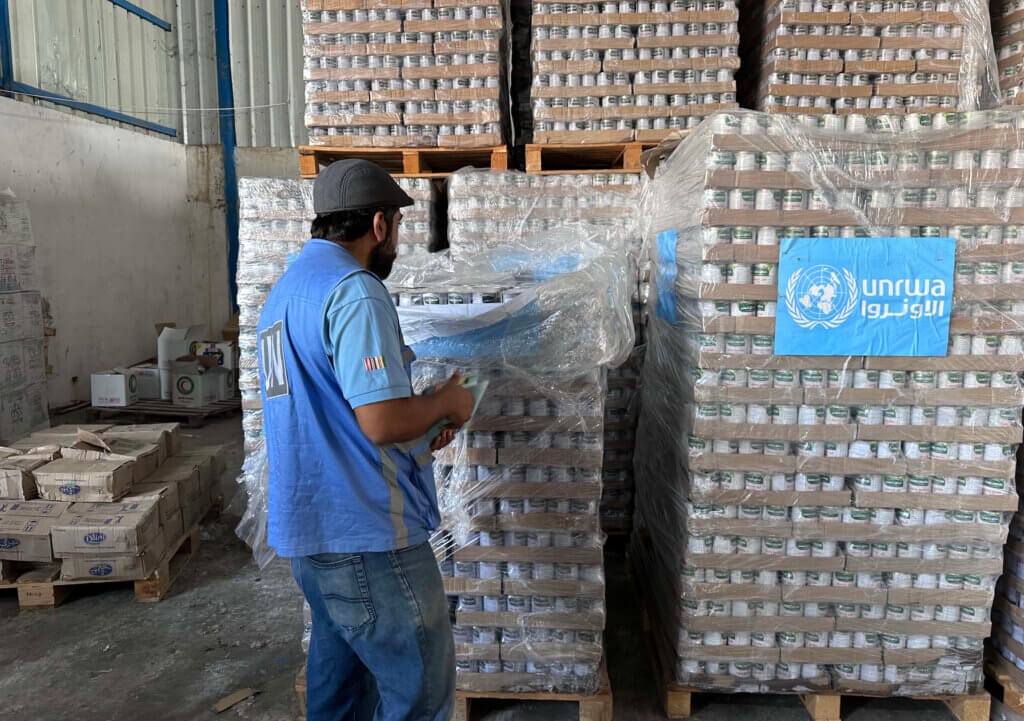
Secretary Blinken admits that the U.S. has been unable to investigate the “evidence” presented by Israel claiming 13 of UNRWA’s 13,000 Gaza employees participated in October 7. Biden took Israel’s word for it anyway.

BY MITCHELL PLITNICK    6

 Facebook Twitter

Workers of the United Nations Relief and Works Agency for Palestine Refugees (UNRWA) prepare medical aid for distribution to shelters, Deir al-Balah, November 4, 2023. (Photo: Suliman El-Fara/APA Images)WORKERS OF THE UNITED NATIONS RELIEF AND WORKS AGENCY FOR PALESTINE REFUGEES (UNRWA) PREPARE MEDICAL AID FOR DISTRIBUTION TO SHELTERS, DEIR AL-BALAH, NOVEMBER 4, 2023. (PHOTO: SULIMAN EL-FARA/APA IMAGES)

In the latest demonstration of the boundless cruelty of U.S. President Joe Biden and his despicable administration, they have turned the backbone of what little aid Palestinians in Gaza receive into a political football, to be toyed with and batted around while jeopardizing that support for people who are already near the edge of what any human, however brave, can possibly endure. 

It’s the latest in what feels like an eternal cycle of the United States and Israel beating up on the UN Relief and Works Agency (UNRWA) for political gain. There have been many hearings on Capitol Hill over the years bashing UNRWA and calling for either a complete structural overhaul of the agency or its dismantlement and absorption into the larger United Nations High Commission for Refugees (UNHCR). 

The root of the attacks, prior to October 7, 2023, has been UNRWA’s unique mission which is to provide humanitarian assistance — including food, housing, medical aid, and the role that has taken up the bulk of its budget for years, education — to Palestinian refugees exclusively. Because of this mandate, Israel and its supporters blame UNRWA for the definition of “refugee” in the Palestinian context, which includes not only those made refugees by the 1948 and 1967 wars, but also their descendants born into refugee status.

Many on the pro-Israel and Israeli right and center believe doing away with UNRWA would essentially allow Israel to do away with Palestinian refugees because they believe UNRWA is the only thing maintaining that generational definition. 

They’re wrong, of course. International law is clear on this point, as the UN states: “Under international law and the principle of family unity, the children of refugees and their descendants are also considered refugees until a durable solution is found. Both UNRWA and UNHCR recognize descendants as refugees on this basis, a practice that has been widely accepted by the international community, including both donors and refugee-hosting countries. Palestine refugees are not distinct from other protracted refugee situations such as those from Afghanistan or Somalia, where there are multiple generations of refugees, considered by UNHCR as refugees and supported as such. Protracted refugee situations are the result of the failure to find political solutions to their underlying political crises.”

There’s no ambiguity there, but that hasn’t stopped the controversy. UNRWA has been routinely accused of keeping Palestinians as refugees, not giving them the tools to move on to an independent lifestyle as individuals. This is a key ideological component in the denial of Israel’s responsibility for the ongoing dispossession of Palestinians. It absolves Israel of all responsibility for the ongoing poverty and hopelessness that decades of dispossession, occupation, and siege have wrought on Gaza and the West Bank.

Yet, while American politicians don’t think twice about trying to score points by bashing UNRWA, Israelis have always known that they need the agency, despite all their hateful rhetoric about it. For years, Israel would bash UNRWA mercilessly in the media, but would always tell the United States that its operations were necessary, especially in Gaza. Without UNRWA, Israel would be expected to ensure that a humanitarian catastrophe did not ensue, so Israel needs the agency. 

In 2018, emboldened by a reckless U.S. administration under Donald Trump, Netanyahu suddenly changed that position and called for the U.S. to dramatically cut its support of UNRWA. Trump eagerly did so. When Netanyahu made that sudden shift, it surprised and disturbed many in his own government who disagreed with the decision. Just about the only positive step Joe Biden took when entering office was to restore UNRWA’s funding. But Trump’s action made the question of UNRWA’s funding even more politically charged than it had always been.

Unable to investigate

The old cycle seems to be playing out again, but this time, the highly charged politics in Washington are more intricate. 

On January 26, Israeli allegations against a dozen UNRWA employees surfaced. The agency immediately fired nine of them and said that two others were dead, hoping their swift and pre-emptive action would stave off rash U.S. actions. Nonetheless, the United States and a host of other countries immediately suspended funding for UNRWA, over the actions of 12 of over 30,000 employees, 13,000 of whom are in Gaza. 

It’s worth pausing over that last fact for a moment. Twelve out of 13,000 Gaza employees have caused all of this, and it’s based on evidence that has not been made public. You’d never know that from much of the media coverage, which is, once again, treating Israeli allegations as proven facts. Nor could you tell by the U.S. response. Secretary of State Antony Blinken stated, “We haven’t had the ability to investigate [the allegations] ourselves. But they are highly, highly credible.” 

That is a stunning statement. They are simply taking Israel’s word for it, and on that basis, they are suspending aid to nearly two million people who need that aid more than anyone in the world. 

Recall that Israel, in October 2021, labeled six Palestinian organizations as being connected to “terrorist groups,” specifically referring to the Popular Front for the Liberation of Palestine (PFLP). The “evidence” Israel presented was so threadbare that European countries dismissed it as baseless, and even the Biden administration, which has repeatedly supported Israeli claims based on no evidence that turned out to be false, could not accept the Israeli charges, though it avoided explicitly calling out Israel’s attempted deception.

Yet now, Israel has presented a “dossier” that contains its case against the twelve UNRWA workers. The actual evidence has not been made public, and even the United States, as noted above, has admitted it can’t verify the Israeli claims. But the U.S. suspended UNRWA’s funding anyway and led seventeen other countries to follow suit. 

Not in Israel’s immediate interests

Israel saw matters going in a worrisome direction, however. The funding suspension will still allow UNRWA to operate through February, so there is time to reverse these decisions. And Israel is concerned that if that does not happen, the humanitarian situation will become so dire that Europe and maybe even the United States will not be able to resist the pressure from outraged populations and finally be forced to press for a permanent ceasefire.

Not only would UNRWA’s humanitarian efforts be shut down, but the UNRWA infrastructure that other groups use to distribute aid would also become unavailable. That will significantly accelerate the already crisis-level state of starvation, malnutrition, exposure, infections, curable diseases, lack of clean water, and all the other conditions that are killing Palestinians with accelerating speed, but much more quietly than Israeli bombs and bullets. 

Fearing it could be pressed into ending its military operations, an Israeli official told The Times of Israel, “UNRWA is currently the international organization that plays the most dominant role in the entry and delivery of humanitarian aid into Gaza, and because there currently is no alternative, Israel is not pushing to shut down UNWRA.”

The Israeli official made clear what the Netanyahu government’s reasoning was. “If UNRWA ceases operating on the ground, this could cause a humanitarian catastrophe that would force Israel to halt its fighting against Hamas. This would not be in Israel’s interest and it would not be in the interest of Israel’s allies either.”

The United States quickly got the message. Even before the Israeli official spoke to The Times of Israel, U.S. Ambassador to the United Nations Linda Thomas-Greenfield shifted the American tone. “We need to look at the organization, how it operates in Gaza, how they manage their staff and to ensure that people who commit criminal acts, such as these 12 individuals, are held accountable immediately so that UNRWA can continue the essential work that it’s doing,” she said

It’s not clear what “held accountable” means in this context since UNRWA has already fired the workers in question and even signaled it is open to criminal prosecution of anyone in “acts of terror.” Thomas-Greenfield also said that “fundamental changes” would be needed for funding to be restored. That’s a vague bit of wording that has been used many times in the past in reference to UNRWA. It’s unclear what it means here, exactly, but the general thrust of her speech was that funding should be restored.

“We shouldn’t let [the allegations] cloud the great work that UNRWA does,” Thomas-Greenfield said. “UNRWA has provided essential humanitarian assistance to the Palestinian people and UNRWA is the only organization on the ground that has the capacity to continue to provide that assistance.”

So, it would seem that the United States is prepared to back off of UNRWA and restore the funding, right? And then the other countries, who followed the U.S. down this rabbit hole, would follow it back out. 

Well, it might not be that simple. As with everything during an election year, politics make this more complicated. 

On January 30, the House Committee on Foreign Affairs held a hearing about UNRWA. The committee heard from one witness, Mara Rudman, who critiqued UNRWA but argued for President Biden’s “pause” on funding, rather than killing the agency. She said, “Is UNRWA, or any of the UN entities perfect? Far from it. The recent termination of 12 UNRWA employees who allegedly participated in the horrific Hamas attacks of October 7, provides one of the more extreme examples. It also shows the need for the ongoing oversight the Biden administration displayed in communicating to the UN that action and thorough investigation was required. For the services UNRWA provides to a desperate population, however, there is no substitute at this time.”

The termination of the twelve employees was a pre-emptive act of desperation and panic. UNRWA was not shown the evidence — merely accusations about the workers. But in this time of incomprehensible human suffering in Gaza, they wanted to do all they can to avoid the worst, so they fired the nine workers who remain alive. It shows how dedicated they are to their mission. 

UNRWA submits lists of all its employees in the West Bank and Gaza to Israel. Somehow, Israel had no problem with these twelve, despite their supposedly extensive knowledge of the membership of Hamas and other Palestinian groups. None of this seems to bother Rudman much.

But she was the best of the witnesses, by far. The other three were Richard Goldberg of the Foundation for the Defense of Democracies, a far-right pro-Israel think tank; Marcus Sheff, CEO of IMPACT-se, a right-wing Israeli institution that leads the propaganda campaign against allegedly inflammatory Palestinian textbooks; and Hillel Neuer of the far-right UN Watch, a group whose mission is to paint the UN as a cesspool of antisemitism. 

Their testimony was as biased as one might expect.

Biden’s incompetence and mindless cruelty

For Biden, the hearings, as well as the general tone and tenor in Washington after years of bashing UNRWA, present a problem. If he doesn’t restore UNRWA’s funding, conditions in Gaza will grow much worse very quickly, and calls for a ceasefire will be overwhelming, as will Biden’s downward trend in polls. If he restores UNRWA’s funding, he will find himself under attack from Republicans as well as some Democrats. 

In the wake of the hearing this week, one of Israel’s leading advocates in Congress, Brad Schneider (D-IL), bluntly stated, “We have to replace UNRWA with something else. I support getting rid of UNRWA.”

Not to be outdone in anti-Palestinian animus, the ever-eager AIPAC shill, Ritchie Torres (D-NY) tweeted, “UNRWA, long funded by your tax dollars, has been governing Gaza at the behest of Hamas so that Hamas, which sees governing as a distraction, could dedicate itself to murdering Jews in Israel.”

Had Biden and Secretary of State Antony Blinken not reacted in knee-jerk fashion to the unsubstantiated Israeli allegations, this would be less of a problem. They could have noted that UNRWA immediately fired the workers in question, that it had launched an investigation, and that its work was needed now more than ever. Biden could then have talked about reviewing UNRWA over the coming weeks and months, and made some political show of it without jeopardizing the aid to Gaza, which even the Israeli government doesn’t want to see cut.

But nothing is as familiar to Joe Biden as the own-goal. By suspending the aid to UNRWA, he now has to take positive action to restore it, which will leave him even more vulnerable to bipartisan attack. 

Netanyahu, for his part, is not going public with his desire to see UNRWA’s funding continued for a while until a more convenient time for it to be decimated. On the contrary, he is maintains his public call for UNRWA to be terminated, despite the message he conveys more quietly. He is very likely content to undermine Biden as much as he can.

Even government officials from both the Biden administration and the Netanyahu government have been forced to acknowledge the crucial role UNRWA plays. That this has become a political hot potato is not just a testament to Biden’s incompetence, but also to his mindless cruelty and unquenchable hostility to the Palestinian people.

Anti-Zionism as Decolonisation

Leila Shomali and Lara Kilani

15-12-2023

As horrifying scenes from Gaza have been recorded, published, and replayed around the world, people have been jolted into action and have thrown themselves into solidarity work. This surge of activism is fuelled by visceral reactions to the harrowing realities of Israel’s ongoing genocide unfolding on the global stage. People are realising, by the thousands, that zionism is a political program of indigenous erasure and primitive resource accumulation. 

Many new activists and reactivated organisers seek to translate their emotional responses into tangible support. They are also searching for community hubs, often in the form of organisations, that confront zionism and colonialism – the root cause of this genocide. Whether activists know it or not, they are looking for an anti-zionist home for their organising efforts. It is exactly the moment, therefore, to provide an honest discussion on some of the essential characteristics of this organising, firmly rooted in the principles of Palestinian liberation and decolonisation, peeling away any remaining layers of confusion or mystery. This essay aims to open the overdue conversation with some suggestions for individuals to consider as they search for their anti-zionist organising home. 

If we accept, as those with even the most rudimentary understanding of history do, that zionism is an ongoing process of settler-colonialism, then the undoing of zionism requires anti-zionism, which should be understood as a process of decolonisation. Anti-zionism as a decolonial ideology then becomes rightly situated as an indigenous liberation movement. The resulting implication is two-fold. First, decolonial organising requires that we extract ourselves from the limitations of existing structures of power and knowledge and imagine a new, just world. Second, this understanding clarifies that the caretakers of anti-zionist thought are indigenous communities resisting colonial erasure, and it is from this analysis that the strategies, modes, and goals of decolonial praxis should flow. In simpler terms: Palestinians committed to decolonisation, not Western-based NGOs, are the primary authors of anti-zionist thought. We write this as a Palestinian and a Palestinian-American who live and work in Palestine, and have seen the impact of so-called ‘Western values’ and how the centring of the ‘human rights’ paradigm disrupts real decolonial efforts in Palestine and abroad. This is carried out in favour of maintaining the status quo and gaining proximity to power, using our slogans emptied of Palestinian historical analysis. 

Anti-zionist organising is not a new notion, but until now the use of the term in organising circles has been mired with misunderstandings, vague definitions, or minimised outright. Some have incorrectly described anti-zionism as amounting to activities or thought limited to critiques of the present Israeli government – this is a dangerous misrepresentation. Understanding anti-zionism as decolonisation requires the articulation of a political movement with material, articulated goals: the restitution of ancestral territories and upholding the inviolable principle of indigenous repatriation and through the right of return, coupled with the deconstruction of zionist structures and the reconstitution of governing frameworks that are conceived, directed, and implemented by Palestinians. 

Anti-zionism illuminates the necessity to return power to the indigenous community and the need for frameworks of justice and accountability for the settler communities that have waged a bloody, unrelenting hundred-year war on the people of Palestine. It means that anti-zionism is much more than a slogan. 

A liberation movement

Given the implications of defining anti-zionism, we must reorient ourselves around it within the framework of a liberation movement. This emphasises the strategic importance of control over the narrative and principles of anti-zionism in the context of global decolonial efforts. As Steven Salaita points out in ‘Hamas is a Figment of Your Imagination’, zionism and liberal zionism continue to influence the shape of Palestinian resistance: 

Zionists [have] a type of rhetorical control in the public sphere: they get to determine the culture of the native; they get to prescribe (and proscribe) the contours of resistance; they get to adjudicate the work of national liberation. Palestinians are entrapped by the crude and self-serving imagination of the oppressor.

We have to wrestle back our right to narration, and can use anti-zionist thought as a guide for liberation. We must reclaim anti-zionist praxis from those who would only use it as a headline in a fundraising email. 

While our collective imaginations have not fully articulated what a liberated and decolonised Palestine looks like, the rough contours have been laid out repeatedly. Ask any Palestinian refugee displaced from Haifa, the lands of Sheikh Muwannis, or Deir Yassin – they will tell that a decolonised Palestine is, at a minimum, the right of Palestinians’ return to an autonomous political unit from the river to the sea.

When self-proclaimed ‘anti-zionists’ use rhetoric like ‘Israel-Palestine’ – or worse, ‘Palestine-Israel’ – we wonder: where do you think ‘Israel’ exists? On which land does it lay, if not Palestine? This is nothing more than an attempt to legitimise a colonial state; the name you are looking for is Palestine – no hyphen required. At a minimum, anti-zionist formations should cut out language that forces upon Palestinians and non-Palestinian allies the violence of colonial theft. 

The settler/native relationship 

Understanding the settler/native relationship is essential in anti-zionist organising. It means confronting the ‘settler’ designation in zionist settler-colonialism – a class status indicating one’s place in the larger settler-colonial systems of power. Anti-zionist discourse should critically challenge the zionist (re)framing of history through colonial instruments, such as the Oslo Accords and an over-reliance on international law frameworks, through which they differentiate Israeli settlers in Tel Aviv and those in West Bank settlements.

Suggesting that some Israeli cities are settlements while others are not perpetuates zionist framing, granting legitimacy to colonial control according to arbitrary geographical divisions in Palestine, and further dividing the land into disparate zones. Anti-zionist analysis understands that ‘settlers’ are not only residents of ‘illegal’ West Bank settlements like Kiryat Arba and Efrat, but also those in Safad and Petah Tikvah. Ask any Palestinian who is living in exile from Haifa; they will tell you the Israelis living in their homes are also settlers.

The common choice to centre the Oslo Accords, international humanitarian law, and the human rights paradigm over socio-historical Palestinian realities not only limits our analysis and political interventions; it restricts our imagination of what kind of future Palestinians deserve, sidelining questions of decolonization to convince us that it is the new, bad settlers in the West Bank who are the source of violence. Legitimate settlers, who reside within the bounds of Palestinian geographies stolen in 1948 like Tel Aviv and West Jerusalem, are different within this narrative. Like Breaking the Silence, they can be enlightened by learning the error of colonial violence carried out in service of the bad settlers. They can supposedly even be our solidarity partners – all without having to sacrifice a crumb of colonial privilege or denounce pre-1967 zionist violence in any of its cruel manifestations.

As a result of this course of thought, solidarity organisations often showcase particular Israelis – those who renounce state violence in service of the bad settlers and their ongoing colonisation of the West Bank – in roles as professionals and peacemakers, positioning them on an equal intellectual, moral, or class footing with Palestinians. There is no recognition of the inherent imbalance of power between these Israelis and the Palestinians they purport to be in solidarity with – stripping away their settler status. The settler is taken out of the historical-political context which afforded them privileged status on stolen land, and is given the power to delineate the Palestinian experience. This is part of the historical occlusion of the zionist narrative, overlooking the context of settler-colonialism to read the settler as an individual, and omitting their class status as a settler. 

Misreading ‘decolonisation’

It is essential to note that Palestinians have never rejected Jewish indigeneity in Palestine. However, the liberation movement has differentiated between zionist settlers and Jewish natives. Palestinians have established a clear and rational framework for this distinction, like in the Thawabet, the National Charter of Palestine from 1968. Article 6 states, ‘The Jews who had normally resided in Palestine until the beginning of the Zionist invasion will be considered Palestinians.’

When individuals misread ‘decolonisation’ as ‘the mass killing or expulsion of Jews,’ it is often a reflection of their own entanglement in colonialism or a result of zionist propaganda. Perpetuating this rhetoric is a deliberate misinterpretation of Palestinian thought, which has maintained this position over a century of indigenous organising. 

Even after 100 years of enduring ethnic cleansing, whole communities bombed and entire family lines erased, Palestinians have never, as a collective, called for the mass killing of Jews or Israelis. Anti-zionism cannot shy away from employing the historical-political definitions of ‘settler’ and ‘indigenous’ in their discourse to confront ahistorical readings of Palestinian decolonial thought and zionist propaganda. 

The zionist version of ‘all lives matter’ 

As we see, settler-colonialism secures the position of the settler, imbuing them with rights, in this case, a divine right of conquest. As such, zionism ensures that settlers’ rights supersede those of indigenous people at the latter’s expense. Knowing this, the liberal slogan ‘equal rights for all people’ requires deeper consideration. Rather than placing the emphasis on the deconstruction of the settler state and the violence inherent to it, which eternally serves the settler to the direct detriment of indigenous communities, the slogan suggests that Palestinians simply need to secure more rights within the violent system. But ‘equal rights’, in the sense that those chanting this phrase mean them, will not come from attempts to rehabilitate a settler state. They can only be ensured through the decolonization of Palestine, through the material restitution of land and resources. Without further discussion, the slogan simply serves as another mechanism of zionism, one that maintains the rights of the settler rather than emphasising the need to restore rights to indigenous communities, who have long been the victims of settlers’ rights.

Anti-zionists cannot both denounce settler-colonialism and zionism, and centre advocacy on the claim that settlers should have equal, immutable rights. Zionists would have you believe that their state has always existed, that Israelis have always lived on the land. But a brief reference to recent history reminds us that anti-zionism must confront the ongoing mechanisms materially advancing the development of colonies in Palestine.  

In 2022 alone, zionist institutions invested almost $100 million, transferring some 60,000 new settlers from Russia, Eastern Europe, the United States, and France to help secure a demographic majority and ensure a physical presence on indigenous lands. This only happens by maintaining the forced displacement of Palestinians, and by violently displacing them anew as we see on a daily basis, particularly across the rural West Bank. 

There is no moral legitimacy in the suggestion that these settlers have a ‘right’ to live on stolen Palestinian land, the theft maintained by force, as long as there has been no restoration of Palestinians’ rights. No theories of justice exist in mainstream ethical or philosophical discourse that advocate for a person who has stolen something to rightfully keep what they have taken. The act of theft, by definition, violates the basic principles of theories of justice, which emphasise fairness, equitable distribution of resources, and respect for individual rights and property.

Reminding people that decolonisation is not a metaphor, some activists with Israeli citizenship, including Nadav Gazit and Yuula Benivolsky, have taken the initiative to tangibly support Palestinian liberation and renounced their claim to settler citizenship. When liberal NGOs champion ‘equal rights for all people’ with no further discussion of what this means, it is the zionist version of ‘all lives matter’, perpetuating – or at best, failing to question – the maintenance of systems of violence against Palestinians. 

Having laid out some of the foundational concepts and definitions pertaining to zionism and anti-zionism, we can explore some essential strategies and tactics of anti-zionist organising. 

Structural changes to support liberation

As anti-zionism necessitates the systematic dismantling of zionist structures, this process may include educational programs and protests, which serve as foundational activities. However, it is essential to be cautious of organising spaces and activities that become comfort zones for activists, lacking the necessary risk and meaningful challenges to existing structures of zionist violence. Anti-zionist organising must involve strategic policy and legal reform that support decolonisation from afar, such as targeting laws that enable international charities to fund Israeli settler militias and settlement expansion. After all, our aim from abroad should be to make structural changes to advance decolonisation, not simply shift public sentiment about Palestine.

Decolonial approaches abroad include changing the internal structures of institutions that support colonisation: charities, churches, synagogues, social clubs, and other donor institutions. This includes entities that many international activists are personally, professionally, and financially linked to, such as the nonprofits we coordinate with and large granting institutions like the Open Society Foundation and Carnegie Corporation of New York.

In the context of the United States, the most threatening zionist institutions are the entrenched political parties which function to maintain the status quo of the American empire, not Hillel groups on university campuses or even Christian zionist churches. While the Anti-Defamation League (ADL) and the American Israel Public Affairs Committee (AIPAC) engage in forms of violence that suppress Palestinian liberation and must not be minimised, it is crucial to recognise that the most consequential institutions in the context of settler-colonialism are not exclusively Jewish in their orientation or representation: the Republican and Democratic Party in the United States do arguably more to manufacture public consent for the slaughtering of Palestinians than the ADL and AIPAC combined. Even the Progressive Caucus and the majority of ‘The Squad’ are guilty of this. 

These internal challenges to the institutions and communities we belong to are, by definition, risky and sacrificial – but essential and liberatory. They require confrontation, and likely the withholding of support and material resources, in order to usher in change. As we have seen over the last months, merely organising protests to pressure politicians without the explicit intent to withdraw electoral and financial support from political parties and institutions is fundamentally flawed. It also does not secure the desired result: on November 28, 2023, in the midst of Israel’s genocide of the Palestinians in Gaza, members of the US House of Representatives voted 421 to 1 (with the 1 unaligned to any decolonisation movement) to support a bill that equates anti-zionism to antisemitism. Members of ‘The Squad’ who did not vote for the bill did not vote against it.

Politicians, organisational leaders, and funding institutions must see the real political consequences of their decisions to support genocide. Reluctance within the executive leadership of international solidarity organisations to hold elected officials accountable is a red flag, as we cannot balance our loyalties between liberation and temporary political convenience. Anti-zionism requires more than political organising that is targeted at those intentionally maintaining white supremacy through zionism; it requires that we wager our access to power to dismantle mechanisms of oppression. We must stop betting on the longevity of zionism.

When we properly decouple zionism from Judaism and understand it as a process of indigenous erasure and primitive resource accumulation, the dominant political formations, the armaments industry, and the high-tech security sector are easily understood as indispensable institutions in the broader zionist project. These bodies also materially benefit from the status quo of zionist colonisation, and therefore wield their power to maintain it. This is part of a larger function of these formations to uphold white supremacy, imperialism, and colonialism globally – systems that harm all communities, albeit unequally. This helps us recognise that zionism does not serve to benefit Jewish people, even if this is not the primary reason we should abolish it. Equating global Jewish communities’ safety and prosperity with the safeguarding of colonial violence is an antisemitic and fallacious argument. It contends that in order to thrive, Jewish communities must displace, dominate, incarcerate, oppress, and murder Palestinians.

This relates to the earlier discussion of understanding Palestinians as the authors and caretakers of anti-zionist decolonial thought. We must be cautious not to portray anti-zionism as belonging in any exclusive way to Jewish activists, or requiring Jewish organisations’ initiative. Characterising anti-zionism as a practice necessarily spearheaded by Jewish activists, rather than acknowledging it as a decolonial praxis aimed at deconstructing the institutions maintaining the colonisation of Palestine, displaces Palestinian decolonial leadership. By placing undue emphasis on the role of Jewish organisations, we de-centre Palestinian knowledge, experience, and decolonial efforts in favour of non-Palestinian agencies. This is a grave error. Such a conflation not only misrepresents the objectives of anti-zionism but also inadvertently contributes to the continuation of antisemitic sentiments by equating Judaism and colonialism. 

Bold solidarity 

In summary, anti-zionism is not a slogan, but a process of decolonisation and liberation. Palestinians committed to resisting zionism and erasure are the caretakers of this political movement. Cities such as Tel Aviv and Modi’in are settlements, just like Itamar or Tel Rumeida in the West Bank. Decolonisation does not imply the displacement of all Jewish communities in Palestine; however, it is crucial to recognise that not every individual identifying as Jewish is indigenous to Palestine. This basic framework must be unabashedly articulated by anti-zionist organisations and allies in their advocacy. Anti-zionist organising should move towards dismantling the colonial structures through the changing of laws and policies of the institutions and formations most essential to the Israeli state project. 

This essay is not an exhaustive manual; instead, it begins a much-needed conversation and presents central principles of anti-zionist praxis. These principles are non-negotiable and represent some of the markers of anti-zionist organising. These anti-zionist indicators should not be sprinkled about through emails or social media posts that one has to dig for, but should be glaringly evident in our work and analysis.

An organisation’s commitment to solidarity and conceptualisation of resistance should be transparent. Its ideals should be clear to potential newcomers as well as its donors. We have seen, too many times, organisations intentionally obfuscate what they stand for so they relate to a broad mass of people while at the same time being palatable to liberal donors. They use vague language about the future they envision, describing ‘equality, justice, and a thriving future for all Palestinians and Israelis’ without a thoughtful discussion of what Palestinians will need to reach this prosperity. The dual discourse phenomenon, where contradictory messages are conveyed to grassroots supporters and financial donors, is a manipulative tactic for institutional or personal gain. It should be clear from the onset that a group’s efforts have one ultimate goal: from the river to the sea, Palestine will be free. Anti-zionism and solidarity should be bold. Palestinians deserve nothing less. 

Acknowledgements: We would like to thank Em Cohen and Omar Zahzah for their meticulous editing and thoughtful suggestions.

Leila Shomali is a Palestinian PhD candidate in International Law at Maynooth University Ireland and a member of the Good Shepherd Collective.

Lara Kilani is a Palestinian-American researcher, PhD student, and member of the Good Shepherd Collective.

Misreading Palestine

Misreading Palestine

Max Ajl

‘An unyielding will to continue’: An Interview with Abdaljawad Omar on October 7th and the Palestinian Resistance

‘An unyielding will to continue’: An Interview with Abdaljawad Omar on October 7th and the Palestinian Resistance

Abdaljawad Omar and Louis Allday

Ebb Publishing |
Oxford, United Kingdom

Palestine is Still the Issue

Watch film on John’s website

John Pilger first made the film ‘Palestine Is Still The Issue’ in 1977. It told how almost a million Palestinians had been forced off their land in 1948, and again in 1967. Twenty five years later, John Pilger returned to the West Bank of Jordan and Gaza, and to Israel, to ask why the Palestinians, whose right of return was affirmed by the United Nations more than half a century ago, are still caught in a terrible limbo – refugees in their own land, controlled by Israel in the longest military occupation in modern times.

“If we are to speak of the great injustice here, nothing has changed,” says Pilger at the start of the film, “What has changed is that the Palestinians have fought back. Stateless and humiliated for so long, they have risen up against Israel’s huge military regime, although they themselves have no army, no tanks, no American planes and gunships or missiles. Some have committed desperate acts of terror, like suicide bombing. But, for Palestinians, the overriding, routine terror, day after day, has been the ruthless control of almost every aspect of their lives, as if they live in an open prison. This film is about the Palestinians and a group of courageous Israelis united in the oldest human struggle, to be free.”

Pilger distills the history of Palestine during the twentieth century into an easily comprehensible struggle for land – the loss of seventy-eight per cent of that belonging to Palestinians when the state of Israel was founded in 1948 and their claim to only the remaining twenty-two per cent, which had for thirty-five years been occupied by Israel.

In a series of extraordinary interviews with both Israelis and Palestinians, he speaks to the families of suicide bombers and their victims. He witnesses the humiliation of Palestinians at myriad checkpoints with a permit system not dissimilar to apartheid South Africa’s infamous pass laws. One Palestinian woman tells of how she was stopped from passing through a checkpoint when she went into labour and had to return home to give birth with her mother-in-law using a razor to cut the umbilical cord. The baby later died. He goes into the refugee camps and meets children who, he says, “no longer dream like other children, or if they do, it is about death.” He is shown round the Palestinian Ministry of Culture in Ramallah after a recent Israeli attack where he discovers faeces smeared on walls and floors and a room of children’s paintings vandalised.

Archive footage shows pledges by successive American presidents in support of Israel. Pilger describes the Israeli administration as “America’s deputy sheriff” in the oil-rich Middle East, receiving billions of dollars and the latest weapons: F16 aircraft, bombs, missiles and Apache helicopters. He reveals that Britain also fuels the conflict even though it condemns Israel for its illegal occupation. “During the first fourteen months of the Palestinian uprising, the Blair government approved 230 export licences for weapons and military equipment to Israel… Tony Blair has said, and I quote him, “We are doing everything we can to bring peace and stability to the Middle East.'” As a result, Israel is now the fourth-largest military power in the world.

On a hillside overlooking Jerusalem, Pilger concludes. “The truth is that Israelis will never have peace until they recognise that Palestinians have the same right to the same peace and the same independence that they enjoy,’ he said. ‘Recently, that great voice of freedom, Archbishop Desmond Tutu, asked this: “Have the Jewish people of Israel forgotten their collective punishment, their home demolitions, their humiliations so soon?” Israel’s own dissenting voices have not forgotten and those who speak out in this film honour the best traditions of Jewish humanity… The occupation of Palestine should end now. Then, the solution is clear: two countries, Israel and Palestine, neither dominating nor menacing the other. Is that impossible or is history to witness the consequences of yet another silence?’”

Palestine Is Still The Issue was a Carlton Television production for ITV first broadcast on ITV1, 16 September 2002. Director: Tony Stark. Producer: Chris Martin.

Awards: The Chris Statuette in the War & Peace division, Chris Awards, Columbus International Film & Video Festival, Ohio, 2003; Winner, War & Peace category, Vermont International Film Festival, 2003; Certificate of Merit, Chicago International Television Awards.

LOOTED & HIDDEN – Palestinian Archives in Israel

click on vimeo link

Main Credits:

Director: Rona Sela
Script: Rona Sela
Main Editors: Ran Slavin, Lev Goltser
Additional Editors: Thalia Hoffman, Iris Refaeli
Original Music: Ran Slavin
Sound Mix: Itzik Cohen – Jungle Studio, Yuri Primenko

Participants: Khadijeh Habashneh, Sabri Jiryis, Former IDF Soldier, Rona Sela
Narration: Sheikha Helawy, Shadi Khalilian, Ran Slavin, Dalia Tsahor
Graphic Design: Yanek Iontef
Translation: Ilona Merber

The film was made possible through the generous support of Sally Stein in memory of Allan Sekula, and additional foundations

© Rona Sela, 2017

A Republican plan for peacemaking: ‘break the will’ of the Palestinians and force them to ‘accept defeat’

Representative Bill Johnson, Republican-Ohio (L), at the launch of the Israel Victory Caucus in Washington DC, April 27, 2017. (Photo: J. Scott Applewhite/AP)

Representative Bill Johnson, Republican-Ohio (L), at the launch of the Israel Victory Caucus in Washington DC, April 27, 2017. (Photo: J. Scott Applewhite/AP)

While President Donald Trump prepares to make his first trip abroad to Israel where he reportedly will announce his administration’s plan for the creation of a Palestinian state (without East Jerusalem as its capital), some members of his own party are calling for an alternative plan: “Israeli victory, Palestinian defeat.”

This is according to the tagline of the new congressional “Israel Victory Caucus” which was launched on April 27, 2017, at a press conference in the Rayburn House Office Building by co-chairs Rep Bill Johnson (R-OH) and Ron DeSantis (R-FL). Congressmen Keith Rothfus (R-PA), Doug Lamborn (R-CO), and Alex Mooney (R-WV) were also in attendance. The event outlined the key policies the caucus will be advocating for the Trump administration to pursue: moving the U.S. embassy from Tel Aviv to Jerusalem, ending U.S. funding of the Palestinian Authority and UN agencies that give aid to Palestinians, and securing the safety of Israeli settlers living in the occupied Palestinian territory.

Israel should “convince the Palestinians that they have lost,” said the head of the Middle East Forum Daniel Pipes, who spoke at the event.

The caucus says it will not focus on historical compromises or division of territory. Instead, it asks Palestinians to accept Israel’s goals. “Victory means imposing your will on your enemy so that he no longer wants to fight, and I think that’s the essence here,” Pipes said.

“Winning doesn’t mean slaughtering your enemy, but it means imposing your will on your enemy,” he continued.

Pipes is a far right-wing historian who notably insists President Barack Obama is a Muslim. The Southern Poverty Law Center lists him as an “anti-Muslim extremist” and said his Middle East Forum is a “major funder of Muslim-bashers even more radical than himself.”

During the 2016 campaign, Pipes endorsed Senator Ted Cruz, and compared Trump to Italian fascist Benito Mussolini, “If this kind of politics has no precedent at the highest precincts of American politics, it does elsewhere, and it has a name: neo-fascism,” Pipes wrote in April 2016.

Yet once Trump proposed banning Muslims from entering the U.S. in August of last year, Pipes warmed to Trump in an interview with Breitbart, where Pipes and other senior staff at the Middle East Forum have held stints as frequent contributors and are regular guests on its SiriusXM radio program.

Pipes and his think-tank are the brain trust advising Johnson and DeSantis. Both congress members are relatively new to formulating policy points on Middle East peace-making. Johnson told media his first trip to the region was on a Judeo-Christian tour free to U.S. elected officials in 2014 where he said he zip lined “over the Hebron valley” in the West Bank—“that was a scary thing,” he said.

Johnson explains, the caucus views the Israelis and the Palestinians as in a protracted state of “war.” If wars only end when one party becomes the victor, he wants the victor to be Israel.

“Israel has been at war with its immediate neighbors over the right to existence as the nation-state of Israel—the nation-state of the Jewish people—for nearly 70 years, and we believe that Israel has been victorious in this war. And this reality must be recognized,” Johnson said.

After the briefing, asked if he would endorse Trump’s vision for a Palestinian state, Johnson said he and the caucus would be against it, “I do not personally support a two-state solution. At least to the current Palestinian thinking, that is not the end result, that is a means to another solution.”

Johnson added, he was not told by the White House that a deal for a Palestinian state is in the works.

“I haven’t heard that myself from the administration. The only thing I’ve heard from the president is he supports moving the embassy from Tel Aviv to Jerusalem,” he said.

Palestinian President Mahmoud Abbas with President Donald Trump, at the While House. (Photo: Reuters)

Yet in the days after Johnson’s group launch, Trump indicated that he may use his May 22, 2017 trip to Israel to announce a new paradigm for U.S. brokered negotiations between the Israelis and the Palestinians. On May 3, 2017, Trump met with Abbas and the two held a joint press conference. The exchange was warm. Trump said the Israelis and Palestinians get along “beautifully.”

This was followed by a reluctant Netanyahu accepting Trump’s bid for peace talks, albeit not without making a dig at Abbas.

“The President [Trump] is seeking to examine ways of renewing the peace process with the Palestinians. I share in this desire as do the citizens of Israel. We want peace. We are also educating our children for peace. I heard Abu Mazen, who praises terrorists and pays them according to the severity of the murders they committed against Israelis; I heard Abu Mazen say that the Palestinians are also educating their children for peace. I regret that this is simply incorrect,” Netanyahu’s said.

With Netanyahu statement indicating he is on board with Trump’s plan, what exactly the Victory Caucus can achieve is likely limited to shaping the rhetoric of the administration.

“Israel is not the problem in the Middle East, Israel is the solution in the Middle East,” representative DeSantis said at the caucus lunch. Adding, Israel is “a diamond in the rough.”

Also speaking at the caucus launch, Gary Lee Bauer, undersecretary of education for Ronald Reagan and a board member of the Emergency Committee for Israel, a group that ran attack ads against Obama as “not pro-Israel” said, “If you see a conflict between barbarism and civilization, you have to rally for civilization.”


Miko Peled : It’s Personal.

Miko Peled

As thousands of Palestinian political prisoners jailed by Israel are going through a hunger strike, we would do well to delve into the deeper, more personal and historical aspects of Palestine.  Though the politics and violence of settler colonialism have determined its fate for almost one hundred years, Palestine is not just a “case” or an “issue,” it’s personal. My dear, dear friend Nader Elbanna said to me a long time ago, “The Palestinian tragedy is more than just losing the house and the land.”  None of us will ever fully understand Palestine, none of us who are not Palestinian, that is, because it is personal. But there are ways to learn. Visiting Palestine is a good start. Living in Palestine is good too and learning Arabic affords a glimpse. Reading Ghassan Kanafani’s stories is moving and enlightening.


Ghassan Kanafani, in his short stories presents an intensely personal narrative and paints a picture that is painfully detailed. In one of his short stories, a young man asks, “would you like to hear about my life?” and he proceeds to describe a mother who died under the ruins of a house in Safed, the house that was built for her by her husband. He describes the father, now working in another part of the Arab World and unable to see his children, and a brother “learning humiliation” in an UNRWA school. In another short story Kanafani describes a father who is standing in the rain leaning on a broken shovel, taking a break from the back- breaking work of digging a ditch in the rain. He is digging in an effort to stop the rain water from flooding a tent where his family, now refugees, must live. He is cold, tired and hungry but avoids going inside the tent, not wanting to see his wife’s glare, knowing she blames him for the inevitable state of being unemployed and unable to provide for his family. Seeing his child wear a torn, old shirt he contemplates taking part in a scam operation, stealing bags of rice from the UNRWA storage facility and selling them on the black market. “The guard is in on it and for a small fee he will look the other way,” he is told by a man of whose morals he does not approve, and whose very presence makes him uneasy.

The occupation of Palestine is not only about the brutality that is inherent in settler colonialism but the daily, painful existence of a nation that is denied the right to live in the land to which it belongs. A nation forced to live in abject poverty in camps that are unfit for humans and which exist just hours away from the land and the homes from which they were kicked out. A land for which they have the deeds, and homes for which they still hold the keys now inhabited by Jewish settlers. “For us, to liberate our country is as essential as life itself” Kanafani says to an Australian reporter in a rare interview in English. He is fierce and forthright, sitting in his office, with photos of Che Guevara and Ho Chi Minh behind him.

But Palestinians are permitted only to be victims or terrorists, never freedom fighters or heroes. If Palestinians wrote “Live Free or Die” on a license plate they will be accused of terrorism and locked up, deported or simply killed, though in New Hampshire it is the official motto. Ironically, Israeli children learn about a legendary Jewish hero who, having been killed in battle in Palestine said, “it is good to die for one’s country” though clearly, he was fighting to take the country of others. Kanafani was brutally murdered, along with his young niece Lamees who was only seventeen, for saying and doing just that – fighting to liberate his country. Since his assassination by Israel almost half a century ago, countless Palestinians were killed by Israel, some fighting, most while sleeping in their beds or trying to flee.

Kanafani talks about “them,” the “Yahud” the Zionists who colonized Palestine and exiled his people, turning them into “people with no rights, with no voice.” “They have put enormous efforts into trying to melt me,” he writes, “Like a sugar cube in cup of tea.” And he talks about “You” the Arab authorities under whom Palestinians are now forced to live. “You had managed to melt millions of people and lump them into one lump, into a single thing you can now call ‘a case.’” And, he continues, “now that we are all ‘a case’” there is no personal attachment to any single person or story. How convenient. That is what allows for the ease with which the world treats the Palestinian tragedy. That is how the West can sell Israel the weapons and technology with which it slaughters Palestinians by the thousands and maintains the oppression.

One wonders what Kanafani would say about the horrific, large scale massacres endured by the people in Gaza since 2008. What would he say if he knew that since his death things have become worse now that Israel’s army of terror has access to more “modern” weapons that allow it to murder and maim thousands in a single “operation.” How would Kanafani react if he heard about entire families that were wiped out by mortars and missiles fired at them and others, incinerated by millions of tons of bombs dropped from war planes? One wonders what stories he might write about children burned and mutilated with such ease in the twenty first century? “We are a small, brave nation” Kanafani said in 1970, “who will fight to last drop of blood.”

Israel – the name that was given to the Zionist state which occupies Palestine – is indignant at the very mention of Palestine and at the idea that as a state it should respect the rights of Palestinians. People who support Israel are offended when they hear accusations of racism, indiscriminate violence and genocide. But these same people have no problem with the actual ongoing campaigns of genocide, ethnic cleansing and the reality of racist apartheid perpetuated by Israel. Because for them Palestine is not personal, it is just a “case,” just a “problem.” But Palestine is not a problem, it is personal, it has a beating heat, and that is why the fight for justice in Palestine is gaining momentum all over the world. As the Palestinian leader and political prisoner Marwan Barghouthi wrote recently from a cell in an Israeli jail, “The chains that bind us will break before our captors can break our resilience.”


Palestinians forever changed by Israeli torture

Former detainees who suffered abuse while in Israeli custody say they are struggling to regain a sense of normality.

Jonathan Brown | 05 Apr 2016 11:48 GMT |

Nour Alyan, 27, who says he was held in stress positions for hours while in Israeli detention, displays the paperwork from his five separate arrests [Edmee Van Rijn/Al Jazeera]

Jalazone refugee camp, occupied West Bank – Abed Abu Sharefa’s hand was on the front door of his home in Jalazone refugee camp as Israeli soldiers worked to break through from the other side and arrest him.

The scar under his left eyebrow, where the metal door blew inwards, is still visible seven years on. Abu Sharefa, 25, told Al Jazeera that his right ear still hurts from the beatings he received at the hands of Israeli interrogators early in the 14-month detention that followed his violent arrest.

Abed Abu Sharefa, 25, says he suffers from post-traumatic stress disorder after being arrested, detained and tortured by Israeli security forces [Edmee Van Rijn/Al Jazeera]

Abu Sharefa, who has a tattoo of an M16 rifle on his chest, is among dozens of residents of Jalazone refugee camp near Ramallah who say they are suffering from post-traumatic stress disorder after being arrested, detained and tortured by Israeli security forces.

Residents of Jalazone, which is near the Israeli settlement of Beit El, are often targeted for arrest amid frequent clashes with Israeli soldiers.

Sitting in front of a rusted electric heater, Abu Sharefa takes long draws from a cigarette as he describes being beaten by Israeli interrogators. He reenacts the stress positions he says he was forced into for long hours while detained in the basement of a compound in Jerusalem.

“Even before I was interrogated, I knew detention would be violent; I’d heard about other Jalazone detainees’ experiences,” Abu Sharefa said. “In one way or another, there is always violence in Israeli detention. I’m afraid to be arrested again.”


READ MORE: Report details ‘inhuman’ treatment in Israeli jail


Abu Sharefa, who was detained twice after his first arrest, says he now has difficulty sleeping. He lifts his hands, palms facing out, to show his chewed nails, which he says he bites incessantly and nervously. He says he frequently considers suicide.

“Abed changed completely,” said Tahani, Abu Sharefa’s older sister. “Sometimes when we tried to speak to him, he didn’t respond, like he had experienced some trauma. He’s still nervous and agitated.”

Mohammad Absi, a psychologist with the Ramallah-based Treatment and Rehabilitation Centre (TRC) who has worked in Jalazone refugee camp since 2009, says he has treated around 100 former detainees who experienced torture, abuse or mistreatment while in Israeli detention.

Someone who has experienced trauma is usually helped and supported by their community, but everyone here is psychologically tired.

Nour Alyan, former detainee

Abu Sharefa’s experience was severe, Absi said, but such anxiety upon release is not uncommon. “Individuals who experience psychological torture or severe stressors manifest symptoms like Abed’s,” he said.

According to Addameer, a Palestinian human rights group, there are currently 7,000 Palestinians in Israeli-administered prisons. There have been hundreds of cases of alleged torture over the past 15 years.

Nour Alyan, 27, has been arrested five times and spent a total of eight years in Israeli prison. He recently replaced the front door of his home in the Jalazone camp for a fourth time, after Israeli soldiers broke it down to arrest him in mid-2014. Alyan was most recently released in February.

Alyan said he was held in stress positions for hours, and in solitary confinement for more than two weeks. Many in the camp – including eight of his cousins – who say they were mistreated while in Israeli custody are now struggling with depression and sleeping problems, he said.

“Someone who has experienced trauma is usually helped and supported by their community, but everyone here is psychologically tired,” Alyan told Al Jazeera.

Psychiatrist Mahmud Sehwail, who founded the TRC, said the consequences of this type of torture are “devastating” for communities.

“Torture does not aim to kill an individual; it aims to kill an individual’s spirit. It aims to alter their mentality and character,” Sehwail said. “In reality, though, torture alters not just a victim, but a victim’s family, their community, and their society.”

With limited rehabilitative resources available and dwindling donor funds to organisations like the TRC, some former detainees have turned instead to “smoking drugs, or alcohol”, Alyan said.


READ MORE: Youngest prisoner in Israeli jail is a 12-year-old girl


Israeli human rights groups B’Tselem and HaMoked recently released a reportdetailing abuses against Palestinian detainees at the Shikma facility in southern Israel. Based on affidavits and witness accounts of 116 Palestinians, the report found they were subjected to a variety of abuses, some of which were “tantamount to torture”.

The report found that that such abuse was facilitated by a “broad network of partners” as Israeli justice officials turned “a blind eye”.

Inside Story: Is force-feeding a form of torture?

Israel’s Ministry of Justice maintains that Israeli interrogations “are conducted within the confines of the law and with the aim of pre-emptively foiling and preventing illegal activities aimed at harming state security, its democratic regimes or its institutions”, noting that detention facilities “are under constant and continuous inspection of several internal and external reviewing bodies”.

Since 2001, the Public Committee Against Torture in Israel, working in concert with Palestinian and Israeli rights groups, has submitted at least 950 complaints of torture to the Israeli Security Agency, at least 95 percent of which were on behalf of Palestinians.

None have resulted in criminal investigations. “The Israeli system protects torture in Shabak interrogations,” the committee’s CEO, Rachel Stroumsa, told Al Jazeera.

“It legalises these interrogations [and] it exempts interrogators from the rule of law … At stake is whether Israel sees itself as a military society, living in fear, acting out of fear, acting in ways it will not be able to countenance later – or whether we see ourselves as a law-abiding society.”

Follow Jonathan Brown on Twitter: @jonathaneebrown

Source: Al Jazeera

The old Palestinian and the soldiers

Blog at WordPress.com.

Up ↑