Search

band annie's Weblog

I have a parallel blog in French at http://anniebannie.net

Category

Palestine

If #KhaderAdnan was a Jewish terrorist, he might be free

Max Blumenthal

February 18, 2012

As I write this, Khader Adnan is near death, on the 63rd day of a hunger strike to protest his detention without charges by Israeli occupation authorities. Having been seized on December 17 in the middle of the night by Israeli soldiers, jailed without trial, humiliated and abused, Adnan is waging one of the longest hunger strikes in Palestinian history. A 33-year-old baker, Adnan has been an activist in the popular resistance faction Palestinian Islamic Jihad for several years, but has never been implicated in any act of violence. As with the more than 300 Palestinians held by Israel in administrative detention, Israeli military authorities refuse to say why Adnan was imprisoned. Human Rights Watch has demanded that Israel “immediately charge or release” Adnan, as has Amnesty International. But the Israeli authorities continue to ignore the pleas of human rights groups.

Unfortunately for Adnan, he was not a Jewish terror suspect.

In July 2010, Jerusalem police arrested a Jewish extremist named Chaim Pearlman. Pearlman was the prime suspect in a cold-blooded settler stabbing spree that left four Palestinians dead. Pearlman had previously engaged in acts of random violence against Palestinians, while maintaining an active role in the Kach terrorist organization. For ten days, the Shin Bet intelligence service subjected him to harsh interrogations while denying him access to legal counsel. Finally, Israeli High Court Justice Edmund Levy admonished the Shin Bet for refusing to produce evidence of Pearlman’s guilt. “Never in my life have I seen such behavior,” Levy claimed, despite having presided over numerous cases of Palestinian Israelis detained in a similarly lawless fashion.

Haaretz, the liberal Israeli daily, reacted with shock to Pearlman’s treatment, proclaiming in an editorial that “the Shin Bet must mend its ways.” The editors declared that while prosecuting Jewish terrorism is important, “the ends do not justify the means.” “Even the war against terror must be conducted using legal means,” the Haaretz editors harumphed. After Justice Levy refused to extend Pearlman’s detention by 8 days, Pearlman was set free and greeted by a cheering crowd of Jewish extremists.

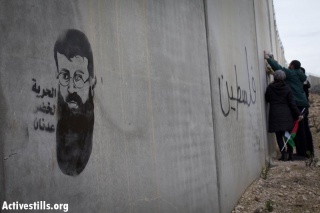
The Israeli High Court has yet to demand evidence of Adnan’s guilt. Nor have any voices in the mainstream of Israeli opinion expressed their indignation at his treatment. Instead, a military appeals court has ruled that Adnan must stay in detention until at least May. One of Adnan’s hands and both of his feet are shackled to a bed at a hospital in Safed. His wife keeps a poster in the family’s living room that features his image above a caption. It reads, “My honor is more important than my food.”

Source

Khader Adnan, Bobby Sands

Khader Adnan’s current hunger strike, presumably to the death, is more than a little reminiscent of the IRA hunger strikes of 1981. As, no doubt, the Israeli occupation of Palestine is more than a little reminiscent of the British occupation of Ireland, most particularly during the Troubles.

Lyric:

Khader Adnan, Bobby Sands

Khader Adnan grew up near Jenin City
You could say he was a product of his time
Ever since he was a kid he’d get arrested
Though he was never charged with any crime
Spending half his life in prison
A life lived like so many of his friends
Arbitrary and indefinite detention
Never knowing if your jail time would end
Khader Adnan was arrested last December
Again he wasn’t told the reason why
He was shackled, he was beaten, he was tortured
There beneath the Middle Eastern sky
Perhaps there was a moment when he realized
That right then, with his body, he’d say no
But from then on he refused to eat another meal
Like in Belfast not many years ago

Khader Adnan grew up in a war zone
But all the tanks and planes were only on one side
It was a type of war that they call occupation
Settlement, removal, fratricide
And anyone who talked about resistance
Who thought they did not deserve to be a slave
Would be looking down the barrel of a gun
And often find themselves inside an early grave
Khader Adnan loves his wife and daughters
And he likes to eat his daily bread
But in prison he can’t see his children
Or live life with the lady that he wed
So on behalf of all the children without fathers
He decided he had to strike a blow
He said I will have dignity or death
Like in Belfast not many years ago

Each time Khader Adnan was arrested
In prison he would learn a little more
And soon he became the teacher
And he’d talk about the times that came before
They talked about civil disobedience
They talked about the ballot and the gun
They talked about the Occupied Six Counties
And the H Blocks in 1981
Khader Adnan talked of perseverance
And how someday their people might be free
How someday they might hear their children laughing
Unafraid, how someday things could be
And then at 3:30 on one morning
The soldiers came, their rifles pointed low
And they took Khader Adnan from his family
Like in Belfast not many years ago

They say Khader Adnan is a terrorist
Just like they said of Bobby Sands
Because he dares speak out against injustice
Because he dares to make a stand
Because he dares believe that he is human
And he does not deserve to live this way
Because he dares to consider an alternative
Because he dares imagine a new day
Khader Adnan lost his liberty before he was born
To fight for life it’s death he must embrace
But just like others come before him
There are others waiting to take his place
And even the great powers can lose interest
In supporting such a vicious status quo
Because you can’t break a man who won’t be broken
Like in Belfast not many years ago

Israelis celebrate death of Palestinian children killed in accident

Ten Palestinian children were killed and 20 wounded on Thursday morning after an Israeli truck carrying a fuel tank crashed into the school bus transporting the kindergarten children near the Qalandia checkpoint in Ramallah.

The bus carrying the children collided with the truck at an intersection in Jaba’a, overturned, and caught on fire.

Ten children immediately died and at least 20 were injured, eight of whom are in critical condition, according to medical officials with the Palestinian Red Cross.

Palestinian Authority President Mahmoud Abbas has declared three days of mourning.

Ramallah-based journalist Diana Alzeer said the collision was likely an accident due to wet weather, and not politically motivated.

In Bethlehem, a 15-year-old boy died this morning after a truck skidded on a slippery road and ran the boy over.

A statement released by the police said they have opened an investigation and confirmed that the boy died on the spot. Emergency crews arrived to the scene and transferred the boy’s body to a hospital in Beit Jala.

Israelis on Facebook were celebrating the deaths of the Palestinian children, writing derogatory statements on a wall of a news post regarding the accident.

The Israeli comments have gone viral on Twitter, shocking users into disbelief at the level of racism and hatred directed towards the deceased Palestinian children.

Israel maintains a military occupation of the West Bank and Jerusalem, imposing harsh restrictions on indigenous Palestinians while providing privileges to illegal Jewish settlers.

Palestinians are frequently attacked and harassed by settlers as well as the Israeli military, often with impunity.

(Al-Akhbar, Wafa)

The BBC censors the word “Palestine”

This press release from the Palestine Campaign beggars belief…

PRESS RELEASE
for immediate release: 31st January 2012 *
*BBC Trust rules in favour of censoring ‘Palestine’

The BBC has admitted it was ‘overcautious’ in editing the word ‘Palestine’ from an artist’s performance on Radio 1Xtra and has said it is ‘looking to learn’ from the way it handled the situation.

However, in a ruling released today (31/01/12), the BBC Trust said the final content that was broadcast on the Charlie Sloth Hip Hop M1X – a music programme – was not biased and therefore did not breach its editorial guidelines.

The Palestine Solidarity Campaign (PSC) has spent eight months trying to find out why the decision was made to censor the lyrics of a freestyle performance by the rapper, Mic Righteous. Appearing on the Charlie Sloth show in February 2011, he sang: ‘I can scream Free Palestine for my beliefs’.

BBC producers replaced the word ‘Palestine’ with the sound of breaking glass, and the censored performance was repeated in April on the same show.

Amena Saleem, of PSC, said: ‘In its correspondence with us, the BBC said the word Palestine isn’t offensive, but ‘implying that it is not free is the contentious issue’, and this is why the edit was made.

‘Putting aside the BBC’s ignorance of international law, which states unambiguously that Palestine is under occupation, we have argued that this decision clearly shows the BBC’s bias against Palestine. Unable to counter this point, the BBC Trust has moved the goalposts and decided to look at the censored content that was broadcast in February and April 2011.

‘And the Trustees have decided that the content from which the word ‘Palestine’ had been edited was not biased against Palestine. This level of manipulation and duplicity would not be out of place in Catch 22.’

Ms Saleem added: ‘It’s a great shame that, in the year of the Arab Spring when the BBC was covering the struggle of millions of people for freedom, it remained wedded to its institutionalised bias against the Palestinians and refused to even recognise the fact of their occupation.’

In May 2011, 19 artists, MPs, academics and lawyers signed a letter to the Guardian protesting at the edit as ‘an attack on the principles of free speech’. Signatories included the director Ken Loach, and comedians Mark Thomas, Jeremy Hardy, Mark Steel and Alexei Sayle. Ends

Contact
Media contact: Amena Saleem
T: 020 7700 6192
E: amena.saleem@palestinecampaign.org

source

Support a Palestinian family fighting to stay together under Israel’s citizenship law

by on January 29, 2012

There has been a flood of new laws, practices and rules of apartheid in Israel. Sometimes many of us feel paralyzed because of the racist manifestations in the judiciary, legislature and executive and don’t know where to start fighting. Yet when those laws begin to destroy the lives of close friends, we know this is a good place to start.

On January 12th, 2012 the Israeli Supreme Court upheld a ruling allowing Israel to prevent Palestinians from the West Bank and Gaza, who marry Israelis, to reside with their spouses in Israel. This law further permits the deportation of Palestinians who are currently living with their families in Israel.

I remember a year ago when I wrote against the collaboration of the Supreme Court of Israel with the apartheid regime within the ’48 borders of the State. Some of my colleagues claimed that we were pushing it too far. While they all agreed that the Supreme Court collaborates with the occupation, they stilled maintained the belief that within Israel there exists equality before the law.

Yet on January 12th, 2012 the Supreme Court proved otherwise by allowing “the only democracy in the Middle East” to destroy the basic human right of Palestinian citizens of Israel to maintain a family unit, just because they are Arab.

Khatib family466
Taiseer Khatib, his wife Lana and their two children,
Yusra (3) and Adnan (4). (Photo: Abir Kopty)

Some of you have probably already heard about the horrific decision of the Supreme Court, but I would like to introduce you to the story of my good friend, Taiseer, and how this new decision can rupture the life of his family just because they are not Jews.

I am asking for your help to disseminate his story to the world and to be in contact with him (email) to enhance the campaign against the new discriminatory rule of the Supreme Court.

Taiseer Khatib is not only a friend, but a colleague of mine from the Freedom Theatre in the Jenin Refugee camp. He began working there six years ago, teaching creative writing and helping to establish the multi-media division at the Theatre.

The January 12th ruling has paved the way for the impending deportation of Taiseer’s wife Lana, a Palestinian from the West Bank town of Jenin, who has been living with him in Israel since their marriage six years ago. The couple lives in Acre and have two children together – Adnan, 4, and Yusra, 3. Currently, the family is terrified of what might happen if Lana is deported, breaking their family apart.

Taiseer’s case is just one of thousands, but I believe that through supporting him we can combat this ruling. It would mean a lot to me if you could contact Taiseer to try to help the cause in any way possible.

I believe that today, pressure from outside of Israel is the only way to reduce the damages of the racist flood, at least until the time comes when the entire ideological structure of the racist ideology that mobilizes Israel will fall apart.

Please see his email address below, along with links to more information about the ruling.

Thanks for your support,

Udi Aloni

Taiseer Khatib’s email is: taiseerk@gmail.com

Source

Where ya from?

[youtube http://youtu.be/AXFFOuUf3i0?]

In Search of Palestine – Edward Said’s Return Home (BBC)

[youtube http://youtu.be/ksTgAL-e9yo?]

Hamas and the Brotherhood: Reanimating history

RAMZY BAROUD

There was an unmistakable hint of triumph in the comments made by Ismail Haniyeh, prime minister of the elected Hamas government in Gaza when he was hosted by Mohammed Badie, chairman of the Egypt’s Muslim Brotherhood.

Both leaders said what would be expected of them under these circumstances. Haniyeh asserted that his movement’s “presence with the Brotherhood threatens the Israeli entity,” and Badie reaffirmed the Brotherhood’s commitment to “issues of liberation, foremost the Palestinian issue.”

It is very telling that Haniyeh’s first official visit outside Gaza as prime minister was to Egypt’s Muslim Brotherhood headquarters in Cairo’s Moqattam district. He shared his message — of resistance against Israeli occupation, national unity with rival Fatah and reaching out to Muslim countries — and then resumed his regional tour.

Since 2006, Hamas has attempted, but largely failed to win the approval of governments in Muslim-majority countries. Muslim solidarity was the thrust of Hamas’ foreign policy aimed at lessening Palestinian political and financial dependence on the US and other Western governments. It failed because, as it turned out, US financial and political leverage is too overpowering and far-reaching for a relatively small movement like Hamas to single handedly challenge. But, as Haniyeh himself reiterated, times are changing

In the first and second rounds of Egyptian elections, the Brotherhood’s newly created Freedom and Justice party won more than 35 percent of the vote. The electoral success was hardly an anomaly. The Islamic Nahda party, which formed the first post-revolutionary government in Tunisia, won more than 40 percent of the vote last October. Morocco’s Justice and Development party won the November elections and the Islamic leaning of Libya’s new political set up is all too palpable. There have been marks of Islamic political influence in other countries across the region.

The reformation of the political landscape in the Arab region has tempted many to infer polarizing, if not frightening conclusions. Israeli Army Home Front Command Chief Maj. Gen. Eyal Eisenberg was one of the first in Israel to refer to these developments as an Arab Spring turning into a “radical Islamic winter”. He said, “This leads us to the conclusion that through a long-term process, the likelihood of an all-out war is increasingly growing.”

However, what truly worries Israel is not the radicalization of Muslim societies, but the rise of Islamic politics to represent a rational, mainstream political discourse. It threatens Israel because it rallies many Arabs around one cohesive political agenda, and repositions Palestine, once more, as central to what many Muslim intellectuals refer to as the “Islamic Awakening.”

Israeli fear mongering aside, the US — Israel’s main benefactor — must find ways to co-exist with the new political arrangement. Other Western governments too “will have to adapt to a power shift they have long sought to prevent,” wrote Roula Khalaf and Heba Saleh in the Financial Times (Dec. 28).

For Israel, however, the transformation in regional politics will prove unbearable. It is not Tunisia’s Nahda party that Israel is most concerned about, of course; it is Hamas. This is partly what compelled Haniyeh to venture out of Gaza. As the US is hoping to control, if not manage, the rise of Islamic parties, Hamas aims at ensuring a primary position for Palestine — as seen through the prism of the Islamic movement — in the region’s new political landscape.

There is little doubt that Hamas’ rise to political prominence in 2006, and the numerous subsequent attempts at isolating and destroying it will influence new Islamic parties in various Arab countries. Hamas’ ability to survive has certainly registered among new Muslim politicians in Egypt and elsewhere. Now, with the early fruits of the Egyptian revolution being plucked by Islamic parties, Hamas is guardedly making its move. Hamas is a “jihadi movement of the Brotherhood with a Palestinian face,” said Haniyeh in Cairo.

A quick look at the roots of the Muslim Brotherhood in Palestine shows that Haniyeh was hardly exaggerating. Since the Society of the Muslim Brotherhood was founded in Ismailiyya, Egypt, in 1928 by Hasan Al-Banna and a few others, it quickly found in Palestine a rally cry to unite Muslims through the entire region. The first link between the movement and Palestine was formed in 1935, when Abd Al-Rahman Al-Banna (the founder’s brother) visited Palestine and met with the Mufti of Jerusalem, Haj Amin Al-Husseini.

The Brotherhood became visible during the revolt of 1936, as they communicated the Palestinian message with an Islamic tone to the rest of the Arab world. The cause of Palestine promptly became the central mission and calling of the Brotherhood, as Hasan Al-Banna himself headed the newly founded General Central Committee to Aid Palestine.

More, in April 1948, when most Arab governments delayed in partaking in the defense of Palestine, the Muslim Brotherhood deployed three battalions of volunteers.

Estimates of the number of Brotherhood volunteers in Palestine during the war and the subsequent Nakba vary, but Hasan Al-Banna himself noted, in March 1948, that the movement had approximately 1,500 volunteers in Palestine.

The relationship between the Brotherhood and Palestine had it ebbs and flows, but the rapport was never completely severed. Even before Hamas was officially established 1987, the movement functioned under various classifications, all directly affiliated with Egypt’s Brotherhood.

The recent Cairo meeting between Haniyeh and Badie could be understood within that historical context, representing a triumphant reunion and possibly open coordination. This would once again rejuvenate the Brotherhood’s Palestine connection, and grant Hamas greater political leverage — after years of isolation, and despite the current political turmoil in the region.

Of course, Hamas’ challenges are many and growing. Leading among them is Israel’s violent escalation in Gaza, and the unremitting US pressure. Still, it is expected that Hamas’ political message and outlook will continue to find balance between Palestinian exceptionality and the more inclusive Arab and Islamic framework.

By venturing out of Gaza, Haniyeh is hoping to expand the diameters of the Palestinian Islamic movement into Egypt and beyond — thus reclaiming what Hamas once considered “the strategic depth” of the Palestinian cause. While such a push failed to attain its objectives in 2006, 2012 is a brand new year.

— Ramzy Baroud (www.ramzybaroud.net) is an internationally-syndicated columnist and the editor of PalestineChronicle.com.

Source
Israel Zochrot : Testimony of Amnon Neumann

[youtube http://youtu.be/KS4OXOom_vk?]

Blog at WordPress.com.

Up ↑