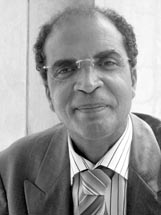
 Leading Libyan author Ibrahim al-Koni yesterday received the 100,000LE “Arabic Novel Award” at the closing ceremony of the Cairo Novel Conference.
The prize, awarded by Egypt’s Ministry of Culture, is handed out every two years.
Al-Koni announced, after receiving the award from Egyptian Culture Minister Farouk Hosni, that he would donate the prize money to the Mali- and Niger-dwelling children of the Touareg tribe. Al-Koni himself hails from the Touareg of Libya.
The selection process apparently considered 23 competing works, although there was no indication, at least that I could find, as to how those 23 were selected.
The first Arab Novel Award went to Saudi author Abel-Rahman Munif. The second round in 2003 went to Egyptian author Sonallah Ibrahim, who took the stage to refuse the award, ending his brief speech by saying he would not accept a literary prize from “a government that, in my opinion, does not possess the credibility to grant it.” He then left the prize and walked out.
The third award in 2005 went to Sudanese author Tayyeb Saleh, and, in 2008, the prize went to Egyptian author Edward Kharrat.
Reading Al-Koni in English
A number of Al-Koni’s books have been translated into English: the beautiful Bleeding of the Stone, translated by May Jayyusi and Christopher Tingley; Gold Dust, which earned Elliott Colla a runner-up citatoin from the 2009 Saif Ghobash Prize for Arabic Literary Translation; Anubis: A Desert Novel and The Seven Veils of Seth, both translated by William Hutchins; and The Puppet, released this fall, also translated by Hutchins.
The Puppet was one of my ten favorite Arabic books (in English translation) of 2010. Of it, I said:
Libya’s leading contemporary author, Ibrahim al-Koni is attracted to ancient struggles, the desert landscape of his childhood, and the power of commerce. The Puppet, first published in Arabic in 1998, is populated by a number of folklore-like characters. Among them are: Aghulli, the “sage and leader”; Ahallum, the “warrior hero,” and Chief Merchant, “the man with two veils.” Aghulli is compelled by oasis residents to take over leadership of the tribe. When he tries to enforce the old laws, there are disastrous effects. Al-Koni, who has published more than forty novels, is one of world literature’s truly original writers.
Also: In June of 2011, al-Koni’s sweeping novel The Animists, should be out from AUC Press, translated by Elliott Colla. From the AUC Press promotional blurb:
Renowned as Ibrahim al-Koni’s masterpiece, The Animists is an epic story of the many winds sweeping north and south across the Sahara—of the struggles between devils and humankind, worldly traders and Sufi ascetics, monotheists and animists, nomads and city dwellers, life and death. Al-Koni’s depiction of the Saharan crossroads is at its richest in this novel—nowhere else is his portrayal of humanity’s spiritual and existential battles so complex and compelling, nowhere else are his unique storytelling skills so evidently displayed.
Yes, Controversies at the Conference!
Al Arabiya notes, in its coverage of the prize and conference, that a number of writers boycotted this year, and that there was almost a complete absence of young authors.
Alaa al-Aswany went further, and dismissed the event—according to Al Masry Al Youm––as “a waste of public money.”
In a statement with which I really can’t agree, al-Aswany announced:
This is a farce? Has the forum ever improved the Arab novel? Novels would improve only when individual novelists can write good novels in their houses… We do not have to spend millions that come from Egyptian taxpayers.
Prominent Egyptian author Gamal al-Ghitani defended the forum:
Forums are a good opportunity for Arab writers to meet and exchange ideas. Spending money on cultural events where respectable Arab writers are invited–isn’t that better than wasting public money on other stuff?
Bahaa Taher added:
The state spends on culture one tenth of what it spends on football and TV.
(And we shan’t go into what-all else the state spends its money on.)
Other Lit-Prize Controversies: Yes, That’s Me, Ms. ‘Rose-Tinted Glasses’
Lastly, in a Reuters piece about the beleaguered and controversy-sieged Arabic Booker, I stand up for the blessed thing. Sigh.
 Mustafa is currently an assistant professor in the Department of Modern Foreign Languages and Literatures at Boston University; he is also the editor and translator of the excellent Contemporary Iraqi Fiction: An Anthology.
 band annie's Weblog