— by Erwin van Veen
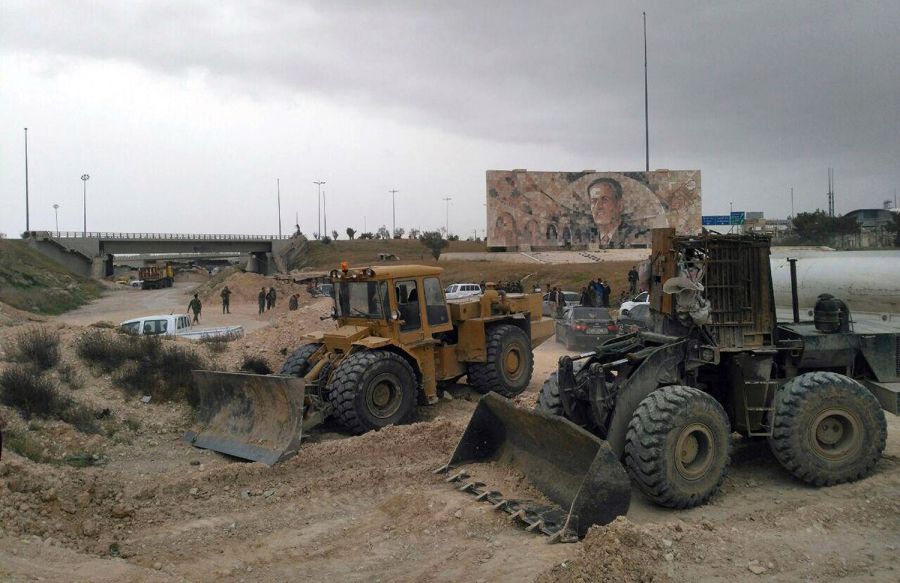
Bulldozers remove barriers from a road in Harasta, east of Damascus (SANA via AP)
 By Erwin van Veen
While all eyes were fixed on the US-led military response to the alleged chemical attack in East Ghouta, a little-noted event occurred that could potentially have a much greater impact on Syria’s future. About 10 days ago, President Assad’s regime passed Law no. 10. The law foresees the creation of local administrative units in each district of regime-held territory that will be in charge of reconstruction efforts. All Syrians will be required to register their private properties with these units by providing proof of ownership, in person or through legal representatives. This must be done within roughly the next two months. The risk of noncompliance is that the Syrian state will take possession of the unregistered properties.
With half the Syrian population displaced and many property transfers prior to 2011 having been done informally, this will be a mission impossible for many. Depending on the implementation and enforcement of the law, its most likely consequence is that the Syrian state will acquire a substantial amount of property in the near future—land, buildings, and other immovable assets—within the territories it currently controls. The real implication here is twofold. Most importantly, President Assad’s regime will lay its hands on the assets it needs to finance the country’s reconstruction and reestablish its power base, preserving its long-term viability and independence. Moreover, it will dispossess hundreds of thousands of Syrians—possibly millions—who escaped the fighting or forced recruitment. Law no. 10 is a Faustian masterstroke—both in its injustice and its ingenuity.
The background is this: The World Bank has estimated the tab for reconstructing Syria at upwards of USD $200 billion. The Syrian regime has been broke for some time, kept financially afloat by the Iranian Central Bank and assorted Lebanese banks. Russia and Iran have neither the will nor the funds to finance Syria’s reconstruction. The Gulf countries, United States, and European Union have made it clear that likewise they will not carry Syria’s reconstruction without a “meaningful political transition”—a reference to their desire for real political concessions in the future governance of Syria. Most who are familiar with the conflict expect such a transition to happen when hell freezes over.
And yet, reconstructing Syria is essential to President Assad’s regime. This is not because it cares about restoring basic services like healthcare and housing to a decent level, or about the return of Syrian refugees. Figures like Syrian Major General Issam Zahreddin (since killed in battle) made it abundantly clear some time ago that returning refugees should not count on a warm welcome.
No. Rather, reconstruction is essential to the regime’s survival because it must reward the networks of businessmen, military, and militia leaders that helped it win the war. Reconstruction is also vital to the regime’s autonomy because it must re-establish its powerbase and independence vis-à-vis its international backers who will expect the future loyalty of a faithful Syrian ally when this conflict is over. Iran, for example, is already working to establish a long-term social, religious, and military presence in the country.
The imperatives of regime survival and autonomy mean that its reconstruction logic will echo its warfighting logic: indiscriminate punishment of disloyalty to impose fear, selective co-optation, and deal-making with opposition groups where this offers a low-cost solution on regime terms and safeguards core regime interests. Initial urban reconstruction efforts of the regime in Damascus, Homs, and Aleppo, on the basis of Decree 66 (2012), already show how the regime uses high-end property developments to generate funds and reward loyalists through forcible dispossession below market rates, as well as the use of regime-linked real estate and construction companies. The nationalization of property enabled by the closely-related Law no. 10 will take this approach to a new level.
An additional consequence of Law no. 10 is that it will enable large-scale demographic engineering by reallocating appropriated property to new owners. This will not necessarily be sectarian in nature as the majority of both Syrians and regime-loyalists are Sunni. Rather, it will create large loyalist urban centers to underpin the regime’s power base and limit the return of refugees, who are largely not perceived as supporters of President Assad.
In addition to remaking urban centers as areas of repopulated loyalist concentration, the strategy will probably also involve undoing the existence of impoverished Sunni-belts around Syria’s main cities from which so many rebels were recruited. Insofar as these poorer suburbs are currently depopulated due to rebel recruitment, casualties, and flight, the regime is likely to use Law No. 10 to appropriate the land (in many such areas, property rights were not well established even before the war) and to then prevent their resettlement if and when refugees return. Any Sunni populations that have not fled but are still living in such suburbs at present will also be at risk of forced displacement and dispossession commensurate with the extent of their perceived disloyalty to the regime. It is clear that the regime has no problem initiating displacement on a large scale when it suits regime interests. Dealing with the suburban belts in this fashion will remove a source of resistance against the regime once and for all.
Though these are the primary aspects of the strategy, Law no. 10 may very well additionally facilitate small-scale sectarian demographic engineering in a few strategic areas. The “four-town deal” that swapped the population of two Sunni villages with two Shi’i ones west of Damascus suggests that the Syrian-Lebanese border could be such an area. Incidentally, this particular deal was enabled by Qatar as the price for release of their captured royal hunting party in Iraq.
If the re-entrenchment of the Syrian regime was not already a sad enough finale, the emerging parallels with the plight of many Palestinians are uncanny and will constitute a further source of international concern. Not only is the relative size of the Syrian diaspora growing fast, but Law no. 10 may well have an effect similar to the Israeli Absentee Property Law, which effectively nationalized Palestinian lands whose owners had fled after November 1947. The Israeli/Palestinian problem still haunts the world’s conscience 70 years later, though apparently not enough to end its neglect and resolve the problem.
In 2017, Pearlman quotes Talia—a fleeing TV correspondent in Aleppo—regarding a sad but remarkably poignant moment: “I waited for the driver outside. I kissed the walls on the street, because I knew that I was never coming back to them.”
Law no. 10 just brought this scenario one step closer to reality.
___________________________________________________________________
Erwin van Veen is a senior research fellow at Clingendael, the Netherlands Institute of International Relations. Follow on Twitter.


 band annie's Weblog
A selection of comments to the latest Syria Comment post
29. ALI said:
For those who claim that Syria was good only in the eyes of tourists and expatriates, I say this is non sense. For example, in Damascus, remember the good days when you used to go for “seeran” every Friday, remember the family visit to the Damascus international exhibition, remember the grilled corn, beans and cactus in Sh3lan, remember the old Damascus and BabToma, remember Ala-Elbal and beet Jabri ….. all these things were for all Syrians not only tourists and expats.
Syria offered all sorts of entertainment and good times to all Syrians from all social classes. Maybe the poor didn’t afford to have a meal in four seasons but for sure everybody could afford a mean at Abo Wa7eed in Ein Elfejeh where Bashar himself used to dine weekly before being a president.
Alawis didn’t take advantage of the state, it just happened that most Alawis do work in the army where the perks of cars and accommodation are really good, but similarly Naz7een people (from Golan) did control Mukhabarat and they were Sunnis, exactly like Idleb and Deer-Zour people controlled police and traffic police and it happened being Sunnis as well.
It’s not fair to blame all corruption on Alawis and forgetting the majority of Sunnis who were part of this corruption in every detail especially when coming and begging Alwais to do things for them above the law. If you claim the state was not great, and I disagree with that, then you need to be fair and honest before throwing non-sense accusations around. Some Alawis villages still till now has no power while Sunnis were spending money in Bloudan, and blue beach but still these poor Alawis never complained.
36. Amjad of Arabia said:
Ali, I’m quite disappointed and saddened that you still don’t feel able to lay the blame for Syria’s current situation squarely where it belongs; at the feet of the regime. Was it really necessary to murder 100 people in Homs on an April night just because they were holding a demonstration? Was it really necessary to beat up Ali Ferzat and imprison najati Tayara and butcher Gaith Mattar?
And who am I going to fight the Jihadists with? Bashar? F*ck Bashar and every member of the Assad family. I’d rather take my chances with an uncertain future than see that ibn el gahba pass the presidency on to Hafiz II
“so it’s your fault and responsibility to assure me that my sisters won’t get raped or stoned for wearing shorts.”
I can give you no assurances on the future. Everything you fear could happen and worse. Nothing is certain about the future, but we have a 100% certainty on what life under Assad will be like. Everything you fear and worse has been done to Assad’s opponents. Rape, murder, entire villages bombed, hundreds of people massacred.
The FSA completely withdrew from Hama. Do you have any idea what life is like for the Hamwis now? An entire neighborhood of 300 houses was leveled. Every week hundreds of people are arrested in mass random arrests. There is rarely a man on the streets of the city. That is what would have awaited the country if Assad had won.
And you blame people for cheering the Islamists who turned out to be the only ones to take the regime on? I may not like their ideology or system, but what have I and the likes of me managed to accomplish in contrast before they came along? We looked to the West and the USA for support, and instead got a POTUS with his thumb in his mouth.
50. MarigoldRan said:
The supporters of the regime lived in a bubble where they thought all was well. They lived in the cities, supported by their rich friends, careful not to offend the police. And the police left them alone because, after all, these people are not a threat. They toed the line, proclaimed Assad as a brilliant leader, and got along with their lives.
Little did they know, but a volcano was brewing under their feet. In the countryside, the poor got poorer, and more numerous. A drought hit, and many of them lost their jobs. When they protested, the police beat them up. When they wrote graffiti on the wall, the police tortured their children. Eventually, the poor rose up and said, “Enough of this, it is time for our vengeance.” And so they rose.
In the meantime, the rich happy people who lived in the cities and who toed the line saw all this happening, and proclaimed in a bewildered voice: “What is this? Where did all these angry people come from? What is this cursed revolution? Wasn’t Syria a beautiful state before?”
And the poor said to the rich people, “NO. It was a beautiful country for you, perhaps, but not for us. You chose to ignore us, treating us like dirt. It is now OUR time to pay you back.”
And so they will.
November 23rd, 2012, 1:40 am