Search

band annie's Weblog

I have a parallel blog in French at http://anniebannie.net

Category

Jewish dissent

Jews – Rebel. Now!!!

A Jewish Plea to The International Court of Justice

Avrum Burg

Aug 08, 2025

Magnified, sanctified
Be the holy name
Vilified, crucified
In the human frame
A million candles burning
For the help that never came
You want it darker

Hineni, hineni
I’m ready, my Lord

(Leonard Cohen)

There is no single definition that defines all who identify themselevs as Jewish. Is Jewishness a religion? A gene? A culture? A nationality? A legal status? In the confusion of these overlapping and contradicting identities, modern Israel has forged its own unprecedented synthesis; a fusion of five elements never fully welded in Jewish history: religion, land, power, language, and sovereignty. The product of this Israeli crucible is a cultural mutation that dares to call itself Judaism.

At this moment in Israeli history, three of those elements; religion, power, and land, have metastasized into malignant growths. Power has become too great and is now wielded in service of the most pathological interpretations of Judaism, bent on conquest and domination. The immediate cost of this cancer is the unraveling of Israeli sovereignty. Power has been handed over to violent messianic militias; their gang leaders now serve as government ministers. Together, from the top and the bottom simultanously, they have dismantled the Israeli state. That country no longer exists.

These destructive elements were always present in the Jewish whole, but they were usually contained, marginalized, restrained. Today, after two thousand years, they have seized control and are implementing their darkest impulses. Every Jew must now confront two fundamental questions: What is my Jewish identity? And am I with them, or against them?

There is no middle ground. There mustn’t be.

To stand with them is to align oneself with the ruinous forces of our past. With those who launched a reckless and delusional revolt against the Roman Empire, bringing the destruction of the Second Temple and untold suffering upon our people. To stand with them is to embrace the biblical commandments of annihilation of the native nations and the myth of mass suicide at Masada. It is to follow a separatist, supremacist culture: a world where non-Jews are reviled, and Jews are chosen and exalted.

There are thick, unbroken lines stretching from Bar Kokhba’s hubris to Ben-Gvir’s thuggery; from Rabbi Akiva’s messianic madness to Smotrich’s crudity and zealotry. The lords of ruin in Jewish history never truly died and now they even kill.

But Judaism has always held within it another civilization. One rooted in introspection, critique, compassion, and moral action. The prophet Nathan stood before King David, Israel’s most powerful ruler, and indicted him for corruption and bloodshed. Centuries later, the prophet Jeremiah warned the decadent elites of Jerusalem of the looming First Temple’s destruction. In the year 70 CE, Rabbi Yochanan ben Zakkai fled the city of zealots and blood-lust and inaugurated the new alternative Judaism: a faith of worship without temple, of identity without territory, of strength without force, and of spiritual authority without political sovereignty.

This was the Judaism that later embraced Yiddish, the language Isaac Bashevis Singer once described as “the language of exile… a language without land and without borders, unsupported by any government, a language with no words for weapons, for ammunition, for military maneuvers or warfare tactics. In the ghettos, Yiddish speakers lived out what the great religions merely preached: a daily practice of studying humanity and human relations. What they called Torah, Talmud, ethics, and mysticism. The ghetto, far from just a refuge for the persecuted, was a grand experiment in peaceful living, self-meaning, and care for others. And it still survives, refusing to surrender, despite the cruelty that surrounds it”.

This inner tension in the Jewish soul is still alive. Between the forces of domination, bloodlust, and silencing of others, and that Judaism of tolerance, openness, and dialogue.

Now, a great moral exaltation is required of all who refuse to accept the dictatorship of power and corruption led by Caesar Netanyahu and his coalition of apocalyptic zealots.

Now is the time to walk out of the city, as Yohanan ben Zakkai did, and rekindle a Judaism of morality and humanity. We have no institutions, no vast resources. We are scattered, often alone. We possess no military or governmental power. But we do have the spiritual and ethical strength of our past. We have Jewish history on our side.

That is why we can and must stop the flow of blood.

Here is how we can begin: We need one million Jews. Less than ten percent of the global Jewish population to file a joint appeal to the International Court of Justice in The Hague. A collective legal complaint against the State of Israel for crimes against humanity committed in our name and under the false banner of our Jewish identity.

It is time to say: enough!

Two suns will rise on that day. One will shine within the Jewish firmament, casting light on our inner darkness and replacing fanaticism with moral clarity. The other will shine across the world, declaring that among Jews there are those who resemble the worst criminals of the nations and there are those who, without fear or favor, stand against them.

Yes, Hamas committed heinous crimes against humanity. But none of that justifies Israel’s actions in Gaza since.

This is a moment of reckoning. We must not run from it.

So this is my plea:

If you are an individual, a community, or a Jewish organization anywhere in the world, and you are shaken by what Israel is doing; if you align yourself with the values of humanistic Judaism, with basic moral decency and collective responsibility, join this historic initiative. Not by turning to weapons or power structures, but to the conscience of humanity. Turn to The Hague.

In our appeal, we shall declare: We will not allow the State of Israel, which systematically inflicts violence upon a civilian population, to speak in our name. We will not allow Judaism to be a cover for crimes. This is not a rejection of our people it is a defense of its soul. Not destruction but repair.

We are thousands, tens of thousands, hundreds of thousands. A million Jews who simply say: We are here, and we are against.

Conscientious individuals whose souls are stirred, thinkers, scholars, clergy, artists, jurists, the time is now. Connect. Sign. Organize. Raise the Jewish voice of moral resistance. The light exists. It only needs many candles.

I really hope activist readers will raise to this call and initiate it

Will hear the most ancient call -, “Where art thou?” and will respond like Leonard Cohen responded:

Hineni, hineni
Hineni, hineni
I’m ready, my Lord


Subscribe to Avrum Burg’s Substack

Launched 3 months ago

My personal SubstackSubscribe

300 Likes

124 Restacks

Discussion about this post

Gershon Baskin

8d

Great article Avrum. I have shared it with my list of thousands

Like (41)ReplyShare

3 replies by Avrum Burg and others

Streets28mm Ali Shadpour

7d

Spare me the selective outrage. Israel’s crimes against humanity didn’t just pop up on October 7th — they’ve been grinding on since before the land was even renamed “Israel.” Decades of stolen land, murdered civilians, and systemic oppression, apartheid. Hamas did exactly what resistance movements throughout history have done: fight the occupier and defend their people, the Palestinians. Viva Palestine!

Like (31)ReplyShare

22 replies by Avrum Burg and others

160 more comments…

Israel. Is the Game Over?

More than twenty years ago, I cried out at the tragic end of Zionism.

Jul 26•

Avrum Burg

60

9

Antisemitism? No, It’s Just Humanity

Antisemitism is suddenly the hottest thing.

Jul 31•

Avrum Burg

54

9

Israel’s Triple Cult of Death

In Israel today, death has become the country’s true government.

Jul 10•

Avrum Burg

23

2

Ready for more?Subscribe

© 2025 אברום בורג

Privacy ∙ Terms ∙ Collection notice

Start writingGet the app

Substack is the home for great culture

Cookie Policy

We use necessary cookies to make our site work. With your consent, we also set performance and functionality cookies that help us make improvements by measuring traffic on our site and we process respective personal data. You can withdraw
Israel’s Support for Apartheid, War Crimes and Genocide Around the World, a Brief History

PALESTINE NEXUS /ZACHARY FOSTER

audio version on spotify

For decades, Israel has supplied weapons and military technology to the world’s most brutal military regimes. This is a brief history of Israel’s support for apartheid, atrocities, war crimes and genocide around the world. 

Chile

In the 1970s-80s, Israel supplied arms to Chile’s Augusto Pinochet during its 17-year long military rule in which civilians were routinely targeted, tortured, and disappeared. The Israeli military trained the Chilean secret service, the DINA, described by the CIA in 1974 as a “Gestapo-type police force,” which tortured at least 35,000 and disappeared over 3,000 people. Meanwhile, Israel maintained excellent relations with Chile throughout Pinochet’s rule, sponsoring Chilean leaders on many state visits.

Now, an Israeli-Chilean family seeks justice for their father, who was tortured and killed by the dictatorship. They have sued the Attorney General to open investigations into the involvement of Israeli government institutions in arms deals with Pinochet. The Israeli lawyer and human rights activist Eitay Mack has filed a series of freedom of information petitions for the release of documents that would detail the nature of Israel’s involvement. “The human rights issue is not part of the consideration of the officials in the Ministry of Defense and the Ministry of Foreign Affairs, unless there is big public pressure on them,” Mack said. Israeli leaders are unconcerned with how the weapons are used so long as they improve Israel’s diplomatic ties abroad.

Guatemala

In 1977, Israel became Guatemala’s principal weapons supplier, providing the country’s authoritarian leaders with $6 million worth of Galil rifles and Uzi submachine guns. Israel also supplied spyware and electronic surveillance and designed and operated the radar system at Guatemala City’s international airport. Guatemalan officials have even bragged their soldiers carry Israeli weapons and underwent training from Israeli soldiers. Guatemalan leaders have also embraced Israeli military tactics, such as using the theoretical presence of guerilla forces in an area as a pretext to indiscriminately kill civilians. During the civil war, right wing supporters of the regime even spoke about the “Palestinianization” of Guate’s indigenous population.

Then, in 1982, Israeli officials helped Guatemala’s Efraín Ríos Montt carry out a military coup. Montt, who later thanked over 300 Israeli advisors for their help in the takeover, ruled during the bloodiest period of Guatemala’s civil war — known as the Mayan genocide or the Silent Holocaust. In 30 years, over 200,000 Mayan people were killed, tortured, and disappeared. Montt’s rule lasted from 1982-83 during which time his regime disappeared some 70,000 people.

South Africa

In the 1970s and 1980s, Israel became one of apartheid South Africa’s most important arms suppliers. In 1988, South Africa saved Israel’s cash-starved defense industry after it purchased 60 Kfir combat planes for $1.7 billion. Israel was then able to launch a reconnaissance satellite that was only made possible after the weapons sales to the apartheid regime.

South Africa operated an apartheid state, a racist legal system that segregated social and civil life in South Africa, privileging the white minority and condemning the Black majority. Apartheid security forces killed between 11,000 and 21,000 people and detained more than 80,000 people without trial over the course of the regime’s four decades of rule. Today, South Africa continues to suffer from the ramifications of apartheid rule.

Serbia

In 1991, Israel made one of the largest arms deals with Serbia during the Bosnian Genocide,  concealing the weapons transfers in violation of a UN arms embargo that same year. Israel’s military relationship with Serbia continued through at least 1995, with Serbian soldiers having received covert Israeli training in Greece and toting Israeli Uzis, snipers, shells and missiles. In 2016, the Israeli Supreme Court declined to release documents despite a petition filed by Mack and others because it would pose a risk to Israeli foreign relations.  To this day the extent of Israeli support for the Bosnian genocide remains unknown.

The Serbian wars waged against Muslims in Bosnia and Croatia after the dissolution of Yugoslavia have been described as the most egregious acts of ethnic cleansing “Europe had seen since the Holocaust.” Between 1991 and 1995 over 250,000 people were killed, and many more injured, raped, and held in concentration camps.

Rwanda

Israel provided arms to Hutu government forces during the Rwandan Genocide. Israeli weapons manufacturing companies sent 7 shipments of bullets, rifles and grenades to Rwanda between April and July 1994 alone despite an international arms embargo. In 2014, human rights lawyer Mack, alongside others, once again petitioned for documents on the arms trade but were denied because the information might harm “Israel’s state security and foreign relations.”

In 1994, Hutu militias killed more than half a million Tutsis in Rwanda in less than 100 days. It was the culmination of decades of tension between Rwanda’s majority ruling ethnic group, the Hutus, and the Tutsi minority. In total, over 1 million people perished in what is considered to be the fastest genocide in human history.

The Philippines

Israel supplied weapons to the Philippines during President Rodrigo’s Duterte’s infamous drug war in which government forces and death squads killed over 12,000 people. Philippine Security forces carried out the executions with Israeli rifles and handguns in largely poor, urban neighborhoods of the country.

In a 2018 visit to Israel, Duterte openly acknowledged that he favored purchasing Israeli weapons because there are virtually no restrictions on the sales while boastfully comparing himself to Hitler. In 2016, Duterte ran on a presidential campaign promising to kill 100,000 people in his first six months in office. He won by a landslide.

Myanmar

Since 2018, Israeli companies have supplied at least four shipments of weapons to the military junta in Myanmar, including patrol boats, advanced radar systems, air combat maneuvering instrumentation and drones.

Israel Aerospace Industries and Elbit Systems, for instance, continued pre-existing trade relations with the regime, ignoring both an international arms embargo and a 2017 Israeli Supreme Court ban. Israel’s government claimed it had stopped sending weapons to Myanmar in 2018, but arms shipments continued as late as 2022, after the junta overthrew the country’s democratically elected leaders a year earlier. In addition, Israel CAA Industries sold millions worth of arms-manufacturing equipment to Myanmar while an Israeli cyber firm supplied the country with spyware to surveil civilian populations.

In 2017, Israeli weapons and equipment were used to carry out a genocide of Rohingya Muslims. That year, Myanmar’s military Junta killed 9,000 Rohingya between August and September alone, with over 500,000 having fled to Bangladesh.

South Sudan

An Israeli general has been accused of trafficking $150 million worth of arms to the South Sudanese government under the guise of an agricultural firm. Israel provided assault rifles and operated surveillance equipment that has been used to target journalists and opposition figures. This was in spite of a 2018 UN Security Council arms embargo, a 2015 UN Report detailing Israeli violations of a previous ban of weapon sales and Israel’s ongoing promises since 2011 to suspend transfers of lethal equipment.

Years of political unrest and conflict between ethnic and militia groups in South Sudan have culminated in what some say is the “biggest hunger crisis” in recent history. Since 2018, some 400,000 people have been killed due to violence, starvation and disease, and between 4 and 11 million people have been displaced.

Azerbaijan

Israel has sold billions of dollars worth of arms to Azerbaijan since 2012. The Azerbaijani military even published videos displaying Israeli missiles and suicide drones and a factory producing these drones on Azeri soil. Meanwhile, the government has also used the Israeli company NSO’s spyware to target journalists and opposition activists.

In 2023, Azerbaijani forces continued to use Israeli arms to institute a 9-month blockade of Nagorno-Karabakh after decades of fighting that had left tens of thousands dead. They starved out the region’s 120,000 ethnic Armenians, blocking access to food, medicine, and fuel until January 24, 2024 when Azerbaijani forces ethnically cleansed the last remaining Armenians in the beleaguered enclave.

——

Israeli arms dealers have been intimately involved in many of the world’s most horrific acts of violence over the past half-century. In addition to the cases cited above, Israel has also reportedly supplied weapons to Argentina, Venezuela, Equatorial Guinea, and Nicaragua. In each of these cases as well, Israeli arms have been used to carry out atrocities. The Israeli firm Pegasus is also distributing its spyware to authoritarian states, where the technology will almost certainly be used to crack down on journalists and opposition figures.

Israeli human rights lawyer Mack emphasizes that the sales are intended to boost Israel’s diplomatic standing in the world. “In my opinion, economic incentive should never be above the moral issues and the human rights issues.”

yt  

Ilan Pappé on YouTube

Attack on Rafah

Decolonizing Israel
New history
Zion : An investigation

Daniel Mahé recorded this on October 8, 2023

Recorded while walking in Bedford Stuyvesant, Brooklyn NY.. Daniel Maté,

Israel Is Voting Apartheid Gideon Levy


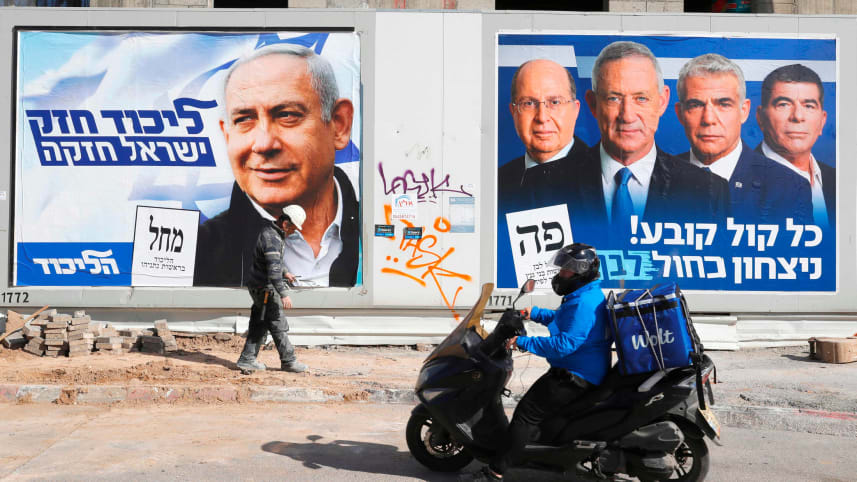
A man walks past electoral campaign posters in Tel Aviv on April 3, 2019.JACK GUEZ / AFP

There will be one certain result from Tuesday’s election: Around 100 members of the next Knesset will be supporters of apartheid. This has no precedent in any democracy. A hundred out of 120 legislators, an absolute of absolute majorities, one that supports maintaining the current situation, which is apartheid.
With such a majority, it will be possible in the next Knesset to officially declare Israel an apartheid state. With such support for apartheid and considering the durability of the occupation, no propaganda will be able to refute the simple truth: Nearly all Israelis want the apartheid to continue. In the height of chutzpah, they call this democracy, even though more than 4 million people who live alongside them and under their control have no right to vote in the election.
Of course, no one is talking about this, but in no other regime around the world is there one community next to another where the residents of one, referred to as a West Bank settlement, have the right to vote, while the residents of the other, a Palestinian village, don’t. This is apartheid in all its splendor, whose existence nearly all the country’s Jewish citizens want to continue.

read on here

Gideon Levy at the National Press Club

https://youtu.be/h-Iaj-LUuFM

LOOTED & HIDDEN – Palestinian Archives in Israel

click on vimeo link

Main Credits:

Director: Rona Sela
Script: Rona Sela
Main Editors: Ran Slavin, Lev Goltser
Additional Editors: Thalia Hoffman, Iris Refaeli
Original Music: Ran Slavin
Sound Mix: Itzik Cohen – Jungle Studio, Yuri Primenko

Participants: Khadijeh Habashneh, Sabri Jiryis, Former IDF Soldier, Rona Sela
Narration: Sheikha Helawy, Shadi Khalilian, Ran Slavin, Dalia Tsahor
Graphic Design: Yanek Iontef
Translation: Ilona Merber

The film was made possible through the generous support of Sally Stein in memory of Allan Sekula, and additional foundations

© Rona Sela, 2017

If being Jewish means catastrophe to the other


Children were the irrepressible vanguard of the first intifada, December 1987. Photo from World Bulletin. It lasted from 1987 to  1993

Trust Me, I Was Once a First-Year Jewish Student Too

By Robert A. H. Cohen, Writing from the Edge,
September 09, 2017

This month a new generation of Jewish students will begin their first term at University. Here’s my advice to them.

Congratulations/Mazel tov!

You’re off to university. First time away from home. First time away from your synagogue community. Or perhaps you’ve had a year out after school and have been in Israel soaking up your Jewish heritage. Maybe you’ve been on a Jewish leadership trip organised by your youth movement or a Birthright tour. But now it’s back to reality and you’re about to discover what it means to have your ideas challenged, your prejudices pointed out and your Jewish identity undermined.

But don’t worry. This is all to the good. It’s exactly what you need. Trust me, I was once a first-year Jewish university student too.

Your baggage

You may realise this already, but the baggage you’re taking with you to university is considerably more than what’s in your rucksack. It’s been accumulating throughout your life, it’s the stuff that’s made you who you are. Now you have the opportunity to unpack it, examine it, and decide if it’s still useful for the journey ahead.

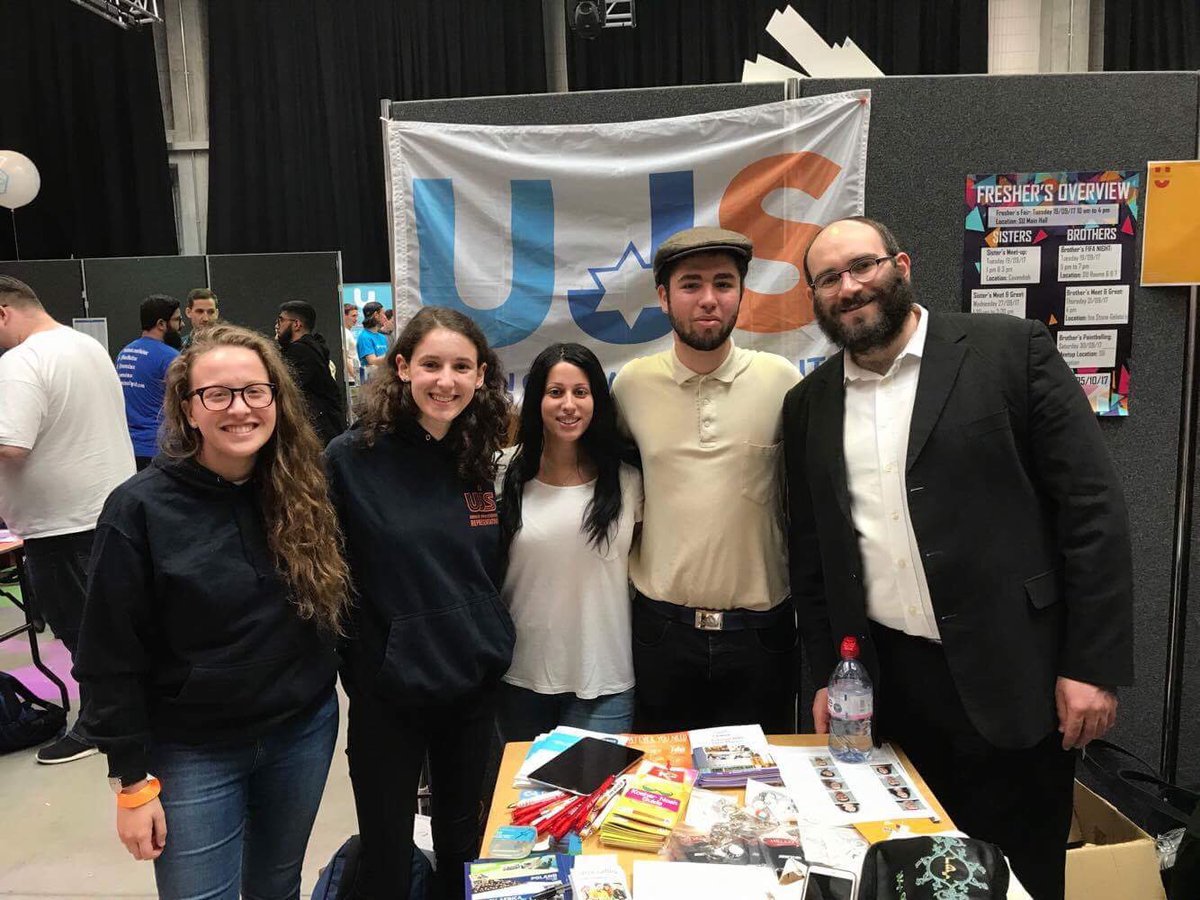
Union of Jewish Students’ stall in Freshers’ week, Manchester Metropolitan University. Any UJS group is likely to support ‘the 2-state solution’ while doing nothing to bring it about.

I’m talking about that sense of being Jewish, the way you relate to your family history, the Jewish community where you grew up, what you think about Israel. In short, your Jewish identity. In an age where identity politics have become so central to our culture your Jewish identity has become almost sacrosanct, untouchable, beyond criticism. But is that how it should be? I’ll come back to this at the end.

I realise my credentials for offering advice about Jewish university life are now pretty thin. It was 1985 when my parents drove me from our home in Bromley, South London, to Manchester University in the north of England, then the institution of choice for a large slice of young Jews who’d grown up in the capital.

Before I pass on the little wisdom I’ve accumulated, let me provide some personal history and reflect on an event that set me on a path to Palestinian solidarity and Zionist dissent.

Ill at ease

Before starting at Manchester I had just come back from a long trip to Israel, my first, and I was already struggling with what the Jewish State meant to me. I didn’t have the words to articulate it at the time but something about my experience in Israel had left me confused and ill at ease.

I’d spent time on both religious and secular kibbutzim and at a project in the northern Galilee town of Safed that aimed to inspire young diaspora Jews to become modern orthodox in their religious practice and firmly Zionist in their politics.

While I could relate easily to the Jews of my age I’d met from America, South Africa and Europe, I found Israelis themselves difficult to get along with. As for the idea that I had somehow returned to my ancestral home – that feeling never kicked in. It turned out to be easier to take the boy out of Bromley than Bromley out of the boy.

Back home in the UK, two of my new flat mates in our student hall of residence had no such angst, no such dilemmas.

Phil and Andy had returned from Jewish leadership programmes in Israel ready to take up positions in the student union and advocate on behalf of Israel whenever the need was required. I recall being slightly in awe of their self-confidence and their self-belief as leaders and as advocates. It would be a long time before I found my own voice on the issue of Jews, Judaism and Israel.

During my first two years I went along to the Wednesday lunchtime political debates in the recently re-named ‘Steve Biko’ student union building. And when Israel came up I voted the way the Jewish Society (J-Soc) advised. Phil and Andy were good at their job.

Intifada


Children run from Israeli soldiers, 1st Intifada. Photo by Coutausse.

Then in my final year at Manchester (exactly thirty years ago) my understanding of Israel began to take a decisive turn.

With my exams approaching I should have been getting down to some academic work. John Locke, Jean-Jacques Rousseau, J.S. Mill and Karl Marx were all demanding my serious attention. But instead I was using the university library to follow, and attempt to fathom, the outbreak of the first Palestinian Intifada.

The uprising that began in Gaza in December 1987 quickly spread to the West Bank. It was an uprising from the streets of occupied Palestine provoked by frustration and disillusionment and it was characterised by strikes. boycotts, civil disobedience and, most notably, children and young people throwing stones at armed Israeli soldiers. The Israeli response from on high (Yitzhak Rabin, then Defence Minister) was to “break their bones”.

The first Intifada was a modern day re-working of David and Goliath from the bible. In fact the tale of the future Jewish king slaying the Philistine giant with just a sling and a stone was my favourite bible story, the one I’d ask my father to read to me again and again. Maybe that’s why this stone throwing rebellion caught my imagination in the first place.

But this time the Palestinian children were David and the Jewish soldiers were Goliath. It was an unsettling role reversal. After all, surely we had ‘written the book’ on what it meant to be the victims of oppressive power? How could this be happening?

Fathoming

You have to remember that in 1987 the internet, Facebook, Twitter and even email were still a long way off. To find out what was going on in Israel and the Occupied Territories I based myself in the first floor periodicals section of the John Rylands Student Library when I should have been one floor up in Politics & Philosophy.

On the shelves of the periodicals section there were current and back copies of the Guardian Weekly and the New York Review of Books, Commentary magazine and Foreign Affairs. I read articles by Americans and Israelis from the left and the right and in particular was hooked by the words of David Grossman and Amos Oz the two most well known Israeli liberal Zionists and opponents of the Israeli Occupation.

Until the first intifada I had little sense of the Palestinians as a community with a heritage and history as close to them as mine was to me. Now they were no longer just terrorists pursuing a militant cause I didn’t fully understand. My sense of unease about Israel that had begun during my first visit to the country was beginning to find its articulation. Here was a people suffering in the West Bank and Gaza because of what my people were doing.

Maybe if I’d walked up to the next floor Locke, Rousseau, Mill and Marx could have shed some light on the reasons for the Intifada too. Rights, liberty, freedom. Hadn’t I spent three years studying these things?

The first Intifada was for me the start of a long journey of reading, reflection and finally encounters and conversations with Palestinians that’s taken me to the place where I now stand.

The two-state fiction

So what’s changed between my leaving university and your arriving?

Well, for a while, the Palestinians were allowed to become a people rather than merely the creators of terror. But the ‘peace process’ that emerged directly from the first Intifada didn’t last long. Israel’s idea of Palestinian autonomy turned out to fall well short of rights, liberty and freedom. And all the time the Settlements expanded, the Jewish only roads grew longer and the checkpoints multiplied. The occupier continued to occupy.

Closer to home the Jewish leadership in the UK, including the Union of Jewish Students (UJS), adopted the two-state solution but then spent 25 years doing nothing to help bring it about.

There was never any serious public pressure on Israel from the Jewish community in Britain and never any attempt to prepare Jews here for the obvious compromises involved in making a Palestinian state, worthy of the name, a reality. Instead, our leaders, both religious and communal, did Israel’s bidding which became ever more right wing and intransigent as the years went by.

And where are we today?

When you get to your university you’ll see that UJS is keen to talk up its commitment to “peace” and “two-states for two peoples”. Through its campaign for “Bridges not Boycotts” it hopes to show itself as a liberal, compassionate defender of free speech. But in practice UJS behaves just like its elders in our Jewish leadership. It pursues tactics that define and constrict the parameters of acceptable student debate on Israel/Palestine; it dictates what antisemitism looks like; and attempts to ‘own’ the definition of modern Jewish identity by locking it into Zionism.

As for discussing one secular democratic state or some kind of federal constitution, no way folks. That’s all off limits. Because ultimately such thinking calls into question the privileged discrimination enjoyed by Jews in Israel, East Jerusalem and the West Bank and indeed for you and me as Jews with the ‘Right of Return’.

calling  for “two-states”, when it’s  clear it will never happen, becomes no more than an excuse for ethical passivity

By parroting “two-states” UJS kicks every moral consideration down the road and into the long grass.

Why worry about today’s land and water theft? Why be concerned about the pauperisation of Palestinian farmers? Or arrests without charge. Or children in prisons. All will be resolved when the moon and the stars are finally aligned and the requirements of Jewish security are satisfied beyond all possible doubt. So that means sometime never.

The truth is that the longer we cling to the fiction of two-states and the belief that Zionism is not merely an ideology but a part of our faith and identity, the longer it will take to bring anything approaching peace with justice to the land.

Making the call for “two-states”, when it’s become clear it will never happen, becomes no more than an excuse for ethical passivity. It allows you to wrap yourself in a banner with with the words “peace/shalom” painted across it and feel secure in your denial of Jewish culpability in the on-going destruction of the Palestinian people.

I know this is tough to hear for young Jews when you’ve been schooled on the innate goodness of all things Israeli. But now is the moment to confront the reality of the Jewish relationship with the Palestinian people – our defining Jewish relationship for the last 70 years.

Advice

So if you’re a Jewish student starting university this month here’s my advice:

Don’t confuse “peace” and “two-states” for justice and equal rights.

Don’t mistake Jewish nationalism for Jewish self-determination.

Don’t wait for the Chief Rabbi or the Board of Deputies to ever say anything remotely ethical about the treatment of Palestinians by Israel.

Don’t wait for Trump, or May, or Macron or Trudeau to say or do anything useful about this.

Don’t wait for another massacre in Gaza.

And don’t take as long as I did to work things out.

Instead, take the opportunity of being away from home to hear other voices and other opinions. Allow yourself to listen with an open mind and an open heart to Palestinian experiences. Check out the history of 1948 especially the last thirty years of Israeli academic writing including the expulsion of the Palestinians from Safed which nobody mentioned while I was living there.

And don’t allow people to tell you you should feel scared or vulnerable if other students talk about boycotts and sanctions against Israel. If you took modern history at school you should be able to work out the difference between Nazi boycotts of Jewish shops in the 1930s and a campaign for human rights in 2017. And if you hear things said that make you upset or confused or angry that doesn’t make it antisemitism.

Jewish identity has never been static and has always been questioned and challenged by Jews themselves in every age and every place where we have lived. Zionism itself is an example of just that tradition of challenging our own understanding of who we are and what our future should be.

You have the same right to challenge today’s received wisdom; to ask the difficult questions; and create a way to be proud of being Jewish that isn’t trapped in an ideology that’s long passed its sell-by date.

So be bold, be courageous and decide where you want to stand and who you want to stand with.

Finally, to return to the start, let me leave you this (exam) question to ponder:

What happens to your sacrosanct understanding of ‘being Jewish’ when it becomes another people’s catastrophe?

Thanks for taking the time to read this. Have a great first term.

Yours

Robert


Print Friendly

Miko Peled : It’s Personal.

Miko Peled

As thousands of Palestinian political prisoners jailed by Israel are going through a hunger strike, we would do well to delve into the deeper, more personal and historical aspects of Palestine.  Though the politics and violence of settler colonialism have determined its fate for almost one hundred years, Palestine is not just a “case” or an “issue,” it’s personal. My dear, dear friend Nader Elbanna said to me a long time ago, “The Palestinian tragedy is more than just losing the house and the land.”  None of us will ever fully understand Palestine, none of us who are not Palestinian, that is, because it is personal. But there are ways to learn. Visiting Palestine is a good start. Living in Palestine is good too and learning Arabic affords a glimpse. Reading Ghassan Kanafani’s stories is moving and enlightening.


Ghassan Kanafani, in his short stories presents an intensely personal narrative and paints a picture that is painfully detailed. In one of his short stories, a young man asks, “would you like to hear about my life?” and he proceeds to describe a mother who died under the ruins of a house in Safed, the house that was built for her by her husband. He describes the father, now working in another part of the Arab World and unable to see his children, and a brother “learning humiliation” in an UNRWA school. In another short story Kanafani describes a father who is standing in the rain leaning on a broken shovel, taking a break from the back- breaking work of digging a ditch in the rain. He is digging in an effort to stop the rain water from flooding a tent where his family, now refugees, must live. He is cold, tired and hungry but avoids going inside the tent, not wanting to see his wife’s glare, knowing she blames him for the inevitable state of being unemployed and unable to provide for his family. Seeing his child wear a torn, old shirt he contemplates taking part in a scam operation, stealing bags of rice from the UNRWA storage facility and selling them on the black market. “The guard is in on it and for a small fee he will look the other way,” he is told by a man of whose morals he does not approve, and whose very presence makes him uneasy.

The occupation of Palestine is not only about the brutality that is inherent in settler colonialism but the daily, painful existence of a nation that is denied the right to live in the land to which it belongs. A nation forced to live in abject poverty in camps that are unfit for humans and which exist just hours away from the land and the homes from which they were kicked out. A land for which they have the deeds, and homes for which they still hold the keys now inhabited by Jewish settlers. “For us, to liberate our country is as essential as life itself” Kanafani says to an Australian reporter in a rare interview in English. He is fierce and forthright, sitting in his office, with photos of Che Guevara and Ho Chi Minh behind him.

But Palestinians are permitted only to be victims or terrorists, never freedom fighters or heroes. If Palestinians wrote “Live Free or Die” on a license plate they will be accused of terrorism and locked up, deported or simply killed, though in New Hampshire it is the official motto. Ironically, Israeli children learn about a legendary Jewish hero who, having been killed in battle in Palestine said, “it is good to die for one’s country” though clearly, he was fighting to take the country of others. Kanafani was brutally murdered, along with his young niece Lamees who was only seventeen, for saying and doing just that – fighting to liberate his country. Since his assassination by Israel almost half a century ago, countless Palestinians were killed by Israel, some fighting, most while sleeping in their beds or trying to flee.

Kanafani talks about “them,” the “Yahud” the Zionists who colonized Palestine and exiled his people, turning them into “people with no rights, with no voice.” “They have put enormous efforts into trying to melt me,” he writes, “Like a sugar cube in cup of tea.” And he talks about “You” the Arab authorities under whom Palestinians are now forced to live. “You had managed to melt millions of people and lump them into one lump, into a single thing you can now call ‘a case.’” And, he continues, “now that we are all ‘a case’” there is no personal attachment to any single person or story. How convenient. That is what allows for the ease with which the world treats the Palestinian tragedy. That is how the West can sell Israel the weapons and technology with which it slaughters Palestinians by the thousands and maintains the oppression.

One wonders what Kanafani would say about the horrific, large scale massacres endured by the people in Gaza since 2008. What would he say if he knew that since his death things have become worse now that Israel’s army of terror has access to more “modern” weapons that allow it to murder and maim thousands in a single “operation.” How would Kanafani react if he heard about entire families that were wiped out by mortars and missiles fired at them and others, incinerated by millions of tons of bombs dropped from war planes? One wonders what stories he might write about children burned and mutilated with such ease in the twenty first century? “We are a small, brave nation” Kanafani said in 1970, “who will fight to last drop of blood.”

Israel – the name that was given to the Zionist state which occupies Palestine – is indignant at the very mention of Palestine and at the idea that as a state it should respect the rights of Palestinians. People who support Israel are offended when they hear accusations of racism, indiscriminate violence and genocide. But these same people have no problem with the actual ongoing campaigns of genocide, ethnic cleansing and the reality of racist apartheid perpetuated by Israel. Because for them Palestine is not personal, it is just a “case,” just a “problem.” But Palestine is not a problem, it is personal, it has a beating heat, and that is why the fight for justice in Palestine is gaining momentum all over the world. As the Palestinian leader and political prisoner Marwan Barghouthi wrote recently from a cell in an Israeli jail, “The chains that bind us will break before our captors can break our resilience.”


Blog at WordPress.com.

Up ↑