4th of March 2009, Brussels
Press conference
Launch of the RUSSELL TRIBUNAL on Palestine
source
Bibi vs. Ajami, back in the days
Update: VIDEO FOUND OK, a little Googling enabled me to find a copy of the Netanyahu tape on the Israeli site MahNishMah!?, since the original YouTube version was removed and its account shut down.
It turns out that the tape has made quite a stir in Israel, as Netanyahu is about to become PM for the second time. Right-wingers saw in Young Bibi (who then called himself Ben Nitay) a better version of his current self, seen as too accommodating (!) to Obama.
In the video, Bibi says he is 28-years-old and describes himself as an “economic consultant” — indeed according to Wikipedia he worked at Boston Consulting Group immediately after graduating from Harvard at that time. He was as smarmy then as he is now.
But actually if you listen carefully to what he says, he is arguing that Palestinian should not have self-determination (which would be “unfair” because there are already 21 Arab states) but instead integrate Jordan or Israel. He argues forcefully that Israel is a democracy and West Bankers and Gazans would be given the right to vote in Israel. Obviously this must predate the current Israeli concern about Palestinian demographics, although Fouad Ajami does raise this issue. So, once again, is Bibi Netanyahu advocating a one-state solution?
Here is the video on YouTube. (It will take a little while for YouTube to process the video, so it might not be immediately available.)
I will soon add a link to a MP4 format file for downloading in case YouTube removes the video again. Download in MP4 format (Quicktime, 31.6MB).
Originally found through: Angry Arab.
Avigdor Lieberman, Israel’s Shame
By NEVE GORDON
Thanks to Binyamin Netanyahu’s overweening ambition, Israel is to be saddled with a foreign minister who is a national disgrace.
Imagine a country that appoints someone who has been found guilty of striking a 12-year-old boy to be its foreign minister. The person in question is also under investigation for money- laundering, fraud and breach of trust; in addition, he was a bona fide member of an outlawed racist party and currently leads a political party that espouses fascist ideas. On top of all this, he does not even reside in the country he has been chosen to represent.
Even though such a portrayal may appear completely outlandish, Israel’s new foreign minister, Avigdor Lieberman, actually fits the above depiction to the letter.
• In 2001, following his own confession, Lieberman was found guilty of beating a 12-year- old boy. As part of a plea bargain, Lieberman was fined 17,500 shekels and had to promise never to hit young children again.
• In 2004, Lieberman’s 21-year-old daughter Michal set up a consulting firm, which received 11m shekels from anonymous overseas sources. Lieberman, according to the police, received more than a 2.1m-shekel salary from the company for two years of employment. In addition, according to an investigation by Haaretz, he allegedly received additional severance pay – amounting to hundreds of thousands of shekels – in 2006 and 2007, while he was minister of strategic affairs and deputy prime minister. According to Israeli law, this is illegal.
• Lieberman is an ex-member of Meir Kahane’s party, Kach, which was outlawed due to its blatantly racist platform. Moreover, his views towards Arabs do not appear to have changed over the years. In 2003, when reacting to a commitment made by Prime Minister Ariel Sharon to give amnesty to approximately 350 Palestinian prisoners, Lieberman declared that, as minister of transport, he would be more than happy to provide buses to take the prisoners to the sea and drown them there.
• In January 2009, during Israel’s war on Gaza, Lieberman argued that Israel “must continue to fight Hamas just like the United States did with the Japanese in the second world war. Then, too, the occupation of the country was unnecessary.” He was referring to the two atomic bombs dropped on Nagasaki and Hiroshima.
• Lieberman does not live in Israel according to its internationally recognised borders, but rather in an illegal settlement called Nokdim. Legally speaking, this would be like US Secretary of State Hillary Clinton residing in Mexico and UK Foreign Secretary David Miliband living on the Canary Islands.
And yet, despite these egregious transgressions, newly-elected Prime Minister Binyamin Netanyahu has no qualms about appointing Lieberman to represent Israel in the international arena. Netanyahu’s lust for power has led him to choose a man who actually poses a serious threat to Israel. Both Lieberman’s message and style are not only violent, but have clear proto-fascist elements; and, as Israeli commentators have already intimated, he is extremely dangerous.
Politics being politics, most western leaders will no doubt adopt a conciliatory position towards Lieberman, and agree to meet and discuss issues relating to foreign policy with him. Such a position can certainly be justified on the basis of Lieberman’s democratic election; however much one may dislike his views, he is now the representative of the Israeli people. Those who decide to meet him can also claim that ongoing diplomacy and dialogue lead to the internalisation of international norms and thus moderate extremism.
These justifications carry weight. However, western leaders will also have to take into account that the decision to meet Lieberman will immediately be associated with the ban on Hamas, at least among people in the Middle East. In January 2006, Hamas won a landslide victory in elections that were no less democratic than the recent elections in Israel. While Hamas is, in many respects, an extremist political party that espouses violence, its politicians are representatives of the Palestinian people and are seen as struggling for liberation and self-determination.
If western leaders want to be conceived as credible, they must change their policy and meet with Hamas as well. Otherwise, their decision to meet Lieberman will be rightly perceived as hypocritical and duplicitous, and the pervasive perception in the region – that the United States and Europe are biased in Israel’s favour – will only be strengthened.
Neve Gordon is chair of the department of politics and government at Ben-Gurion University of the Negev and author of Israel’s Occupation (University of California Press, 2008).
From Mondoweiss
For a brief moment last night, I had a sense of what it would be like to be on the other side of my issue.
The evening was coming to an end, at the New York Theatre Workshop– a reading and discussion of Caryl Churchill’s very short, Gaza-inspired play, “Seven Jewish Children”– and for the second time the play was read, this time by Andre Gregory, the aristocratic actor/director of social/religious engagement. He stood near the front of the stage pouring out anger against the ways of formation of Jewish identity.
I applauded, as did most of the other 300 people in the house, and two seats away I could see the hands of a Zionist clasped in his lap, as he grumbled to his stony-faced girlfriend. You can listen to a recording of the play here [bandannie cannot link you to it but go to the Mondoweis site to download it; after the reading there is an interesting discussion]and read it here.
For the rest of the night I could not get that picture out of my head. An important stage in New York, an elite workshop space that is contested ground: three years ago the writings of an idealistic young woman who was killed by the Israeli occupation could not even be performed here, because of the “sensitivity” of Jews, the cultural importance of Jews.
But even Rachel Corrie’s piece was not directed against the springs of Jewish identity, as Churchill’s piece is, and here it was uncensored–swaddled of course in Context, a whole evening of discussion rather than just the thing itself– but here it was, and Laura Flanders, the very appealing host of Grit TV, wearing black boots and a dark jacket, had begun the evening by invoking Corrie’s name, and the evening now ended with Andre Gregory spitting out anger, which I applauded.
Daily Star staff
Wednesday, March 18, 2009
BEIRUT: Israel deliberately flooded Lebanese farmlands with excess rainwater from an Israeli orchard, located off the southern town of Mais al-Jabal early Tuesday, ruining crops and properties, the state-run national news agency said.The Lebanese Army and the United Nations Interim Force in Lebanon (UNIFIL) dispatched teams to look into the incident, which drew protests from the southern residents.
Tuesday’s flooding is part of a systematic practice by the Israeli authorities to turn the highly-fertile land into swamps by channeling rainwater into the fields via trenches, which were dug for that purpose. The Lebanese Army and UNIFIL have tried to block the water channels to protect the crops. Separately, UNIFIL’s media coordinator, Dhalia Farran, reiterated calls for Israel to hand over official maps detailing where the Israeli army dropped cluster bombs during the summer 2006 war. – The Daily Star
[ 24/03/2009 – 10:51 AM ]
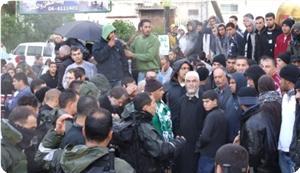
UM AL-FAHAM, (PIC)– Israeli policemen, escorting a march for far-right activists in Um Al-Faham, on Tuesday fired rubber bullets and teargas canisters and opened water cannons at Arab citizens who blocked their way into the city.
Sheikh Ra’ed Salah, the leader of the Islamic Movement in 1948 Palestine, told Al-Jazeera TV that a number of citizens were injured in the process, and charged the police with blocking access to the wounded citizens.
He stressed that the Israeli oppression of Palestinians started ever since the occupation of most of Palestine in 1948, charging the Zionist fanatics with maintaining a policy of religious and racial discrimination against the Palestinians and with trying to force the Palestinians to abandon their lands.
Salah said that Arabs from various areas of Palestine occupied in 1948 came to Um Al-Faham in solidarity with this city in a reflection of a unanimous stand in defense of Arab destiny and future and in rejection of the attempts to force them out of their ancestral land.
The city’s municipality had declared general strike in protest over the far-right march at the outskirts of Um Al-Faham led by the leader of the terrorist Kach movement, Baruch Marzel, which was escorted by 2,500 Israeli policemen.
The Hebrew radio said that the Israeli police turned the city into military barracks to protect the march.
In a related issue, a report by Musawa (equality) center for Arab citizens’ rights in Israel has disclosed that racial dissemination against those citizens was on the rise.
It said that the center monitored 270 assaults on Arabs since start of 2009 compared to 166 assaults in the entire year of 2008.
Posted by uprooted Palestinian at 11:43:00 AM
In light of the most recent Israeli attacks on Gaza, Ali Abunimah speaks at a University of Chicago panel held on January 8, 2008, which included Norman G. Finkelstein and John J. Mearsheimer.
In light of the most recent Israeli attacks on Gaza, Ali Abunimah speaks at a University of Chicago panel held on January 8, 2008, which included Norman G. Finkelstein and John J. Mearsheimer.
By Amira Hass
The IDF soldiers who moved into West Bank cities left behind destruction and degradation, Amira Hass reports.
No one deluded himself that the Palestinian Ministry of Culture, which takes up five of the eight floors of a new building in the center of El Bireh, would be spared the fate of other Palestinian Authority offices in Ramallah and other cities – that is, the nearly total destruction of its contents and particularly its high-tech equipment.
After all, Israel Defense Forces troops were deployed in the building for about a month.
Armed vehicles were always parked in front of the building, around which the familiar pictures of destruction accumulated; crushed cars, banks of earth, deep ditches in the roads, broken pavements, dismantled stone fences, toppling electricity poles, loose cables and clouds of dust and dirt enveloping every vehicle, tree and roof in thickening layers.
The Ministry of Culture is located in the large residential area the IDF kept under curfew, even after its partial withdrawal from Ramallah on April 21 and its focus on the siege of Palestinian Authority Chairman Yasser Arafat’s headquarters.
Every night the neighbors, who hid in their houses, heard the sounds of objects smashing as they were hurled through the windows of the Ministry of Culture.
During the 10 days that preceded the lifting of the siege on Arafat’s office, the force in this building shot every night at the Asra, a large commercial building opposite the ministry, on the slope of the hill.
The residents of the neighborhood at first tried to locate armed Palestinians who had perhaps opened fire at random in the direction of the military base. But there were no armed Palestinians there.
The neighbors concluded that this was nightly entertainment for the soldiers.
All that was left for them to do was to stay awake and alert for four or five hours every night and listen, against their will, to the ceaseless shooting that the walls and windows of the Asra building, causing fragments of building stone to fall straight onto the roof of the small stone house nearby with a noise that echoed through all of the valley east of the building.
After one bullet got stuck in the wall of the home of H. and her two daughters, they decided to leave.
One night the neighborhood awoke to the sound of barking: They saw that someone had attached a speaker to a tape recorder and was playing a recording of barking dogs. Within a few minutes all the dogs in the neighborhood woke up and joined the racket. Very soon the barking reached more distant neighborhoods. A night’s sleep down the drain.
This is an established neighborhood of single-story or two-story stone houses, surrounded by gardens and thick with cypress and fruit trees. L. remembers how her husband planted some of the trees several decades ago. The rural character of the neighborhood was unaffected despite its proximity to the busy main streets and the tall commercial buildings that have sprung up during the past 10 years.
A few days after the partial withdrawal, neighbors were astounded to hear bulldozers and the cutting down of he shady row of cypresses.
One cypress tree was lying across the road, a natural barrier against cars, and an apricot tree laden with fruit had been uprooted from the garden of one woman who lives in the neighborhood and whose entire world is her 35-year-old son who is mentally retarded.
On the evening of Wednesday, May 1, when the siege on Arafat’s headquarters was lifted and the armored vehicles and the tanks had rumbled out, the executives and officials of the ministry who had rushed to the site did not expect to find the building the way they had left it.
Employees of the local radio and television station, Amwaj, also hastened to the scene, as did the employees of the local television channel, Istiqlal, which take up three stories of the building.
But what awaited them was beyond all their fears, and also shocked representatives and cultural attaches of foreign consulates, who toured the site the next day.
In other offices, all the high-tech and electronic equipment had been wrecked or had vanished – computers, photocopiers, cameras, scanners, hard disks, editing equipment worth thousands of dollars, television sets. The broadcast antenna on top of the building was destroyed.
Telephone sets vanished. A collection of Palestinian art objects (mostly hand embroideries) disappeared. Perhaps it was buried under the piles of documents and furniture, perhaps it had been spirited away. Furniture was dragged from place to place, broken by soldiers, piled up. Gas stoves for heating were overturned and thrown on heaps of scattered papers, discarded books, broken diskettes and discs and smashed windowpanes.
In the department for the encouragement of children’s art, the soldiers had dirtied all the walls with gouache paints they found there and destroyed the children’s paintings that hung there.
In every room of the various departments – literature, film, culture for children and youth books, discs, pamphlets and documents were piled up, soiled with urine and excrement.
There are two toilets on every floor, but the soldiers urinated and defecated everywhere else in the building, in several rooms of which they had lived for about a month. They did their business on the floors, in emptied flowerpots, even in drawers they had pulled out of desks.
They defecated into plastic bags, and these were scattered in several places. Some of them had burst. Someone even managed to defecate into a photocopier.
The soldiers urinated into empty mineral water bottles. These were scattered by the dozen in all the rooms of the building, in cardboard boxes, among the piles of rubbish and rubble, on desks, under desks, next to the furniture the solders had smashed, among the children’s books that had been thrown down.
Some of the bottles had opened and the yellow liquid had spilled and left its stain. It was especially difficult to enter two floors of the building because of the pungent stench of feces and urine. Soiled toilet paper was also scattered everywhere.
In some of the rooms, not far from the heaps of feces and the toilet paper, remains of rotting food were scattered. In one corner, in the room in which someone had defecated into a drawer, full cartons of fruits and vegetables had been left behind. The toilets were left overflowing with bottles filled with urine, feces and toilet paper.
Relative to other places, the soldiers did not leave behind them many sayings scrawled on the walls.
Here and there was the candelabrum symbols of Israel, stars of David, praises for the Jerusalem Betar soccer team.
Someone had forgotten to take his dog tag with him. His name is recorded in the newspaper’s editorial offices.
Now the Palestinian Ministry of Culture is considering leaving the building the way it is. A memorial.
No response was available from the IDF by press time

