Search

band annie's Weblog

I have a parallel blog in French at http://anniebannie.net

Category

israel

Humiliation: The hammer crushing Palestinian society  

Damaged mosque by Israeli airstrikes. [File photo]

While the exercise of military control over an occupied country may be expected to inflict inevitable pain and trauma on the citizens of that country, the history of Israeli policy has far exceeded any “pragmatic” needs of an occupier to dominate and subdue a local population. The Israeli humiliation of Palestinians is an end in itself. Humiliation is thus one of the most important injuries experienced in the Palestinian context and yet, it is under-reported to such a degree that humiliation is viewed as almost normal.

Despite resolutions by the United Nations, the global acquiescence to the occupation of Palestine by the previous colonial powers has denied Palestinians their freedom, their status as citizens, and their exercise of human rights on an international level. At the level of society, the occupation has generated layers of humiliation through the maintenance of inequity within power relationships and perceptions of cultural status. In addition to these broad sources of injury, there are endless repetitive personal experiences of humiliation from which no Palestinian individual is spared.

The omnipresent Israeli forces come into daily contact with Palestinian men, women and children; in these interactions, humiliation and shame are typical. One asks: how can a humiliated man look into the eyes of his wife to make her feel protected and proud? How can a humiliated parent promise a future to a little one who is held in the hands of a human being whose spirit has been broken?

In one such example, Issa, a man who worked as a driver for a medical organisation, had transported a group of health workers to an isolated area affected by political violence (all names have been changed to preserve confidentiality). As he was waiting inside his vehicle for his colleagues to return, soldiers approached to ask what he was doing. He produced the proper documentation demonstrating that he and the medical organisation were authorised to enter this location and explained that he was waiting for colleagues to drive them back. A soldier began to shout at him so that everyone could hear: “You’re here to treat dogs! Come to my house to treat my sick dog!” The driver responded, “I don’t treat anyone. I just drive the car.” In response, the soldier struck Issa in the face.

In another case, my patient Mazen was walking home from work late one night in the Mount Scopus area of Jerusalem. He was stopped by three soldiers who pushed him against a wall for a ceremony of humiliation that included kicking him and stripping off his clothes. They demanded the names of his wife, sisters and mother and insulted these women with filthy epithets. They insisted that Mazen repeat these obscenities until he was finally reduced to tears. At this point, the soldiers burst into laughter.

In another example, the Israeli army attacked a Palestinian prison in the town of Jericho in March and forced both the detainees and the Palestinian correction officers to undress. The Israelis took photographs of the detainees and the prison officers in their underwear and distributed them on social media.

Forcing Palestinians to undress is in fact a common practice, seen regularly at the airport and at the ubiquitous checkpoints. Security guards habitually place the headscarves and the shoes of Palestinian women in the same airport plastic bin for mechanical scanning. In fact, I once requested my shoes and headscarf be placed into separate bins to avoid dirtying my headscarf but was told that if I did not comply with “regulations” I would not be permitted to board my flight.

The internet provides frequent opportunities to expose Palestinians to shame and humiliation, such as the degrading practice of young female soldiers who pose with blindfolded and handcuffed elderly Palestinian men and post these pictures on social media.

These omnipresent acts of personal humiliation are not simply collateral by-products of occupation, but its core policy. An essential feature of the occupation is to target and undermine every facet of Palestinian identity, especially those aspects of identity that are a source of pride for the emerging intellectual and moral development of a Palestinian nation. Humiliation acts to crush the sources of autonomy and independence. It aims to reduce Palestinians to a state of passive silence. At the same time, humiliation of Palestinians is a tool that relieves the anxieties and apprehensions of the Israeli forces and their beneficiaries among the Israeli public.

A yet more painful face of humiliation is experienced when our leaders are pushed to villainy and subservience to Israel. The surrender of the Palestinian leadership to Israeli aggression undermines the strength of the Palestinian people in psychological ways as well as in its concrete effects upon economic production. Such Palestinian leadership projects to the world an image of weak beggars deserving only mendacity and lends a hand to efforts to prosecute Palestinian resistance and opposition, while exhausting the resources of the Palestinian population with fees, taxes and loans. And in the midst of these harms, the Palestinian Authority sent a delegation of 15 high-profile members led by Muhammad Al-Madani, a member of the PLO Executive Committee, to “enumerate the merits” of the deceased in a condolence call to the family of Munir Ammar, the head of the Israeli Civil Administration that had been responsible for supporting the illegal settlements in the West Bank!

These stories should be told, but they are often not.

The enactment of humiliation has a goal: to produce an intense sense of weakness within Palestinian individuals and in the community as a whole. The experience of humiliation is unspeakable; the associated shame prevents people from putting their stories into words and renders these stories resistant to narration. Fear and hypocrisy in turn silence public validation of the experience of humiliation. Expecting a failure of public validation, the humiliated are then further isolated. The experience of humiliation then becomes inaccessible to reprocessing; it becomes impossible to construct a counter claim in which the victim is conceptualised as a protagonist and the events are charged with new meanings that reconnect the victim within a network of supportive relationships.

Recently, Israel’s representative at the United Nations was elected as chairman of the UN Legal Committee on the very week of the anniversary of its illegal occupation of Palestinian lands in 1967 and despite its long history of contempt for UN resolutions and violations of international laws. Events such as these deny the Palestinian people the eligibility to articulate counterclaims on the world stage which report upon our experiences of injustice and humiliation. These events render us more vulnerable to the narrative that our humiliation is necessary, appropriate and just.

It is an unfortunate fact that humiliation sets psychological factors into motion which further impair and harm the humiliated. The emotions of a humiliated person don’t stop further humiliation from occurring, quite the contrary. Many humiliated persons become exquisitely attuned to the feelings and expectations of the perpetrator and vigilantly avoid recognising their own rage. There may be impulses to identify with the perpetrator and to justify the humiliation of others who proudly resist it. We see these dynamics in Palestinians who justify the humiliation of those who dare to resist the occupier; we see these dynamics in those who blame others who complain of humiliation, claiming that these victims are merely vulnerable or weak personalities, as if the experience of humiliation had taken place only in their heads rather than in reality.

From a psychological perspective, the experience of humiliation is highly pathogenic. It undermines the self and leads to states of impotent rage. Indeed, when patients present to a mental health clinic with diagnostic profiles of major depression, anxiety, or even suicidal tendencies, there are often stories of humiliation behind these symptoms. Humiliation can also lead to intense active anger; powerless in the face of the perpetrator, the victim may view anyone as a representation of the “other”. Through group activation of these dynamics, we see a vicious cycle of revenge on the humiliated community itself through the perpetuation of further humiliation and violence; I’m writing these lines just after the killing of five Palestinians today at the hands of Palestinians in Jenin and Nablus.

Humiliation restricts the capacity to trust and to grow. In this way, the tyranny and humiliation that protect the occupation tend to diminish the trust and cooperation between the Palestinian community and its members to the narrowest organic level; the family, the tribe and the political party. This narrowing of the circle of social inclusion often leads to antagonism and black-and-white thinking. These impulses towards revenge are born from humiliation and inequalities of circumstance, not innate or cultural factors. We see these elements at work in Palestine following the elections of 2006, when the process of constructive political evolution was reduced to rubble due to, among other causes, political factionalism and polarisation. Thus Israel was able to erect its flags of victory over the defeated Palestinian collective cause. These dynamics were at play in the forces that resulted in the separation in Gaza nine years ago. Experiences of humiliation change the fabric of society, creating new social facts which are not easy to erase from history; they are recorded in the soul, in memories, in fantasies and in the formation of new social structures.

The therapeutic interventions that prevent people from running away from their stories and help them to comprehend the power dynamic are interventions which reframe the experience in a new appraisal. In therapy, the individual’s capacity to generate a counterclaim is identified, fostered and exercised. The development of a personal counterclaim is a key to restoring the individual’s ownership over his own life and its purpose.

It is often necessary to explore in great detail the victim’s experiences and to recreate the narrative of events. Having clarified the events, it is possible to then examine how the victim understands the mind of the perpetrator: why did the perpetrator need to humiliate, coerce, degrade and violate the victim? When these questions are pondered, the victim often can appraise the perpetrator from the inside out as insecure, anxious, perverted and greedy. The coloniser is seen as bolstering a pretended status in front of the “natives”, a fantasy requiring the coloniser to debase and objectify them. From this perspective, my patient Mazen came to recognise that the Israeli soldiers perceived him to be a masculine and protective husband, and that they then experienced anxieties about their own manhood; their envy and resentment of his adequacy found an outlet in forcing him to enact an obscene betrayal of his wife, mother and sister.

The cause of Palestinian liberation likewise requires a reframing of humiliation in both an individual and a national level. Liberation requires active participation, commitment to the principles of equality and political development. It requires a moral and a cultural maturity that are capable of understanding and containing impulses for revenge. Liberation requires the abandonment of policies of exclusion, deprivation, or submission to tyranny which crushes resistance through inducing passivity or inducing vengeance and social fragmentation. Out of experiences of humiliation and through our insight into these experiences, Palestine can forge a liberated identity focused on human rights and human dignity.
 

On Contact: The BDS Movement with Miko Peled

Shimon Peres from the perspective of his victims

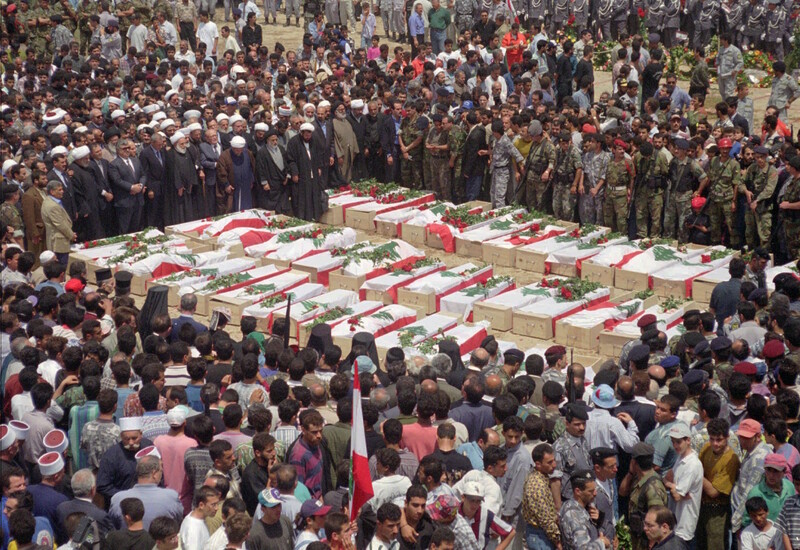
Officials and mourners surround coffins covered with Lebanese flags during a mass funeral in the southern Lebanese town of Tyre, 30 April 1996. The victims were killed in an Israeli artillery attack on a UN base in Qana, in southern Lebanon, on 18 April as part of an operation ordered by then Israeli Prime Minister Shimon Peres. Ahmed Azakir AP Photo

The obituaries for Shimon Peres have already appeared, no doubt prepared in advance as the news of his hospitalization reached the media.

The verdict on his life is very clear and was already pronounced by US President Barack Obama: Peres was a man who changed the course of human history in his relentless search for peace in the Middle East.

My guess is that very few of the obituaries will examine Peres’ life and activities from the perspective of the victims of Zionism and Israel.

He occupied many positions in politics that had immense impact on the Palestinians wherever they are. He was director general of the Israeli defense ministry, minister of defense, minister for development of the Galilee and the Negev (Naqab), prime minister and president.

In all these roles, the decisions he took and the policies he pursued contributed to the destruction of the Palestinian people and did nothing to advance the cause of peace and reconciliation between Palestinians and Israelis.

Born Szymon Perski in 1923, in a town that was then part of Poland, Peres immigrated to Palestine in 1934. As a teenager in an agricultural school, he became active in politics within the Labor Zionist movement that led Zionism and later the young State of Israel.

As a leading figure in the movement’s youth cadres, Peres attracted the attention of the high command of the Jewish paramilitary force in British-ruled Palestine, the Haganah.

Nuclear bomb

In 1947, Peres was fully recruited to the organization and sent abroad by its leader David Ben-Gurion to purchase arms which were later used in the 1948 Nakba, the ethnic cleansing of Palestinians, and against the Arab contingents that entered Palestine that year.

After a few years abroad, mainly in the United States, where he was busy purchasing arms and building the infrastructure for the Israeli military industry, he returned to become director general of the defense ministry.

Peres was active in forging Israel’s collusion with the UK and France to invade Egypt in 1956, for which Israel was rewarded by France with the needed capacity to build nuclear weapons.

Indeed it was Peres himself who largely oversaw Israel’s clandestine nuclear weapons program.

No less important was the zeal Peres showed under Ben-Gurion’s guidance and inspiration to Judaize the Galilee. Despite the 1948 ethnic cleansing, that part of Israel was still very much Palestinian countryside and landscape.

Peres was behind the idea of confiscating Palestinian land for the purpose of building exclusive Jewish towns such as Karmiel and Upper Nazareth and basing the military in the region so as to disrupt territorial contiguity between Palestinian villages and towns.

This ruination of the Palestinian countryside led to the disappearance of the traditional Palestinian villages and the transformation of the farmers into an underemployed and deprived urban working class. This dismal reality is still with us today.

Settlers’ champion

Peres disappeared for a while from the political scene when his master Ben-Gurion, Israel’s founding prime minister, was pushed aside in 1963 by a new generation of leaders.

He came back after the 1967 War and the first portfolio he held was as minister responsible for the occupied territories. In this role, he legitimized, quite often retroactively, the settlement drive in the West Bank and Gaza Strip.

As so many of us realize today, by the time the pro-settlement Likud party came to power in 1977, the Jewish settlement infrastructure, in particular in the West Bank, had already rendered a two-state solution an impossible vision.

In 1974, Peres’ political career became intimately connected to that of his nemesis, Yitzhak Rabin. The two politicians who could not stand each other, had to work in tandem for the sake of political survival.

However, on Israel’s strategy toward the Palestinians, they shared the Zionist settler-colonial perspective, coveting as much of Palestine’s land as possible with as few Palestinians on it as possible.

They worked well together in quelling brutally the Palestinian uprising that began in 1987.

Peres’ first role in this difficult partnership was as defense minister in the 1974 Rabin government. The first real crisis Peres faced was a major expansion of the messianic settler movement Gush Emunim’s colonization effort in and around the West Bank city of Nablus.

Rabin opposed the new settlements, but Peres stood with the settlers and those colonies that now strangulate Nablus are there thanks to his efforts.

In 1976, Peres led government policy on the occupied territories, convinced that a deal could be struck with Jordan, by which the West Bank would be within Jordanian jurisdiction but under effective Israeli rule.

He initiated municipal elections in the West Bank but to his great surprise and disappointment, the candidates identified with the Palestine Liberation Organization were elected and not the ones loyal to Jordan’s Hashemite monarchy.

But Peres remained faithful to what he named the “Jordanian option” as an opposition leader after 1977 and when he returned to power in coalition with the Likud in 1984-1988. He pushed forward the negotiations on the basis of this concept until King Hussein’s decision to cede any political connection between Jordan and the West Bank in 1988.

Israel’s international face

The 1990s exposed to the world to a more mature and coherent Peres. He was Israel’s international face, whether in government or outside it. He played this role even after the Likud ascended as the main political force in the land.

In power, in Rabin’s government in the early 1990s, as prime minister after Rabin’s 1995 assassination, and then as a minister in the cabinet of Ehud Barak from 1999 to 2001, Peres pushed a new concept for what he called “peace.”

Instead of sharing rule in the West Bank and Gaza Strip with Jordan or Egypt, he now wished to do it with the Palestine Liberation Organization. The idea was accepted by PLO leader Yasser Arafat, who may have hoped to build on this a new project for the liberation of Palestine.

As enshrined in the 1993 Oslo accords, this concept was enthusiastically endorsed by Israel’s international allies.

Peres was the leading ambassador of this peace process charade that provided an international umbrella for Israel to establish facts on the ground that would create a greater apartheid Israel with small Palestinian bantustans scattered within it.

The fact that he won a Nobel Peace Prize for a process that advanced the ruination of Palestine and its people is yet another testimony to world governments’ misunderstanding, cynicism and apathy toward their suffering.

We are fortunate to live in an era in which international civil society has exposed this charade and offers, through the boycott, divestment and sanctions movement and the growing support for the one-state solution, a more hopeful and genuine path forward.

Qana

As prime minister, Peres had one additional “contribution” to make to the history of Palestinian and Lebanese suffering.

In response to the endless skirmishes between Hizballah and the Israeli army in southern Lebanon, where Hizballah and other groups resisted the Israeli occupation that began in 1982 until they drove it out in 2000, Peres ordered the bombing of the whole area in April 1996.

During what Israel dubbed Operation Grapes of Wrath, Israeli shelling killed more than 100 people – civilians fleeing bombardment and UN peacekeepers from Fiji – near the village of Qana.

Despite a United Nations investigation that found Israel’s explanation that the shelling had been an accident to be “unlikely,” the massacre did nothing to dent Peres’ international reputation as a “peacemaker.”

In this century, Peres was more a symbolic figurehead than an active politician. He founded the Peres Center for Peace, built on confiscated Palestinian refugee property in Jaffa, which continues to sell the idea of a Palestinian “state” with little land, real independence or sovereignty as the best possible solution.

That will never work, but if the world continues to be committed to this Peres legacy, there will be no end to the suffering of the Palestinians.

Shimon Peres symbolized the beautification of Zionism, but the facts on the ground lay bare his role in perpetrating so much suffering and conflict. Knowing the truth, at least, helps us understand how to move forward and undo so much of the injustice Peres helped create.

The author of numerous books, Ilan Pappe is professor of history and director of the European Centre for Palestine Studies at the University of Exeter.

Was Shimon Peres a Man of Peace?

If Israel is on the verge of a moral abyss, then Peres had a part in that. If it’s a country en route to apartheid, he was a founding partner. The truth must be told: Shimon Peres wanted peace, but never saw Palestinians as equal to Jews.

He was my private political instructor for four years, day and night. He didn’t act like a teacher, but I learned a lot from him, about what to do, but also what not to do. I was very young, and he was already Shimon Peres. We parted with mixed feelings.

He was the last of the old-time Israelis. What’s “Israeli” to you? Once it was Shimon Peres. Now Miri Regev represents Israeliness much more than he does. But when Israel still wanted to be portrayed as a peace-seeking nation, it had Peres.
read more: http://www.haaretz.com/opinion/1.744906

Gideon Levy    Sep 28, 2016 9:01 PM

We’re American Jewish Historians. This Is Why We’ve Left Zionism Behind

Our connections to Israel flourished, faltered and finally ended even though we grew up, live and work in the heart of the American Jewish community.

Hasia Diner and Marjorie N. Feld Aug 01, 2016 4:45 PM

Hasia Diner: The Israel I once loved was a naïve delusion When I was asked to run as a delegate on the progressive Hatikva platform to the 2010 World Zionist Congress, I encountered my personal rubicon, the line I could not cross. I was required to sign the “Jerusalem Program.” This statement of principles asked me to affirm that I believed in “the centrality of the State of Israel and Jerusalem as capital” for the Jewish people. It encouraged “Aliyah to Israel,” that is, the classic negation of the diaspora and as such the ending of Jewish life outside a homeland in Israel.

The “Jerusalem Program” also asked me to declare that I wanted to see the “strengthening [of] Israel as a Jewish, Zionist and democratic state.” As to democratic, I had no problem, but the singular insistence on Israel as a Jewish and Zionist state made me realize that, at least in light of this document, I could not call myself a Zionist, any longer. Does Jewish constitute a race or ethnicity? Does a Jewish state mean a racial state?

The death of vast numbers of Jewish communities as a result of Zionist activity has impoverished the Jewish people, robbing us of these many cultures that have fallen into the maw of Israeli homogenization. The ideal of a religiously neutral state worked amazingly well for the millions of Jews who came to America.

The socialist Zionism of the Habonim youth movement was central to my early years, providing my base during the 1970s when the Jewish settlement of the Occupied Territories began. I need not belabor the point that from that date on, the Palestinian land that has been expropriated for Jews has grown by leaps and bounds and that the tactics used by the State of Israel to suppress the Palestinians have grown harsher and harsher.

Nor do I need to say that the exponential growth of far right political parties and the increasing Haredization of Israel, makes it a place that I abhor visiting, and to which I will contribute no money, whose products I will not buy, nor will I expend my limited but still to me, meaningful, political clout to support it.

I have read too much about colonialism and racism to maintain what I now see as a naïve view, that only the events of June 1967 changed everything. The Israel that I loved, the one my parents embraced as the closest approximation to Eden on earth, itself had depended well before 1967 upon the expropriation of Arab lands and the expulsion of Arab populations. The Law of Return can no longer look to me as anything other than racism. I abhor violence, bombings, stabbings, or whatever hurtful means oppressed individuals resort to out of anger and frustration. And yet, I am not surprised when they do so, after so many decades of occupation, with no evidence of progress.
I feel a sense of repulsion when I enter a synagogue in front of which the congregation has planted a sign reading, “We Stand With Israel.” I just do not go and avoid many Jewish settings where I know Israel will loom large as an icon of identity.

Marjorie N. Feld: The moment I began my reeducation

In all facets of my very Jewish upbringing I was immersed in Holocaust education. It was made absolutely clear to me that only Israel could prevent the concentration camps, right-wing anti-Semitism and genocide, from reappearing. Friends and I travelled throughout Israel on a summer high school program in 1988, hitting the Jewish tourist spots (Masada, the Western Wall) that reinforced both Jewish nationalist triumphalism and the co-constitutive invisibility of Palestinians, their history, the violence and ethnic cleansing that created the Jewish state.

I now call it my propaganda tour, but I learned this language only later. From non-Jews I met in liberal and left organizations in college, I first heard strong critiques of Zionism as Western colonialism, as a militarist project, as racism. Very smart friends of mine were articulating these critiques, and they made me terrifically uncomfortable.

A feminist scholar I met at a conference asked me directly if I considered myself a Zionist, and I gave an indirect answer. Her anger became palpable. She nearly shouted: “You’ve read Chomsky, haven’t you?” I had not yet read Noam Chomsky’s writings on Israel, I confessed. As I recall she turned away and didn’t speak to me again that evening. That might be hyperbole, or more likely my own sense of shame.
I reeducated myself, stopping to look at all of the facts that I had bumped up against for years. The 1948 radio broadcast of the votes at the UN that declared the Jewish people had a home and would never face genocide again: I had listened to this recording and this interpretation dozens of times in the sites of my Jewish education. Now I interpreted it anew. The founding of Israel was the Nakba, the great catastrophe, for Palestinians, with ethnic cleansing, destruction, and no right of return.

In short, I no longer found common ground with those who saw an anti-Semitic or anti-Zionist bent, or even conspiracy, on the left. I saw that that Israel fit neatly into my broader understanding of Western colonialism. How could Israel be the antidote to genocide when it was the product of imperialism and ethnic cleansing?

Like Hasia, I often feel marginalized. I travel across several towns, driving past many other synagogues, to my synagogue precisely because I too refuse to enter to any institution that flies the “We Stand with Israel” banner.

‘Before’ and ‘after’ Zionism in the U.S. Jewish community
Our journeys from “before” to “after” identifying with Zionism have been painful, and we’ve searched for allies and institutions. We have both found Jewish Studies a difficult space in which to criticize Israel, to stand against the Occupation or even Zionism. Though we certainly do not claim to speak for all American Jews, as scholars we know we are a part of something much larger, something that, we assert, should be shaking the foundation of American Jewish leaders. Closing down all conversations on Israel/Palestine, demonizing the Boycott, Divestment and Sanctions movement, marginalizing or silencing those who dissent from the Zionist “consensus”: there is a growing gap between these leaders and the people for whom they claim to speak.

Hasia Diner is a professor of American Jewish history at New York University. She is the author of “We Remember with Reverence and Love: American Jews and the Myth of Silence after the Holocaust” (NYUP, 2010).
Marjorie N. Feld is professor of history at Babson College and the author of “Nations Divided: American Jews and the Struggle over Apartheid” (Palgrave Macmillan, 2014).

Hasia Diner
Haaretz Contributor
read more: http://www.haaretz.com/opinion/.premium-1.734602

Interview with Shir Hever


You went to Berlin to the Free University. Why?

I actually live in Heidelberg, although I’m writing my PhD at the Free University of Berlin. I followed my partner who found a job in Germany. The very large emigration from Israel of young and educated people has meant that much of my family and friends have already left Israel, and Berlin is actually a favorite destination, where I meet many of my old friends from Jerusalem and Tel-Aviv.

What motivated you to research Israel’s military sector and to support BDS? Did your upbringing and family background have a role in this, or was it something you came to later in life?
I did grow up in a leftist and critical family, and was taught to ask questions from a young age. I went to a very militaristic school, so I was taught a Zionist perspective as well, but I didn’t want to take part in the occupation directly as a soldier. In order to try to be a non-combat soldier, I volunteered for a year of social service in the town of Sderot, and there I had time to think about politics, to hear from my friends who were drafted into the army, and to see aspects of Israeli society that I never knew existed. I decided not to do any military service. By pretending to be crazy I easily received an exemption, like thousands do every year.
Only in university, however, did I become aware of the Palestinian side of the story, when Palestinians were invited by a political group called “The Campus Will Not Stay Silent” to speak about their experiences during the Second Intifada. I started to become politically active and joined the Alternative Information Center, a joint Palestinian-Israeli organization.
Supporting BDS came naturally as I was part of the group of activists who were considering various strategies of combating the occupation. As an economist, I felt that BDS can have a very strong impact on the Israeli economy and society and was something that empowers Palestinians to use non-violent resistance.
Choosing my research topics was done in an activist environment, and I would usually write reports and studies on matters upon requests from activists. After writing my book on the political economy of Israel’s occupation, I realized that the Israeli military industry and Israeli arms exports are very important to complete the picture, to explain how Israel’s occupation fits into global interests, and so I chose this as a topic for my PhD.

It is said that the Israeli population is becoming more mentally and psychologically isolated from the rest of the world. Is that also your experience?
Absolutely not. Israelis strongly depend on a feeling of being part of the “west,” and part of Europe (even though Israel is not in Europe). The fascination of Israelis with the European Football Cup, with the Eurovision etc. is one aspect of this, but also the desire to travel in the world, to consume western culture, etc. I admit that when BDS started, I did not imagine that its most powerful impact would be precisely in the sphere of culture. Whenever a famous artist cancels a performance in Israel, the reactions are very powerful, because Israelis don’t want to feel isolated. The fact that Israelis are willing to pay double the prices for tickets to performances of artists who choose to violate BDS and perform in Israel is a testimony to that fact. Actually, this is the reason for BDS being a successful tactic; it targets a sensitive nerve of Israel’s culture, the need to be included.

Listening to Netanyahu and Lieberman, we get the impression here that the division between Jews and Palestinians in Israel itself is increasingly growing. Is that true?
On the political level, yes of course. The Israeli government is not ashamed to call for separation, and to demonize Palestinians as a group. On the local and personal level, there are also many cases of Palestinians and Jews working together, becoming friends, creating families together. Separation is never 100% successful. It is true that many Israeli Jews have little contact with Palestinians and know very little about them. Very few Israeli Jews bother to learn Arabic. But Palestinian Israelis, on the other hand, have frequent contact with Israeli Jews, speak good Hebrew and have a very good understanding of Jewish culture and politics.

How can you explain that an Israeli general has compared the situation in his country with Germany of the 1930s?
Major-General Yair Golan is well-known for being very direct and not too careful with what he says. In a lecture he gave in 2007 he admitted that the Wall of Separation’s main purpose is to separate populations, and security only comes as a second priority.
Currently Israel is witnessing a fierce struggle between two competing elite groups. The old military elite in Israel (to which Golan belongs) is in a state of crisis, losing much of its influence over the government and the business sector.
The military elite is not leftist, progressive or opposed to the occupation, but it believes in creating an “intelligent” occupation, a careful and planned use of force in order to keep the Palestinians under control. They are afraid of the populism of the Israeli government and how it encourages unbounded brutality of Israeli soldiers against Palestinians. Golan hinted that such populism and brutality are not signs of strength of Israel, but actually signs of weakness.
His statement was severely criticized, and gave the government the opportunity to make more populist statements. Minister of Defense Ya’alon (also a member of Israel’s military elite, and former commander of the army) was forced to resign and was replaced by Lieberman, who is not a member of the military elite.

Does militarism and war (also) serve to cover the tensions within Israeli Jewish society?
I wouldn’t say militarism and war, but rather an obsession with security. Israel hasn’t fought a real conventional war since 1973, instead it is constantly engaged in asymmetrical conflicts in civilian areas, where Israeli soldiers use heavy armaments in civilian areas. But the constant fear of retaliation, the threat of real and imagined terrorism, are exploited very cynically by the Israeli government to distract from the burning social issues in Israel.
A good example of this is the 2011 attack on an Israeli bus in the midst of large social protests in Israel. Netanyahu quickly announced that the attackers came from Gaza, and ordered a bombing against Gaza, killing five Palestinians. Even though the attackers did not come from Gaza, Palestinians chose not to react to the Israeli killing of innocent Palestinians, because such retaliation would serve the desire of Netanyahu to suppress the social protests. I think that we can learn from this example how well Palestinians understand Israeli society. Interestingly, the social protests ended eventually with very little effect, and the security issue continues to dominate Israeli political discourse.

If we look at the big military companies such as the Israeli Aerospace Industries (IAI) and Elbit, do they account for a large share of the Israeli economy?
The arms sector is a large section of Israel’s industrial sector, and the two biggest arms companies are the government-owned IAI, and the private Elbit Systems. There are conflicting numbers from various sources, and I estimate that 11% of Israel’s total exports are security and military exports, to which these two companies contribute more than half. Of course this is very significant for the Israeli economy, and no other country in the world has arms as such a high proportion of its total exports (not even the U.S, the world’s largest arms exporter). Nevertheless, one must remember that the majority of Israel’s exports, and industrial companies and workforce are civilian.

How is the Netherlands (and the EU) most complicit in supporting the Israeli military industrial complex? Through its subsidies and financing, its scientific research, its global production facilities, its purchases of Israeli military products and services, or its provision of tax havens for the companies’ profits?

All of the above, but the complicity is not just in helping to fund the Israeli arms industry, but also by legitimizing it. When Dutch and European politicians promote security cooperation projects with Israel, they are fully aware that the Israeli arms industry is based on the Israeli military experience in the Occupied Palestinian Territory, technologies developed in the course of repression of Palestinian resistance and control over a large population denied its basic rights. Therefore, all these ties between European and Israeli arms companies send a message that Europe accepts Israel’s occupation and even seeks to learn from it. This was said by General Yoav Galant (currently Israel’s minister of housing), that “foreign governments are hypocritical. On the one hand they criticize our actions, but then they come to us to learn how we do it.”

BDS campaigns in Europe have the potential to be a powerful force given that the EU traditionally has been one of Israel’s largest markets. Is this where you think BDS efforts can be most effective – or rather in the US or elsewhere?
In the end, the most effective BDS campaigns are not necessarily the ones that have the biggest monetary effect, but those that get the attention of the Israeli public. U.S-based BDS was very effective in making Israelis feel that “even our closest ally is changing its opinion on us,” but so did BDS actions in Germany. Europe remains Israel’s largest target both for exports and for imports, but BDS doesn’t seek to change that. BDS is not a tool to harm the Israeli economy, but to achieve political change through pressure.
The Netherlands play a very important role because of the importance of the Rotterdam port to Israel’s exports to Europe, especially of agricultural produce, which is of great symbolic significance. If the Netherlands will impose more strict controls over that import, it has a direct impact on the Israeli illegal colonies in the Jordan Valley, which is the most fertile land in all of Palestine.

Is BDS a bigger threat for the economy of Israel or for its image?
BDS does not seek to harm the Israeli economy, but to convince Israelis that it is unsustainable to violate international law. I don’t believe that the Israeli government will continue with its policies of apartheid and occupation long enough for BDS to cause a long-term damage to the Israeli exports. When Israeli companies will start moving to other countries to avoid BDS, the Israeli government will either collapse, or change its policies. The majority of the Israeli public today (unlike the situation in the 1970s and 1980s) is no longer willing to make great sacrifices for the sake of Zionism.
The Israeli image, however, is already strongly affected by BDS. The strength of BDS is that it is a movement based on research and information, and that through BDS, activists are able to educate the public about the situation in Palestine, and disseminate materials. The image of Israel in the world is changing as a result, and this is something that has no less of an effect on Israeli decision makers than the economic impact.

What could be important focus points for organizations such as docP and Stop de Wapenhandel (Stop the Arms Trade)?
In my experience, it is a very bad idea for someone from Israel/Palestine to tell organizations what their focus should be. Surely you know better than me who is your audience, what kind of message will be more effective to reach them and what they can do and organize locally. Palestine solidarity groups work in a wide variety of contexts – from student groups to church groups, from labor unions to social justice and environmental movements. My only recommendation would be to choose projects that can have an impact inside Israel, projects that involve major and well-known Israeli companies, politicians, etc. And that each such project should be accompanied by research. Activists can only be successful if they have a lot of information that they can disseminate as part of their activity. It is never enough to say “let’s boycott this company because it is Israeli.” You must explain why.

Shir Hever

DocP |  source


Israeli MPs try to assault Haneen Zoabi


This 9-minute video, showing Israeli Jewish MPs’ reaction to a speech by Haneen Zoabi today, offers a very revealing insight into how Israel’s tribal democracy works. And it isn’t pretty.

Even in the British parliament, which is imploding at the moment, it is impossible to imagine scenes like these.

Zoabi made the speech after Israel agreed this week very belatedly to pay compensation to the families of nine humanitarian activists killed by Israeli commandos in 2010 on the Mavi Marmara, as it plied international waters on its way to deliver aid to Gaza. In fact, it would be more accurate to say Israel assassinated the activists, as a way to deter others from following in their wake.

The Marmara was a Turkish vessel and the compensation was part of Israel’s reconciliation deal with Turkey.

Zoabi was the only Israeli MP on the ship, and was accused of treason by Knesset members for participating in the aid flotilla. She became public enemy number one and received many death threats at the time, including some barely veiled ones from Jewish MPs.

All the exchanges in this video are in Hebrew, but that doesn’t really matter. You don’t need to understand the language to understand what is going on. One Jewish MP, Oren Hazan, of Netanyahu’s Likud party, heckles Zoabi non-stop for more than four minutes, with the Speaker doing nothing more than politely asking him to calm down and refrain from interrupting.

Remember that Palestinians MPs are regularly ejected from the Knesset for far less than this kind of barracking and violation of parliamentary protocol. Notice also that the Knesset TV spends as much time, if not more, focusing on the heckler than Zoabi, implicitly legitimising his anti-democratic behaviour.

But when Zoabi accuses the soldiers of “murder” at about 4.30-min into the video, all hell breaks loose. A dozen or more Jewish MPs rush to the podium and start circling Zoabi like a pack of baying hyenas. By this stage, when Zoabi is being physically threatened by a number of MPs in the parliament chamber, you might think it would be time for some of them to be forcefully ejected, if only to indicate that this subversion of the democratic process will not be tolerated. But not a bit of it. They are treated with kid gloves.

The Knesset guards simply try to block the violent Jewish MPs from reaching the single Palestinian MP in their sights, presumably fearful that were she to be physically assaulted that might make headline news and make Israel look bad.

Paradoxically, the only MP you can see on the film being pushed out of the Knesset chamber is Zoabi’s party leader, Jamal Zahalka, who from the look of things is interceding because he’s worried she is in danger. Hazan was finally removed, though after more than eight minutes of heckling, threats and belligerence.

Another paradox: Zoabi and her fellow party MPs have only recently been allowed to speak in the Knesset again, after the ethics committee (dominated by Jewish MPs) suspended them for several months because of their “unacceptable” political views.

I doubt very much that any of these Jewish MPs, even though they have threatened and tried to physically harm another MP, one from the wrong tribe, will suffer any consequences at all for their behaviour.

Zoabi said in her speech: “I stood here six years ago, some of you remember the hatred and hostility toward me, and look where we got to. Apologies to the families of those who were called terrorists. The nine that were killed, it turns out that their families need to be compensated. I demand an apology to all the political activists who were on the Marmara and an apology to MK Haneen Zoabi, who you’ve incited against for six years. I demand compensation and I will donate it to the next flotilla. As long as there’s a siege, more flotillas need to be organized.”

In addition to the violent reception from MPs visible on film, there was widespread incitement from other MPs. Michael Oren, who a while back was Israel’s ambassador to the US, sounded like Avigdor Lieberman as he said Zoabi’s speech proved she was not loyal and should be permanently stripped of her parliamentary status, under a soon-to-be-passed Suspension Law.

In true colonial style, the government’s chief whip, David Bitan, was reported to have told Palestinian voters in Israel after Zoabi’s speech: “We need to make sure she doesn’t stay in the Knesset. We’ve had enough of this and she doesn’t even represent you properly.”


“Jewish Brigade” email threatens BDS activists

A number of Palestine solidarity activists have received a threatening email from a group calling itself “Brigade Juive,” French for “Jewish Brigade.”

Anyone receiving this or a similar email should not click on any links in it and should not open any attachments.

These emails may contain malware – malicious programs that are used to harm computer users and compromise networks.

They should report to local authorities anything they consider a threat.

The email begins in French with the words “Dear boycotter.”

It then says in English, “We have are [sic] a very particular set of skills, skills We [sic] have acquired over a very long career. Skills that make us a nightmare for people like you.”

It concludes in French, “In brief, you boycotters should understand, now we will scalp you one by one, group by group, association by association.”

The email contains a link to a website for the Brigade Juive, an extremist Jewish group that purports to defend Israel and Jewish communities. The website also purports to “expose” activists with the boycott, divestment and sanctions (BDS) movement for allegedly nefarious activities.

The group’s name appears to be a reference to the Jewish Brigade that fought with British forces during the Second World War and whose members helped colonize Palestine as part of the Zionist movement.

On its Facebook page, Brigade Juive claims to have sent the email to more than 8,000 addresses.

The group also claims that its violent threat of “scalping” activists is “used in the figurative sense.”

The harassment comes as Israel’s government has ramped up its own threats and intimidation against activists.

Given the history of violence by far right-wing Jewish groups, the apparent threat is being taken seriously.

The Electronic Intifada has been sent independent reports of the email being received by activists in Europe, some of whom are reporting it to authorities on the basis that it constitutes a threat of violence.

Association France Palestine Solidarité, an advocacy group for Palestinian rights, also sent an alert to members urging them to report the threatening email to DICRA, the French interior ministry’s body to combat racism and anti-Semitism.

Extreme anti-Palestinian groups in France have a history of using online attacks against their targets.

Gregory Chelli, the former Jewish Defense League hacker known as Ulcan, in 2014 reportedly launched a cyber attack against the website of Rue89 after French reporter Benoît Le Corre wrote a critical profile of him.

Ulcan is known to have been involved in several malicious attacks targeting BDS activists in France, one of which possibly precipitated the death of Le Corre’s father.

Practice good security

Activists, journalists and others should make it a priority to always practice good online security.

Here are some resources:

Palestinian prisoner placed in admin. detention — after serving 15 years

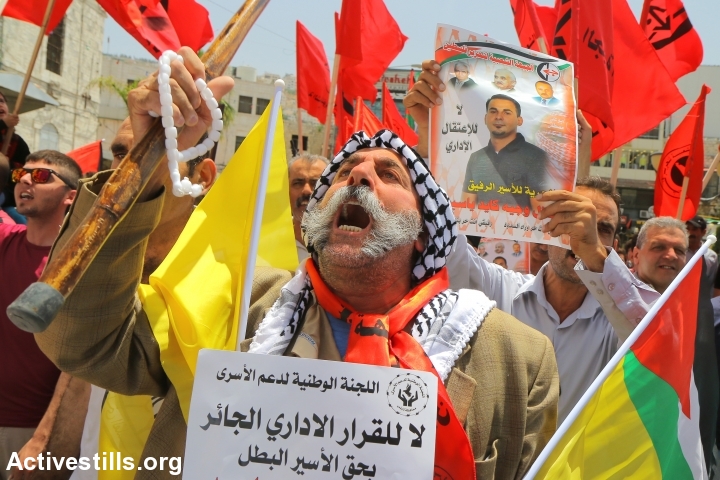
Palestinians take part in a protest in solidarity with the Palestinian prisoner Bilal Khaled, Nablus, West Bank, June 14, 2016. (photo: Ahmad al-Bazz/Activestills.org)

Edo Konrad

972mag.com |

Bilal Kayed was supposed to be released from Israeli prison after serving a nearly 15-year sentence. Instead, he was placed under indefinite detention without charges or trial.

Photos and text by Ahmad al-Bazz/Activestills.org

Palestinian prisoner Bilal Kayed was meant to be released from Israeli prison on Monday after serving 14.5 years. Instead Israeli military authorities decided to put him in administrative detention for a period of six months, which means he will be held indefinitely without charge or trial.

On Tuesday dozens of Palestinians took part in a solidarity protest in the West Bank city of Nablus. Kayed’s detention came as a shock to his family and relatives. ”His lawyer called us to say that he will not be released today,” said his brother Mahmoud Kayed, adding that only a few hours later did they discover that he was put in administrative detention.

During the protest the demonstrators chanted against the decision, while raising photos of Kayed along with Popular Front for the Liberation of Palestine (PFLP) flags, the leftist Palestinian party to which he belongs.

Administrative detention is a procedure that Israel uses to imprison detainees based on secret evidence, without charging them or allowing them to defend themselves at trial. Administrative detention orders may be renewed indefinitely.

The family confirmed that their son is planning on starting a hunger strike to protest his administrative detention. According to a statement released by the PFLP on Monday, its members in prison will begin an initial two-day hunger strike in solidarity with Kayed. “The hunger strike is just the beginning in a series of escalating steps to be implemented by all comrades in Zionist prisons and detention centers,” said the statement.


The mother of the Palestinian prisoner Bilal Kayed (center) takes part in a protest in solidarity with her son, Nablus West Bank, June 14, 2016. (photo: Ahmad al-Bazz/Activestills.org)

Kayed, 34, has been imprisoned by since December 2001 on charges of membership in the PFLP, as well as participation in activities against the State of Israel. He was 19 years old at the time of his arrest. Kayed is now among 750 Palestinians held in administrative detention without charge or trial.

Last Friday Israeli authorities placed a Palestinian prisoners’ rights activist under administrative detention for six months, 40 days after he was first detained and taken in for interrogation.

Mohammed Abu Sakha (photo: Courtesy of Addameer)


Hasan Safadi, who works as media coordinator for Addameer, an NGO that supports Palestinian prisoners in both Israeli and Palestinian prisons, was set to be released from detention on June 10 by order of Jerusalem’s Magistrate’s Court, after paying NIS 2,500 in bail and obtaining third-party guarantees. Later the same day, however, Israeli Defense Minister Avigdor Liberman signed an administrative detention order against Safadi, effectively overriding the court’s decision.

On Monday Israeli military authorities also renewed the administrative detention of Palestinian circus trainer and clown Mohammad Abu Sakha for an additional six months, from June 13 to December 12. Abu Sakha is known for working with special needs children in the West Bank, and runs the Palestinian Circus School. He was first arrested on December 14, 2015 while he was crossing Zaatara military checkpoint near Nablus on his way to work in the village of Birzeit, near Ramallah.

For additional original analysis and breaking news, visit +972 Magazine’s Facebook page or follow us on Twitter. Our newsletter features a comprehensive round-up of the week’s events. Sign up here.

© 2010 – 2016 +972 Magazine


Blog at WordPress.com.

Up ↑