Search

band annie's Weblog

I have a parallel blog in French at http://anniebannie.net

Category

israel

The wonder, anger and occupation of Jerusalem


A Palestinian with his belongings after his home in East Jerusalem is demolished. Getty Images


My essay in The National newspaper about the city of Jerusalem:

House demolitions occur regularly in East Jerusalem, well away from the tourist path. According to the United Nations, Israel destroyed 190 Palestinian homes in 2016 and displaced thousands of people. It was the highest figure since 2000.

I’ve witnessed Palestinian families thrown out of their own houses, sometimes immediately replaced by radical, Jewish settlers, or standing in front of crushed, concrete structures with nowhere to go. Last year, a few hours after a Palestinian home was demolished in the neighbourhood of Wadi Joz, I arrived to find a solitary man sitting under a large, green plastic sheet. He had 12 children and a wife and all his possessions, including couches, fridge, table, crockery and cutlery, were exposed to the elements. “The Palestinian people don’t help me”, he said. Despite his situation, he gave me a cup of hot coffee and then began calling friends to see where he could sleep with his family.

The official policy of Jerusalem mayor Nir Barkat is to make Jerusalem the “united capital”. In practice, this means the approval of thousands of Jewish homes in West Jerusalem, but nothing in the East where Palestinians live. Up to 20,000 Palestinian homes have been built without approval, giving Israel the justification to destroy them, but obtaining permits is almost impossible. It’s a daily reality faced by a Palestinian community that foreigners and Israeli Jews almost never witness nor want to.

To a Jew growing up in Australia, this Jerusalem is vastly different to the fantasy Jewish city described in my youth, although it remains a sparkling and beautiful place. I’m preparing to leave after living here with my partner for more than a year. During this time and in the course of many visits over the past decade, I constantly marvel at the shimmering Al Aqsa Mosque, cobbled streets in the Old City and the green and brown hills of the Mount of Olives. With few tall buildings and its famed cream-coloured stone, the city has a spiritual feeling that is perhaps unrivalled in the world.

However, the brutal politics of division sucks away any inkling of nostalgia. The ubiquitous presence of armed and aggressive Israeli soldiers and police harassing Palestinians increasingly defines it. Many secular, Jewish Israelis hate Jerusalem and try to avoid coming. For them, the comfortable bubble of Tel Aviv is preferable, where the occupation of Palestine is almost completely invisible. They like it that way, away from Palestinians and the ultra-Orthodox, Haredi Jews who ghettoise themselves in isolated neighbourhoods.

As Israel prepares to celebrate 50 years of conquest and occupation of the West Bank, Gaza and East Jerusalem, since the 1967 Arab-Israeli war, this holy city has rarely been so angry and volatile.

Recently released documents revealed that Israel knew from the beginning of its occupation that it was illegal and worried about international reaction. Israel annexed East Jerusalem three weeks after the 1967 war and sent a telegram to its ambassadors around the world explaining that this wasn’t “annexation” but “municipal fusion” to guarantee running services. Israel needn’t have been too concerned, though, because facts on the ground after 50 years have become permanent.

As a journalist in Jerusalem, it’s a strange experience and almost guaranteed to bring cognitive dissonance. It’s possible to spend time in Gaza, the West Bank and East Jerusalem during the day, witnessing suffering and occupation and be safely back at home in the evening. Considering what surrounds us, Jerusalem is perhaps too comfortable for foreign media.

For Palestinians living in East Jerusalem, the city can be a dark experience. I live in Sheikh Jarrah, a Palestinian neighbourhood in East Jerusalem that’s slowly being taken over by extremist, Jewish settlers. There are plans to build a religious school, a 10,000-square-metre complex in the heart of an Arab area, and accelerated moves, backed by the Israeli Supreme Court, to evict even more Palestinians from their homes. The clear Israeli aim, used over decades, is to make Palestinian lives so miserable that they simply pick up and leave. Some agree, most resist.

There may be no checkpoints separating East and West Jerusalem, unlike throughout the West Bank, but the divides are clear. The vast majority of Jews here have no interest or knowledge of Palestinian history before the 1948 Nakba.

Israel is pushing for millions more tourists in Jerusalem in the coming decades, but this can only be achieved by isolating and silencing Palestinian residents, many of whom lost residency unless they regularly proved that this city was their “centre of life”.

Jerusalem will seduce even the most jaded traveller, but only the blind can ignore the racial and political discrimination undertaken in the name of Zionism.

Antony Loewenstein is a Jerusalem-­based journalist and author, most recently, of Disaster Capitalism: Making A Killing Out of Catastrophe

source

The 1967 Obsession, Trump and Trivia By Miko Peled

Israeli Generals Dayan, Narkis and Bar-Lev at the Western Wall

Israeli Generals Dayan, Narkis and Bar-Lev at the Western Wall

I arrived in Jerusalem last night and as always during the weeks between mid-May and mid-June the media is full of romanticized memories. Within these weeks are the two most siginicfant dates in modern Palestinian history: May 1948 when Palestine was conquered and renamed Israel, and June, 1967 when the Israeli army completed the conquest of Palestine by taking East Jerusalem, the West Bank and the Gaza Strip. For Palestinians these dates bring back bitter memories, but for Israelis the memories are sweet – those were the days when we were young and brave and innocent.  Vintage photos of soldiers at the newly conquered Western Wall, generals announcing “the Temple Mount is in our hands,” and teary-eyed old Jews praying with devotion are everywhere. The horrors that make up the Palestinian memories, the piles of dead bodies, civilians panicking as they are forcibly exiled, children lost in the mayhem and ancient villages and communities bulldozed only to be rebuilt for Jews are rarely shown or discussed.

Palestinian refugees fleeing to Jordan across the wrecked Alenbi Bridge

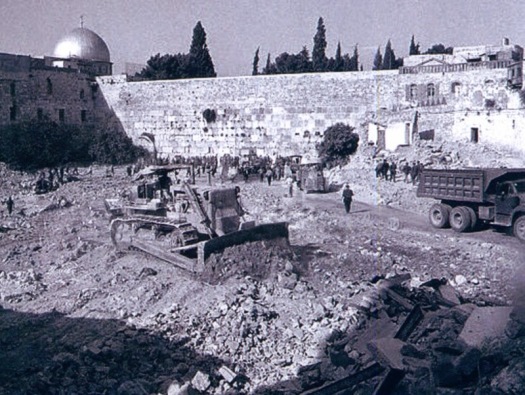
Destruction of the 700 year old Mughrabi neighborhood was done immediately following the Israeli conquest of East Jerusalem to create the Western Wall plaza.

To add to all that, Donald Trump is expected to arrive in Jerusalem and this gives the press and the official state PR machine an even greater opportunity to deal with the two things they love best: smoke screens and trivia.  Gaza? never even heard of it! Fifteen hundred innocent political prisoners on a hunger strike for over a month? Nobody cares! But check this out: apparently Trump will fly directly from Saudi Arabia to Tel-Aviv and this is the first direct flight between the two countries; the King David Hotel in Jerusalem is preparing for Trump’s visit and a drone was spotted in the hotel parking lot! And the ongoing burning question, will the great deal maker be able to close the Israeli-Palestinian peace Deal?  All smoke screens and trivia which are the staples of tabloids – a category into which most Israeli media outlets fit perfectly – though in their defense one must admit that there is no point in dealing with substance because Trump’s visit will offer none.

Here are a few items that are sure not to be on Trump’s agenda: Two million people in Gaza have no access to clean water, proper nutrition or medicine.  They have been victims of devastating attacks for seven decades and before they can recover from one assault there is another one pending.  The Israeli water authority allocates only 3% of the water to Palestinians even though they make up more than 50% of the overall population. More than 55% of Palestinians with Israeli citizenship live below the poverty line, and even though they rate one of the highest in the world in literacy, there is massive unemployment among Palestinians. Palestinians in the West Bank live under a brutal military regime governed by Israeli commanders who impose inhumane laws and prevent people from enjoying the basic most human rights. Seven thousand political prisoners sit in Israeli jails in violation of international law, over fifteen hundred of them on a hunger strike for over a month.

Trump may also visit Ramallah, and there too these topics are not likely to come up. Though there are attempts to prop the legitimacy of the Palestinian Authority, it is on life support and barely surviving. Municipal elections to West Bank cities were a failure – marked by boycotts of major political parties and a lack of voter interest. Mahmoud Abbas, the so-called president of the Palestinian Authority is old and tired and can no longer mask his disinterest in the fate of his people.  Hamas has made some changes to its charter and the newly elected head of Hamas’ political bureau is the Gaza resident, Gaza born Ismail Haniya, who is also the democratically elected Prime Minister of the now defunct Palestinian Authority.  The Authority has no real authority and neither party is relevant anymore.

The question of moving the US embassy to Jerusalem is also dead at this point although for political reasons Netanyahu will pretend it is a priority.  Both Trump and Netanyahu know that Jerusalem is a red line that even two reckless politicians such as them will not dare cross. Trump will not risk a multi billion dollar weapons deal with Saudi Arabia, and Netanyahu won’t risk an uprising for a symbolic gesture for which no country in the world can give its support.  The international community has never recognized Jerusalem as part of Israel, and international recognition of Israel’s jurisdiction is out of the question. So while Israeli politicians may try to create headlines over this topic, it is nothing but a smoke screen.

The terror under which Palestinians live – be it in their own country or in refugee camps  around it, is part of the daily bread of Palestinian existence. The causes for this existence, the wars of 1948 and 1967 are commemorated each year during the weeks between mid-May and mid-June.  The horror of the Palestinian reality is magnified when compared to the dishonest, romanticized narrative presented by Jews during that time: An Israel that is eternally young and brave and facing constant danger, yet winning and succeeding. Judging by Trump’s entourage, which includes David Friedman the new US ambassador to Israel and Jared Kushner, the famous Jewish son in law, Israel’s narrative of lies will dominate the agenda, while trivia and smoke screens will dominate the news.


The war for ‘The New York Times’


18 Comments

A war has begun for the soul of The New York Times.

People in the Palestinian solidarity movement criticize the Times all the time — we do; the glass is always half empty — but then so do supporters of Israel. The glass is also half-empty for them. And something you may not have noticed lately is that we are beginning to have victories. There are people at The New York Times who fully comprehend Israel’s crisis and want the newspaper to reflect that reality. They are digging in, and they are under attack. But they are having little victories.

Consider:

— Jodi Rudoren is gone. She was the last New York Times bureau chief in Jerusalem and came out of a firmly Zionist background and could be counted on to offer a warm, fuzzy, pro-Israel slant to any story that was often embarrassing. Even the human rights atrocities of Gaza could be spun by Rudoren (“sliver of opportunity“). She has been replaced by Ian Fisher, who seems like a fair, open-minded reporter who is probably right now in shock at what he is seeing. His hunger strikers piece yesterday was very good. His piece on Banksy’s new hotel — Fisher’s emphasis was the “ugly” wall. Anyone who tells it like he sees it is going to help Palestinians.

— Yesterday the Times International edition ran Marwan Barghouti’s piece saying that Israel is a “moral and political failure.” We know we slammed the Times for burying this piece in the international edition in our dudgeon yesterday. But the amazement is that it ran at all — Barghouti’s explanation that 40 percent of the male Palestinian population has been in Israeli prisons, that his son jailed in the years that Americans go to college, and these prisons are the cradle of a global anti-colonial movement . . . Yes, the piece has come under enormous attack. Israelis including the prime minister are expressing outrage that it ran at all. To the point that the backsliders of the New York Times have appended a clarification filling in what Barghouti was convicted of. “The article . . . neglected to provide sufficient context by stating the offenses of which he was convicted. They were five counts of murder and membership in a terrorist organization . . .” Etc.

Actually, the many Nelson Mandela references were sufficient context; Mandela was also charged with terrorism, the ANC did use violence. But it is a measure of the war that the Times is in that Michael Oren became unhinged over the newspaper’s role:

Shame on NYT for printing libelous op-ed by convicted killer Barghouti, the Palestinian Dylann Roof. Americans would be horrified. So are we

Crazy, yes. But Oren’s right about one thing: the Times is now in play. And where it goes, everyone else will follow.

— Yes, you say: the New York Times hired neoconservative crank Bret Stephens as an op-ed columnist the other day, a great setback to the discourse; Stephens has a long track record of racist statements. But while editorial page editor James Bennet’s announcement was fulsome (“beautiful,” “profound,” “bravery,” “generous,” “thoughtful”), it contained this important signal:

We read this as a sign that a pro-Palestinian columnist is coming, maybe even an anti-Zionist. Bennet knows exactly what Zaid Jilani is saying at the Intercept and what we have been saying here about the Times‘s conservative pro-Israel range. David Brooks’s son served in the Israeli military, for god’s sakes. The Times is getting battered by young people on the left for the fact that Roger Cohen and Tom Friedman’s weary Zionism is the best it has to offer to critics.

And bear in mind, if you’re pro-Israel, you have seen a deficit. Where is the firebreather to replace AM Rosenthal, William Safire and Bill Kristol? Well, you just got Stephens. The Times is in play.

— There is further evidence of the Times-at-war in the pushback to Stephens from within the Times ranks. (Michael Calderone reported on this at Huffpo.) Declan Walsh, the paper’s Cairo bureau chief, tweeted the following over the weekend:

Max Fisher, the Times “interpreter,” promptly expanded the thought:

Bret Stephens became defensive about the criticism and slung some more anti-Arab horseshit.

There was a time when journalists at a major newspaper were careful not to criticize that paper publicly. Those days are over, thanks to the internet. Two Times reporters are peeved at the racism of a colleague. They surely speak for many more. (Some of whom read Yakov Hirsch pointing out this racism first, last year: “The Politics of Jewish Ethnocentrism.”)

There was a time when the New York Times was a reliable supporter of Israel. A.M. Rosenthal and Max Frankel begat Ethan Bronner and Jodi Rudoren. We say those days are coming to an end. The shift in American discourse on the Palestinian issue that Bernie Sanders reflected a year ago is happening deep inside the Times too. Younger writers are woke on this question. They’re not going to just shut up about it. The neocons are also digging in. But the coverage is getting better . . . the coverage is getting better. Glass half full.

– See more at: http://mondoweiss.net/2017/04/the-york-times/?utm_source=Mondoweiss+List&utm_campaign=04957f876b-RSS_EMAIL_CAMPAIGN&utm_medium=email&utm_term=0_b86bace129-04957f876b-309259350&mc_cid=04957f876b&mc_eid=39adaa9ab6#sthash.pSLErpIS.dpuf

Miko Peled : It’s Personal.

Miko Peled

As thousands of Palestinian political prisoners jailed by Israel are going through a hunger strike, we would do well to delve into the deeper, more personal and historical aspects of Palestine.  Though the politics and violence of settler colonialism have determined its fate for almost one hundred years, Palestine is not just a “case” or an “issue,” it’s personal. My dear, dear friend Nader Elbanna said to me a long time ago, “The Palestinian tragedy is more than just losing the house and the land.”  None of us will ever fully understand Palestine, none of us who are not Palestinian, that is, because it is personal. But there are ways to learn. Visiting Palestine is a good start. Living in Palestine is good too and learning Arabic affords a glimpse. Reading Ghassan Kanafani’s stories is moving and enlightening.


Ghassan Kanafani, in his short stories presents an intensely personal narrative and paints a picture that is painfully detailed. In one of his short stories, a young man asks, “would you like to hear about my life?” and he proceeds to describe a mother who died under the ruins of a house in Safed, the house that was built for her by her husband. He describes the father, now working in another part of the Arab World and unable to see his children, and a brother “learning humiliation” in an UNRWA school. In another short story Kanafani describes a father who is standing in the rain leaning on a broken shovel, taking a break from the back- breaking work of digging a ditch in the rain. He is digging in an effort to stop the rain water from flooding a tent where his family, now refugees, must live. He is cold, tired and hungry but avoids going inside the tent, not wanting to see his wife’s glare, knowing she blames him for the inevitable state of being unemployed and unable to provide for his family. Seeing his child wear a torn, old shirt he contemplates taking part in a scam operation, stealing bags of rice from the UNRWA storage facility and selling them on the black market. “The guard is in on it and for a small fee he will look the other way,” he is told by a man of whose morals he does not approve, and whose very presence makes him uneasy.

The occupation of Palestine is not only about the brutality that is inherent in settler colonialism but the daily, painful existence of a nation that is denied the right to live in the land to which it belongs. A nation forced to live in abject poverty in camps that are unfit for humans and which exist just hours away from the land and the homes from which they were kicked out. A land for which they have the deeds, and homes for which they still hold the keys now inhabited by Jewish settlers. “For us, to liberate our country is as essential as life itself” Kanafani says to an Australian reporter in a rare interview in English. He is fierce and forthright, sitting in his office, with photos of Che Guevara and Ho Chi Minh behind him.

But Palestinians are permitted only to be victims or terrorists, never freedom fighters or heroes. If Palestinians wrote “Live Free or Die” on a license plate they will be accused of terrorism and locked up, deported or simply killed, though in New Hampshire it is the official motto. Ironically, Israeli children learn about a legendary Jewish hero who, having been killed in battle in Palestine said, “it is good to die for one’s country” though clearly, he was fighting to take the country of others. Kanafani was brutally murdered, along with his young niece Lamees who was only seventeen, for saying and doing just that – fighting to liberate his country. Since his assassination by Israel almost half a century ago, countless Palestinians were killed by Israel, some fighting, most while sleeping in their beds or trying to flee.

Kanafani talks about “them,” the “Yahud” the Zionists who colonized Palestine and exiled his people, turning them into “people with no rights, with no voice.” “They have put enormous efforts into trying to melt me,” he writes, “Like a sugar cube in cup of tea.” And he talks about “You” the Arab authorities under whom Palestinians are now forced to live. “You had managed to melt millions of people and lump them into one lump, into a single thing you can now call ‘a case.’” And, he continues, “now that we are all ‘a case’” there is no personal attachment to any single person or story. How convenient. That is what allows for the ease with which the world treats the Palestinian tragedy. That is how the West can sell Israel the weapons and technology with which it slaughters Palestinians by the thousands and maintains the oppression.

One wonders what Kanafani would say about the horrific, large scale massacres endured by the people in Gaza since 2008. What would he say if he knew that since his death things have become worse now that Israel’s army of terror has access to more “modern” weapons that allow it to murder and maim thousands in a single “operation.” How would Kanafani react if he heard about entire families that were wiped out by mortars and missiles fired at them and others, incinerated by millions of tons of bombs dropped from war planes? One wonders what stories he might write about children burned and mutilated with such ease in the twenty first century? “We are a small, brave nation” Kanafani said in 1970, “who will fight to last drop of blood.”

Israel – the name that was given to the Zionist state which occupies Palestine – is indignant at the very mention of Palestine and at the idea that as a state it should respect the rights of Palestinians. People who support Israel are offended when they hear accusations of racism, indiscriminate violence and genocide. But these same people have no problem with the actual ongoing campaigns of genocide, ethnic cleansing and the reality of racist apartheid perpetuated by Israel. Because for them Palestine is not personal, it is just a “case,” just a “problem.” But Palestine is not a problem, it is personal, it has a beating heat, and that is why the fight for justice in Palestine is gaining momentum all over the world. As the Palestinian leader and political prisoner Marwan Barghouthi wrote recently from a cell in an Israeli jail, “The chains that bind us will break before our captors can break our resilience.”


AIPAC speakers say the enemy is BDS, while ‘biggest Jewish-led protest’ surges outside

Young Jewish demonstrators from IfNotNow outside AIPAC conference yesterday

Young Jewish demonstrators from IfNotNow outside AIPAC conference yesterday

This morning, Israeli Prime Minister Benjamin Netanyahu spoke by video to the Israel lobby group AIPAC (the American Israel Public Affairs Committee) in Washington. He bragged about his warm relationship with President Trump to great applause, and said that many states in his region were turning to Israel in the fight of modernism against medievalism. He said it was time for Palestinian Authority to “above all, once and for all, recognize the Jewish state.”

Netanyahu also addressed the Boycott, Divestment and Sanctions, or BDS, movement aimed at Israel, saying Israel will defend itself on the “moral battlefield… We’ll defend ourselves against slander and boycotts.”

Last night Vice President Mike Pence was introduced as an enemy of BDS. He told the AIPAC conference, “The president of the United States is giving serious consideration to moving the United States Embassy from Tel Aviv,” to huge applause. He then called on the next ambassador to Israel, David Friedman, a supporter of settlements, to stand. He also got a warm reception.

Martin Indyk took a jaundiced view of Pence’s promise, saying that George W. Bush had seriously considered the move for eight years, and Trump will still be seriously considering in another four years. “We’re freiers [suckers] to think otherwise.”

Israeli opposition leader Isaac Herzog called on AIPAC’s followers to opposed the BDS movement. While former Prime Minister of Canada Stephen Harper said that BDS was the most serious threat to Israel and merely the latest form of classical anti-Semitism.

“The third threat to Israel is the one we actually need to take the most seriously as Canadians and Americans, and that is the BDS movement… One can disagree with the Israeli government’s policies in this aspect or that, but the BDS is not about that. The BDS movement is about translating the old ideology of anti-Semitism into something acceptable to a new generation.”

The theme was echoed by AIPAC officials.

Democratic political consultant Paul Begala said this morning on the AIPAC stage that he was thinking of making “aliyah” to Israel because of political developments in Washington but affirmed: “I have never worked for someone who is anti-Israel and I never will… How could I and be true to my progressive values?”

As for progressive values: there was a large demonstration yesterday outside the Washington convention center by the “Jewish resistance,” led by IfNotNow. A few demonstrators from IfNotNow managed to get inside the hall and drop a banner protesting the occupation. While hundreds of others in the resistance group led a march to the convention center in an effort to stop the conference. Ben Norton said it’s the “biggest-ever Jewish-led protest” of AIPAC. Bigger than Neturei Karta.

Here’s Ahmed Shihab-Eldin’s thorough video coverage of the demonstration for AJ+.

One organizer says what makes this anti-AIPAC demonstration different is that it’s the 50th year of occupation, and these young people are not going to let AIPAC speak for the Jewish community anymore. Others emphasized the crisis inside the Jewish community. Among the soundbites:

Fifty years is too long. It’s a moral crisis for the Palestinians, it’s eroding our community. AIPAC does not speak for American Jews.

The Trump administration is forcing the American Jewish community to pick.

AIPAC stands for endless occupation. We are the Jewish Resistance.

I’m here fighting for freedom and dignity for all Israelis and Palestinians, and a Jewish community that stands up for those things.

Jews can’t have liberation if Palestinians don’t.

We refuse as Jews and humans to be part of the American Jewish establishment…. I feel heartbroken that it’s taken our community so much to move…. We have a long way to go.

At Minute 20 you can see a dozen demonstrators forming a human chain outside the convention doors.

Shortly after, a group said to be part of the Jewish Defense League attacked the demonstration.

Some shouted at IfNotNow, “sharmouta,” Arabic for prostitute.

Shihab-Eldin asked why no one from JDL was arrested.

Thanks to Annie Robbins. 


The Inside Story on Our UN Report Calling Israel an Apartheid State

A Palestinian woman argues with Israeli soldiers at a West Bank checkpoint south of Hebron on August 16, 2016. (Reuters / Mussa Qawasma)

A Palestinian woman argues with Israeli soldiers at a West Bank checkpoint south of Hebron on August 16, 2016. (Reuters / Mussa Qawasma)

A people cannot be permanently repressed in all these ways without viewing the structure that has emerged as an apartheid regime.

Six months ago, the UN’s Economic and Social Commission for West Asia (ESCWA) asked Virginia Tilley and me to write a study examining the applicability of the international criminal law concept of apartheid to Israel’s policies and practices toward the Palestinian people. We were glad to accept the assignment, and conceived of our role as engaging in an academic undertaking. ESCWA, one of several UN regional commissions, requested the study as a result of an uncontested motion adopted by its 18 Arab member governments.

Almost within hours of its release on March 15, our report was greeted by what can only be described as hysteria. The US ambassador to the UN, Nikki Haley, denounced it and demanded that the UN repudiate it. The newly elected secretary general, António Guterres, quickly and publicly called for ESCWA to withdraw the report from its website, and when Rima Khalaf, the head of the commission, resisted, Guterres insisted. Rather than comply, Khalaf resigned. Soon thereafter, the report was withdrawn from the commission’s website, despite its having been published with a disclaimer noting that it represents the views of its authors and not necessarily that of ESCWA or the UN.

What is striking about this response, which resembles in many respects the US government response to the Goldstone Report (the UN Fact-Finding Mission on the Gaza Conflict of 2008-9), is the degree to which Israel’s supporters, in response to criticism, have sought to discredit the messenger rather than address the message.

We had hoped that our analysis would prompt debate, dialogue, and consideration of our recommendations.

Tilley, a professor of political science at Southern Illinois University Carbondale, and I, as well as ESCWA, would welcome substantive discussion of and critical feedback on our report, and we had hoped that our analysis and conclusions would provide the basis for dialogue and further consideration of the recommendations appended at the end. ESCWA, for its part, took steps to ensure that the report lived up to scholarly standards, submitting the draft text to three prominent international jurists, who anonymously submitted strong positive appraisals along with some suggestions for revision, which we gratefully incorporated before the final text was released. For government officials and others to dismiss our report as a biased polemic is irresponsible, with respect both to the authority of the UN and to international law.

During my tenure as the UN’s Special Rapporteur on human rights in the occupied Palestinian territories (2008-14), I saw how defenders of Israel attempt to discredit critics. My reports in that post often contained sharp criticisms of Israel and other actors, ranging from defiance of international law, unlawful expansion of settlements, excessive use of force, and complicity of international corporations and banks that do business for profit with the settlements. To my surprise, I never received substantive pushback regarding my allegations, but I did have the unpleasant experience of having my words on unrelated issues torn out of context. Among my harshest critics were not only the usual ultra-Zionist NGOs, but also Barack Obama’s diplomats at the UN, including Susan Rice and Samantha Power, as well as then-Secretary General Ban Ki-moon. I mention this personal experience only to note that it falls into a longstanding pattern of rebuttal that prefers to smear rather than engage in reasoned debate about important issues of law and justice.

The international crime of apartheid was set forth in the 1973 Convention on the Suppression and Punishment of the Crime of Apartheid. The main elements of the crime consist in deliberate and systematic acts of racial discrimination with the purpose of maintaining unlawful structures of domination by one race over another. Our report also considered whether, in the context of inquiring into the presence of apartheid, it was appropriate to consider Jews and Palestinians as distinct races; we found that there was abundant grounding to do so. As our report shows, “race” in this context is treated as a socially and politically constructed category defining a distinct people. It has no necessary correlation with biogenetic realities, which in this case show an overlap between Jews and Palestinians.

Even Palestinian citizens of Israel, who can vote and form political parties, are subject to many discriminatory laws.

The report also proceeds from the proposition that whether apartheid exists or not depends on the overall treatment of the Palestinian people as a whole. Adopting what we believed to be innovative methodology, we approached this challenge by dividing the Palestinians into four domains that correspond to the manner in which Israel has exercised its authority over the course of many decades, although specific tactics of control have varied through time. In the past, a thorough study by international law scholars found that Israel’s practices in the occupied Palestinian territories are consistent with apartheid. It called attention to the discriminatory treatment of Palestinians, who are subject to military administration as compared to the Jewish settler population, which enjoys the full benefit of the rule of law as it is observed in Israel in relation to Jewish nationals. That study found that such features as “settler-only roads,” dual legal systems, and the draconian separation of the two populations into regions on the basis of race are the hallmark of apartheid. Repressive practices that have made the lives of ordinary Palestinians a daily ordeal are part of this system, as international law establishes that penalizing resistance to apartheid is itself a crime of apartheid.

A second domain investigated in the report involves Palestinians who are residents of Jerusalem. Here the apartheid character of Israeli rule is exhibited in the way the government undermines the security of those Palestinians, manipulating their rights of residence as well as imposing a variety of discriminatory practices, ranging from fiscal measures to the issuance of building permits. The third domain concerns the Palestinian minority living in Israel, perhaps the most problematic component in terms of establishing a definition of apartheid that encompasses the entire Palestinian population. In this category are some 1.7 million citizens of Israel, who are allowed to form political parties and vote in elections. But this minority, which makes up about 20 percent of the overall Israeli population, is prohibited by law from challenging the proclaimed Jewish character of the state and is subject to a wide range of discriminatory nationality laws as well as administrative practices that severely restrict their rights, with effects on land acquisition, property, immigration, family reunification, and marital freedom.

International law has detached apartheid from its South African origins; it’s now a stand-alone crime against humanity.

A fourth domain, and the one affecting the largest demographic segment, is made up of Palestinians registered as refugees by UN procedures or living under conditions of involuntary exile. In the background is the non-implementation of UN General Assembly Resolution 194 (1948), which confirms the right of return enjoyed by Palestinians dispossessed or displaced by Israel in 1948. This right of return is declared in General Assembly Resolution 3236 to be an “inalienable right,” which thus presumably incorporates those additional several hundred thousand Palestinians displaced by the 1967 war. As far as is known, no Palestinian displaced since the establishment of Israel in 1948 has been granted the right of return to resume residence.

From the perspective of international law, the crime of apartheid has been detached from its historical origins in South Africa. Neither the 1973 Convention nor the 1998 Rome Statute underlying the International Criminal Court ties apartheid to South Africa, but rather treats its practice as a stand-alone crime against humanity. Thus, there are important differences between the way apartheid operated in South Africa and the way it is currently being imposed on the Palestinians, but these differences are not relevant to the question of whether it fairly and accurately applies to Israel. One notable difference is that in South Africa the Afrikaner leadership forthrightly proclaimed apartheid as a reflection of its ideological belief in the separation of races, whereas for Israel such a structure of separation on the basis of race is denied and repudiated. There are other differences as well, relating to degrees of labor dependence and the demographic ratio.

This quasi-permanent structure of domination cannot be justified convincingly by reference to Israeli security needs.

Our report concludes that Israel has deliberately fragmented the Palestinian people in relation to these four demographic domains, relying on systematic discrimination, including “inhuman acts,” to maintain its control, while continuing to expand territorially at the expense of the Palestinian people. On the basis of these findings—backed up by detailed presentations of empirical data, including reliance on Israeli official sources—we conclude that the allegation of apartheid as applied to the Palestinian people is well founded.

We realize that our report is the work of academic investigators and is not an authoritative finding by a formal judicial or governmental institution. At this point it has not—contrary to media reports and diplomatic denunciations—even been endorsed or accepted by the UN, or even ESCWA. We do recommend such an endorsement, and we urge the UN, national governments, and civil society to take measures designed to encourage Israel to dismantle its apartheid regime and treat the Palestinian people in accord with the dictates of international law and human rights, as well as elementary morality.

The broader setting associated with our contention that Israel has become an apartheid state draws on the reality that there is no peaceful resolution to the conflict on the diplomatic horizon, and thus no foreseeable prospect for ending the discriminatory regime. This quasi-permanent structure of domination cannot be justified convincingly by reference to Israeli security needs. A people cannot be permanently repressed in these various ways without viewing the structure that has emerged as an apartheid regime. Indeed, part of the reason for not awaiting a more formal assessment of these charges is our sense of urgency in ending a set of arrangements that have for so long been responsible for so much suffering and denial of basic rights, above all the right of self-determination.

It remains our central hope, one shared by ESCWA, that the widespread availability of the report will lead to a clearer understanding of the Palestinian plight and encourage more effective responses by the UN, by governments, and by civil society. Beyond this, it is our continuing wish that people of good will throughout the world, especially within Israel, will work toward a political solution that will finally allow Jews and Palestinians to live together in peace, with justice.


Actor Richard Gere in Hebron: ‘it’s exactly like what the what the Old South was in America’

Israel/Palestine

on March 24, 2017 25 Comments

While Richard Gere was in Israel and the occupied West Bank promoting his film “Norman,” he was recorded in an unguarded moment wandering the desolate streets of Hebron’s Old City. A dumbfounded Gere is near at a loss for words in the clip, which aired on Israel’s Channel 2 network.

Not a Palestinian in sight. Soldiers and settlers roam comparatively carefree. The roads are too quiet. All of the shops are shuttered. Gere is stunned:

“This is the thing that’s flipping me out right now,” Gere stammers to his Hebron guides, activists with the Israeli human rights group Breaking the Silence, former soldiers that now advocate against Israel’s occupation of the Palestinian territory, “Of everything we’ve seen for two days, the people we’ve talked to, it’s…I mean…I’m…I’m touched by that, I know that story. But this is really bizarre.”

“This is genuinely strange,” Gere adds, before telling his guides, Hebron is like the Jim Crow South:

“It’s the dead city, but who owns the city? And their [the settlers] feeling of ‘I’m protected, I can do whatever I want,’ and that sense of where the boundaries are. I mean it’s like…it’s exactly like what the what the Old South was in America. Blacks knew where they could go, they could drink from that fountain, they couldn’t go over there, they couldn’t eat in that place. It was well understood. You didn’t cross it or you’d get your head beat in or lynched,” Gere said.

At one point soldiers stopped Gere and asked for his passport. He didn’t have it on him. But he’s from New York, he told them. Once the soldiers realized he is the Richard Gere–“Richard Gere, wow,” one said–the mood softens. But Gere is still visibly unsettled.

A car driven by a settler zooms by. Gere catches on, “These guys driving through. It’s a really dark energy. Wow,” he says, “it was kind of Mad Max.”

The scene that Gere had entered for the first time includes Palestinians who are made to use alleyways as the main roads are for settlers only. Palestinians cannot drive in the Old City, settlers can. There is one notorious sidewalk with a rope to segregate Palestinian and Israeli pedestrian traffic. It’s a scene many are horrified by the first time they enter. Philip Weiss had a similar response back in 2006:

“Every now and then in life, and maybe just when you want it, god throws down a thunderbolt. It happened to me on Friday in Hebron, in the Occupied Territories. A group of seven Israelis and I were sitting in an Arab man’s house, discussing the harassment and denial of movement to Palestinians in the center of that city—the second largest city in the West Bank—when I wondered for the 100th or thousandth time how the conditions I was seeing for myself in the occupation compared to apartheid in South Africa, which Americans rose up against 20 years ago.”

Before Gere went to Hebron, he spoke with Haaretz in Jerusalem:

“Obviously this occupation is destroying everyone,” he says. “There’s no defense of this occupation. Settlements are such an absurd provocation and, certainly in the international sense, completely illegal – and they are certainly not part of the program of someone who wants a genuine peace process.” He pauses before adding, “Just to be clear about this: I denounce violence on all sides of this. And, of course, Israelis should feel secure. But Palestinians should not feel desperate.”

Later that same trip Gere met with Palestinian former Prime Minister Salam Fayyad. Following the meeting Gere was asked if he would ever act in a production by a Palestinian filmmaker (“Norman” writer and director, Joseph Cedar, is Israeli). “Why not,” Gere told the Arab News, continuing: 

“My only criteria are the quality of the script and the production. Naturally I’d have to be emotionally connected, but that isn’t enough. It has to be a quality film. I won’t discriminate if it’s a Palestinian film. In fact, I’d look closer if it was a Palestinian director.”

Gere added, “I have a special place in my heart for Palestinians, and I have a special empathy for their suffering.”

– See more at: http://mondoweiss.net/2017/03/richard-exactly-america/?utm_source=Mondoweiss+List&utm_campaign=c8c689aa43-RSS_EMAIL_CAMPAIGN&utm_medium=email&utm_term=0_b86bace129-c8c689aa43-309259350&mc_cid=c8c689aa43&mc_eid=39adaa9ab6#sthash.VPpHdxYv.dpuf

Al Jazeera Investigations – The Lobby P1

Miko Peled : few days in Palestine

img_8471_d6502

It’s only been a few days since I arrived in Palestine so not much has happened. Well, relatively speaking not much. I was traveling to Nabi Saleh to see my friend Bassem Tamimi. Since I didn’t have a car I had to travel by bus through Qalandia checkpoint to Ramallah then by service cab to the village and back – and on the way back, the girl soldier put down her phone long enough to examine my ID, realize I was Israeli and detain me. Then the next day, I went to the epic “Combat BDS” conference also known as, or rather should be known as “Crazy & Loony Bros. How Do We Kill BDS Circus” in Jerusalem. It was an unforgettable experience. And now, as I sit and write this, a soldier is being tried for murder because he shot a Palestinian who was already dead. So its not the soldier that shot and murdered the young Palestinian that’s on trial, it’s the soldier that shot him for fun after he lay dead, or nearly dead on the ground, ignored by several Israeli ambulances that were driving around him – that’s the soldier that’s being tried. But, as I said, it’s only been a few days.

I grew up here and when I come here I live in the home and in the room where I grew up. Very little has changed in Motza Elite, a quiet and disorganized little place where for the most part houses are surrounded by trees and vegetation. Sure, the trees are taller, their trunks thicker, but it is still a quiet, beautiful little place with no soldiers, police or border guards and of course, no Arabs. It is the perfect white, Jewish, privileged community and it is the perfect place to get away from it all, or as most people who live here do, ignore any of it exists. “It” is the rest of Palestine.

*

I will start with what seems to me the most bizarre thing going on at this moment. Two young Palestinians, who attacked fully armed soldiers using knives, were killed. Ambulances are on the scene taking care of the soldiers who were slightly wounded and they drive around the bodies of the young Palestinians. Suddenly a shot is heard. A soldier who was not on the scene originally decides to shoot one of the Palestinians lying on the ground, motionless, in the head. He claims he saw some movement and was concerned the victim on the ground might detonate a bomb. Now for some reason this soldier is charged with murder.

*

It’s a good idea from time to time to travel around the country as Palestinians do. Use buses, service cabs and go through checkpoints. It’s inconvenient, takes a lot of time and is totally unpredictable. So that’s what we did. Fadwa, my better half and I took a bus to East Jerusalem then another bus to Ramallah where we met Bassem Tamimi. We had coffee at “Stars and Bucks Café” and then the three of us took a service cab to Nabi Saleh. Bassem was supposed to be in the US now on a speaking tour. This would have been his third tour since receiving his visa to the US. But suddenly, with no real explanation and no apparent reason he got notice that his visa has been revoked. So American audiences were denied the chance to hear him and he remains here in Palestine trying to help the nearly twenty youth from Nabi Saleh, who are in prison, including his son Wa’ed.

We arrived in Nabi Saleh, spent the afternoon there and then returned to Jerusalem. We took a service cab to Ramallah, a cab to the checkpoint, tried to find our way through the maze that makes up the checkpoint, and thankfully the Palestinian vendors outside pointed us in the right direction. The soldier behind the window rarely takes the trouble to lift their eyes when the ID is presented. So, I press my ID against the window expecting to be waved through when something caught her eye long enough for her to see that mine was an Israeli ID. With nothing better to do she decided to look into this strange phenomenon, an Israeli coming through a Palestinian checkpoint. Thinking I was probably some kind of “human rights” agitator or something she called me from inside, “Are you with human rights?”

MORE…
“ISRAEL IS FIGHTING FOR YOU”: EXPOSING THE FALSEHOODS IN THE RECENT AND RENEWED ZIONIST PROPAGANDA TECHNIQUE AGAINST THE PALESTINIAN STRUGGLE FOR JUSTICE
G4S CONCEDES TO BDS PRESSURE; SET TO LEAVE ISRAEL
WITCH-HUNTING FOR ISRAEL
MORE ON ISRAEL’S COMBATING BDS
“No.”

“Are you with B’Tselem”

“No.”

“Don’t you know Jews are not allowed to cross here?

“No.”

“What were you doing in Ramallah?”

“We bought strawberries, and had coffee.”

Fadwa is not the problem because she is not Jewish. I am the problem. Still they ask her the same questions and we are “invited” in to a waiting room and sit down.

We sit and wait. The room is maybe three feet by three feet and its freezing cold. We start looking at the graffiti in Arabic that is engraved into the walls. Ten minutes go by and nothing happens.

“What are we waiting for?”

“The police are on their way?’

“What for”

“To question you?”

“Why?”

“There is an order from the colonel or general that prohibits Jews from crossing here.”

She should read my book, The General’s Son, Journey of an Israeli in Palestine, there is a chapter called, The Commanding General’s Order.

“OK, we wont do it again.”

“The police will be here any minute.”

We wait ten more minutes and the same conversation takes place, then again and again about every ten minutes. Finally, she hands me my ID and says, “You can go now.” No explanation, no nothing.

*

It was a cold, rainy day as thousands entered the convention center in Jerusalem. Fresh coffee, sandwiches and pastries were free, security was tight and I tried to make myself as un-noticeable as possible. “Just blend in,” I thought to myself when I heard someone say, “look that’s Miko Peled.” Crap! Not the place I want to be recognized. Every kind of Israeli crazy was there. I look over, and it’s Anthony Lowenstein, the Auzzie journalist and Dan Cohen, an American journalist. Both are crazy Jews like me who came to see this circus. We sat down and then it started. The world’s most self-absorbed, self-righteous and criminally insane society was putting on a show, with its best actors playing lead roles. This was the “How To Combat BDS” conference, put on by Israel’s largest newspaper, Yediot Aharonot.

Israeli President Reuven Rivlin was up first. Israel could hardly have selected a better-suited man for the job of representing the state and the people of Israel. Rivlin is a white, European colonizer, constantly patting Israel and himself on the back for being a liberal democratic melting pot. “BDS foundation is de-legitimization of Israel without connection to what Israel does” President Rivlin said and he added that “the world is in awe of Israeli exceptionalism.” He ended his remarks by saying that he sleeps better than ever knowing the Israeli army is the most moral army on earth. Talk about “opium to the masses.”

Anthony Lowenstein wrote a piece about the conference everyone should read, but here is quick review of some of my favorite highlights: Gilad Erdan minister of public security, strategic affairs and Hasbarah (all that is one ministerial office) who has been designated as lead role in the fight against BDS said that it’s all about legitimacy. Indeed this is about legitimacy. Everything Israel does is about claiming it has legitimacy when clearly, being a settler-colonialist project that established a racist system in Palestine, it hasn’t got any legitimacy at all. Erdan went on to say that BDS activists would soon begin to pay for de-legitimization of Israel. He didn’t specify how they would pay, but one can be sure that all dedicated BDS activists expect that the struggle to free Palestine will be a tough one and will readily confront obstacles to achieve this goal.

Then Jewish Billionaire Ron Lauder came up to speak. He said that since anti-Semitic campus groups such as Students for Justice in Palestine and the Muslim Students Association are so well funded, poor Jewish students can’t complete and have no tools to defend themselves. You had to wonder if he is lying or just totally clueless. His remedy is that he will provide the funds for Pro Israeli groups on campus so that the Zionist voice is heard. As president of the World Jewish Congress he works closely with Jewish leaders around the world to push for anti-BDS legislation. Interestingly enough, he was the first one to mention Omar Barghouti, who heads the BDS movement, “why does he want to destroy Israel?” Lauder asked. If they had any sense they would have invited him to explain.

The EU ambassador to Israel was on a panel with some of the worst racist figures in Israel, including Danny Dayan. Dayan who was rejected by the government of Brazil to be Israel’s ambassador was now nominated to be Israel’s Consul General in NY. The EU ambassador said that West Bank settlement products are welcome in the EU, and that the labeling of settlement products is done merely for information purposes. More opium! Dore Good, general director of the Israeli foreign ministry said that we must expose the fact that the Islamic jihad and the Muslim Brotherhood established BDS. He repeated this several times even though it is completely untrue, practicing what was once said about a lie, that if it is repeated enough times, it becomes truth. Well, I doubt that in this case it will work. The day ended shortly after that and the three exhausted Jewish infiltrators drove away to bask in the warmth of Arab East Jerusalem. Who knows what the next few days may bring.

Blog at WordPress.com.

Up ↑