Search

band annie's Weblog

I have a parallel blog in French at http://anniebannie.net

Category

israel

Orange: Making the Future Bright for Israel’s Illegal Settlements

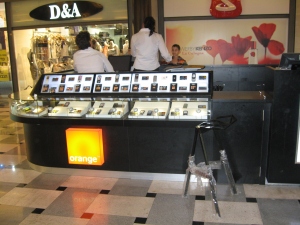
Orange kiosk in the East Jerusalem settlement of Pisgat Ze'ev
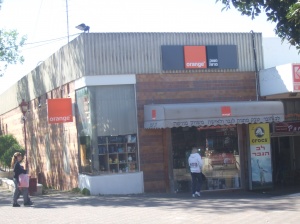
Orange advertising and signage in the settlement of Ariel

Throughout our research around the West Bank it has become obvious that one of the most common ways for international companies to profit from the occupation market is through secondary involvements, such as operating franchises, in Israel’s illegal settlements. Companies such as Blockbuster, Tower Records and Lee Cooper have franchises of their businesses in settlements, Western Union trade in settlements automatically through their deal with the Israeli Post Office.

International companies like these accept royalties from their franchisee’s for the right to use the brand, boost their brand recognition and open a maket for their goods. However, by operating in a less direct way, they hope to be held less accountable for their actions.

For the BDS movement to let this happen would be a mistake.

One good example of how a seemingly distant involvement by a company can have a huge impact on the ground is the agreement by the mobile phone company Orange, which is owned by France Télécom, to license the Israeli Partner Communications Company to use its name and logo. Orange now has a shop or kiosk in many of the larger settlements in both the West Bank and the occupied Golan and advertises very heavily in them. Orange mobile phone masts (operated by Partner Communications) are located both inside the settlements themselves and on land specifically confiscated for the masts. The masts are situated to benefit the settlements and the Israeli army. The Palestinian Authority, in its crack down on settlements and enforcement of the boycott, recently called for all Israeli mobile phone networks, including Orange, to be banned in Palestinian cities. Orange is entirely separate from the Partner Communications Company, but this does not mean that they are innocents in the situation.

When Partner launched Orange Israel the brandname was registered by Hutchison Whampoa, who were a major shareholder in Partner. The success of the new network when it was launched in 1999 is generally considered one of the best advertising efforts undertaken in Israel, largely due to the brandname. Hutchison Whampoa divested their shares from Partner in 2009. Since France Télécom took over Orange PLC in 2000 they have made a conscious decision to keep supporting the activities of the Israeli company, whose success relies heavily on Orange brand recognition. By withdrawing the licence for their name and logo Orange could take a very visible stance against the occupation rather that silently aiding it.

Partner Communications (Orange Israel) has kiosks in the settlements of Pisgat Ze’ev and Modi’in Illit and has erected over 160 antennas and telecommunication infrastructure facilities on occupied territory.

For Who Profits’ page on the Partner Communications Company see: http://www.whoprofits.org/Company%20Info.php?id=713

Partner Communications Company is now controlled by Ilan Ben-Dov’s company Scailex Corporation which owns 51% of its shares.

France Telecom (www.francetelecom.com) is based in Paris. The company has offices and franchises worldwide
source

Press release from The Swedish Dockworkers Union, section 4, Gothenburg.

2010-06-23

The nation-wide blockade of all goods to and from Israel is under way.
– Tens of containers were put under blockade tonight.

————————————–

By midnight at 00:00 on the 23rd June the Swedish Dock-workers union week-long blockade of goods to and from Israel started. The ongoing nation-wide blockade in Swedish harbors, that is based on the request of the united Palestinian union-movement, is The Swedish Dockworkers Union’s attempt to contribute to pressure Israel into:
1. Lifting the blockade on Gaza
2. Allowing an independent, international investigation of what happened at the Israeli boarding of the so called Freedom Flottilla when nine people were shot to death.

In the harbor of Gothenburg the blockade were initiated without any complications. About ten containers, both Israeli imports and exports were immediately identified in the container terminal. All of which have been separated and will stand untouched in the harbor of Gothenburg until the end of the blockade at 24:00 the 29th of June.

– Everything has passed very calmly and I believe it will continue to do so until next Wednesday, says Peter Annerback, chairperson of the Swedish Dockworkers Union section 4 (Hamn4an) and member of the unions executive committee in a late comment.

– Since we are not in a conflict with our employers a “conflict-contained” container that carries any medical equipment will be allowed exemption, continues Annerback.

– We have identified more goods on its way to or from Israel than we had expected. We thought the flow of goods would be much lower considering the blockade has been announced for twenty days, says Hamn4ans trustee Erik Helgeson.

– Our ambition is of course that our action can be one of many grassroots initiatives that will keep the eyes of the world focused on the 800.000 children that lives isolated in Gaza. The Palestinian civilian population must be allowed to rebuild their economy, their infrastructure and freely integrate with the rest of the world. The war on Gaza and Israel’s brutal blockade have made all this impossible for over three years now, Helgeson ends.

The Swedish Dockworkers Union have explained the motives behind the unions blockade of Israeli goods in two articles:

Newsmill:
http://www.newsmill.se/artikel/2010/06/18/internationell-hamnblockad-till-stod-for-gazas-civilbefolkning
Dagens ETC:
http://etc.se/30568/vi-kommer-inte-att-sta-ensamma/

info@hamn4an.se

www.hamn.nu

www.hamn4an.se

EU Considering Aid to Israeli Military

By David Cronin

BRUSSELS, Jun 18, 2010 (IPS) – A leading Israeli supplier of warplanes used to kill and maim civilians in Gaza is in the running for two new scientific research grants from the European Union.

Israel’s attacks on Gaza in late 2008 and 2009 provided its air force with an opportunity to experiment with state-of-the-art pilotless drones such as the Heron. Although human rights groups have calculated that the Heron and other drones killed at least 87 civilians during that three-week war, EU officials have tentatively approved the release of fresh finance to the Heron’s manufacturer, Israel Aerospace Industries (IAI).

Two projects involving IAI have recently passed the evaluation stages of a call for proposals under the EU’s multi-annual programme for research, which has been allocated 53 billion euros (65.4 billion dollars) for the 2007-13 period.

The Union’s executive arm, the European Commission, has confirmed that IAI is one of 34 Israeli “partners” involved in 26 EU-funded projects for information technology which are under preparation.

Among the other Israeli firms being considered for such funding are Afcon, a supplier of metal detectors to military checkpoints in the occupied Palestinian territories, including the Erez crossing between southern Israel and Gaza. Afcon was also awarded a contract in 2008 for installing a security system in a light rail project designed to connect illegal Israeli settlements in East Jerusalem with the city centre.

Mark English, a Commission spokesman, said that the procedures relating to the projects have not yet been completed. But the Israeli business publication Globes reported last month that Israeli firms stand to gain 17 million euros from the latest batch of EU grants for information technology. According to Globes, this will bring the amount that Israel has drawn from the EU’s research programme since 2007 to 290 million euros.

Israel is the main foreign participant in the EU’s science programme. Officials in Tel Aviv say they expect Israeli firms and research institutes will have received around 500 million euros from the programme by the time of its conclusion.

Chris Davies, a British Liberal Democrat member of the European Parliament (MEP), expressed anger at how the Commission’s research department appears willing to rubber-stamp new grants for Israeli companies. Such a “business-as-usual” approach is at odds with tacit assurances from officials handling the EU’s more general relations with Israel, he said.

In late 2008, the EU’s 27 governments agreed to an Israeli request that the relationship should be “upgraded” so that Israel could have a deeper involvement in a wide range of the Union’s activities. But work on giving formal effect to that agreement has stalled because of the subsequent invasion of Gaza.

Approving EU finance for Israel Aerospace Industries “should be regarded as utterly unacceptable, incoherent and outrageously naive,” Davies told IPS. He argued that there appears to be “no communication” between different sets of EU representatives on how Israel should be handled. “Where’s the joined-up thinking?” he asked.

While the European Commission claims that all of its scientific research cooperation with Israel is civilian in nature, the Israeli government has been eager to publicise the almost umbilical links between the country’s thriving technology sector and its military. A brochure titled ‘Communications in Israel’ published by its industry ministry earlier this year refers to a “symbiosis” between the security and technology sectors in Israel. Several technology breakthroughs – such as the invention of voice recognition devices for computers by the Israeli army in the 1980s – have resulted from this “convergence”, the brochure claims.

Other likely Israeli beneficiaries of the new round of EU funding do not conceal how they have benefited from this convergence either. The Israeli subsidiary of SAP, the software manufacturer, has issued publications about how it has provided specialist equipment for the Israeli army. And both Emza and LiveU, two “start-up” companies, are examples of the numerous makers of surveillance equipment in Israel that have seen their order books fill up since the country tried to position itself as an indispensable part of the “war on terror” declared by former U.S. president George W. Bush.

Marcel Shaton, head of the Israel-Europe Research and Development Directorate (ISERD) in Tel Aviv, said that EU citizens should not have any qualms about financing Israeli arms companies. “All research supports the arms industry,” he said. “Non-military technology is used for military purposes all over the world.”

But Yasmin Khan, a specialist on the arms trade with the anti-poverty group War on Want, said that the EU has been complicit in the occupation of Palestine through its support for Israel’s military industry.

She noted that drones made by IAI and other Israeli companies have been bought by several European countries taking part in the U.S.-led war in Afghanistan. “The military industry is a central point of the Israeli economy,” she said. “The equipment it makes is sold as ‘battle-tested’, which is a dark way of describing its use in the occupied (Palestinian) territories.” (END

source

Anait Brutian: Armada of Hate and Violence or Armada of Compassion and Love

Almost two weeks after Israel’s attack on the humanitarian aid ships bound for Gaza, there still remain a lot of questions. This is partly due to the fact that while the deadly assault unfolded in open seas, the journalists and observers on board the ships were prevented from sending accurate reports of the brutal massacre that left nine people dead and many injured. President Obama, in a joint press conference with Mahmoud Abbas, supported the idea of initiating an investigation that “met international standards”: “We saw the tragedy with the flotillas, something that I think has drawn attention all around the world to the ongoing problems in Gaza. As part of the United Nations Security Council, we were very clear in condemning the acts that led to this crisis and have called for a full investigation. And it is important that we get all the facts out. But what we also know is that the situation in Gaza is unsustainable.”

Israel bluntly refused to allow an international investigation. The Free Gaza Movement, designed to deliver aid to besieged Gaza and “to raise international awareness about the prison-like closure of the Gaza Strip” was described as “The armada of hate and violence in support of the Hamas terror organization” by Israel’s deputy foreign minister, Daniel Ayalon, who called the Movement a “premeditated and outrageous provocation” and accused the organizers of having “ties to global Jihad, Al-Qaeda and Hamas.” The outrageous accusations completely ignore the fact that according to the UN statistics, almost 70% of Gazans live on less than $US1a day, 75% rely on food aid and 60% have no daily access to water.

Mr. Ayalon’s contemptible comments attempt to hide the true purpose of Israel’s blockade of Gaza – to subject Gazans to collective punishment for electing Hamas in democratic elections and to weaken its popular support by creating unliveable conditions in Gaza. Accusing parliamentarians, international observers, aid workers, journalists, does not deflect the attention of the world from Israel’s “goal to bring down Hamas,” as much as it highlights the need to rethink the Western bias against a legitimately elected government of the Gaza Strip Israel calls a terrorist organization. In light of Israel’s latest massacre of unarmed civilians aboard Mavi Marmara, the West must not only rethink its attitude towards Hamas, but also must question the credibility of all of Israel’s claims – past and present.

While committing despicable acts of violence against the passengers of the humanitarian aid ships, Israel “tightly controlled the images of its naval raid on the flotilla, seized almost all of the photographic and video equipment of the passengers aboard the ship, also jammed all communications as they were raiding the ships.” A few managed to smuggle out videos and photographs that show the activities on board the ships prior to the Israeli assault and the reaction of the passengers during the attack as well as footage that includes the injured and the dead. New York filmmaker and activist Iara Lee’s hour-long unedited video and Australian photographer Kate Geraghty’s photos provide a glimpse of what actually happened on board the ships.

During her interview with Amy Goodman of Democracy Now, Iara Lee said that the activists on board “were prepared for a confrontation,” but did not think it was going to be so violent. “When we saw commandos coming down the helicopter and all these Zodiacs full of navy soldiers coming just around, it was just – we had no words.” ” … The Zodiacs came and surrounded, and the helicopters had their commandos coming down. And it was chaos, total chaos. The women were told to go downstairs and stay quiet and calm. And, you know, I was very concerned about my cameraman, my friends, so I went up. And by the time I went up just to see what was going on, I already saw many injured and dead bodies. It was terrifying … At the end of the operation we had all our equipment confiscated.” According to Ms. Lee, people had their cameras and video equipment during the raid and “everybody was documenting.” However, they could not get their footage or photographs out because “everything got confiscated.”

Soon after the attack, the megaphones in every room of the ship announced: “Stay quiet and calm. They’re using live ammunition. There is no way we can resist. They are taking over the ship. Just stay calm and don’t resist at all.” Indeed, apart from rubber bullets and tear gas, Israelis used live ammunition on Mavi Marmara. This statement is corroborated by the eyewitness accounts of two Australian Journalists on board Challenger One – Paul McGeough, the author of Kill Khalid: The Failed Mossad Assassination of Khalid Mishal and the Rise of Hamas, who is the chief correspondent of Sydney Morning Herald, and Kate Geraghty, photographer with the Sydney Morning Herald. In an interview with Amy Goodman of Democracy Now, Paul McGeough said: “We were about … 150 meters off to the port side of the ship when the Israelis started lobbing sound grenades, tear-gas canisters onto the rear deck of the boat, where there was a big crowd. You could see them in their lifejackets. You could see the flashes of the incendiary devices. You could hear the noise of them exploding, and a panicked, angry reaction to that.”

As Challenger One was taken over, Kate Geraghty, who was photographing at the time, “took a jolt as she was tasered and thrown across the deck”: “I was photographing, standing right next to Paul. And I was looking over the side of the boat, as the commando came – an Israeli commando came up towards us. … [I] basically got hit on the arm just above my elbow, which knocked me about a meter, about a meter and a half. And then, I was immediately sick.” At the moment Kate started to throw up, the commando came towards her and “wrestled” her camera off. There could be no argument with these armed men, whose accomplishments are measured not in combat, but on high seas, in an act of piracy against tasered photographers and other unarmed civilians. What a sorry addition to a Military Résumé! What a poor use of military might! What an inglorious victory!

Sending military units specially trained to make dangerous raids against unarmed civilians was not “the result of an intelligence rift” as the group of top Israeli Naval reserve officers acknowledged in their denouncement of the raid. Israel has the capacity to intercept all radio communications, and knew in advance that the humanitarian ships carried no militants and no guns. Besides, six activists originally onboard Mavi Marmara, remain unaccounted for: “… They are not hurt, they are not injured, they are not killed. They disappeared … some people … speculate that we had spies, so maybe some of these missing people were … Mossad agents.” The assumption is quite reasonable and it helps answer the question as to why Israel used commandos in camouflage and masked faces to storm a humanitarian ship.

Just as Palestinians in Gaza feel the deadly force of the Israeli military for voting the wrong way, so too, must all supporters of Palestine. The attack was designed to intimidate and punish all those that feel compassion towards besieged Gaza – a collective punishment of sorts, imposed on parliamentarians, aid workers, activists, international observers, and journalists. Ironically, the best support for this statement comes from the Israeli commandos themselves who called Mavi Marmara a “hate boat,” despite the fact that some of their injured soldiers were given medical treatment by the passengers of the so called hate boat: “They [the passengers] managed to get hold of some Israeli soldiers, but obviously we were so brainwashed about nonviolence as our methodology that we didn’t kill any of the Israeli soldiers.”

Measuring their actions against their words leaves one puzzled: “Don’t the Israelis have any sense of Right and Wrong? In the middle of international waters, Israelis came onboard a humanitarian ship and “used live ammunition.” They didn’t “come to play ball … they came to kill.” Nine civilians died and forty-eight others suffered gunshot wounds. Yet, they dare call the ship a “hate boat.” The autopsy results for the nine dead confirmed the use of thirty bullets in each case. Five of the victims had gunshot wounds to the head. The nineteen-year-old Furkan Dogan that also held U.S. citizenship “was shot five times from less than 45 cm […], in the face, the back of the head, twice in the leg and once in the back.” Yet, Israel’s deputy foreign minister Daniel Ayalon dares call the Free Gaza Movement “the armada of hate and violence.” Shooting a human being at “a point-blank range” five times is not “hate and violence” but bringing aid to Gaza is! One has to question not only Israel’s comprehension of International Law, but also its sense of morality that expresses itself in brutal acts of violence.

While constructing a whole new prison facility to accommodate over 600 kidnapped activists of the Freedom Flotilla at Ashdod port of Israel, the architects of the premeditated attack also came up with an ingenious plan of blinding, silencing, obscuring all sources of information. Kate Geraghty’s camera was wrestled away, while she was vomiting – she suffered bruises, minor burns and nausea. Challenger One’s first mate, Shane Dillon witnessed the attack on Kate Geraghty and the “ripping” of equipment from Paul McGeough: “She was just doing her journalistic duties … She advised them she was a bona fide photographer.”

Despite the letter sent on May 24, 2010 by Sydney Morning Herald’s editor, Peter Fray, to Israeli authorities – “In the event that Israel apprehends the vessel on which they are travelling, I urge you to allow McGeough and Geraghty the freedom to pursue their journalistic duty …” – and despite the fact that the letter was received by the Israeli ambassador, Yuval Rotem, before the Flotilla set sail, both journalist were prohibited from doing their job. “… Before they came on the ship, we were able to do our jobs as our contracts require of us. We were filing regular reports. We had satellites. We had handheld sat phones. We had computers that linked into those satellite phones. We had Kate’s very expensive cameras. Anywhere between $60,000 and $80,000 worth of equipment was confiscated from us, and we have not seen it. We were not given receipts for it.”

A similar sentiment was expressed by Iara Lee of Cultures of Resistance, whose hard drives and camera equipment were seized by invading commandos. Despite her demands – “… We demand our footage back … We could reconstruct the events, if we were given our footage back, and not … [in] a manipulative fashion. They [the Israelis] are extracting things for their stories and putting on the YouTube … This is like complete violation of respect for media” – in all likelihood she will not get her equipment. It would beat the purpose of Israel’s censorship.

Fully aware of the illegality of the attack, the Israelis mounted a disproportionate offensive against people repelling them with chairs, broomsticks, pieces of the boat and rubbish. Israeli authorities claimed that the “commandos were attacked by the protesters,” that there were, according to IDF, “hostile weapons on board.” Eyewitness accounts dismiss Israeli claims, reporting that the commandos used “stun grenades, tasers, high velocity paint ball guns,” rubber bullets, tear gas and live ammunition on unarmed civilians.

Israeli lies would have probably been swallowed wholesale, if there were no records of the raid. By confiscating “every recording and communication device it could find,” Israeli government “selected, edited and released footage they wanted the world to see.” Paul McGeough evaluates Israel’s attempt to censor the raid: “… The thing that – talking to people who were on all of the boats, while we were in detention – the systematic attempt and very deliberate first priority for the Israeli soldiers, as they came on the ships, was to shut down the story, to confiscate all cameras, to shut down satellites, to smash the CCTV cameras that were on the Mavi Marmara, to make sure that nothing was going out. They were hell-bent on controlling the story. If you go back to the Dubai disaster, where the story played so badly for the Israelis in January with the murder of the Hamas operative, they are so concerned and so aware of the importance of controlling the narrative at any volatile point in the crisis that their first priority was, as I said, to shut down any other story.”

While Israel “controlled the narrative,” civilians bled to death. The narrative control was not successful either. Iara Lee describes: “I think the miscalculation was that the Israelis thought, by jamming our satellite system, the world would not have any access to information. And they didn’t know that we had a backup system that was able to transmit live some of the events. And obviously it was dark in the middle of the ocean, so they thought they had it all taken care [of] as far as … no information would come out. They would be the only ones holding the information, because they were obviously filming. And we were hundreds of people, so some of us did manage to get … photographs and video footage out. And today we are showing raw, uncensored footage, and everybody can take the clue. And we’ll make it available to the world for investigations.”

Investigation or not, the world did see the raw footage of Israel’s brutality and it formed an opinion. Israeli commandos that were “captured and briefly detained during initial stages of the raid” were given back to the military. Iara Lee rightly observes: “[This] basically proves that we were not there to lynch anybody, because we had the opportunity of killing or really … mistreating these soldiers, and we didn’t … because we are humanitarian[s]. Despite the chaos, we knew we were supposed to stay nonviolent.” And non-violent they remained! One might ask how does Israel’s deputy foreign minister, Daniel Ayalon’s “armada of hate and violence” or the commandos’ branding of Mavi Marmara as “hate boat,” fit into the uncensored narrative. If there are violence and hatred – the attack on Freedom Flotilla certainly proves that there are – both are aimed at Humanity that hasn’t lost the capacity to care for the oppressed, despite Israeli lies, misrepresentations, distortions and censorship.

* Anait Brutian (B. Mus. with Honours in Theory, McGill University; M. A. in Music Theory, McGill University) is a student in the Faculty of Religious Studies at McGill. Her previous research includes a self-published book entitled: Reconciling Geometry, Rhetoric and Harmony: A Fresh Look at C. P. E. Bach. She is currently working on another book on mathematical paradigms in literature (Old and New Testaments), art, architecture, and music. She can be contacted at anaitbrutian@videotron.caYou might also like:
Source here
Israel/Gaza: Easing Blockade of Imports a First Step

New Policy No Improvement on Exports, Freedom of Movement

(Jerusalem) – The Israeli Cabinet decision to ease the blockade of Gaza is a step toward ending a policy that amounts to unlawful collective punishment of Gaza’s civilians, but fails to address severe Israeli restrictions on exports and freedom of movement, Human Rights Watch said today.

Israel announced on June 20, 2010, that instead of permitting only a small number of items to enter Gaza, it would permit imports of all civilian items except “weapons and war materiel, including problematic dual-use” items, a move that could significantly increase the variety and quantity of civilian goods entering Gaza, Human Rights Watch said. While the announced policy change marks a step in the right direction, it would leave in place Israel’s near-total limitations on exports and on Gazans’ freedom of movement, Human Rights Watch said.

Although Prime Minister Benjamin Netanyahu said the decision would allow the “expansion of economic activity,” the Cabinet decision did not address Israel’s policy of restricting exports from Gaza, which has crippled Gaza’s economy and led to high rates of unemployment, poverty, and food insecurity. During the past three years, Israel has permitted the export of only a few truckloads of strawberries and cut flowers.

Under international humanitarian law governing military occupation, Israel has an obligation to ensure the safety and well-being of Gaza’s civilian population.

While the Cabinet decision promised to “streamline the policy” allowing residents to leave Gaza for “humanitarian and medical reasons,” it did not alter Israel’s other restrictions on their freedom of movement, which have prevented Gaza residents from studying and working abroad and have separated families. International human rights law permits restrictions on freedom of movement for security reasons, but the restrictions must have a clear legal basis, be limited to what is necessary, and be proportionate to the threat.

Human Rights Watch called on the international community to press Israel to meet its international obligations to remove unlawful restrictions on the flow of goods into Gaza, and to lift unnecessary restrictions on exports and the free movement of people.

Human Rights Watch said that Egypt’s formal relaxation of its closure of Gaza’s southern border crossing at Rafah to Gaza residents was also a step forward. But Egypt should ensure that its border officials do not arbitrarily delay or deny Gazans’ exit or entry, and open the border to the import and export of goods, Human Rights Watch said.

Human Rights Watch reiterated its call for Hamas to allow the captured Israeli soldier Gilad Shalit to communicate with his family and to allow the International Committee of the Red Cross access to him, and to maintain the de facto moratorium on indiscriminate rocket attacks into Israel it has imposed on its armed wing and other major political factions in Gaza.

source

New bill seeks to outlaw boycott – both of settlements and of Israel

Shamir hummus - reportedly a settlement product

If passed, the bill will lead to heavy sanctions on Palestinian authorities and individuals, as well as Israeli and foreign activists
By JNews

Monday, 21 June, 2010 – 22:26

A new bill (full translation below), the third in a series of proposed laws seeking to restrict the activities of peace activists and human rights organizations in Israel and the Occupied Palestinian Territory (OPT), has been proposed by a group of Members of Knesset.

The first bill, tabled in February and known as the “NGO Funding Bill”, seeks to limit foreign governmental funding of activist groups in Israel, by defining their activities as political and denying them charitable status.

The second bill, tabled in April, will close down and forbid registration of charities involved in or providing information for overseas law suits against Israeli officials suspected of war crimes. This bill is known as the “Universal Jurisdiction Bill.”

The third bill, submitted to the Knesset Law Committee for approval on 15 June by 24 Members of Knesset from both the coalition and the opposition, is more comprehensive, and seeks to outlaw any activities promoting any kind of boycott against Israeli organisations, individuals or products, whether in illegal settlements in the Occupied Palestinian Territory (OPT) or in Israel proper.

The bill targets Israelis, the Palestinian Authority, Palestinians and foreign governments and individuals, and, if passed into law, will impose fines, economic sanctions and entry bans against initiators or supporters of boycott activities.

This bill was proposed after a decision was taken by the Palestinian Authority in the West Bank to cut all business ties with the illegal Israeli settlements and to boycott their produce.

If it becomes law, the bill will lead to the imposition of heavy financial and property-related sanctions on the Palestinian Authority (defined by Israel as “a foreign political entity”) and on individual Palestinians, and could reverse existing contracts and agreements with Israel.

All three proposals were tabled in the wake of incitement campaigns by right wing groups and agitators against Israeli human rights groups, peace activists, critical academics and liberal grant-givers (such as the New Israel Fund).

If passed, the laws will seriously damage the financial viability of NGOs and their ability to function legally in Israel and the OPT. They will criminalize some NGOs’ activities as well as those of volunteer peace activists and intellectuals who work together with groups overseas for human rights and social justice.

All the bills await further votes in the Knesset before they can pass into law.

Translation of the proposed bill, “Prohibition on imposing a boycott – 2010” (unofficial)

Eighteenth Knesset

Law proposal by MKs Zeev Elkin, Dalia Itzik, Arieh Eldad, Ophir Akonis, Tzahi Hanegbi, Moshe Gafni, David Rotem, David Azulai, Zevulun Orlev, Yariv Levin, Hayim Katz, Yoel Hasson, Tzipi Hotovely, Lia Shemtov, Robert Iltuv, Abraham Michaeli, Menachem Eliezer Mozes, Yaakov Katz, Ruchama Avraham-Balila, Magali Wahba, Karmel Shama, Danny Danon, Itzhak Vaknin, Uri Maklev

Proposed bill – Prohibition on imposing a boycott – 2010

Definitions:

1. “Person” – as defined in the Law of Interpretation 1981;

“Area under the control of the state of Israel” – including the areas of Judea and Samaria;

“Boycott” – demanding that others not maintain relations with a person;

“Boycott against the state of Israel” – boycott imposed on a person because of his relations with the state of Israel or with areas under the control of the state of Israel;

“Foreign political entity” – as defined in article 36a(a) of the Law of Associations 1980

Prohibition on boycott against the state of Israel:

2. It is prohibited to initiate a boycott against the state of Israel, to encourage participation in a boycott, or to provide assistance or information with the intention of promoting a boycott.

Boycott – a civil wrong:

3. An act of a citizen or resident of Israel in violation of Article 2 constitutes a civil wrong and the orders of tort law [new version] shall apply to it.

Damages:

4. The court shall order damages for a civil injustice done as defined in this law in the following manner:

a) punitive damages of up to 30,000 NIS to the injured party, subject to evidence of injury done;

b) Additional damages in accordance with the scale of injury and subject to evidence of injury.

Fines

5. In addition to the provisions of Article 4, a resident or citizen of Israel who acts in violation of Article 2 shall pay a fine as defined in Article 61(a)(3) of the Penal Law 1977.

Those who are not residents or citizens of Israel:

6. A person who is not a resident or citizen of Israel and a Magistrates’ Court has defined at the request of the Minister of Interior that he has acted in violation of Article 2:

a) His right to enter Israel shall be revoked for ten years at least;

b) Until the end of the revocation of his right to enter Israel, he and his representatives shall be forbidden to carry out any action in Israeli bank accounts, in shares traded in Israel, in lands or in any other property demanding registration of transfer.

A boycott imposed by a foreign political entity:

7. If a foreign political entity passed a law imposing boycott on the state of Israel, and so long as it has not canceled this law; or if the [Israeli] government has determined by a majority that a foreign political entity has violated Article 2, and so long as the government has reached no other decision:

a) The foreign political entity and its representatives shall be prohibited from carrying out any action in Israeli bank accounts, in shares traded in Israel, in land or in any other property requiring registration of transfer;

b) No sum of money or property shall be transferred by any organ of the state of Israel to the foreign political entity or its representatives, under laws, agreements or governmental decisions that were adopted prior to the definition according to Article 7 or to enactment of the law;

c) Israeli citizens or the state treasury, who are damaged by a boycott imposed by a foreign political entity, may sue for damages from the sum accumulated according to paragraph (a) under the provisions of Article 4 above and subject to necessary changes.

Regulations:

8. The Minister of Justice is appointed to set regulations for the implementation of this law, and he shall consult the Minister of Interior with regard to implementing the provisions of Article 6(a).

Applicability:

9. a) The law shall apply from the day of its publication;

b) Despite paragraph (a) above, anyone who has initiated a boycott or encouraged participation in boycott according to Article 2 in the year prior to the publication of the law, it shall be assumed that he is still initiating a boycott or calling for a boycott even after the publication of the law.

Explanation:

This law aims to protect the state of Israel in general and its citizens in particular from academic, economic and other boycotts, which are imposed as a result of any ties to the state of Israel.
In the USA there is a similar law that protects its friends from boycott by a third party, and the assumption is that a citizen or resident of the state shall not call for the imposition of a boycott on his own country or of its allies. This assumption has proved untrue with regard to the citizens and residents of Israel.

If the USA protects its friends through law, it should be self-evident that Israel has the duty and the right to protect itself and its citizens through law. The proposed bill distinguishes between three different types of boycott: a boycott imposed by a resident or citizen of Israel; a boycott imposed by a foreign citizen or resident; and a boycott imposed by a foreign political entity, according to the definition of the Israeli government or according to a law enacted by the foreign political entity.

The balance between public and state interests and individual liberties is expressed through the limitation of the law’s applicability to the initiation or promotion of a boycott, while abstaining from involvement in the personal decisions of individuals choosing a product or a service.

TRANSLATION ENDS

This article may be reproduced on condition that JNews is cited as its source

Peace, Propaganda and the Promised Land part 3

thebrokenchessboard — 23 septembre 2008 — Peace, Propaganda & the Promised Land provides a striking comparison of U.S. and international media coverage of the crisis in the Middle East, zeroing in on how structural distortions in U.S. coverage have reinforced false perceptions of the Israeli-Palestinian conflict. This pivotal documentary exposes how the foreign policy interests of American political elites–oil, and a need to have a secure military base in the region, among others–work in combination with Israeli public relations strategies to exercise a powerful influence over how news from the region is reported.

Cutting through the confusion about Israel/Palestine

By Richard Forer

21 June 2010

Richard Forer, a former member of the American Israel Public Affairs Committee (AIPAC), exposes the deceitful and dishonest foundations on which support for Israel is built. In a detailed letter, he outlines a path which those interested in justice and genuine peace in the Middle East can take to reach a true understanding of the Palestine-Israel conflict.

In the spring of 2009, I was a member of a group that put up a billboard criticizing Israel’s lethal use of force during Operation Cast Lead in Gaza. A year later, the group received a letter from a college student – referred to as “J” below – asking it to remove the billboard. The student said that he had researched the Gaza invasion and had concluded that both sides were equally responsible for its consequences. He felt that the billboard unfairly placed the blame for all of the destruction solely at the feet of Israel. I replied to the student with the following letter, some of which contains passages from my forthcoming book.

worth reading the continued text

Hi J,

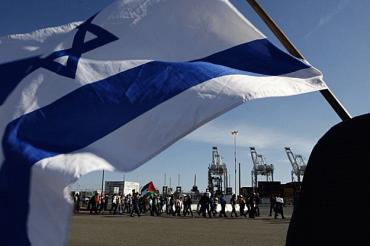
Protesters prevent unloading of Israeli ship


Marshall Schwartz of Oakland waves an Israeli flag across the road from pro-Palestinian supporters protesting the Israeli Zim Shipping Line at the Port of Oakland on Sunday.

John Sebastian Russo / The Chronicle

Marshall Schwartz of Oakland waves an Israeli flag across the road from pro-Palestinian supporters protesting the Israeli Zim Shipping Line at the Port of Oakland on Sunday.

Read more: http://www.sfgate.com/cgi-bin/article.cgi?f=/c/a/2010/06/20/BA0G1E28CV.DTL#ixzz0rTQuuXl3

David R. Baker, Chronicle Staff Writer

(06-20) 12:35 PDT OAKLAND — Hundreds of demonstrators, gathering at the Port of Oakland before dawn, prevented the unloading of an Israeli cargo ship.

The demonstrators, demanding an end to Israel’s blockade of the Gaza Strip, picketed at Berth 58, where a ship from Israel’s Zim shipping line is scheduled to dock later today. The day shift of longshoremen agreed not to cross the picket line.

International pressure to end the Gaza closure has increased since Israeli commandos stormed a flotilla of ships attempting to run the blockade on May 31, killing nine people. Last week, Israeli officials announced that they would loosen but not lift the blockade, allowing more goods to enter the impoverished area.

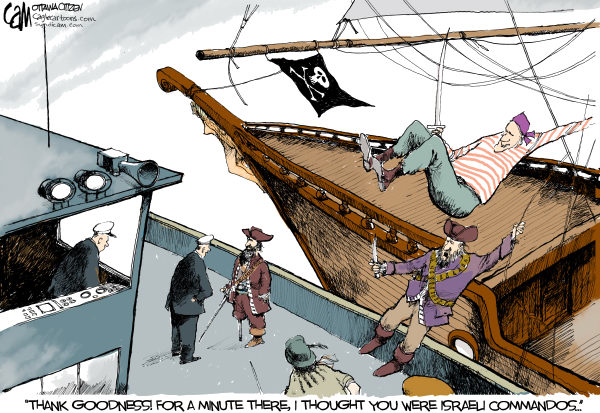
“Our view is that the state of Israel can not engage in acts of piracy and kill people on the high seas and still think their cargo can go anywhere in the world,” said Richard Becker, an organizer with ANSWER, one of many peace and labor groups involved in Sunday’s action.

Becker estimated that 600 to 700 people joined the demonstration, many of them arriving at 5:30 a.m. Oakland police, who estimated the crowd at 500 people, reported no arrests.

The demonstrators want to block the unloading of the Zim ship for a full day. After convincing the day shift of longshoreman to honor the picket line, the demonstrators dispersed around 10 a.m., Becker said. The ship is scheduled to arrive in mid-afternoon, and the demonstrators plan to gather again around 4:30 p.m. and re-establish their picket line before the evening shift of longshoremen arrives at 6 p.m.

Read more: http://www.sfgate.com/cgi-bin/article.cgi?f=/c/a/2010/06/20/BA0G1E28CV.DTL#ixzz0rQNEcyi1

Blog at WordPress.com.

Up ↑