Search

band annie's Weblog

I have a parallel blog in French at http://anniebannie.net

Category

israel

The Second World Power

By Vittorio Arrigoni, Gaza City, Gaza
July 4, 2010

Ketchup, mayonnaise, thread and needles are the items that were included last week by Israel on the list of those few goods now allowed into Gaza. Farming tools, spare parts for cars, toys and make-up were added to the list on Tuesday, items we watched being carried into the Strip loaded onto 130 trucks.
 
Taking into account the decision of the Israeli government to “loosen” the siege of Gaza by allowing the entry of more goods, B’Tselem, the Israeli organisation for human rights commented: “This is a first, tiny step towards the right direction, the direction which’ll bring Israeli policy in line with its obligations.” 

A veritable microscopic step, considering that before the start of the siege, more than ten thousand trucks a month would drive through the Karni pass alone, and even then, these deliveries were miles away from the 500 truckfuls of goods a day (15,000 trucks a month), the minimum decreed by the United Nations to cover the basic needs of one and a half million people.

According to some Palestinian political analysts, this step might even be counterproductive, because it proposes to attempt to legitimise the siege. This is a siege that is a form of collective punishment against a civilian population. As such, it violates Article 33 of the Fourth Geneva Convention, and is considered illegal by all major human rights organisations, whether governmental or otherwise, as Amnesty International and the International Red Cross have recently decreed.
Cement, iron and any other building material continues to be banned from the Strip, so much so that according to the UN, one year after the Cast Lead bombings, 75% of the damaged buildings still gape open among the rubble.
 
According to Christopher Gunness, spokesman for the UNRWA (UN Agency for Palestinian refugees), Israel’s new policy is an attempt to throw smoke into the eyes of the international community and hide its blatant violation of international law: “The Israeli strategy is that of getting the world to talk about a random bag of cement being let in on one side, and a sponsored project on another. What we really need is complete and free access through all the passes.”  

All eyes are now turned towards the mirage of the opened Israeli passes. Yet, forgetting to take note of the Egyptian border is a mistake. Rafah continues to remain semi-open, or better still…semi-closed. The Egyptian border authorities refuse to let any type of goods through, including tons of food supplies and medicine collected during the last weeks by the union of Cairo chemists. The bullies of the infamous Egyptian Mubarak, renowned for their rough treatment of Palestinian civilians, including women, children and sick people, have sent back hundreds of travellers with regular passports and visas over the past few weeks. 

For internationals in Egypt who plan to come and report on what they see, or support the population of Gaza in any way, entering “the Rafah Pass” remains forbidding. John, a freelance journalist who accompanied us from the International Solidarity Movement to report on the daily harrassment that the farmers face from Israeli snipers at the border, eventually came in through the tunnels when he had grown tired of waiting for a pass that never came at Al Arish.  

Italian state television is trying to put through the message that the siege has been loosened as an act of generosity on the part of the Israeli government, but the reality is indeed very different. The siege itself needs to be totally lifted, because the people here certainly don’t need potato chips or toothpicks. They need cement, iron, medicine, medical supplies and all the essentials coming in the way they would normally come in…through import and export. Only that means will help boost the economy and make Gaza self-sufficient, besides opening the borders to make it possible for anyone to come into or leave this prison.
 
All that we have before our eyes these days is the artificial image of a tragic situation, made up to seem like an improvement after the cosmetic surgery of Israeli and Egyptian propaganda. Amid these far-reaching echoes of propaganda, Tony Blair’s congratulations to Israel for the alleged “loosening” of its blockade comes across as a strident contradition. Behind the smile of Blair, one the of puppet masters of the Quartet (USA, EU, Russia and UN) who for years has produced nothing but useless press releases, is all the rot of the stone caryatids jointly holding up the current Iraqi genocide, as well as the political laxity of European governments in the face of the Palestinian tragedy.
I’m keen to remind Tony Blair that if two extra bags of flour enter the besieged Strip, it certainly isn’t thanks to his work within the castrated quartet, or any other institution in charge of resolving the Israeli occupation of Palestine. It’s actually thanks to the sacrifices over many years of thousands of ordinary civilians throughout the world committed to the rights of Palestinians. It’s an effort that has culminated in the murder of nine Turkish activists on the Mavi Marmara, much the same way as before them, Tom Hurndall and Rachel Corrie gave their lives for the good of Gaza.

On the eve of the second Gulf war, the New York Times coined the phrase “second world power”, to define the global pacifist movement that filled thousands of squares around the world. These civilians were protesting against a war “that never before in history had been met with as much blatant hostility.” Well, that second world power has now joined us on the field and is siding with the Palestinians: it is now Israel that’s under siege.

Stay human.

Vittorio Arrigoni from Gaza city
(translated by Daniela Filippin)

Press TV -Epilogue-Israel and the Clash of Civilizations -06-28-2010

UK Church to boycott Israeli goods

By JONNY PAUL, JERUSALEM POST CORRESPONDENT
07/01/2010 04:21

Methodist Church rejects products from the West Bank.

LONDON – The Methodist Church of Britain voted on Wednesday to boycott Israeli-produced goods and services from the West Bank because of Israel’s “illegal occupation of Palestinian lands.”

“A majority of governments recognize the Israeli occupation of Palestinian territories as illegitimate under international law,” the church body said at its annual conference in Portsmouth.

The church body will now encourage Methodists across the UK to follow suit.

The motion stated that the boycott of goods “from illegal Israeli settlements” was in response to a call by the World Council of Churches – which advocates divestment from Israel – and by Palestinian civil society and “a growing number of Jewish organizations in Israel and worldwide.”

“The Methodist Conference notes the call of the World Council of Churches in 2009 for an international boycott of settlement produce and services and the support given for such a boycott by Christian leaders in Palestine in the Kairos document, Palestinian civil society and a growing number of Jewish organizations both inside Israel and worldwide and calls on the Methodist people to support and engage with this boycott of Israeli goods emanating from illegal settlements,” the church said.

Last year, the Methodist Church set up a working group to “work for an end to the Occupation, an end to the blockade of Gaza, adherence to international law by all sides and a just peace for all in the region.”

The resulting 54-page report produced by the church body, titled “Justice for Palestine and Israel,” met with a fierce condemnation by the Board of Deputies of British Jews, the Council of Christians and Jews and British Chief Rabbi Jonathan Sacks.

In a statement released after Wednesday’s vote, the church body said the decision, which carried unanimously, had the goal of ending “the existing injustice.”

“This decision has not been taken lightly, but after months of research, careful consideration and finally, today’s debate at the conference,” said Christine Elliott, secretary for external relationships. “The goal of the boycott is to put an end to the existing injustice. It reflects the challenge that settlements present to a lasting peace in the region.”

Jewish community leadership organizations reacted with dismay. In a joint statement, the Board of Deputies of British Jews and the Jewish Leadership Council said it was, “This is a very sad day, both for Jewish-Methodist relations and for everyone who wants to see positive engagement with the complex issues of Israeli-Palestinian relations. The Methodist Conference has swallowed hook, line and sinker a report full of basic historical inaccuracies, deliberate misrepresentations and distortions of Jewish theology and Israeli policy.

“The deeply flawed report is symptomatic of a biased process: The working group which wrote the report had already formed its conclusions at the outset. External readers were brought in to give the process a veneer of impartiality, but their criticisms were rejected. The report’s authors have abused the trust of ordinary members of the Methodist Church, who assumed that they were reading and voting on an impartial and comprehensive paper, and they have abused the goodwill of the Jewish community, which tried to engage with this issue, only to find that our efforts were treated as an unwelcome distraction,” the statement said.

David Gifford, the chief executive of the Council of Christians and Jews, said he was disappointed that the Israeli narrative was not heard during the debate.

“I was very disappointed at the emotive nature of the debate which again did not hear fairly also the pain and cry of the Israeli,” Gifford said. “It was right to hear the pain of the Palestinian but in the end the vote of the Methodist Conference was to boycott goods and services that originate from the West Bank. We shall have to see how this will affect future relationships of the Methodist Church with other churches, the CCJ [Council of Christians and Jews] and with the British Jewish community.”

The Board of Deputies said the conference should “hang its head in shame.”

“This outcome is extremely serious and damaging, as we and others have explained repeatedly over recent weeks. Israel is at the root of the identity of Jews and of Judaism, and as an expression of Jewish spiritual, national and emotional aspirations. Zionism cannot simply be ruled as illegitimate in the way that the conference has purported to do. This smacks of breathtaking insensitivity, as crass as it is misinformed. That this position should now form the basis of Methodist Church policy should cause the conference to hang its head in shame, just as surely as it will cause the enemies of peace and reconciliation to cheer from the sidelines.”

Anti-Zionist and anti-Israel activists who support a blanket boycott of Israel were the main sources of the document. They included Israeli-born academics Ilan Pappe and Avi Shlaim; Jeff Halper from the Israeli Committee against House Demolitions; Anglican vicar Stephen Sizer; and Beirut-based journalist Robert Fisk.

‘THE BIG BOYCOTT WEEK’: July 9 – 17th 2010

BIG BOYCOTT ACTIONS AT MORRISONS and SAINSBURY

SUPERMARKETS

BIG BOYCOTT PHONE IN

BIG BOYCOTT WRITE IN

BIG BOYCOTT BADGE PLEDGE

People of conscience all over the world want nothing to do with the Apartheid State of Israel. We don’t want Israeli goods in our supermarkets.

Week of action: July 9 – 17th 2010.

Demand an end to the sale of Israeli produce in our supermarkets.

The BIG Boycott Phone in: Friday July 9th 2010.

On July 9th – join the BIG boycott phone in: Use your voice – complain; ask questions.

Phone Morrisons; 0845 611 6111 (Lines open 730 a.m. – 6.30 p.m).

Phone Sainsbury 0800 636 262 (lines open 8 a.m. – 7 p.m.)

Ask why and demand answers:

Why is your supermarket sourcing produce from a country that repeatedly violates international law?

Why is your supermarket sourcing produce from companies that operate on land where Palestinians cannot live or work? (the Jordan Valley)

Why are you sourcing produce from companies that operate in illegal settlements and which benefit from an Apartheid system inside Israel?

Why are you sourcing produce from companies which are all benefitting from the illegal theft of Palestinian water and the theft of Palestinian land?

The BIG Boycott Write in: July 9th 2010

Write to Morrisons Head Office or to your local store manager.

To e mail: http://www.morrisons.co.uk/Store-finder/About-customer-services/Contact-Us1/
Or write to: Morrisons head Office: Hilmore House, Gain lane, Bradford, BD3 7DL.

Write to Sainsbury Head Office: J. Sainsbury plc, Holborn Place, 33 Holborn, Londond EC1 N2HT. Head Office Phone no: 0207 6956000.

Challenge them on the fact that they are trading with Israeli companies. Call for an end to business with Israeli companies which are profiting from Israeli occupation and Israel’s apartheid policies. The Israeli export companies known to be supplying British supermarkets, including Carmel Agrexco, Arava and Mehadrin Tnuport Export (MTEX) are all profiting from Israel’s violations of international law.

The BIG Boycott Badge Pledge: July 9th 2010

Make a pledge to wear your Boycott Israeli Goods badge, or any Boycott Israel badge.

Wear your Boycott Israeli Goods badge and keep on wearing it! Israel has been in the news so much that people are noticing badges and now is the time to tell people about the boycott, in whatever way we can. Wear badges; give out badges on the street; call on all your supporters to wear badges.

Palestinian boycott of Israeli settlement goods starts to bite

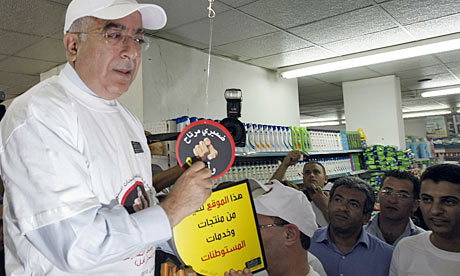
Palestinian prime minister, Salam Fayyad, promotes boycott of goods produced by Israeli settlements The Palestinian prime minister, Salam Fayyad, promotes the Store to Store campaign, part of drive to boycott of goods produced by Israeli settlements in the occupied West Bank. Photograph: Jaafar Ashtiyeh/AFP/Getty Images

Campaign to clear supermarket shelves of West Bank settlement wares forces Israeli factories to cut production

Israeli factories based in settlements on the West Bank have been forced to cut back production as a growing Palestinian boycott movement begins to take effect.

The boycott, endorsed by the Palestinian president, Mahmoud Abbas, was given further momentum this week when a campaign to clear supermarket shelves of produce originating in settlements was rolled out in Ramallah.

“The objective is to ensure the Palestinian market is free of Israeli settlement produce by the end of this year,” the Palestinian prime minister, Salam Fayyad, said at the launch of the Store to Store campaign at the Alameen supermarket.

A team of volunteers will inspect 66,000 stores across the West Bank in the coming weeks, awarding certificates and window stickers to those free of settlement produce.

After a period of grace, shopkeepers retaining such produce in their stores could be liable to a fine of more than £9,000 or up to five years in prison under a law already passed but not yet enforced by the Palestinian legislative council.

“This is the daily expression of rejection of the occupation,” Fayyad said. “It will help ensure that the Palestinian economy is self-sufficient. There will not be a store in Palestine which cannot carry our stickers.”

The pro-boycott campaigners are careful to draw a distinction between produce from West Bank settlements, which are illegal under international law, and produce originating from within Israel. The latter will continue to be sold in Palestinian shops.

The campaign has been attacked by Israeli politicians, businesses and commentators. “The Palestinians are opposing economic peace and are taking steps that in the end hurt themselves,” the Israeli prime minister, Binyamin Netanyahu, said last month.

The West Bank market is worth around $200m (£133m) a year to Israeli businesses. But some settlement factories sell about 30% of their output to the Palestinian market, and the boycott is already having an impact on them.

Seventeen factories in Mishor Adumim, a large industrial estate between East Jerusalem and Jericho, have reportedly closed since the boycott campaign began. Some settlement factories are reported to be considering moving back into Israel.

Others in the Barkan industrial zone, near the settlement of Ariel, have reduced production, according to David Ha’ivri of the Shomron regional council, a pro-settler organisation in the northern West Bank. “Many of the factories are seeking alternative markets,” he said.

A factory producing aluminium window frames, which used to sell 30% of its output to the Palestinian market, had cut the hours of its 160 employees rather than lay people off, he said.

More than half the 5,000-6,000 employees in the Barkan zone are Palestinian, employed under Israeli labour legislation and entitled to the Israeli minimum wage of around $1,000 a month – considerably more than the average wage in the West Bank economy.

“[The boycott] is an unwise act by the Palestinian Authority,” said Ha’ivri. “The damage caused will be felt by both sides. They’re cutting off the branch they’re sitting on.”

The Palestinian Authority has established a $50m fund to provide alternative employment and grants in an effort to both discourage Palestinians from working in the settlements and foster the West Bank economy.

According to the Manufacturers Association of Israel, some 22,000 Palestinians are employed by settlement businesses – in construction, agriculture, manufacturing and service industries.

It is holding an extraordinary meeting this week to ascertain the impact of the boycott and consider what action to take.

Dan Catarivas of the association said firms were more concerned about the withdrawal of Palestinian labour than the boycott of goods, although the impact was uneven.

“These Israeli firms will have to find new workers – either Israelis or foreigners. But at the end of the day the Israeli companies will find other options, and the Palestinian workers will be left without jobs.”

He said the Israeli government had offered incentives to firms to establish factories in the West Bank, and it was possible that some of them may now seek compensation for their losses.

The Palestinian Authority said it was pleased with the level of support for the boycott, put in a recent survey at around 85%. Fayyad said it was “empowering the people” to resist the Israeli occupation without resorting to violence. “People feel national pride that they can participate in this campaign,” a spokesman said.

The boycott is part of a wider attempt to foster non-violent resistance against Israel’s occupation, including largely peaceful demonstrations against the separation barrier.

Internationally, the boycott is gaining momentum. European Union guidelines urge supermarkets to clearly mark the origin of produce on labels to allow consumers to distinguish between Palestinian, Israeli and settlement produce.

The Alameen supermarket owner, Erekat Ribhi Shukar, insisted Palestinian produce was competitive in terms of quality and price with settlement goods. “We should support Palestinian producers to help our economy,” he said beneath a sign declaring “My conscience is clear – my store is clean of settlement produce”.

At the rear of the store, two young women shoppers examining a chiller cabinet containing Palestinian and Israeli dairy products but no settlement goods said they backed the campaign. “We want products that benefit our economy, not harm it,” said one.

source

Condemnation over Gaza attack

BRISTOL City Council has voted to condemn Israel for the Gaza convoy incident that saw nine human rights activists killed.

Members called for the Government to “hold Israel to account for this illegal action” and to impose sanctions on the country until it “complies with international law and ceases perpetrating human rights abuses”.

Two Bristol men were aboard the Freedom Flotilla of ships when the Israeli military opened fire on May 31. One of them, Cliff Hanley, spoke in support of the motion before last night’s council debate.

He was joined by a number of pro-Palestinian protesters outside the council chamber, who want a boycott of all Israeli goods and companies in Bristol.

Mr Hanley said: “We question the morality of the council having money invested in Israeli banks or investment funds where it gains interest derived in any way over 60 years of ethnic cleansing of historic Palestine, the illegal occupation of the West Bank and the brutal starvation and slaughter of the people in Gaza.”

Proposing the motion, Lib Dem councillor John Kiely (Easton) compared life in Gaza to Bristol during the Blitz.

The Conservatives put forward an alternative motion, with what they described as “less emotive language” and calling for Israel to “exercise restraint”.

The amendment failed and while the Conservatives voted against the Lib Dem motion, the majority of the council approved it.

source

The attack on the Gaza relief flotilla jeopardizes Israel itself

.

By John J. Mearsheimer

Israel’s botched raid against the Gaza-bound humanitarian flotilla on May 31 is the latest sign that Israel is on a disastrous course that it seems incapable of reversing. The attack also highlights the extent to which Israel has become a strategic liability for the United States. This situation is likely to get worse over time, which will cause major problems for Americans who have a deep attachment to the Jewish state.

The bungled assault on the Mavi Marmara, the lead ship in the flotilla, shows once again that Israel is addicted to using military force yet unable to do so effectively. One would think that the Israel Defense Forces (IDF) would improve over time from all the practice. Instead, it has become the gang that cannot shoot straight.

The IDF last scored a clear-cut victory in the Six Day War in 1967; the record since then is a litany of unsuccessful campaigns. The War of Attrition (1969-70) was at best a draw, and Israel fell victim to one of the great surprise attacks in military history in the October War of 1973. In 1982, the IDF invaded Lebanon and ended up in a protracted and bloody fight with Hezbollah. Eighteen years later, Israel conceded defeat and pulled out of the Lebanese quagmire. Israel tried to quell the First Intifada by force in the late 1980s, with Defense Minister Yitzhak Rabin telling his troops to break the bones of the Palestinian demonstrators. But that strategy failed and Israel was forced to join the Oslo Peace Process instead, which was another failed endeavor.

read on

Essay of the week: What drives Israel?

Hearld Scotland

By Ilan Pappe
Published on 6 Jun 2010

Probably the most bewildering aspect of the Gaza flotilla affair has been the righteous indignation expressed by the Israeli government and
people.

The nature of this response is not being fully reported in the UK
press, but it includes official parades celebrating the heroism of the
commandos who stormed the ship and demonstrations by schoolchildren
giving their unequivocal support for the government against the new
wave of anti-Semitism.

As someone who was born in Israel and went enthusiastically through
the socialisation and indoctrination process until my mid-20s, this
reaction is all too familiar. Understanding the root of this furious
defensiveness is key to comprehending the principal obstacle for peace
in Israel and Palestine. One can best define this barrier as the
official and popular Jewish Israeli perception of the political and
cultural reality around them.

A number of factors explain this phenomenon, but three are outstanding
and they are interconnected. They form the mental infrastructure on
which life in Israel as a Jewish Zionist individual is based, and one
from which it is almost impossible to depart – as I know too well from
personal experience.

The first and most important assumption is that what used to be
historical Palestine is by sacred and irrefutable right the political,
cultural and religious possession of the Jewish people represented by
the Zionist movement and later the state of Israel.
Most of the Israelis, politicians and citizens alike, understand that
this right can’t be fully realised.

But although successive
governments were pragmatic enough to accept the need to enter peace
negotiations and strive for some sort of territorial compromise, the
dream has not been forsaken. Far more important is the conception and
representation of any pragmatic policy as an act of ultimate and
unprecedented international generosity.

Any Palestinian, or for that matter international, dissatisfaction
with every deal offered by Israel since 1948, has therefore been seen
as insulting ingratitude in the face of an accommodating and
enlightened policy of the “only democracy in the Middle East”. Now,
imagine that the dissatisfaction is translated into an actual, and
sometimes violent, struggle and you begin to understand the righteous
fury. As schoolchildren, during military service and later as adult
Israeli citizens, the only explanation we received for Arab or
Palestinian responses was that our civilised behaviour was being met
by barbarism and antagonism of the worst kind.

According to the hegemonic narrative in Israel there are two malicious
forces at work. The first is the old familiar anti-Semitic impulse of
the world at large, an infectious bug that supposedly affects everyone
who comes into contact with Jews. According to this narrative, the
modern and civilised Jews were rejected by the Palestinians simply
because they were Jews; not for instance because they stole land and
water up to 1948, expelled half of Palestine’s population in 1948 and
imposed a brutal occupation on the West Bank, and lately an inhuman
siege on the Gaza Strip.

This also explains why military action seems
the only resort: since the Palestinians are seen as bent on destroying
Israel through some atavistic impulse, the only conceivable way of
confronting them is through military might.

The second force is also an old-new phenomenon: an Islamic
civilisation bent on destroying the Jews as a faith and a nation.
Mainstream Israeli orientalists, supported by new conservative
academics in the United States, helped to articulate this phobia as a
scholarly truth. These fears, of course, cannot be sustained unless
they are constantly nourished and manipulated.

From this stems the second feature relevant to a better understanding
of the Israeli Jewish society. Israel is in a state of denial. Even in
2010, with all the alternative and international means of
communication and information, most of the Israeli Jews are still fed
daily by media that hides from them the realities of occupation,
stagnation or discrimination.

This is true about the ethnic cleansing
that Israel committed in 1948, which made half of Palestine’s
population refugees, destroyed half the Palestinian villages and
towns, and left 80% of their homeland in Israeli hands. And it’s
painfully clear that even before the apartheid walls and fences were
built around the occupied territories, the average Israeli did not
know, and could not care, about the 40 years of systematic abuses of
civil and human rights of millions of people under the direct and
indirect rule of their state.

Nor have they had access to honest reports about the suffering in the
Gaza Strip over the past four years. In the same way, the information
they received on the flotilla fits the image of a state attacked by
the combined forces of the old anti-Semitism and the new Islamic
Judacidal fanatics coming to destroy the state of Israel. (After all,
why would they have sent the best commando elite in the world to face
defenceless human rights activists?)

As a young historian in Israel during the 1980s, it was this denial
that first attracted my attention. As an aspiring professional scholar
I decided to study the 1948 events and what I found in the archives
sent me on a journey away from Zionism. Unconvinced by the
government’s official explanation for its assault on Lebanon in 1982
and its conduct in the first Intifada in 1987, I began to realise the
magnitude of the fabrication and manipulation. I could no longer
subscribe to an ideology which dehumanised the native Palestinians and
which propelled policies of dispossession and destruction.

The price for my intellectual dissidence was foretold: condemnation
and excommunication. In 2007 I left Israel and my job at Haifa
University for a teaching position in the United Kingdom, where views
that in Israel would be considered at best insane, and at worst as
sheer treason, are shared by almost every decent person in the
country, whether or not they have any direct connection to Israel and
Palestine.

That chapter in my life – too complicated to describe here – forms the
basis of my forthcoming book, Out Of The Frame, to be published this
autumn. But in brief, it involved the transformation of someone who
had been a regular and unremarkable Israeli Zionist, and it came about
because of exposure to alternative information, close relationships
with several Palestinians and post-graduate studies abroad in Britain.
My quest for an authentic history of events in the Middle East
required a personal de- militarisation of the mind.

Even now, in 2010,
Israel is in many ways a settler Prussian state: a combination of
colonialist policies with a high level of militarisation in all
aspects of life. This is the third feature of the Jewish state that
has to be understood if one wants to comprehend the Israeli response.
It is manifested in the dominance of the army over political, cultural
and economic life within Israel. Defence minister Ehud Barak was the
commanding officer of Benjamin Netanyahu, the prime minister, in a
military unit similar to the one that assaulted the flotilla. That
background was profoundly significant in terms of the state’s Zionist
response to what they and all the commando officers perceived as the
most formidable and dangerous enemy.

You probably have to be born in Israel, as I was, and go through the
whole process of socialisation and education – including serving in
the army – to grasp the power of this militarist mentality and its
dire consequences. And you need such a background to understand why
the whole premise on which the international community’s approach to
the Middle East is based, is utterly and disastrously wrong.
The international response is based on the assumption that more
forthcoming Palestinian concessions and a continued dialogue with the
Israeli political elite will produce a new reality on the ground. The
official discourse in the West is that a very reasonable and
attainable solution – the two states solution – is just around the
corner if all sides would make one final effort. Such optimism is
hopelessly misguided.

The only version of this solution that is acceptable to Israel is the
one that both the tamed Palestine Authority in Ramallah and the more
assertive Hamas in Gaza could never accept. It is an offer to imprison
the Palestinians in stateless enclaves in return for ending their
struggle. And thus even before one discusses either an alternative
solution – one democratic state for all, which I myself support – or
explores a more plausible two-states settlement, one has to transform
fundamentally the Israeli official and public mindset. It is this
mentality which is the principal barrier to a peaceful reconciliation
within the fractured terrain of Israel and Palestine.

How can one change it? That is the biggest challenge for activists
within Palestine and Israel, for Palestinians and their supporters
abroad and for anyone in the world who cares about peace in the Middle
East. What is needed is, firstly, recognition that the analysis put
forward here is valid and acceptable. Only then can one discuss the
prognosis.

It is difficult to expect people to revisit a history of more than 60
years in order to comprehend better why the present international
agenda on Israel and Palestine is misguided and harmful. But one can
surely expect politicians, political strategists and journalists to
reappraise what has been euphemistically called the “peace process”
ever since 1948. They need also to be reminded that what actually
happened.

Since 1948, Palestinians have been struggling against the ethnic
cleansing of Palestine. During that year, they lost 80% of their
homeland and half of them were expelled. In 1967, they lost the
remaining 20%. They were fragmented geographically and traumatised
like no other people during the second half of the 20th century. And
had it not been for the steadfastness of their national movement, the
fragmentation would have enabled Israel to take over historical
Palestine as a whole and push the Palestinians into oblivion.

Transforming a mindset is a long process of education and
enlightenment. Against all the odds, some alternative groups within
Israel have begun this long and winding road to salvation. But in the
meantime Israeli policies, such as the blockade on Gaza, have to be
stopped. They will not cease in response to feeble condemnations of
the kind we heard last week, nor is the movement inside Israel strong
enough to produce a change in the foreseeable future. The danger is
not only the continued destruction of the Palestinians but a constant
Israeli brinkmanship that could lead to a regional war, with dire
consequences for the stability of the world as a whole.

In the past, the free world faced dangerous situations like that by
taking firm actions such as the sanctions against South Africa and
Serbia. Only sustained and serious pressure by Western governments on
Israel will drive the message home that the strategy of force and the
policy of oppression are not accepted morally or politically by the
world to which Israel wants to belong.

The continued diplomacy of negotiations and “peace talks” enables the
Israelis to pursue uninterruptedly the same strategies, and the longer
this continues, the more difficult it will be to undo them. Now is the
time to unite with the Arab and Muslim worlds in offering Israel a
ticket to normality and acceptance in return for an unconditional
departure from past ideologies and practices.

Removing the army from the lives of the oppressed Palestinians in the
West Bank, lifting the blockade in Gaza and stopping the racist and
discriminatory legislation against the Palestinians inside Israel,
could be welcome steps towards peace.

It is also vital to discuss seriously and without ethnic prejudices
the return of the Palestinian refugees in a way that would respect
their basic right of repatriation and the chances for reconciliation
in Israel and Palestine. Any political outfit that could promise these
achievements should be endorsed, welcomed and implemented by the
international community and the people who live between the river
Jordan and the Mediterranean Sea.

And then the only flotillas making their way to Gaza would be those of
tourists and pilgrims.

Ilan Pappe is professor of history at the University of Exeter, and
director of the European Centre for Palestine Studies. His books
include The Ethnic Cleansing Of Palestine and A History Of Modern
Palestine. His forthcoming memoir, Out Of The Frame (published this
October by Pluto Press), will chart his break with mainstream Israeli
scholarship and its consequences.

http://www.heraldscotland.com/comment/guest-commentary/essay-of-the-week-what-drives-israel-1.1032971

———————————————————————–
ePalestine Blog:
http://www.epalestine.com
Israel’s Dubious Investigation of Flotilla Attack

by Stephen Zunes

Few decisions of the Obama administration have outraged the peace and human rights community as much as its successful efforts to block an international inquiry into May’s Israeli aid flotilla attack.

Instead, supported by leading Republican and Democratic members of Congress, the Obama administration has thrown its weight behind an investigative committee handpicked by right-wing Israeli Prime Minister Benyamin Netanyahu to examine the incident.

The three-member panel is not a full committee of inquiry as defined under Israeli law, so it does not have subpoena power or the ability to question Israeli soldiers. Nor can it compel anyone in the military to provide evidence.

All the committee members can do is request documents and “summaries of operational investigations” that have already been conducted by the Israeli military itself.

The committee would not have the authority to even request testimony or other evidence “in regard to military personnel and personnel from the other security forces.”

They would not be able to interview any soldiers or officers individually or even see their testimony or statements, instead relying only on “summaries” and other documents of internal military inquiries. These are generally done by officers who have no training in such inquiries on possible violations of international law.

At most, the conclusions the panel gets will be lessons learned rather than any kind of investigation into possible criminal wrongdoing.
Israel’s Claims

“Israel claims the panel is independent, but insists that it accept the military’s version of events,” said Sarah Leah Whitson, Middle East director at Human Rights Watch. “Given the Israel’s military poor record of investigating itself in past cases of possible wrongful death, it is hard to have confidence that the panel’s dependence on the Israeli military will lead to the truth.”

There are also questions regarding the committee’s makeup. None of the three members has any experience in this sort of inquiry. The committee is led by the conservative former Israeli Supreme Court Chief Justice Jacob Turkel, who has attacked credible international inquiries into Israeli violations of international humanitarian law.

A second member is Amos Horev, a reserve Israeli major general and major figure in the Israeli military industrial complex.

The third member is Shabtai Rosen, a 93-year-old law professor who was involved in the cover-up of the 1953 massacre in the village of Qibya when Israeli forces crossed into Jordanian territory, destroying 41 buildings (including the school) and killing 60 villagers.

The Obama administration and other supporters of Netanyahu have emphasized the presence of two foreign observes, Canadian Brigadier General Kenneth Watkin and Northern Ireland’s pro-British Unionist Party leader David Trimble.

The news media has emphasized that Trimble won a Nobel Peace Prize for his role in the Good Friday peace accord. What they have largely failed to mention is that Trimble was also one of the key players — along with right-wing former Bush UN ambassador John Bolton and the conservative former Spanish Prime Minister Jose Maria Aznar — in a group organized late last month known as “Friends of Israel.”

The initiative was launched, according to Trimble and the other sponsors, because of their concern about “the onslaught of radical Islamism” and outrage over the “unprecedented delegitimization campaign against Israel, driven by the enemies of the Jewish state and perversely assumed by numerous international authorities.”

Watkin has been implicated in a scandal, arising from the disappearance and torture of several detainees arrested by the Canadian Forces and turned over to Afghan security services. When called to speak before the Canadian House of Commons, he refused to answer questions about his role in authorizing the transfers despite knowledge of the likelihood of torture and other maltreatment of the prisoners.

International Response

UN Secretary General Ban Ki Moon noted how Netanyahu’s panel was “not sufficient enough to have international credibility.” The leading Israeli daily newspaper Ha’aretz, in its analysis of the probe, editorialized, “The government’s efforts to avoid a thorough and credible investigation of the flotilla affair seem more and more like a farce.”

By contrast, the Obama White House issued a statement praising the formation of the committee as an “important step forward,” insisting that “the structure and terms of reference of Israel’s proposed independent public commission can meet the standard of a prompt, impartial, credible and transparent investigation,” as called for by the UN Security Council. U.S. Deputy Permanent Representative to the UN Alejandro Wolff insisted, “We are convinced and support an Israeli investigation…and have every confidence that Israel can conduct a credible and impartial and transparent, prompt investigation internally.”

Congressional Democrats have defended the Obama’s decision to cover-up for the incident and prevent a credible investigation. Even though Human Rights Watch and Amnesty International have documented the failure of the Netanyahu government to investigate possible war crimes by its armed forces, Rep. Barney Frank (D-MA) recently insisted that “the Israeli government…has a very good record of holding the Israeli government to account,” and that “the Israeli government has a better record of legitimate self-criticism than almost any other government in the world.”

Turning the consensus of international human rights organizations on its head, Frank argues that the only a group “commissioned by the Israeli government” would have credibility, while “clearly no inquiry chartered by the U.N. would have the credibility.”

Other congressional Democrats have insisted that the right-wing Israeli government of Benyamin Netanyahu be entrusted with the investigation, including Brad Ellsworth (D-IN), Jesse Jackson, Jr. (D-IL), Rep. Sestak (D-PA), and Senate majority leader Harry Reid (D-NV).

All this comes in spite of a recent public opinion poll shows a clear majority of Americans — including 65 percent of Democrats — favor an international inquiry over allowing Israel alone to investigate the circumstances of the attack.

It appears, then, that the Obama administration and its allies in Congress are committed to burying the truth and preventing Israel’s right-wing government from any culpability for its attack.

Quid Pro Quo?

At the same time, however, the Obama administration’s acceptance of this whitewash might have been an explicit quid pro quo: The United States would defend the suppression of the truth in the Israeli attack in return for Israel substantially loosening the blockade of humanitarian goods. If true, this maneuver would be yet another case of Obama provoking the outrage of the left wing of his party in order to pursue a behind-the-scenes deal he believes will advance the greater good. Some analysts, like Marc Lynch, make a compelling case that such a trade-off is worthwhile, in terms of easing an enormous level of human suffering as a result of the four-year old-siege.

While tactically defensible, such a quid pro quo is strategically questionable. Given the Israeli government’s history of reneging on its various international commitments, there are questions as to how comprehensive this lifting of the blockade actually may be and how long it will last. It would also mark yet another bad precedent of the United States effectively granting an ally a license to get away with violating international humanitarian law and other illegal activities, thereby further weakening the international legal protection of civilians.

The apparent weakening of the blockade is cause for cautious optimism. But global civil society must continue to pressure governments to ensure that Israel — no more or less than any other country — be held accountable for its violations of international legal norms.

Stephen Zunes, a Foreign Policy In Focus analyst, is a professor of politics and international studies at the University of San Francisco.

source

Blog at WordPress.com.

Up ↑