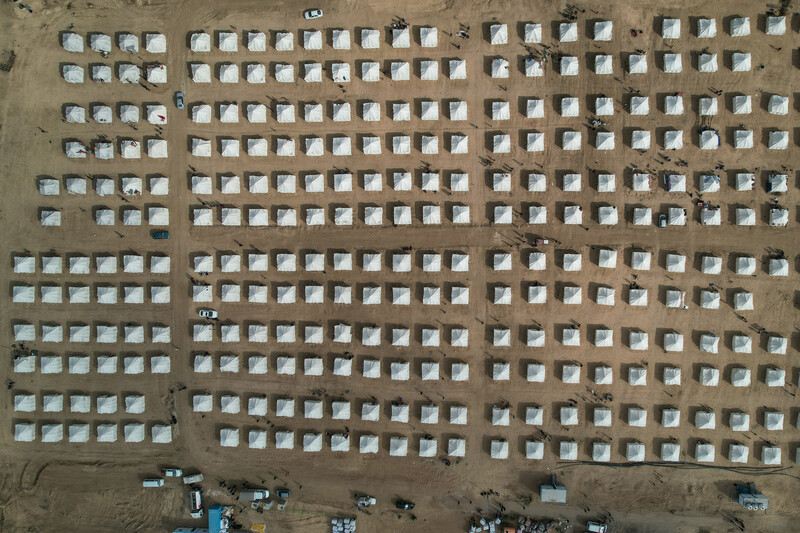
A general view of a tent city in the southern area of Khan Younis, built by Egypt and the Palestine Red Crescent Society, to shelter thousands of Palestinians forcibly displaced by Israel’s genocide in the Gaza Strip. Mohammed TalateneDPA via ZUMA Press / APA images
An Israeli entrepreneur who participated in the genocide in Gaza has pitched a plan to a European firm for the territory’s future.
The Gaza Strip – which the plan assumes would be conquered and controlled by Israel – would be divided into two zones. In the northern zone, Palestinian collaborators would be permitted to live in relative comfort, while those who refuse to serve and obey their Israeli masters would be banished to a southern “area of terror.”
The Electronic Intifada has seen a copy of this so-called “day-after plan.”
The pitch exposes the frightening colonial mindset and condescendingly racist view of Palestinians pervasive in Israel. It also reveals an underlying desire to conquer and control every inch of Palestine, including Gaza.
The plan was submitted by Or Bokobza, an Israeli reserve officer in the Sayeret Matkal elite commando unit, who was deployed in Gaza for several weeks during October and November.
Bokobza lives in New York City, but was in Israel on 7 October when the Palestinian resistance group Hamas led a military operation that destroyed the Israeli army’s Gaza Division, which is responsible for enforcing Israel’s siege on the territory.
Bokobza “immediately reported for duty and was deployed to root out the Hamas fighters that day,” according to a glowing profile in The Wall Street Journal.
Bokobza, who spent eight years in Israel’s army, far longer than the mandatory service requirement, has also participated in “every war since 2005.”
He is also the chief executive of Venn, a company that makes software for large-scale residential landlords to manage, monitor and extract maximum rents and revenue from tenants. It has received $100 million in venture capital, according to The Wall Street Journal.
At least 15 percent of his employees also enlisted as reservists with Israel’s military after the genocidal war on Gaza was declared.
Now Bokobza undoubtedly hopes to profit from the destruction and slaughter – although his proposal is pitched as good for Israel and even good for Palestinians in Gaza.
Another Israeli businessman Eran Haggiag is also named in the proposal, The Electronic Intifada learned. Haggiag is a co-founder of Bokobza’s company Venn.
Post-genocide dreams
Bokobza’s proposal calls for the total destruction of northern Gaza and its reconstruction as a managed colony – Gaza 2.0, where Palestinians who behave according to the rules set by Israel will be allowed to stay. Those who misbehave will be expelled to a hellscape in southern Gaza, or as he calls it, Gaza 1.0 – the “area of terror.”
The plan reads as a cross between a Silicon Valley elevator pitch and the script for a sci-fi horror movie.
But to the extent it purports to be a real plan, it is not the first of its kind. In the early 1990s, when the Oslo accords were signed between Israel and the Palestine Liberation Organization, media hyped that Gaza would turn into a “Singapore on the Mediterranean.”
Such notions were revived again after Israel redeployed its occupation forces to the perimeter of Gaza in 2005 and then began imposing an ever-tightening siege.
The condition behind these pie-in-the-sky promises – whether in Gaza or the West Bank – has always been that Palestinians surrender any hopes of self-determination and instead settle for economic crumbs while Israel retains all real power over their lives.
In the event, under the guise of the “peace process,” Israel began to isolate Gaza and systematically “de-develop” its economy, as scholar Sara Roy describes. At the same time it has accelerated its colonization of the West Bank, corralling Palestinians into ever-shrinking islands of land surrounded by a sea of Israeli settler-colonies.
Bokobza’s vision is in this tradition, albeit with the nightmare softened by the cheerful language of a real estate brochure and sprinkled with upbeat tech charlatanry.
“A week ago I stood in Gaza watching the sunrise over a land destroyed by conflict,” says his proposal submitted to the European firm in late November.
“Gaza is a truly beautiful place, with incredible views, beaches and full of potential,” he says of the killing fields where thousands of dead Palestinians still lie under the rubble of their homes and in makeshift mass graves.
“On 7 October, I put on my army uniform and in that moment I switched from being Or the entrepreneur to Or the soldier and I immediately started to think like a soldier again,” he says.
“You take orders and you execute. You can question the how but not the why, not the big picture or the strategy, I realized that we all put on our army uniform on 7 October and started thinking like soldiers, especially our leaders.”
While participating in the genocide and the bombing and shelling campaign described to be “among the deadliest and most destructive in recent history,” Bokobza dreamed of what to do on the ruins “with the help of the US and certain Arab states” in order to serve Israel’s pipe dream of subduing Palestinian resistance once and for all.
His plan would permanently partition northern and southern Gaza respectively into “the area of hope and the area of terror.”
Bokobza hoped Israel would start implementing the plan as soon as December 2023 and begin turning Gaza into “the poster boy of hope for the Palestinian people.” But that assumed that Israel would quickly defeat the Palestinian resistance and gain control of all or most of Gaza.
That has not happened, however, as the resistance continues to inflict heavy losses on the Israeli invaders in every part of Gaza.
Meanwhile, according to the plan, “the south will serve as a transition area for those awaiting relocation” – an apparent endorsement of ethnic cleansing of those Palestinians who cannot prove their loyalty and utility to Israel.
Residents of this imaginary plan would be recruited “through inspiring brochures that we will drop in the millions from the sky,” which will contain plan details and application procedures.
This plan does not explain how Palestinians displaced, starving, dying of thirst, living with untreated injuries, illnesses and trauma, and cut off from communications, will submit their “applications,” or why they would even consider trusting Israel.
“Applicants will commit to not having any association with terror groups and their residency will be revoked if they do,” Bokobza writes.
Bokobza describes a digital application process and a committee to determine who could live in the proposed Gaza 2.0 made up of Saudis, Emiratis, Americans, Israelis and Palestinian collaborators.
“One mistake and you’re out to the old Gaza without a way to come back for a few years,” Bokobza says, bringing together all the mindsets common to a landlord, prison warden and colonizer.
Helping Joe Biden
Bokobza is not shy that his motivation is entirely Israel’s benefit.
“This is not altruism for the Palestinian people,” he writes, adding that his plan would be the biggest blow to Hamas.
He calls for the Israeli government to begin implementing the project initially, before turning it over to Palestinian collaborators under Israeli supervision – similar to the Palestinian Authority in the occupied West Bank.
Bokobza also hopes that a plan marketed as helping Palestinians will result in “changing sentiment towards Israel in the international community” for the better.
Headlines would, he hopes, “turn to ‘Israel brought a solution’ instead of ‘Israel kills children.’”
Israel has killed tens of thousands of Palestinians in Gaza during its genocide. The United Nations has acknowledged that most victims are women and children.
Bokobza also markets his plan as an effort to bring “a success story” that will aid US President Joe Biden’s reelection campaign.
Destroy everything
Realizing Bokobza’s terrifying vision would begin with the total destruction of all buildings still standing in northern Gaza.
“We have taken over northern Gaza, most of the population evacuated south, we are eliminating all of Hamas’ infrastructure,” he writes.
“We will eliminate any infrastructure in northern Gaza that limits us from building the Gaza of the future.”
He repeatedly calls for total destruction.
“Demolition: Complete demolition of existing structures in Gaza City, paving the way for a fresh start and the construction of a robust infrastructure.”
On reflection, perhaps the closest analogy for this cynical and dystopian vision is Theresienstadt, the Nazi concentration camp that the German government used as a transit camp for Czech Jews who would be deported to death and labor camps across German-occupied Europe.
In Nazi propaganda, Theresienstadt was described as a “spa town,” where elderly Jews could “retire” in safety.
Palestinian children killed in Israeli attacks on Gaza
The Gaza Strip is a graveyard for thousands of children, the United Nations has said.
Since October 7, Israeli attacks have killed at least 10,000 children, according to Palestinian officials. That is one Palestinian child killed every 15 minutes, or about one out of every 100 children in the Gaza Strip.
Thousands more are missing under the rubble, most of them presumed dead.
The surviving children, who have endured the traumatic impact of multiple wars, have spent their lives under the shadow of an Israeli blockade, influencing every aspect of their existence from birth.
Support our work: https://democracynow.org/give We continue to look at the International Court of Justice’s interim ruling in South Africa v. Israel with Stockton University professor Raz Segal and human rights lawyer Diana Buttu. We discuss Israeli Prime Minister Benjamin Netanyahu’s response to the ruling, the role of the United States in stymying international action and more. We also hear more from ICJ president Joan Donoghue’s delivery of the ruling, including the court’s acknowledgement of the dire humanitarian crisis in Gaza. Democracy Now! is an independent global news hour that airs on over 1,500 TV and radio stations Monday through Friday. Watch our livestream at democracynow.org Mondays to Fridays 8-9 a.m. ET. Subscribe to our Daily Email Digest: https://democracynow.org/subscribe
As horrifying scenes from Gaza have been recorded, published, and replayed around the world, people have been jolted into action and have thrown themselves into solidarity work. This surge of activism is fuelled by visceral reactions to the harrowing realities of Israel’s ongoing genocide unfolding on the global stage. People are realising, by the thousands, that zionism is a political program of indigenous erasure and primitive resource accumulation.
Many new activists and reactivated organisers seek to translate their emotional responses into tangible support. They are also searching for community hubs, often in the form of organisations, that confront zionism and colonialism – the root cause of this genocide. Whether activists know it or not, they are looking for an anti-zionist home for their organising efforts. It is exactly the moment, therefore, to provide an honest discussion on some of the essential characteristics of this organising, firmly rooted in the principles of Palestinian liberation and decolonisation, peeling away any remaining layers of confusion or mystery. This essay aims to open the overdue conversation with some suggestions for individuals to consider as they search for their anti-zionist organising home.
If we accept, as those with even the most rudimentary understanding of history do, that zionism is an ongoing process of settler-colonialism, then the undoing of zionism requires anti-zionism, which should be understood as a process of decolonisation. Anti-zionism as a decolonial ideology then becomes rightly situated as an indigenous liberation movement. The resulting implication is two-fold. First, decolonial organising requires that we extract ourselves from the limitations of existing structures of power and knowledge and imagine a new, just world. Second, this understanding clarifies that the caretakers of anti-zionist thought are indigenous communities resisting colonial erasure, and it is from this analysis that the strategies, modes, and goals of decolonial praxis should flow. In simpler terms: Palestinians committed to decolonisation, not Western-based NGOs, are the primary authors of anti-zionist thought. We write this as a Palestinian and a Palestinian-American who live and work in Palestine, and have seen the impact of so-called ‘Western values’ and how the centring of the ‘human rights’ paradigm disrupts real decolonial efforts in Palestine and abroad. This is carried out in favour of maintaining the status quo and gaining proximity to power, using our slogans emptied of Palestinian historical analysis.
Anti-zionist organising is not a new notion, but until now the use of the term in organising circles has been mired with misunderstandings, vague definitions, or minimised outright. Some have incorrectly described anti-zionism as amounting to activities or thought limited to critiques of the present Israeli government – this is a dangerous misrepresentation. Understanding anti-zionism as decolonisation requires the articulation of a political movement with material, articulated goals: the restitution of ancestral territories and upholding the inviolable principle of indigenous repatriation and through the right of return, coupled with the deconstruction of zionist structures and the reconstitution of governing frameworks that are conceived, directed, and implemented by Palestinians.
Anti-zionism illuminates the necessity to return power to the indigenous community and the need for frameworks of justice and accountability for the settler communities that have waged a bloody, unrelenting hundred-year war on the people of Palestine. It means that anti-zionism is much more than a slogan.
A liberation movement
Given the implications of defining anti-zionism, we must reorient ourselves around it within the framework of a liberation movement. This emphasises the strategic importance of control over the narrative and principles of anti-zionism in the context of global decolonial efforts. As Steven Salaita points out in ‘Hamas is a Figment of Your Imagination’, zionism and liberal zionism continue to influence the shape of Palestinian resistance:
Zionists [have] a type of rhetorical control in the public sphere: they get to determine the culture of the native; they get to prescribe (and proscribe) the contours of resistance; they get to adjudicate the work of national liberation. Palestinians are entrapped by the crude and self-serving imagination of the oppressor.
We have to wrestle back our right to narration, and can use anti-zionist thought as a guide for liberation. We must reclaim anti-zionist praxis from those who would only use it as a headline in a fundraising email.
While our collective imaginations have not fully articulated what a liberated and decolonised Palestine looks like, the rough contours have been laid out repeatedly. Ask any Palestinian refugee displaced from Haifa, the lands of Sheikh Muwannis, or Deir Yassin – they will tell that a decolonised Palestine is, at a minimum, the right of Palestinians’ return to an autonomous political unit from the river to the sea.
When self-proclaimed ‘anti-zionists’ use rhetoric like ‘Israel-Palestine’ – or worse, ‘Palestine-Israel’ – we wonder: where do you think ‘Israel’ exists? On which land does it lay, if not Palestine? This is nothing more than an attempt to legitimise a colonial state; the name you are looking for is Palestine – no hyphen required. At a minimum, anti-zionist formations should cut out language that forces upon Palestinians and non-Palestinian allies the violence of colonial theft.
The settler/native relationship
Understanding the settler/native relationship is essential in anti-zionist organising. It means confronting the ‘settler’ designation in zionist settler-colonialism – a class status indicating one’s place in the larger settler-colonial systems of power. Anti-zionist discourse should critically challenge the zionist (re)framing of history through colonial instruments, such as the Oslo Accords and an over-reliance on international law frameworks, through which they differentiate Israeli settlers in Tel Aviv and those in West Bank settlements.
Suggesting that some Israeli cities are settlements while others are not perpetuates zionist framing, granting legitimacy to colonial control according to arbitrary geographical divisions in Palestine, and further dividing the land into disparate zones. Anti-zionist analysis understands that ‘settlers’ are not only residents of ‘illegal’ West Bank settlements like Kiryat Arba and Efrat, but also those in Safad and Petah Tikvah. Ask any Palestinian who is living in exile from Haifa; they will tell you the Israelis living in their homes are also settlers.
The common choice to centre the Oslo Accords, international humanitarian law, and the human rights paradigm over socio-historical Palestinian realities not only limits our analysis and political interventions; it restricts our imagination of what kind of future Palestinians deserve, sidelining questions of decolonization to convince us that it is the new, bad settlers in the West Bank who are the source of violence. Legitimate settlers, who reside within the bounds of Palestinian geographies stolen in 1948 like Tel Aviv and West Jerusalem, are different within this narrative. Like Breaking the Silence, they can be enlightened by learning the error of colonial violence carried out in service of the bad settlers. They can supposedly even be our solidarity partners – all without having to sacrifice a crumb of colonial privilege or denounce pre-1967 zionist violence in any of its cruel manifestations.
As a result of this course of thought, solidarity organisations often showcase particular Israelis – those who renounce state violence in service of the bad settlers and their ongoing colonisation of the West Bank – in roles as professionals and peacemakers, positioning them on an equal intellectual, moral, or class footing with Palestinians. There is no recognition of the inherent imbalance of power between these Israelis and the Palestinians they purport to be in solidarity with – stripping away their settler status. The settler is taken out of the historical-political context which afforded them privileged status on stolen land, and is given the power to delineate the Palestinian experience. This is part of the historical occlusion of the zionist narrative, overlooking the context of settler-colonialism to read the settler as an individual, and omitting their class status as a settler.
Misreading ‘decolonisation’
It is essential to note that Palestinians have never rejected Jewish indigeneity in Palestine. However, the liberation movement has differentiated between zionist settlers and Jewish natives. Palestinians have established a clear and rational framework for this distinction, like in the Thawabet, the National Charter of Palestine from 1968. Article 6 states, ‘The Jews who had normally resided in Palestine until the beginning of the Zionist invasion will be considered Palestinians.’
When individuals misread ‘decolonisation’ as ‘the mass killing or expulsion of Jews,’ it is often a reflection of their own entanglement in colonialism or a result of zionist propaganda. Perpetuating this rhetoric is a deliberate misinterpretation of Palestinian thought, which has maintained this position over a century of indigenous organising.
Even after 100 years of enduring ethnic cleansing, whole communities bombed and entire family lines erased, Palestinians have never, as a collective, called for the mass killing of Jews or Israelis. Anti-zionism cannot shy away from employing the historical-political definitions of ‘settler’ and ‘indigenous’ in their discourse to confront ahistorical readings of Palestinian decolonial thought and zionist propaganda.
The zionist version of ‘all lives matter’
As we see, settler-colonialism secures the position of the settler, imbuing them with rights, in this case, a divine right of conquest. As such, zionism ensures that settlers’ rights supersede those of indigenous people at the latter’s expense. Knowing this, the liberal slogan ‘equal rights for all people’ requires deeper consideration. Rather than placing the emphasis on the deconstruction of the settler state and the violence inherent to it, which eternally serves the settler to the direct detriment of indigenous communities, the slogan suggests that Palestinians simply need to secure more rights within the violent system. But ‘equal rights’, in the sense that those chanting this phrase mean them, will not come from attempts to rehabilitate a settler state. They can only be ensured through the decolonization of Palestine, through the material restitution of land and resources. Without further discussion, the slogan simply serves as another mechanism of zionism, one that maintains the rights of the settler rather than emphasising the need to restore rights to indigenous communities, who have long been the victims of settlers’ rights.
Anti-zionists cannot both denounce settler-colonialism and zionism, and centre advocacy on the claim that settlers should have equal, immutable rights. Zionists would have you believe that their state has always existed, that Israelis have always lived on the land. But a brief reference to recent history reminds us that anti-zionism must confront the ongoing mechanisms materially advancing the development of colonies in Palestine.
In 2022 alone, zionist institutions invested almost $100 million, transferring some 60,000 new settlers from Russia, Eastern Europe, the United States, and France to help secure a demographic majority and ensure a physical presence on indigenous lands. This only happens by maintaining the forced displacement of Palestinians, and by violently displacing them anew as we see on a daily basis, particularly across the rural West Bank.
There is no moral legitimacy in the suggestion that these settlers have a ‘right’ to live on stolen Palestinian land, the theft maintained by force, as long as there has been no restoration of Palestinians’ rights. No theories of justice exist in mainstream ethical or philosophical discourse that advocate for a person who has stolen something to rightfully keep what they have taken. The act of theft, by definition, violates the basic principles of theories of justice, which emphasise fairness, equitable distribution of resources, and respect for individual rights and property.
Reminding people that decolonisation is not a metaphor, some activists with Israeli citizenship, including Nadav Gazit and Yuula Benivolsky, have taken the initiative to tangibly support Palestinian liberation and renounced their claim to settler citizenship. When liberal NGOs champion ‘equal rights for all people’ with no further discussion of what this means, it is the zionist version of ‘all lives matter’, perpetuating – or at best, failing to question – the maintenance of systems of violence against Palestinians.
Having laid out some of the foundational concepts and definitions pertaining to zionism and anti-zionism, we can explore some essential strategies and tactics of anti-zionist organising.
Structural changes to support liberation
As anti-zionism necessitates the systematic dismantling of zionist structures, this process may include educational programs and protests, which serve as foundational activities. However, it is essential to be cautious of organising spaces and activities that become comfort zones for activists, lacking the necessary risk and meaningful challenges to existing structures of zionist violence. Anti-zionist organising must involve strategic policy and legal reform that support decolonisation from afar, such as targeting laws that enable international charities to fund Israeli settler militias and settlement expansion. After all, our aim from abroad should be to make structural changes to advance decolonisation, not simply shift public sentiment about Palestine.
Decolonial approaches abroad include changing the internal structures of institutions that support colonisation: charities, churches, synagogues, social clubs, and other donor institutions. This includes entities that many international activists are personally, professionally, and financially linked to, such as the nonprofits we coordinate with and large granting institutions like the Open Society Foundation and Carnegie Corporation of New York.
In the context of the United States, the most threatening zionist institutions are the entrenched political parties which function to maintain the status quo of the American empire, not Hillel groups on university campuses or even Christian zionist churches. While the Anti-Defamation League (ADL) and the American Israel Public Affairs Committee (AIPAC) engage in forms of violence that suppress Palestinian liberation and must not be minimised, it is crucial to recognise that the most consequential institutions in the context of settler-colonialism are not exclusively Jewish in their orientation or representation: the Republican and Democratic Party in the United States do arguably more to manufacture public consent for the slaughtering of Palestinians than the ADL and AIPAC combined. Even the Progressive Caucus and the majority of ‘The Squad’ are guilty of this.
Politicians, organisational leaders, and funding institutions must see the real political consequences of their decisions to support genocide. Reluctance within the executive leadership of international solidarity organisations to hold elected officials accountable is a red flag, as we cannot balance our loyalties between liberation and temporary political convenience. Anti-zionism requires more than political organising that is targeted at those intentionally maintaining white supremacy through zionism; it requires that we wager our access to power to dismantle mechanisms of oppression. We must stop betting on the longevity of zionism.
When we properly decouple zionism from Judaism and understand it as a process of indigenous erasure and primitive resource accumulation, the dominant political formations, the armaments industry, and the high-tech security sector are easily understood as indispensable institutions in the broader zionist project. These bodies also materially benefit from the status quo of zionist colonisation, and therefore wield their power to maintain it. This is part of a larger function of these formations to uphold white supremacy, imperialism, and colonialism globally – systems that harm all communities, albeit unequally. This helps us recognise that zionism does not serve to benefit Jewish people, even if this is not the primary reason we should abolish it. Equating global Jewish communities’ safety and prosperity with the safeguarding of colonial violence is an antisemitic and fallacious argument. It contends that in order to thrive, Jewish communities must displace, dominate, incarcerate, oppress, and murder Palestinians.
This relates to the earlier discussion of understanding Palestinians as the authors and caretakers of anti-zionist decolonial thought. We must be cautious not to portray anti-zionism as belonging in any exclusive way to Jewish activists, or requiring Jewish organisations’ initiative. Characterising anti-zionism as a practice necessarily spearheaded by Jewish activists, rather than acknowledging it as a decolonial praxis aimed at deconstructing the institutions maintaining the colonisation of Palestine, displaces Palestinian decolonial leadership. By placing undue emphasis on the role of Jewish organisations, we de-centre Palestinian knowledge, experience, and decolonial efforts in favour of non-Palestinian agencies. This is a grave error. Such a conflation not only misrepresents the objectives of anti-zionism but also inadvertently contributes to the continuation of antisemitic sentiments by equating Judaism and colonialism.
Bold solidarity
In summary, anti-zionism is not a slogan, but a process of decolonisation and liberation. Palestinians committed to resisting zionism and erasure are the caretakers of this political movement. Cities such as Tel Aviv and Modi’in are settlements, just like Itamar or Tel Rumeida in the West Bank. Decolonisation does not imply the displacement of all Jewish communities in Palestine; however, it is crucial to recognise that not every individual identifying as Jewish is indigenous to Palestine. This basic framework must be unabashedly articulated by anti-zionist organisations and allies in their advocacy. Anti-zionist organising should move towards dismantling the colonial structures through the changing of laws and policies of the institutions and formations most essential to the Israeli state project.
This essay is not an exhaustive manual; instead, it begins a much-needed conversation and presents central principles of anti-zionist praxis. These principles are non-negotiable and represent some of the markers of anti-zionist organising. These anti-zionist indicators should not be sprinkled about through emails or social media posts that one has to dig for, but should be glaringly evident in our work and analysis.
An organisation’s commitment to solidarity and conceptualisation of resistance should be transparent. Its ideals should be clear to potential newcomers as well as its donors. We have seen, too many times, organisations intentionally obfuscate what they stand for so they relate to a broad mass of people while at the same time being palatable to liberal donors. They use vague language about the future they envision, describing ‘equality, justice, and a thriving future for all Palestinians and Israelis’ without a thoughtful discussion of what Palestinians will need to reach this prosperity. The dual discourse phenomenon, where contradictory messages are conveyed to grassroots supporters and financial donors, is a manipulative tactic for institutional or personal gain. It should be clear from the onset that a group’s efforts have one ultimate goal: from the river to the sea, Palestine will be free. Anti-zionism and solidarity should be bold. Palestinians deserve nothing less.
Acknowledgements: We would like to thank Em Cohen and Omar Zahzah for their meticulous editing and thoughtful suggestions.
Leila Shomali is a Palestinian PhD candidate in International Law at Maynooth University Ireland and a member of the Good Shepherd Collective.
Lara Kilani is a Palestinian-American researcher, PhD student, and member of the Good Shepherd Collective.
A man walks past electoral campaign posters in Tel Aviv on April 3, 2019.JACK GUEZ / AFP
There will be one certain result from Tuesday’s election: Around 100 members of the next Knesset will be supporters of apartheid. This has no precedent in any democracy. A hundred out of 120 legislators, an absolute of absolute majorities, one that supports maintaining the current situation, which is apartheid.
With such a majority, it will be possible in the next Knesset to officially declare Israel an apartheid state. With such support for apartheid and considering the durability of the occupation, no propaganda will be able to refute the simple truth: Nearly all Israelis want the apartheid to continue. In the height of chutzpah, they call this democracy, even though more than 4 million people who live alongside them and under their control have no right to vote in the election.
Of course, no one is talking about this, but in no other regime around the world is there one community next to another where the residents of one, referred to as a West Bank settlement, have the right to vote, while the residents of the other, a Palestinian village, don’t. This is apartheid in all its splendor, whose existence nearly all the country’s Jewish citizens want to continue.
Director: Rona Sela
Script: Rona Sela
Main Editors: Ran Slavin, Lev Goltser
Additional Editors: Thalia Hoffman, Iris Refaeli
Original Music: Ran Slavin
Sound Mix: Itzik Cohen – Jungle Studio, Yuri Primenko
Participants: Khadijeh Habashneh, Sabri Jiryis, Former IDF Soldier, Rona Sela
Narration: Sheikha Helawy, Shadi Khalilian, Ran Slavin, Dalia Tsahor
Graphic Design: Yanek Iontef
Translation: Ilona Merber
The film was made possible through the generous support of Sally Stein in memory of Allan Sekula, and additional foundations
On April 21 in the town of Shefamru we have begun the preparatory meeting for launching the one democratic state initiative.The idea is to bring together under one roof all the movements and individuals who believe in this solution in and outside Palestine and to try and create together a movement of change. The challenge is enormous. The representative bodies of the Palestinian national movement (in Israel and in the PLO) still adhere to the two states solution as do some genuine friends of the Palestinians such as Jeremy Corbyn. The early discussion revealed on the one hand significant questions that still have be discussed from secularism, the future of the West Bank settlements, and the right or the absence of it for collective rights. and more importantly how can such movement be representative and democratic in the present reality. Nothing resolved yet.
On the other hand there was a total agreement on the right of return, the abolition of Zionist institutions and equality (although i think we have to talk about the future economic system as well).
We hope to launch the initiative in September and would love to hear suggestions and responses. The two states solution is dead, even if we were not invited to the funeral, and who know the developments in the region are not all favourable to Israel and make it a great time to push forward this old new idea once more.
The meeting was in Arabic and mainly with Palestinians as we believe that this should be first and foremost a Palestinian project but we will have a separate meeting with anti-Zionist Jewish activists to get more feedback and listen to their suggestions and concerns. Meetings are planned for Gaza, the West Bank and the Naqab.
It is been a while that a meeting made feel optimistic, but i know the people who were there and i feel empowered and hopeful!


![Presenters Assi Azar and Lucy Ayoub show the card of Israel during the Eurovision Semi-Final allocation draw, in the Tel Aviv Museum of Art, Israel on January 28, 2019 [Corinna Kern/Reuters]](https://www.aljazeera.com/mritems/imagecache/mbdxxlarge/mritems/Images/2019/3/20/984007b188d5473cb5fff41d3d0b2d44_18.jpg "Singing in Europe's last Middle Eastern colony")

 band annie's Weblog